Abstract
Anorexia nervosa is a serious illness that lowers the quality of life and has a high mortality rate. As the prevalence of anorexia nervosa and social media use increases, the central question of this research was to examine the correlation between social media content, particularly content that falls into the categories of pro-recovery and pro-anorexia, and anorexia recovery. Through the analysis of interviews with eating disorder professionals and surveys sent to adolescents diagnosed with anorexia, we found that pro-anorexia content and similar types of negative content are associated with perceived harms to adolescents, while pro-recovery and other positive types of content are associated with certain beneficial effects. However, pro-recovery content can also intermix with pro-anorexia content, leading to potential hindrance in adolescent anorexia recovery. Therefore, becoming more aware of the risks of social media use can enhance the treatment and support given to adolescents with anorexia.
Introduction
Anorexia nervosa (AN) is an eating disorder – defined as an individual having certain eating behaviors that can negatively impact health – and it has the highest fatality rate out of all psychiatric disorders. Close to 5% of those with AN will die within four years of diagnosis1. Symptoms include severe restriction of food, a distorted perception of body image, and other behaviors done to lose weight, such as engaging in excessive-compulsive exercise. Only half of patients diagnosed with AN fully recover, and the prevalence of the disorder in adolescents is increasing2. Adolescents are also spending more time on social media, with up to 81% of teens reporting usage3. Previous research has established a strong link between social media use and the development of eating disorders. Social media is home to all kinds of content, and much of that content can damage adolescents’ self-perception. However, at the same time, it also contains content that aims to promote recovery. Because of the long-term impacts on life and the high mortality rate, recovery from AN is crucial for adolescents. Therefore, it is important to examine the connections between pro-anorexia content and similar types of online content with detrimental effects on adolescents, while also being aware of the impacts of positive types of content, particularly pro-recovery content. The purpose of this paper is to discuss how pro-anorexia content can be correlated with greater difficulty in the recovery of adolescents with AN; prove that other types of detrimental social media content can also have a similar relationship; explore pro-recovery content and positive social media content in the recovery process; and demonstrate that the divisions between pro-recovery and pro-anorexia content are not entirely separate.
Pro-Anorexia Content
Pro-anorexia content or “pro-ana” content is content that explicitly promotes anorexia nervosa. One prominent example of this content is pro-ana communities online. Users in these communities on Tumblr or Twitter created content that described AN as a lifestyle choice and glorified it4. When AN seemingly provides adolescents with positive feelings or benefits, it is known as the “ego-syntonic identity”5. Thus, it becomes harder for adolescents to change their behavior, because they don’t have the desire to do so. In a group of females who were receiving eating disorder treatment, many of them said that pro-ana content made their symptoms worse, because it compelled them to engage in eating disorder behavior or avoid treatment. Online users might “motivate” adolescents like the females to do so through “meanspo”, content that insults someone’s weight or willpower as an incentive for them to try harder6. Additionally, through online communities, adolescents can share their experiences with AN. As opposed to shame or stigma from real-world relationships, there may be less judgement from their peers online, which encourages pro-ana behavior7. In a recent meta-synthesis of participants’ experiences with pro-ana communities, for many of them, these platforms felt like a place where other people could be there for them. In fact, for several online users, they believed that these communities were the only places they had left for support. At the same time that pro-anorexia communities or content can allow adolescents to be their true selves, it can also prompt them to hide their eating disorder from the people around them. Some participants reported that when they did not want to recover from their eating disorder or get better, they willingly engaged with pro-ana content; even if the content felt harmful, many participants reported choosing the pain or using it as a form of self-punishment. Furthermore, there were some participants who believed that they were not anorexic enough, leading to desires to become a better “Ana”. Although there were some users who indicated concern about the potential triggering impact that their content might have on others, a lot more participants felt strongly inclined to these types of communities/content8. Even when the communities or content online feel very detrimental, characteristics such as peer support and emotional appeal makes pro-ana content enticing and thus dangerous to adolescents trying to recover.
Other Types of Negative Content
Unfortunately, pro-ana content isn’t the only detrimental influence present on social media. Further influences include content that promotes diet culture and places emphasis on visuals, especially thin-ideal visuals, exacerbating the disorder present within adolescents. In a study on people living in Fiji, the introduction of television had a drastic impact on the body image of teenage girls, leading many to develop eating disorders9,10. Social media is also home to an abundance of subtle content, which can be harder to realize are dangerous to adolescents, including food and photo-related content11. In a study of Portuguese adolescents, the participants reported that social media affected their perceptions of body image, beauty standards, and/or potential eating disorder behavior through two main methods. The first channel was through comparison to influencers or those popular on social media, including what they looked like and food that they may have been eating, shared through common “what I eat in a day” or WIEIAD videos. However, these types of content only showcase a certain type of eating that does not universally represent everyone. The second channel was through comments left on online platforms, especially TikTok. Although these comments may not have been directed at the adolescents in the study, when targeted at other people who have similar body types or appearances as the adolescents, it could still lead them to feel ashamed or self-conscious12. In another study, the association between body dissatisfaction and eating disorder behavior was actually higher when adolescents compared themselves to their peers rather than to celebrities. The most prominent areas of comparison were those related to food intake, such as portion size. Similarly to WIEIAD videos, adolescents may be using others’ food choices and meal frequency to evaluate what kinds of food and how much of these foods they should have13. Hence, other types of negative content can lead adolescents to follow others’ rules, compare themselves with others, and have limited perspectives about the world11. Adolescents may further exacerbate negative body image or eating disorder symptoms through self-objectification, where they repeatedly view their bodies in comparison to the ideals or beauty standards that social media presents. Social media content that involves selfies is especially correlated with increased self-objectification14. So while most social media platforms prohibit explicit pro-ana content, there is still a presence of implicit peer communities, influencers, and trends that negatively focus on body image15. In general, adolescents with AN may be spending more time on social media platforms, particularly ones that are algorithmically driven and focus on visual-based content. Compared to the control group in a recent study, the adolescents with AN group spent more time not just on content regarding nutrition/eating, but also on content related to their own appearance or that of other people. Feelings of body dissatisfaction and decreased self-esteem may lead adolescents with AN to spend more time on social media, adding greater fuel to negative emotions, driving a vicious cycle16. When these types of content become normalized or more accessible, it is easier for adolescents to continue engaging in AN behavior.
Pro-Recovery and Other Types of Positive Content
However, pro-recovery content, along with other types of positive content, can be prominent in supporting recovery. In pro-recovery content, adolescents may be able to see healthy examples of meal plans and interact with medical professionals and other users. These peers can help each other understand the importance of recovery17. Pro-recovery communities can also provide content that is motivational and diverse in body types and experiences and serve as a medium for users to get support outside often inaccessible professional treatment18. In a recent study conducted on TikTok videos, almost all of the content celebrating recovery emphasized pro-recovery messages, while a smaller percentage had messages that were anti pro-ana. No messages related to pro-ana or other topics were found in these videos. For the recovery-oriented videos, positive and hopeful themes were used, as these videos centered on individuals’ transformation and progress. Compared to pro-ana videos that encouraged weight loss, these types of content had more engagement, primarily as supportive comments, suggesting a sense of unity among users19. In another TikTok study, some adolescents reported using the platform to manage anxiety around mealtimes, alongside viewing content that helped them increase self-acceptance or simply pass time/“escape from reality”20. Social media can also provide accurate information, AN helplines, support groups, virtual therapy, and lived experiences, all cementing that recovery is possible5,9. Additionally, social media may be beneficial for adolescents who are able to approach online platforms with a critical eye, as well as engaging with content that sets a good example12. Such content could come in the form of body-positive and body-neutral content. A study of 195 females (ages 18 – 30) showed that even a quick exposure to body positive Instagram posts led to them having improved moods and/or body image21. Content that was body or appearance-neutral had a similar positive impact, as females on Facebook who engaged with this type of content reported less dissatisfaction with their bodies and less tendencies to compare their appearances with others22. These positive effects were amplified when images were accompanied by captions that stressed body appreciation and/or self-compassion. Also, content that emphasized body functionality reduced self-objectification, and anti-diet videos increased positive thoughts regarding weight and intuitive eating23. Either thinking about one’s body in a more positive way or not thinking about body image and food at all can both advance recovery.
Content Overlap
However, pro-ana and pro-recovery content are not mutually exclusive. There can still be the presence of harmful or triggering content in places meant to promote recovery, as users in an Instagram recovery community noted that despite the community’s objective being centered around eating disorder recovery, there was still content that emphasized a single beauty standard, provided misinformation, and evoked comparison with other users18. Additionally, a recent study conducted on TikTok content labelled with pro-recovery hashtags found that half of the posts still included content that reinforced eating disorder behavior or themes. There was also a positive correlation between adolescents receiving recovery-centered content, and then going on to receive content that was pro-anorexia or pro-eating disorder, indicating that adolescents who watched pro-recovery content may have been more likely to also receive pro-anorexia content. Although the associations between the severity of symptoms and whether the adolescent watched pro-recovery or pro-anorexia videos was not significant, the researchers noted that this study may not have been adequately equipped to detect associations on the smaller side24. A study on Pinterest that centered solely on pro-recovery content found that in each of the ten trials conducted, several of the first 25 pins to show up still had content such as thinspo or weight loss tips. Tweets from Twitter that were also analyzed in this study had users attempting to avoid pro-ana or eating disorder content, yet still being shown it, which they reported was triggering or led to relapse – a return to eating disorder behavior6. Other researchers have pointed out that for some users, the perceptions they have towards the content could be shaped by the stage of recovery they’re in and the degree their identity is connected to their eating disorder. Thus, the attitudes that adolescents have towards the content they’re engaging with could be important as well. Adolescents who are early on in recovery may be more sensitive to triggering content; they may also be more affected by social comparison, as it reinforces the “ego-syntonic identity”. Similarly, even for adolescents who didn’t have an eating disorder, some of them expressed reluctance towards greater body positivity, emphasizing concerns about the potential health implications of those whose body types might classify as obese12. Conversely, adolescents who are further into recovery may be able to focus on more positive content, along with making decisions on how to manage content that is triggering. When adolescents are deeper into recovery, their mindset may shift to consider health over their illness, strengthening the desire to recover and maintain that health25. Such an example occurred in a study of adolescents using TikTok. The adolescents stressed the importance of being self-aware, knowing when or what content could be triggering. As they continued recovery, they were able to tell when TikTok usage was helping or hindering them. In times of relapse, they knew to reduce the amount of time spent on TikTok20. But once again, the interactions of pro-recovery and pro-anorexia users may be associated with cross-effects on each other. In the Flickr community, pro-recovery users interacting with pro-anorexia users made the latter more eager to continue posting pro-anorexia content, while pro-anorexia users interacting with pro-recovery users did the complete opposite. It discouraged them from continuing to post pro-recovery content26. When pro-ana and pro-recovery content overlap, it can be associated with certain negative consequences. Although places that house pro-recovery content are meant to help adolescents obtain a more positive perception of recovery, these platforms may still have pro-anorexia content. And because many adolescents may not be fully recovered when they interact with online mediums, they can still be strongly susceptible to the “appeals” of pro-anorexia content.
Methodology
Rationale
The purpose of this research was to further explore how the types of content on social media are associated with helping or hindering recovery in adolescents with AN. Both qualitative and quantitative methods were used, with qualitative interviews taking place between March and April 2025, and survey creation and response collection taking place between March and June 2025. Around 100 emails were sent out, either on the topic of survey distribution, interviews, or a combination of the two. The purpose of having joint survey responses and interviews was to obtain a broader perspective on the correlation between social media content and anorexia nervosa recovery, combining the firsthand accounts of adolescents along with the perceptions of professionals.
Survey Methods
The survey was intended to gather data on the personal experiences of 27 adolescents – 13 – 18 years old – with AN on social media. No information was gathered regarding the gender or ethnicity of the participants. Participants were informed that the survey was anonymous, confidential, and entirely voluntary. By choosing to provide responses, participants were essentially offering assent for their information to be seen by only the researcher. No personally identifying information was collected. The survey was sent out to numerous eating disorder centers, organizations, and research programs at institutions, along with general mental health organizations and wellness centers. The survey was also shared on several social media sites, including platforms such as Instagram, Reddit, and Discord. The survey was hosted on Google Forms, with participants asked about the impact of content types pulled from the literature examined in earlier sections. Most questions used a rating scale from “Strongly Disagree” to “Strongly Agree”. Participants self-reported answers, including their age and the stage of anorexia recovery and/or treatment they were in – categorized as either diagnosed and haven’t started recovery/treatment; diagnosed and less than 1 month into recovery/treatment; diagnosed and more than 1 month into recovery treatment; or fully recovered, deemed so by a professional or professional team. Participants were informed that they should only fill out the survey if they have or had anorexia.
Interview Methods
Four interviews with professionals in the fields of eating disorders or mental health were obtained and conducted over Zoom. Professionals were located through several methods: one, if the professional had already been sent an email asking for potential distribution of the above survey; two, professionals were found through psychiatry or eating disorder related programs at various academic institutions; three, the websites or contact information of dietitians/nutrition experts were also scoured. The rationale behind selecting these professionals was to ensure that they could provide their perspectives, backed by their existing knowledge and any research done, to compare and contrast with the personal experiences of a small number of adolescents, who generally have less professional expertise on the subject matter. However, it was also a necessary condition that any professionals contacted were willing to be interviewed and were also able to give their time to do so. The first interview was conducted with an assistant professor of pediatrics, psychiatry, and behavioral health and the program director of the Young Adult Eating Disorders Partial Hospitalization and Intensive Outpatient program at Penn State University. The second interview was conducted with a clinical research coordinator of the Eating Disorders Clinical and Research program associated with Massachusetts General Hospital. The third interview was conducted with a registered dietitian associated with the Swarthmore College Student Health and Wellness Center. And the final interview was conducted with an assistant professor in the Department of Psychiatry and Behavioral Sciences and the clinical director of the Center for Eating Disorders associated with Duke University. Questions were taken from the survey and altered to gear towards professional opinions on the various types of social media content and the correlation with positive or negative effects on adolescents. The interviews over Zoom typically ranged from 30 – 45 minutes, and meetings were recorded. After the interviews, transcripts were generated either through Zoom’s automatic transcription feature or through the use of the AI tool Restream.io. However, the transcripts were also manually reviewed and edited, in order to be as accurate to the original interview as possible. Although bias cannot be eliminated, it was generally managed by asking the interviewees the same series of questions.
Results
Interview Results
All four interviewees agreed that pro-ana content is associated with harms to adolescents with AN. Interviewees stated that pro-ana content encourages eating disorder behavior, as seen in past research4, and creates a connection to others that has harmful effects7,17. Interviewees also agreed that other types of negative content can normalize AN behavior. A common theme was that it presents narrow standards, similar to past research about adolescents listening to society over individual preference9. Interviewees had a wider range of responses regarding pro-recovery content. While all interviewees agreed that pro-recovery content can be helpful, several interviewees cautioned that it also depends on the type of pro-recovery content. One interviewee stated that eating disorders can often feel very isolating and many times people with eating disorders are seeking to be loved, similar to previous research regarding pro-recovery communities as a supportive space25. However, many interviewees said that pro-recovery content could contain pro-ana undertones and may hinder recovery in certain ways, as stated in studies, such as the Instagram and Flickr online eating disorder communities18,25,26. All interviewees believed that content that was not explicitly pro-recovery could also be helpful. According to some, it can be healthier to be surrounded by people who don’t have any connections to eating disorders or dieting. However, many interviewees emphasized that positive content should have a strong foundation, ensuring that exposure to this content will actually benefit users. Overall, interviewees believed that while pro-recovery content can be helpful, it can also have its harms. Finally, some interviewees were asked how social media compares to professional treatment. One interviewee felt that social media could prevent adolescents from seeking professional treatment, while another interviewee said that it could be helpful because there are many ways to get treatment (Table 1).
| Question | Interviewee 1 (Penn State) | Interviewee 2 (Mass Gen Hospital) | Interviewee (Swarthmore) | Interviewee 4 (Duke) |
| How do you think viewing or interacting pro-anorexia content affects body image, restriction thoughts, or desire to recover for adolescents? | Increases restriction thoughts; decreases recovery interest; impacts body image: continue to value thinness; provides motivation to continue anorexic behavior; peers motivate each other, shared interest | Not conducive to recovery; perpetuates disordered eating; negative body image; sense of community (want to stay); reinforces negative behavior, body image; low emotions; social network (relate to others) | Makes ED voice louder; glamorizes; more desirable to continue ED; community feels less isolating | More impactful on adolescents (brain developing); keeps ED behavior fresh in mind (especially if they want treatment); continue behaviors; best thing is to distance from pro-anorexia content |
| When adolescents see content that doesn’t explicitly promote anorexia, but is related to body image, beauty standards, diet culture, or food, how do you think it affects their desire to recover? | Complicates recovery process; demonizes food, narrow beauty standards; leads to development of ED; social media algorithms provide more content; opposing viewpoints (recovery says one thing, social media another) | Normalized content; reinforces disordered attitudes; sends messages to fit certain standards/actions; more dangerous (disguised as something healthy) | Disordered behaviors normalized; hard to see negative side to ED; harder to see content as harmful; ex: WIEIAD (what I eat in a day) videos offer only glimpse of someone’s life | Indirect way of saying someone needs to look/behave a certain way; bodies are so different; can’t compare to others; equally as harmful as pro-anorexia |
| How do you think pro-recovery content affects the desire to recover for adolescents? | Generally helpful; patients see each other, encouragement; ex: challenge fear foods | Good example; motivation; focus on body function + protection (counter thin ideal); builds trust in medical community; seek professional help; however, could also depend on pro-recovery over professional; attach to recovery community (stuck to recovery identity) | Really helpful; see variety of body shapes + sizes; see someone similar to them; feel connection to others (large part of ED wanting to be loved/feel like enough) | Talk about emotional experience; others can relate; good intentions, but posting about food/body; lead to comparison; depends on content; professionals tell adolescents not to befriend others; can lead to comparison; having someone moderate and talking about experiences might be okay |
| How do you think content that isn’t explicitly pro-recovery, but is related to aspects like eating disorder education; body diversity, positivity, or neutrality; helplines/support groups, etc. affects the desire to recover for adolescents? | Implicit may be more helpful; doesn’t contain pro-anorexia undertones; body diversity/neutrality improves body image; education on societal pressure helpful; hanging out with people who have nothing related to eating disorders | Content of fully recovered people (not having ED); more positive body image, healthy eating; health attitudes; lived experience create support and community; normalize discussion, spread resources; should be solid in advice | Body diversity; information show ED is problem (may not have realized it); not alone; others same experience; life can be different without ED; lived experience | Depends on content; information supported by professional; help those who feel nervous about treatment; may not be more helpful than pro-recovery; similar amount; ED isn’t always about food (used as coping); self care –> find different coping mechanisms |
| How do you think these two types of content can overlap and interact with each other, and affect the recovery of adolescents? | Pro-recovery contain pro-anorexia undertones (recovery is so difficult); eating disorder education could lead to ED development; mixed signals; depends on content | Disordered discussion + visuals; trying to recover, still disordered (tried to eat, couldn’t); keep people stuck in mindset (barrier to fully recovering); can’t recover fully; fully recovered won’t really engage in these communities (can’t contribute to conversation); better to engage with body positivity, intuitive eating, etc content | Pro-anorexia content overpowers positive content; feel like they need ED to go on with life; slippery slope; normal to be in recovery progress, feel like going back to ED; someone earlier in recovery, see content; may feel like recovery isn’t worth it | Mentioned previously, but pro-recovery with good intentions, but content related to food/visuals can lead to comparison; may set someone back (compare experience with recovery too) |
| Social media vs. professional treatment | Social media dangerous; find misinformation from non-professionals; supplement recovery; first step, gather information, give hope; best approach is to have multidisciplinary team | Helpful; think a bit more about recovery/treatment; different ways to get into treatment |
Survey Results
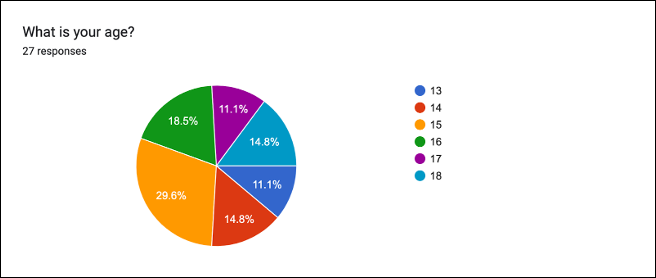
Starting with demographic-related questions, the largest category of participants (29.6%) were 15 years old (Fig 1).
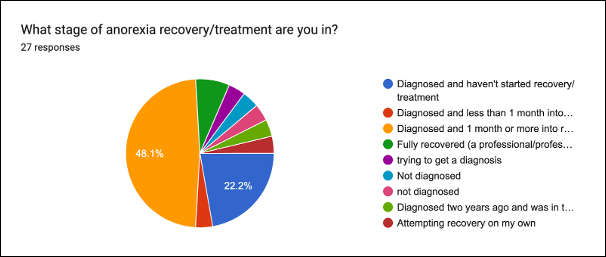
For the stage of AN recovery/treatment, almost half of participants (48.1%) were diagnosed with AN and were 1 month or more into recovery/treatment (Fig 2).
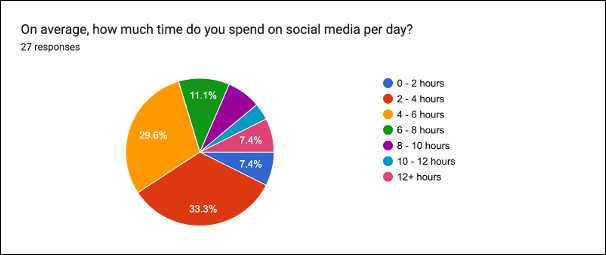
The biggest chunk of participants (33.3%) reported spending 2-4 hours on social media per day (Fig 3)
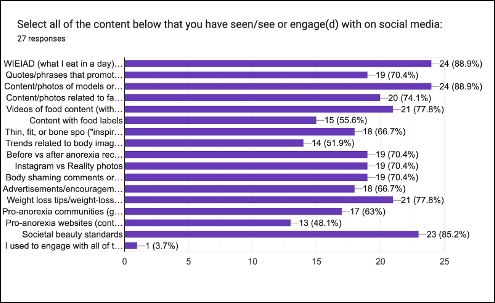
The top five types of pro-ana and/or negative content that adolescents engaged with or had seen on social media can be classified more as negative types of content that supplement AN, rather than explicitly pro-ana content, being WIEIAD – what I eat in a day – content (88.9%), content/photos of models or influencers (88.9%), societal beauty standards (85.2%), weight loss tips/weight-loss related content (77.8%), and videos of food content, with calorie counting (77.8%) (Fig 4).
The impacts of all the content listed in Figure 4 are strongly perceived as negative. When asked whether the content they selected made them feel less positive about their bodies, the majority of participants had a greater negative perception of their bodies after engaging with these types of content, with 40.7% expressing “Strongly Agree” and 37% expressing “Agree”, for a total of 77.7% (Fig 5).
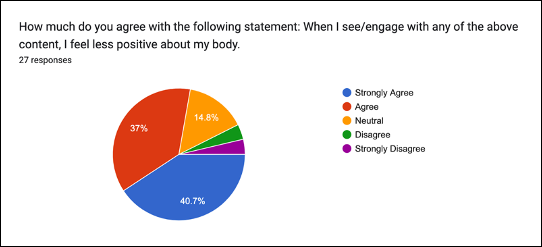
Much of past research supports this idea17. Additionally, when asked if the content they selected in Figure 4 increased their food restriction or fear of trying certain foods, most said that they “Strongly Agree” (55.6%) or “Agree” (33.3%) (Fig 6).
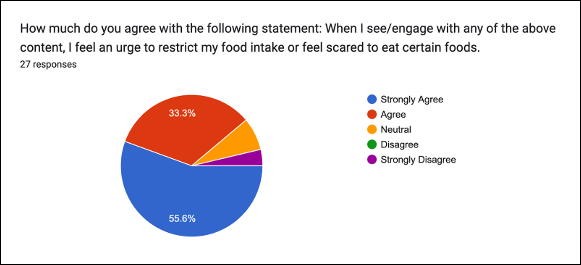
However, when asked whether the content they selected in Figure 4 made them want to discontinue recovery, there were several participants who indicated that they felt “Neutral” (25.9%), alongside the participants who expressed “Strongly Agree” (33.3%) and “Agree” (25.9%) (Fig 7).
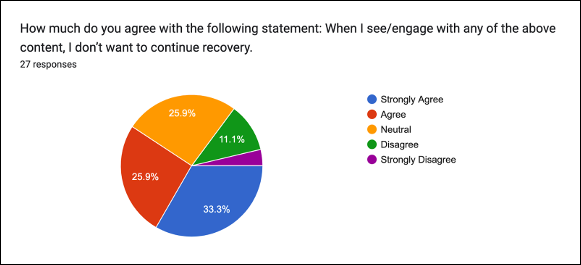
Adolescents may be interacting with pro-recovery and/or positive content to combat the negative content, as demonstrated by a similar number of responses for engaging/seeing the former type(s) of content. Regarding pro-recovery and positive types of content, the top five types of content lean more towards pro-recovery content, but there are several types which also fall into the general positive content category, being stories of others’ recovery (81.5%), advice for recovery (77.8%), seeing others who still have eating disorders (74.1%), diversity of body types (74.1%), and body positive content (74.1%) (Fig 8). The first three types of content are ones that correspond more with pro-recovery content, while the latter two correspond more with general positive content.
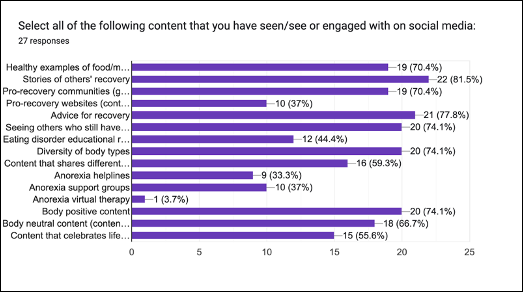
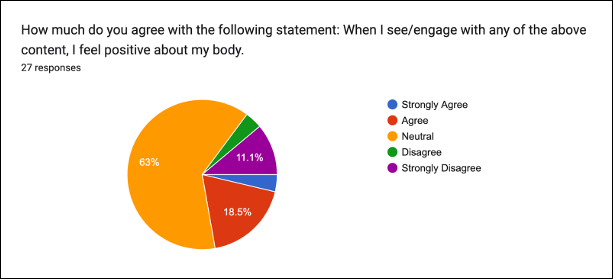
When asked how the content they selected in Figure 8 affected them, the answers were more varied compared to the pro-ana/negative content, but this could be due to a specific limitation. When asked whether engaging with the positive content made adolescents feel more positive about their bodies, the majority said “Neutral” (63%), which sharply contrasts with the results of the body positivity study21 (Fig 9).
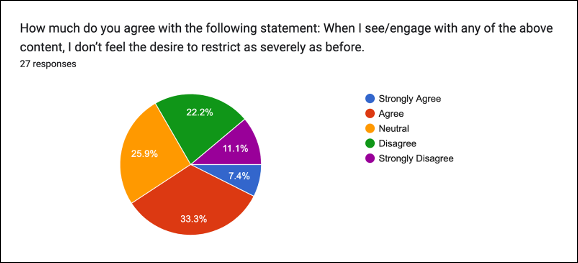
When asked whether positive content in Figure 8 discouraged restriction, most answers were either “Agree” (33.3%) or “Neutral” (25.9%) (Fig 10).
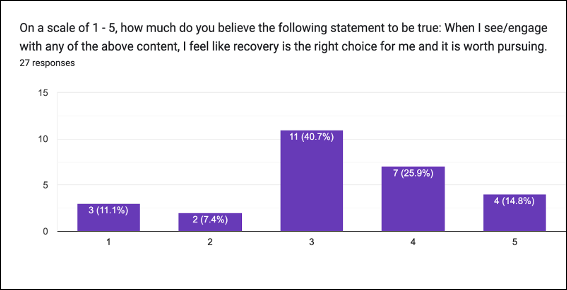
Finally, when asked on a scale of 1 – 5, with 1 representing “Not true at all” and 5 representing “Very true”, overall, a greater percentage of participants believed that recovery was the right choice for them and worth pursuing. However, a closer examination displays that the greatest number of participants answered in the middle, 40.7% for 3, indicating that they may still have uncertainties in the idea that recovery is worth choosing (Fig 11).
The presence of more “Neutral” answers in the pro-recovery and/or positive content section (Figure 8) could relate to what interviewees expressed about the impact of pro-recovery content depending on its type, as demonstrated in previous research18,25,26.
Discussion
Significance
From both the self-reported data of a small group of adolescents with AN and the responses gathered from several interviewees, there seems a stronger agreement that pro-ana and similar content have a positive correlation with the perceptions of adolescents who engage with/see them. As referenced in Figures 5, 6, and 7, for adolescents interacting with content that either explicitly or implicitly encouraged AN behavior, there were associations with negative body image perception, increased food restriction or fear of certain foods, and a decreased desire to continue recovery, respectively. These findings align with previous studies conducted. Some of the content that the greatest number of participants saw/engaged with were WIEIAD videos, content from models and influencers, and societal beauty standards. Similar to the study on Portuguese adolescents12, survey participants who were comparing their bodies and food choices to those of models or social media creators were less likely to be satisfied with their body image. In another study, adolescents felt more negative emotions from comparing themselves to their peers13, and although the survey did not explicitly ask about peer-created content, this kind may fit under the umbrella of societal beauty standards. Adolescents who constantly interact with societal beauty standards may have increased self-objectification14, which could be connected to an increased negative perception of their bodies. When the view of their body is already less positive due to social media content, adolescents may be more vulnerable to pro-anorexia communities and content. As previously found in several studies, pro-anorexia communities are built on social networks that evoke comparisons in adolescents, yet also a sense of solidarity with others7,8. Additionally, these communities can also present what seems like positives of anorexia4. So, participants who selected and were exposed to pro-ana content and/or communities may have felt an increased need to restrict from comparing themselves with others. At the same time, the feeling of community or support from others, as well as potentially perceived benefits of the illness, may have decreased their desire to recover. The interview findings also correspond with previous research, as the interviewees stressed how negative content can both encourage and normalize AN. These results are important because they demonstrate that the correlations between detrimental content on social media and the influences it has on the willingness of adolescents to recover from AN are existent. Even content that may appear benign or less extreme – such as commonly created WIEIAD videos – as opposed to explicit pro-anorexia content is associated with less confidence and self-esteem for adolescents. And because adolescents are on social media for several hours a day – in this survey, the average amount of time was two – four hours per day – the possibility of adolescents seeing these types of content is not small. On the other hand, pro-recovery content and positive content are in grayer areas, as both the survey participants and interviewees had indicated that it doesn’t have such a straightforward positive correlation In Figure 9, most of the adolescents who interact(ed) with pro-recovery and positive content reported an association with feeling “Neutral” towards their body image, revealing that content that aims to make individuals feel better about their bodies may not always achieve this purpose. In Figure 10, several adolescents continued to report a correlation between seeing positive content and feeling “Neutral” about the desire for less food restrictions, although a greater number of adolescents still reported that positive content was associated with a decreased desire for food restriction. Once again, although the objective of pro-recovery content is to discourage these kinds of thoughts, the responses for the participants displays that it isn’t associated with being effective all the time. In Figure 11, despite interacting with pro-recovery and positive content, most of the adolescents only believed that recovery was the right choice to a somewhat true degree. Researchers had expressed that pro-recovery content could still have hidden messages that are suggestive of pro-anorexia content. While the previous findings from one TikTok study displayed that none of the pro-recovery content had any messages associated with pro-ana19, another study found that half of the content that were tagged with pro-recovery hashtags still had pro-anorexia content24. Similar types of studies on platforms like Pinterest have also demonstrated that interacting exclusively with pro-recovery content can still lead to being recommended/shown pro-ana content6 Because three out of the top five types of positive content that the survey participants had viewed/interacted with fall more into the pro-recovery content, the potential interference from pro-ana content could be associated with why many of the participants felt “Neutral” about recovery-oriented behavior after engaging with the content. When adolescents are still being shown content that doesn’t align with the recovery process, it can lead to them feeling frustrated or having thoughts of relapse, counteracting thoughts of recovery6. Previous studies have shown that body positive or neutral content can lead to less appearance comparison and more body satisfaction21,22,23, and diversity of body types and body positive content were among the top five types of content selected. Many of the interviewees agreed that these types of content could be associated with beneficial effects on adolescents. However, if the survey participants were interacting more with pro-recovery content that could have been mixed with pro-ana content, the pro-ana undertones may still have led the adolescents to feel less certain about their appearances and recovery. Although pro-recovery and positive content can be used to inspire hope and help manage emotions like anxiety, as emphasized by both previous findings and the interviewees, if not managed well, just like in the Flickr community, pro-ana and pro-recovery content could both end up hurting users attempting to recover. Thus, these results become important because they emphasize how even if pro-recovery and positive content are designed to help adolescents feel more confident and strongly towards recovery, there is still a discrepancy between the purpose of these content types and the actual reality of how they may influence adolescents. These results also showcase that even when adolescents seek out pro-recovery content or content that will support them, social media and algorithms may hamper their efforts by recommending pro-ana or unsupportive content against their wishes. However, it is important to mention that almost half of the survey participants reported being one month or more into recovery. Although there is no clear response on just how far they are into recovery, several of the participants might be further into recovery compared to the other respondents. So, just as it was found in some studies, adolescents who have spent more time in recovery may be more self-aware and know to turn away from triggering content20,25, methods that might have led them to agree on better body image perception, decreased food restriction, and a stronger desire for recovery. On the other hand, participants who are less far into recovery may have made up a bigger portion of the respondents who expressed “Neutral” on feeling better about themselves and/or recovery. For future research, it may be pertinent to collect data from a larger sample size of adolescents on how different types of social media affect/affected them in their recovery process, to obtain more representative results. Certain survey questions should be added and/or modified, such as getting more demographic details on the participants (ex: gender, ethnicity), obtaining more specifics on what stage of recovery they’re in, etc. Additionally, it might be helpful for researchers to design a data collection method that can more clearly investigate the effects correlated with positive and negative content overlap; in this study, content and its associated effects were separated into two distinct categories, rather than asking about both types of content and their effects at the same time.
Limitations
One main limitation of the survey was the smaller sample size due to challenges with voluntary response and a time frame of only four months. The sample of survey participants is also limited in scope, as most participants were likely to have access to digital technology or the Internet in order to provide responses. Furthermore, the gender and ethnicity of participants were not collected, so the scale of generalization towards all adolescents is small. These factors will be pertinent to consider for future research. Time constraints also applied to the number of interviews collected, as interviews were concentrated between the months of March and April. Another limitation may be the questions that were given to the survey participants and interviewees. For the survey, certain types of social media content may have not been included, even with the answer choice “Other”. Additionally, most of the questions were in the form of a rating or numerical scale. Participants may also have interpreted certain survey questions differently. For example, many questions started with the phrase “When I see/engage with any of the above content”. Depending on the question, the phrase was either referring to either negative or positive content. However, some participants may have thought that for the questions later in the survey, the above phrase was referring to all the content types. Most importantly, because the survey data comes from self-reported answers, it is susceptible to potential bias from the participants, such as social desirability bias. For the interview questions, if a different set of questions had been asked, then the information received may also have been different. Because there was a lack of necessary software, statisticians, resources, etc, statistical testing or testing for significance was unable to be carried out, so the data gathered is meant to be more descriptive in nature.
Conclusion
As adolescents are spending many hours on social media and online platforms, it becomes important for these mediums to be a positive environment for all users. With the growing rates of AN and the known health implications that come with the disease, recovery is a necessity. From the survey results and interviewee responses, we’ve found that pro-anorexia and other types of negative content have a positive correlation with decreased desire to continue recovery. For pro-recovery and positive content, while they can be associated with beneficial effects for adolescents, with a number of adolescents feeling more positive after interacting with these types of content, they do not have as strong a positive correlation with an increased desire to recover as compared to pro-anorexia and negative content. Thus, it is important to recognize that the type of social media content does have a visible association with the decision and process of recovery for adolescents with AN.
Acknowledgements
I would like to thank my high school research teacher Mrs. Toni Ireland, whose support and supervision were crucial to the entire process and completion of this paper during my Research course, and Ms. Nathalie Gullo, who provided me with great help during the editing and submission process. Additionally, the original data in this paper would not have been conceived without the interviewees and participants who took part in it.
References
- Auger, N., Potter, B. J., Ukah, U. V., Low, N., Israël, M., Steiger, H., Healy-Profitós, J., & Paradis, G. (2021). Anorexia nervosa and the long-term risk of mortality in women. World psychiatry: Official Journal of the World Psychiatric Association (WPA), 20(3), 448–449. https://doi.org/10.1002/wps.20904. [↩]
- Krzemień, O., Kosiec, K., Karpowicz, N., Pacocha, N., Kaszucka, J., Popczyńska, J., Raczyńska, A., Krzyżanowska, M., Zgierska, M., & Jędrychowski, J. (2024). EXAMINING THE INFLUENCE OF TIKTOK ON ANOREXIA nervosa: A SOCIAL MEDIA PERSPECTIVE – LITERATURE REVIEW. International Journal of Innovative Technologies in Social Science, 2(42). https://doi.org/10.31435/rsglobal_ijitss/30062024/8154. [↩]
- Rideout, V., and Robb, M. B. (2018). Social media, social life: Teens reveal their experiences. San Francisco, CA: Common Sense Media. https://www.commonsensemedia.org/sites/default/files/research/report/2018-social-media-social-life-executive-summary-web.pdf [↩]
- Branley, D. B., & Covey, J. (2017). Pro-ana versus pro-recovery: A content analytic comparison of social media users’ communication about eating disorders on twitter and tumblr. Frontiers in Psychology, 8. https://doi.org/10.3389/fpsyg.2017.01356. [↩] [↩] [↩]
- Santucci, Patricia. (2024, December 3). Patricia Santucci interviewed by Amy Gu on December 3, 2024. [Interview]. [↩] [↩]
- Golbeck, J. (2025). Recommender System-Induced Eating Disorder Relapse: Harmful Content and the Challenges of Responsible Recommendation. ACM Transactions on Intelligent Systems and Technology, 16(1), 1-13. https://doi.org/10.1145/3675404. [↩] [↩] [↩] [↩]
- Saul, J., Rodger, R. F., & Saul, M. (2022). Adolescent eating disorder risk and the social online world. In J. Larson (Ed.), Hot Topics in Child and Adolescent Psychiatry (pp. 167-177). Elsevier. https://doi.org/10.1016/j.chc.2021.09.004. [↩] [↩] [↩]
- Stänicke, L. I., Rymoen, L. C., Omdal, T. S. A., & Halvorsen, M. S. (2026). Pro-Ana-Balancing a Digital Safe Space and Indirect Self-Harming. Findings From a Meta-Synthesis. International Journal of Eating Disorders, 59(6), 1225–1245. https://doi.org/10.1002/eat.70067. [↩] [↩]
- DeCaro, Samantha. (2024, December 3). Samantha DeCaro interviewed by Amy Gu on December 3, 2024. [Interview]. [↩] [↩] [↩]
- Becker A. E. (2004). Television, disordered eating, and young women in Fiji: negotiating body image and identity during rapid social change. Culture, Medicine and Psychiatry, 28(4), 533–559. https://doi.org/10.1007/s11013-004-1067-5. [↩]
- The Renfrew Center. (2021, November 8). Control the scroll: Social media literacy and eating disorder recovery [Video]. Youtube. https://www.youtube.com/watch?v=NEzJHy3Aq Jo&t=43s. [↩] [↩]
- Costa, A., Teixeira, B., Pereira, R., Warkentin, S., & Oliveira, A. (2026). Adolescents’ Perceptions of Disordered Eating Behaviors, Influencing Factors, and Perceived Effects on Health and Well-Being. Journal of Nutrition Education and Behavior, 58(5), 416–426. https://doi.org/10.1016/j.jneb.2026.01.008. [↩] [↩] [↩] [↩]
- Turk, F., A. Bozdogan, R. Hughes, P. Longhurst, M. Chilvers, and E. E. Fitzsimmons-Craft. (2026). Social Comparison and Its Association With Disordered Eating Symptoms: A Systematic Review and Meta-Analysis. International Journal of Eating Disorders, 59(6), 1117–1194. https://doi.org/10.1002/eat.70058. [↩] [↩]
- Fortunato, L., Gullo, S., Muscolino, A. et al. (2026). Relation Between Social Media Use and Body Image Concerns and Disordered Eating in Adolescence: A Systematic Review and Meta-Analysis. Adolescent Research Review. https://doi.org/10.1007/s40894-026-00285-7. [↩] [↩]
- Conger, K., Browning, K., & Woo, E. (2021, October 22). Eating disorders and social media prove difficult to untangle. The New York Times. https://www.nytimes.com/2021/10/22/technology/social-media-eating-disorders.html. [↩]
- Duygu, Ö. A., Tetik, K., Turan, S., Eray, Ş., Ergün Özdel, Z. G., & Mutlu, C. (2026). The Relationship Between Social Media Use and Body Image: A Comparative Analysis on Adolescents with Anorexia Nervosa. Journal of Uludağ University Medical Faculty, 52. https://doi.org/10.32708/uutfd.1866112. [↩]
- Šmahel, D., Macháčková, H., Šmahelová, M., Čevelíček, M., Almenara, C. A., & Holubčíková, J. (2018). Usage of digital technology among people with eating disorders. Digital Technology, Eating Behaviors, and Eating Disorders (pp. 121-137). Springer. https://doi.org/10.1007/978-3-319-93221-7. [↩] [↩] [↩]
- Au, E. S., & Cosh, S. M. (2022). Social media and eating disorder recovery: An exploration of instagram recovery community users and their reasons for engagement. Eating Behaviors, 46, 101651. https://doi.org/10.1016/j.eatbeh.2022.101651. [↩] [↩] [↩] [↩]
- De Marco E, Polizzotto G, Catellani S, et al. (2026). Scrolling to heal or hurt? TikTok’s impact on eating disorders. Journal of Psychopathology, 32, 121-134. https://doi.org/10.36148/2284-0249-1582. [↩] [↩]
- Sjöström, D.K., de Mendonca Lindström, T., Kapetanovic, S. and Claesdotter-Knutsson, E. (2024). Helpful or Not? A Qualitative Study on Female Adolescents’ Experience of TikTok When Recovering From Anorexia Nervosa. International Journal of Eating Disorders, 57(11), 2217-2227. https://doi.org/10.1002/eat.24265. [↩] [↩] [↩]
- Cohen, R., Fardouly, J., Newton-John, T., & Slater, A. (2019). #BoPo on Instagram: An experimental investigation of the effects of viewing body positive content on young women’s mood and body image. New Media & Society, 21(7), 1546–1564. https://doi.org/10.1177/1461444819826530. [↩] [↩] [↩]
- Fardouly, J., Slater, A., Parnell, J., & Diedrichs, P. C. (2023). Can following body positive or appearance neutral Facebook pages improve young women’s body image and mood? Testing novel social media micro-interventions. Body Image, 44, 136–147. https://doi.org/10.1016/j.bodyim.2022.12.008. [↩] [↩]
- Jiménez-García, A.M., Arias, N., Hontanaya, E.P., et al. (2025). Impact of body-positive social media content on body image perception. Journal of Eating Disorders, 13. https://doi.org/10.1186/s40337-025-01286-y. [↩] [↩]
- Griffiths, S., I. Martyn, H. Kannan, et al. (2026). Blurring the Boundaries: An Investigation of Eating Disorder Recovery Content on TikTok. International Journal of Eating Disorders 1–10. https://doi.org/10.1002/eat.70153. [↩] [↩]
- Jones, M. E., Salafia, E. H. B., & Leonard, K. C. (2022). Users’ perceptions of how an unmoderated eating disorder community may benefit or harm their recovery. Journal of Eating Disorders, 10(1). https://doi.org/10.1186/s40337-022-00653-3. [↩] [↩] [↩] [↩] [↩]
- Yom-Tov, E., Fernandez-Luque, L., Weber, I., & Crain, S. P. (2012). Pro-anorexia and pro-recovery photo sharing: a tale of two warring tribes. Journal of Medical Internet Research, 14(6), e151. https://doi.org/10.2196/jmir.2239. [↩] [↩] [↩]