
Abstract
Public concern that artificial intelligence (AI) will replace human workers is widespread, but its predictors remain contested. By drawing on existing technology acceptance and trust frameworks, this study shows which factors are associated with worry about AI-driven job displacement in a nationally representative sample of U.S. adults. Data from the 2024 General Social Survey (N = 1,074) was fitted on a binary logistic regression where the covariate modeling worry was dichotomized. Frequency of internet use was associated with higher worry (OR = 1.26, 95% CI: 1.02–1.54), while greater comfort with driverless cars as a proxy for trust in AI systems was associated with lower worry (OR = 0.92, 95% CI: 0.85–0.99). Respondents who agreed (versus strongly agreed) that technology provides opportunities expressed higher worry (OR = 1.64, 95% CI: 1.07–2.52). Sociodemographic variables were not statistically significant predictors. Our results show that future efforts to address public concern should focus on building trust in AI systems and communicating equitably about technology’s benefits.
Keywords: artificial intelligence; job displacement; technology acceptance; trust; public opinion.
Introduction
Artificial intelligence has generated both optimism and anxiety about the future of work1,2. The widespread anxiety held by the public is justified by multiple labor-market analyses which find a large portion of the job market automatable. Frey and Osborne estimated that up to 47% of U.S. occupations were susceptible to computerization within two decades3, and Acemoglu and Restrepo showed that robot adoption in the industrial sector reduced both employment and wages in exposed U.S. commuting zones4. National survey evidence also describes a consistent pattern of public pessimism. Kelley et al. found that expectations of AI-driven job loss were some of the most common public reactions to the technology5, and Erer and Ateş found that AI anxiety is positively associated with concern about technological unemployment in European samples6. Zhang and Dafoe similarly found that a majority of U.S. adults in a nationally representative survey expected AI to have a large labor-market impact and expressed concern about displacement7. Although some analyses emphasize AI’s potential to augment rather than replace human labor, public apprehension about job losses appears consistent. The literature has established that worry about AI exists, and what remains unresolved is why people worry and how that worry is distributed across the population.
Prior survey research measured this worry and found that anxiety was directly associated with employment concerns. For example, by using the Chapman Survey of American Fears, McClure identified a substantial segment of U.S. adults termed as “technophobes,” and showed that fear of robots and AI was associated with a heightened fear of unemployment and financial insecurity8. Additionally, Brougham and Haar developed and validated the STARA awareness measure, capturing the degree to which employees believe their own job could be replaced by smart technology, and found that higher awareness was associated with lower organizational commitment, career satisfaction and higher turnover intentions9. Cao and Song extended this to nationally representative U.S. data, analyzing General Social Survey respondents and finding that the automation potential of a respondent’s occupation was positively associated with perceived job insecurity10. Comparable population-level work outside the United States shows that these attitudes are not uniform across populations and change over time: analyzing repeated Eurobarometer waves, Gnambs and Appel documented a measurable decline in favorability toward autonomous robotic systems across the European Union over a five-year period, with support varying sharply by application domain11. Showing how to address these concerns has become more salient as worries concerning AI in the workplace increase.
We find it necessary to investigate the distribution of worry to find its source. However, prior research on who is more apprehensive about the future of employment is inconsistent across domains. For education, Morikawa found that workers with higher educational attainment reported lower perceived risk of replacement12, while Wang and Lu found the opposite, arguing that AI increasingly competes in specialized knowledge domains13. For age, Gerlich found no statistically significant association in multivariate analysis14, while Wang and Lu detected a significant but small effect13. For gender, Russo et al. reported higher AI anxiety among women15, a pattern echoed by Schepman and Rodway16 in a larger study of general AI attitudes. Methodological differences are a likely source of these contradictions: most findings come from analyses that examine predictors one at a time, rely on workplace or university samples, or use non-representative convenience samples, none of which reflect the general population’s overall attitudes.
This inconsistency is important to address. Across studies that use validated instruments and model attitudes alongside demographics, demographic characteristics tend to be weak and unreliable predictors. Stein et al., who developed and validated the ATTARI-12 attitude measure across three samples, found that personality and belief variables such as agreeableness and susceptibility to conspiracy beliefs predicted attitudes toward AI over and above demographic factors like age17. In a cross-cultural workplace study spanning multiple countries, Mantello et al. found that sociodemographic characteristics were weaker and less consistent determinants of attitudes toward emotional AI than were respondents’ general dispositions toward technology18. Surveying U.S. local officials, Horowitz and Kahn likewise reported that background characteristics explained relatively little variance in support for AI adoption compared with perceived benefits and risks19. Brauner et al. offer one explanation for this pattern: because AI remains largely a “black box” for much of the public, neither its risks nor its benefits can be reliably assessed, so attitudes do not sort cleanly along demographic lines20. Together, these patterns suggest that demographic differences in worry may be largely absorbed by differences in trust and disposition. This is a possibility our analysis tests directly.
This study’s goal is to build a unified, nationally representative account of AI worry by utilizing the existing Technology Acceptance Model (TAM) and distributive-fairness research. TAM, originating with Davis21, states that perceived usefulness and ease of use are the main predictors of how people respond to new technologies; Venkatesh et al. extended this to show that social influence also shapes adoption across populations22. More recent applications of TAM to AI continue to show trust is a central mediating variable: Choung, David, and Ross demonstrated that trust in AI significantly predicts acceptance above and beyond perceived usefulness and ease of use23. Araujo et al. reached a convergent conclusion from a different direction, showing in a scenario-based survey experiment with a national sample that perceptions of automated decision-making were driven by evaluations of fairness, usefulness, and risk rather than by respondent characteristics alone24. Gillath et al. further demonstrated experimentally that trust in AI is not a fixed trait but can be raised or lowered, indicating that it is a modifiable target rather than a stable demographic correlate25. People who trust a technology’s reliability and intentions are more willing to accept it and less likely to view it as threatening. Applied to AI, this predicts that individuals comfortable with concrete AI applications should express less worry about AI taking jobs, because trust and acceptance tend to accompany more benign expectations of the technology’s societal role. This is consistent with Gillespie et al.’s finding that willingness to trust AI is a stronger predictor of AI-related attitudes than demographic characteristics26.
The literature supports using comfort with autonomous vehicles as a proxy as an observable indicator of trust. Paddeu et al. showed that passengers’ comfort during first-time use of an autonomous shuttle tracked their trust in the vehicle, because riding requires ceding control in a high-risk setting27. In an international questionnaire of roughly 5,000 respondents across 109 countries, Kyriakidis et al. found that willingness to ride in and pay for automated vehicles was closely tied to concerns about software reliability and system failure rather than to demographic profile alone28. Kaur and Rampersad likewise identified trust, reliability, and perceived security as the dominant determinants of driverless-car adoption29. Comfort with such systems is therefore a defensible behavioral proxy for generalized trust in automated systems. We use this proxy in our study in order to investigate the associations between specific AI use-cases, such as driverless cars, and worry.
Within distributive-fairness research, Paik et al. found that perceptions of who benefits from AI are systematically related to broader attitudes toward the technology30, and Shoss and Ciarlante documented that AI is viewed as a greater workforce threat in societies where inequality is more salient31. Bankins et al. found that workers judged identical human-resource decisions as less fair and less dignity-affirming when attributed to an AI system rather than a human decision-maker, indicating that fairness perceptions are connected to the decision-making agent itself32. Expanding the scope of this assertion to the population level, Wilczek et al. showed across European samples that AI risk perceptions are systematically linked to demands for regulation, suggesting that worry about AI is bound up with judgments about whether its effects will be equitably governed33. Cave et al. add a cautionary note for interpreting any single measure of public sentiment, finding that expressed responses to AI vary substantially depending on how the technology is framed to respondents34.
To our knowledge, few studies have tested these expectations simultaneously in a general-population sample. By synthesizing these frameworks, we can determine whether the way people feel about technology shapes their fear of it more than who they are, and reconcile existing differences in the literature. This study addresses that gap with the 2024 General Social Survey (GSS). Establishing which factors underlie AI worry is important because if worry stems from modifiable attitudes such as trust rather than in fixed demographic traits, then targeted communication and policy efforts can plausibly reduce it, whereas demographic drivers would instead imply persistent at-risk groups requiring different responses. We bounded the scope of the study by examining U.S. adults in a single 2024 cross-section of secondary survey data, characterizing associations rather than causal effects, and limiting to the trust, attitudinal, and demographic measures available in the GSS.
To what extent are trust in AI systems and perceptions of technology’s societal benefits, relative to sociodemographic characteristics, associated with U.S. adults’ worry that AI will take over many jobs done by humans? We test three hypotheses drawn from the technology-acceptance and trust frameworks. H1: Greater comfort with AI applications (driverless cars and medical robots), as an indicator of trust, is associated with lower worry. H2: More positive beliefs about technology’s societal effects, specifically that it provides future job opportunities, are associated with lower worry. H3: Demographic differences in worry observed descriptively will not be significant once attitudinal and trust-related variables are included simultaneously. To test these hypotheses, we fit design-based binary logistic regression models to the weighted 2024 GSS sample, entering demographic, attitudinal, and trust-related predictors simultaneously; full procedures are detailed in the Methods.
Methods
Data source and study design
This cross-sectional study used the 2024 GSS, a nationally representative survey of U.S. adults conducted by NORC at the University of Chicago. The 2024 wave was administered both online and in person, with respondents randomly selected from households and questionnaire content divided across ballots. The technology and AI module analyzed here was administered to one ballot subset. Of 75,699 records in the cumulative file, 1,536 respondents were administered and answered the outcome item. Of these, 462 were excluded due to missing values on one or more covariates, yielding an analytic sample of N = 1,074.
Outcome variable
The outcome was based on the item: “Overall, how worried, if at all, are you that in the next 10 years machines, computer programs, and Artificial Intelligence (AI) will take over many of the jobs done by humans?” The original five-point scale ranged from “very worried” to “not at all worried.” Following prior work on public AI worry7, responses were dichotomized: “very worried” or “somewhat worried” were coded as worried (1) and all remaining responses as not worried (0). We initially fitted an ordinal logistic regression as the primary model, but abandoned it after the proportional-odds assumption was formally rejected by a Brant test conducted on an unweighted analog of the model (omnibus χ²(90) = 179.97, p < 0.001)35. Examined term by term, the violation was concentrated in the software-learning skill and technology-harm predictors, as confirmed by both the per-term Brant results and a comparison of logistic-regression coefficients across four binary cutpoints of the outcome. The binary logistic regression is therefore the primary reported model; ordinal results and full diagnostic output are available in Supplementary Material.
Covariates
Covariates comprised demographic characteristics (age group [18–29, 30–54, 55–64, 65+], sex, race/ethnicity, and years of schooling) and technology-related attitudes and exposure. Attitudinal covariates included perceived inequity in who benefits from digital technology (rich vs. poor, more vs. less educated, men vs. women); agreement that technology does more harm than good (5-point scale); agreement that technology provides more opportunities (5-point scale); self-assessed skill at learning new software (5-point scale, reversed so higher = better skill); and frequency of internet use over the past 12 months (treated as a continuous 1–6 scale). Trust in AI was proxied through comfort with a medical operation performed by a robot (0–10) and comfort with riding in a driverless car (0–10), following Paddeu et al.’s argument that willingness to place oneself in an autonomous system’s control is a valid indicator of trust27. Because several cells were too sparse for stable estimation, race/ethnicity was analyzed as four groups (Hispanic, non-Hispanic White, non-Hispanic Black, and non-Hispanic Other—combining Asian [n = 9], American Indian or Alaska Native, Native Hawaiian or Other Pacific Islander, and other identifications). The “strongly disagree” and “disagree” categories of the technology-opportunities item were collapsed (n = 35 combined), and the “very bad” and “bad” categories of software-learning skill were collapsed (n = 36 combined). The complete recoding script is provided as Supplementary Material.
Statistical analysis
All analyses used a design-based approach. A survey design object was specified with the 2024 GSS stratum variable (vstrat), primary sampling unit variable (vpsu), and post-stratification weight (wtssps), with variance estimated by Taylor-series linearization; single-PSU strata were handled by centering at the grand mean (survey.lonely.psu = “adjust”). Weighted prevalence estimates used logit-transformed 95% confidence intervals, which are bounded within 0–100%. The primary model was a design-based binary logistic regression (svyglm with quasibinomial family) with all covariates entered simultaneously; results are reported as odds ratios with 95% confidence intervals. Multicollinearity was assessed using generalized variance inflation factors (GVIF) on an unweighted logistic-regression analog; all GVIF^(1/(2·Df)) values were below 1.25, indicating no meaningful collinearity. All tests were two-tailed with α = 0.05. Analyses were conducted in R version 4.4.2 (2024-10-31) using the survey, srvyr, tidyverse, gtsummary, gt, and car packages; the complete analysis script is provided as Supplementary Material.
Results
Sample characteristics
The analytic sample included 1,074 respondents (Table 1). The weighted sample was 56% female and 44% male. By age, 16% were 18–29, 45% were 30–54, 16% were 55–64, and 23% were 65 or older. By race/ethnicity, 64% identified as non-Hispanic White, 16% as non-Hispanic Black, 14% as Hispanic, and 5% as non-Hispanic Other. The median years of schooling was 14 (IQR: 12–16). A majority (61%) believed that rich people benefit more than poor people from digital technology, and 53% believed that the highly educated benefit more than the less educated. Over half (56%) agreed that technology provides more opportunities. The median comfort score for medical robots was 3 (IQR: 0–6) and for driverless cars was 2 (IQR: 0–5), both out of 10.
Weighted prevalence of worry
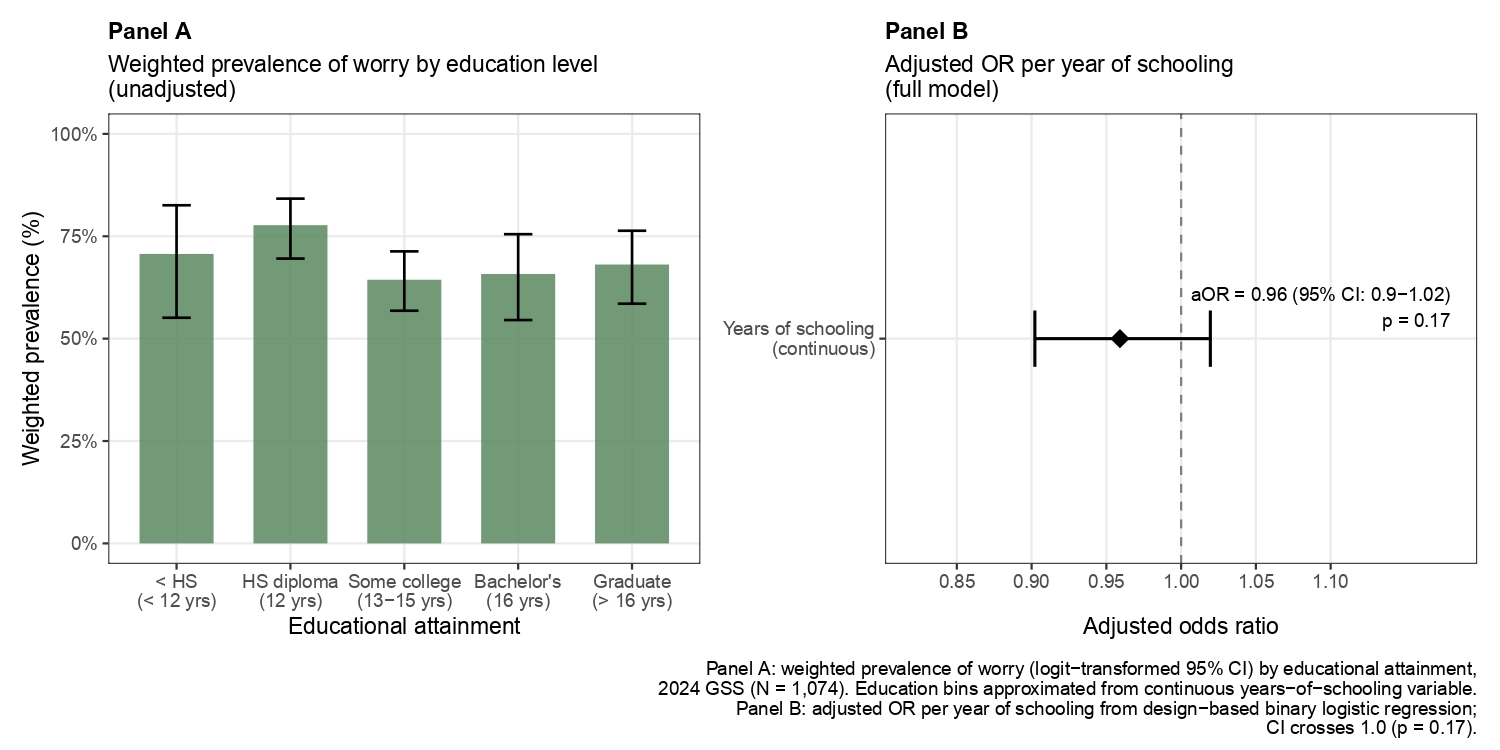
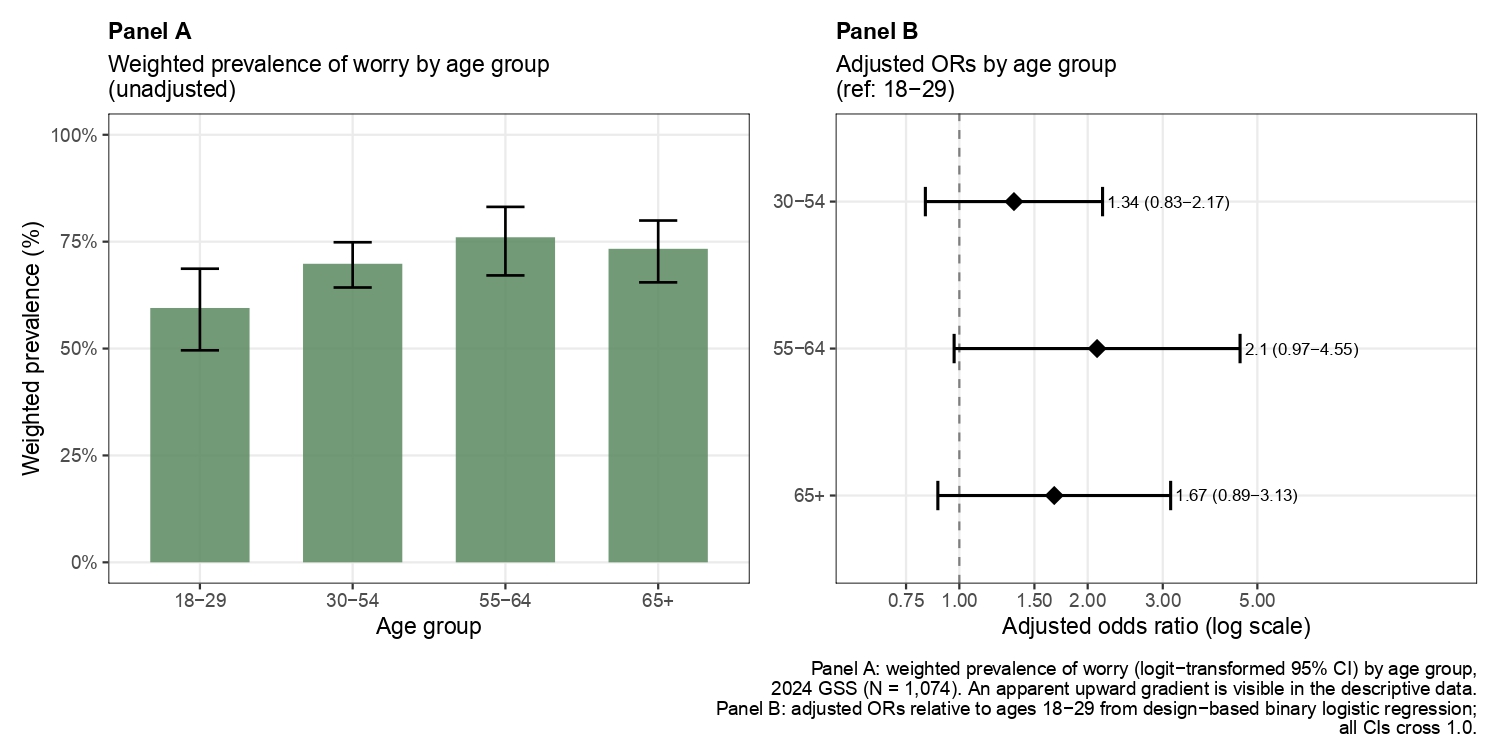
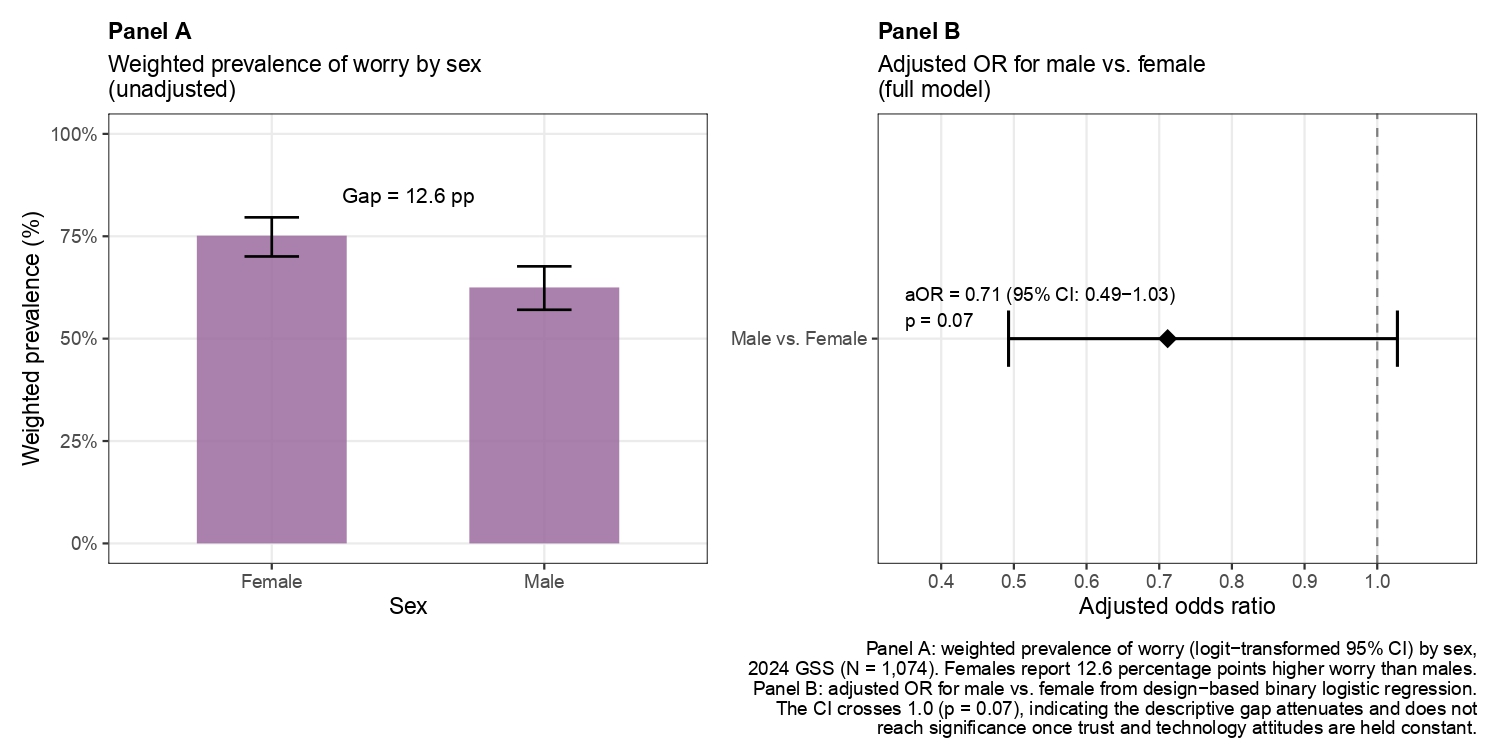
Overall, 69.1% of U.S. adults (95% CI: 65.2%–72.8%) reported being very or somewhat worried that AI will take over many jobs done by humans (Table 2). Prevalence was higher among older respondents (76.0% for ages 55–64; 73.3% for ages 65+) compared to younger adults (59.5% for ages 18–29; Figure 3). Females reported higher prevalence (75.2%) than males (62.5%; Figure 4). Prevalence varied modestly across education levels, with no clear monotonic gradient (Figure 2). Respondents who strongly agreed that technology provides opportunities showed the lowest prevalence of worry (58.6%), compared with higher prevalence among those who agreed (72.9%) or were less positive. Worry decreased as comfort with driverless cars increased, from 77.4% among those with a comfort score of 0–2 to 58.5% among those with a score of 6–10.
Regression results
Table 3 presents the design-based binary logistic regression results. No sociodemographic variable reached statistical significance after adjustment, though confidence intervals were wide enough to be compatible with modest effects. Age groups 30–54 (aOR = 1.34, 95% CI: 0.83–2.17), 55–64 (aOR = 2.10, 95% CI: 0.97–4.55), and 65+ (aOR = 1.67, 95% CI: 0.89–3.13) showed higher point estimates than the 18–29 reference group but did not reach significance at α = 0.05. Males showed lower odds than females (aOR = 0.71, 95% CI: 0.49–1.03, p = 0.07), a difference that approached but did not reach the threshold. Race/ethnicity and years of schooling were also non-significant, though the point estimates for non-Hispanic Black respondents (aOR = 0.68) and years of schooling (aOR = 0.96 per year) suggest trends that warrant investigation in larger samples.
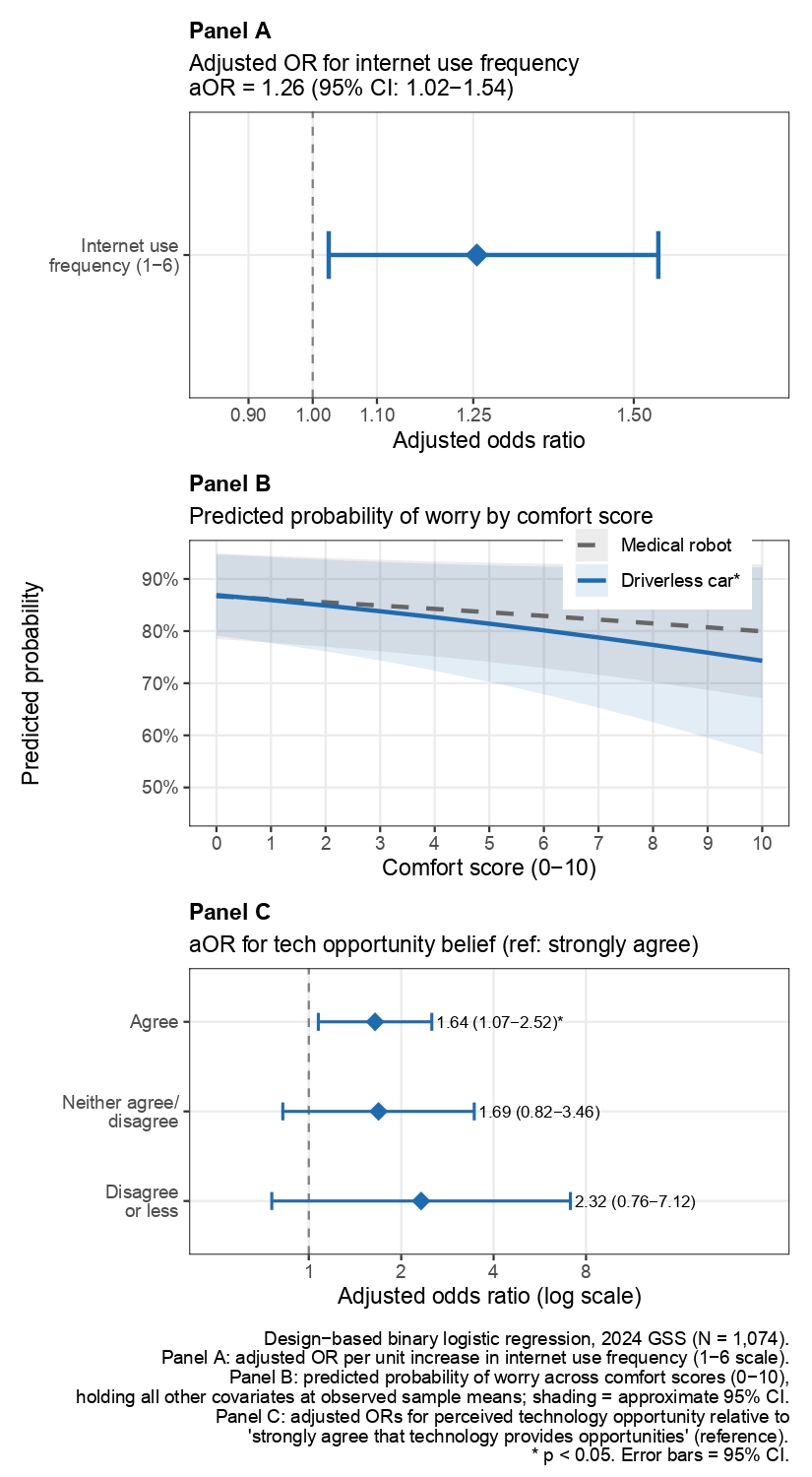
Among technology-related predictors, frequency of internet use was a significant predictor: each one-unit increase on the internet-use scale was associated with 26% higher odds of worry (aOR = 1.26, 95% CI: 1.02–1.54; Figure 1, Panel A). Greater comfort with driverless cars was associated with lower odds of worry (aOR = 0.92 per unit, 95% CI: 0.85–0.99; Figure 1, Panel B), consistent with H1. Comfort with medical robots was not statistically significant (aOR = 0.95, 95% CI: 0.89–1.01; Figure 1, Panel B). Respondents who agreed (vs. strongly agreed) that technology provides more opportunities had higher odds of worry (aOR = 1.64, 95% CI: 1.07–2.52; Figure 1, Panel C), consistent with H2; the neither-agree-nor-disagree and disagree-or-less categories showed similar trends but were not significant. Among perceived-inequity measures, respondents who felt neither the more nor less educated benefit more from digital technology had lower odds of worry than those who felt the educated benefit more (aOR = 0.43, 95% CI: 0.20–0.94); the remaining income- and gender-benefit comparisons were not significant predictors. Agreement that technology does more harm than good and self-assessed software-learning skill were also non-significant.
Discussion
Worry about AI-driven job displacement was significantly associated with trust-related and technology-acceptance variables, such as comfort with driverless cars and beliefs about technology’s provision of opportunities, while sociodemographic characteristics including age, sex, race/ethnicity, and educational attainment were not statistically significant when considered simultaneously. These findings support H1 and H2 and partially support H3.
The association between comfort with driverless cars and lower worry is the pattern that technology-acceptance and trust frameworks predict. Paddeu et al. argue that willingness to ride in an autonomous vehicle reflects generalized trust in AI systems, because the user cedes control in a high-risk situation27. Choung et al.’s framework similarly holds that trust in AI is associated with reduced threat perceptions and greater acceptance23. However, comfort with medical robots was not significant, suggesting that trust in AI may not generalize uniformly across applications. This is consistent with Gillespie et al.’s observation that willingness to trust AI varies significantly by domain and context26, and with Gnambs and Appel’s finding that European support for robots differed substantially between workplace and healthcare applications11. This indicates that trust in AI systems, while depending on context, is the primary predictor of lower worry.
The association between perceived technology opportunity and worry is nuanced. Respondents who agreed (versus strongly agreed) that technology provides opportunities expressed higher worry. This is consistent with a distributive-fairness account: people who hold a moderate view of technology’s benefits may worry more about displacement. We posit that even when people believe technology provides more opportunities, they have lower worry only if they expect those opportunities to reach them. Paik et al. similarly found that fairness perceptions about AI relate to broader attitudes about who benefits from technology30, and Bankins et al. showed experimentally that the perceived fairness of a decision depends on whether an AI or a human made it32.
Higher internet use was associated with higher worry. This is consistent with the view that greater exposure to online media and news heightens awareness of AI’s potential to displace workers; Nader et al. similarly found that increased consumption of AI-related media is associated with greater belief in AI replacing workers36. Cave et al.’s demonstration that public responses to AI shift with framing supports the same mechanism, since heavier internet users encounter a greater volume and variety of AI framings34. We note that an earlier categorical specification of internet use produced an unstable estimate driven by sparse cells; treating internet use as a continuous frequency scale yields a stable positive association in the same direction. Because our measure captures overall internet-use frequency rather than exposure to AI-specific content, this interpretation remains associational and requires further research.
The non-significance of demographic variables is substantive. Descriptive prevalences showed higher worry among women and older adults, consistent with prior work by Russo et al.15 and Wang and Lu13. However, because these differences were not significant after we adjusted for technology attitudes and trust, H3 is supported. This suggests that demographic differences in worry may be largely mediated by differences in trust and technology acceptance, and that studies finding demographic associations may be capturing unmeasured variation in trust instead of independent demographic effects. This aligns with Mantello et al. and Horowitz and Kahn, both of whom found demographic characteristics to be weaker predictors of AI attitudes than dispositional and evaluative variables18,19. While these observed differences may exist in specific populations such as workplaces or universities, they do not persist within the general population.
Limitations
All measures are self-reported, so they are subject to social-desirability and recall biases; self-assessed software-learning skill may be optimistically inflated, and internet-use frequency is recalled over a 12-month window. The 462 respondents excluded for missing covariate data (30% of the ballot subsample) may introduce bias if missingness is related to both predictors and outcome. The model omits income, political orientation, and geographic region, all plausible confounders. The trust proxies of comfort with driverless cars and medical robots are indirect measures of trust in AI systems, though inferences are reasonable due to the nature of the activities. Finally, AI perceptions are evolving rapidly, and associations estimated in 2024 may not persist. We suggest that future studies analyze the evolution of sentiment toward AI as the technology evolves and it becomes more ingrained in daily life.
Recommendations
Public AI-literacy initiatives should emphasize trust-building by explaining how AI systems work, demonstrating their reliability, and clearly communicating where human oversight is required. Since perception is nuanced and distrust is prevalent, explaining how these systems work is necessary to remove negative stigmas. By explaining how human oversight is necessary, the sentiment that AI exists solely to replace labor would reduce. Employers and policymakers introducing AI in workplaces should communicate clearly about how AI will and will not affect specific roles, since uncertainty about displacement appears to track general exposure to information about AI. Communications about AI’s labor-market effects should explicitly address who benefits from the technology, since perceived inequity in technology’s benefits was associated with higher worry in this analysis.
Conclusion
As AI systems become further ingrained in more people’s lives, our results suggest that the central determinant of public worry is not who people are demographically, but how much they trust the technology and believe its benefits are equitably distributed. Policymakers and employers who invest in building that trust through transparency, demonstrated reliability, and equitable benefit sharing would address public concern about these rapid new developments in our society.
| Characteristic | Unweighted n | Weighted % |
| Age 18–29 | 166 | 16% |
| Age 30–54 | 486 | 45% |
| Age 55–64 | 176 | 16% |
| Age 65+ | 246 | 23% |
| Female | 599 | 56% |
| Male | 475 | 44% |
| Hispanic | 153 | 14% |
| NH White | 681 | 64% |
| NH Black | 175 | 16% |
| NH Other | 65 | 6% |
| Years of schooling (median, IQR) | — | 14 (12, 16) |
| Rich benefit more (digital tech) | 654 | 61% |
| Educated benefit more | 563 | 53% |
| Agree tech provides opportunities | 555 | 53% |
| Comfort: medical robot (median, IQR) | — | 3 (0, 6) |
| Comfort: driverless car (median, IQR) | — | 2 (0, 5) |
| Group | Proportion | Lower 95% CI | Upper 95% CI |
| Overall | 69.1% | 65.2% | 72.8% |
| Age 18–29 | 59.5% | 49.6% | 68.7% |
| Age 30–54 | 69.8% | 64.3% | 74.9% |
| Age 55–64 | 76.0% | 67.1% | 83.1% |
| Age 65+ | 73.3% | 65.5% | 79.9% |
| Female | 75.2% | 70.1% | 79.6% |
| Male | 62.5% | 57.1% | 67.7% |
| Hispanic | 69.6% | 59.2% | 78.3% |
| NH White | 70.1% | 65.3% | 74.6% |
| NH Black | 65.9% | 55.8% | 74.8% |
| NH Other | 65.6% | 41.1% | 83.9% |
| Tech opportunities: strongly agree | 58.6% | 52.0% | 64.9% |
| Tech opportunities: agree | 72.9% | 67.4% | 77.8% |
| Tech opportunities: neither | 76.0% | 63.6% | 85.2% |
| Tech opportunities: disagree or less | 86.5% | —† | —† |
| Driverless car comfort 0–2 | 77.4% | 73.0% | 81.3% |
| Driverless car comfort 3–5 | 60.9% | 53.0% | 68.2% |
| Driverless car comfort 6–10 | 58.5% | 47.0% | 69.1% |
Note. Logit-transformed CIs used throughout. † The “disagree or less” category (n = 35) produced a boundary-value proportion; the logit CI did not converge and is not reported. Groups with n < 30 should be interpreted with caution.
| Variable | OR | 95% CI | p-value |
| Age 30–54 (ref: 18–29) | 1.34 | 0.83–2.17 | 0.22 |
| Age 55–64 | 2.10 | 0.97–4.55 | 0.06 |
| Age 65+ | 1.67 | 0.89–3.13 | 0.11 |
| Sex: Male (ref: Female) | 0.71 | 0.49–1.03 | 0.07 |
| NH White (ref: Hispanic) | 0.96 | 0.52–1.76 | 0.88 |
| NH Black | 0.68 | 0.37–1.26 | 0.22 |
| NH Other | 0.77 | 0.36–1.66 | 0.51 |
| Years of schooling | 0.96 | 0.90–1.02 | 0.19 |
| Educated benefit: Neither (ref: Educated more) | 0.43 | 0.20–0.94 | 0.04* |
| Internet use frequency (continuous) | 1.26 | 1.02–1.54 | 0.03* |
| Tech provides opportunities: Agree (ref: Strongly agree) | 1.64 | 1.07–2.52 | 0.02* |
| Comfort: medical robot (0–10) | 0.95 | 0.89–1.01 | 0.11 |
| Comfort: driverless car (0–10) | 0.92 | 0.85–0.99 | 0.03* |
Note. * p < 0.05. Survey-weighted logistic regression accounting for stratification (vstrat), clustering (vpsu), and post-stratification weights (wtssps). Variance by Taylor-series linearization; single-PSU strata centered at grand mean. Selected rows shown; full model in Supplementary Material. The ordinal model was abandoned after the proportional-odds assumption was formally rejected by a Brant test (χ²(90) = 179.97, p < 0.001).
Supplementary Material
References
- A. Tyson, M. Faverio. What the data says about Americans’ views of artificial intelligence. Pew Research Center, 2023. [↩]
- World Economic Forum. The future of jobs report 2025. World Economic Forum, 2025. [↩]
- C. B. Frey, M. A. Osborne. The future of employment: how susceptible are jobs to computerisation? Technological Forecasting and Social Change. Vol. 114, pg. 254-280, 2017. https://doi.org/10.1016/j.techfore.2016.08.019 [↩]
- D. Acemoglu, P. Restrepo. Robots and jobs: evidence from US labor markets. Journal of Political Economy. Vol. 128, pg. 2188-2244, 2020. https://doi.org/10.1086/705716 [↩]
- P. G. Kelley, Y. Yang, C. Heldreth, C. Woodruff, A. Woodruff, A. Ng, N. T. Mattson, A. Yeung. Exciting, useful, worrying, futuristic: public perception of artificial intelligence in 8 countries. Proceedings of the 2021 AAAI/ACM Conference on AI, Ethics, and Society. pg. 627-637, 2021. https://doi.org/10.1145/3461702.3462605 [↩]
- B. Erer, A. Ateş. Does artificial intelligence anxiety affect concern about technological unemployment? Zenodo, 2025. Preprint. [↩]
- B. Zhang, A. Dafoe. Artificial intelligence: American attitudes and trends. SSRN, 2019. [↩] [↩]
- P. K. McClure. “You’re fired,” says the robot: the rise of automation in the workplace, technophobes, and fears of unemployment. Social Science Computer Review. Vol. 36, pg. 139-156, 2018. https://doi.org/10.1177/0894439317698637 [↩]
- D. Brougham, J. Haar. Smart technology, artificial intelligence, robotics, and algorithms (STARA): employees’ perceptions of our future workplace. Journal of Management & Organization. Vol. 24, pg. 239-257, 2018. https://doi.org/10.1017/jmo.2016.55 [↩]
- J. Cao, Z. Song. An incoming threat: the influence of automation potential on job insecurity. Asia Pacific Journal of Business Administration. Vol. 17, pg. 116-135, 2025. https://doi.org/10.1108/APJBA-07-2022-0328 [↩]
- T. Gnambs, M. Appel. Are robots becoming unpopular? Changes in attitudes towards autonomous robotic systems in Europe. Computers in Human Behavior. Vol. 93, pg. 53-61, 2019. https://doi.org/10.1016/j.chb.2018.11.045 [↩] [↩]
- M. Morikawa. Who are afraid of losing their jobs to artificial intelligence and robots? Evidence from a survey. RIETI Discussion Paper Series 17-E-069, 2017. [↩]
- K. H. Wang, W. C. Lu. AI-induced job impact: complementary or substitution? Empirical insights and sustainable technology considerations. Sustainable Technology and Entrepreneurship. Vol. 4, pg. 100085, 2025. https://doi.org/10.1016/j.stae.2024.100085 [↩] [↩] [↩]
- M. Gerlich. Public anxieties about AI: implications for corporate strategy and societal impact. Administrative Sciences. Vol. 14, pg. 288, 2024. https://doi.org/10.3390/admsci14110288 [↩]
- C. Russo, L. Romano, D. Clemente, L. Iacovone, T. E. Gladwin, A. Panno. Gender differences in artificial intelligence: the role of artificial intelligence anxiety. Frontiers in Psychology. Vol. 16, 2025. https://doi.org/10.3389/fpsyg.2025.1559457 [↩] [↩]
- A. Schepman, P. Rodway. The general attitudes towards artificial intelligence scale (GAAIS): confirmatory validation and associations with personality, corporate distrust, and general trust. International Journal of Human–Computer Interaction. Vol. 39, pg. 2724-2741, 2023. https://doi.org/10.1080/10447318.2022.2085400 [↩]
- J. P. Stein, T. Messingschlager, T. Gnambs, F. Hutmacher, M. Appel. Attitudes towards AI: measurement and associations with personality. Scientific Reports. Vol. 14, pg. 2909, 2024. https://doi.org/10.1038/s41598-024-53335-2 [↩]
- P. Mantello, M.-T. Ho, M.-H. Nguyen, Q.-H. Vuong. Bosses without a heart: socio-demographic and cross-cultural determinants of attitude toward emotional AI in the workplace. AI & Society. Vol. 38, pg. 97-119, 2023. https://doi.org/10.1007/s00146-021-01290-1 [↩] [↩]
- M. C. Horowitz, L. Kahn. What influences attitudes about artificial intelligence adoption: evidence from U.S. local officials. PLOS ONE. Vol. 16, pg. e0257732, 2021. https://doi.org/10.1371/journal.pone.0257732 [↩] [↩]
- P. Brauner, A. Hick, R. Philipsen, M. Ziefle. What does the public think about artificial intelligence? A criticality map to understand bias in the public perception of AI. Frontiers in Computer Science. Vol. 5, pg. 1113903, 2023. https://doi.org/10.3389/fcomp.2023.1113903 [↩]
- F. D. Davis. Perceived usefulness, perceived ease of use, and user acceptance of information technology. MIS Quarterly. Vol. 13, pg. 319-340, 1989. https://doi.org/10.2307/249008 [↩]
- V. Venkatesh, M. G. Morris, G. B. Davis, F. D. Davis. User acceptance of information technology: toward a unified view. MIS Quarterly. Vol. 27, pg. 425-478, 2003. https://doi.org/10.2307/30036540 [↩]
- H. Choung, P. David, A. Ross. Trust in AI and its role in the acceptance of AI technologies. International Journal of Human–Computer Interaction. Vol. 39, pg. 1727-1739, 2023. https://doi.org/10.1080/10447318.2022.2050543 [↩] [↩]
- T. Araujo, N. Helberger, S. Kruikemeier, C. H. de Vreese. In AI we trust? Perceptions about automated decision-making by artificial intelligence. AI & Society. Vol. 35, pg. 611-623, 2020. https://doi.org/10.1007/s00146-019-00931-w [↩]
- O. Gillath, T. Ai, M. S. Branicky, S. Keshmiri, R. B. Davison, R. Spaulding. Attachment and trust in artificial intelligence. Computers in Human Behavior. Vol. 115, pg. 106607, 2021. https://doi.org/10.1016/j.chb.2020.106607 [↩]
- N. Gillespie, S. Lockey, T. Ward, A. Macdade, G. Hassed. Trust, attitudes and use of artificial intelligence: a global study 2025. The University of Melbourne, 2025. [↩] [↩]
- D. Paddeu, G. Parkhurst, I. Shergold. Passenger comfort and trust on first-time use of a shared autonomous shuttle vehicle. Transportation Research Part C: Emerging Technologies. Vol. 115, pg. 102604, 2020. https://doi.org/10.1016/j.trc.2020.02.026 [↩] [↩] [↩]
- M. Kyriakidis, R. Happee, J. C. F. de Winter. Public opinion on automated driving: results of an international questionnaire among 5,000 respondents. Transportation Research Part F: Traffic Psychology and Behaviour. Vol. 32, pg. 127-140, 2015. https://doi.org/10.1016/j.trf.2015.04.014 [↩]
- K. Kaur, G. Rampersad. Trust in driverless cars: investigating key factors influencing the adoption of driverless cars. Journal of Engineering and Technology Management. Vol. 48, pg. 87-96, 2018. https://doi.org/10.1016/j.jengtecman.2018.04.006 [↩]
- S. Paik, E. Novozhilova, K. K. Mays, J. E. Katz. Who benefits from AI? Examining different demographics’ fairness perceptions across personal, work, and public life. Discover Artificial Intelligence. Vol. 5, pg. 39, 2025. https://doi.org/10.1007/s44163-025-00235-7 [↩] [↩]
- M. K. Shoss, K. Ciarlante. Are robots/AI viewed as more of a workforce threat in unequal societies? Evidence from the Eurobarometer survey. Technology, Mind, and Behavior. Vol. 3, 2022. https://doi.org/10.1037/tmb0000078 [↩]
- S. Bankins, P. Formosa, Y. Griep, D. Richards. AI decision making with dignity? Contrasting workers’ justice perceptions of human and AI decision making in a human resource management context. Information Systems Frontiers. Vol. 24, pg. 857-875, 2022. https://doi.org/10.1007/s10796-021-10223-8 [↩] [↩]
- B. Wilczek, S. Thäsler-Kordonouri, M. Eder. Investigating the relationships between uncertainty avoidance, people’s AI risk perceptions, and their regulatory preferences in Europe. AI & Society. Vol. 40, pg. 3797-3811, 2025. https://doi.org/10.1007/s00146-024-02138-0 [↩]
- S. Cave, K. Coughlan, K. Dihal. “Scary robots”: examining public responses to AI. Proceedings of the 2019 AAAI/ACM Conference on AI, Ethics, and Society. pg. 331-337, 2019. https://doi.org/10.1145/3306618.3314232 [↩] [↩]
- R. Brant. Assessing proportionality in the proportional odds model for ordinal logistic regression. Biometrics. Vol. 46, pg. 1171-1178, 1990. https://doi.org/10.2307/2532457 [↩]
- K. Nader, P. Toprac, S. Scott, S. Baker. Public understanding of artificial intelligence through entertainment media. AI & Society. Vol. 39, pg. 713-726, 2024. https://doi.org/10.1007/s00146-022-01427-w [↩]