
Abstract
Background/Objective: Dairy intake has been associated with acne, but most evidence comes from Western populations and rarely distinguishes between specific commercial product types. This study examined milk and yogurt products reported by patients at a single Thai dermatology clinic and their association with acne severity using a clinician-assessed scale.
Methods: A cross-sectional observational study was conducted with 69 Thai participants (73.91% female; mean age 28.07 (±6.64); age range 14–40) who attended a dermatology clinic. Self-administered questionnaires captured the type, frequency, and volume of milk and yogurt consumption. Acne severity was assessed using the Thai Global Evaluation Acne Scale (TGEA), which categorized grades into non-severe (Grades 0–2) and severe (Grades 3–5). Fisher’s exact tests were used for all comparisons, with Firth penalized logistic regression adjusted for age and sex.
Results: Severe acne was present in 38 of 48 dairy milk consumers (79.2%) and 14 of 21 non-consumers (66.7%), OR 1.90 (95% CI 0.61–5.96), p = .36. Among yogurt consumers, 21 of 32 (65.6%) were graded severe compared with 30 of 36 non-consumers (83.3%), OR 0.38 (0.12–1.19), p = .10. Adjustment for age and sex did not alter the any-milk or yogurt estimates (1.65 and 0.42). Product type, consumption frequency, and serving volume showed no statistically significant association with severity.
Conclusion: Neither milk nor yogurt consumption was significantly associated with acne severity, and the confidence intervals were sufficiently wide to include both meaningful benefits and potential harm. Thus, adequately powered multicenter studies using product-level exposure definitions are required to inform dietary guidance.
Keywords: Acne vulgaris, dairy products, dairy composition, Southeast Asian population, pilot study
Introduction
Acne as a Clinical and Psychosocial Burden
Acne vulgaris is a chronic skin disorder primarily driven by irregularities in the pilosebaceous unit and its associated sebaceous-producing gland1. Its pathogenesis is traditionally attributed to four factors: excess sebum production (hyperseborrhoea), abnormal thickening of the follicular lining (follicular hyperkeratinization), bacterial colonization by Cutibacterium acnes, and subsequent inflammation1,2. Clinically, lesions are classified into non-inflammatory comedones and inflammatory papules, pustules, nodules, and cysts, which can cause pain, swelling, scarring, and hyperpigmentation2,3. The condition also carries psychological burdens, including depression, anxiety, and a reduction in self-esteem4. Globally, acne is among the most prevalent skin conditions worldwide, and skin and subcutaneous diseases collectively rank among the leading contributors to global years lived with disability5. A Thai cross-sectional study on 2,467 participants revealed an overall 81.66% prevalence of acne6, while a similar study indicated that 32.7% of Thai high school students suffer from moderate-to-severe forms of the disease7. Although genetics may determine the baseline risk of acne, factors such as diet have been proposed as modifiers of severity3.
Dairy–Acne Discussion
The role of dietary components, particularly dairy, represents a major avenue of investigation within acne research, generating considerable debate in the dermatological field. Three evidential meta-analyses of observational studies have reported associations between dairy intake and acne8,9,10. Juhl et al. reported an unadjusted odds ratio (OR) of 1.25 for any dairy versus none, and Aghasi et al. an adjusted OR of 2.61 for the highest versus lowest intake category8,10. Dai et al. found an association only in moderate-to-severe cases and none in mild acne, hypothesizing that the effect may depend on baseline severity9. Consistent with global risk, regional data in Malaysia revealed that a higher frequency of milk intake is more positively associated with acne, showing nearly a fourfold increase in odds of acne (OR 3.988) for those who consumed milk more than once a week11. Conversely, regionally specific data in a Thai study found no association between milk consumption and acne7. The proposed mechanisms underlying milk and acne pathogenesis are attributed to the hormonal and insulinotropic properties12. The consumption of dairy increases levels of insulin-like growth factor-1 (IGF-1), which activates the mammalian target of rapamycin complex 1 (mTORC1), a key regulator that controls cell growth and metabolism12,13. The activation simultaneously suppresses the transcription factor FoxO1 (Forkhead Box O1), which acts as a key protective factor in the integumentary system by suppressing key pathways that lead to acne, including sebum production12,13. For this reason, IGF-1 and insulin are critical components in contributing to acne pathogenesis: increasing androgen bioavailability to stimulate the sebaceous glands to produce excessive sebum, which facilitates comedogenesis12. Variation in composition between milk products may modify this response. Protein composition within milk is a varying factor as whey supplementation is hypothesized to be associated with acne development14,15. Representing a potential effect modifier, as milk’s protein content is composed of approximately 80% casein and 20% whey, both of which sustain basal IGF-1 elevation and are potent inducers of insulin secretion; whey is also rich in leucine, which readily activates mTORC1 alongside these spikes12,13,16. Another potential effect modifier is added sugar, as observed in high-glycemic-load (GL) dairy products such as ice cream, where weekly consumption carried nearly fourfold increase in the odds of acne11,12. Alternatively, plant-based milks such as soy and oat serve as a comparison group rather than a dairy subtype, since they are proposed to produce a weaker insulinotropic response than cow’s milk due to the absence of insulinotropic amino acids12,17. However, it should be noted that added sugars in plant-based milks could still potentially spike insulin due to high-GL18,19,20. The effects of fermented dairy, such as yogurt, are inconsistent. Some studies report null or reduced odds for yogurt, on the hypothesis that lactobacilli alter IGF-1 and its downstream signaling during fermentation10,11,21. While others report yogurt behaving much like unfermented dairy8.
Limitation
Several features of this evidence base limit the conclusion of the association between dairy consumption and acne. Intake is generally self-reported and often recalled retrospectively, and several foundational studies used self-reported acne rather than a clinician diagnosis; therefore, exposure and outcome are both open to misclassification8,22,23. Furthermore, cross-sectional designs are vulnerable to reverse causation, where patients with severe acne may have already modified their diet, leading to misinterpretation of a reaction as a cause.
The Regional-Exposure Gap
Despite growing evidence of an association between dairy and acne in Western populations, the impact of dairy consumption is highly dependent on geographic region, ethnicity, and cultural dietary habits22. Consequently, research investigating these dietary relationships within Southeast Asian populations, specifically within Thai demographics, remains highly limited, with traditional Asian cuisines being largely underrepresented in global dermatological literature6. While Niltem et al. examined the relationship between milk consumption and acne severity among Thai adolescents, their analysis was restricted to broad categories, specifically low-fat/skim milk versus full-fat milk, and general dietary habits, such as the intake of chocolate and sweets7. Consequently, there is a lack of evidence regarding the specific composition of dairy products within existing studies, as many treat most types of milk and yogurt as a single exposure8,10. Such distinctions, however, do not account for substantial variation in the protein and added-sugar content of individual products. Products sold under the same category may differ considerably in these components, meaning that a participant reporting milk or yogurt consumption may be consuming products with markedly different nutritional compositions. This broad classification may therefore obscure potential associations between specific dairy-product characteristics and acne.
Objective
This study examined the association between commercially available milk and yogurt products and acne severity in a Thai dermatology clinic sample. Using a cross-sectional design, dairy consumption was recorded by an administered questionnaire covering product type, frequency, and quantity, alongside anthropometric, demographic, and medical history data. Acne severity was graded by a board-certified dermatologist using the Thai Global Evaluation Acne scale (TGEA), which is a clinician-assessed rather than self-reported24. The study captured findings at a single point rather than tracking changes over time; additional genetic and hormonal mechanisms are outside the scope. Recruitment from Siam Dermatology Clinic yielded a sample interpretable only for that clinical setting, and self-reported intake, unmeasured confounders such as skincare practice, and the absence of a validated dietary instrument constrained what can be concluded. The findings are presented as a pilot characterization of commercial dairy exposure in a clinic sample, intended to inform the design of larger prospective studies rather than to support dietary recommendations.
Methods
Study Design
This was cross-sectional, single-center pilot study conducted at one private dermatology clinic (Siam Dermatology Clinic) in Samut Prakan Province, Thailand, between September 2025 and December 2025. The study was designed as an exploratory pilot to assess whether associations between commercially available dairy product types and clinician-graded acne severity could be detected in a clinic population and to establish feasibility and effect-size estimates for a larger study.
Participants
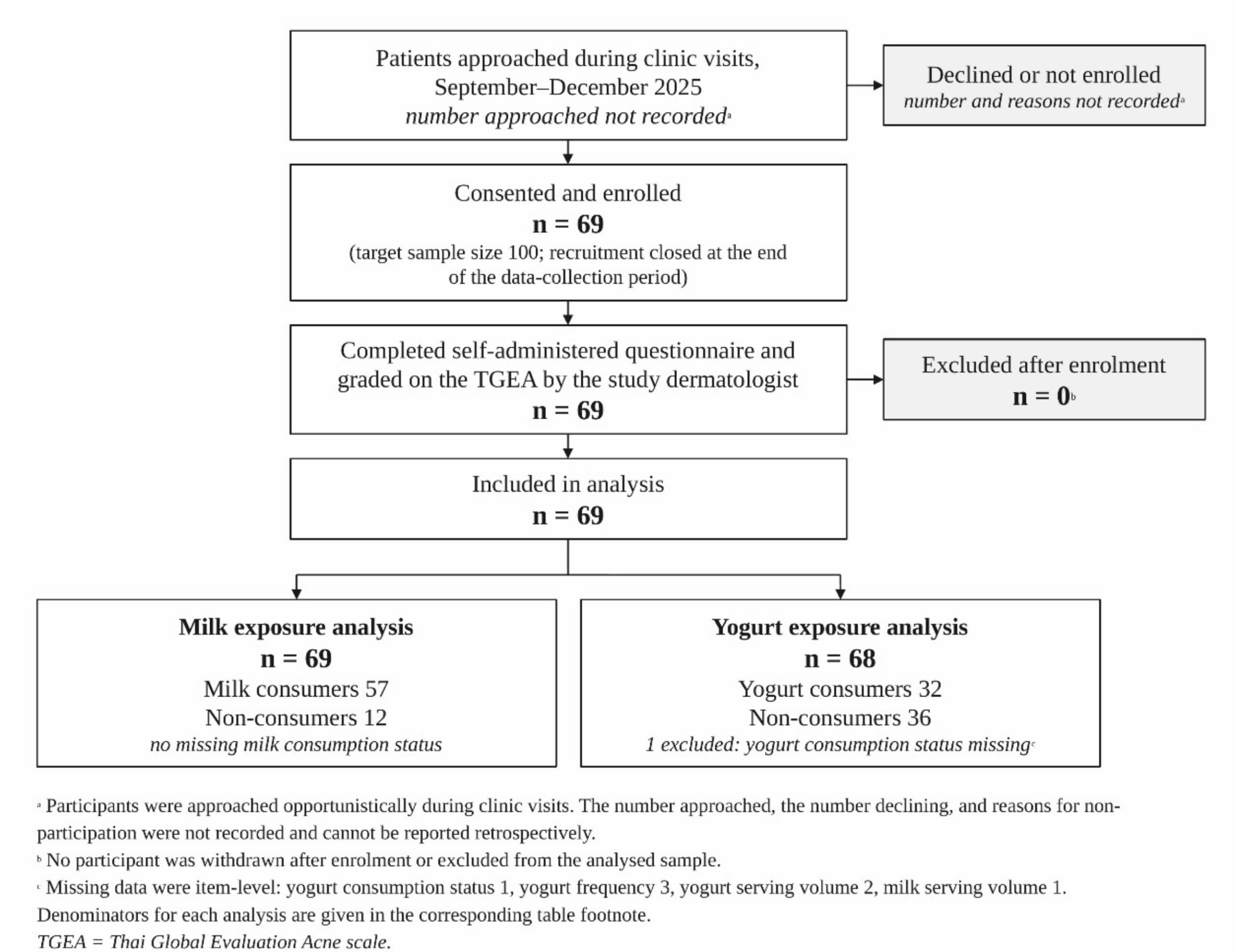
Sixty-nine participants were enrolled against a planned sample of 100 within the available data-collection period. All were existing patients of the clinic. Eligible participants were Thai nationals or long-term residents aged 11 to 40 years, irrespective of dairy consumption status. The enrolled age range was 14 to 40 years, and six participants were under 18 years old. Sixty-eight reported Thai nationality, one left nationality blank, and all 69 reported living in Thailand. The exclusion criteria were inability to consume milk in any quantity (for example, lactose intolerance), systemic disease affecting skin health, pregnancy or breastfeeding, current use of combined oral contraceptives or systemic acne medication, secondary acne of drug-induced or occupational origin, and enrolment in another clinical trial. Eligibility was established from the corresponding self-report items, completed after written consent. The numbers screened and excluded were not recorded and cannot be reported. Additionally, no washout was prespecified or verified.
Data Collection
Participants’ data were collected through a self-administered questionnaire that captured demographic information, medical history, and anthropometric data. This method was chosen because of its suitability for examining multiple exposure–outcome relationships and its cost-effectiveness for hypothesis generation; additionally, it captures current dairy consumption patterns and acne status simultaneously. The questionnaire comprised 30 items across three sections, using tick-box, multiple-select, and free-text response formats. Items on dairy consumption asked participants to report their usual consumption over the preceding three months. Serving size was captured in ordered categories (milk: <100 mL, 100–200 mL, 200–300 mL, >300 mL; yogurt: <100 g, 100–150 g, 150–250 g, >250 g), and frequency in five ordered categories ranging from rarely or never to daily. Participants were also asked to list the brands of milk and yogurt they usually consume. The questionnaire was developed for this study. It was not adapted from a previously validated dietary assessment instrument, was not piloted before use, and was not tested for internal reliability or test–retest repeatability.
Variables and Measurements
Exposures. Milk and yogurt were treated as separate exposures. For each, a single gate item established consumer status: 57 milk consumers and 12 non-consumers; 32 yogurt consumers, 36 non-consumers, and one participant for whom the item was blank. Product type. Eight milk types and five yogurt types were offered as tick-all-that-apply items. Twenty of 57 milk consumers selected more than one type, up to five, giving 95 selections; 11 of 32 yogurt consumers selected more than one, giving 47. No rule assigned a single predominant type at data collection, and none was imposed retrospectively. Each type is therefore a non-exclusive indicator among consumers of that product, reported descriptively; type counts do not sum to the number of consumers. High-protein milk denotes participants who ticked the “protein milk” option (n = 7); this was participant-assigned, was not verified against declared label content, and the questionnaire defined no protein threshold. Flavored or sweetened milk covers flavored products and ready-to-drink sweetened beverages such as milk tea and malt drinks; conventional cow’s milk covers whole, standard, low-fat, and skim milk without added flavoring. The plant-based option was worded “I drink only plant-based milk”, with brands recorded as free text; soy, almond and oat brands were reported. Twenty-one participants selected it, but 12 also selected at least one dairy type, so exclusive plant-based consumption cannot be identified and only nine selected plant-based alone. Because plant-based beverages contain no milk protein, a secondary dairy-milk exposure excluding them (48 consumers, 21 non-consumers) is analyzed alongside the any-milk definition. Yogurt types were later grouped into plain or low-sugar (plain unsweetened, Greek or strained, and drinking yogurt or probiotic drinks) and flavored or high-sugar (flavored cup yogurts and dessert-style products with fruit or toppings). This grouping is also non-exclusive. The serving volume was recorded and analyzed in its natural ascending order. The stored frequency codes were not in ascending order of intake, and the frequency bands differed between the milk and yogurt items; therefore, frequency was recorded in ascending exposure order, with rarely or never as the lowest level, before any ordered analysis. Acne severity was graded on the Thai Global Evaluation Acne Scale (TGEA), a six-point scale from grade 0 (clear) to grade 5 (very severe), by the same dermatologist for every participant24. Grades were dichotomized into non-severe (0 to 2, n = 17) and severe (3 to 5, n = 52). This cut-point was chosen by the investigators; the instrument defines no binary threshold24. It separates comedonal and limited inflammatory disease from substantial inflammatory involvement. The TGEA was developed and validated as a patient self-assessment instrument and was applied here by a clinician.
Procedure
Patients were approached by clinic administrative staff before their scheduled consultation. Those who agreed to participate provided written informed consent, with written consent obtained from a parent or guardian for participants under 18 years of age. After consenting, each participant completed the questionnaire in a room separate from the consultation area, capturing demographic, medical, anthropometric, and dairy consumption information. Acne severity was then graded by the dermatologist, who did not see the completed questionnaire; questionnaires were retained separately and were not available in the consultation room at the time of grading. Questionnaire and clinical grading data were subsequently merged and de-identified before being provided to the analyst. The number of patients approached, and the number declining participation was not recorded during data collection. Sixty-nine participants consented, completed the questionnaire, and underwent clinical grading, and all 69 were included in the analysis.
Statistical Analysis
Categorical variables are reported as counts and percentages, continuous variables as means with standard deviations. Baseline characteristics were compared between severity groups using Fisher’s exact test, Pearson’s chi-square test where a variable had more than two categories, and the independent-samples t-test for age and body mass index. Milk and yogurt consumption, each as a consumer versus non-consumer, were the primary exposures. Because expected counts below five were common, Fisher’s exact test is reported for all 2×2 comparisons, and each association is summarized as an odds ratio with a 95% confidence interval. Consumption frequency and serving volume were tested for trends across ordered categories using the linear-by-linear association test. Milk and yogurt product types were recorded as multiple-response items with no exclusive assignment rule; therefore, each type was analyzed as a separate indicator among consumers of that product and is reported descriptively. Because only 17 participants were classified as non-severe, conventional logistic regression was expected to be unstable. Firth penalized logistic regression, adjusted for age and sex alone, was therefore fitted for milk (n = 69) and yogurt (n = 68), with profile penalized likelihood intervals; convergence and separation were checked for both25. Ordinal proportional-odds models across all observed TGEA grades were fitted for each exposure separately and were not adjusted, with the parallel-lines test used to assess proportional odds. As a post hoc sensitivity analysis, the unadjusted comparisons were repeated using an alternative cut-point of grades 0–3 versus 4–5. Analyses were performed using IBM SPSS Statistics version 26.0; Firth penalized logistic regression was performed in R version 4.5.1 (R Foundation for Statistical Computing, Vienna, Austria) using the logistf package version 1.26.1. Both penalized models produced finite profile-likelihood confidence intervals for every term (milk 0.42–5.86; yogurt 0.13–1.25) and standard errors between 0.04 and 1.56, indicating no separation.
Ethical Considerations
This study was conducted as a secondary school research project under the academic supervision of the high school leadership of Ramkhamhaeng Advent International School. The protocol was reviewed by school academic leadership; it was not submitted to, and did not receive approval from, a constituted institutional review board or independent research ethics committee, and no approval number or approval date was issued. The authors state this explicitly so that readers may weigh it when interpreting the study. The study was conducted in accordance with the principles of the Declaration of Helsinki26. Written informed consent was obtained from all participants prior to enrolment. For participants under 18 years of age, written consent was obtained from a parent or legal guardian; a separate age-appropriate assent document was not used, and participant assent was therefore not separately recorded. Participants were existing patients of the recruiting clinic, and the dermatologist who graded acne severity was also the treating physician and clinic owner. Several measures were taken to protect voluntariness. Patients were approached about the study by clinic administrative staff rather than by the treating dermatologist and were approached before rather than during their consultation. All participants were told verbally, in addition to the written statement in the information sheet, that declining to participate would have no effect on the care they received. No compensation was offered. Participants could withdraw at any time without giving a reason. All questionnaire and clinical data were de-identified before analysis.
Results
Participant Characteristics
Sixty-nine participants were enrolled and included in the analysis. Fifty-two (75.4%) were graded as severe (TGEA 3–5) and 17 (24.6%) were non-severe (TGEA 0–2). Fifty-one participants (73.9%) were female; the mean age was 28.1 ± 6.6 years, and the mean body mass index was 21.8 ± 3.5 kg/m². No baseline characteristics differed between the severity groups (all p ≥ .34; Table 1).
| Characteristic | Non-severe (n = 17) | Severe (n = 52) | Total (N = 69) | p |
|---|---|---|---|---|
| Sex, male / female, n (%) | 3 (17.6) / 14 (82.4) | 15 (28.8) / 37 (71.2) | 18 (26.1) / 51 (73.9) | .53 |
| Age, years, mean ± SD | 29.4 ± 6.7 | 27.6 ± 6.6 | 28.1 ± 6.6 | .34 |
| Age group 11–20 / 21–30 / 31–40, n | 3 / 4 / 10 | 9 / 22 / 21 | 12 / 26 / 31 | .34 |
| BMI, kg/m², mean ± SD | 21.3 ± 3.5 | 21.9 ± 3.5 | 21.8 ± 3.5 | .57 |
| BMI < 23.0 / ≥ 23.0, n (%) | 12 (70.6) / 5 (29.4) | 32 (61.5) / 20 (38.5) | 44 (63.8) / 25 (36.2) | .57 |
| Family history of acne, n (%) ᵃ | 6 (35.3) | 26 (50.0) | 32 (46.4) | .40 |
| Current acne treatment, n (%) | 13 (76.5) | 39 (75.0) | 52 (75.4) | 1.00 |
| Treatment duration < 1 / 1–3 / > 3 months, n ᵇ | 2 / 5 / 6 | 8 / 14 / 18 | 10 / 19 / 24 | .93 |
TGEA, Thai Global Evaluation Acne Scale; non-severe = grades 0–2, severe = grades 3–5. Percentages are within the severity group. Continuous variables compared by independent-samples t-test, categorical variables by Fisher’s exact test where any expected cell count was below 5 and by Pearson chi-square otherwise.
ᵃ Two characteristics did not differ between severity groups and are reported here rather than tabulated. Occupation (non-severe vs severe): student 3 vs 12, government or specialist 3 vs 8, private-sector 7 vs 23, self-employed 3 vs 9, other 1 vs 0; p = .51. Self-reported skin type: oily 6 vs 19, dry 1 vs 4, combination 7 vs 22, sensitive 2 vs 6, unsure 1 vs 1; p = .94. ᵇ Restricted to the 53 participants who recorded a treatment duration. This exceeds the 52 reporting current treatment because one participant in the severe group reported no current treatment but recorded a duration.
Dairy Consumption and Acne Severity
Fifty-seven participants (82.6%) reported consuming milk of any type; with plant-based beverage consumers reclassified as non-consumers of dairy milk, 48 (69.6%) were consumers. Yogurt consumption status was recorded for 68 participants, of whom 32 (47.1%) reported yogurt consumption.
Severe acne was present in 44 of 57 milk consumers (77.2%) and 8 of 12 non-consumers (66.7%), OR 1.69 (95% CI 0.44–6.53), p = .47, and in 21 of 32 yogurt consumers (65.6%) and 30 of 36 non-consumers (83.3%), OR 0.38 (0.12–1.19), p = .10. Estimates for the dairy-only milk definition and for all three exposures under age- and sex-adjusted, ordinal and alternative-cut-point analyses are given in Table 2.
Firth penalized logistic regression adjusted for age and sex converged for both fitted models with no separation, and neither improved on the intercept-only model (p = .62 and p = .28). The proportional-odds assumption was not violated in any of the three ordinal models (test of parallel lines p = .38, .48 and .30).
| Any milk (N = 69) | Dairy milk (N = 69) ᵃ | Yogurt (N = 68) ᵇ | |
|---|---|---|---|
| Consumers with severe acne, n/N (%) | 44/57 (77.2) | 38/48 (79.2) | 21/32 (65.6) |
| Non-consumers with severe acne, n/N (%) | 8/12 (66.7) | 14/21 (66.7) | 30/36 (83.3) |
| Unadjusted OR (95% CI) | 1.69 (0.44–6.53)p = .47 | 1.90 (0.61–5.96)p = .36 | 0.38 (0.12–1.19)p = .10 |
| Age- and sex-adjusted OR (95% CI) ᶜ | 1.65 (0.42–5.86)p = .46 | not fitted— | 0.42 (0.13–1.25)p = .12 |
| Ordinal OR, full six-grade TGEA (95% CI) ᵈ | 0.93 (0.29–2.91)p = .89 | 1.33 (0.52–3.41)p = .56 | 0.58 (0.24–1.40)p = .23 |
| OR under alternative cut-point, grades 0–3 vs 4–5 (95% CI) | 0.70 (0.20–2.50)p = .74 | 1.10 (0.37–3.24)p = 1.00 | 0.71 (0.26–1.95)p = .61 |
All odds ratios are for the more severe outcome category with non-consumers as reference; unadjusted and alternative-cut-point p-values are two-sided Fisher’s exact tests. Rows 1–2 give the cell counts from which the unadjusted odds ratios are computed; rows 3–6 apply different analytic treatments to the same participants and are not independent findings.
ᵃ Participants who reported only plant-based beverages were classified as non-consumers of dairy milk. ᵇ Yogurt status was missing for one participant; denominator 68 (17 non-severe, 51 severe). ᶜ Firth penalized logistic regression, profile-likelihood confidence intervals, adjusted for age and sex; covariates restricted to two by design given 17 events in the smaller outcome group. Neither covariate was significant in either model. ᵈ Proportional odds of a higher grade on the full six-point TGEA, unadjusted; test of parallel lines p = .38, .48 and .30 respectively.
Detailed Consumption Among Consumers
Frequency, serving size and reported product type were analyzed among consumers of each product (Table 3). No trend across ordered categories reached significance and no product type was associated with severity. Product type was a multiple-response item (95 selections from 57 milk consumers, 47 from 32 yogurt consumers); therefore, these categories were not mutually exclusive.
| Measure | Category, n (% severe) | p ᵃ |
|---|---|---|
| Milk frequency (n = 57) | 1–3/month 6 (66.7); 1–2/week 25 (76.0); 3–6/week 5 (100.0); daily 21 (76.2) | .69 |
| Milk volume per occasion (n = 56) | < 100 mL 4 (100.0); 100–200 mL 24 (75.0); 200–300 mL 20 (70.0); > 300 mL 8 (87.5) | .83 |
| Yogurt frequency (n = 29) | 1–3/month 5 (80.0); 1–2/week 23 (60.9); daily 1 (100.0) | .74 |
| Yogurt quantity per occasion (n = 30) | < 100 g 5 (80.0); 100–150 g 17 (70.6); 150–250 g 8 (37.5) | .10 |
| Milk product types (n = 57) ᵇ | whole/full-fat 1 (100.0); high-protein 7 (85.7); plain/regular 29 (79.3); reduced-fat 9 (100.0); skim 3 (100.0); flavoured 9 (77.8); ready-to-drink sweetened 16 (87.5); plant-based 21 (76.2) | — |
| Yogurt product types (n = 32) ᵇ | plain unsweetened 14 (64.3); sweetened/flavoured 11 (72.7); drinking/probiotic 6 (66.7); Greek/strained 9 (77.8); fruit or dessert-style 7 (71.4) | — |
Restricted to consumers of each product; denominators reflect item-level missing data. Entries indicate the number of consumers in each category, and, in parentheses, the percentage of that category graded as severe. Yogurt sweetness preference did not differ by severity (unsweetened 11 [63.6], slightly sweet 16 [62.5], no preference 5 [80.0]; p = .76).
ᵃ Trend across ordered categories by linear-by-linear association; product-type rows by Fisher’s exact test (all p ≥ .10 for milk types, ≥ .44 for yogurt types). ᵇ Multiple-response items. Participants could select more than one type; therefore, categories are not mutually exclusive, and selections exceed the number of consumers (95 selections from 57 milk consumers; 47 from 32 yogurt consumers). Percentages are the proportion graded severe within each selected category.
Discussion
Principal findings
Among the 48 participants classified as dairy milk consumers, 38 (79.2%) had severe acne, compared with 14 of 21 non-consumers (66.7%). The observed 12.5-percentage-point difference corresponds to an odds ratio of 1.90, but its confidence interval ranges from 0.61 to 5.96 (Fisher’s exact p = .36). However, yogurt consumption showed the opposite association: 21 of 32 consumers (65.6%) were graded as severe against 30 of 36 non-consumers (83.3%), with an odds ratio of 0.38 (95% CI 0.12–1.19, p = .10). Adjustment for age and sex did not change either estimate (1.65, 95% CI 0.42–5.86; 0.42, 95% CI 0.13–1.25), consistent with Table 1, in which no baseline characteristics differed between severity groups.
Milk consumption and acne severity
The milk estimates depend heavily on how acne severity is divided. Under the prespecified split between grades 0–2 and 3–5, dairy milk consumption carried an odds ratio of 1.90 (95% CI 0.61–5.96). Modelling the full six-grade scale rather than a binary outcome reduced this to 1.33 (0.52–3.41), and moving the split to grades 0–3 versus 4–5 reduced it further to 1.10 (0.37–3.24). The consumption of any type of milk crossed the null value from the modification of the severity classification, with the corresponding odds ratios declining from 1.69 to 0.93 and then to 0.70. This pattern was consistent across all three exposure measures, with the associations being strongest under the binary severity classification and progressively attenuated as more information from the six-grade severity scale was incorporated. This pattern suggests that an association reflecting a genuine gradient in acne severity would be expected to remain consistent when the full severity scale is modelled, whereas an association driven primarily by the choice of threshold may weaken or disappear under alternative classifications. The proportional odds assumption was not rejected for any exposure; however, the limited sample size substantially reduced the power of this test to detect departures from the assumption and, therefore, provided limited evidence for its validity. Although the limited sample size reduces the power of this test, the two threshold-specific estimates for dairy milk differ more than expected under a common-odds model. These findings also highlight a broader methodological consideration, as the apparent association between milk consumption and acne severity in a sample of this size appears to be sensitive to how severity is categorized, an analytical decision that may substantially affect the estimated association.
Yogurt consumption and acne severity
The yogurt comparison produced the largest contrast in the study, at 17.7 percentage points, illustrating the weak points of using a cross-sectional design for interpretation. Patients may have altered their yogurt consumption in response to their acne before participating in the study, which could produce precisely the distribution observed, with 30 of 36 non-consumers graded as severe compared with 21 of 32 consumers. Thus, an apparent association between yogurt consumption and acne severity could reflect either an effect of fermented dairy or dietary changes made by individuals in response to their acne, and the cross-sectional data cannot distinguish between these explanations. This limitation warrants particular attention rather than being dismissed as a general methodological consideration, as it has implications that extend well beyond the present study. Cross-sectional investigations of diet and acne conducted in treatment-seeking populations are similarly vulnerable to reverse causation6,8, which is particularly relevant given that the majority of the observational evidence is cross-sectional or case–control8,22; the few longitudinal and genetically instrumented analyses that avoid this vulnerability have not reproduced the association27. Moreover, the observed association was attenuated under alternative analytical approaches, decreasing to 0.58 (95% CI 0.24–1.40) when the full ordinal severity scale was modelled and to 0.71 (95% CI 0.26–1.95) under the alternative threshold, consistent with the pattern observed for the milk estimates. Further observation showed an opposing association from milk and yogurt within the 69 participants, complicating the mechanistic interpretation as both are hypothesized to influence acne through pathways involving milk protein fractions, insulin and IGF-113,16.
Dairy exposure as a measurement problem
The most reliable finding of this study concerns how dietary exposure was captured. Fifty-seven participants reported consuming milk and collectively identified 95 products, while 32 yogurt consumers reported 47 products. Notably, 29 of the 57 milk consumers selected a questionnaire category whose label permits both an “unflavored” and a “standard fat content” interpretation, with each overlapping with other available response options. Consequently, the variable recorded as “milk consumption” encompasses a wide range of products, including whole and skim milk, high-protein formulations, sweetened ready-to-drink beverages, and plant-based alternatives, which can differ substantially in both protein composition and added sugar, making it difficult to determine which specific characteristics of milk consumption may be associated with acne. This classification issue is important because it can substantially affect the study results. Plant-based beverages do not contain milk proteins involved in the pathway under investigation; however, some may produce higher glycemic responses than cow’s milk and therefore should not be considered metabolically negligible17,18,20,28. Nevertheless, 21 of the 57 participants classified as milk consumers reported consuming plant-based beverages, and nine of these reported no dairy milk of any kind. When those nine participants were reclassified as non-consumers of dairy based solely on the biological composition of their reported beverages, the number of dairy milk consumers fell from 57 to 48 and the odds ratio increased from 1.69 to 1.90, an approximately 12% shift produced by moving nine participants. The result changed solely because the definition of the exposure was modified without any new recruitment of participants or change in measurements. The product-specific analyses further highlight the importance of distinguishing between different types of milk and yogurt. None of the eight milk types or five yogurt types was significantly associated with acne severity (all p ≥ .10 and p ≥ .44, respectively; Table 3). These categories were too small to estimate type-specific associations: they contained between 1 and 29 consumers, and three of the eight milk categories included no non-severe participants at all. Although these individual comparisons cannot establish meaningful association due to the small scale of the study, the compositional differences between these products suggest that grouping different beverages under a single “milk consumption” category may obscure product-specific associations. Therefore, more participants would be required to reliably assess product-specific associations beyond the scale of this single-clinic pilot study.
Implications for existing literature
The study presents inconsistencies in the existing dairy–acne literature. This variation is evident in the existing literature, with Juhl et al. reporting an odds ratio of 1.36 for yogurt, whereas Aghasi et al. reported 0.90, placing their estimates on opposite sides of the null despite examining the same broad food category8,10. Pooled estimates for overall dairy consumption are more modest, generally ranging from approximately 1.2 to 1.38,9 although comparisons between the highest and lowest levels of consumption have yielded substantially larger estimates10. Confidence intervals across individual studies also frequently overlap, indicating that the magnitude of these associations varies considerably across studies.8,10 A possible explanation is that the products classified as “yogurt” differ between study populations. If yogurt consumption consists mainly of plain, unsweetened products in one cohort but predominantly sweetened or dessert-style products in another, the studies may not actually be assessing the same exposure22. The present study demonstrates this variation within a single population, as the 32 yogurt consumers reported 14 plain unsweetened products, 11 sweetened or flavored products, 6 drinking or probiotic products, 9 Greek or strained products, and 7 fruit or dessert-style products, with some participants reporting more than one category. Similar variations are evident across regions, with Ismail et al. reporting a nearly fourfold increase in the odds of acne among Malaysian young adults who consumed milk more than once per week11. The statistical precision of the present study is important when interpreting its null findings. As the study was not large enough to reliably identify the relatively small effects that some studies have reported, the absence of a statistically significant association should therefore not be interpreted as evidence that dairy consumption is unrelated to acne29, but rather as a reflection of the study’s limited statistical power. Notably, the contribution of the study demonstrates that the definition of dairy exposure can alter the estimated association, indicating that a larger study would not eliminate bias arising from an inappropriate exposure definition.
Limitations
The sample size (N = 69) fell short of the planned target (N = 100) within the available data-collection period, limiting statistical power to detect modest associations. Recruitment was confined to patients attending Siam Dermatology Clinic, with 52 of 69 participants (75.4%) classified as having severe acne and 52 receiving acne treatment at the time of assessment. Additionally, 17 participants were classified as having non-severe acne, which limited the analysis to adjustment for age and sex, while several product-category comparisons included only three to eight participants, reducing the reliability of these estimates. The resulting high baseline proportion of severe acne may have compressed the contrast between dairy consumers and non-consumers and contributed to the absence of statistical significance. Beyond limitations to generalizability, recruiting exclusively from patients attending an acne treatment clinic may introduce collider bias30. If both dairy intake and acne severity influence the likelihood of seeking clinical care, restricting the sample to clinic attendees may induce or obscure an association between dairy consumption and acne, even in the absence of a causal relationship. This therefore represents a potential threat to internal validity, rather than solely a limitation to external validity30. Additionally, reliance on self-reported dietary data introduces the possibility of recall bias and portion size inaccuracy. The cross-sectional nature of the study creates additional plausibility in reverse causality, as measurements of diet and acne were taken simultaneously. Adjustment was possible only for age and sex. While dietary glycemic load, skincare regimen, and psychological stress were not measured, and variables that were recorded, including diagnosed hormonal disorder, body mass index and family history, could not be entered into the models given the number of non-severe cases; limiting the ability to isolate dairy’s independent contribution to acne severity. Furthermore, the questionnaire developed for this study was not adapted from a validated dietary instrument, was not piloted, and defined no protein or added-sugar thresholds. In addition, the TGEA was developed and validated for patient self-assessment but was applied here by a dermatologist, placing its use outside the conditions under which it was validated24.
Significance and future directions
Acne severity in this study was assessed by a dermatologist rather than self-reported by participants, reducing the risk of outcome misclassification that may affect much of the existing dairy–acne literature. Dairy intake was also classified according to the characteristics of the commercial products consumed, providing a product-specific approach to classifying milk and yogurt products, rather than relying solely on fat content or broad product categories. Together, these approaches provide important methodological findings. Reclassifying the nine participants who reported consuming plant-based beverages alone as non-consumers of dairy changed the milk odds ratio by approximately 12%, despite no changes to the participants or measurements. This demonstrates that the way dairy exposure is defined can meaningfully influence the estimated association and provides a useful basis for designing future studies with more precise exposure classification. These findings are insufficient to support changes in clinical practice, and patients should not alter their diet based on a study with this sample size. However, this study provides useful guidance for improving the design of future research. Collecting product-level dietary information alongside dermatologist-assessed acne severity revealed several sources of ambiguity in exposure measurement. Participants could report multiple products without identifying a predominant one, some questionnaire categories could be interpreted in more than one way, and reported products were not directly linked to their protein or added sugar content. These limitations can be addressed in future studies by asking participants to identify their predominant product, recording the brand and serving size, obtaining nutritional composition directly from product labels rather than relying on broad category names, and specifying in advance how multiple or equally reported products will be classified. These findings have implications for the sample size required for future research. Detecting associations of the magnitude observed here would require a considerably larger sample than the present study was able to recruit, with the milk comparison requiring a larger sample. However, more important than the overall size is the composition of the sample. Non-consumers of milk were substantially less common than consumers in this clinic, and this imbalance increased the total number of participants needed for the milk comparison. Future studies should therefore recruit non-consumers deliberately rather than relying solely on increasing the overall sample size. However, a larger sample size alone would not address the study’s other limitations. A more robust design would incorporate multicenter and community-based recruitment, prospective follow-up to establish temporal relationships, prespecified adjustment for potential confounders such as glycemic load, psychological stress, skincare regimen, and hormonal status, standardized treatment washout with blinded severity assessment, and preregistration of the study protocol and analytical plan. Whether the observed 17.7-percentage-point difference in severe acne between yogurt consumers and non-consumers represents a true association remains uncertain, although such a relationship would have potential clinical relevance if it is confirmed. Establishing this association was beyond the statistical capacity of a study involving only 69 patients from a single clinic in the present study. However, this study demonstrated that clinician-assessed acne severity and product-level dietary information can be collected in a Thai clinical setting, while also identifying specific limitations in the measurement of dietary exposure. These findings provide practical guidelines for designing a sufficiently powered future study and contribute to a literature that has examined the dairy–acne relationship for decades but continues to face substantial variations in how dietary exposure is defined and measured.
Conclusion
This pilot study did not demonstrate a statistically supported association between milk or yogurt consumption and clinician-graded acne severity. Both estimates were compatible with a substantial increase and a substantial decrease in the odds of severe acne, and neither is precise enough to inform dietary decisions. Fifty-seven participants reporting milk consumption described 95 different products between them, and reclassifying the 9 who reported only plant-based beverages moved the odds ratio from 1.69 to 1.90 without a single new participant or measurement. The sensitivity of the estimated association to how the exposure is defined raises concerns about its reliability and provides a testable explanation for the conflicting findings reported across pooled analyses of the same food category. Furthermore, recruitment from a single dermatology clinic and the limited number of non-severe cases constrain the generalizability and statistical precision of these findings. Nevertheless, the study provides a clear framework for future research through predominant-product reporting, label-based assessment of nutritional composition, prospective follow-up, and deliberate oversampling of non-consumers.
Acknowledgments
The author would like to acknowledge the dermatology staff of Siam Dermatology Clinic for assistance with acne severity grading.
Author Contributions
Withawin Woramongkholchai1: Conceptualization, Methodology, Investigation (data collection), Formal analysis, Writing–original draft, Writing–review and editing.
Patara Voravutinon MD2: Investigation (acne severity grading), Supervision
References
- B. Dréno. What is new in the pathophysiology of acne, an overview. Journal of the European Academy of Dermatology and Venereology. Vol. 31, pg. 8–12, 2017 https://doi.org/10.1111/jdv.14374 [↩] [↩]
- M. Vasam, S. Korutla, R. A. Bohara. Acne vulgaris: a review of the pathophysiology, treatment, and recent nanotechnology based advances. Biochemistry and Biophysics Reports. Vol. 36, pg. 101578, 2023 https://doi.org/10.1016/j.bbrep.2023.101578 [↩] [↩]
- A. H. S. Heng, F. T. Chew. Systematic review of the epidemiology of acne vulgaris. Scientific Reports. Vol. 10, pg. 5754, 2020 https://doi.org/10.1038/s41598-020-62715-3 [↩] [↩]
- D. V. Samuels, R. Rosenthal, R. Lin, S. Chaudhari, M. N. Natsuaki. Acne vulgaris and risk of depression and anxiety: a meta-analytic review. Journal of the American Academy of Dermatology. Vol. 83, pg. 532–541, 2020, https://doi.org/10.1016/j.jaad.2020.02.040 [↩]
- L. Naldi, S. Cazzaniga, C. Flohr, M. M. Lee, C. Fuller, R. Hay, E. E. Freeman, R. Sarkar, R. Romiti, A. Torrelo, Q. Lu, N. Dlova, V. Z. Breton, J. Austin, M. Augustin, H. Lim, L. Borradori. The worldwide burden of skin diseases: lessons from the global burden of disease data. Journal of the European Academy of Dermatology and Venereology: JEADV. 2026 https://doi.org/10.1111/jdv.70562 [↩]
- K. Roengritthidet, N. Kamanamool, M. Udompataikul, S. Rojhirunsakool, S. Khunket, S. Kanokrungsee. Association between diet and acne severity: a cross-sectional study in thai adolescents and adults. Acta Dermato-Venereologica. Vol. 101, pg. adv00611–adv00611, 2021 https://doi.org/10.2340/actadv.v101.569 [↩] [↩] [↩]
- E. Niltem. PREVALENCE and associated factors of acne vulgaris among high school students in rural and urban areas of thailand a cross-sectional study. [↩] [↩] [↩]
- C. R. Juhl, H. K. M. Bergholdt, I. M. Miller, G. B. E. Jemec, J. K. Kanters, C. Ellervik. Dairy intake and acne vulgaris: a systematic review and meta-analysis of 78,529 children, adolescents, and young adults. Nutrients. Vol. 10, pg. 1049, 2018 https://doi.org/10.3390/nu10081049 [↩] [↩] [↩] [↩] [↩] [↩] [↩] [↩] [↩] [↩]
- R. Dai, W. Hua, W. Chen, L. Xiong, L. Li. The effect of milk consumption on acne: a meta-analysis of observational studies. Journal of the European Academy of Dermatology and Venereology. Vol. 32, pg. 2244–2253, 2018 https://doi.org/10.1111/jdv.15204 [↩] [↩] [↩]
- M. Aghasi, M. Golzarand, S. Shab-Bidar, A. Aminianfar, M. Omidian, F. Taheri. Dairy intake and acne development: a meta-analysis of observational studies. Clinical Nutrition. Vol. 38, pg. 1067–1075, 2019 https://doi.org/10.1016/j.clnu.2018.04.015 [↩] [↩] [↩] [↩] [↩] [↩] [↩]
- N. H. Ismail, Z. A. Manaf, N. Z. Azizan. High glycemic load diet, milk and ice cream consumption are related to acne vulgaris in malaysian young adults: a case control study. BMC Dermatology. Vol. 12, pg. 13, 2012 https://doi.org/10.1186/1471-5945-12-13 [↩] [↩] [↩] [↩]
- B. C. Melnik. Linking diet to acne metabolomics, inflammation, and comedogenesis: an update. Clinical, Cosmetic and Investigational Dermatology. Vol. 8, pg. 371–388, 2015 https://doi.org/10.2147/CCID.S69135 [↩] [↩] [↩] [↩] [↩] [↩] [↩]
- H. Baldwin, J. Tan. Effects of diet on acne and its response to treatment. American Journal of Clinical Dermatology. Vol. 22, pg. 55–65, 2021 https://doi.org/10.1007/s40257-020-00542-y [↩] [↩] [↩] [↩]
- J. Muhaidat, A. Qablan, F. Gharaibeh, G. H. Albataineh, N. Abdo, D. Alshiyab, F. Al-Qarqaz. The effect of whey protein supplements on acne vulgaris among male adolescents and young adults: a case-control study from north of jordan. Dermatology Research and Practice. Vol. 2024, pg. 2158229, 2024 https://doi.org/10.1155/2024/2158229 [↩]
- T. Simonart. Acne and whey protein supplementation among bodybuilders. Dermatology. Vol. 225, pg. 256–258, 2012 https://doi.org/10.1159/000345102 [↩]
- I. Ryguła, W. Pikiewicz, K. Kaminiów. Impact of diet and nutrition in patients with acne vulgaris. Nutrients. Vol. 16, pg. 1476, 2024 https://doi.org/10.3390/nu16101476 [↩] [↩]
- N. Da Silva, G. H. Anderson, A. M. Amr, S. Vien, H. Fabek. A comparison of the effects of dairy products with their plant-based alternatives on metabolic responses in healthy young canadian adults: a randomized crossover study. Applied Physiology, Nutrition, and Metabolism = Physiologie Appliquee, Nutrition Et Metabolisme. Vol. 50, pg. 1–17, 2025 https://doi.org/10.1139/apnm-2024-0158 [↩] [↩]
- S. Jeske, E. Zannini, E. K. Arendt. Evaluation of physicochemical and glycaemic properties of commercial plant-based milk substitutes. Plant Foods for Human Nutrition. Vol. 72, pg. 26–33, 2017 https://doi.org/10.1007/s11130-016-0583-0 [↩] [↩]
- L. Sun, K. W. J. Tan, C. M. S. Han, M. K.-S. Leow, C. J. Henry. Impact of preloading either dairy or soy milk on postprandial glycemia, insulinemia and gastric emptying in healthy adults. European Journal of Nutrition. Vol. 56, pg. 77–87, 2017 https://doi.org/10.1007/s00394-015-1059-y [↩]
- B. Shkembi, T. Huppertz. Glycemic responses of milk and plant-based drinks: food matrix effects. Foods. Vol. 12, pg. 453, 2023 https://doi.org/10.3390/foods12030453 [↩] [↩]
- A. K. Aalemi, I. Anwar, H. Chen. Dairy consumption and acne: a case control study in kabul, afghanistan. Clinical, Cosmetic and Investigational Dermatology. Vol. Volume 12, pg. 481–487, 2019 https://doi.org/10.2147/CCID.S195191 [↩]
- J. Meixiong, C. Ricco, C. Vasavda, B. K. Ho. Diet and acne: a systematic review. JAAD International. Vol. 7, pg. 95–112, 2022 https://doi.org/10.1016/j.jdin.2022.02.012 [↩] [↩] [↩] [↩]
- H. H. Kwon, J. Y. Yoon, J. S. Hong, J. Y. Jung, M. S. Park, D. H. Suh. Clinical and histological effect of a low glycaemic load diet in treatment of acne vulgaris in korean patients: a randomized, controlled trial. Acta Dermato-Venereologica. Vol. 92, pg. 241–246, 2012 https://doi.org/10.2340/00015555-1346 [↩]
- K. Pakornphadungsit, S. Harnchoowong, P. Wattanakrai. Evaluation of an acne severity grading self-assessment system suitable for the thai population – a pilot study. Clinical, Cosmetic and Investigational Dermatology. Vol. 16, pg. 3171–3179, 2023 https://doi.org/10.2147/CCID.S427648 [↩] [↩] [↩] [↩]
- G. Heinze, M. Schemper. A solution to the problem of separation in logistic regression. Statistics in Medicine. Vol. 21, pg. 2409–2419, 2002 https://doi.org/10.1002/sim.1047 [↩]
- World medical association declaration of helsinki: ethical principles for medical research involving human subjects. JAMA. Vol. 310, pg. 2191, 2013 https://doi.org/10.1001/jama.2013.281053 [↩]
- C. R. Juhl, H. K. M. Bergholdt, I. M. Miller, G. B. E. Jemec, J. K. Kanters, C. Ellervik. Lactase persistence, milk intake, and adult acne: a mendelian randomization study of 20,416 danish adults. Nutrients. Vol. 10, pg. 1041, 2018 https://doi.org/10.3390/nu10081041 [↩]
- B. Walther, D. Guggisberg, R. Badertscher, L. Egger, R. Portmann, S. Dubois, M. Haldimann, K. Kopf-Bolanz, P. Rhyn, O. Zoller, R. Veraguth, S. Rezzi. Comparison of nutritional composition between plant-based drinks and cow’s milk. Frontiers in Nutrition. Vol. 9, 2022 https://doi.org/10.3389/fnut.2022.988707 [↩]
- P. Alderson. Absence of evidence is not evidence of absence. BMJ : British Medical Journal. Vol. 328, pg. 476–477, 2004 https://doi.org/10.1136/bmj.328.7438.476 [↩]
- M. R. Munafò, K. Tilling, A. E. Taylor, D. M. Evans, G. Davey Smith. Collider scope: when selection bias can substantially influence observed associations. International Journal of Epidemiology. Vol. 47, pg. 226–235, 2018 https://doi.org/10.1093/ije/dyx206 [↩] [↩]