
Abstract
The transverse thermal and electrical conductivities (TTC and TEC) of various common carbon nanotubes (CNTs) are currently still being researched due to difficulties in understanding the research question, resulting in a gap in the general understanding of CNTs. A common problem researchers face is isolating the extreme anisotropic properties of CNTs from other factors that also affect their thermal and electrical conductivities. These factors, which primarily include chirality, purity, defects, diameter, and density, affect one or both conductivities. Current findings in the field’s methods and literature suggest that the TTC is extremely low relative to the longitudinal thermal conductivity. However, there is a current difficulty in determining a quantitative value of the TEC of CNTs, despite established literature indicating that the TEC is lower than that of the longitudinal electrical conductivity. This issue can be resolved by acknowledging factors that affect the electrical and thermal conductivities of CNTs in ongoing and future experiments and academic literature. A possible way to get to this solution is by making better experimental designs that incorporate and account for these factors that affect the electrical and thermal conductivities of CNTs, which include anisotropy, chirality, purity, and others, or by listing the specific details related to these factors that affect the thermal and electrical conductivities of CNTs. This paper is being done so future researchers can more easily isolate anisotropy and determine the TTC and TEC of various common CNTs.
Keywords: CNTs, transverse, thermal conductivity, electrical conductivity, anisotropy, chirality
Introduction
The general study of various carbon nanoparticles and materials, along with research done on their thermal and electrical conductivities, has numerous important applications in other fields. Carbon nanotubes (CNTs) have become increasingly widely used in energy storage and conversion technologies, sensors, and reinforcing certain materials across multiple fields, including aerospace, electrical engineering, and biomedicine1. CNTs are carbon nanoparticles that are cylindrically rolled sheets of graphene with diameters typically in nanometers and lengths in several millimeters2. Like most other carbon nanoparticles, they usually exhibit high longitudinal thermal and electrical conductivities (LTC and LEC) compared to other forms of matter at standard temperature and pressure (STP) due to their strong covalent bonds, free electron flow, and other unique properties3. Strong covalent bonds create efficient pathways for the transport of both electrons and heat energy, and free electron flow increases electrical conductivity by forming a “sea of electrons” not bound to a specific atom but rather able to freely move around the material they’re in3.
However, CNTs, typically used in the longitudinal and transverse orientations, have transverse thermal and electrical conductivities (TTC and TEC respectively). Researchers have had difficulty determining the TTC and TEC numerically due to several issues in isolating anisotropy, the change in the physical properties of an object or substance due to a change in orientation, from other underlying variables that also affect the thermal and electrical conductivity of CNTs, despite some progress4. Other factors that affect the thermal and electrical conductivities of CNTs include chirality, purity, and density, and current research is having trouble differentiating those factors from anisotropy5. Thus, the lack of information on the TTC and TEC of CNTs influences experimental results and data, leaving gaps in the understanding of this research topic. This gap creates issues in the practical applications of the worldwide CNT industry because misunderstandings about the TTC and TEC of individual CNTs can amount to something significant when combined into practical applications of CNTs, like CNT fibers, since the thermal and electrical properties of individual CNTs, when combined, determine the thermal and electrical properties of CNTs in practical applications6. This can result in lower CNT quality and lifespan, with unexpected electrical and thermal conductivities for practical CNT applications. As a result of this issue, engineers and other field specialists don’t consider these constraints in their designs, causing common materials and devices, such as phones and computers, that rely on CNTs to be less efficient, more costly, and less reliable than what is possible with the technology. Although researchers are currently attempting to solve this issue, there are struggles in finding conclusive results despite some successful breakthroughs, such as a past well-researched study to find the TTC and TEC of CNTs using magnetically aligned CNTs by Hone et al. (2000), which used magnetically aligned CNTs7.
This research paper seeks to help researchers in the field, both current and future, solve the current knowledge gap in the TTC and TEC of CNTs by acknowledging problems within the methodologies of current and past experiments by thoroughly examining, analyzing, and interpreting the currently available literature on CNTs which will be used for creating an overview of the current understanding of the transverse and longitudinal electrical and thermal conductivities of CNTs and the common experimental methodologies used behind these studies. Afterwards, possible solutions will be generated for the field’s current difficulties. For this paper, the research question used is: What do we know about the TTC and the TEC of CNTs, and what remains unknown about them using current research, and what do we know about CNTs generally? Findings from this study can be used to design more accurate and representative experiments related to this research question and topic generally.
For non-specialists, transverse conductivity, longitudinal conductivity, and chirality should be defined before reading the rest of this manuscript for clarity. Transverse conductivity is the conductivity of a CNT in the transverse or perpendicular direction to the CNT structure8. Meanwhile, longitudinal conductivity is the conductivity of a CNT in the same direction as the CNT structure or lengthwise along the CNT9. Chirality, typically indicated by the indices (n,m), is essentially the structure of the CNT after being rolled up from 2D graphene sheets10.
Before continuing with the rest of this paper, it is important to note that single-walled carbon nanotubes (SWCNTs) are considered the most studied CNTs because they essentially act as the basic building blocks for other types of CNTs, making them the primary focus of this manuscript, like many others11. This detail matters because, realistically, it would be too difficult to discuss every form of CNT, but by focusing on SWCNTs, the study becomes more concentrated. Thus, the manuscript’s primary focus will be on individual SWCNTs for their electrical and thermal conductivities. However, this manuscript will also use papers involving films and composites to allow access to more literature, as long as those papers involving these other materials aren’t directly cited for the CNT thermal and electrical conductivity values and data or confused with actual CNTs. For anisotropy, though the longitudinal and transverse aren’t the only orientations, these orientations will be this manuscript’s main focus due to their common usage. These terms are also interchangeable with axial and perpendicular in the context of CNT orientation, respectively, though this paper will be using the former terms.
Methods
This paper is organized utilizing a narrative systematized literature review method, which focuses on current understandings and identifies what is not known to develop or answer a research question while also providing a subjective overview and interpretation12.The literature for this paper was primarily researched using Google Scholar and other research databases, including ScienceDirect and JSTOR, with the following keywords to assess the study’s relevance: CNTs, transverse, thermal conductivity, electrical conductivity, anisotropy, and chirality. Papers without these words or other keywords that were similar enough to be interchangeable terms (i.e., instead of using “CNT”, a paper may use the unabbreviated version “Carbon Nanotube”, or instead of “transverse”, the “perpendicular direction” is used) or were also important, such as electrons and phonons, were not considered relevant enough to the research question to be included. The inclusion and exclusion criteria are shown below, with papers being reviewed and retained based on their relevance and credibility to this manuscript.
To be included, the paper must be:
- The source is fully in proper English.
- Contain content related to the thermal and electrical conductivities of CNTs, which may include beyond just SWCNTs and individual CNTs, though papers focusing specifically on SWCNTs and individual CNTs are preferred.
- Use experimental data gathered from a lab or from an MD simulation, or use a comprehensive literature review that uses such experimental data.
- Come from a credible, academic website from an accredited institution or agency, such as Science Direct, ACS Publications, Nature, or the National Institute of Health (NIH).
- No older than 2019 for most literature directly related to the current understanding of the TTC and TEC of various common CNTs.
- No older than 2000 for literature on methodologies and well-established papers that haven’t been replicated recently and are still considered relevant to today’s research.
- It is a definition from a credible dictionary website, such as Webster or Britannica Dictionary.
The paper was excluded if:
- The source was not fully in proper English.
- The source did not come from a credible academic website.
- If another paper could support a claim better through superior relevance, quality, or results, and if that paper could not be used effectively elsewhere in the paper. (i.e.., although several papers did support that anisotropy is being confused with other factors that affect the thermal and electrical conductivity of CNTs, Najmi & Hu (2024) support it best, so other papers weren’t included since they were less relevant).
- The content was irrelevant or not closely related to the thermal and electrical conductivities of CNTs or to this paper’s research process.
- If the source came before 2019, if the source dates back before 2000 for literature on the research process and methodologies or on well-established papers, or isn’t a definition from a credible dictionary website.
These criteria maintained flexibility within this study, allowing the integration of newer developments in the field that arose from renewed interest, alongside older, well-established literature. Papers that were screened but did not meet these criteria were not referenced within the paper. For data extraction, data was collected by analyzing literature gathered from the aforementioned credible academic websites. These were mostly found through online research databases, primarily Google Scholar, Science Direct, and JSTOR. Data extraction was accomplished by searching for keywords in literature, skimming important paragraphs such as the abstract and conclusion, focusing on numbers and central details, and analyzing detailed images and their figure descriptions. Most of the time, this strategy achieved what was needed, but other papers required more thorough screening for proper data extraction.
Process of a Systematized Literature Review
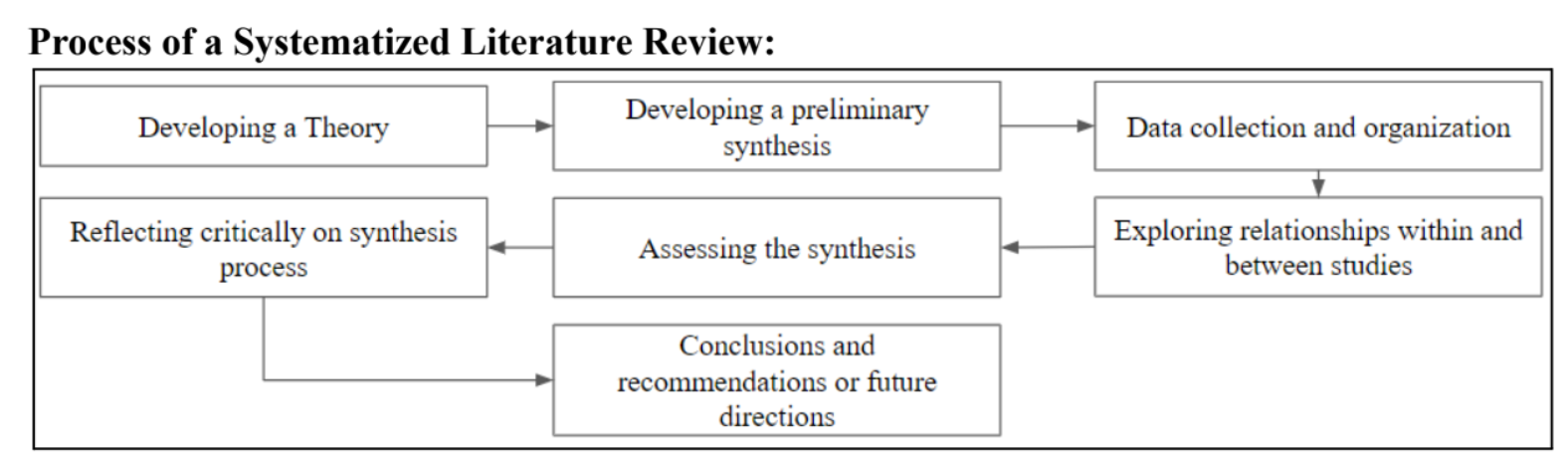
For information synthesis and overall structure, a narrative systematized literature review synthesis was used12. The general process for the narrative systematized literature review is shown in Fig 1 and starts with developing a theory and ends with making conclusions and recommendations for future directions12. In total, 116 papers were screened for this paper from August 1st, 2025, to September 5th, 2025, all of which are recorded on a separate Google Doc and were excluded if they didn’t meet the necessary inclusion criteria. Literature gathered from multiple studies was used to summarize the current understanding of the research topic and question, including the most recent quantifiable answer to the question of what the TTC and TEC of CNTs are based on current research. Later, the paper identifies hindrances to the understanding of the TTC and TEC, analyzes why this hindrance arises, and then proposes possible solutions for future experiments and researchers. The general process for a narrative systematized literature review is shown in Fig 1. For information organization, this paper used the funnel approach, also known as from general to specific information. For quality assessment of each paper, the trustworthiness of the website containing it, the number of citations from other researchers, and the overall quality of the experimental methods used were considered.
Findings & Future Directions
I) Current Understanding of the Longitudinal and Transverse Thermal and Electrical Conductivities of CNTs
There are several common methods used in real-life lab experiments or molecular dynamics (MD) simulations to determine the thermal or electrical conductivity of CNTs. Some common methodologies mentioned by Kumanek & Janas (2019) for determining the thermal conductivity of CNTs and carbon nanomaterials in general include methods such as optothermal Raman (OTR) spectroscopy, 3-ω, hot-disk, bolometric, steady-state, flash analysis, and others13. Meanwhile, common methodologies used for determining the electrical conductivity of CNTs, as noted by Xiang et al. (2025), include: Scanning Tunnel Microscopy (STM), electron microscope-based nanoprobes such as the four-point probe method, and nanodevice-based measurements14. This is significant in the understanding of the longitudinal and transverse thermal and electrical conductivities of CNTs because current research utilizes these methods to gather data and experiment on CNTs to develop current knowledge on the research topic. It’s necessary to understand the methodology behind current studies to suggest improvements on them, which will be done later in this paper, as well as to deepen the understanding of how data from the modern studies mentioned were collected.
Although results vary, current literature has generally placed the LTC and LEC significantly higher than the TTC and TEC for CNTs, respectively. This phenomenon is due to the longitudinal direction’s better electron and phonon transfer relative to the transverse direction of CNTs, thus the anisotropic properties of CNTs. The LTC is higher than the TTC because of the longitudinal direction’s strong sp2 covalent bonding and lack of interfacial resistance15. On the other hand, the transverse direction has weaker van der Waals forces and significant interfacial resistance (Ma et al., 2017). Furthermore, several other sources note that the longitudinal direction of CNTs has a superior electrical conductivity to the transverse direction of CNTs primarily because of the longitudinal direction’s electron delocalization, ballistic transport, and higher electron mobility compared to the hopping/tunneling, high contact resistance, and defect-induced scattering of the transverse direction16.
Other papers have also quantitatively noted the significance of the effect of anisotropy on CNTs, based on the idea that the LTC and LEC of CNTs are significantly higher than their TTC and TEC, respectively. The LTC of an individual SWCNT is often considered to be around 2000-3000 W/mk, while the TTC is estimated to be roughly between 0.1-5.6 W/mk13. For electrical conductivity, the longitudinal direction of an individual SWCNT generally ranges from 102 S/cm to 106 S/cm17. However, current research has had difficulty defining a general numerical range for the TEC of individual SWCNTs despite some relatively limited progress in them and other CNT forms and materials, with most papers accepting that it is often lower than the longitudinal electrical conductivity. The difficulty in finding the TEC and the electrical and thermal conductivities of individual SWCNTs in general occurs due to several underlying differences in the CNT in each unique experiment14. The differences that affect the thermal and electrical conductivity of CNTs include geometry, density, and orientation or anisotropy17. The issue is problematic because many of these papers do not account for chirality, density, and diameter, and thus do not set appropriate parameters when designing and executing the experiment, nor do they mention and take note of them in their research. The ranges in the data reported by different experiments and papers are further exacerbated because different papers use different experimental methods. This information is supported when comparing the LTC findings of individual SWCNTs from Li et al., which used Raman spectroscopy to achieve 1651 W/mk and 2423 W/mk, while a study used in Kumanek & Janas’s literature review using equilibrium MD simulations indicates that the ideal SWCNT thermal conductivity should be around 2980 W/mk, a noticeable difference13,18. These findings from Kumanek & Janas, compared to Li et al., suggest that researchers are having trouble finding the electrical and thermal conductivities of CNTs because some papers do not account for or provide proper parameters for other factors that affect the thermal and electrical conductivity of CNTs, despite developments, indicating that more can be done within the field19.
Longitudinal and Transverse Thermal and Electrical Conductivity of Individual SWCNTs
| Thermal Conductivity | Electrical Conductivity | |
| Longitudinal | 2000 to 3000 W/mk | 102 to 106 S/cm |
| Transverse | 0.1 to 5.6 W/mk | Current Difficulties Determining |
II) How do Other Factors Affect the Thermal and Electrical Conductivities in CNTs and Result in Confusion?
Anisotropy changes the thermal and electrical conductivities of CNTs significantly based on the CNT’s orientation. Chen et al. (2016) mentioned that, “In the length direction of CNT, the electrical conductivity of the CNT array is ∼5 times larger as compared to the direction vertical to the alignment of CNTs, while the difference in thermal conductivity between these two directions is ∼25 times,” suggesting that CNTs naturally exhibit extreme anisotropic properties when comparing the transverse and longitudinal directions, which can be observed when comparing the longitudinal and transverse electrical and thermal conductivities. This matters in the context of the research question because CNTs generally have extremely anisotropic properties, meaning that the CNT’s orientation affects its thermal and electrical conductivities significantly. The effect is due to the CNT’s alignment, inherently causing vastly different transport properties along the tube axis when compared to the perpendicular direction.
Chirality also significantly affects the electrical conductivity of general CNTs and, to a lesser extent, the thermal conductivity of CNTs as well, according to some studies, since chirality modifies the nanotube’s electronic band structure, thus controlling electrical conductivity (Yang et al., 2020). The reasons as to why chirality affects the electrical conductivity of CNTs are mentioned by Su et al. (2023), who noted, “According to theoretical calculations, the chirality-dependent electrical properties are derived from the electronic band structure, which determines the contact barrier height between metal electrodes and SWCNTs, the intrinsic resistance, and the intertube contact resistance.”20. This suggests that chirality is a considerable variable that affects the thermal and electrical conductivities of CNTs, which should be isolated from anisotropy, which is necessary in attempting to figure out the TTC and TEC of CNTs.
Besides chirality, other factors such as purity, defects, diameter, and density, whose definitions are mostly self-explanatory, are sometimes mistaken with anisotropy within the context of CNTs. It is noted by Chen (2022b) that higher purities and by Kumanek & Janas (2019) that greater densities typically cause higher electrical and thermal conductivities due to fewer disruptions in the transport of electrons and phonons, respectively, and reduced interfacial resistance13,21. Meanwhile, recent research conducted by Zhao et al. (2025) and earlier research conducted by Chen et al. (2014) indicate that increased diameter is generally known to increase thermal and electrical conductivity, though this phenomenon is not as established as the effect of purity and density on the electrical and thermal conductivity of CNTs. On the other hand, more defects generally decrease electrical and thermal conductivity due to increased disruptions in graphene, thereby reducing the transport of both electrons and phonons22. All these factors and variables combined pose an issue for researching the thermal and electrical conductivity of CNTs in general, and particularly become an issue when trying to find the TTC and TEC of CNTS. If researchers fail to consider these factors when designing their experiments, anisotropy may not be properly isolated from these other factors in its effect on the thermal and electrical conductivities, making the TTC and the TEC of CNTs found within these studies less accurate. This lack of accountability matters because many studies in current literature don’t or haven’t isolated these other variables or considered isolating them from anisotropy when attempting to determine the TTC and/or TEC of CNTs. Thus, the aforementioned confusion in isolating anisotropy results in a wide range of TTC and TEC values for CNTs, something that researchers other than the author of this paper have also suspected to be hindering progress in the field as well19.
Comparison of Studies on SWCNTS with Various Methodologies and Notable Differences
| Citation and Author | Methodology | LTC | LEC |
| Earp et al. (2020)17 | Reduction Expansion Synthesis (RES) | N/A | 102 – 106 |
| Guo et al. (2021)23 | Literature review with Raman shift | 2400 | N/A |
| Gojny et al. (2006)24 | Theoretical Calculations | 6600 | N/A |
| Jia et al. (2024)25 | Literature Review | 3500 | 108 |
| Kumanek & Janas (2019)13 | Literature review with MD simulations and various other methods | 2000-3000 | N/A |
| Li et al. (2022)26 | Raman Optothermal Spectroscopy | 1651-2423 | N/A |
| Yue et al. (2015)27 | Boltzmann-Peirels phonon Transportation Equation (BTE) and ab-inito | 3580-14350 | N/A |
III) Limitations of Current Models
The incompleteness in the understanding of the TTC and TEC of CNTs is due, at least in part, to anisotropy being confused with multiple other factors, which can also affect the thermal and electrical conductivity of CNTs, such as chirality, purity, diameter, density, and defects, with many researchers not designing their experiments to account for these other factors resulting in notable variances in data and thus uncertainty about the TTC and TEC of CNTs. Thus, this poses an experimental issue when trying to find the TTC and TEC of a CNT, preventing the field from being fully developed, understood, and analyzed for finding a quantitative answer to the TTC and TEC of CNTs, thus hindering research within the field as a whole. This is not an issue just noticed by the author alone, as other authors have suspected this may be the case, and that a substantial number of experimental papers fail to consider many of these other variables when designing an experiment to determine the thermal and electrical conductivity of CNTs generally, not just in finding the TTC and TEC28. Being unable to isolate these variables is potentially harmful when trying to isolate anisotropy from these other factors because anisotropy can easily be mistaken for something not caused by the CNT’s orientation if the experiment is designed in such a way that doesn’t account for these other variables. Thus, noticeable differences in results between different papers form, resulting in some of the current troubles in finding a quantitative answer to the problem, even though a lot has been done to explain and solve this phenomenon. Thus, more accurate and consistent results are needed to establish a TTC and TEC value range for CNTs.
IV) Potential Experimental Innovations and Isolation Strategies
More accurate and consistent data is needed to establish a TTC and TEC value range for CNTs. To help solve the issue of the significant differences in findings between papers on the TTC and TEC of CNTs, anisotropy should be isolated from other factors, particularly chirality, purity, defects, diameter, and density, which can also influence the thermal and electrical conductivity of CNTs. The following section will provide recommendations for isolating these other factors from anisotropy to improve and refine current field methodologies. These recommendations will be conveyed by using what is currently known in the research field and discipline, pointing out what was done well and what wasn’t in the methodologies used by different experiments, and finding possible ways to isolate or at least account for the issue.
Although MD simulations could be used to isolate the intrinsic anisotropy of CNTs from other factors that affect the thermal and electrical conductivity, MD simulations have limitations as they typically rely on ideal conditions and aren’t always reliable representations of real-world phenomena29. Thus, this review suggests that research on this topic be done primarily in real-world labs and controlled environments until more accurate data on the thermal and electrical conductivities of CNTs is gathered, since current MD simulations can exhibit inconsistencies up to a whole magnitude30. Although this makes their reliability for this specific research topic questionable, this is not to say that MD simulations are completely unreliable, but rather that they aren’t currently an ideal option for pursuing research on this specific research topic due to what is available currently on the TTC and TEC of CNTs, despite their merits in other research topics in this field.
To help eliminate chirality as a variable in TTC and TEC, experiments should ensure that not only the chirality type – armchair/near-armchair, zigzag, and chiral – that the experiment uses remains consistent or accounted for in the experiment’s design, but also the chirality indices in each experiment are as well31. This was done well in Slepchenkov et al.’s (2020) experiment, where the significance of chirality in affecting the thermal and electrical conductivities of CNTs was accounted for by specifically studying the (6,6) and (9,9) armchair chirality indices. Other ways to isolate chirality from anisotropy include giving all trial samples within an experimental or control group the same chirality type and index before involving anisotropy. This idea of keeping as many variables as possible other than the variable we want to test for, in this case anisotropy, constant or accounted for in some way within an experiment, and establishing the quantitative values of those variables clearly in a study applies to the other mentioned factors that affect the thermal and electrical conductivities of CNTs in this paper, not just chirality32.
Purity is another variable to account for in TTC and TEC because, as purity increases, both conductivities typically increase. Experiments should ensure that they use a consistent purity among their CNTs and explicitly note it within the paper’s methodology. Currently, general research-grade quality CNTs are CNTs with high purities of ideally >99.9% for electronic research33. However, the purity should still be explicitly mentioned within the paper and considered as a possible research limitation when conducting experiments, especially if the experiment involves varying purities or if a CNT of such purity was not used. For isolating the rest of the other variables – defects, diameter, and density – it is necessary to establish specific quantities or account for other factors that could affect the result in some way within each paper applied to defects, diameter, and density, which will help clarify the field’s current misconceptions and ease challenges. The variables could also be accounted for by using specific quantities of these variables in control groups while keeping the orientation the same in these control groups, or by calculating them mathematically and theoretically, and combining the knowledge gained from those models with the experimental group on the TTC and TEC of CNTs. For those seeking mathematical and theoretical models on the thermal conductivity of CNTs, see Kumanek & Janas (2019).
V) Constraints and Limitations of this Study
A limitation of this study is the semi-limited quantity of literature directly related to the TTC and TEC of various CNTs and how electrical and thermal conductivities are typically affected by multiple variables. However, the field has relatively recently had renewed interest and is currently being actively studied, with most experiments utilizing one of many commonly used CNTs due to a lack of an industry standard, since CNTs are often meant to occupy several unique niches, resulting in producers creating significant alterations and property changes to specific CNTs to suit those roles1.
Another limitation was the use of only fully proper English for the paper because English is the main language used in research worldwide, and it’s often difficult to write a paper that isn’t in English with the tools available to the author of this paper. Additionally, this project was constrained to undoped CNTs and did not expand to incorporate metal-doped CNTs, even though they are commonly used commercially and can affect the thermal and electrical conductivities of CNTs. This exclusion is because being metal-doped is a feature that not all CNTs naturally possess, and thus isn’t representative of the field generally because CNTs that aren’t metal-doped are also commonly researched and used34. Also, this study had some difficulty accessing potentially useful research since some papers were made inaccessible by the institution owning the website. The author had to rely on research and papers that were accessible without requiring much in terms of special criteria, such as paying a subscription fee. Thus, due to this project’s limitations, direct incorporation of metal-doped CNTs and certain institution-restricted papers should be considered for future research.
Conclusion
The transverse thermal and electrical conductivity of various common CNTs is a complicated topic that requires further development. Current knowledge places the TTC of individual SWCNTs at around 0.1-5.6 W/mk and an uncertain range for the TEC, despite some relatively limited progress in understanding the TEC in individual SWCNTs and other CNT materials and forms. As knowledge of the TTC and TEC of CNTs grows, future research must be able to isolate anisotropy from other factors that affect their thermal and electrical conductivities. Future researchers should consider factors that also affect the electrical and thermal conductivities of CNTs, such as chirality, purity, defects, diameter, and density, so that research on the thermal and electrical conductivity of CNTs can more easily isolate anisotropy to determine the transverse thermal and electrical conductivities. The following can be done by using real-world labs to gather data, designing experiments with control groups, or using mathematical or theoretical models to account for these other variables to isolate them from anisotropy, and properly and explicitly noting the specific parameters and quantities of these other variables in research papers to help avoid confusion among other researchers. If implemented successfully and effectively, not only will researchers experimenting and studying the TTC and TEC of CNTs benefit, but also those generally involved in the field, specialists from other fields, and the general public, by providing vital information on the constraints of the thermal and electrical properties of CNTs.
Acknowledgements
I, the author, would like to personally acknowledge and thank my mentor, (anonymized), for being an amazing teacher who provided me with a strong learning foundation and helped guide me throughout the research process. I would also like to acknowledge (anonymized), for believing in me and my work despite my early difficulties researching.
Reference
- Hughes, K. J., Iyer, K. A., Bird, R. E., Ivanov, J., Banerjee, S., Georges, G., & Zhou, Q. A. (2024). Review of Carbon Nanotube Research and Development: Materials and Emerging Applications. ACS Applied Nano Materials, 7(16), 18695–18713. https://doi.org/10.1021/acsanm.4c02721 [↩] [↩]
- He, H., Pham-Huy, L. A., Dramou, P., Xiao, D., Zuo, P., & Pham-Huy, C. (2013). Carbon Nanotubes: Applications in Pharmacy and Medicine. BioMed Research International, 2013(1), 578290. https://doi.org/10.1155/2013/578290 [↩]
- Coetzee, D., Venkataraman, M., Militky, J., & Petru, M. (2020). Influence of Nanoparticles on Thermal and Electrical Conductivity of Composites. Polymers, 12(4). https://doi.org/10.3390/polym12040742 [↩] [↩]
- The Editors of Encyclopedia Britannica, 2021 [↩]
- Daneshvar, F., Chen, H., Noh, K., & Sue, H.-J. (2021). Critical challenges and advances in the carbon nanotube-metal interface for next-generation electronics. Nanoscale Adv., 3(4), 942–962. https://doi.org/10.1039/D0NA00822B [↩]
- Zhang, X., Lu, W., Zhou, G., & Li, Q. (2020). Understanding the Mechanical and Conductive Properties of Carbon Nanotube Fibers for Smart Electronics. Advanced materials (Deerfield Beach, Fla.), 32(5), e1902028. https://doi.org/10.1002/adma.201902028 [↩]
- Hone, J., Llaguno, M. C., Nemes, N. M., Johnson, A. T., Fischer, J. E., Walters, D. A., … & Smalley, R. E. (2000). Electrical and thermal transport properties of magnetically aligned single wall carbon nanotube films. Applied physics letters, 77(5), 666-668. [↩]
- Merriam-Webster. (n.d.-b). Transverse. In Merriam-Webster.com dictionary. Retrieved April 10, 2026, from https://www.merriam-webster.com/dictionary/transverse [↩]
- Merriam-Webster. (n.d.-a). Longitudinal. In Merriam-Webster.com dictionary. Retrieved April 9, 2026, from https://www.merriam-webster.com/dictionary/longitudinal [↩]
- de Albornoz-Caratozzolo, J. M., & Cervantes-Sodi, F. (2023). Chiraltube, rolling 2D materials into chiral nanotubes. Nanoscale advances, 6(1), 79–91. https://doi.org/10.1039/d3na00301a [↩]
- Aqel, A., El-Nour, K. M. M. A., Ammar, R. A. A., & Al-Warthan, A. (2012). Carbon nanotubes, science and technology part (I) structure, synthesis and characterisation. Arabian Journal of Chemistry, 5(1), 1–23. https://doi.org/10.1016/j.arabjc.2010.08.022 [↩]
- Popay, J., Roberts, H., Sowden, A., Petticrew, M., Arai, L., Rodgers, M., Britten, N., Roen, K., & Duffy, S. (2006). Guidance on the conduct of narrative synthesis in systematic reviews. A Product from the ESRC Methods Programme Version, 1(1), b92. [↩] [↩] [↩]
- Kumanek, B., & Janas, D. (2019). Thermal conductivity of carbon nanotube networks: A review. Journal of Materials Science, 54(10), 7397–7427. https://doi.org/10.1007/s10853-019-03368-0 [↩] [↩] [↩] [↩] [↩]
- Xiang, Y., Zhang, L., & Liu, C. (2025). Electrical Properties of Carbon Nanotubes: From Individual to Assemblies. Nanomaterials, 15(15). https://doi.org/10.3390/nano15151165 [↩] [↩]
- Guo, X., Cheng, S., Cai, W., Zhang, Y., & Zhang, X. (2021). A review of carbon-based thermal interface materials: Mechanism, thermal measurements and thermal properties. Materials & Design, 209, 109936. https://doi.org/10.1016/j.matdes.2021.109936 [↩]
- Lin, C.-T., Lee, C.-Y., Chin, T.-S., Xiang, R., Ishikawa, K., Shiomi, J., & Maruyama, S. (2011). Anisotropic electrical conduction of vertically-aligned single-walled carbon nanotube films. Carbon, 49(4), 1446–1452. https://doi.org/10.1016/j.carbon.2010.12.014 [↩]
- Earp, B., Dunn, D., Phillips, J., Agrawal, R., Ansell, T., Aceves, P., Rosa, I. D., Xin, W., & Luhrs, C. (2020). Enhancement of electrical conductivity of carbon nanotube sheets through copper addition using reduction expansion synthesis. Materials Research Bulletin, 131, 110969. https://doi.org/10.1016/j.materresbull.2020.110969 [↩] [↩] [↩]
- Li, P., Feng, D., Feng, Y., Liu, X., Xiong, M., Zhang, X., & Liu, J. (2022). Measuring thermal conductivity of an individual carbon nanotube using RAMAN spectroscopy. Journal of Thermal Science, 31(4), 1016–1022. https://doi.org/10.1007/s11630-022-1625-6 [↩]
- Daneshvar, F., Chen, H., Noh, K., & Sue, H.-J. (2021). Critical challenges and advances in the carbon nanotube-metal interface for next-generation electronics. Nanoscale Adv., 3(4), 942–962. https://doi.org/10.1039/D0NA00822B [↩] [↩]
- Su, W., Li, X., Li, L., Yang, D., Wang, F., Wei, X., Zhou, W., Kataura, H., Xie, S., & Liu, H. (2023). Chirality-dependent electrical transport properties of carbon nanotubes obtained by experimental measurement. Nature Communications, 14(1), 1672. https://doi.org/10.1038/s41467-023-37443-7 [↩]
- Chen, J. (2022b). Effects of structure, purity, and alignment on the heat conduction properties of a nanostructured material comprising carbon nanotubes. DYSONA – Applied Science, 3(2), 46–55. https://doi.org/10.30493/das.2022.327865 [↩]
- Ohnishi, M., Shiga, T., & Shiomi, J. (2017). Effects of defects on thermoelectric properties of carbon nanotubes. Phys. Rev. B, 95(15), 155405. https://doi.org/10.1103/PhysRevB.95.155405 [↩]
- Guo, X., Cheng, S., Cai, W., Zhang, Y., & Zhang, X. (2021). A review of carbon-based thermal interface materials: Mechanism, thermal measurements and thermal properties. Materials & Design, 209, 109936. https://doi.org/10.1016/j.matdes.2021.109936 [↩]
- Gojny, F. H., Wichmann, M. H., Fiedler, B., Kinloch, I. A., Bauhofer, W., Windle, A. H., & Schulte, K. (2006). Evaluation and identification of electrical and thermal conduction mechanisms in carbon nanotube/epoxy composites. Polymer, 47(6), 2036–2045. [↩]
- Jia, Y., Zhou, K., Sun, W., Ding, M., Wang, Y., Kong, X., Jia, D., Wu, M., & Fu, Y. (2024). Enhancement mechanisms of mechanical, electrical and thermal properties of carbon nanotube-copper composites: A review. Journal of Materials Research and Technology, 32, 1395–1415. https://doi.org/10.1016/j.jmrt.2024.07.181 [↩]
- Li, P., Feng, D., Feng, Y., Liu, X., Xiong, M., Zhang, X., & Liu, J. (2022). Measuring thermal conductivity of an individual carbon nanotube using RAMAN spectroscopy. Journal of Thermal Science, 31(4), 1016–1022. https://doi.org/10.1007/s11630-022-1625-6 [↩]
- Yue, S. Y., Ouyang, T., & Hu, M. (2015). Diameter Dependence of Lattice Thermal Conductivity of Single-Walled Carbon Nanotubes: Study from Ab Initio. Scientific reports, 5, 15440. https://doi.org/10.1038/srep15440 [↩]
- Najmi, L., & Hu, Z. (2024). Effects of Topological Parameters on Thermal Properties of Carbon Nanotubes via Molecular Dynamics Simulation. Journal of Composites Science, 8(1), 37. https://doi.org/10.3390/jcs8010037 [↩]
- Frenkel, D., & Smit, B. (2023). Understanding Molecular Simulation: From Algorithms to Applications. Academic Press. https://books.google.com/books?id=jyipEAAAQBAJ [↩]
- Salaway, R. N., & Zhigilei, L. V. (2014). Molecular dynamics simulations of thermal conductivity of carbon nanotubes: Resolving the effects of computational parameters. International Journal of Heat and Mass Transfer, 70, 954–964. https://doi.org/10.1016/j.ijheatmasstransfer.2013.11.065 [↩]
- Prince, Md. T. M., Kaisar, T., & Mominuzzaman, S. (2019). Effect of Finite Length on the Band gap of Semiconducting and Metallic Carbon Nanotube. 1–5. https://doi.org/10.1109/ECACE.2019.8679143 [↩]
- Dormann, C. F., Elith, J., Bacher, S., Buchmann, C., Carl, G., Carré, G., Marquéz, J. R. G., Gruber, B., Lafourcade, B., Leitão, P. J., Münkemüller, T., McClean, C., Osborne, P. E., Reineking, B., Schröder, B., Skidmore, A. K., Zurell, D., & Lautenbach, S. (2013). Collinearity: A review of methods to deal with it and a simulation study evaluating their performance. Ecography, 36(1), 27–46. https://doi.org/10.1111/j.1600-0587.2012.07348.x [↩]
- Lefebvre, J., Ding, J., Li, Z., Finnie, P., Lopinski, G., & Malenfant, P. R. L. (2017). High-Purity Semiconducting Single-Walled Carbon Nanotubes: A Key Enabling Material in Emerging Electronics. Accounts of Chemical Research, 50(10), 2479–2486. https://doi.org/10.1021/acs.accounts.7b00234 [↩]
- Eletskii, A. V., Knizhnik, A. A., Potapkin, B. V., & Kenny, J. M. (2015). Electrical characteristics of carbon nanotube-doped composites. Physics-Uspekhi, 58(3), 209. https://doi.org/10.3367/UFNe.0185.201503a.0225 [↩]