Abstract
Gardenia fruit, derived from the Gardenia jasminoides plant, is a small berry known for its medicinal and dye-producing properties, found mainly in Asia—specifically Southern China and Japan. This plant provides a vibrant yellow pigment that is currently used in a variety of food products as a natural colorant. Its vivid pigment makes it the best use of paint, as it creates a profound and rich coloring in mixtures. As the paint industry transitions to more sustainable formulations, gardenia fruit pigment stands out as one such possible option. We hypothesize that extracting pigment from gardenia fruit and mixing it with water and flour results in a natural paint. The optimal viscosity of paint was determined through repeated testing of various flour-to-water ratios using the Zahn #3 cup; gardenia fruit extract was then mixed with flour to create the yellow paint. Our results showed a possible flour-to-water ratio that yields a bright yellow paint, suggesting that gardenia fruit pigment can produce a sustainable alternative to synthetic paints.
Keywords: Gardenia Fruit, Natural Paint
Introduction
Paint is most often a mixture of pigment, binder, and thinner, which can be made from a variety of materials. The process begins with mixing the pigment, which provides the paint’s color, and then the binder, which holds the ingredients together. Following this step, a thinner is added to create the consistency of the final product1. The earliest forms of paint date back as early as 300,000 years ago, when prehistoric artists created pigments using coal and soil2. Different materials were used depending on location and time period3. Inhabitants of prehistoric Spain around 16,000 years ago used burnt animal fat4, those of second-millennium Egypt used indigo and woad, and those of ancient Greece used various minerals such as copper5. The first creation of artificial paint, which occurred in 1826, began with heating kaolinite, sodium carbonate, and sulfur in a kiln6.
The rise of synthetic paints in the 20th century led to the use of ingredients such as lead and volatile organic compounds (VOCs), which can cause air pollution, and trigger allergic reactions and irritation7. These strong chemicals have also been found to cause both short-term and long-term health issues; for instance, asthma and related symptoms, including wheezing and throat irritation, can result from prolonged exposure8. Heavy metals found in synthetic paints, such as zinc and lead, have also been linked to environmental degradation by disrupting delicate microbiological processes9. In response, the paint industry has seen a growing shift toward sustainability, particularly through the development of low-VOC formulation paint10. Paints made with non-toxic components, such as plants, offer a much more promising direction, as they have been beneficial not only to human health but also to the environment11.
Gardenia jasminoides, an integral fruit in Chinese medicine, is a prime candidate for substitution with synthetic paint12. It is actively used in essential oils and food coloring because of its effective anti-inflammatory properties and vibrant yellow color13. Yet, its potential to act as a substitute for synthetic paints has remained unexplored, despite it being used in other products related to color14. Native to temperate regions of Asia and the Pacific Islands, Gardenia fruit is the mature fruit of the species Gardenia jasminoides15. Due to its red and yellow hues, this fruit has been used for dyeing purposes. Additionally, gardenia fruits have been used in traditional Chinese medicine for over a thousand years to treat various conditions, including fever, inflammation, and liver disorders16. Its flowers provide ornamental value and are also used in tea and pastries. The fruit can also be used as a pigment, providing a water-soluble bright yellow color with low allergenicity17 An absorbent material pulls molecules into its interior volume, similarly to how a sponge soaks up liquid18. Rather than holding the molecules on the surface, like with adsorption, the absorbent draws the molecules in through its porous structure19. Flour is an absorbent material with starch, minerals, and protein content that enables it to draw in and retain liquids such as water and oil20. This property of flour can thus be used to thicken the paint to a desired viscosity, matching the thickness of conventional paint.
The many health and environmental risks associated with VOCs have created a modern interest in more organic alternatives to synthetic materials. This shift necessitates a return to the principles of primitive art but with a focus on modern performance standards. By utilizing the intense pigment of the gardenia fruit and the natural absorbent properties of flour, it is possible to replicate the functional qualities of commercial paint without the associated chemical hazards. This experiment seeks to bridge the gap between traditional botanical knowledge and contemporary needs by testing the viability of these specific organic components.
Our experiment will investigate which formulation of flour, water, and gardenia fruit produces the most stable natural paint based on consistency and color intensity. Through this experiment, we aim to determine whether gardenia fruit pigment can serve as a possible natural dye option, thereby expanding the market for natural paints. A paint made with a non-toxic pigment was created through this experiment. There will be two stages of the experiment: one testing the viscosity and one testing the color. For the viscosity testing, the independent variable is the water-to-flour ratio, while the dependent variable is the viscosity of the mixture. For the color testing, the independent variable is the concentration of gardenia fruit, while the dependent variable is the color intensity. We hypothesized that gardenia fruit pigment can be mixed with water and flours to produce a natural paint. Since the plant is natural, this could be a possible alternative method for creating non-toxic paint.
Methods
To test the viscosity for paint texture, different ratios of water and all-purpose flour were mixed in a 200mL beaker. Both materials were weighed using a scale and mixed thoroughly using a blender. Viscosity was measured using a Zahn Cup (Amazon, model: B09FWWMWFM) number 3. The cup was submerged in the mixture and lifted into the air. As the mixture flowed through the hole at the bottom, the seconds required for the paint mixture to drain were recorded. To convert this time to centipoise (cp) for the viscosity values, we used the equation n = 11.7 (t−7.5), where n is the kinematic viscosity in mm2/s and t is the flow time in seconds21. The kinematic viscosity value was converted to centipoise by multiplying the value by the flour mixture’s average density of 1.1 grams/centimeter³. This density was found by dividing the grams of the mixture by its cubic centimeters when the mixture was at a ratio of 2.5 milliliters of water to 1 gram of flour. To ensure accuracy, multiple trials were performed for each water-to-flour ratio, and the results were logged in a spreadsheet in Google Sheets, for a total of twelve trials. With this, we were able to create a graph that shows the line of best fit. To test the ratio of gardenia fruit (Amazon, model: B0D6Z6WGF6) in the dye extract, we created different amounts of gardenia fruit in water. Using a 200mL beaker, the water and the gardenia fruits were mixed and placed on a hot plate. The mixture was boiled for 4 minutes until the liquid turned yellow. The gardenia fruits were then crushed and soaked in the water for at least an hour. The liquid was then strained using a coffee filter and a funnel. The mixture was cooled to room temperature before any use. The water in the water-flour mixture was replaced with the previous dye extract to add pigment to the paint, and was also similarly mixed with a blender. The natural paint and a store-bought acrylic paint (Amazon, model: B0B3S6T8R1) were then swatched on a sketchbook and analyzed with a colorimeter. The natural paint and the store-bought paint were then compared in various trials.
Results
To determine the ratio of water to flour for the paint, we first began testing the amount of flour needed to achieve a specific viscosity. We wanted to mimic widely used acrylic paints, which have a viscosity around the 200 centipoise range22. We designed an experiment to study the relationship between the ratio and the viscosity of the mixture.
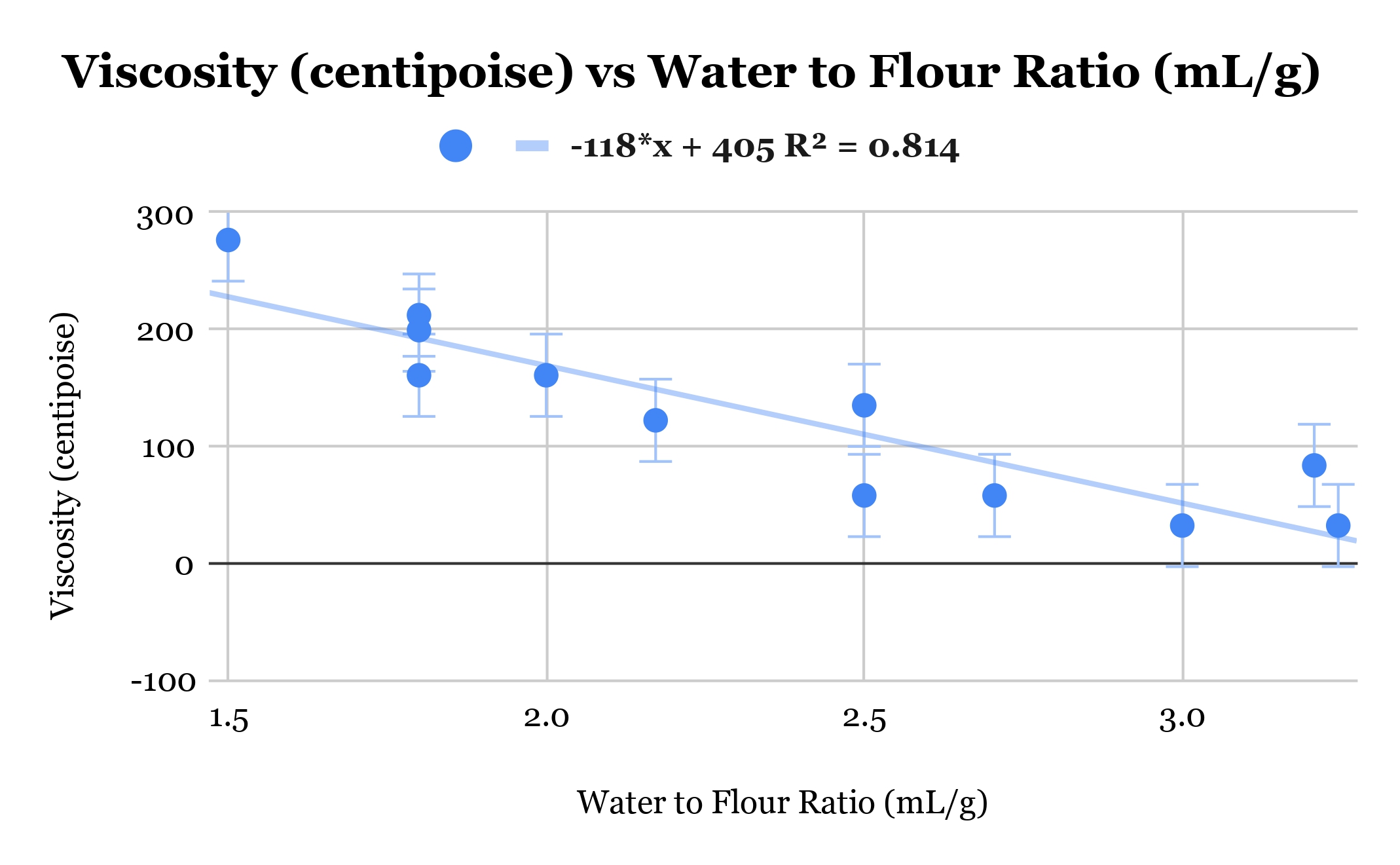
Figure 1 displays the water-to-flour ratio corresponding to the viscosity value measured by the Zahn cup. The ratio is calculated by dividing the volume of water in milliliters by the weight of flour in grams. With this regression, we see that as more water is added to the mixture, the viscosity decreases linearly. The R-squared value was determined to be 0.814. This value is statistically significant and indicates a strong, linear relation between the flour-to-water ratio and the viscosity. Because of the R-squared value, we are able to create a simple linear regression equation to predict the relationship between water-to-flour ratio and viscosity. The equation is determined to be  . In the equation,
  is the viscosity in centipoise,
  is the milliliters of water, and
  is the grams of flour. The
  would determine the water-to-flour ratio. Through this equation, we concluded that the ratio needed for a desired viscosity of 200 is 1.75 milliliters of water for every gram of flour.
Using the ratio found in the previous experiment, we replaced the water in the mixture with gardenia fruit extract prepared by boiling the fruits in water. Because the extract consisted primarily of water and appeared to exhibit a similar flow to water during mixing, the flour-to-water ratio was used as an approximation. However, because the viscosity of the extract was not measured separately, we cannot conclude that the extract and water had equal flow. Thus, applying the same ratio can be considered an approximation and a limitation.
To find the amount of gardenia fruit needed to create the brightest yellow paint, different ratios of gardenia fruit in water were tested. The data ranged from 1 gram of gardenia fruit to 10 millilitres of water to 1 gram per 80 millilitres of water. Figure 2 shows the swatches of each paint.
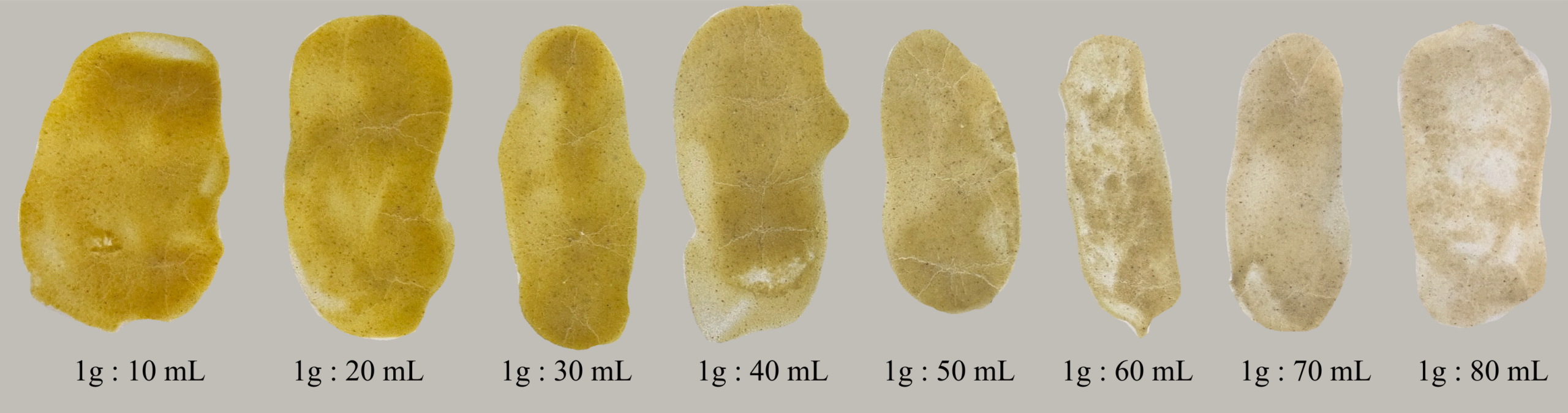
Using a colorimeter, the International Commission on Illumination (CIE) color space values (CIELAB) of each color were analyzed. The B value (the yellow-blue axis) of each color is shown in Figure 3. The results show that as more water is put into the extract compared to the gardenia fruit, the yellowness of the paint decreases linearly.
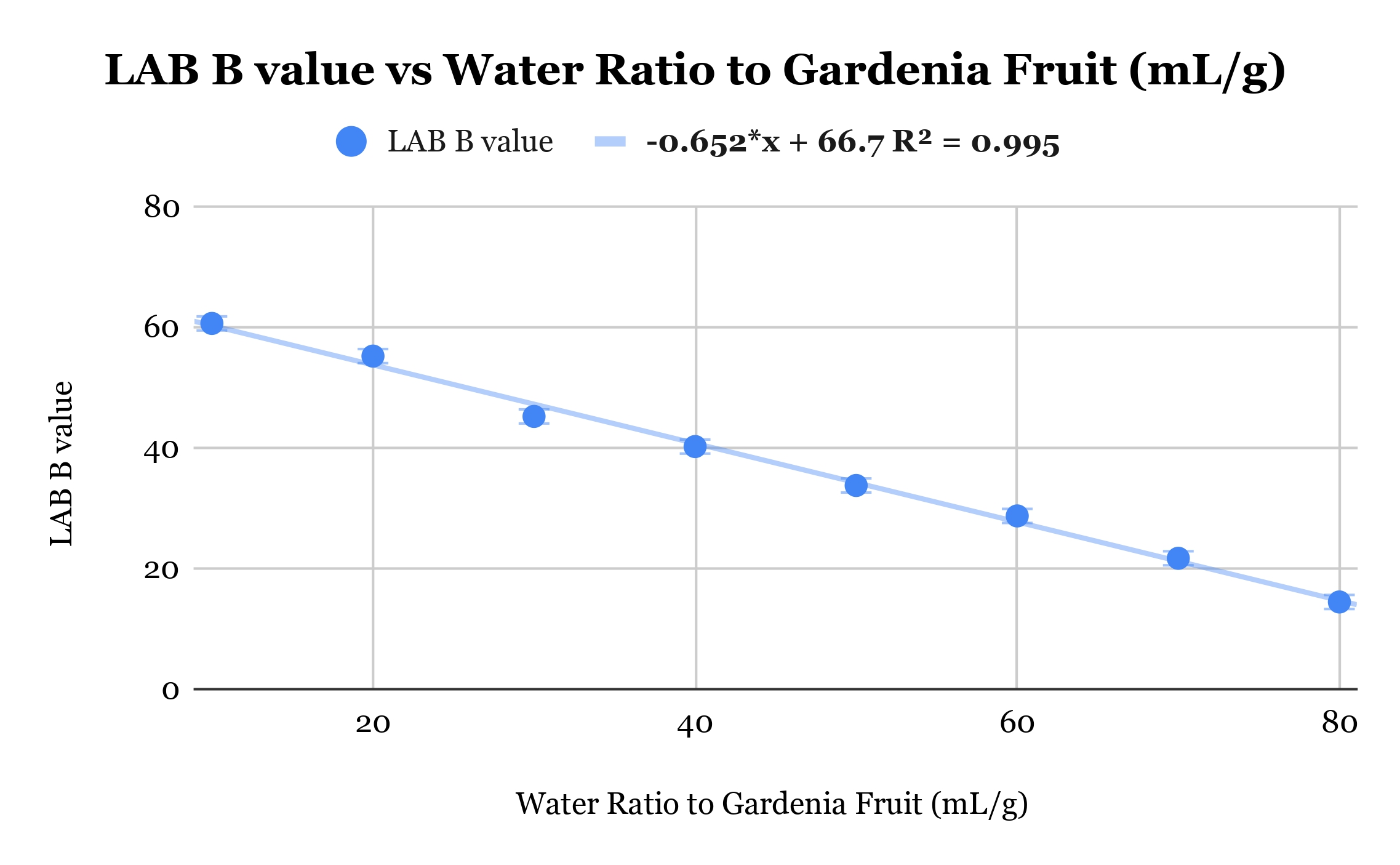
The B value of the store-bought yellow acrylic paint is 59.41, and the ratio of 10 milliliters of water for every gram of gardenia fruit exhibited the most similar corresponding B value. Combining the results of the flour-to-water ratio test and the gardenia fruit-to-water ratio test, this created the yellow paint with a suitable consistency and color for painting.
In order to discover the functionality of natural paint made from gardenia fruit extraction, we tested its abilities in the respective functions expected of paint: adhesion, drying time, cracking, smudging resistance, and water resistance. For these functions, we designed experiments to compare the capabilities of natural paint with those of store-bought acrylic paint to fully comprehend the extent of natural paint’s proficiency for common usage.
To understand natural paint’s ability to adhere to surfaces, we observed the natural and acrylic paints’ resistance to tape. The amount of paint removed by the tape was calculated, yielding the results that the natural paint had an average of 18% paint loss, while the acrylic paint had an average of 2.5% to 15% loss.
Natural paint’s drying ability was analyzed as we measured the transferability of both natural and acrylic paint throughout the time span of their drying process. Using a stopwatch or phone timer, after laying each paint on identical surfaces, a new spot on the painted area was touched at intervals of 10 minutes. The time when each paint no longer transferred on contact was recorded, where the natural paint took roughly 107-120 minutes to dry, while the acrylic paint took 3-5 minutes to dry.
For natural paints prone to cracking, we examined how natural and acrylic paints would perform when demonstrating their flexibility in a dried form. When observing the number and lengths of cracks formed by the dried paint around identical pencils, it was recorded that natural paint averaged crack lengths of 23-40 mm throughout 3 trials, while acrylic paint exhibited none.
The natural paint’s smudging resistance was identified after comparing the transferred areas of paint with those of acrylic paint. After the paper was applied and pressed down by a textbook on top of each paint for 10 seconds, the natural paint was found to transfer an area of an estimated 14-19 square inches, while acrylic paint transferred 4-8.5 square inches.
Gardenia fruit extracted natural paint’s water resistance was determined by comparison with acrylic paint. While natural paint exhibited some peeling and changes in brightness across three trials of applying water from a dropper for a fixed time of 10 minutes, acrylic paint only exhibited a slight color loss.
Discussion
Based on our experiment, we found a linear relationship between flour and water. The more water we added to the flour, the thinner, or less viscous, the mixture became, and vice versa. This may have occurred because of the way flour and water mix. Flour is primarily composed of starch, which can absorb fluids. When we mix flour with water, flour particles become hydrated as the contained starch can absorb the water and swell up. When there is a lack of water, flour particles, consisting of starch granules, interact more strongly, and gluten forms a sticky (viscoelastic) network23, making the mixture thick and hard to move, or highly viscous. When more water is added, the starch granules can distribute further, decreasing interactions between starch molecules, resulting in a thinner mixture. Flour particles form a dense network of starch and protein that resists movement in environments with less water, while sliding past one another more freely as more water is added. When heat is added, starch gelatinization may occur, where starch granules absorb water, leading to increased viscosity. Figure 1 shows this with a line of best fit. This allowed us to predict exactly how much water and flour we needed to achieve the typical thickness of acrylic paint, around 200 cp. This ratio is found to be 1.75:1 water to flour. The Zahn Cup #3 was selected for viscosity measurements because it is widely used in the coatings and paint industries to measure the flow of low-viscosity liquids. Its measurement range is appropriate for many fluid paint formulations, making it suitable for comparing the flow properties of the flour-based mixtures. Flour was selected as the binder because it contains starches and proteins that can absorb water and form viscous pastes. The target viscosity of approximately 200 centipoise was selected because it is in the lower range of viscosities for fluid paints, which range from approximately 100 to 3000 centipoise. Lower centipoise paints show smoother flow and easily spread with brushes, which makes them suitable for craft use.
To create a natural paint with a similar color to one sold in the market, we purchased a store-bought acrylic paint to compare and a colorimeter to measure the CIELAB values. We focused on the B value since it measures the yellowness of a color when the number is larger. The store-bought acrylic paint’s B value was 59.41. Out of all the trials, the mixture with a ratio of 10 mL of water to every gram of gardenia fruit had the closest B value to the paint sold in the market, as seen in Figure 3. The testing demonstrates that gardenia fruit pigment is able to mimic a color that is available in the market, indicating the possibility of creating non-toxic and natural paint using this pigment in the field.
Comparing the B value to current natural paint alternatives, we note that the gardenia fruit-based paint performs on par with its commercially available competitors. For instance, turmeric, a commonly used colorant, has been shown to have a B value in the range of ~30-46 when implemented in paints24; similarly, paints from saffron and safflower origins have demonstrated B values of 35-40 and 25-45, respectively25,26. In this manner, the gardenia fruit extract yields a higher color intensity and a B value closer to store-bought paints than other natural paint counterparts, indicating its effectiveness and feasibility as a natural paint colorant.
To ensure the viability of the gardenia paint compared to market paint, several experiments were conducted to test adhesion, drying time, cracking, smudge resistance, and water resistance. The results of these experiments demonstrated that while the gardenia mixture exhibited similar properties and functional qualities to store-bought acrylic paint, it is still generally less effective across all of the tested categories.
After testing and observing the adhesive properties of both natural and store-bought paints, it can be inferred that the natural paint adhered to surfaces at a lower rate than the acrylic paint. The findings from the experiment, indicating an 18% and a 2.5-15% loss for natural and store-bought paint, respectively, show that natural paint is easily weakened on surfaces compared to acrylic. From the drying properties examined through three iterations of the same experiment, natural paint is established to dry at a significantly longer amount of time than acrylic paint. Taking roughly 20 to 40 times as long as acrylic paint to dry, natural paint may not be considered to have the same capabilities as commercially used paint. The tendencies of cracks appearing in both paints are examined to be very different, as although natural paint had varying lengths of cracking, acrylic paint experienced none. The appearance of cracking in the natural paint, therefore, suggests that its paint formula may require additional changes in order to form a cohesive layer on different surfaces. Smudge resistance is equally tested, with the paints’ transferability observed over identical trials. From these tests, natural paint was observed to transfer at a significantly greater rate compared to acrylic paint. This indicates that acrylic paint creates a protected layer of pigment more quickly than natural paint. Tests on the resistance of water gave a wide range of effects for the natural paint, contrary to acrylic paint, which received a consistent outcome. These variations may indicate that natural paint may have an inconsistent level of durability and a lower resistance to water.
Overall, the gardenia mixture showed less functionality than the store-bought paint in the areas tested, showing areas for improvement in the future. In addition, each category only had three test trials, so further testing would be needed to better assess the paint’s performance.
Using the results of our two experiments, we successfully created a paint with a suitable consistency, as shown in Figure 4. These findings suggest the possibility of utilizing gardenia fruit extract, flour, and water to create a non-toxic, natural paint with a commercially available texture and vibrancy. Our results demonstrate that safe alternatives to synthetic paints are possible. Gardenia fruit extract provides a non-toxic pigment that can help reduce reliance on paints containing volatile organic compounds (VOCs), which are harmful to both human health and the environment. Our main objective was to determine whether gardenia fruit pigment could serve as a promising option for creating natural paint, and this objective was met. The final mixture matched the target viscosity range of paints while maintaining a bright and stable color. To establish a control, the viscosity of pure water was considered. At room temperature, water has a viscosity of approximately 1 cP, which is significantly lower than all the tested mixtures and confirms that the viscosities we had observed came from the addition of flour. Additionally, while the water in the mixture was replaced with gardenia fruit extract for pigment incorporation, the viscosity of the extract without flour was also approximately 1 cP.
In this experiment, a limitation would be the use of Zahn cups. The Zahn cups are designed for low- to medium-viscosity Newtonian fluids. Since flour mixtures are non-Newtonian, they may not consistently behave according to the assumptions of the Zahn cup method. The resulting viscosity values may not represent the true non-Newtonian behavior of the mixtures. A look at gardenia pigment shows that its color shift over months remains unknown. Oxidation might alter natural dyes, just like sunlight or tiny organisms breaking them down, and light, open air, and surroundings could weaken the paint’s strength over time. Tests tracking slow changes would help see how well hues hold up when left exposed, and long-term checks are missing but needed to truly measure lasting power. An unexpected result was that the natural paint’s viscosity increases with time, likely caused by the evaporation of the water at room temperature. Thus, while this mixture works initially, there may need to be some changes to store the mixture over a longer period of time. Another potential drawback of using natural flour-based paints, as well as being affected by microbial growth (such as mold), is their organic composition and high water content. This is another limit to the possibility of using these types of natural paints, as microbial contamination can impact the safety and longevity of the paint. Other areas of study would include using additional natural pigments or evaluating the paint’s durability and colors after exposure to light and air. Areas of future study may include evaluating the use of natural preservatives or alternative formulations to inhibit microbial growth and increase the shelf life of the paint. One of the next steps we could take is to identify an alternative to water that is nontoxic. Since water evaporates at room temperature, the natural paint will eventually become thicker and more viscous than the original intended viscosity. An alternative, ethylene glycol, which will hold water, thus decreasing evaporation of water, could prevent this issue. These drawbacks could be researched further in future experiments. Moreover, this study implemented flour as the sole tested natural binder. Investigations could be conducted and tested for other natural binders, such as starch paste and gum arabic, with viscosity and stability results analyzed and compared to our current flour benchmark. Therefore, while our study concludes that gardenia paint can produce a possible natural paint, it lacks a comparison with other formulations, and future research is needed to determine the gardenia fruit-based paint system with optimal performance. As the paint industry continues shifting toward sustainability, similar studies can pave the way for safer, eco-friendly products.
References
- Kubasek, L., & Rossiter, L. M. (2026). Chemistry of paint: Interdisciplinary lessons and experiments for undergraduate and high school students. Journal of Chemical Education, 103(4), 1847–1853. [↩]
- Siddall, Ruth. “Mineral Pigments in Archaeology: Their Analysis and the Range of Available Materials.” Minerals, vol. 8, no. 5, May 2018, p. 201. [↩]
- Aceto, Maurizio. “Pigments—the Palette of Organic Colourants in Wall Paintings.” Archaeological and Anthropological Sciences, vol. 13, no. 10, Sept. 2021. [↩]
- Barnett, J. R., et al. “Colour and Art: A Brief History of Pigments.” Optics & Laser Technology, vol. 38, no. 4-6, June 2006, pp. 445–53. [↩]
- Becker, Hilary. “Pigment Nomenclature in the Ancient near East, Greece, and Rome.” Archaeological and Anthropological Sciences, vol. 14, no. 1, Dec. 2021. [↩]
- Habashi, F. (2016). Pigments through the ages. Interceram – International Ceramic Review, 65, 156–165. [↩]
- Ghobakhloo, S., Khoshakhlagh, A. H., Morais, S., & Mazaheri Tehrani, A. (2023). Exposure to Volatile Organic Compounds in Paint Production Plants: Levels and Potential Human Health Risks. Toxics, 11(2), 111. [↩]
- Alford, Kyle L., and Naresh Kumar. “Pulmonary Health Effects of Indoor Volatile Organic Compounds—a Meta-Analysis.” International Journal of Environmental Research and Public Health, vol. 18, no. 4, 7 Feb. 2021, p. 1578. [↩]
- Nowińska, Katarzyna, and Magdalena Kokowska-Pawłowska. “Mineralogy of Zinc and Lead Metallurgical Slags in Terms of Their Impact on the Environment: A Review.” Minerals, vol. 14, no. 9, Aug. 2024, p. 852. [↩]
- Schieweck, A., & Bock, M.-C. (2015). Emissions from low-VOC and zero-VOC paints – Valuable alternatives to conventional formulations also for use in sensitive environments? Building and Environment, 85, 243–252. [↩]
- Kralikova, Ruzena, et al. “Environmental and Health Impact of Paint Products.” DAAAM Proceedings, 2020, pp. 0035–43. [↩]
- Chen, Liping, et al. “Gardenia Jasminoides Ellis: Ethnopharmacology, Phytochemistry, and Pharmacological and Industrial Applications of an Important Traditional Chinese Medicine.” Journal of Ethnopharmacology, vol. 257, July 2020, p. 112829. [↩]
- Zhang, Nan, et al. “Essential Oils of Gardenia Jasminoides J. Ellis and Gardenia Jasminoides F. Longicarpa Z.W. Xie & M. Okada Flowers: Chemical Characterization and Assessment of Anti-Inflammatory Effects in Alveolar Macrophage.” Pharmaceutics, vol. 14, no. 5, Apr. 2022, p. 966. [↩]
- Yin, Fei, and Jian Liu. “Research and Application Progress of Gardenia Jasminoides.” Chinese Herbal Medicines, vol. 10, no. 4, Oct. 2018, pp. 362–70. [↩]
- Gómez-Gómez, L., Morote, L., Fajardo, C. M., Rubio-Moraga, Á., Frusciante, S., Diretto, G., & Ahrazem, O. (2023). Engineering the production of crocins and picrocrocin in heterologous plant systems. Industrial Crops and Products, 194, 116283. [↩]
- Lv, S., Ding, Y., Zhao, H., Liu, S., Zhang, J., & Wang, J. (2018). Therapeutic Potential and Effective Components of the Chinese Herb Gardeniae Fructus in the Treatment of Senile Disease. Aging and Disease, 9(6), 1153–1164. [↩]
- Yin, S., Niu, L., Zhang, J., & Liu, Y. (2024). Gardenia yellow pigment: Extraction methods, biological activities, current trends, and future prospects. Food Research International, 179, 113981. [↩]
- Sparks, T., Chase, G. G., & Sutherland, K. (2016). Filters and filtration handbook (6th ed.). Elsevier. [↩]
- Hutten, I. M. (2007). Handbook of Nonwoven Filter Media. Elsevier. [↩]
- Awuchi, C., Igwe, V., & Echeta, C. (2019). The functional properties of foods and flours. International Journal of Advanced Academic Research, 5, 139–160. [↩]
- Cannon Instrument Company. (2023). CANNON flow cup standards viscometer equations. [↩]
- Flores, I. (2025, October 25). Measuring paint viscosity: A step-by-step guide for accurate results. CyPaint. https://cypaint.com/article/how-to-find-the-viscosity-of-paint. [↩]
- Fanari, F., Keller, J., Desogus, F., Grosso, M., & Wilhelm, M. (2021). Impact of water and flour components in dough investigated through low-field nuclear magnetic resonance. Chemical Engineering Transactions, 87, 289–294. [↩]
- Lourenço, A., Gominho, J., & Pereira, H. (2019). Chemical characterization of lignocellulosic materials by analytical pyrolysis. In V. K. Thakur & M. K. Thakur (Eds.), Lignocellulosic biomass to liquid biofuels. IntechOpen. [↩]
- Naidis, P., Lykidou, S., Mischopoulou, M., Vouvoudi, E., & Nikolaidis, N. F. (2023). Study of the dyeing properties of saffron and ultrafiltrated saffron powders, as colourants for natural and synthetic fibres. Coloration Technology, 139(5), 565–577. [↩]
- Li, S., Wang, Y., Zhang, J., Liu, Y., & Niu, L. (2023). Extraction, purification, characterization, and applications of gardenia yellow pigment: A review. Agronomy, 13(4), 956. [↩]