
Abstract
Background/Objective. Attention-deficit/hyperactivity disorder (ADHD) is characterized by various cognitive vulnerabilities but can also induce creativity and expression. Prior work on the relationship between ADHD and music has solely been focused on children or passive listening in small sample sizes. Therefore, this study will investigate how ADHD affects musical behavior, preference, and well-being within a large and demographically matched dataset of musicians.
Methods. 1,298 self-reported ADHD musicians were drawn from the Sound Mind Databank and were matched demographically on age, sex, and years of musical training to non-ADHD musicians in a 1:1 ratio. T-tests on musical engagement and preference variables and bootstrap mediation analysis for pathways from personality to well-being through music as a mediator were conducted on the matched group of musicians.
Results. The ADHD group displayed small but consistent differences (d = 0.11-0.29) such as more consumption of background music, higher preference for improvisation and high-arousal style music, and lower preference for playing with other musicians. Mediation analysis showed that 96% of extraversion’s association with well-being was statistically mediated by making music with others (collaborative), though the direct association between extraversion and well-being was non-significant.
Conclusions. Overall, ADHD musicians displayed a pattern of higher preference for improvisational and high-arousal styles but lower preference for structured and collaborative contexts. However, it is essential to note that the fit between musical context and an individual’s personality was also associated with well-being rather than music involvement alone. Therefore, providing the correct fit in approaches to ADHD music education or therapy is key.
Keywords: ADHD, Musicianship, Personality, Well-being, Neurodivergence, Emotion Regulation
Introduction
Attention-deficit/hyperactivity disorder (ADHD) affects 5-7% of children worldwide, though the effect of ADHD on music (as well as music’s effect on it) has remained relatively underexplored1. ADHD itself is often viewed overall as a deficit: struggles with attention, memory, focus, and hyperactivity all represent potential challenges to be overcome2. However, these traits may also cultivate creativity, resilience, and spontaneity in contexts that encourage divergent thinking and high energy3. Music is a valuable medium to study ADHD for it provides both structure and discipline but also improvisation and creativity in its extremely diverse styles.
According to Nordby et al.3, adults with ADHD describe creativity, spontaneity, and resilience as separate strengths instead of mere compensation for the possible loss of attention or focus. The extent to which these characteristics extend to musical practice, though, remains largely unexplored. This study seeks to explore the relationship between ADHD and musicianship, seeking to move beyond a conceptual framework based solely on a “deficit” perspective and explore how neurodiversity can impact artistic practice. By not only seeing ADHD as a limitation, but rather seeking to discover its potential, we hope to gain a deeper and more nuanced understanding of how ADHD shapes (and is shaped by) the world of music.
Previous research on music and ADHD
Previous research conducted on the relationship of music and ADHD has yielded overall mixed results on music’s effect on cognition, behavior, and emotion. Early studies found that children with ADHD showed improved arithmetic performance4 and reduced motor activity5 when listening to music instead of silence or speech. A more recent study, Madjar et al.6, found that calm music improved better reading comprehension in preadolescents with ADHD. Pelham et al.7 noted that music impact varies by genre, and Dong et al.8 found that background pop music affected reading comprehension in a non-ADHD sample, suggesting that music can also serve as a distraction under high cognitive load. These studies suggest overall that outcomes depend heavily on the actual task and the characteristics of the music.
Other studies have shown that music can also support emotional and motor regulation. For instance, listening to Mozart improved mood in adults with ADHD9, and both music and white noise enhanced balance in children with ADHD10. ADHD individuals reported listening to background music more during routine or demanding tasks and also preferred stimulating or high-arousal music types11,12. In addition to these findings, a computational analysis of a large online ADHD community indicated that music is used strategically as a potential tool for cognitive and emotional self-regulation12. This analysis also showed that instrumentalness stood out as the most significant auditory characteristic distinguishing music’s use for enhancing attention12.
Certain music therapy and intervention studies have reported additional findings. For example, structured programs have been shown to induce psychological and neurophysiological improvements by reducing stress and modulating serotonin13. Smaller intervention studies have shown similar improvements in quality of life, attention, and EEG markers, though sample sizes were typically uncontrolled and small14,15.
Several studies have also examined music production and processing. Carrer16 found that children with ADHD could estimate short time intervals less accurately, while Groß et al.17 found that adolescents with ADHD scored significantly lower on improvisational pitch and rhythm tests compared to controls. A recent systematic review also concluded that individuals with ADHD have more difficulty performing musical tasks, including perceiving time, rhythm, and complex auditory stimuli18. A follow-up study by Groß et al.19 showed challenges in understanding complex music processing in adults with ADHD, suggesting the need for training in cognitive and metacognitive skills. It is evident that the evidence for the power of music on ADHD is conflicting, and claims of an improvisational advantage are not currently supported by outcome-based measures.
Key limitations do exist across these studies, such as small samples, cultural variation, and a focus on children and passive listening. There are few studies that study socially embedded patterns of musical engagement or personality fit. This study, therefore, will address these gaps by analyzing a large and demographically matched sample of ADHD and control musicians ages 13-65, and aim for preference-driven and interactive forms of music use.
Towards a model of ADHD musicianship
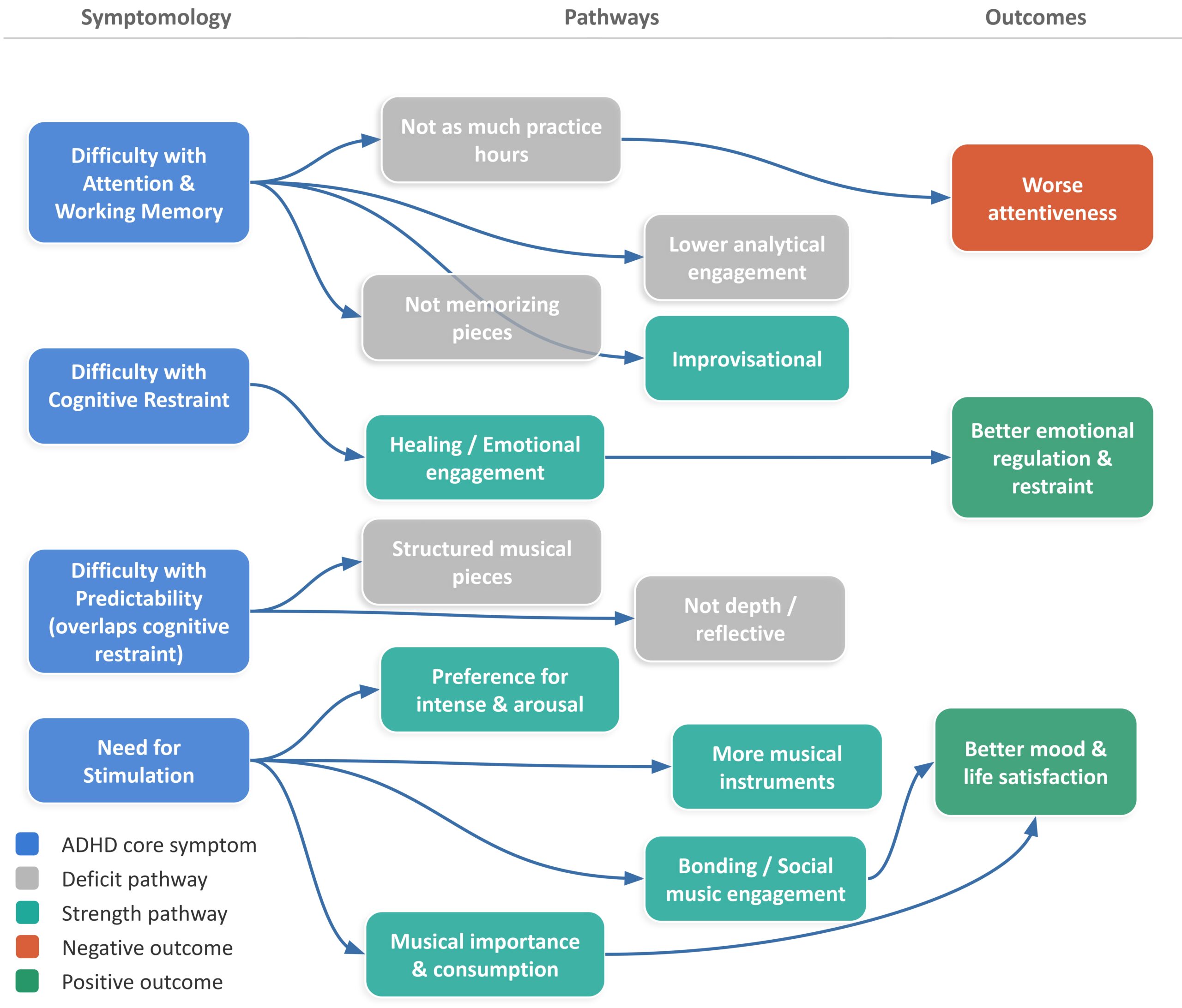
This model proposes that ADHD interacts with music by linking core aspects or challenges of ADHD to distinct musical behaviors and emotional or well-being-related outcomes. Systematic musical activities require significant effort, involving sustained attention, memory, cognitive control, and the patience to anticipate outcomes. If these abilities are impaired, learning and memorizing specific songs becomes more difficult, the frequency or efficiency of practice declines, and maintaining coordination within a musical group can also prove challenging18,20. However, ADHD has also been theorized to involve stimulation-seeking21,22 and high-arousal styles like improvisation or playing multiple instruments. This broader engagement can lead to greater music consumption overall, which then in turn may feed into better emotional regulation and better mood and life satisfaction, ultimately feeding into better well-being. Therefore, the two pathways combine to form a dual pathway. Cognitive vulnerabilities like memory, restraint, and stimulation can impede structured or fixed performance, but on the other hand, stimulation-driven or more free styles of music can serve as compensation to support well-being (Figure 1).
Study overview
The main focus of this study is to investigate how ADHD traits influence musical behavior, preferences, usage, and well-being outcomes. We compared ADHD and non-ADHD musicians from a large international dataset (Sound Mind Databank) on variables like preference, improvisation, engagement, and well-being related to music. Our approach combines survey-based indicators of musical engagement (e.g., preferences, improvisation, duration of practice) with indicators of the emotional use of music (e.g., therapeutic benefits, strengthening of social bonds), while controlling for confounding variables such as age, sex, musical training, and extraversion. Drawing on previous research and our cognitive-behavioral model, we formulate and test three key hypotheses:
Hypothesis 1: ADHD musicians show reduced preference for structured, memory-based, or collaborative musical settings.
Due to common drawbacks like difficulty with attention and working memory in ADHD musicians, we predict they will report lower preference for structured or attention-intense musical contexts. For example, playing with other musicians, memorizing pieces, arranging, or performing in formal concert settings.
Hypothesis 2: ADHD musicians report stronger preference for emotionally intense, high-arousal, and improvisational music.
We hypothesize that ADHD musicians show stronger preferences for energetic, rebellious, and emotionally intense styles due to their heightened need for stimulation and lower tolerance for predictability and restraint. They likely will often engage in improvisational and movement-based performance forms that allow spontaneity.
Hypothesis 3: Music plays a compensatory and regulatory function in the daily lives of ADHD musicians.
Music can be used for emotional and attentional self-regulation, so ADHD musicians are expected to incorporate music more frequently into daily activities, such as studying, completing repetitive tasks, or managing their mood. We will further explore if different personality types will influence well-being directly, and whether different forms of musical engagement are associated with different well-being outcomes depending on these traits.
Methods
Participants and Procedure
Data from the Sound Mind Databank were used for this study (N = 116,555). Participants over the age of 65 were excluded to minimize the influence of confounding factors associated with age-related hearing loss; participants under the age of 13 were excluded due to the lack of parental consent. To restrict the study population to musicians, we selected participants who had experience playing a musical instrument (including voice) and had received at least one year of formal musical training. This resulted in a final sample size of 35,476 musicians from an original 116,555.
Participants were assigned to two groups: adolescence (13–17 years; n = 1,599) or adulthood (18–65 years; n = 33,877). ADHD status was determined using self-report questions regarding diagnoses from the Mental Health Status Questionnaire. Propensity score matching was used to match musicians with ADHD to musicians without ADHD based on sex, age, and duration of musical training. The final matched sample consisted of 1,298 musicians with ADHD and 1,298 musicians without ADHD, aged 13 to 65 years. Although age was included as a matching variable, it was not examined as an effect modifier in the primary analyses (i.e., group comparisons or mediation analyses). As participation in the various modules of the Sound Mind Databank questionnaire was voluntary, missing answers to certain questions varied across the individual measures; consequently, the sample size for the analysis ranged from approximately 502 to 1,298, depending on the specific variables included.
Measures
Demographics. Age, sex (1 = male, 2 = female), and years of musical training were collected for all participants.
ADHD Diagnosis. ADHD status was determined through a single question: “Have you been diagnosed with ADHD?” (1=yes, 2=no). Participants that did not self-report an ADHD diagnosis served as the comparison group. It should be noted that an absence of a self-reported diagnosis does not necessarily establish the actual absence of ADHD or of other neurodevelopmental or psychiatric conditions, since the question is not based on clinical screening.
Personality Traits. Big Five personality dimensions were assessed using the Ten-Item Personality Inventory (TIPI23: extraversion (α = .68), openness to experience (α = .45), conscientiousness (α = .50), agreeableness (α = .40), and neuroticism (α = .73). All questions were conducted using a 7-point Likert scale (1 = strongly disagree, 7 = strongly agree).
Musical Engagement. Three key musical engagement measures were included: (a) musical importance (“How important is music in your life?” rated 1–7), (b) musical consumption total (sum of background and primary music consumption, range 0–20), and (c) number of instruments played (count of different instruments). Five domains of the Emotional Music Involvement (EMI) scale (analyzing, healing, dancing, storytelling, and bonding) were also administered on 7-point Likert scales. An analysis of the different subdomains of the Evaluation of Music Practice Situations falls outside the scope of this study and will be the subject of future research; therefore, this paper does not report psychometric properties at the subscale level. Eight aspects of musical performance context were assessed: performing with other musicians, performing alone, composing, arranging, performing from memory, improvising, performing in large concert halls, and performing in small basement clubs. Each item was rated using a 7-point Likert scale.
Musical Performance Preferences. Seven musical performance style variables were measured: arousal, valence, depth, upbeat conventional, energetic rhythmic, intense rebellious, and reflective complex24. Items were rated on 7-point Likert scales.
Well-being. Life satisfaction was measured using the Satisfaction with Life Scale (SWLS25; α = .87). The 5-item scale was rated on a 7-point Likert scale (1 = strongly disagree, 7 = strongly agree), with higher scores indicating greater life satisfaction.
Statistical Plan
Data Preparation and Matching. Case-control matching was performed using propensity score matching, a procedure that pairs each participant with ADHD to a non-ADHD participant with a similar profile on selected background variables, so that group differences cannot be attributed to those variables. Matching was performed on sex, age, and musical training to ensure balanced groups. Matching quality was verified through t-tests and chi-square tests comparing groups on matching variables.
Missing data. Because the Sound Mind Databank was completed on a voluntary, modular basis, item-level missingness was substantial and non-systematic across questionnaire sections. No imputation was performed. All analyses used pairwise complete cases — that is, each test was conducted on the subset of participants who completed the variables required for that specific analysis — so effective sample sizes varied across analyses as reported throughout the Results.
Group Comparisons. Independent samples t-tests were conducted to compare ADHD and control groups on all outcome variables. Effect sizes were calculated using Cohen’s d, with 95% confidence intervals.
Mediation Analysis. Bootstrap mediation analysis was conducted to examine indirect effects of personality traits on well-being through musical engagement variables. Bootstrapping repeatedly resamples the dataset (here, 1,000 times) to build an empirical distribution of the indirect effect, which allows a confidence interval to be estimated without assuming that the effect is normally distributed. The PROCESS macro26 was used to estimate direct and indirect effects with 95% confidence intervals.
Effect Size Interpretation. Cohen’s d effect sizes were interpreted as: small (0.20), medium (0.50), and large (0.80)27. For mediation analyses, unstandardized regression coefficients (b) were reported.
Statistical Software. All analyses were conducted using R (version 4.5.1) with packages: readr, dplyr, ggplot2, and PROCESS.
Ethical Considerations. This study involved secondary analysis of de-identified data from the Sound Mind Databank. Original data collection was conducted with informed consent from adult participants and with parental consent and adolescent assent for participants under 18. All data were fully anonymized prior to analysis, and no individually identifiable information was accessible to the research team. Because the present study used only pre-existing, fully de-identified data, it qualified for exempt status from additional ethical review.
Results
Sanity check
We conducted a group analysis comparing the ADHD and non-ADHD groups on the variables they were matched on: sex, age, and musical training. T-tests confirmed that there were no significant differences between the groups on sex (p = 1.000), age (p = 0.997), and musical training (p = 1.000). This showed us that we could proceed with analysis.
Musical engagement
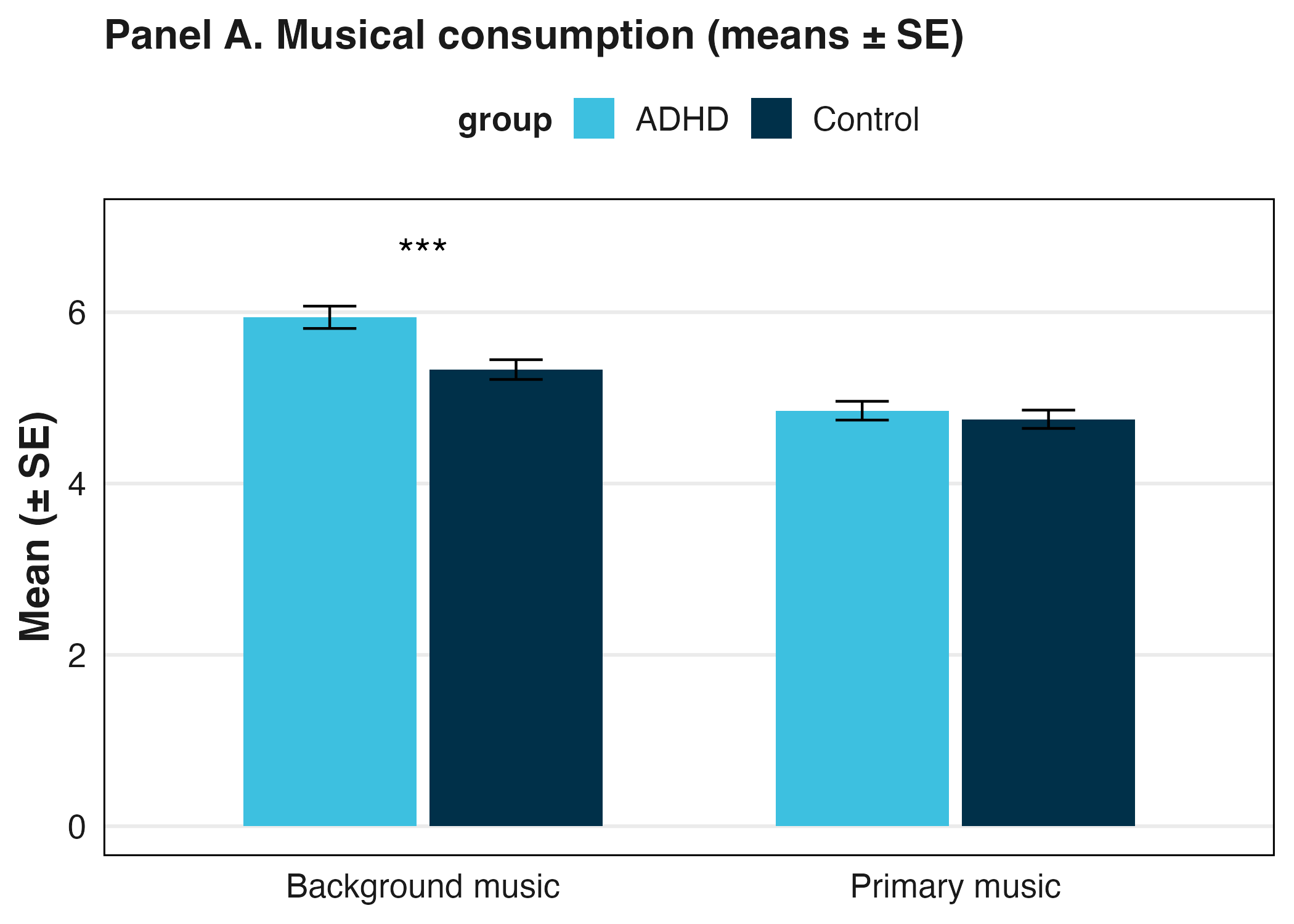
In phase 1 of the analysis, we compared differences between ADHD and non-ADHD groups on musical engagement variables, including importance, consumption, and engagement styles. A significant difference was found in background music consumption between ADHD cases and controls, t(2594) = 3.51, p < .001. ADHD cases reported higher background music consumption (M = 5.94, SD = 4.69) than controls (M = 5.33, SD = 4.15), representing a small effect size (Cohen’s d = 0.14; mean difference = 0.61, 95% CI [0.27, 0.95]) (Figure 2).
Musical Preferences
A series of independent-samples t-tests was conducted to examine group differences in musical performance preferences, performance-style ratings, and emotional attributes, using ADHD diagnosis as the independent variable. Complete data were available for n = 785 ADHD and n = 792 control participants on the eight performance-context items and four performance-style items, and for n = 502 ADHD and n = 564 control participants on the three emotional-attribute ratings (arousal, valence, depth). To ensure the same balance in-between the two groups after exclusion of missing items, ADHD and control groups were re-compared on the matching variables, and there were no significant differences (sex: p = .540/.259; age: p = .580/.600; musical training: p = .660/.634).
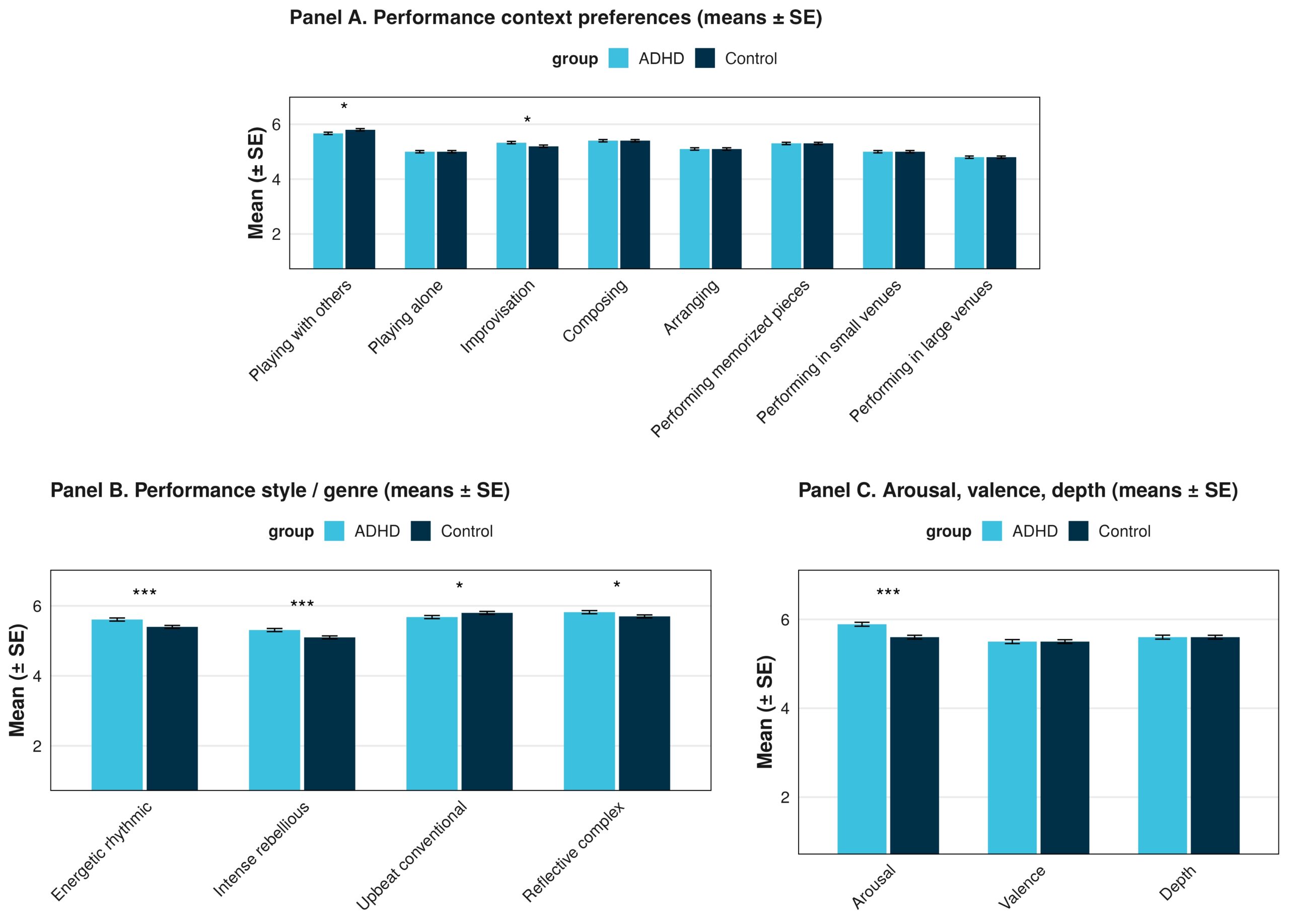
In total, there were seven significant differences between ADHD and non-ADHD groups (Figure 3). In the category of performance-context preferences, ADHD participants reported lower preference for playing with other musicians (d = −0.11, p = .025) and higher preference for musical improvisation (d = 0.11, p = .037), but with no differences on composing, arranging, performing memorized pieces, playing alone, or performing in large or small venues (all p > .09, |d| < 0.05). For performance style (Panel B), ADHD participants preferred more energetic rhythmic (t(1575) = 4.21, p < .001, d = 0.21, 95% CI [0.11, 0.31]), intense rebellious (t(1575) = 4.18, p < .001, d = 0.21, 95% CI [0.11, 0.31]), and reflective complex performance (t(1575) = 2.47, p = .014, d = 0.12, 95% CI [0.02, 0.22]), and lower on upbeat conventional performance (t(1575) = −2.41, p = .016, d = −0.12, 95% CI [−0.22, −0.02]). For emotional attributes (Panel C), ADHD participants reported higher arousal (t(1064) = 4.71, p < .001, d = 0.29, 95% CI [0.17, 0.41]), with no difference on valence (p = .213) and depth (p = .161). All effect sizes were generally small by conventional standards (|d| = 0.11 to 0.29), with the largest observed for arousal and energetic rhythmic performance. With 1,577 participants providing complete data on the context and style items, the study should be able to detect small-to-medium effects, though only small effects emerged.
Mediation
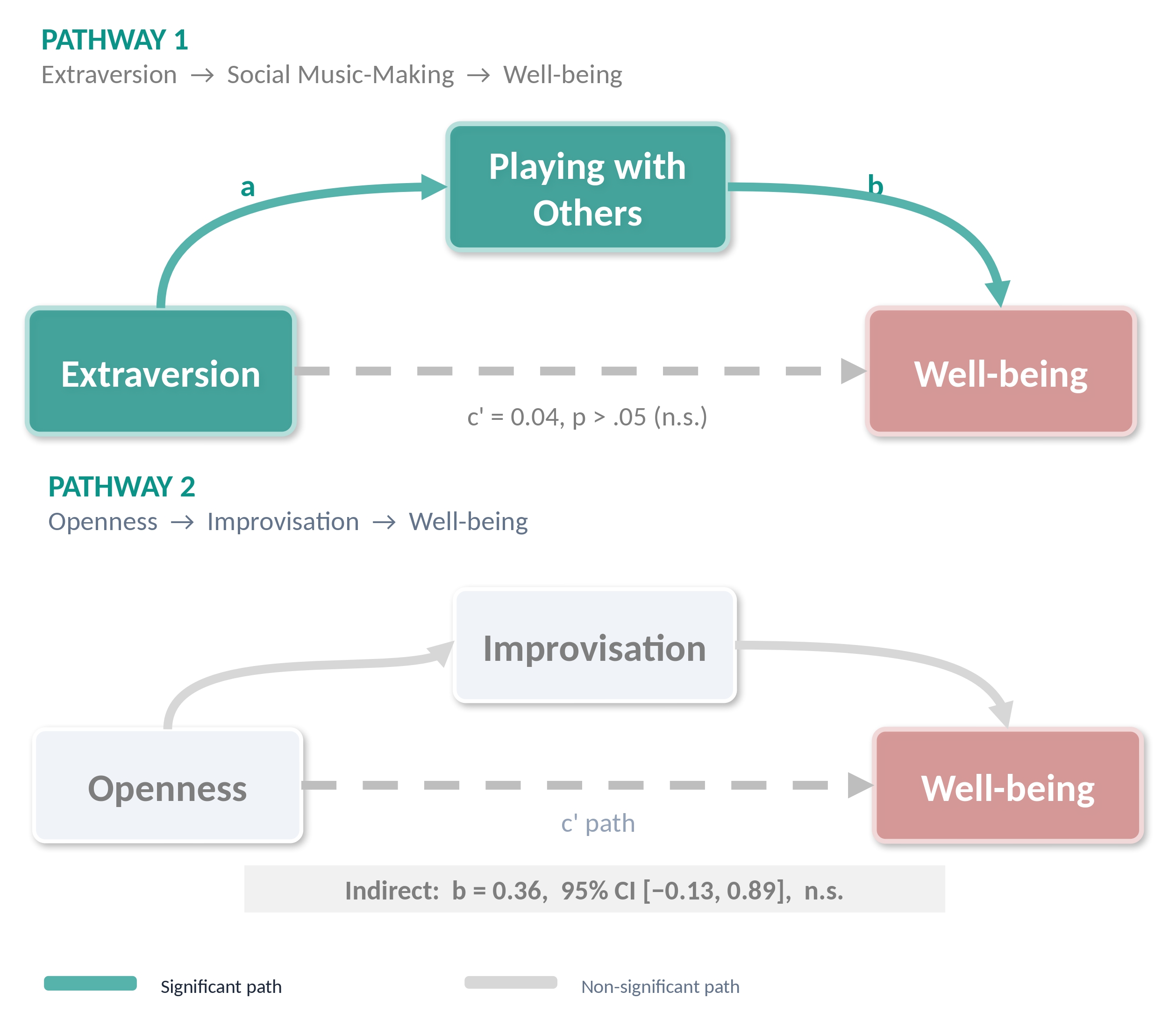
The mediation analysis revealed a significant indirect effect of personality traits on well-being through musical engagement pathways in ADHD musicians (n = 787). A bootstrap mediation analysis with 1,000 simulations indicated that extraversion’s association with well-being was almost entirely mediated through playing music with others (b = 1.01, 95% CI [0.72, 1.29], p < .001), accounting for 96.3% of the total effect (Figure 4). The direct association between extraversion and well-being was non-significant (b = 0.04, p > .05). Therefore the extraversion-to-well-being effect was statistically accounted for by playing music with others rather than simply extraversion alone. In contrast, the mediation pathway from openness to well-being through musical improvisation was not statistically significant (b = 0.36, 95% CI [−0.13, 0.89], p = .166), despite accounting for 90.6% of the total effect. These findings suggest that social musical engagement may play an important role in the relationship between personality traits and well-being, with collaborative music-making showing a stronger association with well-being than individual musical activities. Since this is a cross-sectional study, observations above can only determine association and cannot determine any real effect nor the direction of said effect.
We specifically tested these two pathways because they were the most theoretically direct connections between Big Five traits and our musical engagement model’s central social and exploratory dimensions. We did not estimate every possible combination of Big Five × engagement combinations in order to limit multiple-testing burden. However, other pathways like neuroticism × background music consumption or conscientiousness × structured performance are also plausible and should be tested as predefined hypotheses in future research.
Discussion
Overview of key findings
Our study aimed to discover effects of ADHD on musical behavior and engagement, and noticeable differences were found between the two groups, particularly in musical preferences, engagement patterns, and musical attributes. Using large-scale self-reported data, we found that ADHD musicians had a higher preference for improvisation and emotionally intense, high-arousal musical styles, but a lower preference for playing with others. These patterns suggest the use of music as an emotional stimulation or regulation device, and not just a creative outlet. Our results suggest that characteristics associated with ADHD can correspond to both challenges and preferences for particular musical contexts.
Hypothesis 1: ADHD musicians show reduced preference for structured, memory-based, or collaborative musical settings.
This hypothesis was partially supported. ADHD musicians scored significantly lower on the preference for playing with other musicians, which is consistent with the prediction of reduced preference for collaborative musical settings. On the other hand, differences on other performance contexts, including composing, arranging, performing memorized pieces, playing alone, or performing in large or small venues, were not significant. Therefore, the prediction that ADHD musicians would show reduced preference for structured or memory-based settings was not directly supported by the current data. Reduced preferences for collaborative musical contexts might be due to the required additional attentional demand of coordinating with other performers, though this mechanism was not directly measured.
Hypothesis 2: ADHD musicians report stronger preference for emotionally intense, high-arousal, and improvisational music.
This hypothesis was largely supported. ADHD musicians scored significantly higher on preference for musical improvisation as a performance context and scored significantly higher on preference for four of the performance style/attribute measures: energetic rhythmic (d = 0.21), intense rebellious (d = 0.21), reflective complex (d = 0.12), and musical performance arousal (d = 0.29). ADHD musicians scored significantly lower on preference for upbeat conventional performance (d = -0.12). Musical performance arousal had the largest difference observed, though it was still small in absolute terms. Overall, these differences support the predicted preference for emotionally intense, high arousal, and improvisational music styles.
Because this study measured only self-reported preferences instead of objective skill, performance, or accuracy, we cannot equate these differences in preference to differences in ability. For instance, Groß et al.17 found that adolescents with ADHD scored lower than controls on rated improvisation performance. Our finding that ADHD musicians have a higher preference for improvisation is not in direct contradiction to that result, since preference and rated ability are distinct constructs; the relationship between them in ADHD musicians remains to be studied.
This preference pattern is consistent with numerous prior theories. For instance, individuals with ADHD may seek out external stimuli to reach optimal arousal levels, possibly from a lower dopaminergic baseline22. Dopamine was not a measure in the dataset of this study, so this is only a possibility. Other theories of arousal regulation, like optimal stimulation theory and the moderate brain arousal model21,22, also propose that ADHD-related behavior such as frequent attention switching may be a cause of attempts to self-generate sensory input under low stimulation conditions.
Hypothesis 3: Music plays a compensatory and regulatory function in the daily lives of ADHD musicians.
This hypothesis was partially supported. Background music consumption was significantly higher in the ADHD group, meaning a greater integration of music into daily life, with music playing a compensatory or regulatory role. The mediation analysis showed that the association between extraversion and well-being was almost entirely mediated by playing music with others, which is consistent with a possible social regulatory role of music in the ADHD population. Direct group comparisons of the EMI subdomains were not analyzed in this study but are in the scope for future investigation.
Prior research shows that children with ADHD who listen to background music demonstrate better cognitive performance14; given the age range of this study’s sample (ages 13-65), background music may therefore continue to serve a self-regulatory function beyond childhood. However, this interpretation remains speculative due to the benefits not directly being measured and the cross-sectional nature of this study.
Our mediation analysis adds nuance to these group differences by showing that the relationship between personality and well-being in ADHD musicians varies with musical context. Extraversion’s association with well-being was almost entirely statistically accounted for by the indirect pathway through collaborative musical engagement instead of directly. Notably, this relationship emerged despite ADHD musicians reporting a lower overall preference for playing with others, suggesting that collaborative engagement may be less preferred at the group level while still being particularly relevant to well-being among more extraverted individuals. Moreover, the openness–improvisation pathway was not significant, even though ADHD musicians reported a greater preference for improvisation.
These findings suggest that there may not be a universal “best” way to engage with music for individuals with ADHD: associations with well-being may vary with the fit between personality and the context of musical engagement. In particular, collaborative musical environments such as ensembles, jam sessions, or bands may be especially relevant to well-being among extraverted ADHD musicians.
Educational applications: personalized music engagement for children with ADHD
We hope these findings can add to growing research on tailoring learning environments for students with ADHD. While prior studies have shown that background music can support cognitive performance14, our results suggest that the type of musical engagement and its fit with individual personality traits may also be important. In particular, the association between extraversion, collaborative musical engagement, and well-being suggests that group-based formats such as ensemble work or jam sessions may be especially relevant for some students with ADHD. These findings show that music can be a customizable context instead of a generic stimulus. More specifically, music-based educational supports might consider a flexible, person-centered, and responsive approach to individual differences in personality and musical preferences, rather than relying on one-size-fits-all approaches.
Clinical applications: adaptive music therapy for ADHD
Previous research has shown that utilizing music in cognitive behavioral therapy can improve emotion regulation in individuals with ADHD28. Our study builds on this literature by identifying a specific association between musical engagement and well-being: the relationship between extraversion and well-being was almost entirely statistically accounted for by collaborative music-making. This finding suggests that personality and musical context may be relevant considerations when developing individualized music-based interventions. For example, future research could attempt to fit musical activities to both preference and personality traits and observe therapeutic outcomes. These findings point toward a possible direction for individualized therapeutic planning rather than a validated clinical protocol; controlled and longitudinal studies are needed before these correlational patterns can inform clinical practice.
Limitations and future directions
Even though our results may suggest some positive or distinctive patterns, other studies have found performance deficits; therefore, our findings should also be considered alongside previous research showing difficulties in musicians with ADHD. Performance-based studies have shown that ADHD patients have more difficulties with rhythmic and pitch improvisation17, complex music perception29, and interval timing16. A recent systematic review also found difficulties, mostly in timing and complex auditory processing18. Our results only reflect self-reported preference rather than objective or rated skill, and therefore cannot directly determine whether these preferences will translate into strengths in objective performance. A full picture requires studies that measure rated performance as well as preference in the same participants.
Our study itself has several limitations. First, we relied on self-reported measures, which may introduce subjective bias. ADHD status, importantly, was determined using a single yes-or-no item, rather than clinical interview or diagnosis. Therefore, the ADHD group may contain false positives, and the control group may contain false negatives, as well as participants with other disorders that are not ADHD. Future work should incorporate objective behavioral or physiological measures to form a spectrum of symptom severity instead of a simple yes-or-no question. Second, no information on ADHD medication status, dosage, or treatment history was available. Some diagnosed ADHD patients take medication that may affect attention, mood, regulation, or directly affect preferences, and medicated participants cannot be separated from non-medicated patients. Third, four of the Big Five subscales used in this study showed low internal reliability (openness α = .45; agreeableness α = .40; conscientiousness α = .50; extraversion α = .68), which is well the conventional 0.70 threshold. Findings involving these traits, most particularly the openness to improvisation mediation pathway, should take this into account. Fourth, the cross-sectional nature of the study causes all reported relationships to be simply correlational, and neither causation nor its direction can be established from this data; to do so will require longitudinal or experimental designs.
Fifth, because most of the responses in the dataset came from English-speaking participants, the results may not be generalizable to other or all cultural settings or contexts. Future research should investigate if these differences are generalizable across more diverse cultural contexts.
Sixth, because the dataset did not collect specific ADHD subtypes, we cannot examine whether inattentive, hyperactive-impulsive, or combined types of ADHD would show distinct results. Future work may examine how each ADHD subtype can affect preferences or engagement patterns.
Lastly, the Databank did not include measures of ethnicity, socioeconomic status, or educational attainment, so we cannot assess whether any observed patterns can be generalized across them.
Addressing all of the limitations above will help improve the clarity and robustness of the findings, as well as the potential utilization of the relationships and differences observed above.
Conclusion
Overall, ADHD musicians have been shown to have stronger preference for improvisation and emotionally intense, high-arousal styles, greater background music consumption, and lower preference for playing with other musicians compared to non-ADHD musicians. The relationship between personality and well-being also varied with musical context, particularly in the significant association between extraversion, collaborative music-making, and well-being.
By situating these findings within broader research on ADHD and music, this study contributes to a more nuanced understanding of ADHD musicianship that considers both challenges and distinctive patterns of engagement. The findings also suggest potential implications for music education and therapy, where individual differences in personality and musical preference may be relevant when considering how people with ADHD engage with music. The results suggest moving from a purely deficit-based view of ADHD and instead considering how certain traits of ADHD contribute to differences, both advantageous and disadvantageous, in musical environments and expression.
Acknowledgments
Funding. This research received no external funding.
Author contribution. CW developed the research idea; CW and DMG designed the research; CW and DMG performed the analysis; DMG collected the data; CW and DMG wrote the paper.
Competing interests. The authors declare no conflict of interest.
References
- CDC. Data and statistics on ADHD. Attention-Deficit / Hyperactivity Disorder (ADHD) https://www.cdc.gov/adhd/data/index.html 2024 [↩]
- R. M. Montgomery. Redefining ADHD in the light of predictive coding and active inference: a neurodevelopmental perspective. Preprint at 2024 https://doi.org/10.20944/preprints202407.0801.v1 [↩]
- E. S. Nordby, F. Guribye, T. Nordgreen, A. J. Lundervold. Silver linings of ADHD: a thematic analysis of adults’ positive experiences with living with ADHD. BMJ Open. Vol. 13, pg. e072052, 2023 https://doi.org/10.1136/bmjopen-2023-072052 [↩] [↩]
- H. Abikoff, M. E. Courtney, P. J. Szeibel, H. S. Koplewicz. The effects of auditory stimulation on the arithmetic performance of children with ADHD and nondisabled children. Journal of Learning Disabilities. Vol. 29, pg. 238–246, 1996 https://doi.org/10.1177/002221949602900302 [↩]
- F. F. Cripe. Rock music as therapy for children with attention deficit disorder: an exploratory study. Journal of Music Therapy. Vol. 23, pg. 30–37, 1986 https://doi.org/10.1093/jmt/23.1.30 [↩]
- N. Madjar, R. Gazoli, I. Manor, G. Shoval. Contrasting effects of music on reading comprehension in preadolescents with and without ADHD. Psychiatry Research. Vol. 291, pg. 113207, 2020 https://doi.org/10.1016/j.psychres.2020.113207 [↩]
- W. E. Pelham, D. A. Waschbusch, B. Hoza, E. M. Gnagy, A. R. Greiner, S. E. Sams, G. Vallano, A. Majumdar, R. L. Carter. Music and video as distractors for boys with ADHD in the classroom: comparison with controls, individual differences, and medication effects. Journal of Abnormal Child Psychology. Vol. 39, pg. 1085–1098, 2011 https://doi.org/10.1007/s10802-011-9529-z [↩]
- Y. Dong, H.-Y. Zheng, S. X.-Y. Wu, F.-Y. Huang, S.-N. Peng, S. Y.-K. Sun, H. Zeng. The effect of Chinese pop background music on Chinese poetry reading comprehension. Psychology of Music. Vol. 50, pg. 1544–1565, 2022 https://doi.org/10.1177/03057356211062940 [↩]
- M. B. Zimmermann, K. Diers, L. Strunz, N. Scherbaum, C. Mette. Listening to Mozart improves current mood in adult ADHD – a randomized controlled pilot study. Frontiers in Psychology. Vol. 10, pg. 1104, 2019 https://doi.org/10.3389/fpsyg.2019.01104 [↩]
- F. E. Aydinli, T. Çak, M. Ç. Kirazli, B. Ç. Çinar, A. Pektaş, E. K. Çengel, S. Aksoy. Effects of distractors on upright balance performance in school-aged children with attention deficit hyperactivity disorder, preliminary study. Brazilian Journal of Otorhinolaryngology. Vol. 84, pg. 280–289, 2018 https://doi.org/10.1016/j.bjorl.2016.10.007 [↩]
- K.-A. Lachance, P. Pelland-Goulet, N. Gosselin. Listening habits and subjective effects of background music in young adults with and without ADHD. Frontiers in Psychology. Vol. 15, pg. 1508181, 2025 https://doi.org/10.3389/fpsyg.2024.1508181 [↩]
- K. Achuthan, S. Khobragade. The role of music in ADHD: a multi-dimensional computational and theoretical analysis. PLOS One. Vol. 20, pg. e0324369, 2025 https://doi.org/10.1371/journal.pone.0324369 [↩] [↩] [↩]
- J.-I. Park, I.-H. Lee, S.-J. Lee, R.-W. Kwon, E.-A. Choo, H.-W. Nam, J.-B. Lee. Effects of music therapy as an alternative treatment on depression in children and adolescents with ADHD by activating serotonin and improving stress coping ability. BMC Complementary Medicine and Therapies. Vol. 23, pg. 73, 2023 https://doi.org/10.1186/s12906-022-03832-6 [↩]
- C. G. Mendes, J. J. De Paula, D. M. Miranda. Effects of background music on attentional networks of children with and without attention deficit/hyperactivity disorder: case control experimental study. Interactive Journal of Medical Research. Vol. 13, pg. e53869, 2024 https://doi.org/10.2196/53869 [↩] [↩] [↩]
- M.-W. Lee, N.-J. Yang, H.-K. Mok, R.-C. Yang, Y.-H. Chiu, L.-C. Lin. Music and movement therapy improves quality of life and attention and associated electroencephalogram changes in patients with attention-deficit/hyperactivity disorder. Pediatrics & Neonatology. Vol. 65, pg. 581–587, 2024 https://doi.org/10.1016/j.pedneo.2023.11.007 [↩]
- L. R. J. Carrer. Music and sound in time processing of children with ADHD. Frontiers in Psychiatry. Vol. 6, pg. 127, 2015 https://doi.org/10.3389/fpsyt.2015.00127 [↩] [↩]
- C. Groß, B. L. Serrallach, E. Möhler, J. E. Pousson, P. Schneider, M. Christiner, V. Bernhofs. Musical performance in adolescents with ADHD, ADD and dyslexia—behavioral and neurophysiological aspects. Brain Sciences. Vol. 12, pg. 127, 2022 https://doi.org/10.3390/brainsci12020127 [↩] [↩] [↩]
- P. Saville, C. Kinney, A. Heiderscheit, H. Himmerich. Exploring the intersection of ADHD and music: a systematic review. Behavioral Sciences. Vol. 15, pg. 65, 2025 https://doi.org/10.3390/bs15010065 [↩] [↩] [↩]
- C. Groß, V. Bernhofs, E. Möhler, M. Christiner. Misjudgement of one’s own performance? Exploring attention deficit (hyperactivity) disorder (ADHD) and individual difference in complex music and foreign language perception. International Journal of Environmental Research and Public Health. Vol. 20, pg. 6841, 2023 https://doi.org/10.3390/ijerph20196841 [↩]
- J. A. Sergeant. Modeling attention-deficit/hyperactivity disorder: a critical appraisal of the cognitive-energetic model. Biological Psychiatry. Vol. 57, pg. 1248–1255, 2005 https://doi.org/10.1016/j.biopsych.2004.09.010 [↩]
- S. Zentall. Optimal stimulation as theoretical basis of hyperactivity. American Journal of Orthopsychiatry. Vol. 45, pg. 549–563, 1975 https://doi.org/10.1111/j.1939-0025.1975.tb01185.x [↩] [↩]
- S. Sikström, G. Söderlund. Stimulus-dependent dopamine release in attention-deficit/hyperactivity disorder. Psychological Review. Vol. 114, pg. 1047–1075, 2007 https://doi.org/10.1037/0033-295X.114.4.1047 [↩] [↩] [↩]
- S. D. Gosling, P. J. Rentfrow, W. B. Swann. A very brief measure of the big-five personality domains. Journal of Research in Personality. Vol. 37, pg. 504–528, 2003 https://doi.org/10.1016/S0092-6566(03)00046-1 [↩]
- P. J. Rentfrow, S. D. Gosling. The do re mi’s of everyday life: the structure and personality correlates of music preferences. Journal of Personality and Social Psychology. Vol. 84, pg. 1236–1256, 2003 https://doi.org/10.1037/0022-3514.84.6.1236 [↩]
- E. Diener, R. A. Emmons, R. J. Larsen, S. Griffin. The satisfaction with life scale. Journal of Personality Assessment. Vol. 49, pg. 71–75, 1985 https://doi.org/10.1207/s15327752jpa4901_13 [↩]
- A. F. Hayes. Partial, conditional, and moderated moderated mediation: quantification, inference, and interpretation. Communication Monographs. Vol. 85, pg. 4–40, 2018 https://doi.org/10.1080/03637751.2017.1352100 [↩]
- J. Cohen. Statistical Power Analysis for the Behavioral Sciences. Routledge, 1988 https://doi.org/10.4324/9780203771587 [↩]
- M. Zemestani, M. Azadbakht, E. A. Storch. Preliminary evaluation of music-based emotion-regulation skills to augment CBT for adolescents with ADHD. Musicae Scientiae. Vol. 27, pg. 757–779, 2023 https://doi.org/10.1177/10298649221146050 [↩]
- C. Groß, V. Bernhofs, E. Möhler, M. Christiner. Misjudgement of one’s own performance? exploring attention deficit (hyperactivity) disorder (ADHD) and individual difference in complex music and foreign language perception. International Journal of Environmental Research and Public Health. Vol. 20, pg. 6841, 2023 https://doi.org/10.3390/ijerph20196841 [↩]