

Abstract
Eating disorders (EDs), defined by the National Institute of Mental Health as serious conditions involving problems with eating behaviors and related thoughts and emotions, such as anorexia nervosa, bulimia nervosa, and binge eating disorder, occur at significantly higher rates in athletes than in the general population. While dangerous for all, eating disorders observed in weight-class and leanness sports such as martial arts can lead to dehydration, poor performance, and long term health consequences. This paper presents a literature review that synthesizes findings from cross-sectional surveys, adolescent cohort studies, and systematic reviews to examine the prevalence and risk factors of EDs among martial arts athletes. In addition, this review addresses sources for weight management practices and their impacts in martial arts. Key findings suggest that rapid weight loss (RWL), repeated weight cycling, and pressures from coaches and competitive structures are major contributors to disordered eating. Additionally, research illustrates that these behaviors often begin during the earlier stages of an individual’s athletic career. Future work should investigate potential adjustments to weight classes and the effectiveness of these changes on athlete performance and safety. Meanwhile, coaches and athletic organizations could support athletes’ well-being through regular mental health check-ins, nutrition education, and involvement of sports dietitians.
Keywords: Eating Disorders (EDs), Weight Class Sports, Martial Arts, Prevalence, Risk Factors, Rapid Weight Loss (RWL), Disordered Eating.
Introduction
Disordered eating involves a range of harmful eating behaviors. These can include restrictive dieting, bingeing, or purging. While these behaviors may not always qualify as an eating disorder, they can still negatively impact health and performance.1,2 Eating disorders are seen in 13.5% of elite athletes overall, compared with 4.6% of controls, and as many as 42% of female athletes in aesthetic sports3. Elite athletes are those who train and compete at high levels, often nationally or internationally, where performance pressures are intense and the physical demands of training are rigorous4. In addition to the standard rigor, certain sports bring about additional challenges. Martial arts, including a broad range of sports, such as, judo, taekwondo, wrestling, and mixed martial arts, are weight class disciplines in which competitors are matched based on body mass, making weight regulation a central element of the sport5.
Research has shown that athletes in weight-sensitive sports are significantly more likely to develop eating disorders than athletes in non-weight-sensitive sports or the general population3,6. Dangerous practices such as rapid weight loss (RWL), starvation, and repeated weight cycling are normalized in combat sports, despite clear evidence of short term consequences such as dehydration, fatigue, and impaired cognitive performance7,8, as well as long term risks including psychological distress and metabolic damage9. Addressing eating disorders in martial arts is critical for both athlete health and the integrity of competition.
This paper synthesizes existing scholarship to present prevalence rates and risk factors for disordered eating among martial arts athletes, examine weight management practices and their psychological and physiological impacts, and review current intervention and organizational policies while proposing recommendations for healthier approaches. Additionally, we highlight gaps in the literature, such as the lack of longitudinal, martial arts-specific studies, and suggest directions for future research, including tailored interventions and monitoring systems.
Methods
Search Strategy
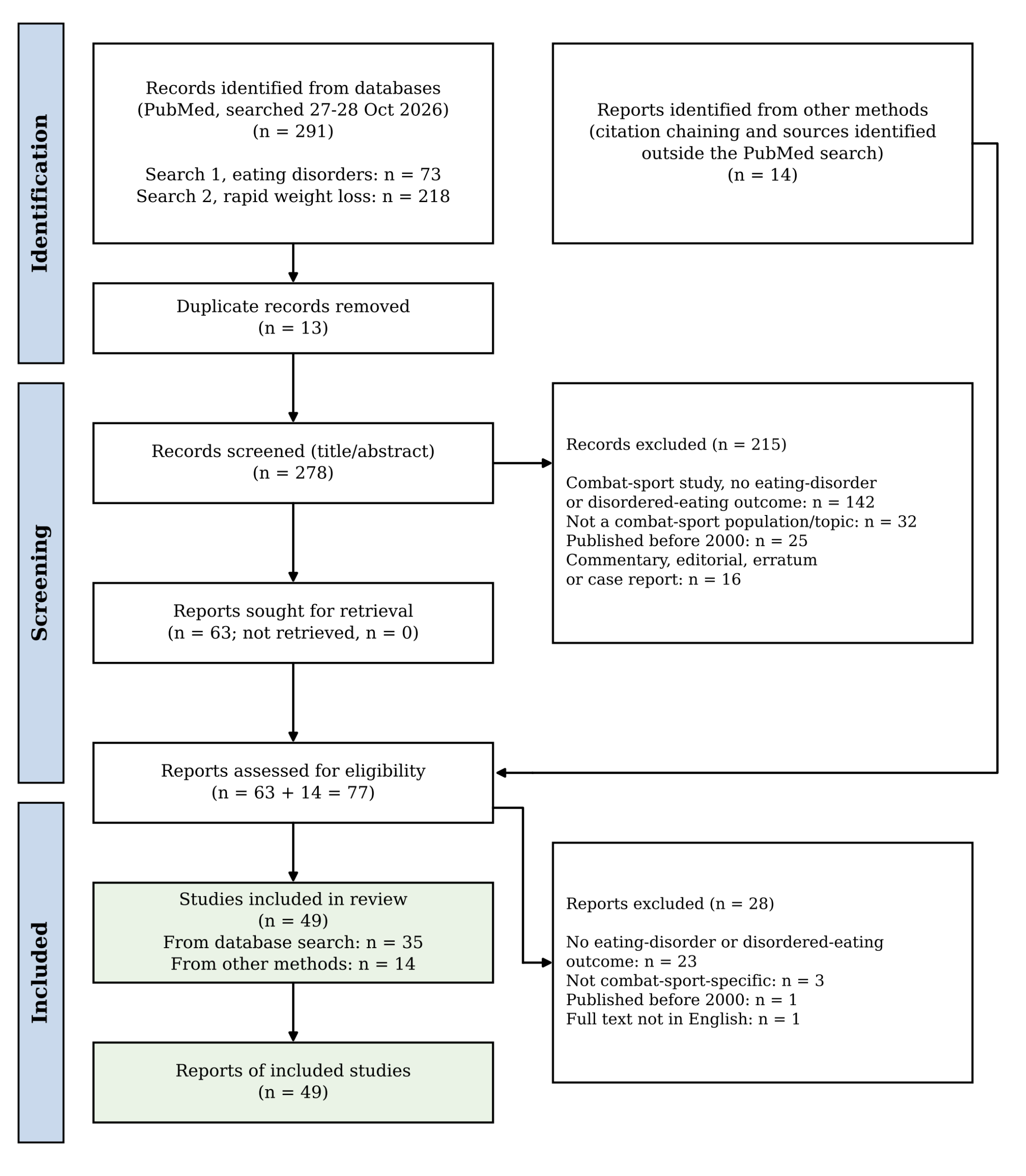
Sources were identified through a structured PubMed search conducted on 27-28 October 2026, supplemented by citation chaining through the reference lists of major reviews (e.g.,3,6,10). Two searches were run without language or date limits: (1) eating disorders AND (judo OR taekwondo OR wrestling OR combat sport), which returned 73 records; and (2) rapid weight loss AND (judo OR taekwondo OR wrestling OR combat sport OR martial arts), which returned 218 records. After removal of 13 duplicates, 278 records were screened by title and abstract, 63 reports were assessed for eligibility, and 35 were included; 14 additional sources identified through citation chaining and other sources outside the PubMed search were also included, giving 49 included sources (Figure 1, PRISMA 2020 flow diagram).
Inclusion and Exclusion Criteria
Records were included if they were peer-reviewed, published in English in 2000 or later, included martial arts or combat sport athletes as a distinct population or reported subgroup, and either reported eating disorder or disordered eating outcomes or were reviews synthesizing the prevalence, magnitude, or methods of rapid weight loss in combat sport athletes. Records were excluded if they did not involve combat sport athletes, reported no eating disorder or disordered eating outcome (for example, studies of the physiological, performance, injury, or nutritional effects of rapid weight loss alone), were commentaries, editorials, errata, or single case reports, or were published before 2000. Three primary studies without eating disorder outcomes were retained from the original manuscript as foundational or policy-relevant sources: a judo rapid weight loss prevalence survey7, a hydration biomarker study11, and an evaluation of the NCAA wrestling weight-management rule change12. Measurement-instrument and background sources identified through other methods (e.g.,13,14,15) are summarized in Table 1 with their role in this review. Eligibility was judged from titles and abstracts by a single reviewer, and no formal risk-of-bias tool was applied; because only one database was searched systematically, some relevant studies may have been missed.
Quality Appraisal
Each primary study discussed below is evaluated against four criteria, summarized in Table 1: sample size and representativeness; whether disordered eating was assessed with a validated instrument (e.g., EDI, EAT-26) or unvalidated self-report items; whether findings were confirmed by clinical interview or relied on self-report alone; and study design (cross-sectional, cohort, or review), which bears on whether a study can support claims about onset or causation. Table 1 now covers all 49 included sources, including reviews and background sources, with design-appropriate strengths and limitations for each.
Prevalence and Risk of Eating Disorders in Athletes
The relationship between sport participation and eating disorders (EDs) has been examined for several decades, with consistent findings that athletes, particularly those in weight-sensitive and weight-class disciplines, face greater risk of developing an eating disorder than the general population3,6. Although methodologies differ, spanning large-scale surveys, adolescent cohort studies, and systematic reviews4,16, they converge on a central conclusion: the structural demands of sports like martial arts, wrestling, and gymnastics amplify vulnerability to disordered eating1,17. Because included studies used heterogeneous diagnostic tools (EAT-26, EDI, clinical interviews), prevalence estimates should be interpreted as approximations rather than directly comparable rates.
One of the most influential studies remains Sundgot-Borgen and Torstveit’s3 cross-sectional survey of over 1,600 Norwegian elite athletes and nearly 1,700 controls aged 13-39 years old. Using standardized questionnaires such as the eating disorder inventory (EDI) — a 64-item self-report instrument with eight subscales14 and subsequent clinical interviews, Sundgot-Borgen and Torstveit found that 13.5% of athletes had subclinical or clinical eating disorders, compared with 4.6% of controls, with a prevalence of 42% among female athletes in aesthetic sports. The EDI includes statements such as “I eat when I am upset” or “I feel extremely guilty after eating,” which clearly demonstrate symptoms like motivation for thinness, bulimia, and body dissatisfaction. This study combines screening with clinical confirmation, making the findings more reliable. However, since it looks at data from a single point in time, it cannot show how disordered eating starts or improves over time.
Martinsen and Sundgot-Borgen4 built on this study by focusing on younger athletes, comparing first-year students at Norwegian elite sport high schools (677 invited; 611 completed the questionnaire) with controls (421 invited; 355 completed). They found that eating disorders were more prevalent in adolescent elite athletes than in controls (7.0% vs. 2.3%) and in female than in male athletes (14.0% vs. 3.2%). Among females, the difference between weight-sensitive and less weight-sensitive sports was not statistically significant (19.7% vs. 11.9%). This study showed how health risks can begin as soon as the athletic rigor starts, because it is a part of the developmental stages of sport participation. Nonetheless, relying on information that people report about themselves can lead to faulty results, since individuals may not be fully sharing their experiences. This can be especially true for young people dealing with eating disorders, since there is stigma and shame attached to these disorders.
Meta-analytic work strengthens these findings by showing consistency across contexts. Mancine et al.6 reviewed studies that used standardized screening tools or interviews and found that disordered eating was significantly more common in lean sports in 6 of 7 studies, with less consistent findings when athletes were grouped by sport type. Similarly, Borowiec et al.17 showed that adolescent female athletes in lean, non-aesthetic sports, including judo and taekwondo, faced the greatest odds of developing disordered eating symptoms. Importantly, their results suggested that age modifies risk patterns: adolescents appeared especially vulnerable to external pressures such as coach expectations and peer comparison, while adults were more affected by chronic, sport-specific weight management habits. Both studies rely on self-reported symptom measures rather than clinical diagnosis, which may under- or over-estimate true prevalence.
Broader reviews help contextualize these sport-specific findings. El Ghoch et al.1 summarized evidence linking eating disorders to both mental health decline and physical performance impairment, noting that the risk extends beyond diagnostic categories to encompass disordered eating behaviors that may not meet clinical thresholds. More recently, Ghazzawi et al.10 conducted a systematic review and meta-analysis of 177 studies (n = 70,957 athletes) and concluded that one in five athletes overall is at risk, with variation depending on sex, age, and sport type. Large-scale syntheses are important for showing consistent prevalence trends. However, variations in diagnostic tools, like the Eating Attitudes Test (EAT-26) a 26-item questionnaire which screens for risky behaviors related to food or weight (clinical cutoff of 20 or above)13, complicate the ability to compare studies.
Eating Disorder Evidence Specific to Combat Sports
Studies focused specifically on combat sport athletes point in the same direction. A systematic review of eight studies published between 2014 and 2024 concluded that wrestlers are more susceptible to eating disorders than athletes in other sports and often use unhealthy weight-control behaviors18. A meta-analysis of male athletes found no significant overall difference from non-athletes, but wrestling showed a greater incidence of disordered eating19, and a meta-analysis of female athletes reported higher disordered eating in weight-category sports such as judo than in sports that do not emphasize leanness20. Among 22 elite Spanish female Olympic wrestlers with a history of eating disorders, extreme weight-control practices, including fasting, diuretic and laxative use, and binge eating, were prevalent21, and interviews with athletes from the same population described the use of inadequate procedures when moving down to lower weight categories22. Among 22 wrestlers aged 15 to 19, 13.6% were at high risk of an eating disorder on the EAT-2623, and in 15 high school wrestlers, eating attitudes did not change significantly across the season, although 60% reported thinking about burning calories while exercising in the preseason24.
Findings in other combat disciplines are similar. Among 335 Croatian taekwondo athletes, eating disorder symptoms were more common in females and were predicted by body dissatisfaction, coach pressure on diet and weight, and task goal orientation25, and among 110 Lebanese black belt players, 15.5% were at risk of an eating disorder and 33.6% showed disordered eating patterns26. In 55 elite Polish contact karate athletes, the EAT-26 indicated potential eating disorder risk in 58.1% when all three referral criteria were applied27. In 144 elite Spanish judo athletes, females reported more eating disorder symptoms than males28, and in 166 combat sport athletes, the desire to weigh less, threat appraisal of weight change, denial coping, and anxiety predicted disordered eating behaviors29. In a prospective study of combat sport competitors, moderate to very high disordered eating was identified in about 4 of every 5 participants30. Among 29 female combat athletes, 21-67% had symptoms of eating disorders, injuries, low bone density, or low energy availability31; among 84 Chinese female combat athletes, 21.4% were at high eating disorder risk on the EDE-Q32; and among Chinese male adolescent combat athletes, 18% had eating disorder symptoms, with higher habitual weight loss associated with greater eating concern33. In 70 judo athletes, 95.7% reported rapid weight loss and 65.7% reported binge eating after weigh-in, which was associated with larger weight loss34. In contrast, a study of 244 university-level contact sport athletes found lower EAT-26 scores among those following a nutritionist-guided diet than among those on a free diet, although its authors questioned the suitability of the EAT-26 for athletes35, and a study of weight cycling in 48 athletes found no eating disorders during the episode but a higher binge-eating risk among combat sport athletes and females36.
These studies are mostly cross-sectional, rely on screening questionnaires rather than clinical interviews, and often use small or convenience samples (22 to 335 participants), so they indicate elevated risk rather than confirmed diagnosis. Table 1 summarizes the design, sample, and limitations of each.
These studies show a consistent pattern: athletes in weight-class and leanness sports face significantly greater risks of eating disorders than both non-athletes and athletes in non-lean sports. The methodologies differ in scale and precision, with clinical interviews offering depth, self-report surveys capturing breadth, and reviews providing cross-study validation, but they collectively reinforce the conclusion that risk emerges early, persists across career stages, and is inseparable from the weight regulation demands inherent in sports like martial arts. This body of evidence establishes the foundation for examining how weight management practices themselves contribute to these risks.
Weight Management Practices and Impacts in Martial Arts
The higher possibility of eating disorders demonstrates the relevance of the topic, especially focusing on how athletes manage their weight in martial arts and other combat sports. Athletes commonly engage in rapid weight loss (RWL) before competition, followed by rapid weight regain. This may entail people trying to lose water weight by drinking less water, dehydrating themselves, using saunas, sweating a lot, exercising in hot environments using dietary supplements or laxatives, and wearing sauna suits to sweat out7,37. Since the body is not used to the full stomach capacity feeling, due to the aggressive rehydration and sudden increase in food intake, the regain period can produce gastrointestinal distress and metabolic strain. Although culturally normalized, this cycle carries substantial physiological and psychological consequences, with risks beginning as early as adolescence.
Artioli et al.7 found that 86% of 822 judo athletes (607 males, 215 females) around the age of 19 years old had lost weight to compete, with most reporting usual reductions of up to 5% of body mass and many reporting maximum reductions of 5-10%, typically within about one week of competition. Another review describes RWL as an entrenched cultural feature of combat sports5. It has also been estimated that more than half of athletes in weight-class sports have practiced RWL during competitive periods38. Reale et al.39, for example, reviewed the acute weight-loss practices used in Olympic combat sports and their performance implications. Matthews et al.40 added that combat sport athletes often lose 4-7% of body weight prior to weigh-ins and regain much of it within 24 hours, creating a recurring cycle of manipulation. Although broadly consistent, the magnitude and methods of RWL differed substantially across disciplines.
Further, a systematic review by Zhong et al.41 of 26 survey studies (3,994 athletes across 14 combat sports) confirmed that weight loss for competition is highly prevalent, that many athletes begin as teenagers, and that most usually lose less than 5% of body weight in the 7-14 days before competition. In a more recent study by Barley and Harms37, researchers surveyed 256 athletes in various types of martial arts, and found that practices and severity varied by discipline, with MMA and Muay Thai competitors cutting the most weight. Use of certain high-risk methods, such as sauna, was also associated with an increased likelihood of disordered eating behaviors. Similarly, recent reviews show that many judo athletes frequently undergo repeated RWL cycles throughout competitive seasons. This leads to dehydration and quick weight gain becoming a regular part of their routine42. Together, this evidence underscores that RWL is widespread, begins early, and is often viewed as a necessary strategy for success. A narrative review of weight cutting in wrestlers adds that its psychological implications include an increased risk of eating disorders43.
The physiological effects of weight cutting are immediate and harmful. One hydration study recruited 15 male and female combat sport athletes around 26 years old with a body mass of about 67.7 kg, using dehydration protocols targeting ~3-4% body mass loss to observe biomarker shifts11. They revealed that urine specific gravity tests confirm hypohydration, defined as a body water deficit of more than 2% of body mass15, even after recovery periods. Martínez-Aranda et al.44 highlighted physiological stressors such as electrolyte imbalance, reduced plasma volume, and impaired recovery following RWL. Importantly, while some studies suggested that performance outcomes may not always be diminished, none of the reviewed studies reported the specific performance metrics or effect sizes needed to confirm this, and the underlying metabolic strain is substantial. In a prospective study of combat sport competitors, Doherty et al.30 noted that about 80% (4 of every 5) of combat athletes displayed moderate to very high disordered eating concerns, pointing to the overlap between weight management behaviors and long-term health consequences. Thus, even if athletes can perform in the short term, the physiological damage accumulates over time.
Psychological outcomes are equally concerning. Lakicevic et al.8 showed that judo athletes undergoing RWL reported increased fatigue, anger, and tension, paired with decreased vigor. Rouveix et al.9 found that 25% of female judo athletes (n = 12) were at risk of an eating disorder (EAT-26 above 20), with body-weight satisfaction the strongest predictor of eating-disorder symptoms. Levy and Boyd45 expanded on this by examining the motivational and cultural underpinnings of weight cutting, noting that athletes often believe RWL enhances performance despite limited evidence of actual benefit. Their review concluded that the glorification of extreme weight manipulation reflects cultural values within martial arts, where toughness and discipline are prioritized over health. This interpretation reflects the review authors’ own theoretical framing rather than a directly measured finding. The psychological costs include not only disordered eating but also broader disruptions to mood, motivation, and cognitive function.
Particularly troubling is the evidence of early adoption of weight cutting behaviors. Lakicevic et al.46, in a systematic review of youth combat athletes, reported that 25-94% engaged in RWL, with methods including increased exercise, reduced fluid and food intake, training in impermeable suits, and sauna use. This wide range likely reflects differences in discipline, competition level, and how RWL was defined across the studies pooled. Borowiec et al.17 further demonstrated that adolescent athletes in lean, non-aesthetic sports like judo and taekwondo are disproportionately vulnerable, due to both biological development and external pressures. Lakicevic et al.47 confirmed that weight cycling in adolescents is common, with typical losses of 1-6% of body mass. These findings suggest that harmful practices are ingrained in athletes long before they reach senior competition levels, normalizing behaviors that carry lasting health risks.
Evidence from surveys, clinical studies, and reviews shows that RWL is common, harmful to physical health, and damaging to mental well-being, with increased risks for adolescents. The practice is not confined to one discipline but extends across martial arts, MMA, and wrestling, with methods varying in severity. While short-term performance may not always appear impaired, the cumulative costs to hydration, metabolic health, and mental well-being are significant. Moreover, the normalization of RWL in athlete development pathways reinforces cycles of disordered eating and places young athletes at heightened risk. These findings indicate consistent correlational evidence linking the cultural practices of martial arts weight management to the elevated prevalence of eating disorders identified in earlier research, though causation cannot be confirmed from cross-sectional and self-report data alone.
| Study (Author, Year) | Design & Sample | Method | Key Finding(s) | Strengths / Limitations |
| Sundgot-Borgen & Torstveit, 20043 | Cross-sectional, two-step; entire Norwegian elite-athlete population (n = 1,620) and controls (n = 1,696) | Self-report questionnaire, then clinical interview (DSM-IV criteria) | Subclinical or clinical eating disorders in 13.5% of athletes vs. 4.6% of controls; 42% of female athletes in aesthetic sports; more common in leanness- and weight-dependent sports | Strength: population-wide sample with clinical confirmation. Limitation: cross-sectional; not combat-specific. |
| Martinsen & Sundgot-Borgen, 20134 | Two-phase cross-sectional; first-year students at 16 Norwegian elite sport high schools (677 invited; 611 completed) and controls (421 invited; 355 completed) | Questionnaire, then clinical interview of at-risk and sampled not-at-risk participants | Eating disorder prevalence 7.0% in athletes vs. 2.3% in controls; 14.0% in female vs. 3.2% in male athletes; no significant difference between weight-sensitive and less weight-sensitive sports among females (19.7% vs. 11.9%) | Strength: adolescent sample with interview confirmation. Limitation: weight-sensitive group not limited to combat sports; first phase self-report. |
| Mancine et al., 20206 | Systematic review; studies using standardized screening tools or interviews | Narrative synthesis by sport type (lean vs. non-lean) | 6 of 7 studies found significantly higher disordered eating in lean sports; findings by sport type less consistent | Strength: restricted to standardized measures. Limitation: few eligible studies; not combat-specific. |
| Borowiec et al., 202317 | Cross-sectional; 241 female athletes aged 12-30 (82 adolescents, 159 adults), Poland | Eating Attitudes Test; body satisfaction scale | Eating disorder risk in 14.6% of adolescents vs. 6.9% of adults; in adolescents linked to lean non-aesthetic sports (OR = 11.50) and lower body satisfaction | Strength: age-stratified analysis. Limitation: female-only; screening questionnaire, not diagnosis; wide confidence interval. |
| El Ghoch et al., 20131 | Systematic review; 29 studies | Narrative synthesis (PRISMA-guided) | Eating disorders impair physical fitness and sport performance via low energy availability, loss of fat and lean mass, dehydration, and electrolyte disturbance | Strength: systematic methods. Limitation: sparse data; not combat-specific. |
| Ghazzawi et al., 202410 | Systematic review, meta-analysis, meta-regression; 177 studies (132 publications), n = 70,957 athletes | Pooled prevalence of self-reported disordered eating above validated screening cutoffs | Pooled prevalence 19.23% (about 1 in 5); higher in anaerobic (37.9%) than aerobic sports (19.6%); higher with female sex, older age, higher BMI; very high heterogeneity (I2 = 97.4%) | Strength: very large evidence base. Limitation: self-report tools with varying cutoffs; not combat-specific. |
| Fatt et al., 202416 | Umbrella review; 24 systematic reviews (10 meta-analyses) of elite athletes | Systematic search of five databases; AMSTAR 2 risk-of-bias appraisal | Disordered eating prevalent in elite athletes across sexes and sport types; elevated risk for disordered eating and eating disorders but lower risk of body image concerns vs. controls | Strength: appraises the quality of included reviews. Limitation: most included reviews had substantial risk of bias; not combat-specific. |
| Chapa et al., 202220 | Meta-analysis (PRISMA); 56 studies of female athletes vs. non-athletes | Three-level random-effects model | Overall eating disorder psychopathology similar to non-athletes; greater drive for thinness and restricting in aesthetic/lean sports; weight-category sports such as judo higher than non-lean sports | Strength: large synthesis with sport-type moderator. Limitation: female athletes only; combat sports appear only within weight-category subgroups. |
| Chapman & Woodman, 201619 | Meta-analysis; 31 studies of male athletes | Effect sizes by sport type, competition level, and diagnostic tool | No overall difference from non-athletes, but wrestling showed greater incidence of disordered eating; EAT-based studies showed greater incidence | Strength: sport-type moderator analysis. Limitation: weak, heterogeneous effects; male-focused tools limited; wrestling only combat sport examined. |
| Alpay et al., 202518 | Systematic review (PRISMA); 8 studies of wrestlers published 2014-2024 | PubMed, Scopus, PsycINFO, SPORTDiscus, Web of Science | Wrestlers more susceptible to eating disorders than other sport branches; unhealthy weight-control behaviors used for performance and muscular appearance; female wrestlers understudied | Strength: wrestling-specific, multi-database. Limitation: only 8 studies; mostly male wrestlers; 10-year window. |
| Rueda Flores et al., 202421 | Cross-sectional; 22 elite Spanish female Olympic wrestlers with a history of eating disorder | EAT-26, BITE, EDI-3, DASS-21 | Abnormal eating patterns on BITE; competition and training experience predicted bulimia severity; fasting, diuretic and laxative use, and binge eating prevalent | Strength: multiple validated instruments in an elite group. Limitation: small purposive sample selected for ED history; cannot estimate prevalence. |
| Rueda Flores et al., 202322 | Qualitative; 22 elite Spanish female wrestlers with current or past eating disorder | Semistructured interviews; NVivo analysis | Three themes: reasons for losing weight, inadequate procedures used, and reference persons involved; moving down weight categories drives rapid loss and eating disorder incidence | Strength: athletes’ lived experience. Limitation: small purposive sample; not generalizable. |
| Ayar et al., 202523 | Cross-sectional; 31 apprentice jockeys and 22 wrestlers aged 15-19 | EAT-26; ORTO-15 | High eating disorder risk (EAT-26 of 20 or more) in 13.6% of wrestlers vs. 25.8% of jockeys; wrestlers’ mean EAT-26 11.05 | Strength: validated screening tool. Limitation: very small sample; comparison group not a combat sport. |
| Shriver et al., 200924 | Longitudinal; 15 high school wrestlers | DXA body composition; Eating Attitudes Test at preseason, in-season, and off-season | No significant change in EAT score; weight rose from preseason to off-season; 60% (preseason) vs. 40% (in-season) thought about burning calories when exercising | Strength: repeated measures with DXA. Limitation: n = 15; conducted after a 2006 weight-management rule change. |
| Barić & Erdeljac, 202425 | Cross-sectional; 335 Croatian taekwondo athletes, mean age 14.7 (range 10-26) | EAT; Figure Rating Scale; goal orientation and negative coach behavior questionnaires | Symptoms more common in females; body dissatisfaction (β = 0.310), coach pressure on diet and weight (β = 0.156), and task goal orientation (β = 0.120) predicted symptoms | Strength: sizeable youth sample; examines coach influence. Limitation: cross-sectional; screening instrument; single country. |
| Hoteit et al., 202526 | Cross-sectional; 110 Lebanese black belt taekwondo players, mean age 24.3 | SMHAT-1; EAT-26; anthropometry | 15.5% at risk of an eating disorder; disordered eating 33.6% overall and 50% in females; risk linked to unemployment, high exercise volume (10 h/week or more), and reduced income | Strength: links mental health and eating outcomes. Limitation: cross-sectional; self-report; single country. |
| Dobkowska-Szefer et al., 202527 | Cross-sectional; 55 elite Polish contact karate athletes | EAT-26; Düsseldorf Orthorexia Scale; Body Esteem Scale (online) | Potential eating disorder risk in 58.1% when all three EAT-26 criteria applied; 12.7% screened positive on Part A; 47.5% reported cutting weight (about 4.6% of body mass per event) | Strength: elite sample, validated tools. Limitation: small sample; online self-report. |
| Escobar-Molina et al., 201528 | Observational; 144 Spanish elite judo athletes (66 F, 78 M); cadets, juniors, seniors | EAT-40; STAI-T; Food Craving Questionnaire-Trait; Restraint Scale | Seniors used weight-loss methods most, especially the week before competition; females showed more eating disorder symptoms and anxiety; symptom differences most common in cadets | Strength: age- and sex-stratified. Limitation: self-report; single national team. |
| Gonçalves et al., 202129 | Case-control analytic (Level III); 166 combat sport athletes aged 14-56 (75.3% male) | Questionnaires on cognitive appraisal, coping, emotions, and eating behaviors | 57.3% reported high stress about unwanted pre-competition weight change; desire to weigh less, threat appraisal, denial coping, and anxiety predicted disordered eating behaviors | Strength: examines psychological mechanisms. Limitation: wide age range; self-report. |
| Doherty et al., 2024b30 | Prospective; 122-132 male and female combat sport competitors across 24 events | Body mass questionnaire; Athletic Disordered Eating questionnaire at ~7 and ~28 days after competition | Moderate to very high disordered eating in 83% of males and 89% of females (4 of every 5 competitors); sex-specific change in body discontent; relationship with RWL magnitude limited | Strength: prospective, sex-stratified. Limitation: attrition (89 respondents at 28 days); self-reported body mass. |
| Mathisen et al., 202231 | Cross-sectional; 29 female combat-sport athletes | Questionnaire, diet registration, DXA scan | 21-67% had symptoms of eating disorders, injuries, low bone density, or low energy availability; more than 20% used unfavorable weight-loss methods or rapid weight-loss periods; insufficient energy and nutrient intake common | Strength: combines self-report with DXA and diet records. Limitation: n = 29, recruited via social media and clubs. |
| Liang et al., 202532 | Cross-sectional with pre-competition monitoring; 84 Chinese female combat athletes (judo, freestyle wrestling, sanda); 11 judo athletes monitored | LEAF-Q; EDE-Q | 45.2% at increased risk of low energy availability; 21.4% at high eating disorder risk; no difference between elite and recreational athletes | Strength: validated questionnaires plus physiological monitoring. Limitation: monitored subsample of 11; screening, not diagnosis. |
| Meng et al., 202633 | Cross-sectional; 525 Chinese male adolescent combat athletes (285 completed the ED measure) | Adapted Rapid Weight Loss Questionnaire; EDE-Q8 (weight-loss participants only) | 57% intentionally lost weight (habitual loss 7.2% of body mass); 18% had eating disorder symptoms; habitual weight loss correlated with eating concern | Strength: large adolescent sample. Limitation: convenience sample; males only; ED measure limited to weight losers. |
| Staśkiewicz-Bartecka et al., 202534 | Cross-sectional; 70 national and international judo athletes (17 F, 53 M) | Author-designed questionnaire on RWL, diet, and post-weigh-in eating | 95.7% engaged in RWL (mean 3.64 kg), 65.7% began at ages 13-16; post-weigh-in binge eating in 65.7%, associated with larger RWL | Strength: documents compensatory eating. Limitation: unvalidated questionnaire; small sample. |
| Bagot et al., 202536 | Repeated-measures experimental (Wave study); 48 athletes (28 M, 20 F), 23 in combat sports | Dietary and appetite questionnaires; food reward task; DXA at baseline, weight loss, and regain | No eating disorders found during the episode; combat-sport athletes and females had higher binge-eating risk; appetite responses not impaired | Strength: controlled design. Limitation: small combat subgroup; moderate weight cycling only. |
| Martínez Rodríguez et al., 201535 | Randomized frequency study; 244 university-level contact-sport athletes (158 M, 86 F) | EAT-26 | Free-diet group scored higher than the nutritionist-guided group; authors judged the EAT-26 not appropriate for detecting eating disorders in sport | Strength: tests dietary guidance. Limitation: mixed contact sports; instrument validity questioned by authors. |
| Marten et al., 202543 | Narrative review; male and female wrestlers | Synthesis of medical, physiological, and psychological effects of weight cutting | Weight cutting linked to injury risk, lower testosterone, higher cortisol, and increased eating disorder risk; female hormone disruption; >5% RWL linked to decreased performance | Strength: wrestling-specific, both sexes. Limitation: narrative method; no pooled estimates. |
| Rouveix et al., 20079 | Cross-sectional; 24 judo athletes (12 F, 12 M) and 31 controls | EAT-26; perfectionism, self-esteem, body esteem, and mood scales | 25% of female judo athletes at risk of an eating disorder (EAT-26 above 20); body-weight satisfaction and BMI predicted EAT scores; menstrual dysfunction in 58.3% of judo athletes | Strength: psychological trait data. Limitation: very small sample; correlational. |
| Artioli et al., 20107 | Cross-sectional; 822 judo athletes (607 M, 215 F), mean age 19.3 | Validated RWL questionnaire | 86% had lost weight to compete; most usual reductions up to 5% (mean 2.5%), maximum reductions often 5-10%; began cutting weight at about 12.6 years; elite athletes scored higher | Strength: large discipline-specific sample. Limitation: self-reported behavior; no eating disorder outcome. |
| Barley & Harms, 202537 | Cross-sectional online survey; 256 competitors from eight combat disciplines | Survey of weight-loss habits, magnitude, and methods | Larger cuts in muay thai/kickboxing and MMA; wrestlers skipped meals or fasted more; fluid-manipulation methods associated with greater loss; high-risk methods linked to disordered eating behaviors | Strength: explicit discipline comparison. Limitation: self-report; convenience sample. |
| Zhong et al., 202441 | Systematic review (PROSPERO-registered); 26 survey studies, 3,994 participants, 14 combat sports | Web of Science, EBSCOhost, PubMed | Weight loss highly prevalent; many began as teenagers; usual loss under 5% in 7-14 days; increased exercise and gradual dieting most common | Strength: preregistered, discipline range. Limitation: survey-only evidence; self-report. |
| Matthews et al., 201940 | Systematic review (PROSPERO-registered); 16 studies, 4,432 participants, five combat sports | EBSCOhost and PubMed Central search to July 2018 | Magnitude of RWL and rapid weight gain differed by sport, with the largest changes in two MMA cohorts; time allowed for regain ranged from 3 to 32 h | Strength: cross-sport comparison. Limitation: only 3 studies reported RWL; mostly male participants. |
| Franchini et al., 20125 | Narrative review of weight loss in combat sports | MedLine, Lilacs, PubMed, SciELO | Prevalence about 50%; harmful methods include laxatives, diuretics, plastic suits, and sauna; RWL affects physical and cognitive capacities | Strength: covers prevalence, effects, and strategies. Limitation: narrative selection of studies. |
| Reale et al., 201739 | Narrative review; Olympic combat sports | Review of weigh-in practices, physiology of acute body mass loss, and performance effects | Provides a decision tree for achieving acute weight loss while minimizing performance decrements | Strength: Olympic regulatory context. Limitation: narrative; no prevalence data. |
| Khodaee et al., 201538 | Narrative review; weight-sensitive sports | Literature review of RWL | Estimated that more than half of weight-class athletes practiced RWL; true prevalence unknown; rule changes had the greatest impact in wrestling | Strength: policy relevance. Limitation: limited epidemiological data; narrative. |
| Dos Santos et al., 202442 | Scoping review; 53 of 446 articles on judo | Web of Science, PubMed, Scopus | RWL prevalence 40-92.9%, about 5% body mass reduction; no performance decline when recovery exceeded 4 h; health risks remain | Strength: judo-specific. Limitation: single discipline; no quality appraisal. |
| Martínez-Aranda et al., 202344 | Systematic review; RWL strategies and performance in combat sports | PubMed, SPORTDiscus, Web of Science, ScienceDirect | Reviewed the effect of RWL strategies on performance; cited here for the physiological stressors of RWL | Strength: systematic searches. Limitation: performance focus; findings beyond the aim not summarized here. |
| Lakicevic et al., 20208 | Systematic review; 14 studies, 1,103 judo athletes | Web of Science, PubMed; RWL of 5% or more within 7 days | Psychological well-being outcomes were more consistent than physiological outcomes; tension, anger, and fatigue increased | Strength: PRISMA-guided, judo-specific. Limitation: conflicting physiological findings; self-reported mood measures. |
| Lakicevic et al., 202247 | Review | Narrative synthesis, youth combat athletes | Weight cycling common in adolescents (1-6% body mass loss); final days pre-weigh-in under-researched | Strength: highlights understudied period. Limitation: narrative, not quantitative pooling. |
| Lakicevic et al., 2022b46 | Systematic review; youth combat athletes | PubMed, EBSCOhost, Web of Science; studies in official competitions | RWL in 25-94% of child and adolescent combat athletes; magnitude about 1% to 6.3%; methods include exercise, reduced fluid and food, impermeable suits, sauna | Strength: youth focus. Limitation: wide range reflects heterogeneous studies. |
| Levy & Boyd, 202545 | Mini review of psychological factors in weight cutting | Narrative synthesis of motivation, relationship with food, body image, and disordered eating | Calls for research on gradual weight loss to promote psychological resilience | Strength: addresses under-studied psychological dimension. Limitation: narrative; interpretive. |
| Doherty et al., 2024 (hydration)11 | Experimental; 15 male and female combat athletes, mean age 26.3 | Sauna protocol targeting 4% body mass loss (achieved 3.0%), twice; hydration biomarkers | Body mass loss explained hematocrit change (R2 = 0.22); USG and serum osmolality cutoffs gave 80% true negative and 62% true positive rates | Strength: objective biomarker data. Limitation: small sample; no eating disorder outcome. |
| Oppliger et al., 200612 | Observational; 811 NCAA Division I-III wrestlers at national championships, 1999-2004 | Body composition and weight before tournament and after day 1 | RWL averaged 1.2 kg (1.7%) and weight regain 0.9 kg (1.3%), significantly lower than earlier studies with mat-side weigh-ins | Strength: large national sample. Limitation: comparison with earlier studies is indirect. |
| Davis et al., 200248 | Preliminary observational evaluation; 32 NCAA Division I wrestlers (1998-99) and 29 (1999-2000) | Weight data under the Wrestling Weight Certification Program | First-week weight loss less pronounced in 1999-2000; wrestlers may be breaking the historic cycle of weight fluctuation | Strength: direct policy evaluation. Limitation: single institution; small samples; no control group. |
| Oppliger & Bartok, 200249 | Narrative review; hydration monitoring in athletes | Review of weight, urine, bioimpedance, and blood tests | Simple weight and urine tests useful; bioimpedance lacks precision; blood tests most accurate but impractical; recommends hydration monitoring protocols | Strength: practical comparison of methods. Limitation: not combat-specific; test accuracy needs further study. |
| Sawka et al., 201515 | Narrative review; hypohydration (body water loss over 2% of body mass) | Review of physiological mechanisms and environmental effects | Hypohydration impairs aerobic performance, mainly in warm-hot environments, through cardiovascular strain, elevated tissue temperature, and metabolic changes | Strength: mechanistic synthesis. Limitation: not combat-specific; focuses on aerobic performance. |
| Garner et al., 198213 | Psychometric study; 160 female anorexia nervosa patients and 140 female comparison subjects | Factor analysis of the 40-item EAT to derive the 26-item EAT-26 | EAT-26 highly correlated with EAT-40 (r = 0.98); three subscales; judged a reliable, valid screening measure; norms provided | Strength: large clinical and comparison samples. Limitation: screening tool developed in female patients, not diagnostic. |
| Garner et al., 198314 | Instrument development and validation study (Eating Disorder Inventory) | 64-item self-report inventory with eight subscales | Used here to describe how eating disorder attitudes and behaviors are measured in the primary studies | Strength: multidimensional measurement. Limitation: self-report; not a diagnostic interview. |
| Slevec & Tiggemann, 20112 | Narrative review; body dissatisfaction and disordered eating in middle-aged women | Review of empirical correlates and risk factors | Risk factors resemble those in younger women: biological (BMI), psychological (thin-ideal internalization), and sociocultural (weight-related teasing) | Strength: summarizes shared risk factors for disordered eating. Limitation: not athlete- or combat-specific; used for general risk-factor context only. |
Future Implications
Even though research has made it clear that there is a relationship between weight class sports and eating disorder risks, there are still many unanswered questions. Many studies look at data from different sports as a whole, but do not study details specific to martial arts, such as their rules and regulations on strict weight in traditions, and the effects on those particular athletes5,1. Another limitation lies in the honesty of self reported data. Notably, people may not be honest about their actions due to the fear of being judged or ashamed, which result in underreporting. For instance, in sports, athletes tend to downplay actions that could be viewed as harmful, so they can maintain a strong image. Athletes rarely talk about weight cutting, even though it is a common practice, which shows the stigma in discussion, and points to drawbacks of self reported data. Furthermore, more research can be done on the final days of weight cutting. These final days are periods when athletes often experience impaired sleep, dehydrations, gastrointestinal distress, and fatigue. Few studies have been done about this topic, despite being the most taxing part for athletes mentally and physically. One 2022 review on youth athletes emphasized that little attention has been paid to the final days before weigh-ins, when the combination of sleep deprivation, gastrointestinal distress, and severe dehydration is most dangerous47.
In addition to more research, future policy reforms should incorporate leniency in a minimal “allowance” at weigh ins. Just like any other allowance, it is defined as the amount of something that is permitted, especially within a set of regulations or for a specified purpose, according to the Oxford Dictionary. The minimal weight allowance refers to the extra weight that may be added, such as clothing or hair, which is typically around one kilogram or half a kilogram that is allowed. Usually, half a pound of leeway is too little and may lead to urgent, drastic reductions. Increasing this allowance to one or two pounds and moving weigh-ins earlier, such as two days before competition, may allow for safer recovery. In addition, the issue of weight classes being set too low in the lower divisions may pressure athletes to pursue unhealthy cuts. When weight classes are too restrictive, athletes may feel pressured to lose weight beyond healthy limits to qualify for a particular class. Overall, increasing the lowest categories slightly, even by a kilo, may help reduce risks while maintaining the discipline of the sport.
These proposals are not purely speculative: an analogous natural experiment exists in NCAA collegiate wrestling. Following a cluster of wrestler deaths linked to extreme dehydration in 1997, the NCAA introduced a Weight Certification Program that established a minimum competitive weight based on a body-fat floor, mandated a hydration test (via urine specific gravity) at weigh-in, moved weigh-ins closer to competition, and added several pounds of margin to each weight class12. Evaluations of this program found that rapid weight loss and weight regain among national championship wrestlers declined significantly compared with the pre-certification era12, and an earlier preliminary evaluation similarly found reduced reliance on extreme weight-cutting methods after the program took effect48. This precedent suggests that hydration testing, earlier weigh-ins, and modest weight-class adjustments are not merely theoretical proposals but measures with a documented record of reducing dangerous weight-cutting behavior in a comparable weight-class sport.
Other suggestions can be hydration testing and height based divisions. Hydration testing is the practice of monitoring an athlete’s fluid balance to determine whether they are properly hydrated, dehydrated, or overhydrated49. For weight-class athletes, hydration testing is particularly beneficial because many use dehydration as a method to “make weight.” By providing an objective measure of hydration status, testing would allow coaches and medical staff to identify when an athlete’s dehydration reaches harmful levels, which not only protects long-term health but also prevents performance decline. Future research studies should focus not just on medical tracking of athletes but also on their mental health status. By incorporating researched knowledge and experiences from athletes we can approach these measures in a safer way.
Ethical Considerations
The scale of the behaviors documented in this review, up to 25-94% of youth combat athletes in some samples engaging in rapid weight loss46, raises ethical questions that extend beyond individual athletes. Coaches and training staff, who often set or reinforce weight-cutting expectations, have an obligation to avoid normalizing practices with documented health risks. Parents and guardians of youth athletes bear responsibility for monitoring their children’s well-being and questioning weight-cutting demands that are not medically supervised. Sports organizations and governing bodies that set weight-class structures and weigh-in timing have a duty to weigh competitive tradition against athlete safety. Researchers, in turn, have an obligation to report prevalence and risk data in ways that inform protective policy, particularly for youth athletes who are least able to advocate for changes to sport structures on their own behalf.
Conclusion
The literature on eating disorders in athletes reveals a consistent and troubling pattern: martial arts athletes, alongside competitors in other weight-class sports, face disproportionately high risks of disordered eating due to the structural demands of weight regulation. Cross-sectional adult and adolescent studies demonstrate elevated prevalence compared to the general population, while systematic reviews confirm that the greatest risks lie in sports where competitive advantage depends on manipulating body weight. Weight management practices such as rapid weight loss and repeated weight cycling, although normalized within martial arts, carry significant physiological costs, including dehydration, impaired recovery, and long-term metabolic strain, as well as psychological consequences ranging from fatigue and anxiety to entrenched disordered eating behaviors. Addressing these risks will require coordinated attention from coaches, sports organizations, and researchers, alongside further study specific to martial arts populations, so that competitive tradition and athlete health are no longer treated as being in conflict.
References
- M. El Ghoch, F. Soave, S. Calugi, R. Dalle Grave. Eating disorders, physical fitness and sport performance: a systematic review. Nutrients. Vol. 5, pg. 5140-5160, 2013. [↩] [↩] [↩] [↩] [↩]
- J. H. Slevec, M. Tiggemann. Predictors of body dissatisfaction and disordered eating in middle-aged women. Clinical Psychology Review. Vol. 31, pg. 515-524, 2011. [↩] [↩]
- J. Sundgot-Borgen, M. K. Torstveit. Prevalence of eating disorders in elite athletes is higher than in the general population. Clinical Journal of Sport Medicine. Vol. 14, pg. 25-32, 2004. [↩] [↩] [↩] [↩] [↩] [↩]
- M. Martinsen, J. Sundgot-Borgen. Higher prevalence of eating disorders among adolescent elite athletes than controls. Medicine & Science in Sports & Exercise. Vol. 45, pg. 1188-1197, 2013. [↩] [↩] [↩] [↩]
- E. Franchini, C. J. Brito, G. G. Artioli. Weight loss in combat sports: physiological, psychological and performance effects. Journal of the International Society of Sports Nutrition. Vol. 9, pg. 52, 2012. [↩] [↩] [↩] [↩]
- R. P. Mancine, D. W. Gusfa, A. Moshrefi, S. F. Kennedy. Prevalence of disordered eating in athletes categorized by emphasis on leanness and activity type—a systematic review. Journal of Eating Disorders. Vol. 8, pg. 47, 2020, 10.1186/s40337-020-00323-2. [↩] [↩] [↩] [↩] [↩]
- G. G. Artioli, B. Gualano, E. Franchini, F. B. Scagliusi, M. Takesian, M. Fuchs, A. H. Lancha Jr. Prevalence, magnitude, and methods of rapid weight loss among judo competitors. Medicine & Science in Sports & Exercise. Vol. 42, pg. 436-442, 2010. [↩] [↩] [↩] [↩] [↩]
- N. Lakicevic, R. Roklicer, A. Bianco, D. Mani, A. Paoli, T. Trivic, S. M. Ostojic, A. Milovancev, N. Maksimovic, P. Drid. Effects of rapid weight loss on judo athletes: a systematic review. Nutrients. Vol. 12, pg. 1220, 2020, 10.3390/nu12051220. [↩] [↩] [↩]
- M. Rouveix, M. Bouget, C. Pannafieux, S. Champely, E. Filaire. Eating attitudes, body esteem, perfectionism and anxiety of judo athletes and nonathletes. International Journal of Sports Medicine. Vol. 28, pg. 340-345, 2007. [↩] [↩] [↩]
- H. A. Ghazzawi, L. S. Nimer, A. J. Haddad, O. A. Alhaj, A. T. Amawi, S. R. Pandi-Perumal, K. Trabelsi, M. V. Seeman, H. Jahrami. A systematic review, meta-analysis, and meta-regression of the prevalence of self-reported disordered eating and associated factors among athletes worldwide. Journal of Eating Disorders. Vol. 12, pg. 24, 2024. [↩] [↩] [↩]
- C. S. Doherty, L. V. Fortington, O. R. Barley. Blood, sweat, and tears: implications for hydration testing in combat sports—investigating body mass loss and biomarker changes. Scandinavian Journal of Medicine & Science in Sports. Vol. 34, pg. e14701, 2024, 10.1111/sms.14701. [↩] [↩] [↩]
- R. A. Oppliger, A. C. Utter, J. R. Scott, R. W. Dick, D. Klossner. NCAA rule change improves weight loss among national championship wrestlers. Medicine & Science in Sports & Exercise. Vol. 38, pg. 963-970, 2006. [↩] [↩] [↩] [↩]
- D. M. Garner, M. P. Olmsted, Y. Bohr, P. E. Garfinkel. The eating attitudes test: psychometric features and clinical correlates. Psychological Medicine. Vol. 12, pg. 871-878, 1982. [↩] [↩] [↩]
- D. M. Garner, M. P. Olmsted, J. Polivy. Development and validation of a multidimensional eating disorder inventory for anorexia nervosa and bulimia nervosa. International Journal of Eating Disorders. Vol. 2, pg. 15-34, 1983, 10.1002/1098-108X(198321)2:2<15::AID-EAT2260020203>3.0.CO;2-6. [↩] [↩] [↩]
- M. N. Sawka, S. N. Cheuvront, R. W. Kenefick. Hypohydration and human performance: impact of environment and physiological mechanisms. Sports Medicine. Vol. 45, pg. S51-S60, 2015. [↩] [↩] [↩]
- S. J. Fatt, E. George, P. Hay, N. Jeacocke, E. Gotkiewicz, D. Mitchison. An umbrella review of body image concerns, disordered eating, and eating disorders in elite athletes. Journal of Clinical Medicine. Vol. 13, pg. 4171, 2024. [↩] [↩]
- J. Borowiec, A. Banio-Krajnik, E. Malchrowicz-Mośko, A. Kantanista. Eating disorder risk in adolescent and adult female athletes: the role of body satisfaction, sport type, BMI, level of competition, and training background. BMC Sports Science, Medicine and Rehabilitation. Vol. 15, pg. 91, 2023, 10.1186/s13102-023-00683-7. [↩] [↩] [↩] [↩]
- M. R. Alpay, R. E. Kovacs, S. Saadani, F. Wang, S. Boros. Eating disorders and disordered eating on wrestling sport: a systematic review. BMC Nutrition. Vol. 11, pg. 198, 2025, 10.1186/s40795-025-01169-0. [↩] [↩]
- J. Chapman, T. Woodman. Disordered eating in male athletes: a meta-analysis. Journal of Sports Sciences. Vol. 34, pg. 101-109, 2016, 10.1080/02640414.2015.1040824. [↩] [↩]
- D. A. N. Chapa, S. N. Johnson, B. N. Richson, K. Bjorlie, Y. Q. Won, S. V. Nelson, J. Ayres, D. Jun, K. T. Forbush, K. A. Christensen, V. L. Perko. Eating-disorder psychopathology in female athletes and non-athletes: a meta-analysis. International Journal of Eating Disorders. Vol. 55, pg. 861-885, 2022, 10.1002/eat.23748. [↩] [↩]
- M. R. Flores, A. Martín-Castellanos, O. López-Torres, V. E. Fernández-Elías, J. García-González, D. Mon-López. Eating behavior disorders and disordered eating habits in Spanish high-performance women’s Olympic wrestling athletes. Nutrients. Vol. 16, pg. 709, 2024, 10.3390/nu16050709. [↩] [↩]
- M. Rueda Flores, D. Mon-López, J. Gil-Ares, J. Coterón. Training conditions and psychological health: eating behavior disorders in Spanish high-performance women’s Olympic wrestling athletes – a qualitative study. International Journal of Environmental Research and Public Health. Vol. 20, pg. 2441, 2023, 10.3390/ijerph20032441. [↩] [↩]
- M. Ayar, A. Atar, İ. N. Şahin, F. Özbey. Evaluation of eating attitudes and obsession with healthy eating of apprentice jockeys and wrestlers. BMC Nutrition. Vol. 11, pg. 79, 2025, 10.1186/s40795-025-01058-6. [↩] [↩]
- L. H. Shriver, N. M. Betts, M. E. Payton. Changes in body weight, body composition, and eating attitudes in high school wrestlers. International Journal of Sport Nutrition and Exercise Metabolism. Vol. 19, pg. 424-432, 2009, 10.1123/ijsnem.19.4.424. [↩] [↩]
- R. Barić, T. Erdeljac. Eating disorders in taekwondo athletes: the contribution of coach behavior, body satisfaction, and goal orientation. Sports. Vol. 12, pg. 315, 2024, 10.3390/sports12120315. [↩] [↩]
- M. Hoteit, H. Karaki, A. Haidar, R. Baroud, H. Zarifeh, A. Saidi, F. Kibbeh, N. Jbeily, Z. Sadek. Mental health, eating disorder risk, and disordered eating patterns among Lebanese national taekwondo players: a cross-sectional study. PLOS ONE. Vol. 20, pg. e0331975, 2025, 10.1371/journal.pone.0331975. [↩] [↩]
- D. Dobkowska-Szefer, W. Staśkiewicz-Bartecka, A. Kiciak, M. Kardas. Eating disorders risk assessment and body esteem among elite Polish contact karate athletes. Frontiers in Nutrition. Vol. 12, pg. 1704743, 2025, 10.3389/fnut.2025.1704743. [↩] [↩]
- R. Escobar-Molina, S. Rodríguez-Ruiz, C. Gutiérrez-García, E. Franchini. Weight loss and psychological-related states in high-level judo athletes. International Journal of Sport Nutrition and Exercise Metabolism. Vol. 25, pg. 110-118, 2015, 10.1123/ijsnem.2013-0163. [↩] [↩]
- S. Gonçalves, A. Ribeiro, S. Félix, A. R. Gomes. Does weight change relate to psychological variables and eating behaviours in combat sports?. Eating and Weight Disorders. Vol. 26, pg. 921-930, 2021, 10.1007/s40519-020-00933-4. [↩] [↩]
- C. S. Doherty, L. V. Fortington, O. R. Barley. Prevalence of disordered eating and its relationship with rapid weight loss amongst male and female combat sport competitors: a prospective study. Journal of Science and Medicine in Sport. Vol. 27, pg. 745-752, 2024, 10.1016/j.jsams.2024.06.007. [↩] [↩] [↩]
- T. F. Mathisen, R. S. Kumar, K. M. E. Svantorp-Tveiten, J. Sundgot-Borgen. Empowered, yet vulnerable: motives for sport participation, health correlates, and experience of sexual harassment in female combat-sport athletes. Sports. Vol. 10, pg. 68, 2022, 10.3390/sports10050068. [↩] [↩]
- Y. Liang, Y. Li, Y. Chen, K. Meng, F. Zhou, Y. Pei, Y. Liu, J. Qiu. The impact of low energy availability risk on pre-competition physiological function in Chinese female combat athletes. Journal of the International Society of Sports Nutrition. Vol. 22, pg. 2490170, 2025, 10.1080/15502783.2025.2490170. [↩] [↩]
- F. Meng, Z. Zhang, K. Xu, M. Lvu, Y. Zhong. Weight loss practices, perceptions, and eating disorder symptoms among Chinese male adolescent combat sports athletes. Frontiers in Nutrition. Vol. 12, pg. 1726260, 2026, 10.3389/fnut.2025.1726260. [↩] [↩]
- W. Staśkiewicz-Bartecka, P. Ziomek, D. Dobkowska-Szefer, E. Malchrowicz-Mośko, P. Tomaszewski. Rapid weight reduction in judo: dietary practices and short-term health effects. Nutrients. Vol. 17, pg. 3964, 2025, 10.3390/nu17243964. [↩] [↩]
- A. Martínez Rodríguez, N. Vicente Salar, C. Montero Carretero, E. Cervelló Gimeno, E. Roche Collado. Eating disorders and diet management in contact sports; EAT-26 questionnaire does not seem appropriate to evaluate eating disorders in sports. Nutrición Hospitalaria. Vol. 32, pg. 1708-1714, 2015, 10.3305/nh.2015.32.4.9214. [↩] [↩]
- S. Bagot, I. Ramos, A. C. Hackney, G. Finlayson, E. Fournier, Y. Boirie, M. Duclos, L. Isacco, D. Thivel. Appetite-control and eating-behavior traits might not be impacted by a single weight-cycling episode in weight-cycling athletes: results of the Wave study. International Journal of Sports Physiology and Performance. Vol. 20, pg. 372-384, 2025, 10.1123/ijspp.2024-0298. [↩] [↩]
- O. R. Barley, C. A. Harms. Rapid weight loss across combat sports and the relationships between methods and magnitude. Translational Sports Medicine. Vol. 2025, pg. 2946317, 2025. [↩] [↩] [↩]
- M. Khodaee, L. Olewinski, B. Shadgan, R. R. Kiningham. Rapid weight loss in sports with weight classes. Current Sports Medicine Reports. Vol. 14, pg. 435-441, 2015. [↩] [↩]
- R. Reale, G. Slater, L. M. Burke. Acute-weight-loss strategies for combat sports and applications to Olympic success. International Journal of Sports Physiology and Performance. Vol. 12, pg. 142-151, 2017. [↩] [↩]
- J. J. Matthews, E. N. Stanhope, M. S. Godwin, M. E. Holmes, G. G. Artioli. The magnitude of rapid weight loss and rapid weight gain in combat sport athletes preparing for competition: a systematic review. International Journal of Sport Nutrition and Exercise Metabolism. Vol. 29, pg. 441-452, 2019. [↩] [↩]
- Y. Zhong, Y. Song, G. G. Artioli, T. I. Gee, D. N. French, H. Zheng, M. Lyu, Y. Li. The practice of weight loss in combat sports athletes: a systematic review. Nutrients. Vol. 16, pg. 1050, 2024, 10.3390/nu16071050. [↩] [↩]
- D. F. Dos Santos, W. H. Yang, E. Franchini. A scoping review of rapid weight loss in judo athletes: prevalence, magnitude, effects on performance, risks, and recommendations. Physical Activity and Nutrition. Vol. 28, pg. 1, 2024. [↩] [↩]
- A. D. Marten, M. D. Mattin, M. V. Rumps, S. M. Saraf, M. K. Mulcahey. Effects of rapid weight loss in male and female wrestlers. Journal of Strength and Conditioning Research. Vol. 39, pg. e721-e729, 2025, 10.1519/JSC.0000000000005097. [↩] [↩]
- L. M. Martínez-Aranda, M. Sanz-Matesanz, G. Orozco-Durán, F. T. González-Fernández, L. Rodríguez-García, A. Guadalupe-Grau. Effects of different rapid weight loss strategies and percentages on performance-related parameters in combat sports: an updated systematic review. International Journal of Environmental Research and Public Health. Vol. 20, pg. 5158, 2023. [↩] [↩]
- J. J. Levy, C. Boyd. Getting small to feel big: the psychology of weight cutting in combat sports. Frontiers in Sports and Active Living. Vol. 7, pg. 1495612, 2025. [↩] [↩]
- N. Lakicevic, J. J. Matthews, G. G. Artioli, A. Paoli, R. Roklicer, T. Trivic, A. Bianco, P. Drid. Patterns of weight cycling in youth Olympic combat sports: a systematic review. Journal of Eating Disorders. Vol. 10, pg. 75, 2022, 10.1186/s40337-022-00595-w. [↩] [↩] [↩]
- N. Lakicevic, R. Reale, G. D’Antona, E. Kondo, H. Sagayama, A. Bianco, P. Drid. Disturbing weight cutting behaviors in young combat sports athletes: a cause for concern. Frontiers in Nutrition. Vol. 9, pg. 842262, 2022. [↩] [↩] [↩]
- S. Davis, G. Dwyer, K. Reed, C. Bopp, J. Stosic, M. Shepanski. Preliminary investigation: the impact of the NCAA Wrestling Weight Certification Program on weight cutting. Journal of Strength and Conditioning Research. Vol. 16, pg. 305-307, 2002. [↩] [↩]
- R. A. Oppliger, C. Bartok. Hydration testing of athletes. Sports Medicine. Vol. 32, pg. 959-971, 2002. [↩] [↩]