

Abstract
Utopia is an imagined ideal society characterized by perfect order, justice, equality, and the absence of suffering, poverty, and oppression. This idea provided an image of a just society, and had played an important role in political philosophy. From Plato’s Republic to modern theories such as John Rawls’s justice as fairness and Robert Nozick’s minimal state, philosophers have used ideal societies to explore principles of justice and inspire political reform. But the practical value of utopian ideals remains debated. This essay argues that while utopian ideals provide useful guidance for thinking about justice and motivating reform, the simple image cannot offer a reliable blueprint for designing institutions or policies, as utopian visions are often too distant from real social conditions and may create uncertainty consequences when applied to political reform. Drawing on Gerald Gaus’s critique of ideal theory, particularly his concept of the “justice score” and the metaphor of a “rugged landscape,” the essay demonstrates why the ideal cannot guide society toward full justice. While Stone and Melenovsky criticize Gaus’s arguments, their objections fail to show that utopian models provide a viable path to justice. Therefore, the essay concludes that although utopian ideals provide valuable conceptual guidance for clarifying moral principles, they cannot furnish dependable institutional-design and direct-policy guidance to drive real-world societies toward greater justice.
Keywords: utopia; justice; ideal theory; utopian practicalism; Gaus; Rawls; Nozick
Introduction
The concept of utopia has long captured the imagination of thinkers and dreamers, promising a perfect world where justice, equality, and peace prevail. From Plato’s Republic1 to Thomas More’s Utopia2, authors have proposed utopian visions of societies. Utopian ideals seem to describe a state of justice. However, utopian ideals themselves rarely offer a clear or practical path to achieve justice. This essay argues that utopian ideals cannot provide reliable institutional design or direct policy guidance to steer real societies toward justice—they cannot generate a stable, linear reform pathway from existing flawed institutions to a fully just social order—even though they supply meaningful conceptual, evaluative, and motivational guidance for normative reflection on justice. Using utopian ideals as a guide to justice is a popular approach in political philosophy, and this essay criticizes this approach.
Understanding why this issue matters are critical for evaluating how social reform should be approached. Utopian ideals influence both theoretical political thought and real policies, especially when societies aim to create “perfect” systems to achieve justice. This concern responds to Karl Popper’s critique of ‘utopian social engineering’, which contrasts attempts to redesign society according to an abstract ideal with more limited and incremental forms of reform3 While utopian visions might seem appealing, concrete political measures needed to realize them may in fact decrease the level of justice in a given society. For example, radical redistribution of wealth may disrupt established property standards, break social trust, and change economic incentives, potentially producing the inequality that the ideal seeks to eliminate or generating other forms of injustice. Instead of making a given society more just, such methods can disrupt a functioning political order and cause even greater degrees of injustice. This essay examines whether utopian ideals are truly useful for the purpose of making concrete societies more just. This is an important topic because it clarifies whether utopian ideals can help philosophers and politicians identify policies and institutional changes that make societies more just.
This essay argues that utopian ideals should not be relied upon as direct guides to greater justice because they do not provide a clear pathway to achieving it. First, utopias are too distant from reality. They do not provide a direct path to achieving full justice for contemporary societies and therefore have limited value in guiding the development of society. Second, the pathway to achieving utopia does not increase justice linearly. That is, incrementally greater approximation to the utopian ideal does not necessarily increase the degree of justice in a given society proportionally. Gaus calls this a “rugged landscape,” meaning that institutional changes that are necessary to incrementally approximate a utopian ideal might in fact lead to lower degrees of justice along the pathway to utopia4. There is no clear evidence demonstrating a linear relation between justice and social development that approximates the utopian ideal. Thus, relying on utopian blueprints to create institutional redesigns and ordered policy sequences may, at least in the short term, lower a society’s overall justice score.
The following sections state this argument and provide evidence for it. The first section defines the concept of “utopia” and introduces the ideas of utopian practicalism, anti-utopianism, and anti-practicalism. The second section focuses on the theories of philosophers who were utopian practicalists, including John Rawls and Robert Nozick. The third section summarizes the theories of Gerald Gaus, who argues against utopian practicalism. The fourth section considers the theories of Stone and Melenovsky, who object to Gaus. The fifth section explains how Stone and Melenovsky’s objections cannot overthrow Gaus’s criticism of utopian practicalism. The last section restates the argument and concludes this essay.
Approach
This essay uses a comparative method, conceptual analysis and normative evaluation. First, conceptual analysis is used to clarify the meaning of utopia, ideal theory, guidance, and utopian practicalism. Second, rational reconstruction is used to examine the strongest versions of the arguments developed by Rawls, Nozick, Gaus, Stone, and Melenovsky rather than merely summarizing their positions. Third, normative evaluation is used to assess whether utopian ideals can provide reliable political guidance according to the criteria of feasibility, stability, and legitimacy. The argument therefore proceeds by comparing competing conceptions of the relationship between ideal theory and political practice.
Utopian Practicalism
This section defines the concept of “utopia” by explaining its general meaning and etymology and how it is used in political philosophy. It then explains the concept of utopian practicalism, why it is attractive to philosophers, and how utopia relates to justice. It then explains the relationship between utopia and justice, and introduces the concepts of anti-utopianism and anti-practicalism.
Although the term utopia is comparatively new, the concept has been used in political philosophy at least since Plato. For example, in Plato’s Republic (circa 380 BCE), an ideal society governed by philosopher-kings is outlined, where justice, equality, and virtue are realized.1 Although Plato did not use the term “utopia,” his work is often considered an early form of utopian thought, as it imagines a perfect state where individuals live harmoniously in a just system. This tradition of using theories of utopia is still alive in contemporary political theory. Thus, the idea of a utopian society has long served as a foundational tool for thinking about justice, guiding both historical and contemporary philosophical reflections on the ideal organization of society.
Understanding the origin of the term and its meaning helps clarify the way in which the notion of an ideal society has been presented in political theory. The word utopia comes from Greek and was first used by Sir Thomas More in Utopia.2 To put it simply, the word is a combination of two Greek roots: ‘ou’, meaning no and ‘topos’, meaning place. Therefore, utopia can be understood as “no place,” indicating an envisioned or perfect society that does not exist in real life. The notion of a perfect society existed before More introduced the term. Although More coined the term, the desire to have an ideally organized society existed before him, reflecting a longstanding human desire to imagine ideals that guide political and moral thinking.
Utopian theories have been employed in modern political thought not only as models of ideal societies but also as ways of criticizing existing ones. For example, in his book A Theory of Justice5, John Rawls introduces the concept of a realistic utopia, which involves principles of justice such as equality and basic freedom as guiding rules for organizing a properly functioning society. Another example is Anarchy, State, and Utopia6, in which Nozick presents a libertarian vision of the perfect political order. In contrast, The Principle of Hope7 by Ernst Bloch treats utopia as an element of criticism and anticipation in history. In its role as hope, Bloch views it less as a blueprint and more as a means of revealing the incompleteness and injustice of existing social forms. Another example comes from Archaeologies of the Future8 by Fredric Jameson, in which the author suggests that utopian thought acts mostly as a form of ideological critique, illuminating the structural constraints of modern capitalism through imaginings of alternatives.
Utopian theories remain popular in political philosophy because they are believed to help elucidate justice and its principles. Justice is a central issue in political philosophy because value systems, interests, and conceptions of the good life differ across societies. Political institutions always make choices about rights, resources, opportunities, and authority. These decisions would be arbitrary or oppressive if there were no normative standards. The challenge of justice thus arises when one tries to explain how power is exercised in society, how social and economic inequalities are structured, and why citizens should accept the basic structure under which they live. Utopian theories are proposed as a response to such problems by providing an idealized version of a just society that serves as a standard against which existing institutions are evaluated and reforms are guided9. By abstracting from contingency and injustice, they seek to discover core values that should guide political life, despite the fact that their ultimate implementation is only hypothetical. As Levitas suggests, utopian thought can help us criticize existing social arrangements by imagining alternative ways of living10. Therefore, utopian ideals may remain valuable as a source of criticism and inspiration, even when they cannot provide a practical blueprint for reform.
A fair society is frequently characterized as one in which people are treated well, goods are distributed fairly, and the legal, political, and social systems guarantee the protection of individual rights and freedoms. In Plato’s Republic, justice is understood as harmony in society1. His concept of justice relies on the assumption that society must be divided into three classes of rulers, soldiers and producers. Justice is achieved when each class performs its proper role without interfering in the work of the others. This leads to the identification of justice with the ideal society, since the level of justice in a society may also be used as an indication of how far it is from utopia.
The fact that there is such a tight link between justice and what is ideal in society leads to an additional question: how should these ideals relate to political reality? Philosophical ideas of the ideal and the shortcomings of real institutions have generated a long-standing debate in modern political theory. Philosophers have disagreed over whether ideals should serve primarily as aspirational blueprints, as critical benchmarks for evaluating existing societies, or as concrete guides for reform. It is within this broader debate about the role of ideals that the distinctions between utopian practicalism, anti-utopianism, and anti-practicalism emerge. This distinction is complicated by the fact that ideal and non-ideal theory can refer to different questions, including the assumptions of compliance, the realism of the ideal, and whether theory concerns an ideal end-state or a transition toward it11.
The ideas of utopian practicalism, anti-utopianism, and anti-practicalism developed within the debate about the relation between the ideal society and reality.9 These positions can be understood through two components. “Practicalism” sees the theory of justice as a guide to political action. “Utopianism” sees the idea of a just society as a reflection that plays an important role in the theory of justice.9 By combining these two positions, “utopian practicalism” emerges. This position suggests that reflection on the nature of a just society is important for all five forms of guidance, including supplying institutional templates and sequential policy roadmaps to directly guide governmental action9.
Anti-practicalists criticize the idea of utopian practicalism as too practical and believe it is not a suitable guide for society. Anti-utopians, on the other hand, criticize utopian practicalists for not being practical enough. From their point of view, preoccupation with the idea of a just society hinders political philosophy from providing appropriate guidance for the struggle with injustice9.
This section has discussed the definition of “utopia” and introduced its importance to politics and philosophy. It then introduced and compared the concepts of utopian practicalism, anti-practicalism, and anti-utopianism. This conceptual foundation leads to an examination of specific philosophers whose theories exemplify utopian practicalism and illustrate how ideals can be applied within real-world social structures.
To clarify the scope of the central thesis, this paper outlines five normative modes of guidance that utopias provide in debates about justice and clarifies which it accepts and rejects. Conceptual guidance helps frame moral reasoning and clarify justice, evaluative guidance uses utopias as benchmarks to identify institutional injustice, and motivational guidance inspires long-term reform—all three are accepted in this essay. Institutional-design guidance, which involves remaking entire social systems around a utopian blueprint, and direct-policy guidance, which creates linear stepwise reforms to reach the utopian ideal, are both rejected. Utopian practicalism holds that utopias provide various forms of guidance, but this essay only rejects institutional-design and direct-policy guidance, while affirming the conceptual, evaluative, and motivational values of utopias.
Ideal Theory and Utopian Practicalism: Rawls, Nozick, and Gaus
Examples of Utopian Practicalism
This section gives examples of two important philosophers who are both utopian practicalists, John Rawls and Robert Nozick. Both thinkers provide distinct visions of ideal societies while attempting to connect their theoretical principles to practical political structures. Rawls develops a framework of justice that seeks equality and social cooperation. Nozick, on the other hand, emphasizes individual rights, private property, and minimal state intervention. By examining their arguments, this section illustrates how utopian practicalism turns abstract ideals into usable guidance for shaping society.
Rawls was not classified as a utopian practicalist because of his argument of ideal conception of justice. Rather, he takes the principles derived from the Original Position as the base for guiding basic structure of society, which makes his theories relevant to utopian practicalism12. This does not mean that Rawls abandons practical application, it actually reflects his attempt to connect ideal principles with available institutional setups.
Rawls’s theory of justice can be seen as a utopian theory because, based on realistic assumptions about human psychology and economic incentives, it provides the two basic principles of organizing a perfectly just society. The foundation of Rawls’s principles of justice is the thought experiment of the Original Position, in which individuals are placed behind a veil of ignorance that prevents them from knowing their social status, abilities, or personal advantages.
In A Theory of Justice, Rawls argues that to understand which basic principles should govern a perfectly just society, he uses a thought experiment that he calls the “Original Position.”5 The device of the “Original Position” does not describe an actual historical event but serves as a method of representation that models impartial reasoning under fair conditions. In the Original Position, individuals are imagined to stand behind a “veil of ignorance.”5 This veil of ignorance ensures that the principles chosen are not for any particular social advantages, but show a commitment to equal respect5. In the “Original Position,” people have no knowledge about their personal characteristics, such as their or others’ abilities, intelligence, or strength5. This hypothetical scenario ensures impartial reasoning, as choices cannot favor any particular group.
If people in this Original Position were to choose principles for the organization of a society in which they were supposed to live, they would choose principles that would not confer any unfair advantages or disadvantages on anyone. As a result, the chosen principles of justice would be fair, thereby establishing a just basic structure. In this sense, Rawls’s theory functions as a social contract in which rational actors hypothetically agree on fair principles to govern society5.
Based on this thought experiment of the Original Position, Rawls outlines two principles of justice: the Equal Liberty Principle, which ensures fundamental rights to everyone, and the Difference Principle, which allows inequalities only when they benefit the least advantaged5. They form the foundation of a utopian ideal since they provide guidance for designing political institutions in order to ensure fairness under the conditions that exist in reality.
Rawls’s theory reveals both the strengths and the limitations of utopian practicalism. His model is successful in demonstrating that an ideal could be used to frame political thinking without necessarily requiring something unattainable. Nonetheless, relying on a highly idealized choice situation also brings up the more general issue that is the focus of the present essay: can well-developed ideals really help direct societies toward justice under conditions of extensive moral pluralism and institutional complexity? Although Rawls has provided a clearer link between aspiration and practice compared to conventional utopian thinking, it remains unclear to what extent this kind of abstract reasoning is capable of managing real-world conflict. Stemplowska and Swift similarly understand Rawlsian ideal theory as a starting point for non-ideal theory rather than as a complete substitute for practical political reasoning13. Farrelly raises a related concern, arguing that ideal theory can rely on assumptions such as full compliance and may overlook the trade-offs created by scarcity and real-world constraints14.
Another significant utopian practicalist is Robert Nozick. In Anarchy, State, and Utopia, Nozick defends the Entitlement Theory, according to which a distribution of holdings is just when each individual is entitled to what they possess. The theory emphasizes individual rights and private property.6 He argues that a utopia is a society where the state shrinks until its sole purpose is the safeguarding of individual rights, specifically property rights. In contrast to Rawls, he contends that any form of redistributive justice is morally wrong as it infringes upon individual rights of self-ownership and property. He criticizes patterned distributions such as compulsory equality or welfare redistribution as infringements of liberty6. The utopia image by Nozick is a community of self-ownership and voluntary transactions, and the function of government is confined to contract enforcement and the protection of individuals against force.
However, Nozick’s account of utopia is broader than a defense of minimal-state property protection. He argues that a just society should provide a framework where individuals and communities can voluntarily organize their lives according to different conceptions of the good. The minimal state, therefore, is not itself the complete content of utopia, but a framework that allows diverse voluntary arrangements to emerge15. Nozick’s relevance to utopian practicalism lies in his claim that this framework can serve as a model for organizing political institutions in accordance with principles of individual liberty and voluntary cooperation.
Nozick’s utopianism appears practical because he proposes a community in which people can live according to their own preferences, provided that they do not infringe upon the rights of others. In addition, it can be seen as a form of utopian practicalism, since Nozick maintains that this utopian idea could be implemented in practice. The minimal state functions as an inspiring ideal of what ought to be done that would enhance individual freedom and property rights without requiring excessive redistributive policies.6
This summary of the justice theories of Rawls and Nozick shows that utopian practicalism takes different forms; Rawls focuses on justice and established institutions to balance equality and liberty whereas Nozick concentrates on the minimal role of government and individual liberty. They both show how utopian visions are applied in political thought as a means of guiding political practice, supposedly providing a practicable direction within the constraints of existing social arrangements16. However, even such meticulously built-up models have difficulties in morally pluralist societies, which is precisely why Gaus criticizes the notion of utopia.
Gaus’s Anti-Utopianism
This section introduces Gaus’s objection against utopian practicalism. Gaus is an anti-practicalist who argues that when deploy for institutional-design and direct-policy guidance, utopias become “tyrannical ideals”. This imposes a single contested vision of perfection on people that distorts political judgment and damages real-world justice. Gaus does not reject utopia’s conceptual and motivational guidance, but criticizes the highly abstract utopian blueprints that fails to deliver usable institutional templates. He introduces the notion of a “justice score” as an alternative, emphasizing principles that can be used to compare arrangements within morally pluralistic societies. Gaus also uses the metaphor of a “rugged landscape” to illustrate the non-linear and complex path toward ideal justice. By examining his arguments, this section highlights the limitations of utopian practicalism and explores how justice can be pursued incrementally, without imposing a singular, idealized vision on diverse societies.
This section focuses on Gerald Gaus’s theories of justice as developed in The Order of Public Reason17 and The Tyranny of the Ideal17. It begins by outlining his notion of the “justice score,” an alternative to highly idealized or utopian conceptions of justice. It then introduces Gaus’s arguments for rejecting the linear assumptions of ideal theory. He develops the metaphor of a “rugged landscape” and gives examples of this “pathway to the ideal” that support his arguments.
In The Tyranny of the Ideal, Gerald Gaus develops the concept of a “justice score” as a critique of what he views as the excesses of highly idealized political theory17. Gaus begins from the premise that modern societies are characterized by deep and reasonable moral pluralism: citizens hold diverse and often incompatible conceptions of the good life and justice. The “justice score” is introduced not as a precise policy metric, but as a simplified way of expressing Gaus’s comparative concern with how different institutional arrangements may be more or less just under conditions of moral pluralism. It should therefore be understood as a theoretical device or metaphor rather than as an operational index for policymakers.
Gaus’s critique of utopian ideals demonstrates why highly abstract conceptions of justice struggle to provide actionable guidance for real-world societies. According to Rawls, political philosophy provides a long-term goal of political endeavor by showing how the social world may realize the features of a realistic utopia18. Gaus agrees with this idea to the extent that ideal theory can orient people’s thinking about justice in society, serving as a conceptual benchmark or what he calls a “mythical Paradise Island.”17. However, Gaus also emphasizes that if the institutional setup of an ideal is very distant from an existing society’s institutions, then it will fail to inform concrete reforms; it becomes politically useless17. While the ideal retains theoretical value, it offers little practical guidance for addressing the immediate challenges that confront political theorists. From this perspective, defining a long-term vision, evaluating justice in existing social arrangements and guiding judgments about movement toward or away from the ideal are all essential for a successful ideal theory17. This shows that a limitation of utopian theories is that the practical effectiveness in guiding societies toward justice is constrained by the achievability. Gaus’s analysis supports the claim that utopian ideals cannot serve as tools for achieving justice in a complex society. Mills argues that the ideal theory can overlook existing injustices when it abstracts from unequal social relations19. This suggests that utopian theories may be limited not only in how they guide reform, but also in how accurately they represent the societies they seek to improve.
While utopian practicalists argue that ideal theory serves as a long-term guide for reform, Gaus highlights significant limitations in its ability to meaningfully orient political action. According to utopian practicalists, the core function of a utopian ideal is to provide a long-term goal for political reform. From Plato to Rawls, ideal theory has aimed to identify a perfectly just social world that can orient reform under nonideal conditions and give direction and meaning to present political action17. This use of utopian ideals for concrete political action assumes that there is a practicable pathway from current social reality to the utopian ideal, grounding judgments about whether specific reforms move society closer to or farther from the utopian ideal. However, Gaus demonstrates that this assumption holds only if one limits utopia to conceptual or evaluative guidance; it collapses entirely when treating utopia as a source of institutional-design or direct-policy guidance. In many cases, institutional overhauls and sequenced policy changes crafted to draw society closer to the utopian ideal may in fact reduce a society’s justice score. As a result, institutional and policy measures modelled on utopian blueprints, the two rejected forms of guidance, often lower overall societal justice.
One way in which Gaus explains the non-linear relationship between institutional approximation to a utopian ideal and a society’s justice score is with the metaphor of a “justice landscape.” Gaus argues that a justice landscape is typically rugged, not smooth17. Gaus models the justice landscape as an optimization problem over a rugged landscape, where local improvements may not lead to the global optimum20. He argues that the pathway of institutionally approximating a utopian ideal has justice score points that rise and fall along the way. Societies might therefore experience a decline in justice along the way to the utopian ideal. Consequently, the institutional pathway to the utopian ideal may lead to unacceptable decreases in a society’s overall justice score, which means that getting closer to the ideal might actually make a society less just.
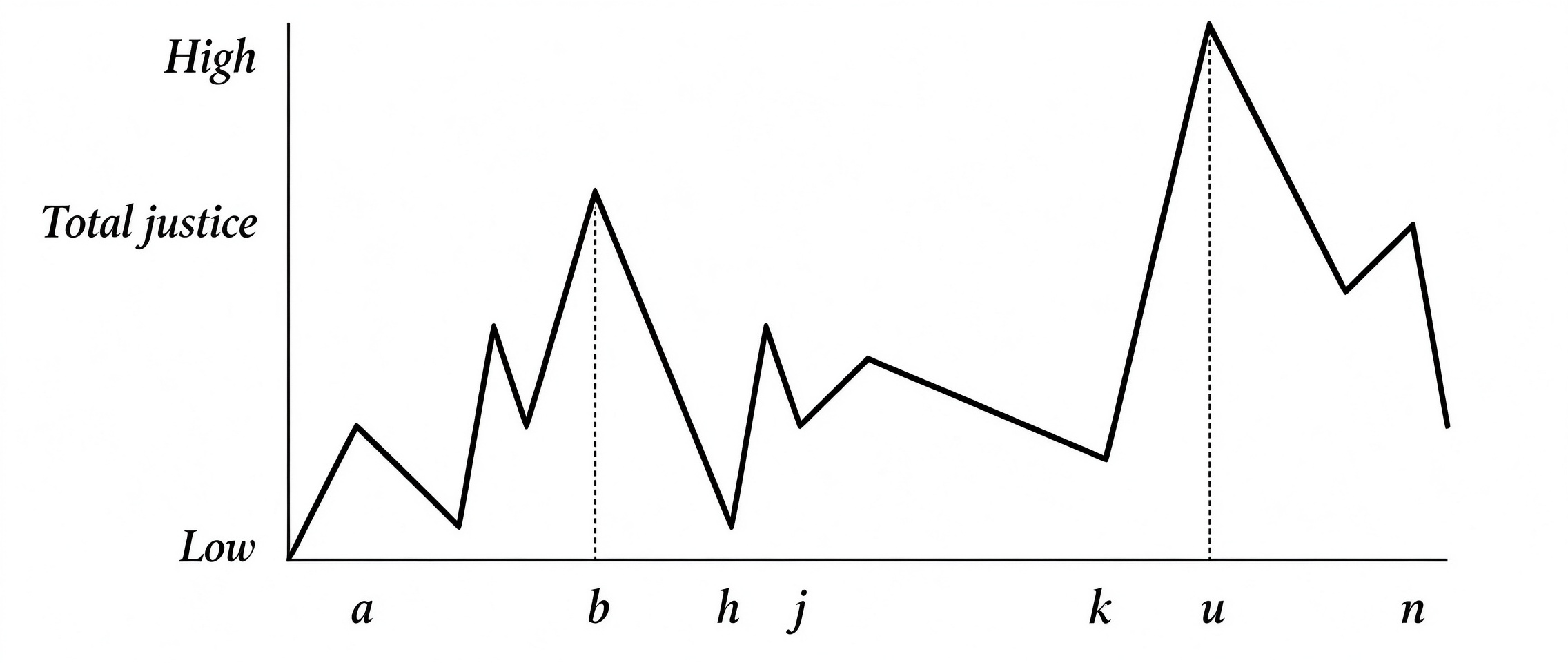
An example of the rugged pathway to the utopian ideal is property redistribution. In The Tyranny of the Ideal, Gerald Gaus argues that well-intentioned reforms aimed at realizing a utopian ideal may generate instability, conflict, or unintended consequences4. The issue of property redistribution provides a clear illustration of this point. For example, a society adopts the ideal of strict economic equality and implements extensive redistributive policies to approach this vision. Reforms may be driven by a commitment to fairness or a desire to improve the situation of the most disadvantaged groups. But, established expectations and incentives for productivity and investment can be weakened, while resistance may be provoked among those who perceive the policy as unfair. Undermine social trust and cooperation from this destabilizes the basic institutions necessary to maintain justice. For Gaus, this example illustrates that the path toward the ideal is not linear: reforms interact with complex economic systems and diverse moral views, producing trade-offs and risks that cannot be ignored21. Therefore, the pursuit of justice requires sensitivity to institutional stability and public legitimacy, rather than directly leaping to a completely equal distribution of property.
In conclusion, Gaus’s critique demonstrates that highly idealized utopian visions can be politically and morally problematic in diverse societies. Using the concept of a “justice score,” he shifts attention from pursuing a distant, perfectly just society to comparing social arrangements under real conditions. His metaphor of the “rugged landscape” illustrates how reforms aimed at approaching an ideal can produce unintended consequences, instability, or setbacks, showing that the path to justice is complex and non-linear. Overall, Gaus’s approach challenges the assumption that utopian ideals provide a practicable roadmap for societal reform, instead highlighting the importance of practical guidance, institutional stability, and sensitivity to real-world conditions.
| Philosopher | Main ideal of justice | Practical role of ideals | Stance on types of utopian guidance |
| Rawls | Justice as fairness; equal liberties and the Difference Principle | Ideals guide institutional design in a well-ordered society | Endorses all five forms of guidance |
| Nozick | Self-ownership, entitlement, minimal state | Ideals protect liberty through minimal state intervention | Supports all five forms of guidance |
| Gaus | Comparative justice under pluralism; justice score and rugged landscape | Ideals have limited guidance; reform must consider complexity | Accepts conceptual, evaluative, motivational guidance; rejects institutional design and direct policy guidance |
Discussion
Where Gaus May Be Wrong
Although Gaus’s rugged landscape metaphor reveals the danger of complete utopian institutional and policy blueprints, he ignores the historical examples in which utopian ideals have successfully inspired meaningful reform. The Enlightenment’s utopian commitments to universal equal liberty have promoted abolition and suffrage expansions, providing specific policy goals so that the legal system can be gradually revised without causing social collapse. Rawlsian utopian principles of fair redistribution also affect the European welfare system, improve the well-being of marginalized groups, and enhance the overall justice level. These successes will only occur when policymakers partially and gradually apply utopian ideas rather than pursuing thorough systemic overhauls. Such cases do not verify the core proposition of utopian practicalism, that is, that complete utopian visions can provide credible institutional-design and direct-policy guidance for wholesale societal transformation. Estlund challenges the assumption that an ideal is philosophically worthless simply because it is difficult or impossible to realize22. However, even if an ideal establishes what society ought to achieve, it does not necessarily provide a reliable path towards achieving it.
Stone and Melenovsky vs. Gaus
This section introduces Stone and Melenovsky’s criticism of Gaus’s argument against utopian practicalism. Criticism of Gaus’s argument highlights the limitations of Gaus’s own positive theory in guiding practical justice efforts. Stone and Melenovsky believe that although Gaus put forward a theoretically rigorous model, it is still out of touch with the reality of morality and political practice. They argue that Gaus’s path is too abstract, ignores the broader function of ideal theory, and incorrectly presents the mechanism of diversity and predictive knowledge to promote justice. By examining these criticisms, we can understand why it is difficult for Gaus’s framework to provide a direct and actionable alternative to utopian theories to achieve justice in the real world. If Stone and Melenovsky are correct, then Gaus underestimated the practical significance of utopian theories in political philosophy.
In “Ideal Theory: True and False”, Peter Stone first reconstructed Gerald Gaus’s ideal theory formal model, which defines “the ideal theory” as a specialized evaluation perspective to evaluate social justice23. Gaus insists that any credible ideal theory must meet two core conditions: the Social Realizations Condition, which requires a consistent comparison and ranking according to the justice inherent in the social world; and the Orientation Condition, which requires evaluating them by the measurable proximity between the non-ideal society and the ideal social world of a single perfect justice. In order to satisfy the Orientation Condition, Gaus added that the theory of the ideal must include similarity ordering to judge the relative proximity between social worlds, and a distance metric quantifying the proximity, thus forming a two-dimensional evaluation that combines the intrinsic justice score with the distance from the ideal. Gaus based all his criticism of ideal theory on this model, arguing that it reveals the “tyranny of the ideal” embedded in contemporary political philosophy.
Stone first criticized Gaus’s failure to defend the normative necessity of the Orientation Condition, which is a fundamental flaw in his model. Although Gaus cited Sen’s comparative justice framework to support the Social Realizations Condition, he did not fully explain why political philosophy must require orientation towards an ideal society. Sen’s writings show that consistent and useful comparative judgements can be made without referring to the perfect social world, so that the ideal becomes redundant in theory24. Gaus admits that Sen’s analysis makes the ideal less necessary, but still argues that some role of orientation is still important. Stone pointed out that Gaus’s model lacks a solid foundation.
Stone’s strongest objection is that Gaus may criticize an overly narrow version of ideal theory. If the ideal theory does not require a single fixed end point or a measurable distance from the end point, Gaus’s argument for the guidance problem may not be applicable to all ideal theories. According to this view, ideals can guide political reasoning without acting as blueprints for complete institutional transformation.
Stone further argues that Gaus’s model is empty in description because it does not correspond to any major contemporary theory of justice, especially the works of John Rawls, which are often regarded as paradigmatic instances of ideal theory. Rawls’ justice as fairness relies on lexically ordered principles to compare and evaluate social arrangements, rather than measuring the ideal distance from the fixed system. In fact, Rawls argues about which system can best realize its principles without focusing on a single utopian endpoint5. Gaus’s model also failed to capture other important paths, which means that his criticism may attack a simplified version of the ideal theory, rather than the real academics it claims to challenge.
Melenovsky made two criticisms of Gaus’s views on ideal theory and diversity. First, Gaus overly narrowed the value of ideal theory to set long-term reform goals, ignoring its role in developing and refining normative theory. Thinking about the ideal society helps to clarify the core moral values, distinguish intrinsic and instrumental goods, and define justice principles, even if the ideal is not the goal of reform. Second, Gaus confused the evaluation perspective with the scientific perspective. He advocates that the perspective of multiple evaluations expands people’s cognitive scope and prediction ability, but Melenovsky believes that neighbourhood constraints are actually determined by the level of development of social science, not just by evaluative diversity alone25. Although the two may be indirectly related, improving social science is the main way to reduce prediction uncertainty.
Melenovsky’s criticism is clear and important: Gaus overly narrowed the ideal theory into a tool for long-term change, thus underestimating its broader philosophical and moral importance. Specifically, Melenovsky insists that critical participation in ideal theory can strengthen the ethical and moral foundation of justice. By thinking about the ideal society, philosophers can distinguish between intrinsic and instrumental goods more clearly, so as to improve the moral reasoning that guides both theoretical and practical reform. Therefore, Gaus limited the concept of ideal theory to practical reform, ignoring a key role of the concept: it can create space for moral reflection and conceptual clarity.
Melenovsky provides an exceptionally clear and sharp criticism of Gaus’s view of diversity and its neighborhood constraint in that Gaus confuses two different concepts, namely evaluative diversity and the role of the social sciences in prediction. Whereas Gaus argues that greater evaluative diversity expands cognitive range, Melenovsky notes that the neighborhood constraint also depends on the limits of social scientific knowledge. This distinction suggests that the limits of social scientific prediction cannot be explained solely by the variety of moral perspectives. Societies may better predict and address issues of justice not merely by embracing diversity, but also by improving social scientific knowledge. Melenovsky argues that this weakness makes Gaus’s theory less useful for improving social and political structures in a specific and empirically grounded way.
In conclusion, Stone and Melenovsky identify what they regard as a significant weakness in Gaus’s model: the tension between an abstract conception and its practical implementation. Stone highlights the potential disconnect between theory and action, while Melenovsky emphasizes the insufficient attention given to moral reflection and empirical knowledge. Both therefore argue that a theory of justice should not stop at aspirational statements, but should also provide workable guidance for complex societies. However, it is still necessary to determine whether their criticisms in fact refute Gaus’s claim about utopian practicalism.
Why Their Objections Do Not Work
The arguments by Stone and Melenovsky are valuable, but they did not explain why Gaus’s criticism of utopian practicalism is flawed. Most of their concerns revolve around whether ideal theory has other philosophical applications or whether Gaus offers the strongest positive proposal. Nevertheless, the central issue in this essay is narrower: do their criticisms show that utopian aspirations can lead society toward justice in the strong practical sense required by utopian practicalists? The answer remains negative.
The first step is to recognize that utopian practicalism is not a straw man but a genuine position within political philosophy. Philosophers such as Rawls and Nozick demonstrate how idealized conceptions of justice can be applied to institutional design and political assessment9,5,6. Although Stone may be correct that not every ideal theory precisely matches Gaus’s formal model, this does not dismiss Gaus’s criticism. Gaus is criticizing a real inclination in political philosophy: the idea that consideration of an idealized or highly idealized system of social organization may be used to guide reforms in the existing society. As both Rawls and Nozick use idealized constructions in this manner, Gaus is still criticizing a genuine and significant position.
Second, Stone cannot demonstrate any fault in Gaus’ argument against utopian practicalism. It is strongest when Stone argues that some justice theories might not require a single fixed endpoint. However, even supposing this is the case, the practical issue raised by Gaus remains. Actual societies are characterized by moral pluralism, institutional complexity, and unpredictability. Under these circumstances, it remains challenging to demonstrate how an ideal could direct the reform of a given society without oversimplifying the path from an unjust society to a more just one. Stone thus undermines part of Gaus’s model, but fails to prove that utopian practicalism can be successfully used to solve the guidance problem.
Third, Melenovsky’s criticism cannot be effective against Gaus’s objection either. It may be true that ideal theory has broader value than Gaus permits. Ideal theory can support moral reflection, conceptual clarification, and normative discourse. Nevertheless, this admission only confirms utopia’s conceptual, evaluative, and motivational value as a source of guidance; it cannot prove utopian ideals are capable of supplying reliable institutional-design or direct-policy guidance in practice. At most, Melenovsky’s argument validates utopia’s theoretical reflective function, which is distinct from the dependable reform roadmap function demanded by utopian practicalism’s institutional and policy guidance claims.
It is therefore reasonable to concede to Stone and Melenovsky that a more limited version of utopian ideals is still useful. Ideals can be used by philosophers to reason more carefully about justice, organize moral disagreement, or criticize existing institutions. However, such a role is not the strong practical role required by utopian practicalism. Once this distinction has been made, their criticisms lose much of their force. Their objections do not show that Gaus’s criticism fails; rather, they show that ideal theory may retain some limited theoretical value.
For this reason, Stone and Melenovsky do not establish that Gaus’s argument against utopian practicalism fails. If utopias are applied in the strong practical sense required by utopian practicalists, then Gaus is still convincing in his critique: such ideals are too remote, too speculative, and too prone to becoming politically misleading or even tyrannical.
Conclusion
This essay has argued that utopian theories cannot deliver reliable institutional-design or direct-policy guidance to move societies toward justice, as they fail to provide a clear, stable sequential reform route from non-ideal institutions to a fully just social order. This conclusion does not deny utopia’s capacity to provide conceptual, evaluative, and motivational guidance for normative thinking about justice. However, even though utopian models have occupied a central place in political philosophy for a long time by clarifying concepts of justice and presenting images of ideal societies, they remain too far removed from reality to be directly applicable to politics. Theories put forward by theorists like Rawls and Nozick demonstrate how ideal models seek to organize institutions according to principles of justice, but still depend on highly idealized assumptions concerning agreement, rationality, and social cooperation.
The main issue with using utopian thinking as a point of reference in reform is highlighted by Gerald Gaus. In morally diverse communities, citizens have conflicting views of justice, which makes it difficult to impose a single vision of an ideal society which everyone agrees with. Gaus introduces the idea of the justice score to redirect attention toward comparative ways of assessing justice in real societies. He also uses his metaphor of the rugged landscape to further illustrate how institutional changes intended to approximate an ideal may have unpredictable effects, disrupt social cooperation and create new types of injustice. As this analysis indicates, progress towards perfect justice is non-linear, and cannot be confidently predicted by ideal theories alone.
Gerald Gaus presents the core problem with using utopia as the basis of reform clearly and convincingly: there are various and sometimes incompatible views on what justice should look like in morally pluralistic societies, and it is impractical to implement a single, all-encompassing vision of an ideal society. To this end, Gaus introduces the concept of the justice score to focus attention on more practicable comparative standards rather than on creating an ideally just social order.
Gaus presents a clear argument about comparative judgments of justice in real communities and further demonstrates how his concept of the rugged landscape might help illustrate the fact that institutional reforms aimed at approximating an ideal may have unintended consequences, undermine cooperation and create novel types of injustice. Therefore, he concludes that ideal justice cannot be achieved through a linear process and cannot be reliably planned through ideal theory alone.
Stone and Melenovsky critique Gaus. They point out important questions about the role of ideal theory. They mainly ask how people use it to explain moral rules and help normative thinking. But they do not break Gaus’ main idea. This idea says utopia-based ideals cannot work as a guide to get justice in complex societies. Ideal theory still has real problems when people use it to change groups and make new policies. This is because people cannot easily guess institutions, moral disagreements, and social conditions.
Acknowledgments
The author would like to thank the mentor for the feedback and suggestions given during the revision process.
References
- Plato. The Republic. Penguin Classics, London, 2012. [↩] [↩] [↩]
- T. More. Utopia. Yale University Press, New Haven, 2001 [↩] [↩]
- Popper, K. R. The Poverty of Historicism. Routledge, 1957. [↩]
- G. Gaus. The Tyranny of the Ideal. Princeton University Press, Princeton, 2016, https://doi.org/10.23943/princeton/9780691183428.001.0001. [↩] [↩]
- J. Rawls. A Theory of Justice. Harvard University Press, Cambridge, MA, 1971. [↩] [↩] [↩] [↩] [↩] [↩] [↩] [↩] [↩]
- R. Nozick. Anarchy, State, and Utopia. Basic Books, New York, 1974. [↩] [↩] [↩] [↩] [↩]
- E. Bloch. The Principle of Hope. MIT Press, Cambridge, MA, 1986. [↩]
- F. Jameson. Archaeologies of the Future: the desire called utopia and other science fictions. Verso, London, 2005. [↩]
- B. Laurence. Justice in theory and practice: debates about utopianism and political action. Philosophy Compass. Vol. 18, no. 11, e12945, 2023, https://doi.org/10.1111/phc3.12945. [↩] [↩] [↩] [↩] [↩] [↩]
- Levitas, R. The Concept of Utopia. Peter Lang, 2010. [↩]
- Valentini, L. “Ideal vs. Non-Ideal Theory: A Conceptual Map.” Philosophy Compass, Vol. 7, No. 9, 2012, pp. 654–664. [↩]
- Freeman, S. Rawls. Routledge, New York, 2007. [↩]
- Stemplowska, Z. and Swift, A. “Ideal and Nonideal Theory.” In The Oxford Handbook of Political Philosophy, Oxford University Press, 2012, pp. 373–390. [↩]
- Farrelly, C. “Justice in Ideal Theory: A Refutation.” Political Studies, Vol. 55, No. 4, 2007, pp. 844–864. [↩]
- Bader, R. M. “The Framework for Utopia.” In The Cambridge Companion to Nozick’s Anarchy, State, and Utopia, edited by R. M. Bader and J. Meadowcroft, Cambridge University Press, 2011, pp. 255–288. [↩]
- Kukathas, C. “E Pluribus Plurum, or, How to Fail to Get to Utopia in Spite of Really Trying.” In The Cambridge Companion to Nozick’s Anarchy, State, and Utopia, edited by R. M. Bader and J. Meadowcroft, Cambridge University Press, 2011. [↩]
- G. Gaus. The Order of Public Reason: a theory of freedom and morality in a diverse and bounded world. Cambridge University Press, Cambridge, 2010. [↩] [↩] [↩] [↩] [↩] [↩] [↩] [↩]
- J. Rawls. The Law of Peoples: with “The Idea of Public Reason Revisited”. Harvard University Press, Cambridge, MA, 1999. [↩]
- Mills, C. W. “‘Ideal Theory’ as Ideology.” Hypatia, vol. 20, no. 3, 2005, pp. 165–183. [↩]
- Singer, A. “Gaus’s Choice: The Open Society as an Ideal.” Social Theory & Health / Political Studies Review [verify journal details before final submission], 2018. [↩]
- Brinkmann, M. “A Problem for Transcendental Justice.” 2016. [↩]
- Estlund, D. Utopophobia: On the Limits (If Any) of Political Philosophy. Princeton University Press, 2020. [↩]
- P. Stone. Ideal theory: true and false. Ethical Theory and Moral Practice. Vol. 24, No. 2, pg. 375–380, 2021. [↩]
- A. Sen. The Idea of Justice. Harvard University Press, Cambridge, MA, 2009. [↩]
- C. M. Melenovsky. The value of a non-ideal. Social Theory and Practice. Vol. 45, no. 3, pg. 427–450, 2019. [↩]