
ABSTRACT
Background/Objective: Cosmic inflation posits that the early universe underwent rapid exponential expansion, resolving fundamental problems in standard Big Bang cosmology—namely the horizon, flatness, and magnetic monopole problems. Despite its theoretical elegance, inflation remains observationally unconfirmed. The Cosmic Microwave Background (CMB)—relic radiation released approximately 380,000 years after the Big Bang—represents the most powerful tool for probing early-universe physics and constraining inflationary models. This paper reviews the theoretical foundations of inflation, the physics encoded in CMB temperature and polarization signals, and the current and future observational efforts to detect direct evidence of inflation.
Methods: This review synthesizes peer-reviewed literature, published observational datasets from space-based and ground-based CMB experiments, and established theoretical frameworks in cosmology to evaluate the current state of inflationary theory and CMB science.
Results: The CMB temperature power spectrum constrains fundamental cosmological parameters, including the spatial geometry of the universe, the baryonic matter fraction (∼4.9%), and the cold dark matter density (Ωc h2 = 0.1200 ± 0.0012). CMB polarization measurements confirm E-mode signals consistent with primordial density perturbations. However, primordial B-mode polarization—the gravitational-wave signature of inflation—remains undetected, with the tensor-to-scalar ratio constrained to r0.05 < 0.036 at 95% CL.
Conclusions: While the CMB provides strong indirect support for inflation, detection of primordial B-modes remains essential for direct confirmation. Next-generation instruments—including CMB-S4, LiteBIRD, and the Simons Observatory—target sensitivities in the range σ(r) ∼ 0.0005–0.003, positioning the field to resolve this question within the next decade.
Keywords: Cosmic inflation, Cosmic Microwave Background, CMB polarization, B-modes, primordial gravitational waves, tensor-to-scalar ratio, inflationary cosmology
Introduction
Background and Context
The origin of our universe remains among the most profound questions in modern physics. The prevailing cosmological framework—the Hot Big Bang model—successfully accounts for the expansion of the universe, the abundance of light elements, and the existence of the Cosmic Microwave Background. The reasons for this model’s successes regarding expansion and light elements are general relativity and Big Bang nucleosynthesis (BBN), respectively. By applying Einstein’s equations of general relativity to a universe that is both homogeneous and isotropic, while using the Friedmann-Lemaître-Robertson-Walker metric, scientists derived the Friedmann equations1. Solving these equations can tell scientists how far the distance between distant objects grows with time—which is what expansion is. Big Bang nucleosynthesis occurred a few minutes after the Big Bang, when the universe cooled to the point where protons and neutrons could combine via nuclear fusion2. This cooling universe, the Coulomb barriers, and the lack of stable nuclei at mass number 8 ensured only the lightest elements could form: mostly helium-4 with small amounts of deuterium, helium-3, and lithium-72. However, the Hot Big Bang model leaves several observational puzzles unresolved: the near-perfect uniformity of the CMB across causally disconnected regions, the extraordinary spatial flatness of the universe, and the absence of magnetic monopoles that grand unified theories predict should be abundant3. Cosmic inflation, first proposed in the early 1980s3,4,5, offers an elegant resolution to all three problems through a brief period of exponential spatial expansion in the universe’s earliest moments.
Problem Statement and Rationale
Despite inflation’s theoretical success, it remains an unconfirmed hypothesis. No direct observational evidence has yet been obtained that proves inflationary expansion occurred. The critical missing piece is the detection of primordial B-mode polarization in the CMB—a signal that would be the direct imprint of the gravitational waves generated by inflation. Current observational upper limits on the tensor-to-scalar ratio (r0.05 < 0.036 at 95% CL) demonstrate that this signal, if it exists, is extraordinarily faint, requiring increasingly sensitive instrumentation to detect6.
Significance and Purpose
Confirming or ruling out inflation would constitute one of the most significant advances in modern cosmology. A positive detection of primordial B-modes would not only validate the inflationary paradigm but would also provide a direct probe of physics at energy scales some 13 orders of magnitude beyond the reach of particle accelerators. This paper synthesizes the theoretical and observational landscape of CMB physics to clarify what has been established, what remains unknown, and what the next generation of experiments can realistically achieve. While there are a few sources that map predicted values to observed limits and projected sensitivities7,8,9, they are advanced and written for specialists. Therefore, researchers with basic calculus and physics knowledge will have difficulty understanding these research papers, hindering their ability to contribute to the search for the primordial B-modes. This paper is meant for those aforementioned researchers, and follows a thread through the theory of inflation, physics behind the CMB, the tensor-to-scalar ratio and several next-generation experiments, the current limits set by observations, and ends by comparing current limits to what models predict. This thread is developed in the scope of the single-field slow-roll, due to reasons explained later in Scope and Limitations.
Objectives
This review has three objectives: (1) to present the theoretical motivation for cosmic inflation and the three classical problems it resolves; (2) to present measurements and features of the CMB that inflation predicts, such as the temperature power spectrum, the E-modes, and the search for B-modes; and (3) to compare current upper limits on the tensor-to-scalar ratio with predictions of models to find what classes of models are disfavored by the current limits or are under pressure from projected sensitivities from the next-generation experiments.
Scope and Limitations
This paper uses the Slow-Roll Single Scalar Field model, treating it as the primary inflationary framework, and the CMB as the source for observational data. The choice of model used was because of the observational limits mentioned later. Planck, for instance, derives its limit on r assuming the single-field consistency relation in slow-roll10. The Slow-Roll Single Scalar Field model is also the simplest model of inflation in accordance with observed data10. That reasoning is why this paper does not have an in-depth survey of other models, and if other models are mentioned, it is due to their predictions and how they bear on the interpretation of the CMB (see the Limitations in Discussion).
Theoretical Framework
This paper adopts the ΛCDM (Lambda Cold Dark Matter) cosmological model, the current standard model of cosmology, which describes a spatially flat universe composed of ordinary matter, cold dark matter, and a cosmological constant driving accelerated expansion. Base ΛCDM does not assume inflation itself; it assumes a parameterized primordial scalar power spectrum—adiabatic, nearly scale-invariant, and close to Gaussian11. Inflation is the leading physical mechanism proposed to generate those initial conditions, and the CMB power spectrum is analyzed here as the primary window into whether it did.
Methods
Source Identification
There was no systematic search of any database to find the sources used for this paper. Rather, the preliminary sources were given by the mentor the author worked with on this paper. Between January and May of 2026, this mentor—who held a PhD in physics, was a postdoctoral research associate at the University of Chicago, and specialized in the CMB—provided and directed readings regarding CMB anisotropies, blackbody radiation, and the CMB temperature power spectrum. The author also used Claude—an AI model made by Anthropic—from July to October 2026 to trace results reported in the sources recommended by the mentor to the underlying research papers that produced those results. These research papers were then checked by the author to determine that the papers existed and that they matched what Claude reported.
Inclusion and Exclusion Criteria
The research papers used meet the following criteria: (1) whether the paper was relevant to the theory of inflation, the CMB physics, and the observed limits on the tensor-to-scalar ratio; and (2) whether the paper reported its own results or analysis and the paper was published in a peer-reviewed journal. However, there are some sources that are exceptions to these criteria, as they are either reviews or web pages. The reviews are used to support context claims in the text, while the web pages—as well as one review—are used as credits for the figures in the paper.
Data Extraction
There are several key parameters extracted from the literature. These include: the CMB temperature of 2.725 K12, the amplitude of the CMB anisotropies (δT/T ∼ 10−5)13, the physical baryon density (Ωbh2 = 0.0224 ± 0.0001)11, the cold dark matter density (Ωch2 = 0.1200 ± 0.0012)11, and the current upper limit on the tensor-to-scalar ratio r0.05 < 0.036 at 95% confidence6. These values all come from primary measurement research papers, and were found by the author.
Synthesis Method
Extracted information was organized thematically into three areas: (1) the theoretical framework of inflation, (2) the physics of CMB temperature and polarization signals, and (3) the experimental landscape. Content was synthesized narratively, with quantitative results presented in context of their source experiments and theoretical significance.
Verification
To ensure verification of every quantitative value, the author identified them in the source cited for those values. If the reported value could not be found in the source, then the value itself was corrected or replaced to be one reported in the source. Claude was also responsible for informing the author about the papers in which those values should appear, and the author looked through those recommended papers.
Limitations of the Approach
The identification of sources was done by the mentor and Claude, without a systematic approach to find sources. As such, there are no screening counts or search dates that can be reported, and there was only a single author who did both the writing of this paper and checking of the data values against the sources they appeared in, as discussed previously.
Results
The Theory of Inflation
The Inflation Theory holds that, after the Big Bang, space underwent an exponential expansion spanning at least 60 e-folds14, which was sufficient to bring the observable universe into causal contact before the expansion began. This theory posits that quantum fluctuations in the early universe became macroscopically amplified during this expansion, giving rise to the density perturbations that seeded the large-scale structure of the universe15. Inflation provides the leading mechanism for generating the primordial initial conditions used in ΛCDM fits, but direct observational confirmation that it occurred has not yet been achieved. The theory nonetheless commands broad acceptance in cosmology because it addresses three major unsolved problems of the Hot Big Bang model: the Horizon Problem, the Magnetic Monopole Problem, and the Flatness Problem. Inflation is not the only proposed resolution; bouncing and ekpyrotic cosmologies address the same three problems16. It is, however, the most extensively studied of these frameworks and the only one with a broad observational test program currently underway9, and for the reasons given in Scope and Limitations it is the focus of this review.
Horizon Problem
The CMB exhibits a nearly uniform temperature in all directions across the sky, implying that all observed regions were once in thermal equilibrium. Under standard Big Bang cosmology without inflation, however, the regions of the CMB sky separated by more than approximately 2° would have been causally disconnected—too far apart for light to have traveled between them since the Big Bang. Inflation resolves this by positing that the entire observable universe originated from a region small enough to be in causal contact before the inflationary epoch, after which the rapid expansion placed these regions beyond each other’s particle horizons3.
Magnetic Monopole Problem
Grand Unified Theories (GUTs)—models that unify the strong nuclear, weak nuclear, and electromagnetic forces—predict the production of magnetic monopoles (hypothetical particles carrying isolated magnetic charge) at extremely high temperatures in the early universe17. Despite this prediction, no magnetic monopole has ever been detected. The predicted production rate varies across different GUTs, as the different symmetry-breaking schemes result in different monopole densities17. However, generic GUT-scale phase transitions imply a monopole density far greater than observational limits. Inflation offers a solution: any monopoles produced before or during inflation would have been exponentially diluted by the subsequent expansion, reducing their number density to essentially zero in the observable universe3.
Flatness Problem
The ratio of the universe’s actual energy density to the critical energy density needed for spatial flatness (Ω) is measured to be extremely close to unity today11. In the standard Big Bang model, Ω = 1 is an unstable fixed point: even a tiny departure from flatness in the early universe would have grown rapidly, leading either to recollapse or to a universe expanding too fast for structure to form. The extreme precision of the current measurement (Ω ≈ 1 to within observational uncertainties) implies an extraordinary fine-tuning of initial conditions. Inflation resolves this by stretching any initial spatial curvature to negligibly small values, naturally driving Ω toward unity regardless of initial conditions3.
Slow-Roll Single Scalar Inflation
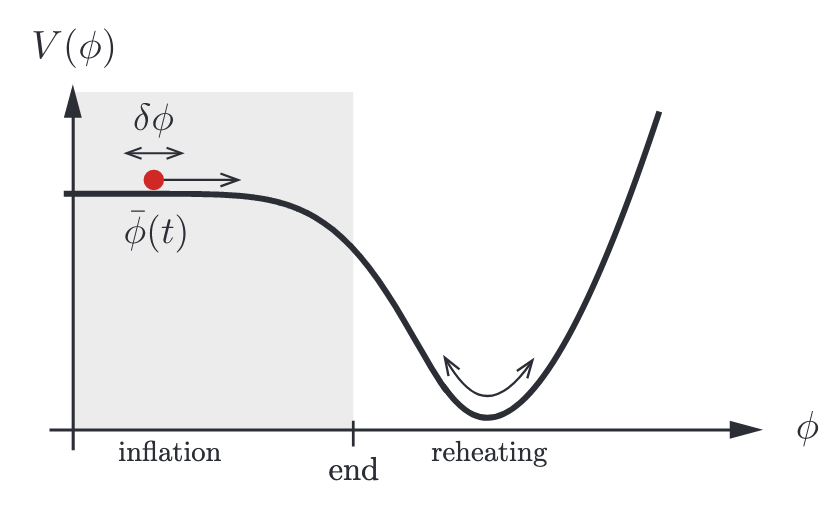
The most widely studied class of inflationary models is Slow-Roll Single Scalar Field inflation, in which a single scalar field—the inflaton, denoted as φ—permeates space, and the value of φ at each point sets the potential energy density V(φ) stored in the field. The “slow-roll” condition requires that φ evolves slowly down its potential, so that this energy density remains nearly constant, driving quasi-exponential expansion4. The duration of inflation is measured in e-folds: the number N = ln(aend/astart), where astart is the scale factor when inflation begins, and aend is the scale factor when inflation ends. For example, it would take roughly 60 e-folds to resolve the horizon and flatness problems14. The rate of how slow the field rolls is quantified by two dimensionless slow-roll parameters: ε = (MPL2/2)(V’/V)2 , and η = (MPL)2(V’’)/V, where MPL is the reduced Planck mass and primes denote derivatives with respect to φ. Physically, ε measures the steepness of the potential, while η measures its curvature. Inflation is only sustained while |ε| ≪ 1 and |η| ≪ 1, and the e-folds will continue to accumulate until ε reaches 1, at which point inflation ends. This model naturally generates both scalar (density) perturbations and tensor (gravitational-wave) perturbations, whose relative amplitude is characterized by the tensor-to-scalar ratio r.
It is important to note that these three problems constitute supporting evidence for inflation rather than proof. To obtain direct observational confirmation, it is necessary to examine the imprints inflation would have left on the Cosmic Microwave Background.
The Cosmic Microwave Background
Formation of the CMB
The Cosmic Microwave Background is the relic thermal radiation released approximately 380,000 years after the Big Bang during the epoch of recombination—the period in which the universe cooled sufficiently for electrons and protons to combine into neutral hydrogen atoms at a redshift of z* = 1089.92 ± 0.2511, which corresponds to a temperature of approximately 3000 K. Prior to recombination, photons were tightly coupled to the baryon-electron plasma via Thomson scattering, rendering the universe opaque. As the universe expanded and cooled, the electron-photon scattering rate fell below the Hubble rate, and the photons decoupled, streaming freely for the first time. This “first light” constitutes what we measure today as the CMB. The subsequent expansion of the universe has redshifted these photons from their emission temperature of ∼3000 K to the current observed temperature of 2.725 K12. The CMB was discovered in 1965 by Penzias and Wilson, who identified an isotropic excess antenna temperature that could not be attributed to any known instrumental or terrestrial source19. The CMB temperature scales with redshift as T(z) = T0(1+z), which is a relation confirmed by direct measurements of the CMB temperature at intermediate redshift20.
Although the mean CMB temperature is spatially uniform to high precision, temperature anisotropies at the level of tens of microkelvin (δT/T ∼ 10⁻5) are present across the sky11. These anisotropies reflect density perturbations in the primordial photon-baryon plasma and encode a wealth of cosmological information.
Blackbody Radiation and the CMB Spectrum
The CMB spectrum is among the most precisely measured blackbody spectra in nature. A perfect blackbody absorbs all incident radiation and re-emits it as thermal radiation distributed according to the Planck function:
where h is the Planck constant, ν is frequency, c is the speed of light, k is the Boltzmann constant, and T is the absolute temperature. The spectral peak shifts to shorter wavelengths with increasing temperature (Wien’s displacement law), and the total emitted power scales as T⁴ (Stefan-Boltzmann law). Prior to recombination, the constant photon-baryon interactions maintained the radiation in perfect thermal equilibrium, producing a blackbody spectrum. COBE’s FIRAS instrument showed that the CMB matches a blackbody spectrum to within 50 parts per million of its peak brightness21 —the most precise blackbody measured in nature.
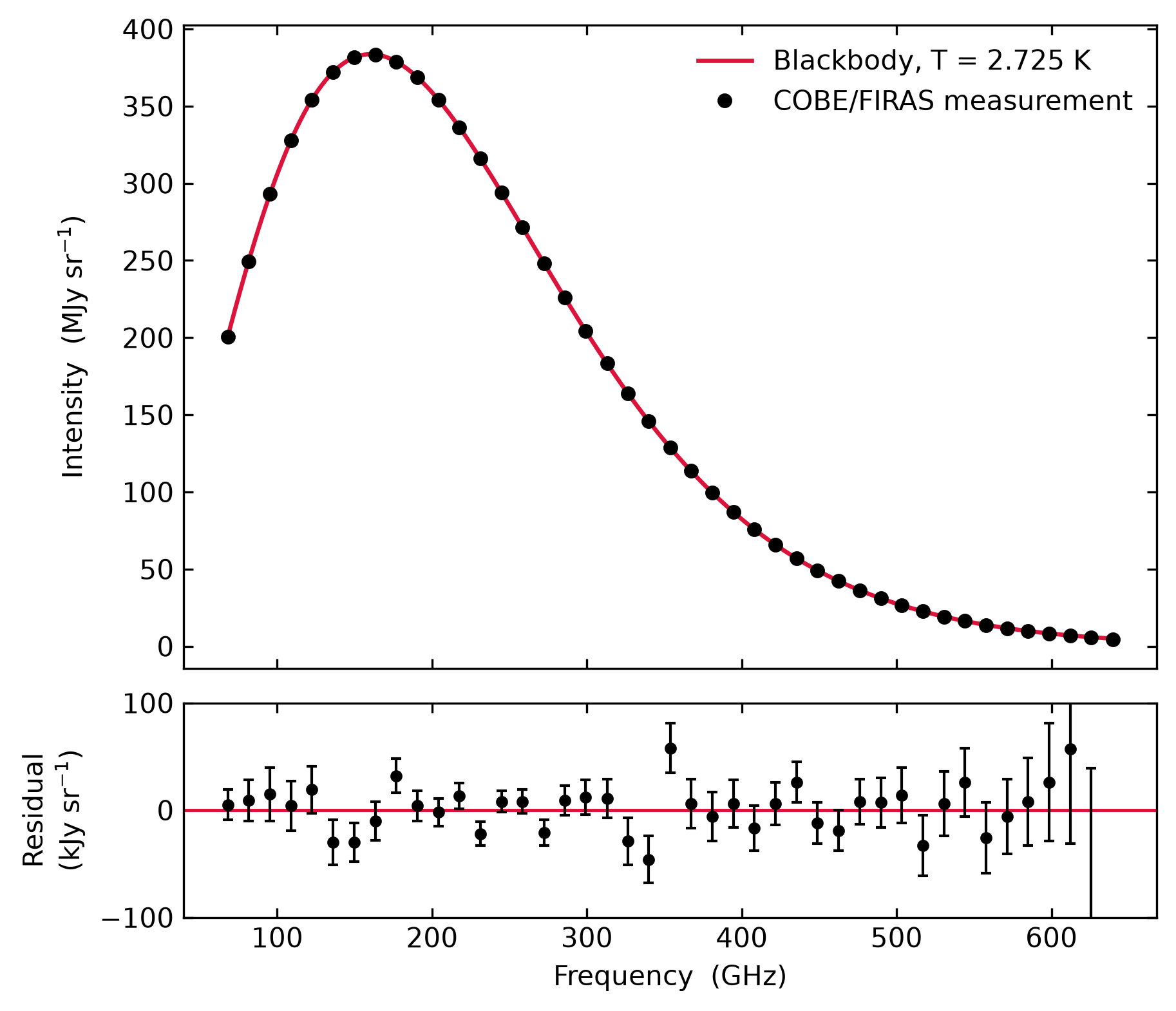
The CMB is the preserved blackbody emission from the photon-baryon plasma at decoupling, redshifted by cosmic expansion into the microwave regime, and its near-perfect blackbody form testifies to the thermal equilibrium conditions that prevailed in the early universe.
The CMB Temperature Power Spectrum
The angular temperature anisotropies of the CMB are decomposed into spherical harmonics, and their amplitude as a function of angular scale is described by the CMB temperature power spectrum. The x-axis of the power spectrum represents the multipole moment ℓ, which corresponds to angular scale (ℓ ∼ 180°/θ)22. The y-axis represents the amplitude of temperature fluctuations at each angular scale. The power spectrum exhibits a series of acoustic peaks arising from oscillations of the photon-baryon plasma before decoupling23: regions driven to maximum compression or rarefaction by gravity and radiation pressure at the moment of photon decoupling appear as peaks in the power spectrum.
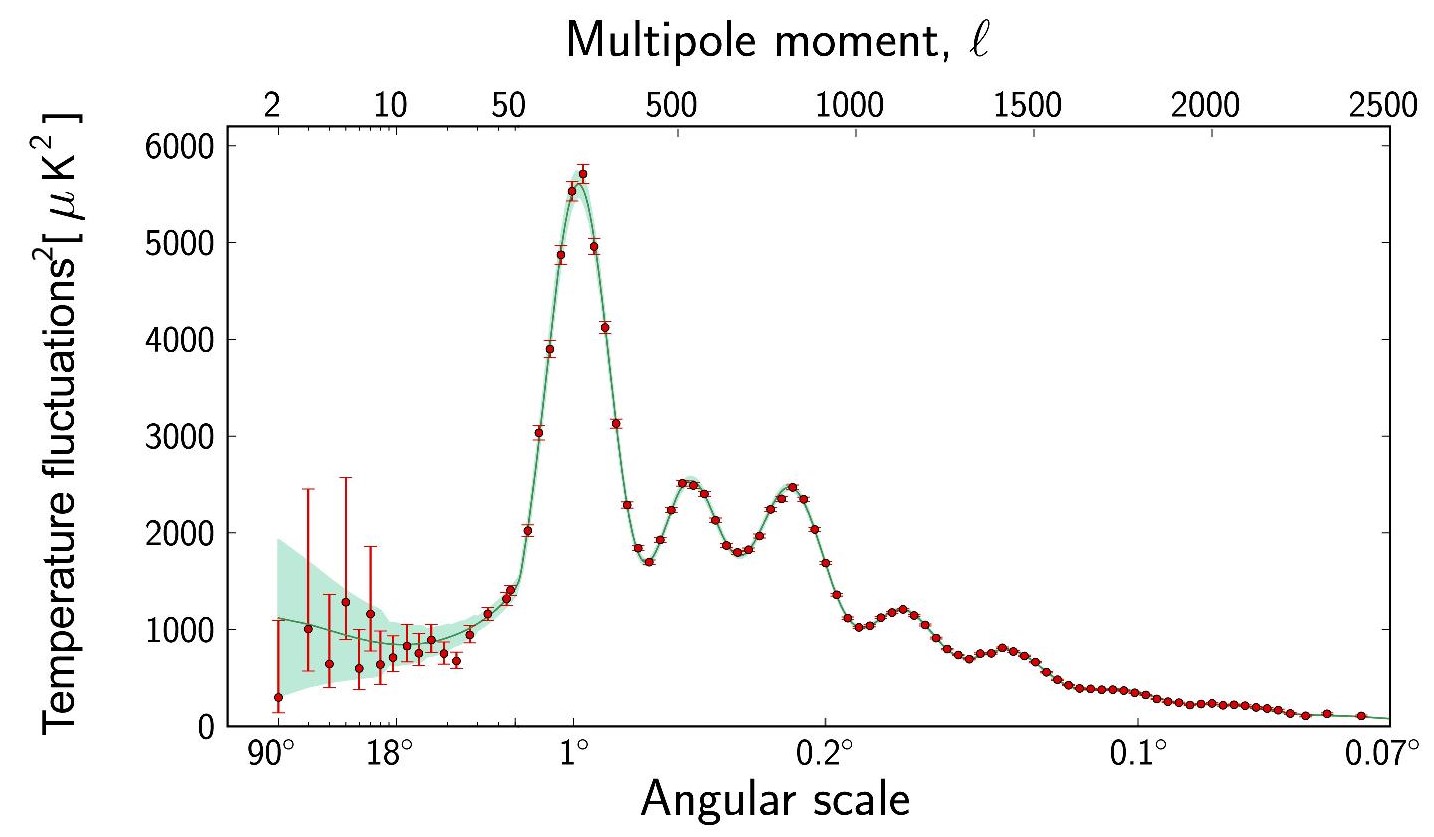
The peak structure constrains cosmological parameters through a combined multi-parameter fit to the full power spectrum rather than through single-peak readouts. Nonetheless, individual peaks are diagnostic of specific parameter combinations. The angular position of the first peak—observed at ℓ ≈ 220—is sensitive to the total energy density of the universe; its location at the predicted position for a flat geometry confirms that the universe is spatially flat to within observational uncertainties11. The relative height of the second peak is sensitive to the baryon-to-photon ratio: higher baryon density increases the amplitude of compressions relative to rarefactions, raising the first peak relative to the second. The observed second peak amplitude is consistent with baryonic matter constituting approximately 4.9% of the total mass-energy of the universe11. The relative height of the third peak, within this global fit, is sensitive to the matter-to-radiation ratio; since dark matter deepens gravitational potential wells without experiencing radiation pressure, a higher dark matter fraction enhances the third peak relative to the second. The Planck 2018 analysis reports a cold dark matter density of Ωc h2 = 0.1200 ± 0.001211, which corresponds to approximately 26.4% of the total energy density of the universe.
CMB Polarization: E-modes and B-modes
Thomson scattering of CMB photons off electrons at the surface of last scattering produces a partial linear polarization of the CMB. This polarization field is decomposed into two components based on their symmetry properties: E-modes (curl-free, or gradient-type) and B-modes (divergence-free, or curl-type)25,26.
E-modes are the dominant polarization signal, generated by the same scalar density perturbations responsible for the CMB temperature anisotropies. Crucially, the E-mode power spectrum is observed to be out of phase with the temperature power spectrum—the E-mode peaks coincide with the troughs of the temperature spectrum, precisely as predicted for a plasma oscillating under adiabatic initial conditions. This phase relationship has ruled out alternative models in which the CMB anisotropies are generated by causal mechanisms after the Big Bang (e.g., topological defects), and confirmed that the temperature anisotropies originate from super-horizon perturbations present before recombination27.
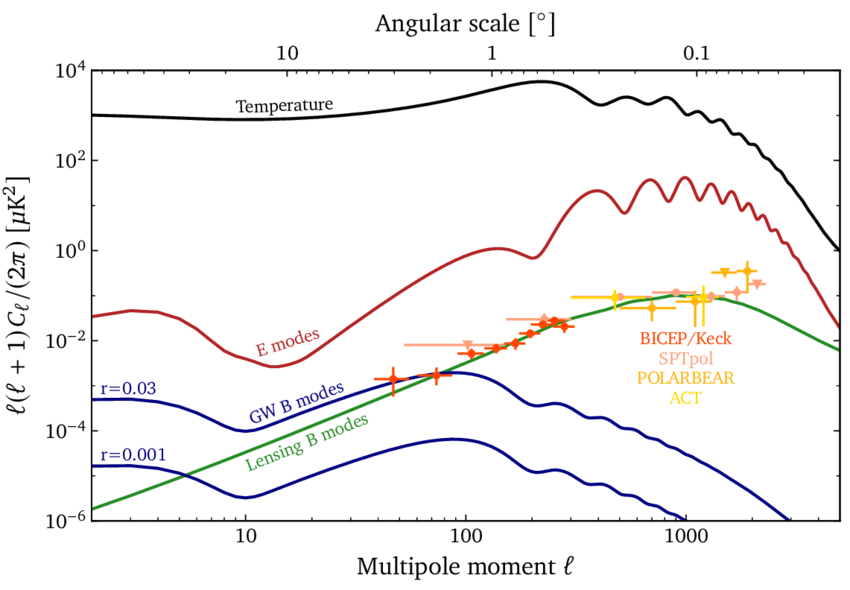
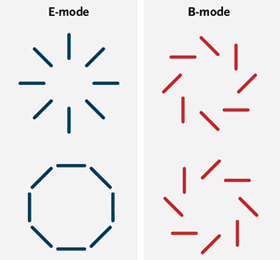
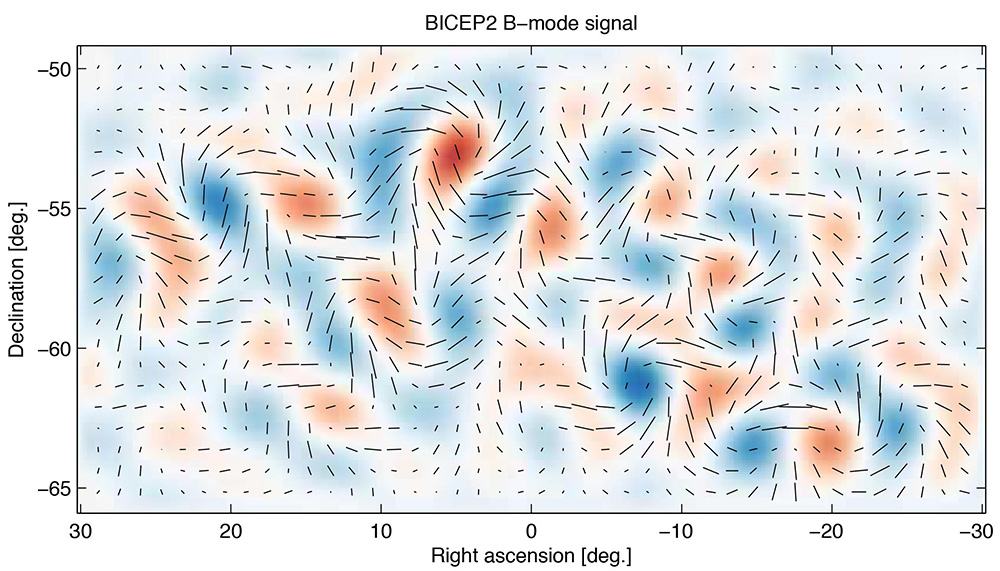
B-modes, by contrast, cannot be generated by scalar density perturbations at linear order. In the primordial universe, only tensor perturbations—gravitational waves—produce B-mode polarization. If inflation occurred, it would have generated a stochastic background of gravitational waves that imprinted a characteristic B-mode pattern on the CMB at degree angular scales. The detection of primordial B-modes would therefore constitute direct observational evidence that inflation occurred.
A second, observationally distinct source of B-modes exists: the gravitational lensing of the dominant E-mode signal by large-scale structure as CMB photons traverse the universe over billions of years. This lensing-induced B-mode signal has been detected and measured, and serves as a cosmological probe of the integrated matter distribution along the line of sight. Disentangling lensing B-modes from the primordial signal—a process called “delensing”—is one of the primary technical challenges facing next-generation experiments.
The Tensor-to-Scalar Ratio
Inflationary models predict two types of primordial perturbations: scalar perturbations (density fluctuations), which generate temperature anisotropies and E-modes; and tensor perturbations (gravitational waves), which generate primordial B-modes. The amplitude ratio of these two perturbation types is characterized by the tensor-to-scalar ratio r = At/As, where At and As are the primordial tensor and scalar power spectrum amplitudes, respectively. In slow-roll inflation, r ≈ 16ε, which fixes the steepness of the inflaton potential and the energy scale of inflation30.
Different inflationary models predict different values of r: large-field models (e.g., chaotic inflation with φ² or φ⁴ potentials) predict relatively large values (r ≳ 0.01), while small-field and plateau models (e.g., Starobinsky R² inflation31) predict r ∼ 0.003 or smaller10. Current observations from the BICEP/Keck Array and Planck place an upper limit of r0.05 < 0.036 at 95% CL6, strongly disfavoring the simplest large-field models. This constraint means that the primordial B-mode signal, if it exists, is the weakest of the four CMB observables—below the temperature anisotropy, E-mode, and lensing B-mode signals in amplitude—making its detection the principal technical challenge of observational cosmology.
Observational Experiments
Space-Based Missions
The history of space-based CMB observation begins with the Soviet RELIKT-1 satellite (1983–1984), which provided early upper limits on CMB anisotropies, bounding the amplitude of primordial density perturbations before any detection existed32. NASA’s Cosmic Background Explorer (COBE, launched 1989) achieved two landmark results: the FIRAS instrument confirmed the near-perfect blackbody spectrum of the CMB33, and the DMR instrument detected for the first time the temperature anisotropies at the level of δT/T ∼ 10⁻⁵, fixing the amplitude of the primordial scalar perturbations that any inflationary model must produce13. This work earned Smoot and Mather the 2006 Nobel Prize in Physics. NASA’s Wilkinson Microwave Anisotropy Probe (WMAP, launched 2001) provided the first full-sky CMB temperature maps with sufficient resolution to resolve the acoustic peaks, measuring the fundamental cosmological parameters with percent-level precision, including the scalar spectral index ns—the primary slow-roll observable—whose measured value falls below unity27. The European Space Agency’s Planck spacecraft (2009–2013) extended WMAP’s measurements to higher angular resolution and sensitivity, producing the most precise CMB temperature and E-mode power spectra to date. However, Planck’s polarization sensitivity is not sufficient to compete with ground-based B-mode experiments. As such, its constraint on r is derived from temperature and E-mode spectra rather than from a B-mode measurement: r0.002 < 0.10 at 95% CL from Planck alone. Once BICEP2/Keck B-mode data are included, that constraint is tightened to r0.002 < 0.056 at 95% CL10.
Ground-Based Telescopes
Ground-based telescopes operating from high-altitude, low-humidity sites have provided complementary high-resolution CMB measurements and led the search for B-mode polarization. The Atacama Cosmology Telescope (ACT), located at 5,190 m elevation in the Atacama Desert of Chile, conducted high-sensitivity, high-resolution surveys that produced CMB lensing maps, which contribute to the delensing needed to isolate primordial B-mode signals34. The South Pole Telescope (SPT), located at the Amundsen-Scott South Pole Station and still in operation, conducted observations in the millimeter and submillimeter wavelength ranges and contributed to the first detection of gravitationally lensed B-modes in the CMB, which constitute the contaminating foreground that any primordial B-mode measurement must be separated from35. The BICEP/Keck Array series of experiments, also at the South Pole, is specifically optimized for degree-scale B-mode polarization and currently sets the most stringent upper limit on the primordial tensor-to-scalar ratio (r0.05 < 0.036 at 95% CL)6. Together, these observatories and the satellite missions established the ΛCDM framework as the standard model of cosmology and set the observational constraints on inflation that the following sections examine.
Discussion
Restatement of Key Findings
This review has established that inflation elegantly resolves the three classical problems of the Hot Big Bang model (horizon, flatness, magnetic monopole) and predicts a specific observational signature—primordial B-mode polarization in the CMB—that would constitute direct evidence of inflationary gravitational waves. The CMB temperature power spectrum, measured by WMAP and Planck, confirms a spatially flat universe with a baryonic matter fraction of ∼4.9% and a cold dark matter density of Ωc h2 = 0.1200 ± 0.0012. The E-mode polarization spectrum confirms that CMB temperature anisotropies originate from adiabatic, super-horizon density perturbations. Primordial B-modes have not been detected, and the current observational upper limit stands at r0.05 < 0.036 at 95% CL6.
Implications and Significance
An important distinction must be maintained between confirming that inflation occurred and identifying which inflationary model is correct. Detection of primordial B-modes at any level of r > 0 would provide strong and direct evidence for a primordial gravitational-wave background of the kind that inflation predicts. Establishing inflation as a physical event, however, would only happen if that detection was consistent with other predictions, such as the measured spectral index and the adiabaticity of the primordial perturbations, rather than resting on r alone. Even then, determining which of the many viable inflationary models correctly describes that expansion requires a precise measurement of r compared against model-specific predictions. Because many models predict overlapping or degenerate values of r (particularly in the r ≲ 0.01 regime), even a positive detection may not uniquely discriminate between competing theoretical frameworks without additional information from the spectral tilt and running of the primordial power spectrum.
The significance of this line of research extends beyond resolving inflation. In single-field slow-roll inflation, the tensor amplitude fixes the potential energy density during inflation: V = (3π2 × As/2) × r × MPl4, where As is the measured scalar amplitude and MPl is the reduced Planck mass10. Evaluating this with the Planck value of As results in V1/4 ≈ (1.02 × 10¹⁶ GeV) × (r/0.01)1/4. As a result, a measured r translates directly into the energy scale at which inflation occurred. The current upper limit, r0.05 < 0.036, corresponds to V1/4 < 1.4 × 10¹⁶ GeV at 95% CL10. Taking the LHC’s sensitivity to new particle production to be of order 1 TeV, this places the inflationary energy scale at approximately 13 orders of magnitude beyond direct accelerator reach—a ratio that follows from the relation stated above, rather than from any independent assumption. That being said, it still inherits the assumptions from the single-field slow-roll inflation used to derive it.
Connection to Objectives
The three objectives outlined in the Introduction have been addressed: (1) the paper presents the horizon, flatness, and magnetic monopole problems and how inflation solves them, as well as the slow-roll framework; (2) the paper presents features of the CMB that inflation predicts, such as the temperature power spectrum, the E-modes, and the search for B-modes; and (3) the current upper limit on r disfavors the simplest large-field models while the next-generation projected sensitivities put pressure on plateau models. Traced end to end, the chain holds so far as data currently allows: the slow-roll framework predicts a specific relationship between the spectral index and the tensor-to-scalar ratio, the measured ns = 0.9649 ± 0.0042 sits comfortably inside the range needed for the framework, a spectrum that lies 8.4σ from scale invariance10, and the limit on r has strongly disfavored simple large-field potentials. Even so, the final link—a positive detection of primordial B-modes—remains open.
Future Research Directions
Several next-generation experiments are under development or have been proposed with the sensitivity to detect primordial B-modes at the r ∼ 0.001 level or below. CMB-S4, a joint NSF/DOE initiative, was designed to deploy approximately 500,000 detectors across telescopes at the South Pole and in the Atacama Desert, but DOE and NSF ended their support for the project in 2025; its design sensitivity remains a useful benchmark. Its two-telescope architecture—large-aperture telescopes for high-resolution delensing reconstruction and small-aperture telescopes for large-angular-scale primordial B-mode sensitivity—was designed to achieve σ(r) ∼ 0.000536. JAXA’s LiteBIRD satellite, currently targeted for launch in Japanese fiscal year 2036, with the plan under review, is optimized for full-sky CMB polarization mapping at degree angular scales from above the atmosphere, targeting a total uncertainty on r of σ(r) < 0.0017. The Simons Observatory (SO), located in the Atacama at 5,200 m elevation, serves as an intermediate-generation instrument bridging the current BICEP/Keck results and the CMB-S4 era, projecting a sensitivity of σ(r) ∼ 0.0038.
The non-detection of the primordial B-modes does not—by itself—suggest that r is small, but rather is a reflection of four major limitations of our current technology as well as what current observations can separate from the sky. The first of these is that the sensitivity of the surveys can be improved either by observing certain sections for longer or by increasing the number of detectors—both of which can increase the detector-seconds, which is one detector observing a given area for one second. To find the total number of detector-seconds, multiply the number of detectors by the observing time. The problem with adding more of these detector-seconds is that the resulting improvement has diminishing returns—to increase the sensitivity by a certain factor k, the number of detector-seconds has to increase by a factor k2. For example, to reduce the noise by half, four times as many detector-seconds are needed36. The second limit is from atmospheric emissions—specifically water vapor and oxygen. These specific emissions limit the ability to observe certain frequencies and they can corrupt the largest angular scales—including scales at which the primordial signals are expected7—meaning that ground-based observations will have a harder time searching for those primordial gravitational waves than space-based observations7. The third limit comes from polarized Galactic foregrounds—which are thermal emissions from the dust grains and the synchrotron radiation from the fast electrons in the Galaxy’s magnetic field. Because both of these are polarized, they can mimic the primordial B-modes, and at a single frequency, they look the same as the CMB. To differentiate between the polarized Galactic foregrounds and the CMB, one must take observations across multiple frequencies6. The final limit is delensing. As the CMB photons traveled to us, the gravitational force of the large-scale structures bent their paths slightly, which is referred to as “weak lensing”. This lensing can turn E-mode polarization into B-mode patterns, which are a source of contamination for researchers searching for the primordial gravitational waves36. Unlike the Galactic foregrounds, the lensing signal cannot be mitigated by simply using more frequencies36. Delensing is the mathematical process of reducing the lensing B-modes: it builds a template of the lensing B-mode map using the lensing potential—which is the total gravitational deflection from large-scale cosmic structures—and an E-mode map, then subtracts that template from the measured B-mode map. Doing this process to a high degree of precision requires high-resolution and high-sensitivity maps36. To progress on the search for the primordial B-modes, advancements must be made on all four limits at once, and improving raw sensitivity alone would not tighten the constraint on r.
No experiments have detected the primordial B-modes, and the current upper limit is r < 0.0366. σ(r) is the uncertainty that experiments have on their r value, and experiments can only confirm a signal if their r is at least 5 times the magnitude of its σ(r). This value has been adopted as the usual standard for claiming a discovery. For instance, the Simons Observatory has projected that σ(r) ∼ 0.0038, so its threshold is 0.015. This means that the window of r where the Simons Observatory can detect 5σ is 0.015 to 0.036. The observatory cannot make a 5σ signal detection below 0.015, and therefore, the observatory’s main contribution is likely going to be improving the upper limits. LiteBIRD, on the other hand, projected σ(r) ∼ 0.0017, so its 5σ threshold is 0.005, while CMB-S4 projected σ(r) ∼ 0.000536, so its 5σ threshold is 0.0025. Finally, the Starobinsky R2 inflation predicts r ∼ 0.0038, which is below LiteBIRD’s threshold, but above CMB-S4’s threshold. To be specific, R2’s signal is near 3σ for LiteBIRD, which is not a discovery, while it is near 6σ for CMB-S4, making it a detection. Because its prediction is approximately a factor of 10 below the current limit, R2 is the natural target for the next generation of experiments to reach. If nothing is found at LiteBIRD’s σ(r) or CMB-S4’s σ(r), the upper limit would fall to approximately r < 0.002 or r < 0.001 respectively, excluding Starobinsky’s prediction for N ≈ 60. The observed outcomes depend on whether experiments reach those sensitivities. These outcomes will likely be either marginal signals or exclusions, and the sensitivity targets are the deciding factors.
Limitations
This review has several limitations. The first is a lack of original data or analysis: every data value is taken from existing sources, meaning that those values are only as reliable as the sources, and the values were not independently derived. The second is a narrow scope: by only developing the narrative thread through the Slow-Roll Single Scalar Field model, readers cannot judge multi-field models, non-Gaussianity, or alternative models such as the ekpyrotic one16. The third is that this review was last edited and verified in October 2026, and because the scientific community is constantly making advancements in inflation research, new constraints may exist, rendering the constraints reported here—such as the 0.036 r limit—outdated.
Closing Thought
The CMB is a time capsule from the first moments of the universe, and B-mode polarization is the key that may unlock its most fundamental secret. Whether the coming decades yield a detection of primordial gravitational waves or a null result that forces the field to rethink its theoretical frameworks, the pursuit of inflationary cosmology through the CMB represents one of the most ambitious scientific endeavors of our era—one that probes not merely the history of the universe, but the quantum mechanical origins of all structure within it.
Acknowledgements
This author would like to thank Sanah Bhimani—the mentor mentioned in this paper—for providing and directing research papers about the theory of inflation, CMB physics, blackbody radiation, and for her help with clarifying any doubts the author had when writing this paper. This paper also used data based on observations obtained with Planck (http://www.esa.int/Planck), an ESA science mission with instruments and contributions directly funded by ESA Member States, NASA, and Canada.
AI Use Statement
Claude, an AI model made by Anthropic, was used by the author for a few purposes. These are: (1) source tracing: as mentioned previously, Claude was used to trace values from the preliminary sources supplied by the mentor to the research papers they appeared or were mentioned in. When the new sources were found, the author used Claude to determine the new order of the sources and the author reordered the citations; (2) checking: Claude was also used to check whether the numbers the author found while reading the papers matched what was being looked for at the time; (3) feedback: Claude was often used to check if the author’s spelling or grammar contained any major errors, and the author would rewrite the sentence when those errors were pointed out; (4) explanations: Claude was also used as a source of explanations for when the mentor was unavailable, and the author would first understand key parts, and rewrite that in their own words; and (5) plotting: Claude wrote code to plot Figure 2, and the author inputted the COBE/FIRAS data into its code to obtain the plot.
References
- A. Friedmann. Über die Krümmung des Raumes. Zeitschrift für Physik. Vol. 10, pg. 377–386, 1922, https://doi.org/10.1007/BF01332580 [↩]
- R. H. Cyburt, B. D. Fields, K. A. Olive, T.-H. Yeh. Big bang nucleosynthesis: present status. Reviews of Modern Physics. Vol. 88, pg. 015004, 2016, https://doi.org/10.1103/RevModPhys.88.015004 [↩] [↩]
- A. H. Guth. Inflationary universe: a possible solution to the horizon and flatness problems. Physical Review D. Vol. 23, pg. 347–356, 1981, https://doi.org/10.1103/PhysRevD.23.347 [↩] [↩] [↩] [↩] [↩]
- A. D. Linde. A new inflationary universe scenario: a possible solution of the horizon, flatness, homogeneity, isotropy and primordial monopole problems. Physics Letters B. Vol. 108, pg. 389–393, 1982, https://doi.org/10.1016/0370-2693(82)91219-9 [↩] [↩]
- A. Albrecht, P. J. Steinhardt. Cosmology for grand unified theories with radiatively induced symmetry breaking. Physical Review Letters. Vol. 48, pg. 1220–1223, 1982, https://doi.org/10.1103/PhysRevLett.48.1220 [↩]
- BICEP/Keck Collaboration. Improved constraints on primordial gravitational waves using Planck, WMAP, and BICEP/Keck observations through the 2018 observing season. Physical Review Letters. Vol. 127, pg. 151301, 2021, https://doi.org/10.1103/PhysRevLett.127.151301 [↩] [↩] [↩] [↩] [↩] [↩] [↩]
- LiteBIRD Collaboration. Probing cosmic inflation with the LiteBIRD cosmic microwave background polarization survey. Progress of Theoretical and Experimental Physics. Vol. 2023, pg. 042F01, 2023, https://doi.org/10.48550/arXiv.2202.02773 [↩] [↩] [↩] [↩] [↩]
- P. Ade, et al. The Simons Observatory: science goals and forecasts. Journal of Cosmology and Astroparticle Physics. Vol. 2019, pg. 056, 2019, https://doi.org/10.48550/arXiv.1808.07445 [↩] [↩] [↩] [↩]
- A. Achúcarro, M. Biagetti, M. Braglia, G. Cabass, et al. Inflation: Theory and observations. Snowmass 2021 White Paper. https://doi.org/10.48550/arXiv.2203.08128, 2022 [↩] [↩] [↩]
- Planck Collaboration. Planck 2018 results. X. Constraints on inflation. Astronomy & Astrophysics. Vol. 641, pg. A10, 2020, https://doi.org/10.1051/0004-6361/201833887 [↩] [↩] [↩] [↩] [↩] [↩] [↩]
- Planck Collaboration. Planck 2018 results. VI. Cosmological parameters. Astronomy & Astrophysics. Vol. 641, pg. A6, 2020, https://doi.org/10.1051/0004-6361/201833910 [↩] [↩] [↩] [↩] [↩] [↩] [↩] [↩] [↩]
- D. J. Fixsen. The temperature of the cosmic microwave background. The Astrophysical Journal. Vol. 707, pg. 916–920, 2009, https://doi.org/10.1088/0004-637x/707/2/916 [↩] [↩]
- G. F. Smoot, et al. Structure in the COBE differential microwave radiometer first-year maps. The Astrophysical Journal. Vol. 396, pg. L1–L5, 1992 [↩] [↩]
- J. Ellis, D. Wands. Inflation. Review of Particle Physics, Particle Data Group. https://pdg.lbl.gov/2023/reviews/rpp2023-rev-inflation.pdf, 2023 [↩] [↩]
- V. F. Mukhanov, G. V. Chibisov. Quantum fluctuations and a nonsingular universe. JETP Letters. Vol. 33, pg. 532–535, 1981 [↩]
- J. Khoury, B. A. Ovrut, P. J. Steinhardt, N. Turok. The ekpyrotic universe: colliding branes and the origin of the hot big bang. Physical Review D. Vol. 64, pg. 123522, 2001, https://doi.org/10.1103/PhysRevD.64.123522 [↩] [↩]
- J. P. Preskill. Cosmological production of superheavy magnetic monopoles. Physical Review Letters. Vol. 43, pg. 1365–1368, 1979 [↩] [↩]
- H. A. Winther. CMB theory: Initial conditions. cmb.wintherscoming.no. https://cmb.wintherscoming.no/theory_initial.php [↩]
- A. A. Penzias, R. W. Wilson. A measurement of excess antenna temperature at 4080 Mc/s. The Astrophysical Journal. Vol. 142, pg. 419–421, 1965, https://doi.org/10.1086/148307 [↩]
- T. Kotani, et al. A new precise measurement of the cosmic microwave background radiation temperature at z = 0.89 toward PKS1830–211. The Astrophysical Journal. Vol. 993, pg. 134, 2025, https://doi.org/10.3847/1538-4357/ae0a1e [↩]
- D. J. Fixsen, E. S. Cheng, J. M. Gales, J. C. Mather, R. A. Shafer, E. L. Wright. The cosmic microwave background spectrum from the full COBE FIRAS data set. The Astrophysical Journal. Vol. 473, pg. 576–587, 1996, https://doi.org/10.1086/178173 [↩] [↩]
- W. Hu, M. White. CMB anisotropies: total angular momentum method. Physical Review D. Vol. 56, pg. 596–615, 1997, https://doi.org/10.1103/PhysRevD.56.596 [↩]
- P. J. E. Peebles, J. T. Yu. Primeval adiabatic perturbation in an expanding universe. The Astrophysical Journal. Vol. 162, pg. 815–836, 1970, https://doi.org/10.1086/150713 [↩]
- European Space Agency. Planck power spectrum of temperature fluctuations in the cosmic microwave background. ESA/Planck. https://sci.esa.int/web/planck/-/51555-planck-power-spectrum-of-temperature-fluctuations-in-the-cosmic-microwave-background, 2013 [↩]
- U. Seljak, M. Zaldarriaga. Signature of gravity waves in the polarization of the microwave background. Physical Review Letters. Vol. 78, pg. 2054–2057, 1997, https://doi.org/10.1103/PhysRevLett.78.2054 [↩]
- M. Kamionkowski, A. Kosowsky, A. Stebbins. A probe of primordial gravity waves and vorticity. Physical Review Letters. Vol. 78, pg. 2058–2061, 1997, https://doi.org/10.1103/PhysRevLett.78.2058 [↩]
- G. Hinshaw, et al. Nine-year Wilkinson Microwave Anisotropy Probe (WMAP) observations: cosmological parameter results. The Astrophysical Journal Supplement Series. Vol. 208, pg. 19, 2013, https://doi.org/10.1088/0067-0049/208/2/19 [↩] [↩]
- B. Koberlein. So mode it B. briankoberlein.com. https://briankoberlein.com/blog/so-mode-it-b/ [↩]
- C. Bischoff. CMB polarization. Lweb.cfa.harvard.edu. https://lweb.cfa.harvard.edu/\~cbischoff/cmb/, 2016 [↩]
- D. Baumann. Inflation. Physics of the Large and the Small: TASI 2009. World Scientific, pg. 523–686, 2011, https://doi.org/10.48550/arXiv.0907.5424 [↩]
- A. A. Starobinsky. A new type of isotropic cosmological models without singularity. Physics Letters B. Vol. 91, pg. 99–102, 1980, https://doi.org/10.1016/0370-2693(80)90670-X [↩]
- A. A. Klypin, I. A. Strukov, D. P. Skulachev. The Relikt missions: results and prospects for detection of the microwave background anisotropy. Monthly Notices of the Royal Astronomical Society. Vol. 258, pg. 71–81, 1992, https://doi.org/10.1093/mnras/258.1.71 [↩]
- J. C. Mather, et al. Measurement of the cosmic microwave background spectrum by the COBE FIRAS instrument. The Astrophysical Journal. Vol. 420, pg. 439–444, 1994, https://doi.org/10.1086/173574 [↩]
- M. S. Madhavacheril, et al. The Atacama Cosmology Telescope: DR6 gravitational lensing map and cosmological parameters. The Astrophysical Journal. Vol. 962, pg. 113, 2024, https://doi.org/10.3847/1538-4357/acff5f [↩]
- D. Hanson, et al. Detection of B-mode polarization in the cosmic microwave background with data from the South Pole Telescope. Physical Review Letters. Vol. 111, pg. 141301, 2013, https://doi.org/10.1103/PhysRevLett.111.141301 [↩]
- K. Abazajian, et al. CMB-S4: forecasting constraints on primordial gravitational waves. The Astrophysical Journal. Vol. 926, pg. 54, 2022, https://doi.org/10.3847/1538-4357/ac1596 [↩] [↩] [↩] [↩] [↩] [↩]