

Abstract
Stem cell-based therapies have been increasingly investigated in the management of chronic musculoskeletal pain. However, the completion and transparency of related clinical trials remain uncertain. In this study, trial completion and public results reporting were evaluated among stem cell-based treatments for chronic musculoskeletal pain using ClinicalTrials.gov data. In the initial dataset, a total of 171 records were contained. Among them, 147 eligible interventional trials remained after screening. Completion was evaluated among 70 trials with resolved statuses, and results-reporting was assessed among 52 completed trials that at least 24 months of reporting opportunity had been given. To examine associations with randomization, masking, intervention model, funder type, trial phase, and enrollment, descriptive statistics, Fisher’s exact tests, odds ratios, and Mann-Whitney U tests were used. Among trials with resolved status, 58 of 70 (82.9%) were completed. In the primary final-status, no statistically significant association between completion and the predefined design characteristics was detected. Only 8 of 52 mature completed trials (15.4%) had posted results on ClinicalTrials.gov. Higher observed reporting was shown in masked trials than unmasked trials (28.6% versus 6.5%; OR = 5.80; nominal p = 0.049), even though this finding was exploratory due to the small number of reporting events. Overall, trial completion was relatively common. However, public registry reporting remained limited. This highlights the need for greater transparency and timely results disclosure in this developing clinical research field.
Introduction
Chronic musculoskeletal pain usually arises from osteoarthritis and degenerative spinal disease as a major cause of disability. In 2020, approximately 595 million people worldwide were affected by osteoarthritis, while around 619 million people were affected by low back pain as the leading global cause of years lived with disability1,2. Nonfatal disease burden is substantially contributed by other musculoskeletal disorders with an expectation to increase as population age3. Due to the reduction of symptoms primarily from many current treatments rather than reverse structural degeneration, there has been continued interest in therapies that may provide longer-lasting functional improvement4.
Potential regenerative approaches for musculoskeletal disease is stem cell-based therapies that are particularly mesenchymal stromal cells (MSCs). MSCs are known to be able to differentiate toward connective-tissue lineages and release bioactive factors that may influence inflammation, immune response, and tissue repair5. For their therapeutic effects, paracrine and immunomodulatory signaling are main influencing factors rather than direct replacement of damaged tissue6. Clinical investigation of MSCs from bone marrow, adipose tissue, and other sources for osteoarthritis has been encouraged by these properties as well as other sources for osteoarthritis and related painful musculoskeletal conditions7.
However, clinical findings remain varied. Improvements in pain and function in knee osteoarthritis have been reported by randomized trials of allogeneic bone-marrow MSCs8, while symptomatic benefit has been suggested by dose-ranging studies of autologous bone-marrow MSCs9. Pain and functional improvement has been reported by trials of adipose-derived MSCs10, even though other controlled studies have indicated variable treatment effects across doses and outcomes11. Improvement in selected outcomes after bone-marrow MSC treatment and adipose-derived MSC treatment has been reported by placebo-controlled trials12,13. However, little to no clinically important improvement was found in chronic knee pain in a 2024 meta-analysis of 16 randomized trials compared with placebo or usual care14. For degenerative disc disease, Xie et al., reported statistically significant pooled reductions in pain and disability, even though the analysis included only three small randomized trials15. Schol et al., also examined clinically meaningful signals for cell-based and platelet-rich plasma treatments while emphasizing substantial heterogeneity, risk of bias, and the limited number of randomized studies16. Therefore, possible benefit may be suggested by early evidence, but its reliability remains uncertain. According to the U.S. Food and Drug Administration, regenerative medicine products are not approved for orthopedic conditions, including disc disease, osteoarthritis, back pain, and knee pain17.
Beyond efficacy, whether trials are completed and whether findings become publicly available matter to confirm the reliability of the evidence. Trial discontinuation may waste research resources, while leaving clinical questions unresolved18. Both discontinuation and non-publication were documented by the research on chronic-pain trials19. Incomplete results reporting was repeatedly shown by studies of ClinicalTrials.gov20,21, and registry results may appear substantially later than trial completion22. In addition, many studies were shown to never achieve timely public disclosure, according to analyses of completed U.S. trials23.
These transparency concerns are especially relevant to cell-based musculoskeletal research. Substantial non-reporting, retrospective registration, and discrepancies between registered and published outcomes were identified by a 2024 systematic review of MSC trials for musculoskeletal disorders24. Furthermore, rapid growth in clinical activity was found in a 2026 global analysis of stem cell-based osteoarthritis trials but with continued heterogeneity and incomplete public reporting25. Structured registration and results disclosure were emphasized by ClinicalTrials.gov reporting standards26. Together, these studies leave a narrower question unresolved that is about whether trial-design characteristics are associated with both successful completion and registry results posting within an updated ClinicalTrials.gov cohort especially focused on stem cell-based treatments for chronic musculoskeletal pain. From this perspective, this study specifically seeks to answer the research question about whether clinical-trial characteristics are associated with trial completion and public results reporting in stem-cell based treatments for chronic musculoskeletal pain. This study hypothesized that completion and publicly report results will be more likely achieved by trials with more rigorous design features, including randomized allocation, masking, parallel-group structure, and later development phase than the ones lacking these characteristics.
Methods and Materials
In this retrospective registry study, publicly available records from ClinicalTrials.gov were analyzed to examine completion and results reporting among stem cell-based trials for chronic musculoskeletal pain. The dataset was downloaded as a comma-separated values (CSV) file on July 21, 2026. The ClinicalTrials.gov search used the Intervention/Treatment query (‘mesenchymal stem cell’ OR ‘mesenchymal stromal cell’) together with the Condition/Disease query (osteoarthritis OR ‘musculoskeletal pain’ OR ‘low back pain’ OR ‘degenerative disease’). No additional status, phase, country, sex, or date filters were applied. In the file, a total of 171 records and 30 registry fields, including NCT number, study title, status, conditions, interventions, sponsor, funder type, phase, enrollment, study design, masking, allocation, intervention model, outcomes, study dates, and results-posting information were contained.
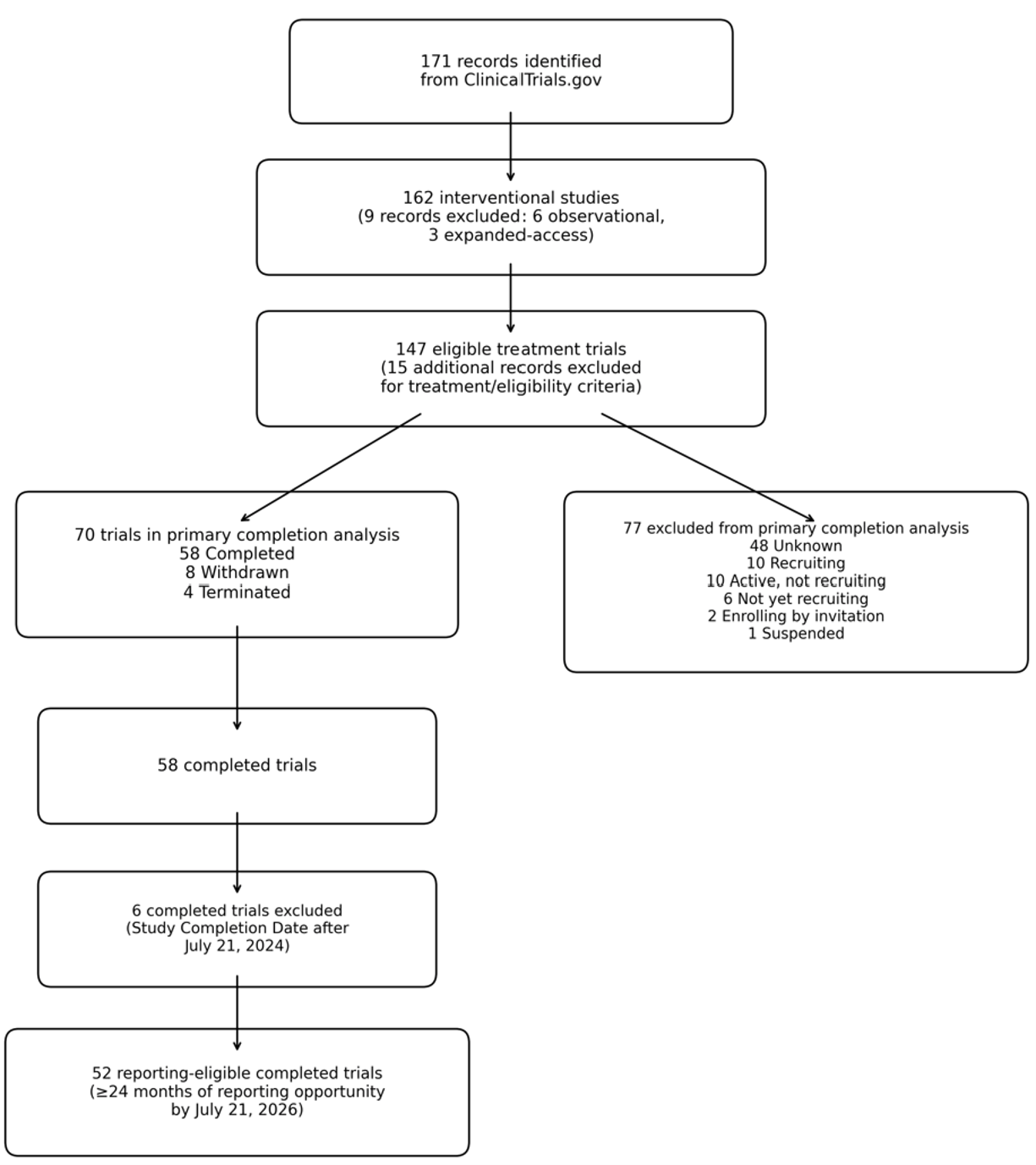
Records were first restricted to interventional studies. There were six observational studies and three expanded-access records that were removed, and a total of 162 interventional records were left. After reviewing titles, conditions, and brief summaries, each study was confirmed to directly administer a stem/stromal cell-based or cell-containing treatment for a chronic musculoskeletal condition. Studies evaluating only cell-free products such as exosomes, secretomes, or conditioned media; non-cell treatments, such as physical therapy or platelet-rich plasma without direct cell administration; diagnostic, cell-count, or cell-tracking procedures, or other interventions outside the study definitions were excluded. Eligible treatment required direct administration of viable stem/stromal cells or a viable cell-containing preparation, including BMAC, stromal vascular fraction, or microfragmented adipose tissue. Cell-free exosomes, secretomes, conditioned products, PRP-only or physical-therapy interventions, and diagnostic, cell-characterization, or cell-tracking studies were excluded. In the 15 additional exclusions, there were 7 cell-free derivative studies, 5 non-cell therapeutic/procedural studies, and 3 diagnostic, characterization, or tracking studies. For uncertain records, the title, intervention description, and brief summary were reviewed together. In addition, clear evidence of therapeutic cell administration was required for the inclusion. After excluding fifteen additional records, final descriptive cohorts of 147 eligible trials were produced.
Two primary outcomes were assessed. From the Study Status field, trial completion was determined. Trials listed ‘Completed’ were classified as completed, whereas ‘Withdrawn’ and ‘Terminated’ trials were classified as not completed. The single ‘Suspended’ trial was excluded as a final outcome was not represented by suspension. Therefore, a total of 70 trials were contained in the primary completion cohort: 58 completed, 8 withdrawn, and 4 terminated. Among the remaining 77 trials, 48 had Unknown status, 10 were Recruiting, 10 were Active, not recruiting, 6 were Not yet recruiting, 2 were Enrolling by invitation, and 1 was Suspended. As a sensitivity analysis, the 48 trials with Unknown status were classified as not completed to evaluate whether excluding these potentially stalled trials affected the completion findings. Result reporting was separately evaluated among completed trials. Rather than Primary Completion Date, Study Completion Date was used when determining reporting eligibility. Providing at least 24 months of reporting opportunity before the July 21, 2026 analysis date, completed trials with a Study Completion Date on or before July 21, 2024 were eligible. In all 58 completed trials, a Study Completion Date was contained. When only year and month were reported, the last day of that month was used conservatively without altering cohort membership. 52 trials met the reporting-eligibility criterion.
To directly correspond to the hypothesis established in this study, four design characteristics were pre-specified: randomization, masking, parallel-group design, and trial phase. When allocation explicitly indicated randomized assignment, randomization was coded as present. ClinicalTrials.gov allocation values were Randomized, Non-randomized, or NA. Since NA showed designs in which randomized allocation was not applicable, primarily single-group trials, Non-randomized and NA were combined as the ‘not randomized/NA’ reference category. No allocation values were blank. Funder Type was classified as industry when the registry value was INDUSTRY; OTHER, OTHER_GOV, and NETWORK were classified as non-industry. UNKNOWN was treated as missing/unclear and excluded from funder-specific comparisons. Single, double, triple, or quadruple masking was classified as masked, whereas no masking was classified as unmasked. For intervention model, parallel-groups versus other designs were classified. For trial phase, Early Phase 1 and Phase 1 studies were combined as the Early Phase1/Phase 1 group. Phase 1/2, Phase 2, Phase 2/3, Phase 3, and Phase 4 studies were combined as the Phase 1/2-or-later group. Records with phase coded as not applicable (NA) or with missing phase information were treated as phase unavailable and excluded only from phase-specific comparisons. Funder type was examined secondarily as industry versus non-industry. For enrollment, due to the nature of final enrollment itself being influenced by early trial discontinuation, it was summarized descriptively and examined only in the completed-trial reporting cohort. The Enrollment field was used as reported in ClinicalTrials.gov. As a separate indicator distinguishing actual from anticipated enrollment was not contained in the exported dataset, enrollment values for ongoing trials were treated as registry-reported values and were not assumed to represent final actual enrollment.
A simple logistic probability model was used to describe the relationship between individual trial characteristics and each binary outcome as follows:
where  indicates the probability that trial I was competed or publicly reported results,
 shows one trial characteristic such as randomization or masking,
 shows the intercept,
 shows the association between that characteristic and the outcome. The corresponding odds ratio was calculated as follows:
Higher odds of completion or reporting for trials possessing the characteristic were indicated by an odds ratio greater than 1, and lower odds were indicated by the one below 1.
Counts, percentages, medians, and ranges were calculated for study characteristics and outcomes. For categorical comparisons, Fisher’s exact test was used as small cell counts were contained in several groups, and univariable odds ratios with 95% confidence intervals were calculated for results-posting comparison; completion comparisons were summarized using proportions and Fisher’s exact tests. The Mann-Whitney U Test was used to compare enrollment distributions for trials with and without posted results. A two-sided p < 0.05 was used as the nominal significance threshold. However, results-reporting associations were treated as exploratory rather than definitive since only eight mature completed trials had posted results and multiple design characteristics were examined. Since the small number of reporting events could produce unstable estimates and overfitting, multivariable logistic regression was not performed. Python was used for the analyses with pandas for data management and SciPy-based statistical procedures. Since only publicly available, de-identified registry records were analyzed in this study without direct interaction with human participants, institutional review board approval was not required.
Results
A total of 171 registry records were yielded by the ClinicalTrials.gov search. Six observational studies and three expanded-access records were excluded, and a total of 162 interventional studies remained. An additional 15 records that did not represent direct stem/stromal cell treatment for chronic musculoskeletal conditions were removed by the screening of study titles, conditions, interventions, and summaries. Afterward, a total of 147 eligible trials remained. These trials formed the descriptive cohort. In the completion analysis, a total of 71 trials with resolved status were included, while a total of 52 completed trials that ended on or before July 10, 2024 were included in the results-reporting analysis, providing at least 24 months for results posting by the July 21, 2026 analysis date (Figure 1).
Among the 147 eligible trials, osteoarthritis or joint degeneration was investigated in 123 trials (83.7%), followed by 15 trials (10.2%) investigating spine, disc, or low-back conditions, 8 trials involving other musculoskeletal conditions, and 1 trial (0.7%) involving shoulder arthritis. Randomization was reported in 81 trials (55.1%), followed by masking in 66 trials (44.9%) and a parallel-group intervention model in 91 trials (61.9%). Fifty-five trials (37.4%) were industry funded. The median enrollment was 28 participants (range, 0 – 573). Phase 1/2 was the most common phase designation (37147, 25.2%), followed by Phase 1 (29/147, 19.7%), and Phase 2 (26/147, 17.7%); phase was unspecified in 29 trials (19.7%).
Among the 71 trials with resolved status, 58 were completed, 8 were withdrawn, 4 were terminated, and 1 was suspended. Therefore, it produced an overall completion rate of 82.9%. There was no significant difference in completion according to randomization, masking, intervention model, or funder type (Table 1). 83.8% completion rate was shown in the randomized trials, compared with 79.4% among trials classified as not randomized or with unavailable allocation information (p = 0.762). For masked trials, completion rates were 81.5% , compared with 81.8% for unmasked trials (p = 1.000). Completion rates were 83.3% for parallel-group and 79.3% for other intervention models (p = 0.759). Completion rates were 80.6% for industry funded trials and 82.9% for non-industry trials, respectively (p = 1.000). Among phase-specified trials, completion occurred in 38 of 42 Phase 1/2-or-later trials (90.5%) and 12 of 15 Early Phase 1/Phase 1 trials (80.0%). This difference was not statistically significant (Fisher’s exact p = 0.365).
| Characteristic | Group | Completed, n/N (%) | Completion p | Results posted, n/N (%) | Results-posting OR (95% CI) | Reporting p |
| Randomization | Randomized | 31/37 (83.8%) | 1.000 | 6/28 (21.4%) | 3.00 (0.54–16.52) | .262 |
| Not randomized/NA | 27/33 (81.8%) | 2/24 (8.3%) | Ref. | |||
| Masking | Masked | 22/26 (84.6%) | 1.000 | 6/21 (28.6%) | 5.80 (1.04–32.31) | .049 |
| Unmasked | 36/44 (81.8%) | 2/31 (6.5%) | Ref. | |||
| Intervention model | Parallel | 35/41 (85.4%) | .536 | 6/32 (18.8%) | 2.08 (0.38–11.48) | .463 |
| Other | 23/29 (79.3%) | 2/20 (10.0%) | Ref. | |||
| Funder type | Industry | 29/35 (82.9%) | 1.000 | 5/25 (20.0%) | 2.00 (0.42–9.42) | .458 |
| Non-industry | 29/35 (82.9%) | 3/27 (11.1%) | Ref. | |||
| Phase | Phase 1/2 or later | 38/42 (90.5%) | .365 | 7/34 (20.6%) | Not estimable | .165 |
| Early Phase 1/Phase 1 | 12/15 (80.0%) | 0/12 (0.0%) | Ref. |
Registry results posting was uncommon. Only 8 of 52 mature completed trials (15.4%) had posted results on ClinicalTrials.gov. Reporting rate of 21.4% was observed in randomized trials, compared with 8.3% among non-randomized/NA trials (OR = 3.00, p = 0.262). 18.8% of reporting was observed in parallel-group, compared with 10.0% for other models (OR = 2.08, p = 0.463), while 20.0% reporting was observed in industry-funded trials compared with 11.1% among non-industry trials (OR = 2.00, p = 0.458). Among the 46 reporting-eligible trials with available phase information, results were posted for 7 of 34 Phase 1/2-or-later trials (20.6%) and 0 of 12 Early Phase 1/Phase 1 trials (0.0%; Fisher’s exact p = 0.165). An odds ratio was not estimated since no Early Phase 1/Phase 1 trial had posted results. 6 of the 52 reporting-eligible trials had unavailable or not-applicable phase information. Therefore, they were excluded from this comparison. One of these six trials had posted results. Masking had the largest observed difference: 6/21 masked trials (28.6%) posted results compared with 2/31 unmasked trials (6.5%). This corresponded to OR = 5.80 and a nominal Fisher’s exact p = 0.049 (Figure 2). This finding was not treated as confirmatory as only eight reporting event occurred, and multiple exploratory comparisons were performed. 29 participants were the median enrollment among trials with posted results versus 24.5 among trials without posted results (Mann-Whitney p = 0.559).
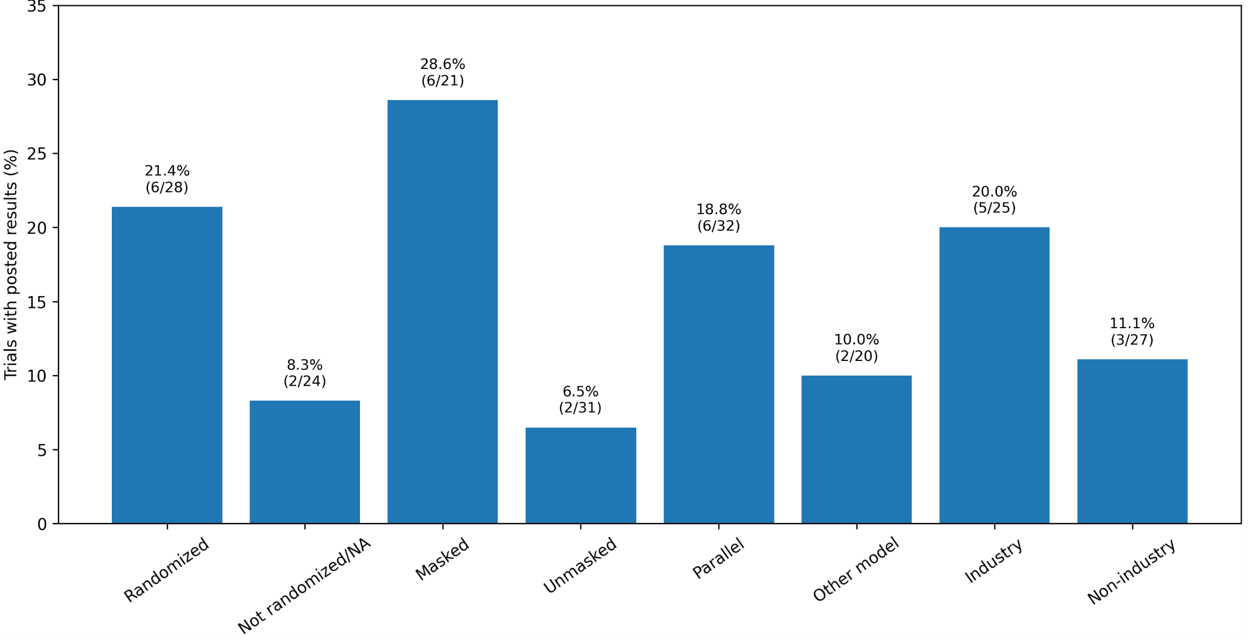
Overall, a statistically significant association with trial completion was not shown by predefined design characteristic. Across all groups, registry results posting remained low, with masking producing the strongest exploratory association with reporting.
Discussion
In this study, whether trial-design characteristics were associated with completion and public results reporting was examined among stem cell-based clinical trials for chronic musculoskeletal pain. Among trials with resolved statuses, 82.9% were completed. This suggested that most registered studies successfully reached completion. However, there was no reported statistically significant association of completion with randomization, masking, parallel-group design, funder type, or trial phase. These findings did not support the hypothesis that trials with more rigorous design characteristics will more likely be able to reach completion. There may be greater influence of factors not captured in the registry, including recruitment challenges, funding limitations, regulatory changes, investigator decisions, or treatment-related concerns on whether a trial is completed.
Public results reporting was substantially less frequent. Only 15.4% of mature completed trials had posted results in ClinicalTrials.gov even though they had at least 24 months of reporting opportunity. A higher observed reporting rate was shown in masked trials than unmasked trials (28.6% v. 6.5%; OR = 5.80; nominal p = 0.049). However, only eight trials had posted results, and several characteristics were tested. Therefore, the aforementioned association should be considered exploratory. Results posting was not significantly associated with randomization, intervention model, funder type, and enrollment.
This study has several limitations. First, ClinicalTrials.gov records may have incomplete, outdated, or incorrectly entered information. Trials registered exclusively in other international registries may have been missed. Second, studies with results published in scientific journals without posting them on ClinicalTrials.gov were classified as lacking registry results. Statistical power was limited by the small number of reporting events, while preventing reliable multivariable modeling. Finally, only associations were identified by this observational registry analysis, and causal relationships could not be established. Despite these limitations, the findings emphasize limited registry transparency within this developing clinical research field.
Conclusion
In this study, clinical trial completion and public results reporting were evaluated among stem cell-based treatments for chronic musculoskeletal pain using ClinicalTrials.gov data. Most trials with resolved statuses were completed that an overall completion rate was 82.9%. However, there was no statistically significant association of completion with randomization, masking, intervention model, funder type, or trial phase. In contrast, public registry reporting was uncommon. Only 15.4% of mature completed trials had posted results even though they had at least 24 months of reporting opportunity. The strongest observed association with results posting was shown in masked trials, even though this finding should be interpreted cautiously due to the small number of reporting events and exploratory comparisons. Overall, the findings suggest that trial completion is relatively common in this field. However, public reporting remains limited. Transparency may be strengthened by improving timely registry reporting, and this may help clinicians, researchers, and patients better evaluate the developing evidence for stem cell-based treatments for chronic musculoskeletal pain.
References
- GBD 2021 Osteoarthritis Collaborators. Global, Regional, and National Burden of Osteoarthritis, 1990–2020 and Projections to 2050: A Systematic Analysis for the Global Burden of Disease Study 2021. The Lancet Rheumatology 5 (2023). [↩]
- GBD 2021 Low Back Pain Collaborators. Global, Regional, and National Burden of Low Back Pain, 1990–2020, Its Attributable Risk Factors, and Projections to 2050: A Systematic Analysis of the Global Burden of Disease Study 2021. The Lancet Rheumatology 5 (2023). [↩]
- GBD 2021 Other Musculoskeletal Disorders Collaborators. Global, Regional, and National Burden of Other Musculoskeletal Disorders, 1990–2020, and Projections to 2050: A Systematic Analysis of the Global Burden of Disease Study 2021. The Lancet Rheumatology 5 (2023). [↩]
- D. J. Hunter, L. March, M. Chew. Osteoarthritis in 2020 and Beyond: A Lancet Commission. The Lancet 396 (2020). [↩]
- X. Wu, J. Jiang, Z. Gu, J. Zhang, Y. Chen, X. Liu. Mesenchymal Stromal Cell Therapies: Immunomodulatory Properties and Clinical Progress. Stem Cell Research & Therapy 11 (2020). [↩]
- M. B. Murphy, K. Moncivais, A. I. Caplan. Mesenchymal Stem Cells: Environmentally Responsive Therapeutics for Regenerative Medicine. Experimental & Molecular Medicine 45 (2013). [↩]
- C. Kim, A. Keating. Cell Therapy for Knee Osteoarthritis: Mesenchymal Stromal Cells. Gerontology 65 (2019). [↩]
- A. Vega, M. A. Martín-Ferrero, F. Del Canto, M. Alberca, V. García, A. Munar, et al. Treatment of Knee Osteoarthritis With Allogeneic Bone Marrow Mesenchymal Stem Cells: A Randomized Controlled Trial. Transplantation 99 (2015). [↩]
- J. M. Lamo-Espinosa, G. Mora, J. F. Blanco, F. Granero-Moltó, J. M. Nuñez-Córdoba, C. Sánchez-Echenique, et al. Intra-Articular Injection of Two Different Doses of Autologous Bone Marrow Mesenchymal Stem Cells Versus Hyaluronic Acid in the Treatment of Knee Osteoarthritis: Multicenter Randomized Controlled Clinical Trial (Phase I/II). Journal of Translational Medicine 14 (2016). [↩]
- J. Freitag, D. Bates, J. Wickham, K. Shah, L. Huguenin, A. Tenen, et al. Adipose-Derived Mesenchymal Stem Cell Therapy in the Treatment of Knee Osteoarthritis: A Randomized Controlled Trial. Regenerative Medicine 14 (2019). [↩]
- P. K. Gupta, A. Chullikana, M. Rengasamy, N. Shetty, V. Pandey, V. Agarwal, et al. Efficacy and Safety of Adult Human Bone Marrow-Derived, Cultured, Pooled, Allogeneic Mesenchymal Stromal Cells (Stempeucel®): Preclinical and Clinical Trial in Osteoarthritis of the Knee Joint. Arthritis Research & Therapy 18 (2016). [↩]
- M. Emadedin, N. Labibzadeh, M. Ghorbani Liastani, A. Karimi, N. Jaroughi, T. Bolurieh, et al. Intra-Articular Implantation of Autologous Bone Marrow-Derived Mesenchymal Stromal Cells to Treat Knee Osteoarthritis: A Randomized, Triple-Blind, Placebo-Controlled Phase 1/2 Clinical Trial. Cytotherapy 20 (2018). [↩]
- W. S. Lee, H. J. Kim, K. I. Kim, G. B. Kim, W. Jin. Intra-Articular Injection of Autologous Adipose Tissue-Derived Mesenchymal Stem Cells for the Treatment of Knee Osteoarthritis: A Phase IIb, Randomized, Placebo-Controlled Clinical Trial. Stem Cells Translational Medicine 8 (2019). [↩]
- B. Sadeghirad, Y. Rehman, A. Khosravirad, A. Sofi-Mahmudi, S. Zandieh, J. Jomy, et al. Mesenchymal Stem Cells for Chronic Knee Pain Secondary to Osteoarthritis: A Systematic Review and Meta-Analysis of Randomized Trials. Osteoarthritis and Cartilage 32 (2024). [↩]
- B. Xie, S. Chen, Y. Xu, W. Han, R. Hu, M. Chen, et al. Clinical Efficacy and Safety of Human Mesenchymal Stem Cell Therapy for Degenerative Disc Disease: A Systematic Review and Meta-Analysis of Randomized Controlled Trials. Stem Cells International 2021 (2021). [↩]
- J. Schol, S. Tamagawa, T. N. E. Volleman, M. Ishijima, D. Sakai. A Comprehensive Review of Cell Transplantation and Platelet-Rich Plasma Therapy for the Treatment of Disc Degeneration-Related Back and Neck Pain: A Systematic Evidence-Based Analysis. JOR Spine 7 (2024). [↩]
- U.S. Food and Drug Administration. Important Patient and Consumer Information About Regenerative Medicine Therapies. U.S. Food and Drug Administration (2021). [↩]
- B. Kasenda, E. von Elm, J. You, A. Blümle, Y. Tomonaga, R. Saccilotto, et al. Prevalence, Characteristics, and Publication of Discontinued Randomized Trials. JAMA 311 (2014). [↩]
- S. M. Jacobsen, T. Moore, A. Douglas, D. Lester, A. L. Johnson, M. Vassar. Discontinuation and Nonpublication Analysis of Chronic Pain Randomized Controlled Trials. Pain Reports 8 (2023). [↩]
- M. L. Anderson, K. Chiswell, E. D. Peterson, A. Tasneem, J. Topping, R. M. Califf. Compliance With Results Reporting at ClinicalTrials.gov. The New England Journal of Medicine 372 (2015). [↩]
- N. J. DeVito, S. Bacon, B. Goldacre. Compliance With Legal Requirement to Report Clinical Trial Results on ClinicalTrials.gov: A Cohort Study. The Lancet 395 (2020). [↩]
- C. Riveros, A. Dechartres, E. Perrodeau, R. Haneef, I. Boutron, P. Ravaud. Timing and Completeness of Trial Results Posted at ClinicalTrials.gov and Published in Journals. PLoS Medicine 10 (2013). [↩]
- H. Saito, C. J. Gill. How Frequently Do the Results From Completed US Clinical Trials Enter the Public Domain? A Statistical Analysis of the ClinicalTrials.gov Database. PLoS ONE 9 (2014). [↩]
- R. Holtedahl, J. I. Brox. Compliance With Requirements for Registration and Reporting of Results in Trials of Mesenchymal Stromal Cells for Musculoskeletal Disorders: A Systematic Review. BMJ Open 14 (2024). [↩]
- X. Li, Y. Zhao, D. Guo, C. Yan, J. Zhang, L. Cheng, Y. Dong. Global Clinical Trial Landscape of Stem Cell-Based Therapies for Osteoarthritis: Trends and Translational Implications. Frontiers in Cell and Developmental Biology 14 (2026). [↩]
- D. A. Zarin, T. Tse, R. J. Williams, S. Carr. Trial Reporting in ClinicalTrials.gov—The Final Rule. The New England Journal of Medicine 375 (2016). [↩]