

Abstract
Skin cancer is a major public health concern requiring attention to both health-information engagement and ultraviolet-exposure behaviors for the prevention, which may follow different socioeconomic patterns. In this cross-sectional secondary analysis, Health Information National Trends Survey 6 (HINTS 6; 2022; N = 6,252) data were used to examine household income in relation to ever seeking cancer information and self-reported sunburn during the previous 12 months. The final person-level weight and 50 jackknife replicate weights were incorporated in the survey-weighted logistic regression. Income was modeled as a five-level categorical predictor with $75,000 or more as the reference group. In the cancer information-seeking model, a total of 5,238 complete cases were included and adjusted for age, sex, education, and race/ethnicity. Adjusted chances of seeking cancer information were lower for adults with income below $20,000 (aOR = 0.48, 95% CI 0.32 – 0.73, p = 0.001), $20,000-$34,999 (aOR = 0.49, 95% CI 0.35 – 0.70, p < 0.001), $35,000 – $49,999 (aOR = 0.65, 95% CI 0.47 – 0.90, p = 0.012), and $50,000 – $74,999 (aOR = 0.78, 95% CI 0.61 – 0.99, p = 0.044) when compared with the $75,000-or-more group. Recent sunburn was most prevalent in te $75,000-or-more group (49.2%). In the adjusted sunburn model (N = 4,910), income was associated overall with sunburn (p = 0.006) even though not every lower-income category statistically significantly differed from the reference group. These findings suggest that socioeconomic patterns are distinct in cancer-information seeking and sunburn prevalence without establishing a causal relationship between them.
Introduction
Skin cancer is currently a significant public health concern in the United States. Ultraviolet exposure and repeated sunburn are well-established risk factors of skin cancer. Prevention of it depends on both medical care and accurate health guidance people receive and act on1,2. Recent sunburn provides a measurable indicator of excessive ultraviolet exposure and incomplete sun protection3,4. Therefore, it is relevant to studies of skin-cancer prevention. If large number of adults still report recent sunburn, prevention messaging may have not been fully translated into protective behavior. National evidence shows that sunburn remains common among adults in the United States, making it reasonable to research the social and informational factors that may shape this outcome5.
At the same time, the relationship between socioeconomic status and skin-cancer-related risk is complicated. Prior literature suggests that socioeconomic differences are often not a single, linear direction. Several studies have found that higher melanoma incidence was shown more by advantaged population, partially because of travel, recreation, and intermittent sun exposure6. On the other hand, disadvantaged population may struggle from other barriers, including less effective prevention outreach, lower access to accurate health information, or later engagement with health systems. This shows that inequality in skin-cancer-related outcomes should be examined through the informational conditions for the prevention rather than as a question of disease rates7. However, information-related inequality and sun-exposure-related behavior may indicate distinct socioeconomic pathways. Cancer information seeking may be associated with household income through differences in digital access and engagement with health information. However, exposure opportunities, outdoor recreation, travel, skin sensitivity, and sun-protection behavior may be reflected by recent sunburn. Therefore, cancer information seeking and recent sunburn are examined as related but distinct outcomes in this study rather than assuming that greater information access directly reduces sunburn.
In this sense, access to cancer information is important to the present study. Whether adults in the United States recognize prevention guidance and convert it into behavior may be influenced by how much they are able to seek, find, understand, and interpret health information. The Health Information National Trends Survey was developed by the National Cancer Institute to help people in the United States access cancer-related information in a changing communication environment8. Subsequent HINTS research has documented changes in the cancer-information environment as digital sources have expanded9. At the same time, socioeconomic differences remain in e-Health use and broadband access10,11.
Prior literature further supports an idea that cancer information behavior has social patterns. Particularly, prior HINTS-based research has found that several groups of adults tend to actively seek for cancer information, while others report frustration, confusion, or difficulty in interpreting information they find12. In addition, there has been an increasing trend of people finding health information from the Internet13. However, digital access and confidence are not evenly distributed. Broadband access and digital literacy are now regarded as social determinants of health as they influence who may benefit from online health information in the first place14. For skin-cancer prevention, this is an important matter as media, websites, and other nonclinical sources are mainly used by people for prevention advice before it is discussed with a healthcare professional15,16.
Despite this foundation, there is an important literature gap. Much of the prior literature focused on skin-cancer epidemiology, socioeconomic disparity, and health-information behavior, separately. There are only a few studies conducted to test whether household income is correlated with both cancer information access and a recent-sunburn behavioral indicator by using a quantitative framework through a national cancer-communication dataset17. To fill this literature gap, this study uses HINTS 6 (2022) to examine income disparities in cancer information seeking and related informational resources as well as variation in recent sunburn experienced by adults in the United States. This study aims to answer the research question about how household income associated with cancer information seeking and self-reported recent sunburn among U.S. adults in HINTS 6 (2022). This study hypothesizes that lower household income will be associated with lower chances of cancer information seeking, while the prevalence of recent sunburn will significantly differ across household-income groups.
Methods
Data Source and Study Design
In this study, data from Health Information National Trends Survey 6 (HINTS 6), a nationally representative survey administered by the U.S. National Cancer Institute in 2022, was used. HINTS contains information on cancer knowledge, health communication, information-seeking behavior, and health-related practices among adults in the civilian, non-institutionalized population in the United States. Exclusively relying on publicly available and de-identified secondary data, this study did not involve direct recruitment or intervention of participants. HINTS 6 was designated exempt research under 45 CFR 46.104 by the Westat Institutional Review Board and received a “Not Human Subject Research” determination from the National Institutes of Health. As this study used only the publicly available and de-identified HINTS 6 dataset without no interaction with participants or access to identifiable private information, no additional institutional review board approval was required for this secondary analysis. Therefore, the design of this study was a cross-sectional quantitative secondary-data analysis18.
The time period for data collection for HINTS 6 was from March 7, 2022, to November 8, 2022, and it used a mixed-mode design combining web and mailed paper survey options. In each sampled household, one adult aged 18 years or older was selected by using the next-birthday method. In this public-use dataset, final survey weights and variance variables were included, allowing estimates to better reflect the national adult population19.
Analytic Sample
A total of 6,252 respondents were contained in the HINTS6 public-use dataset. Household income was available for 5,520 respondents, but 732 respondents had missing household-income data. Cancer information-seeking status was available for 6,235 respondents, and recent-sunburn status was available for 5,604 respondents. In the regression analysis, complete cases for all variables included in each model were used. A total of 5,238 respondents were included in the adjusted cancer information-seeking model, representing 1,014 exclusions from the full HINT6 sample. A total of 4,910 respondents were included in the adjusted recent-sunburn model, representing 1,342 exclusions from the full sample. Due to the nature of the differed variables required for the two models, their analytic sample sizes also differed.
Variables
In the analysis, household income (HHInc) was the primary independent variable. Household income was analyzed as a nominal categorical predictor with five categories: less than $20,000; $20,000-$34,999; $35,000-$49,999; $50,000-$74,999; and $75,000 or more. The $75,000-or-more category served as the reference group in both regression models. The main information-related outcome was cancer information seeking (SeekCancerInfo), based on whether respondents reported ever looking for information about cancer from any source. When coding responses, 1 was used for yes, and 0 was used for no. General internet use (UseInternet) and online health-information seeking during the previous 12 months (Electronic2_HealthInfo) were examined only as secondary descriptive indicators of digital health-information engagement. These variables were not treated as equivalent measures of cancer information seeking20.
The secondary primary outcome was self-reported recent sunburn (TimesSunburned). Respondents reported the number of times they had experienced a sunburn during the previous 12 months. For logistic regression, this variable was coded in a way that 0 indicated no sunburn, and 1 indicated at least one sunburn. Recent sunburn was interpreted not as a direct measure of skin-cancer incidence or individual cancer risk but as an exposure- and protection-related behavioral indicator. Internet use (UseInternet), online health-information seeking in the past 12 months (Electronic2_HealthInfo), and confidence in finding helpful health resources on the Internet (ConfidentInternetHealth) were included as additional information-access variables21. Covariates were also chosen to reduce confounding, and age group (AgeGrpA), sex (BirthGender), education (EducA), and race/ethnicity (RaceEthn5) were included. For the recent-sunburn model, Census region (CENSREG) and self-reported skin response after one hour of unprotected sun exposure (SunEffectAfter1Hour) were additionally included due to a possibility of geographic ultraviolet exposure and individual sun sensitivity confounding the associations with sunburn.
Race/ethnicity was represented using the five-category HINTS recode: non-Hispanic White, non-Hispanic Black or African American, Hispanic, non-Hispanic Asian, and non-Hispanic other. Race/ethnicity was included as the prevalence of sunburn may vary across population groups through differences in skin phenotype, exposure patterns, and social context. Self-reported response to unprotected sun exposure was included separately as a sun-sensitivity measure.
Data Preparation and Statistical Analysis
Non-substantive codes were treated as missing according to the HINTS6 public-use codebook. For household income, the coded treated as missing were -9 and -7. For cancer information seeking, it was -9. For recent sunburn, they were -9 and -7. For age group, they were -9 and -4. For sex, they were -9, -7, and -5. For education, they were -9 and -7. For race/ethnicity, they were -9 and -7. For sun sensitivity, they were -9, -7, and -5. No statistical imputation was performed. In each regression, complete-case analysis was used for all variables included in that model. In addition, missingness of the primary outcomes was also assessed across household-income groups. Descriptive statistics were calculated to summarize sample characteristics, comparing information access and sunburn prevalence across income groups. In all analyses, the HINTS 6 final person-level survey weight (PERSON_FINWT0) was incorporated to obtain population-weighted point estimates. Using the 50 HINTS replicate weights (PERSON_FINWT1-PERSON_FINWT50) with the jackknife replication (JKn) procedure and the HINTS-specified scale factor of 0.98, design-based standard errors, 95% confidence intervals, and hypothesis tests were calculated. The jackknife procedure was consistently used instead of Taylor-series linearization for inferential analyses. This approach accounts for the complex sampling and weighting design of HINTS when estimating uncertainty as a crucial step as it produced population-relevant estimates instead of unweighted sample summaries22.
Two survey-weighted logistic regression models were fitted using a logit link. Analyses were conducted in Python 3 using pandas and Numpy for data management, statsmodels for weighted logistic regression, patsy for model construction, and SciPy for design-based statistical inference.
The first model examined cancer information seeking as follows:
Where  indicates that respondent I reported ever seeking cancer information.
Second model examined recent sunburn as follows:
where  indicates at least one self-reported sunburn during the previous 12 months. In the reference categories, household income of $75,000 or more, age 45 years or older, male sex, college graduate or higher education, non-Hispanic White race/ethnicity, Northeast region, and no skin reaction after one hour of unprotected sun exposure were included. Two-sided
 were used for statistical significance.
Cancer information seeking and internet-use variables were not included as predictors in the adjusted sunburn model as health-information engagement and sun-exposure behavior were not treated as a causal mediation pathway between outcome domains but as distinct outcome domains in this study.
Results
The analytic sample was drawn from HINTS 6 (2022), including the adults in the U.S. with valid responses for the study variables. Missingness of cancer information seeking did not statistically significantly differ across income groups (design-adjusted p = 0.335). There was a difference in the missingness for recent sunburn across income groups (p < 0.001), reporting a decrease from 9.2% in the lowest-income group to 2.1% in the highet-income group. When interpreting the sunburn findings, this differential missingness was considered. A clear socioeconomic gradient in cancer information access was shown in the weighted descriptive analyses. There was a higher weighted proportion for respondents in higher household income categories to report an experience of having sought cancer information. In addition, it was more likely for them to use Internet-based health resources. However, there was no same direction reported from the pattern for sunburn-related prevention risk. Recent sunburn was reported more frequently among respondents in higher-income categories without showing higher risk in lower-income groups.
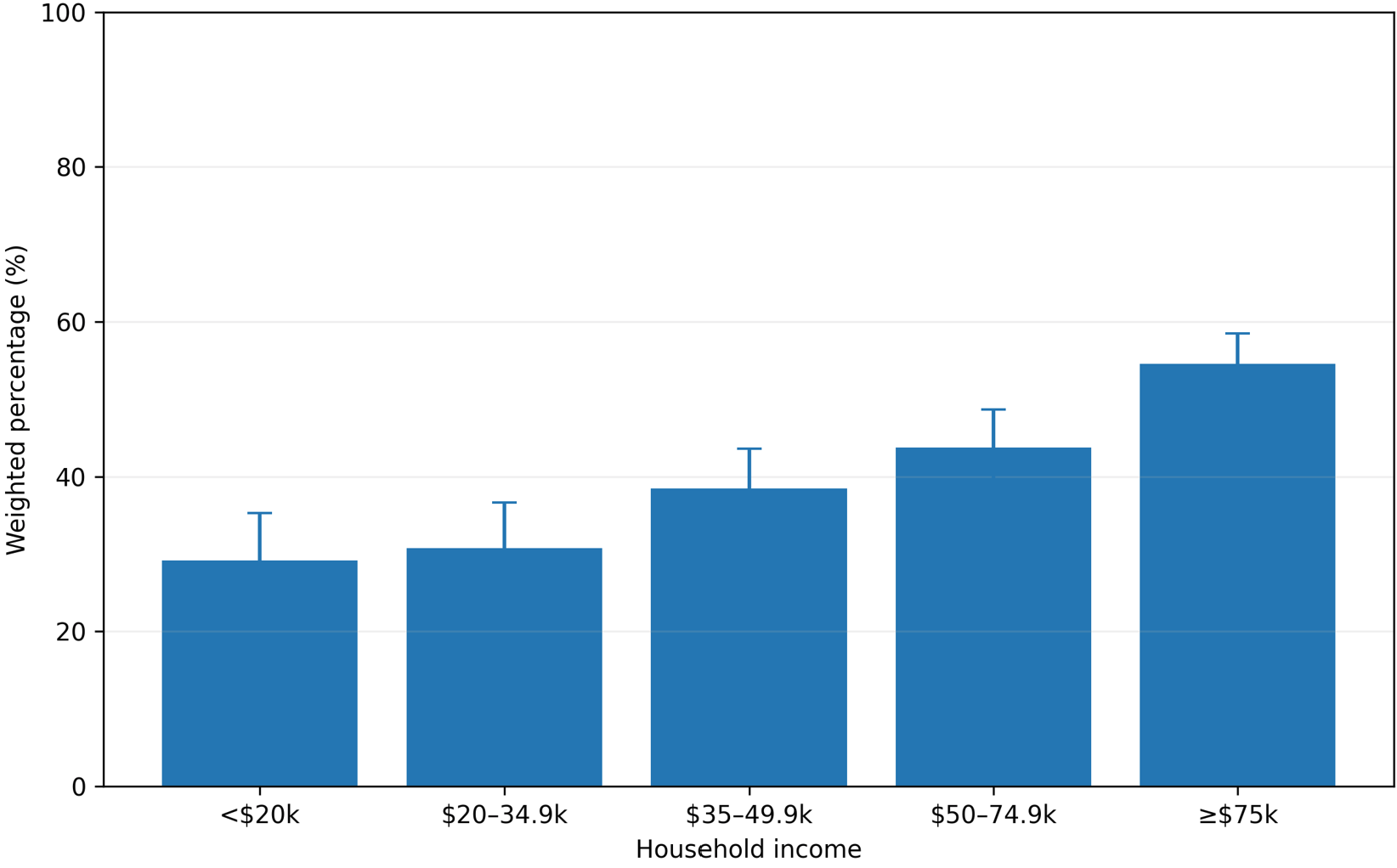
The population of adults with an experience of seeking cancer information was reported to increase steadily with income from descriptive comparisons by income group. More specifically, around 29.15% of the respondents in the household categories below $20,000 reported seeking cancer information, compared to 54.57% in the income categories of $75,000 or higher (See Figure 1). For Internet use and online health-information use, a similar gradient was observed. The lowest income group reported 69.79% in general Internet use, while the highest income group reported 94.89%.
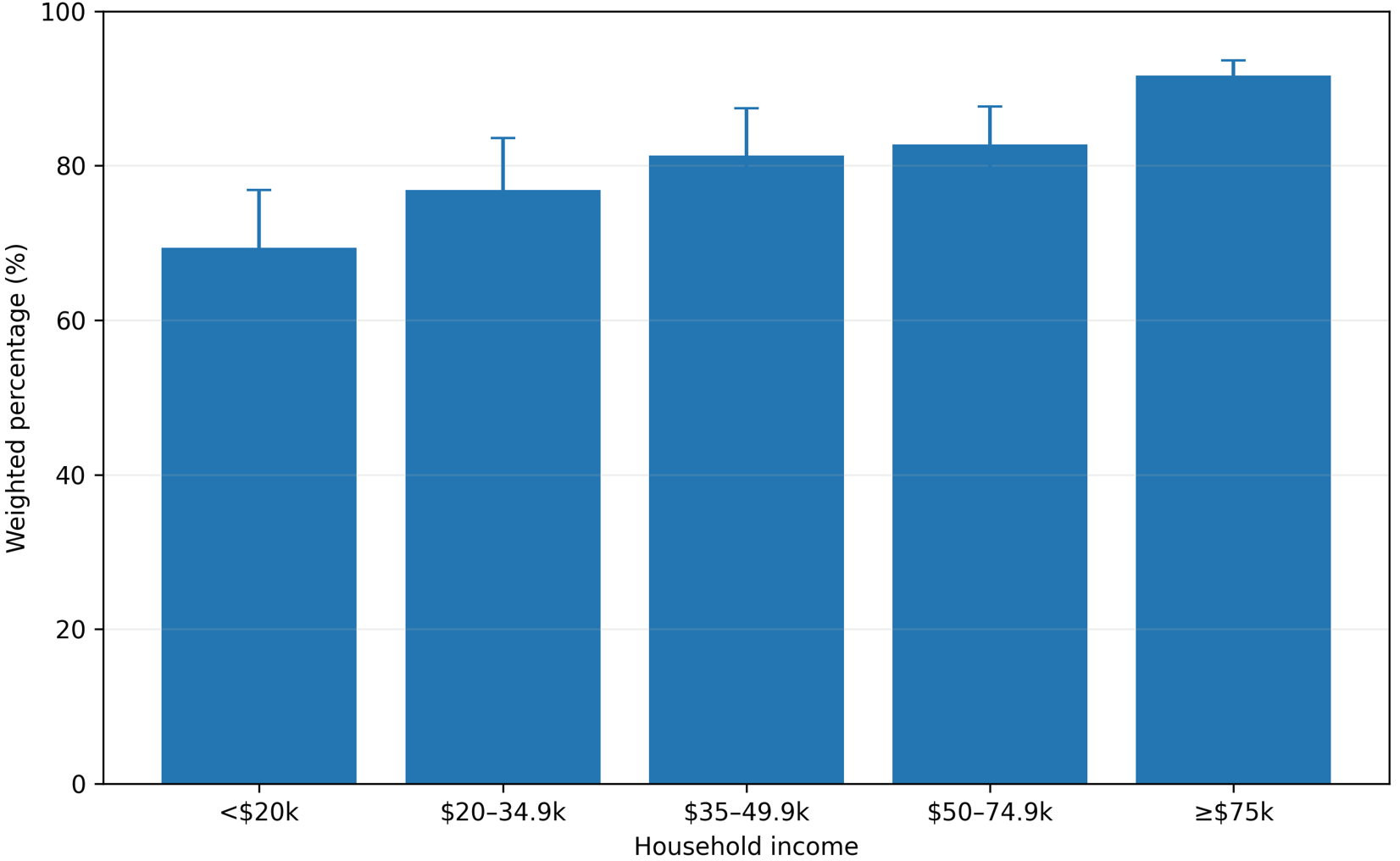
In addition, the lowest income group reported 69.40% in the use of the Internet for health information, while the highest income group reported 91.62% (See Figure 2). These descriptive findings show that respondents in the higher-income categories tended to have greater access to, and engagement with, cancer-related information resources (See Table 1 weighted percentages reported for cancer information seeking, recent sunburn, general Internet use, and online health-information use across household income categories.)
| Household income | Unweighted n | Sought cancer information, weighted % (95% CI) | Any sunburn in past 12 months, weighted % (95% CI) | Uses internet, weighted % (95% CI) | Online health-information seeking, weighted % (95% CI) |
| <$20,000 | 959 | 29.2 (23.0–35.3) | 31.2 (23.8–38.6) | 69.8 (65.7–73.9) | 69.4 (62.0–76.8) |
| $20,000–$34,999 | 729 | 30.8 (24.9–36.6) | 23.6 (18.3–28.8) | 77.1 (71.7–82.5) | 76.9 (70.2–83.6) |
| $35,000–$49,999 | 732 | 38.4 (33.3–43.6) | 30.1 (24.6–35.6) | 80.2 (74.8–85.6) | 81.3 (75.2–87.4) |
| $50,000–$74,999 | 937 | 43.8 (38.9–48.6) | 36.7 (31.4–42.0) | 88.0 (84.5–91.4) | 82.7 (77.8–87.6) |
| ≥$75,000 | 2,163 | 54.6 (50.7–58.4) | 49.2 (45.7–52.6) | 94.9 (93.6–96.2) | 91.6 (89.6–93.6) |
| Overall income-group difference | — | p < .001 | p < .001 | p < .001 | p < .001 |
Note: Percentages and 95% confidence intervals are design-based estimates calculated using the HINTS 6 final person-level survey weight and 50 jackknife replicate weights. Unweighted n represents respondents with valid household-income data. Outcome-specific denominators vary due to item nonresponse.
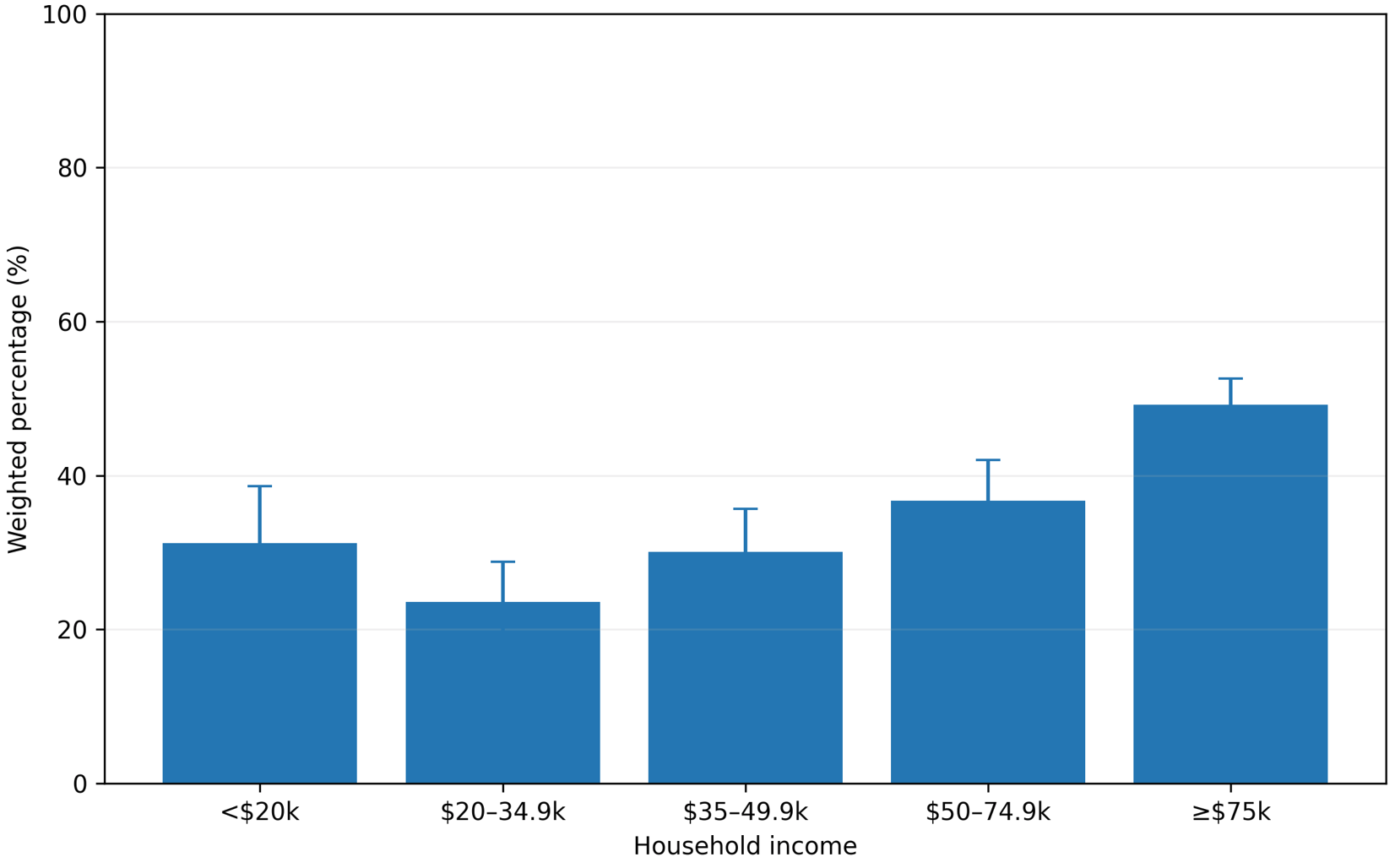
However, the descriptive pattern for sunburn differed from the information access. Among respondents in the income category of less than $20,000, 31.24% had at least one sunburn in the previous 12 months. Among those earning between $20,000 to $35,000, 23.56% had at least one sunburn in the previous 12 months, followed by 30.11% among those earning between $35,000 and $50,000, 36.72% among those earning between $50,000 and $75,000, and 49.16% among those earning $75,000 or more (See Figure 3). These findings suggest that the greater health-information engagement was not necessarily associated with lower sunburn prevalence.
In the first survey-weighted logistic regression, a total of 5,238 respondents with complete data were included. A significant association between household income and cancer information seeking was reported after adjusting for age, sex, education, and race/ethnicity (design-adjusted F(4,34) = 6.16, p < 0.001). The adjusted chances of seeking cancer information were lower among respondents earning less than $20,000 (aOR = 0.48, 95% CI = 0.32 – 0.73, p = 0.001), $20,000 – $34,999 (aOR = 0.49, 95% CI = 0.35 – 0.70, p < 0.001), $35,000 – $49,999 (aOR = 0.65, 95% CI = 0.47 – 0.90, p = 0.012), and $50,000 – $74,999 (aOR = 0.78, 95% CI = 0.61 – 0.99, p = 0.044) when compared with adults reporting household incomes of $75,000 or more. Therefore, all four lower-income categories had significantly lower adjusted chances of cancer information seeking than the highest-income category (Table 2).
In the adjusted recent-sunburn model, a total of 4,910 complete cases were included and controlled for age, sex, education, race/ethnicity, Census region, and self-reported sun sensitivity. Household income was associated overall with recent sunburn (designed-adjusted F(4,27) = 4.55, p = 0.006). Respondents earning $20,000 – $34,999 had lower adjusted chances of sunburn (aOR = 0.47, 95% CI = 0.32 – 0.71, p < 0.001), as did respondents earning $35,000 – $49,999 (aOR = 0.53, 95% CI = 0.35 – 0.81, p = 0.004) when compared with the $75,000-or-more group. The differences for respondents earning less than $20,000 (aOR = 0.69, 95% CI = 0.42 – 1.14, p = 0.145) and $50,000 – $74,999 (aOR = 0.71, 95% CI = 0.51 – 1.01, p = 0.055) were not statistically significant. Higher weighted proportion of recent sunburn were associate with younger age and greater self-reported sun sensitivity (Table 3).
Discussion
This study examined whether household income was associated with access to cancer information and prevention risk of sunburn among adults in the United States using HINTS 6 (2022). A clear and consistent socioeconomic gradient was reported with cancer information seeking in the results. More specifically, adults in lower income households were significantly less likely to report having an experience of seeking cancer information and using Internet-based health resources. This finding supports that health-information access is socially patterned and also that household income was associated with differences in reported cancer information seeking and digital health-information engagement. In the perspective of skin-cancer prevention, this is important as whether individuals recognize risk, adopt protective behaviors, and respond properly to sun exposure is influenced by access to understandable and credible information.
At the same time, the results for sunburn-related prevention risk were much more complex than a simple disadvantage model. The analysis reported that adults in the highest-income group were more likely to report have recent sunburn. There was no higher sunburn prevalence among lower-income respondents. This suggests that lower exposure-related risk was not always led by greater information access. A possible explanation is that respondents in higher-income groups may have many opportunities for outdoor recreation, travel, or intermittent leisure-related sun exposure, and this may have increased sunburn in spite of better access to health information23. In other words, informational advantage does not necessarily move in the opposite direction with behavioral risk. Health information shows only one component of sun-protection behavior. Opportunities for ultraviolet exposure, outdoor leisure and occupational patterns, perceived susceptibility, motivation to use sun protection, social norms, skin sensitivity, and environmental conditions may influence recent sunburn. Consequently, there may be association between greater engagements with health information with greater ultraviolet exposure in some socioeconomic groups. This interpretation supports previous evidence connecting higher socioeconomic status with intermittent recreational ultraviolet exposure and with recent national evidence that indicates greater sunburn prevalence among adults with higher household income and education.
Another important finding was that, when the analysis was restricted to adults who already had an experience of seeking cancer information, income was no longer a strong predictor of the information-seeking experience scaled24.This suggests that the main inequality may occur in the beginning stage of seeking health information rather than in the reported experience after respondents began searching for information. From a public health perspective, this implies that interventions should focus on both improving the quality of cancer information and ensuring that adults in lower-income categories have more opportunities to seek and encounter health information in the first place25.
Public Health Implications
These findings should not be considered evidence that increasing cancer information seeking would directly reduce sunburn but hypothesis-generating. Less cancer-information seeking was reported by lower-income adults, showing a population difference that future health-communication research need to investigate. In addition, exposure opportunities and sun-protection behaviors need to be assessed separately from information engagement due to the contrasting socioeconomic pattern for recent sunburn. Longitudinal studies are required to determine if changes in sun-protection behavior influences changes in health-information engagement.
Limitations
Despite all these important findings, this study has several limitations. First, causal interpretation was not provided due to the nature of the cross-sectional design in this study. The observed association should not be interpreted as proof that income directly causes differences in information access or sunburn. Second, all variables were self-reported in this study, and this may have introduced the possibility of recall bias and reporting error. Third, sunburn was not used as a direct measure of skin-cancer diagnosis but a prevention-related risk indicator. Therefore, the findings should not be interpreted as clinical outcomes but behavioral risk patterns. Fourth, HINTS, a nationally representative survey data, was still not designed specifically as a dermatology survey. Even though the revised sunburn model explained demographic characteristics, geographic region, and self-reported sun sensitivity, not all determinants of ultraviolet exposure were captured in the HINTS 6. Residual confounding may remain from factors, including cumulative outdoor recreation, occupational exposure, sunscreen-application patterns, intentional tanning, travel, and local ultraviolet intensity. Due to the nature of cross-sectional study, temporal direction cannot be established. Particularly, whether cancer information seeking influences subsequent sunburn, whether experiencing sunburn motivates later information seeking, or whether both are associates with other socioeconomic and behavioral characteristics cannot be determined by the analysis in this study.
Substantial racial/ethnic differences in adjusted sunburn chances were also observed. As the HINTS race/ethnicity variable does not directly measure skin phenotype and may also indicate differences in environmental exposure, behavioral, and social context, aforementioned estimates should not be interpreted as biological effects of race.
Overall, the findings in this study suggest that household income is strongly correlated with cancer information access, but a more complex socioeconomic pattern is required to analyze sunburn-related risk.
Conclusion
In this study, HINTS 6 (2022) was used to examine the association between household income, cancer information access, and sunburn-related prevention risk among adults in the United States. A clear socioeconomic pattern in cancer information behavior was reported in the results. Adults in lower-income households were significantly less likely to seek cancer information and to use Internet-based health resources. These findings support the idea that household income was associated with substantial differences in reported cancer-information engagement.
However, the pattern for sunburn-related prevention risk was more complex. Adults in higher-income households reported more recent sunburn, indicating that lower behavioral risk was not always led by greater information access. This suggests that both access to health information and differences in lifestyle, exposure opportunities, and behavioral context shape prevention outcome of skin cancer. As a result, socioeconomic disparities in prevention should not be understood by a single-direction model.
Overall, this study emphasizes the importance of distinguishing between informational inequality and behavioral risk. Public health efforts should continue expanding access to understandable and credible cancer information aiming at skin-cancer prevention, especially for lower-income population. In addition, it is also important to recognize how prevention-related risk may not be eliminated only by higher information access. It is recommended for future study to focus on examining additional behavioral and environmental factors that influence both sunburn and long-term skin-cancer risk.
Data Availability. The HINTS 6 public-use dataset and supporting documentation are publicly available from the National Cancer Institute Health Information National Trends Survey program.
References
- U.S. Preventive Services Task Force. Behavioral counseling to prevent skin cancer: U.S. Preventive Services Task Force recommendation statement. JAMA 319 (2018). [↩]
- R. L. Siegel, T. B. Kratzer, A. N. Giaquinto, H. Sung, A. Jemal. Cancer statistics, 2025. CA: A Cancer Journal for Clinicians 75 (2025). [↩]
- D. M. Holman, Z. Berkowitz, G. P. Guy Jr., A. M. Hartman, F. M. Perna. The association between demographic and behavioral characteristics and sunburn among U.S. adults—National Health Interview Survey, 2010. Preventive Medicine 63 (2014). [↩]
- D. M. Holman, Z. Berkowitz, G. P. Guy Jr., N. A. Hawkins, M. Saraiya, M. Watson. Patterns of sunscreen use on the face and other exposed skin among U.S. adults. Journal of the American Academy of Dermatology 73 (2015). [↩]
- D. M. Holman, H. Ding, G. P. Guy Jr., M. Watson, A. M. Hartman, F. M. Perna. Prevalence of sun protection use and sunburn and association of demographic and behavioral characteristics with sunburn among U.S. adults. JAMA Dermatology 154 (2018). [↩]
- A. J. Jiang, P. V. Rambhatla, M. J. Eide. Socioeconomic and lifestyle factors and melanoma: a systematic review. British Journal of Dermatology 172 (2015). [↩]
- C. A. Reyes-Ortiz, J. S. Goodwin, J. L. Freeman. The effect of socioeconomic factors on incidence, stage at diagnosis and survival of cutaneous melanoma. Medical Science Monitor 11 (2005). [↩]
- D. E. Nelson, G. L. Kreps, B. W. Hesse, R. T. Croyle, G. Willis, N. K. Arora, B. K. Rimer, K. V. Viswanath, N. Weinstein, S. Alden. The Health Information National Trends Survey (HINTS): development, design, and dissemination. Journal of Health Communication 9 (2004). [↩]
- K. D. Blake, R. P. Moser, H. D’Angelo, A. Gaysynsky, R. C. Vanderpool. The evolution of NCI’s Health Information National Trends Survey: methods, data, and future directions. Journal of the National Cancer Institute 117 (2025). [↩]
- E. Kontos, K. D. Blake, W.-Y. S. Chou, A. Prestin. Predictors of eHealth usage: insights on the digital divide from the Health Information National Trends Survey 2012. Journal of Medical Internet Research 16 (2014). [↩]
- A. J. Greenberg-Worisek, S. Kurani, L. J. Finney Rutten, K. D. Blake, R. P. Moser, B. W. Hesse. Tracking Healthy People 2020 internet, broadband, and mobile device access goals: an update using data from the Health Information National Trends Survey. Journal of Medical Internet Research 21 (2019). [↩]
- S. Kim. An exploratory study of inactive health information seekers. International Journal of Medical Informatics 84 (2015). [↩]
- K. J. Serrano, C. L. Thai, A. J. Greenberg, K. D. Blake, R. P. Moser, B. W. Hesse. Progress on broadband access to the internet and use of mobile devices in the United States: tracking Healthy People 2020 goals. Public Health Reports 132 (2017). [↩]
- N. K. Arora, B. W. Hesse, B. K. Rimer, K. Viswanath, M. L. Clayman, R. T. Croyle. Frustrated and confused: the American public rates its cancer-related information-seeking experiences. Journal of General Internal Medicine 23 (2008). [↩]
- L. J. Finney Rutten, K. D. Blake, A. J. Greenberg-Worisek, S. V. Allen, R. P. Moser, B. W. Hesse. Online health information seeking among U.S. adults: measuring progress toward a Healthy People 2020 objective. Public Health Reports 134 (2019). [↩]
- N. C. Benda, S. Veinot, N. Sieck, K. Y. Ancker. Broadband internet access is a social determinant of health. American Journal of Public Health 110 (2020). [↩]
- L. T. Wigfall, D. B. Friedman. Cancer information seeking and cancer-related health outcomes: a scoping review of the Health Information National Trends Survey literature. Journal of Health Communication 21 (2016). [↩]
- National Cancer Institute. Overview of the HINTS 6 Survey (2022) and Data Analysis Recommendations. National Cancer Institute (2024). [↩]
- Westat. Health Information National Trends Survey 6 (HINTS 6): HINTS 6 Methodology Report. National Cancer Institute (2025). [↩]
- National Cancer Institute. HINTS 6 Public Codebook. National Cancer Institute (2025). [↩]
- National Cancer Institute. Health Information National Trends Survey 6 (HINTS 6): Annotated Form, English Version. National Cancer Institute (2025). [↩]
- C. L. Birrell, D. G. Steel, M. J. Batterham, A. Arya. How to use replicate weights in health survey analysis using the National Nutrition and Physical Activity Survey as an example. Public Health Nutrition 22 (2019). [↩]
- L. W. Idorn, H. C. Wulf. Socioeconomic status and cutaneous malignant melanoma in Northern Europe. British Journal of Dermatology 170 (2014). [↩]
- M. V. Kaltchenko, A. L. Chien. Have we moved the needle on photoprotection messaging? Insight from sunburn trends using the 2019 Behavioral Risk Factor Surveillance System. Photodermatology, Photoimmunology & Photomedicine 41 (2025). [↩]
- A. Prestin, S. N. Vieux, W.-Y. S. Chou. Is online health activity alive and well or flatlining? Findings from 10 years of the Health Information National Trends Survey. Journal of Health Communication 20 (2015). [↩]