
Abstract
Prostheses for the upper extremity are intended to restore function and improve the quality of life, but 20 to 30% of users eventually give up on them, particularly those who use advanced myoelectric devices. A major factor in this is the lack of intuitive sensory feedback, since this can damage the sense of embodiment and increase cognitive load. This review looks at the way these limitations affect the user’s experience, embodiment, and decision to abandon the prosthesis. The main point of comparison is between body-powered (BP) and myoelectric (MYO) prostheses, as these two types differ most in the way they provide sensory information. Twenty-three studies were included following a search of PubMed, Google Scholar, and IEEE Xplore. To be eligible, the studies had to be peer-reviewed and must have focused on sensory feedback, embodiment, device performance, cost-effectiveness, or abandonment; publications that were commercial or not peer-reviewed were excluded. The evidence goes in both directions: BP prostheses offer incidental feedback that can help with embodiment even though they limit dexterity, while most MYO devices do not provide a similar means of feedback and place a greater cognitive burden on the user. New haptic and neural feedback systems seem to enhance precision, performance, and embodiment, but the studies supporting this are small and of short duration. The overall conclusion is deliberately cautious: sensory integration is probably a key factor in the use of prostheses, but because of the diversity of the evidence and its short length, this conclusion is not certain, and positive results still depend on assessing the mechanical and neural factors on a case-by-case basis for each individual user.
Keywords: upper-limb prosthesis; abandonment of prosthesis; sensory feedback; embodiment; myoelectric prosthesis; body-powered prosthesis.
Introduction
The loss of a limb means the absence of all or part of it, whether the condition is present from birth or results from surgical amputation due to trauma or disease. A recent estimate of the prevalence in the United States suggests that there are approximately 2.31 million people who have a limb loss, around 9.2% of whom have a loss of an upper extremity1. Prostheses are designed to restore lost movement and function2. They are by no means the same in all cases; both their design and their use in everyday life vary according to the level of amputation and the part being replaced, and even the most advanced prostheses currently available do not match a natural limb in terms of range of motion, precision, or ease of incorporation into daily life3.
Three main types of prosthetic devices are used for the upper extremity, each corresponding to a different user need. Cosmetic prostheses reinstate the look of a limb without restoring any movement; body-powered devices enable a basic degree of movement although only over a fairly restricted range; and myoelectric devices, which are externally powered, convert the electrical signals from the muscles in the remaining limb into movement. Despite this increased sophistication, acceptance has not risen in proportion. It is estimated that between 20 and 30% of upper-extremity prostheses are eventually rejected4, and this problem affects the more advanced devices much more severely. In one study involving children, the use of myoelectric hands fell from 78% to 44% within two years, even though users of body-powered devices expressed higher levels of satisfaction5. This discrepancy between capability and adoption is seen repeatedly in the literature, and it is this very tension that the present review aims to look at.
Most of the current research looks at device types or feedback technologies on their own. Only a small number of studies directly compare body-powered and myoelectric systems along the feature that best separates them: intuitive sensory feedback. When viewed in terms of trade-offs, the two approaches reveal conflicting priorities: high functionality can go hand in hand with poor usability, and open-loop motor control means that the user does not have a closed sensory loop. This review sees sensory feedback as a key factor in how fully a prosthesis feels like part of the user’s body and in how long it stays in use, a factor that is often underestimated in present myoelectric designs. Without it, users have to rely on strenuous visual monitoring, embodiment diminishes, and the chance of abandoning the prosthesis increases. A great deal of this problem arises from the loss of naturalistic somatosensation, the sensory system involved in perceiving touch, pressure, and the properties of objects such as texture and hardness6. Since a prosthesis cannot match the level of input that an intact limb provides, users are often left with a reduced sense of embodiment and less intuitive control. By focusing on the two systems specifically through the lens of sensory feedback, this review brings together the current findings on somatosensory integration and points the way towards improvements in embodiment, usability, and long-term adoption.
Background
The section here summarises the fundamental neurophysiology and terminology on which the review is based; by putting it before the Results, it enables that section to focus on synthesis. Nerves carry small electrical and chemical signals which control movement and are responsible for the sense of touch7. The central nervous system (CNS) processes and regulates these signals in order to coordinate motor control7, and is also at the heart of sensory perception, touch being included6. In the arm and hand, this biological arrangement is the basis of both movement and sensation.
Following amputation, the part of the limb that remains is known as the residual limb or stump, and the nerves passing through it are referred to as the residual nerves7. The process of amputation interrupts the peripheral nerve pathways, leading in many cases to a deterioration in signal quality and changes in sensory processing, both of which can make motor control and rehabilitation more difficult7. Many amputees also have the phenomenon of phantom limb sensation, which is the continued feeling that the missing limb is still there8. There is one more term that is relevant: degree of freedom (DOF), which refers to the number of independent movements that a joint or mechanism can carry out. The more degrees of freedom there are, the more complex and precise the movements can be, for example allowing for independent finger movement.
Methods
It is a narrative review which used a selection process guided by the PRISMA guidelines and does not assert that it is as comprehensive as a full systematic review. The literature was found by carrying out searches on PubMed, Google Scholar, and IEEE Xplore for articles published between 1990 and 2026. The search terms included “myoelectric prosthesis,” “body-powered prosthesis,” “neuroprosthetics,” “sensory feedback,” “haptic feedback,” “embodiment,” and “prosthesis abandonment/rejection.” The main Boolean string, modified for each database, was (“myoelectric prosthes*” OR “body-powered prosthes*” OR neuroprosthet*) AND (“sensory feedback” OR haptic* OR electrotactile OR vibrotactile OR embodiment OR “phantom limb” OR abandonment OR rejection).
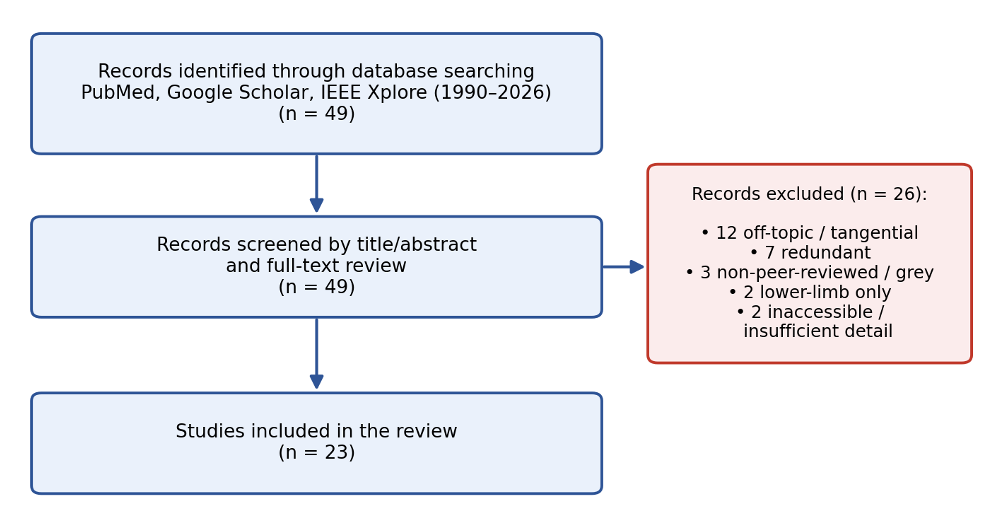
The screening was carried out in several stages according to a PRISMA-style approach. First, the titles and abstracts were checked for relevance to the topic. Those records that passed this stage then went through a full-text examination, during which the figures and the results reported were evaluated for methodological quality, and the number of citations was used as a secondary measure of the study’s influence. A study was included if it was peer-reviewed and if it dealt with upper-extremity prosthesis design, neural or myoelectric control, sensory feedback, embodiment, cost, or abandonment, and if it provided original data, a comparison of clinical outcomes, or a relevant synthesis. Excluded were non-peer-reviewed materials such as websites, blogs, news articles, and manufacturer literature, as well as studies that were limited to lower-limb prostheses, those outside the review’s scope, and those without an accessible full text or with insufficient detail for assessment. Of the 49 records compiled, 23 met the criteria. The other 26 were excluded for specific reasons: 12 because they were off-topic or only loosely related to the focus on body-powered versus myoelectric prostheses and on sensory feedback, 7 because they were redundant with better included studies, 3 because they were not peer-reviewed or were from grey literature, 2 because they concerned only lower-limb prostheses, and 2 because they lacked an accessible full text or adequate detail. Since only one reviewer carried out the screening, selection bias cannot be ruled out; this point is discussed again in the Limitations section. The studies were assessed throughout on the basis of their methodology, design, sample, endpoints, and the limitations that were reported, not on the prestige of the journal in which they were published. Figure 1 gives a summary of the process.
Results and Synthesis
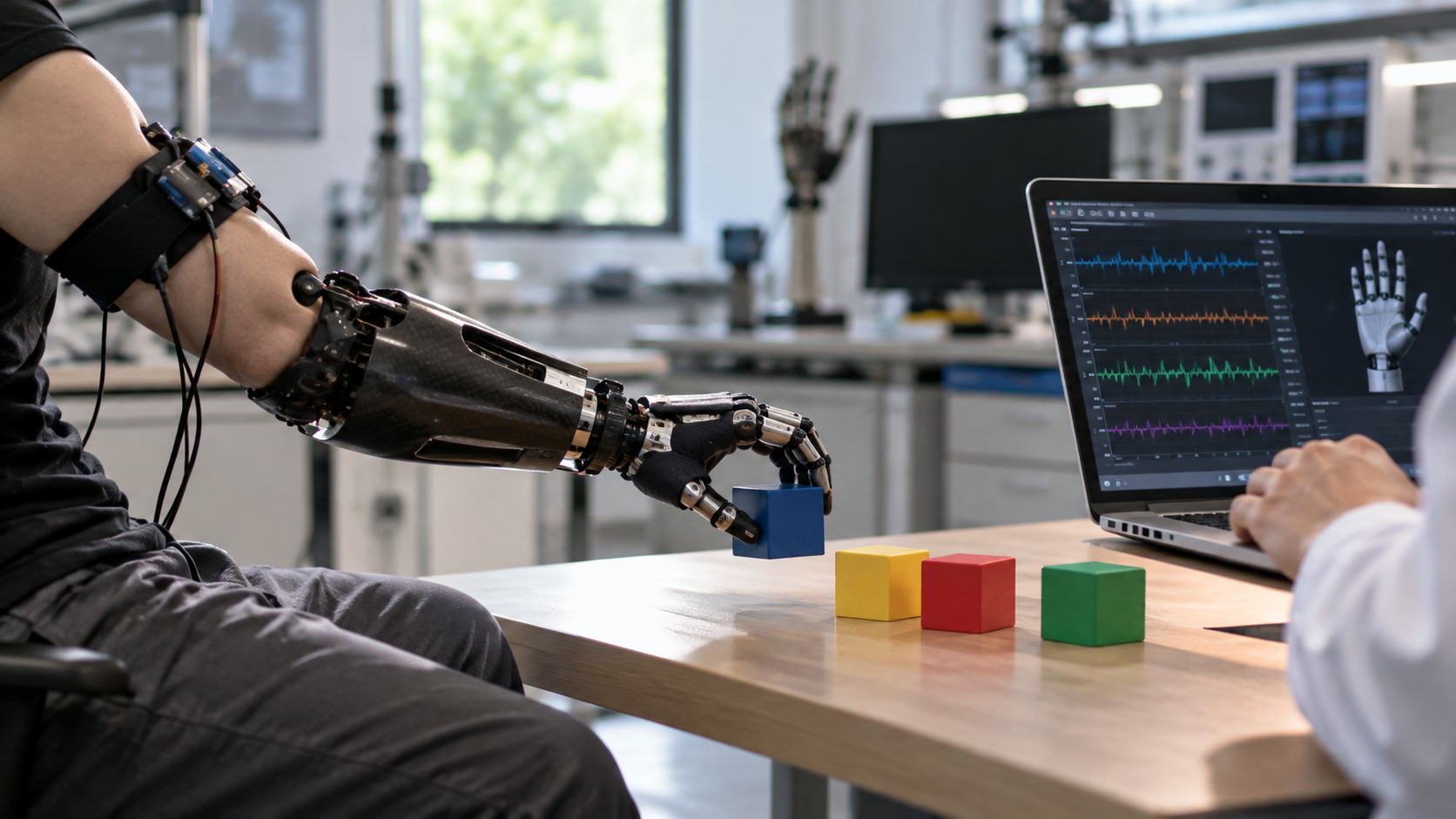
Starting from the background, this section brings together the results from various studies and indicates in which cases the evidence is strong, mixed, or limited. Modern prostheses for the upper extremity are designed to function in coordination with the nervous system by making use of the nerves and muscles that remain in the residual limb. Even after amputation the brain still sends motor commands via the intact neural pathways7. Myoelectric devices make use of this fact: electrodes placed on the residual limb pick up the electrical activity caused by the contraction of the muscles9, and that activity is then converted into actions such as opening the hand or rotating the wrist3. More advanced controllers employ pattern recognition, mapping the patterns of muscle activation onto particular movements in order to achieve smoother control10. A common claim found in these studies is that aligning control with the existing neural pathways can decrease the mental effort required and enhance the user’s feeling of being connected to the device11. The evidence supporting this, however, comes mostly from small samples that have been studied in a laboratory setting, so it is still uncertain how great a benefit this will be in everyday life.
The design of a prosthesis has a major effect on the things it is able to do. The choice of materials is important, since lightweight and strong ones like carbon fiber allow the device to be light while at the same time maintaining durability, and every prosthesis has to combine joints, cable systems, motors, and circuitry into one working unit3. In the case of body-powered prostheses, movement is produced by a cable-and-harness system which is operated by the residual limb or the shoulder12. Because of their simpler mechanical structure these prostheses are cheaper and more accessible, a factor that is especially important in low-resource environments2. When the prosthetic joint is unable to get to the position that is required, users resort to compensating movements, thereby overusing their shoulder or trunk and taking on extra physical strain13. This is supported by kinematic analyses: both body-powered users and myoelectric users change their joint coordination during ordinary tasks when compared to able-bodied controls14. These compensations have a direct bearing on the central issue of the review, since they involve both physical and cognitive costs, and costs of this magnitude lead users to abandon the device.
Sensory feedback refers to the information that the nervous system picks up as the body moves and interacts with its surroundings, allowing the brain to understand touch, force, and the position of the limbs15,6. In myoelectric systems, surface electrodes are used to pick up the control signals, but their accuracy is reduced due to signal distortion and interference from unwanted muscle activity or electrical noise7. Body-powered prostheses provide feedback by accident. Since physical force causes the movement, the cable-and-harness system gives back a resistance that is proportional to the force applied, so the user can feel the grip force and the position of the limb without needing any extra equipment12. Most commercial myoelectric prostheses have no similar channel and rely almost completely on visual monitoring12. This difference is at the heart of the argument put forward in this review. The advantage of body-powered prostheses lies in an incidental closed sensory loop which sends information back to the user while movement is taking place16. The deficiency with myoelectric prostheses is the opposite: it is an open loop that shifts the sensing function onto vision and working memory.
In order to overcome these limitations, externally powered feedback systems have been created to function together with myoelectric prostheses15. These systems range from noninvasive vibrotactile cues to invasive neural interfaces that stimulate either peripheral nerves or central structures6,17. Haptic feedback, which provides tactile information about grip force, contact, and the position of the limb, has been the subject of the most research11. With regard to one particular aspect, the evidence is in agreement: adding either haptic or neural feedback generally leads to better task accuracy, fewer grip-force errors, and a greater sense of limb ownership when compared to situations with no feedback11,6. However, when it comes to more detailed issues, the findings become uncertain. It is not clear which modality is best or whether the benefits last beyond the laboratory environment; in fact, a single direct comparison found no significant difference between vibrotactile and joint-torque feedback18, and there is a lack of long-term data from home use9. Each of the different modalities has its own features. Vibrotactile feedback uses small motors attached to the skin and is relatively easy to learn19. Electrotactile feedback involves the application of mild electrical stimulation and is capable of encoding more graded information20. Mechanotactile feedback physically moves the skin to mimic natural contact, although it might cause discomfort21. When these results are considered in this way, they suggest that feedback can reduce the sensory gap and promote a sense of embodiment, while comfort, durability, and user acceptance are still unresolved and could ultimately decide whether the improvements seen in the laboratory lead to continuous use.
Sophisticated devices combine fine engineering with neural control. The DEKA Arm, which is generally known as the “LUKE” arm, is one of the most capable upper-limb prostheses currently in clinical use. In terms of its hardware, the DEKA/LUKE system offers up to ten powered degrees of freedom, comprising powered wrist and humeral rotation features that are missing from most commercially available devices, and it allows for several control inputs rather than just one, these including surface EMG, inertial measurement units, and pressure switches; the exact setup has differed in various studies and among individual fittings22. As for the outcome evidence, a Veterans Affairs study found that the use of DEKA was linked to changes in perceived disability, levels of engagement in daily tasks, and activity performance when compared with conventional prostheses3. Research into advanced systems also shows an opposing effect: the greater mechanical complexity and the extra degrees of freedom increase the cognitive and physical demands of operating the device, especially during the early stages of use23, so it is largely the training and adaptation that determine whether the extra capabilities result in real functional improvements24. Surface-electrode control is still vulnerable to variability in the signal due to electrode placement, muscle fatigue, and skin condition7, a factor that can reduce accuracy. Altogether, the DEKA literature reflects the central dilemma discussed in the review. Increasing capability without at the same time providing a sensory channel can increase the user’s burden, which helps to explain why greater sophistication by itself does not ensure that the device will be adopted25,23.
User experience is also influenced by psychological, neurological, and clinical factors. Although cosmetic prostheses have no mechanical function, studies of clinical outcomes connect their appearance, comfort, and the satisfaction that goes with them to acceptance and the decision to continue using them26. Phantom limb sensations occur when the nervous system keeps on producing perceptions of the limb that is missing8. These are linked to maladaptive cortical reorganization that takes place after normal afferent input is lost27. In some people this develops into phantom limb pain which hinders their daily activities8. Clinical and biomechanical evidence indicates, though mostly based on small or cross-sectional samples, that interventions which improve body representation and embodiment may lessen phantom-limb symptoms by reducing sensory mismatch27. This line of reasoning supports the proposed mechanism in that embodiment seems to be connected with both the severity of symptoms and with acceptance of the device, and its significance extends well beyond cosmetic considerations.
Discussion
The conclusions drawn earlier point to a mechanism which this review makes clear. When sensory feedback is reduced, there is greater reliance on visual monitoring and a higher cognitive load, which in turn weakens the sense of embodiment, the feeling that the device is part of the body, and less embodiment then leads to lower satisfaction and an increased chance of the device being abandoned. The evidence in support of this sequence is mainly associative and based on cross-sectional studies rather than experimental ones. It should therefore be seen as a well-justified hypothesis; it does not prove causation.
The reason for the body-powered advantage in terms of embodiment seems to lie in the presence of an incidental closed sensory loop, while the disadvantage associated with myoelectric systems stems from an open loop. It follows that the more important design aim should be to close the loop rather than merely increasing the number of degrees of freedom. Therefore, myoelectric developments should be directed towards closed-loop systems in which motor decoding is combined with feedback that the user can actually make use of. Although present haptic methods, such as vibrotactile, electrotactile, and mechanotactile ones, have already been shown to improve grip control and task performance, they still need to be optimised with regard to comfort, reliability, and practical use11.
The second priority is to achieve advances in neural interfacing. Although surface electromyography is the standard control method since it is noninvasive, it is susceptible to variations in the signal caused by fatigue, electrode displacement, and changes to the skin7. Implanted electrodes, regenerative peripheral nerve interfaces, and nerve transfers offer more stable and more selective signals, but their use will depend on long-term safety, clinical results, and user acceptance28. Currently, there are few longitudinal studies concerning the stability and function of neural signals, and the field could benefit from having more such studies7.
The effectiveness of prostheses is not the same for all users; it depends on the level of amputation, the anatomy of the remaining limb, and the user’s previous experience24, which is why it is necessary to use adaptive control and customizable feedback settings together with patient-reported outcomes such as comfort, embodiment, and satisfaction if real-world usability is to be captured beyond what can be measured in the laboratory23,24. Similarly, abandonment has both real-world and psychosocial causes. A number of studies make use of short-term laboratory tasks that do not reflect everyday use or long-term adaptation29, while evidence from rehabilitation shows that structured and ongoing rehabilitation is essential for achieving functional recovery and for the successful integration of advanced prostheses30. Future research should include longitudinal, home-based studies and look more closely at how cosmetic and hybrid prostheses affect body image and acceptance9,3.
There are some limitations to these conclusions. Since this is a narrative rather than a systematic review, the search was targeted and the studies were selected by one reviewer only, which means that selection bias is present. The scope of the databases searched was limited, and it is possible that it has omitted papers from Scopus and the Web of Science. The number of studies included is small, just 23, and they are highly varied; no quantitative synthesis or meta-analysis was carried out. A great deal of the evidence upon which this review is based comes from small, short-term laboratory studies, and the review brings together a range of work involving body-powered systems, myoelectric systems, advanced bidirectional technologies, cosmetic applications, biomechanics, and rehabilitation, all of which address different questions and therefore should not be given equal weight.
Caution should therefore be exercised when making causal or universal claims. Although it is reasonable to say that improving sensory integration is important for reducing rejection and this claim is generally supported in direction, it has not been consistently shown within the diverse body of evidence, and it is very likely that there are exceptions. The summary table in Appendix A classifies the studies according to design, device type, method of feedback, endpoint, and length of follow-up, making the evidence upon which each claim is based clear.
Conclusion
Prostheses for the upper extremity are designed to restore function and improve quality of life, but rejection still occurs even though there have been considerable advances in mechanical design and control. The evidence presented here is in line with, although it does not definitively prove, the idea that limitations in sensory feedback lead to a reduced sense of embodiment, an increased cognitive load, and eventual abandonment, and that body-powered and myoelectric systems differ most significantly in whether or not they close the sensory loop. The DEKA Arm, for example, shows what can be achieved by combining advanced mechanics with neural control, even as it highlights the compromise between capability and user burden23. Taking all the evidence into account and considering the variety of it, it is likely that enhancing sensory integration will be important for achieving wider adoption. Future development should therefore go beyond simple mechanical improvements and focus on closed-loop, user-oriented designs that are in line with human neurobiology and lived experience.
Appendix
Appendix A. Summary of Reviewed Studies
Summary of the 23 reviewed studies, sorted by reference number and stratified by design, device class, feedback modality, endpoint, and follow-up.
| Ref | Author (Year) | Design | Sample | Device / feedback focus | Key findings | Strengths / weaknesses | Gaps |
| 1 | Nat’l Academies (2017) | Consensus report (cost chapter) | n/a | Cost by device class | Approx. cost: BP $4,400; MYO transradial $15,100; transhumeral $56,200; hybrid $19,200 | Strength: authoritative cost benchmarks. Weakness: US-only; not peer-reviewed | Prices may differ internationally / from actual |
| 2 | Rivera et al. (2024) | Epidemiological prevalence/projection | US national data | Limb-loss prevalence | ~2.31M with limb loss; UE ~9.2% | Strength: recent national estimate. Weakness: modeling assumptions | Not prosthesis- or feedback-specific |
| 3 | Resnik et al. (2018) | Clinical outcome comparison (VA) | 23 users (15 in home phase) | DEKA outcomes | DEKA slightly slower than conventional but more capable | Strength: real-user outcomes. Weakness: home-study confounders | Not a device-tech description; modality varied |
| 4 | Raspopovic et al. (2014) | Proof-of-concept, invasive intraneural | 1 participant (single amputee) | Real-time bidirectional feedback | First real-time closed-loop sensory prosthesis; participant distinguished object stiffness/shape and modulated grasp force | Strength: landmark bidirectional. Weakness: n=1; invasive | Durability, generalizability |
| 5 | Vu et al. (2023) | Longitudinal, RPNI + implanted EMG | 2 participants | Long-term control; peripheral-nerve background | Stable long-term control; strong peripheral-nerve background | Strength: long-term implanted signals. Weakness: very small n | Broader adoption |
| 6 | Stankevicius et al. (2021) | Systematic rapid review | Pooled studies | Phantom limb pain/sensation | High prevalence of PLP/PLS post-amputation | Strength: systematic. Weakness: heterogeneity | Mechanism, treatment linkage |
| 9 | Schofield et al. (2020) | Long-term home-use study | 3 participants (2 sensate, 1 control) | Sensory-motor integrated bidirectional arm | Functional, perceptual & cognitive gains at home | Strength: home-use, longitudinal. Weakness: very small n | Controlled/RCT evidence |
| 11 | Marasco et al. (2021) | Experimental neurorobotic feedback | TMR users (small cohort) | Touch + kinesthesia + movement fusion | Marked improvement on grip/other tests; intrinsic brain behaviors & ownership | Strength: multimodal feedback. Weakness: low sample; TMR-specific | General MYO users |
| 12 | Gonzalez et al. (2021) | Experimental incidental-feedback (VR) | 9 limb-loss + 9 anatomical | Incidental feedback BP vs MYO vs hand | BP more accurate & less variable at grasp/stiffness than MYO; MYO gives almost no proprioceptive feedback | Strength: isolates incidental feedback. Weakness: virtual environment; small n | Real-world use |
| 13 | Bouwsema et al. (2010) | Experimental movement analysis | 6 users (3 hybrid, 3 myoelectric) | Goal-directed task kinematics | Characteristic compensations & timing | Strength: detailed kinematics. Weakness: lab tasks | Ecological validity |
| 14 | Carey et al. (2009) | Comparative kinematic (case) | 1 subject (bilateral) | Kinematics of common activities | Shoulder ROM better in MYO; elbow ROM better in BP | Strength: early comparative. Weakness: single subject; old | Modern devices, larger n |
| 15 | D’Anna et al. (2019) | Proof-of-concept closed-loop | 2 amputees | Intraneural tactile + position feedback | Near-natural proprioceptive accuracy; good object-size distinction | Strength: closed-loop bidirectional. Weakness: n=2; invasive | Long-term / home |
| 16 | Engdahl et al. (2020) | Comparative embodiment study | 9 prosthesis users | Embodiment BP vs MYO | No large difference in perceived embodiment BP vs MYO | Strength: directly on embodiment. Weakness: only 9 users; cross-sectional | Causal direction over time |
| 17 | Tan et al. (2014) | Proof-of-concept, peripheral nerve electrodes | 2 participants | Long-term natural touch percepts | Restored natural touch 16-24 mo; felt pressure/tapping/vibration | Strength: percept stability. Weakness: small n; invasive | Scale-up, home use |
| 18 | Thomas et al. (2019) | Comparative feedback modalities (testbed) | 12 non-amputee participants | Vibrotactile (MYO) vs joint-torque (BP) | No significant difference between joint-torque and vibrotactile feedback | Strength: head-to-head. Weakness: exoskeleton testbed | Durability, best modality |
| 19 | Witteveen et al. (2015) | Experimental vibrotactile feedback | 10 upper-limb-loss subjects | Vibrotactile grasp-force / aperture feedback | Vibrotactile feedback improved grasping performance | Strength: on-topic vibrotactile. Weakness: lab; daily-life value unclear | Real-world value |
| 20 | Garenfeld et al. (2023) | Closed-loop control study | 10 non-disabled + 1 amputee | Anatomically congruent electrotactile feedback | Improved position control; graded proprioceptive/force info | Strength: full-state electrotactile. Weakness: complex; lab | Long-term learning |
| 21 | Schoepp et al. (2018) | Engineering design + validation | 1 participant | Inexpensive mechanotactile feedback | User correctly identified stimulated finger; low-cost feasible | Strength: cheap translational device. Weakness: n=1; motor noise | Clinical trials |
| 22 | Resnik et al. (2014) | Device description (VA study) | n/a (device) | DEKA/LUKE features & control | Up to 10 powered DOF; EMG/IMU/pressure control inputs | Strength: primary technical source. Weakness: single device line | Independent replication |
| 23 | Metzger et al. (2010) | Experimental reaching study | Transradial amputees (small case-control) | Feedforward control in reaching | Characterized feedforward strategies | Strength: control-strategy insight. Weakness: lab task | Feedback integration |
| 24 | Engdahl & Gates (2021) | Experimental movement-quality study | 9 users + 9 controls | Movement quality in ADLs | Differences in movement quality BP vs MYO | Strength: ADL relevance. Weakness: small sample; variation | Matched-factor, long-term |
| 25 | Hussaini et al. (2017) | Observational categorization | 4 users + 20 able-bodied | Compensatory motions | Taxonomy of compensatory movements | Strength: clinical classification. Weakness: descriptive | Intervention/prevention |
| 26 | Fitzgibbons & Medvedev (2015) | Narrative / clinical review | n/a | Functional & clinical UE outcomes | Appearance/comfort/satisfaction affect acceptance | Strength: clinical overview. Weakness: non-systematic | Quantitative outcomes |
| 27 | Granata et al. (2020) | Cortical plasticity (TMS/mapping) | 3 transradial amputees | Cortical reorganization & feedback | Feedback training linked to more normal cortical maps | Strength: mechanism-level. Weakness: small; focused | Longitudinal effect on pain |
| 28 | Salminger et al. (2019) | Longitudinal implant (~2.5 yr) | 3 above-elbow amputees | Intramuscular sensors + nerve transfers | Implanted sensors outperformed surface electrodes; everyday gains | Strength: long-term implant. Weakness: small n; invasive cost | Cost-benefit, broad adoption |
| 29 | Williams et al. (2021) | Comparative simulation (motion capture) | 3 MYO users + 12 non-disabled (simulated) | Compensatory strategies | Similar shoulder/trunk compensations across groups | Strength: control comparison. Weakness: only 3 MYO users; simulated | Real users, BP comparison |
| 30 | Sturma et al. (2022) | Clinical rehab (Delphi/scoping) | Delphi expert consensus | Rehabilitation after TMR | Structured rehab supports functional outcomes | Strength: clinical rehab focus. Weakness: specialized population | Standardized protocols |
References
- J. A. Rivera, K. Churovich, A. B. Anderson, B. K. Potter. Estimating recent US limb loss prevalence and updating future projections. Archives of Rehabilitation Research and Clinical Translation. Vol. 6, pg. 100376, 2024, https://doi.org/10.1016/j.arrct.2024.100376. [↩]
- National Academies of Sciences, Engineering, and Medicine. The promise of assistive technology to enhance activity and work participation. The National Academies Press, 2017, https://doi.org/10.17226/24740. [↩] [↩]
- L. J. Resnik, M. L. Borgia, F. Acluche, J. M. Cancio, G. Latlief, N. Sasson. How do the outcomes of the DEKA Arm compare to conventional prostheses? PLOS ONE. Vol. 13, pg. e0191326, 2018, https://doi.org/10.1371/journal.pone.0191326. [↩] [↩] [↩] [↩] [↩]
- E. A. Biddiss, T. T. Chau. Upper limb prosthesis use and abandonment: a survey of the last 25 years. Prosthetics and Orthotics International. Vol. 31, pg. 236–257, 2007, https://doi.org/10.1080/03093640600994581. [↩]
- J. E. Edelstein, N. Berger. Performance comparison among children fitted with myoelectric and body-powered hands. Archives of Physical Medicine and Rehabilitation. Vol. 74, pg. 376–380, 1993, https://pubmed.ncbi.nlm.nih.gov/8466418/. [↩]
- S. Raspopovic, M. Capogrosso, F. M. Petrini, M. Bonizzato, J. Rigosa, G. Di Pino, J. Carpaneto, M. Controzzi, T. Boretius, E. Fernandez, G. Granata, C. M. Oddo, L. Citi, A. L. Ciancio, C. Cipriani, M. C. Carrozza, W. Jensen, E. Guglielmelli, T. Stieglitz, P. M. Rossini, S. Micera. Restoring natural sensory feedback in real-time bidirectional hand prostheses. Science Translational Medicine. Vol. 6, pg. 222ra19, 2014, https://doi.org/10.1126/scitranslmed.3006820. [↩] [↩] [↩] [↩] [↩]
- P. P. Vu, A. K. Vaskov, C. Lee, R. R. Jillala, D. M. Wallace, A. J. Davis, T. A. Kung, S. W. P. Kemp, D. H. Gates, C. A. Chestek, P. S. Cederna. Long-term upper-extremity prosthetic control using regenerative peripheral nerve interfaces and implanted EMG electrodes. Journal of Neural Engineering. Vol. 20, pg. 026039, 2023, https://doi.org/10.1088/1741-2552/accb0c. [↩] [↩] [↩] [↩] [↩] [↩] [↩] [↩] [↩]
- A. Stankevicius, S. B. Wallwork, S. J. Summers, B. Hordacre, T. R. Stanton. Prevalence and incidence of phantom limb pain, phantom limb sensations and telescoping in amputees: a systematic rapid review. European Journal of Pain. Vol. 25, pg. 23–38, 2021, https://doi.org/10.1002/ejp.1657. [↩] [↩] [↩]
- J. S. Schofield, C. E. Shell, D. T. Beckler, Z. C. Thumser, P. D. Marasco. Long-term home-use of sensory-motor-integrated bidirectional bionic prosthetic arms promotes functional, perceptual, and cognitive changes. Frontiers in Neuroscience. Vol. 14, pg. 120, 2020, https://doi.org/10.3389/fnins.2020.00120. [↩] [↩] [↩]
- E. Scheme, K. Englehart. Electromyogram pattern recognition for control of powered upper-limb prostheses: state of the art and challenges for clinical use. Journal of Rehabilitation Research and Development. Vol. 48, pg. 643–659, 2011, https://doi.org/10.1682/jrrd.2010.09.0177. [↩]
- P. D. Marasco, J. S. Hebert, J. W. Sensinger, D. T. Beckler, Z. C. Thumser, A. W. Shehata, H. E. Williams, K. R. Wilson. Neurorobotic fusion of prosthetic touch, kinesthesia, and movement in bionic upper limbs promotes intrinsic brain behaviors. Science Robotics. Vol. 6, pg. eabf3368, 2021, https://doi.org/10.1126/scirobotics.abf3368. [↩] [↩] [↩] [↩]
- M. A. Gonzalez, C. Lee, J. Kang, R. B. Gillespie, D. H. Gates. Getting a grip on the impact of incidental feedback from body-powered and myoelectric prostheses. IEEE Transactions on Neural Systems and Rehabilitation Engineering. Vol. 29, pg. 1905–1912, 2021, https://doi.org/10.1109/TNSRE.2021.3111741. [↩] [↩] [↩]
- H. Bouwsema, C. K. van der Sluis, R. M. Bongers. Movement characteristics of upper extremity prostheses during basic goal-directed tasks. Clinical Biomechanics. Vol. 25, pg. 523–529, 2010, https://doi.org/10.1016/j.clinbiomech.2010.02.011. [↩]
- S. L. Carey, R. V. Dubey, G. S. Bauer, M. J. Highsmith. Kinematic comparison of myoelectric and body powered prostheses while performing common activities. Prosthetics and Orthotics International. Vol. 33, pg. 179–186, 2009, https://doi.org/10.1080/03093640802613229. [↩]
- E. D’Anna, G. Valle, A. Mazzoni, I. Strauss, F. Iberite, J. Patton, F. M. Petrini, S. Raspopovic, G. Granata, R. Di Iorio, M. Controzzi, C. Cipriani, T. Stieglitz, P. M. Rossini, S. Micera. A closed-loop hand prosthesis with simultaneous intraneural tactile and position feedback. Science Robotics. Vol. 4, pg. eaau8892, 2019, https://doi.org/10.1126/scirobotics.aau8892. [↩] [↩]
- S. M. Engdahl, S. K. Meehan, D. H. Gates. Differential experiences of embodiment between body-powered and myoelectric prosthesis users. Scientific Reports. Vol. 10, pg. 15471, 2020, https://doi.org/10.1038/s41598-020-72470-0. [↩]
- D. W. Tan, M. A. Schiefer, M. W. Keith, J. R. Anderson, J. Tyler, D. J. Tyler. A neural interface provides long-term stable natural touch perception. Science Translational Medicine. Vol. 6, pg. 257ra138, 2014, https://doi.org/10.1126/scitranslmed.3008669. [↩]
- N. Thomas, G. Ung, C. McGarvey, J. D. Brown. Comparison of vibrotactile and joint-torque feedback in a myoelectric upper-limb prosthesis. Journal of NeuroEngineering and Rehabilitation. Vol. 16, pg. 70, 2019, https://doi.org/10.1186/s12984-019-0545-5. [↩]
- H. J. Witteveen, H. S. Rietman, P. H. Veltink. Vibrotactile grasping force and hand aperture feedback for myoelectric forearm prosthesis users. Prosthetics and Orthotics International. Vol. 39, pg. 204–212, 2015, https://doi.org/10.1177/0309364614522260. [↩]
- M. A. Garenfeld, M. Strbac, N. Jorgovanovic, J. L. Dideriksen, S. Dosen. Closed-loop control of a multifunctional myoelectric prosthesis with full-state anatomically congruent electrotactile feedback. IEEE Transactions on Neural Systems and Rehabilitation Engineering. Vol. 31, pg. 2090–2100, 2023, https://doi.org/10.1109/TNSRE.2023.3267273. [↩]
- K. R. Schoepp, M. R. Dawson, J. S. Schofield, J. P. Carey, J. S. Hebert. Design and integration of an inexpensive wearable mechanotactile feedback system for myoelectric prostheses. IEEE Journal of Translational Engineering in Health and Medicine. Vol. 6, pg. 2100711, 2018, https://doi.org/10.1109/JTEHM.2018.2866105. [↩]
- L. Resnik, S. L. Klinger, K. Etter. The DEKA Arm: its features, functionality, and evolution during the Veterans Affairs study to optimize the DEKA Arm. Prosthetics and Orthotics International. Vol. 38, pg. 492–504, 2014, https://doi.org/10.1177/0309364613506913. [↩]
- A. J. Metzger, A. W. Dromerick, C. N. Schabowsky, R. J. Holley, B. Monroe, P. S. Lum. Feedforward control strategies of subjects with transradial amputation in planar reaching. Journal of Rehabilitation Research and Development. Vol. 47, pg. 201–211, 2010, https://doi.org/10.1682/jrrd.2009.06.0075. [↩] [↩] [↩] [↩]
- S. M. Engdahl, D. H. Gates. Differences in quality of movements made with body-powered and myoelectric prostheses during activities of daily living. Clinical Biomechanics. Vol. 84, pg. 105311, 2021, https://doi.org/10.1016/j.clinbiomech.2021.105311. [↩] [↩] [↩]
- A. Hussaini, A. Zinck, P. Kyberd. Categorization of compensatory motions in transradial myoelectric prosthesis users. Prosthetics and Orthotics International. Vol. 41, pg. 286–293, 2017, https://doi.org/10.1177/0309364616660248. [↩]
- P. Fitzgibbons, G. Medvedev. Functional and clinical outcomes of upper extremity amputation. Journal of the American Academy of Orthopaedic Surgeons. Vol. 23, pg. 751–760, 2015, https://doi.org/10.5435/JAAOS-D-14-00302. [↩]
- G. Granata, G. Valle, R. Di Iorio, F. Iodice, F. M. Petrini, I. Strauss, E. D’Anna, F. Iberite, L. Lauretti, E. Fernandez, R. Romanello, T. Stieglitz, S. Raspopovic, P. Calabresi, S. Micera, P. M. Rossini. Cortical plasticity after hand prostheses use: is the hypothesis of deafferented cortex ‘invasion’ always true? Clinical Neurophysiology. Vol. 131, pg. 2341–2348, 2020, https://doi.org/10.1016/j.clinph.2020.06.023. [↩] [↩]
- S. Salminger, A. Sturma, C. Hofer, M. Evangelista, M. Perrin, K. D. Bergmeister, A. D. Roche, T. Hasenoehrl, H. Dietl, D. Farina, O. C. Aszmann. Long-term implant of intramuscular sensors and nerve transfers for wireless control of robotic arms in above-elbow amputees. Science Robotics. Vol. 4, pg. eaaw6306, 2019, https://doi.org/10.1126/scirobotics.aaw6306. [↩]
- H. E. Williams, C. S. Chapman, P. M. Pilarski, A. H. Vette, J. S. Hebert. Myoelectric prosthesis users and non-disabled individuals wearing a simulated prosthesis exhibit similar compensatory movement strategies. Journal of NeuroEngineering and Rehabilitation. Vol. 18, pg. 72, 2021, https://doi.org/10.1186/s12984-021-00855-x. [↩]
- A. Sturma, T. Stamm, L. A. Hruby, B. Bischof, S. Salminger, C. Gstoettner, C. Prahm, A. Pittermann, R. Wakolbinger, C. Hofer, D. Farina, O. C. Aszmann. Rehabilitation of high upper limb amputees after targeted muscle reinnervation. Journal of Hand Therapy. Vol. 35, pg. 58–66, 2022, https://doi.org/10.1016/j.jht.2020.10.002. [↩]