

Abstract
This literature review examines how generative AI (GenAI) in customer service within the commercial aviation industry affects bookings and sales. This review synthesizes other scholarly sources to understand (1) the importance of customer service and GenAI individually, and highlights the lost potential without them being integrated, (2) GenAI tools that are being used by the aviation industry to improve its customer care, (3) the effect of sales from these tools, (4) the ethical concerns that come with this technology. These findings suggest that new GenAI technologies, emotion detectors, and chatbots can generate personalized suggestions and ideas, which are reported to improve customer service and satisfaction. This is associated with improved customer service, customer satisfaction, and potential commercial benefits. Future research around the implementation of GenAI solutions would increase the accuracy and confidence of the suspected impacts.
Keywords: Customer Service, Generative AI, Sales, Aviation Industry
Introduction
Customer frustration has remained a common challenge within the commercial aviation industry, where operational disruptions and communication issues are apparent and affect customers’ travel experience. In response to these challenges, the commercial airline industry has started to implement generative artificial intelligence (GenAI) technologies to improve the efficiency of their customer services. This review seeks to answer the following research question: How does GenAI-powered customer service influence customer satisfaction and business performance in the commercial aviation industry?
Generative Artificial Intelligence (GenAI) refers to an artificial intelligence system in which users can enter prompts, and the system creates a new output based on that input. This output can be in the form of text, images, or even code. Although many artificial intelligence systems rely on some automation or predictive measures, GenAI is different. GenAI systems rely on the outputs of previous data to continually improve and make new suggestions. Systems that rely on automation and predictive measures are much more limited when compared to GenAI systems1. GenAI systems use a form of learning that is more immune to the constraints of classical automation or predictive systems. The pre-training that GenAI systems use, coupled with the integration of reinforcement learning and retrieval-augmented generation, can substantially improve the system’s ability to accomplish more complex tasks.
This type of model can create original content that is monumental for many people and industries. It plays a significant role in customer service, which is defined as “anything to do for the customer that enhances the customer experience”2. The commercial aviation industry can do this with GenAI through chatbots and emotion detectors. With thousands of businesses in the commercial aviation industry (airlines) operating globally, customer service is an integral component of their success. Unlike many other industries, airlines offer many alternatives, which is why maximizing customer experience is essential, as it can be a key differentiator. Technologies such as GenAI are believed to make this process more efficient because these tools can provide stronger assistance than humans in some contexts. Overall, this paper will analyze how the implementation of AI helps businesses in commercial aviation to strengthen customer experience and its association with increased sales.
This review adopts the following conceptual perspective: Generative AI in customer service is expected to improve service quality. Those improvements in service quality should lead to enhanced customer satisfaction and improved sales performance. The relationship among generative AI, customer service, customer satisfaction, and sales performance is the focus of this literature review.
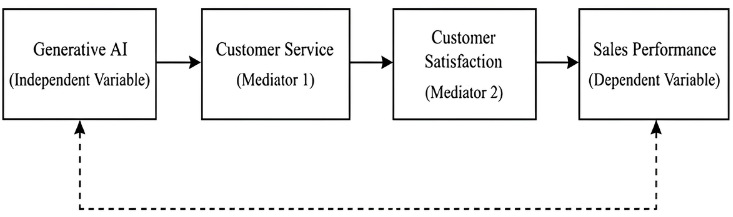
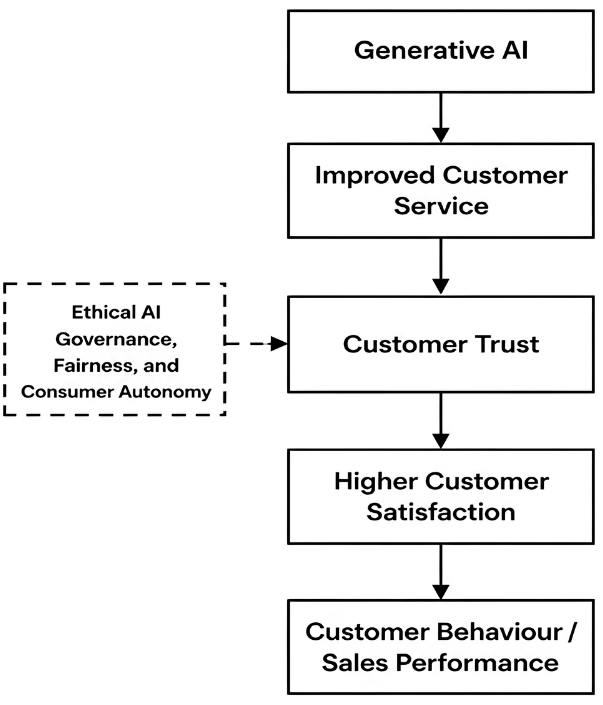
Note: Ethical AI governance, fairness and consumer autonomy influence customer trust throughout the process.
This review draws from a number of well-established theories. For example, service quality is measured by the responsiveness and reliability dimensions of customer service as outlined by the SERVQUAL example. Satisfaction and resultant behaviors are discussed with reference to the Theory of Planned Behavior. Finally, the Customer Experience framework discusses the impact of efficiently and effectively designed service interfaces on the perception of the customer as well as the resultant impact on the bottom line. These are the theories drawn upon to discuss the interrelations described in the review.
In this review, customer satisfaction is defined as the customer’s assessment of their airline service encounter. Sales impact is defined as the probable effects of generative AI on the purchase of airline tickets, ancillary sales, and the retention of customers. Finally, Personalization means the propensity of generative AI to deliver tailored information, recommendations, and customer engagements.
This review attempts to clarify the understanding of related and overlapping technologies. Generative AI (GenAI) systems are those that have the capability of producing new text or other content upon the request of a user. Traditional or predictive AI systems analyze data and make predictions that aid in the process of decision-making. Finally, rule-based chatbots do not create novel responses, but respond to queries and provide information based on a pre-set decision framework. Recommendation systems, on the other hand, present suggestions based on the data and behaviors of a particular user. The maturity and capabilities of these technologies differ, and therefore this review discusses the evidence pertaining to each.
Growing use of generative AI in customer service results in fragmented literature regarding its use in the commercial aviation sector. Many studies focus on individual technologies or sparse business use cases, while few evaluate generative AI’s impact on customer service, customer satisfaction, and sales within commercial aviation. To fill this gap, this review attempts to answer this question: What is the impact of generative AI customer service systems on customers’ satisfaction and sales within commercial aviation? The purpose of this review is to consolidate the existing data and describe the gaps in research in the context of this new area.
This paper first examines the importance of customer service to business success before discussing the limitations of traditional customer service in the commercial aviation industry. It then reviews how businesses have adopted generative AI to address these challenges and examines how airlines are applying GenAI technologies to improve customer service. Finally, the review evaluates the potential impact of these technologies on customer satisfaction, business performance, and sales while considering the associated ethical challenges and remaining research gaps.
From a conceptual viewpoint, this review considers generative AI to be the independent variable in the context where customer service is improved through personalization and increased operational speed and efficiency. Improved customer service is postulated to increase customer satisfaction. Customer trust and the perceived usefulness of the service are considered to be mediating variables in this context. Improved customer satisfaction will be likely to improve customer loyalty and increase sales. The relationships are explained using the frameworks of consumer behavior, technology adoption, and the service quality model which are discussed in this review.
Methodology
The goal of this study was to investigate the effects of GenAI-powered customer service in the aviation industry through a literature review. Where studies examined technologies other than generative AI, their findings are interpreted as contextual evidence rather than direct evidence of GenAI implementation. The paper relies heavily on published research (with some exceptions). It focuses on sources from 2018 to the present to maintain relevance to generative AI, a significant element of this research topic. Some sources may be from before 2018, but they are used strictly for comparing pre -GenAI vs GenAI today. These studies are strictly composed of information regarding customer service, generative AI, aviation, or that has links to some/all of the above.
First, an analysis of studies was carried out, showing that customer service not tied to generative AI is detrimental, by extracting details on how it increases customer frustration and damages airline reputation. Next, studies regarding generative AI and customer service were individually picked, and details were extracted to depict the effect of sales for businesses with good customer service and the utilization of generative AI. Next, studies were investigated that describe GenAI tools being utilized by airlines for customer service, such as GenAI chatbots and tools that detect customer emotion. This is to provide details on the positive effects it has, such as strengthening customer experience and satisfaction. The review then examines studies that exhibit the impact on sales and the success of businesses with GenAI being implemented. This is shown through customers purchasing more and purchasing higher-value services. Finally, the review considers that while researching this topic, various ethical concerns were apparent and needed to be addressed. This was done by integrating studies that highlight the potential negative impacts of GenAI technology on aviation’s customer service, such as people over-trusting artificial intelligence and the biases that algorithms hold.
| Database | Search Query | Search Date | Records Retrieved | Records Screened | Studies Included |
| Google Scholar | (“Generative AI” OR “Artificial Intelligence”) AND (“customer service” OR “customer satisfaction”) AND (aviation OR airline) | March 2025 | 31 | 28 | 15 |
| SSRN | (“Generative AI” AND customer service) | March 2025 | 9 | 8 | 4 |
| ResearchGate | (“Generative AI” AND aviation customer service) | March 2025 | 7 | 6 | 3 |
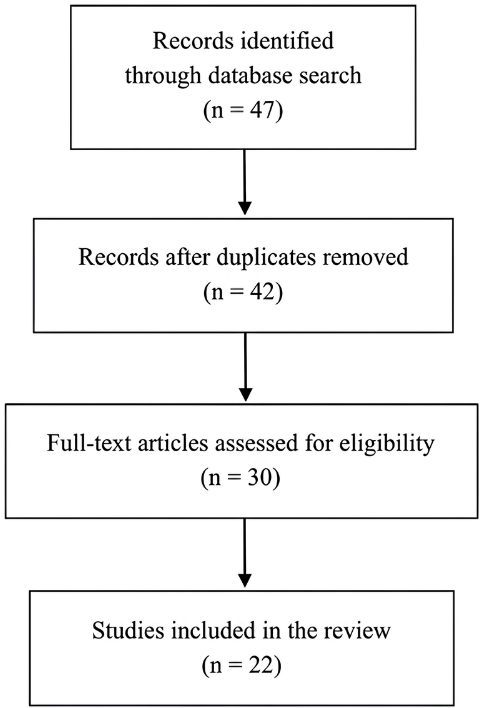
| Total | — | — | 47 | 42 | 22 |
From the screening, 26 studies were selected for thorough analysis. The studies formed the base of evidence for the thematic analysis developed in the next sections of this review.
The reviewed literature combines various types of evidence: empirical case studies, correlational studies, conceptual papers, and review articles. This evidence is considered based on the relative strengths of the methodology, and findings from other sectors are used to provide contextual background where direct evidence from commercial aviation is lacking.
The papers that were included were analyzed based on thematic analysis, and the findings were organized into sections on the use of generative AI, the effects on customer service and satisfaction, ethics, and the gaps in research. This provided the analytical base for the discussion that follows.
The selection of studies was based on the PRISMA reporting framework to enhance the clarity and replicability of the selection process.
The sources that were reviewed were assessed based on the type of evidence. In the evaluation of the outcomes of the evidence, greater consideration was given to empirical studies and evidence from conceptual studies and market reports, which were primarily used to provide background information and describe the emerging trends. This was also depicted in the evidence summary table.
| Study | Industry | Technology Class | GenAI? | Evidence Type | Sample Size | Outcome Type | Statistical Result | Relevance to Commercial Aviation |
| Bi, Q. (2023) | General business | Generative AI | Yes | Conceptual | N/A | Business efficiency, personalization | N/A | Moderate – general business applications relevant to airline customer service |
| Ahmed, T. & Hussain, B. (2023) | Digital business | Generative AI | Yes | Conceptual / Review | N/A | Customer experience and engagement | N/A | Moderate – discusses AI-enabled customer experience applicable to airlines |
| Hildebrand, C. & Bergner, A. (2019) | Car rental | AI chatbot | No | Empirical | Reported in original study | Upselling and customer purchasing behaviour | Customers were approximately twice as willing to trade up and purchase add-ons when interacting with chatbots | Indirect – demonstrates customer-service effects relevant to airline sales |
| Vássil Rjsé et al. (2023) | Commercial aviation | Affective computing / AI-augmented cabin services | No | Conceptual / Service design | N/A | Passenger emotional experience | N/A | High – directly examines AI-enabled airline cabin services |
| D’Agostino, D. (2006) | Commercial aviation | None (traditional customer service) | No | Case study | N/A | Airline customer-service limitations | N/A | High – provides baseline problems motivating AI adoption |
| Dash, M. et al. (2014) | General service sector | None | No | Empirical | Reported in original study | Customer service, loyalty, sales growth | Positive relationship between customer service, loyalty and sales growth | Moderate – supports importance of customer service |
| Bommasani, R. et al. (2021) | Artificial intelligence | Foundation models (Generative AI) | Yes | Review | N/A | Opportunities and risks of foundation models | N/A | Moderate – supports discussion of risks associated with GenAI |
| Hermann, Erik & Puntoni, Stefano (2024) | Marketing | Generative AI | Yes | Conceptual | N/A | Ethical AI deployment | N/A | Moderate – informs ethical implementation in airline customer service |
| Steven, A. B. et al. (2012) | Commercial aviation | None | No | Empirical | Reported in original study | Customer satisfaction and airline performance | Positive association reported between customer service, customer satisfaction and airline performance | High – directly relevant to commercial aviation |
Results
Traditional customer service, rooted in direct human interactions long before the advancement of technology and artificial intelligence, was an essential aspect of business success. Traditional customer service can vary sector by sector. Different industries offer different types of services to their clients. As mentioned earlier, customer service is described as “anything to do for the customer that enhances the customer experience”2. In a traditional sense, those expectations would be acquired without the help of technology (or GenAI).
A study was conducted comparing businesses that offered average/inferior basic customer service with those that offered superior basic customer service. The services these businesses offered varied by department; however, superior basic customer service involved more extensive tasks than average/inferior basic customer service3. The businesses recorded data based on the number of customer complaints. Businesses with superior basic customer service had a 25% complaint rate, whereas those with average/inferior basic customer service had a 32.8% complaint rate3. The 8% difference in customer complaint rates shows how vital customer service is to customer satisfaction, as customers who received better service had fewer complaints. Better customer satisfaction is something all businesses strive for, as it leads to greater success for the business as a whole. We can see this because, in the same study, businesses with superior basic customer service experienced a larger increase in sales over the last two years than those with average/inferior basic customer service. For example, businesses with superior basic customer service experienced an average 24.28% increase in sales over the past 2 years, while businesses with average/inferior basic customer service experienced an average 12.12% increase3. This shows the impact good customer care has on businesses.
Although customer service has been recognized as a significant contributor towards customer satisfaction and the success of a business, delivering high-quality customer service has posed a challenge in many industries. These challenges are evident in commercial aviation, where delays, communication issues, and other operational constraints make it difficult to meet customer expectations. The following section examines the limitations posed by traditional forms of customer service before generative AI technology implementation, and explains why airlines have decided to adopt new technological solutions.
Businesses in the aviation industry struggle to satisfy customers with traditional customer service systems fully.
Traditional airline customer care quality has been weakening: more delays, poor communication protocol, reduced services, overcrowding, and more4. This has left many customers frustrated and dissatisfied with their experience. The need for warranties, exchange, and refund policies has become increasingly critical as customer dissatisfaction has risen5. This harms businesses in aviation because they end up with lower profits when people seek compensation. Many studies also claim that good quality training for air crew is vital for reducing in-flight conflicts6. Airline employees are described as “underpaid, under-trained, overworked, and highly stressed,” and therefore aren’t able to stay positive under stressful circumstances. Customers facing issues are more likely to act out toward impolite staff members, which disrupts the overall customer experience. Airline staff are human beings, and it’s very difficult for them to stay pleasant all the time. Negative interactions with staff upset customers and undermine the airline’s overall experience, weakening its reputation. This shows that traditional methods of customer service are inefficient, as they expect staff members to execute complex tasks and stay positive at all times, unrealistically. Not only are sales and reputation negatively affected, but poor customer care also causes safety issues. Nearly half of travel workers have reported seeing disrespectful behavior lead to physical confrontation7. Many conflicts like these are likely started by staff rudeness, since that is also an issue in aviation. This angers a lot of clients and causes them to become physically abusive, creating an unsafe, hostile environment for everyone.
These challenges highlight limitations that the commercial aviation industry experiences by relying solely on traditional customer service. Many businesses have been looking for ways to improve their operational efficiency through technological innovations, one newly being GenAI. The following section examines how businesses have implemented GenAI and how GenAI has enhanced business quality.
The recent rise of GenAI is suspected to have made it more convenient for businesses to operate more productively.
Businesses have utilized GenAI for various components. GenAI uses market data to generate forecasts and recommendations that businesses can use to brainstorm new ideas and innovations.8 Rather than taking hours, days, or months trying to come up with a particular idea/solution, GenAI can ease that process and work with humans to create new plans. Many businesses struggle to provide after-sales service to clients; however, GenAI also offers substantial after-sales support to customers. With its arithmetic power, memory, and communication skills, it can provide clients with new, original, and personalized responses for the subsequent best actions8. Additionally, GenAI streamlines the sales process for businesses by analyzing CRM/funnel data and client behavior patterns, detecting which clients to outreach, when to outreach, personalizing discussions based on client data, and understanding who to discount to8.
GenAI is able to handle all of these tasks more consistently than humans, helping businesses progress faster and reducing labor costs. The extra time and money from GenAI can be allocated by businesses to drive greater advancements for their companies.
The growing usage of GenAI in business highlights its ability to improve efficiency and customer experience. These capabilities are highly valuable in the commercial aviation industry where airlines consistently face challenges in customer service, as described in the previous section. The following section examines how airlines have integrated GenAI into their customer service operations to combat the issues faced in traditional forms of customer service.
Generative artificial intelligence is transforming customer service in aviation through new tools that help airlines better serve their clients. This keeps clients more satisfied with their experience and helps aviation businesses grow their reputation and profits (which will be discussed in the next section).
There are many different types of AI technology being used to improve customer care within the aviation industry. Vássil Rjsé et al. (2023)9 mention how airlines are using AIAS (AI Augmented Services) to identify and analyze human emotions. AIAS can do this by using noise, motion, and chemical imbalance sensors, as well as heart rate and physiological sensors embedded in the seats9. Airline staff can use this to their advantage by understanding clients’ emotions and addressing their concerns as soon as possible. These systems may help infer certain observable affective states from physiological and behavioral indicators under specific conditions; however, such inferences remain uncertain and should not be interpreted as direct measures of a passenger’s thoughts or emotions10. With that, the AIAS model can provide passengers (both in the sky and on the ground) with tailored solutions appropriate to the problems they face9. There are many scenarios in which this technology can be helpful within the aviation industry. As Vássil Rjsé et al. (2023)9 again note, if a customer is seated on board but shows signs of claustrophobia, the AIAS can detect this and provide guidance on how the customer can mitigate their discomfort, thereby providing a much more leisurely experience9. A possible solution could be suggesting moving them to a different seat, playing a video tailored to support this type of anxiety on the screen, etc. As mentioned in the previous section, rude staff is a significant cause of client outrage in the aviation industry. However, now that artificial intelligence technology can identify passengers’ emotions and address them, the likelihood of staff’s negative emotions reflecting on clients and ruining their experience is reduced. This is because staff members no longer need to make high -pressure decisions that could potentially harm the customer’s experience. Alternatively, it is proposed that AIAS may support the employees of the airline in recognizing patterns that might be an indicator of passenger discomfort11. Such systems, however, are prone to false positives, need careful calibration of the sensors, may exhibit varying performances due to the cultural differences in the display of emotions, and should only be implemented when there are adequate governance structures regarding passenger’s biometric data, ensure the sensors could be deployed in an aircraft cabin, are fit for purpose, and when there are sufficient systems in place to safeguard passengers’ rights.
Although it doesn’t explicitly mention generative AI, Kumar (2022)12 notes that AI chatbots have been used to interact and provide customer support, and to play the human role by stimulating our behaviors. These chatbots are able to provide benefits such as providing assistance in purchases, answering politely, being available at all times, and creating a better connection with the client12. Airlines typically position these chatbots to assist with online ticket purchases, as those transactions generate more sales for the business12. This is simply an AI-powered chatbot, whereas a generative AI chatbot can do all of that, plus more. Ni et al. (2025)13 evaluate a GenAI chatbot that goes beyond what a regular AI-powered chatbot would do. The chatbot can diagnose a customer’s issues in the chat and conduct analysis of those issues, providing a tailored solution that perfectly accommodates the customer’s needs13. This is game -changing because, rather than scripted responses, which chatbots typically deliver, GenAI can generate customized suggestions in real time. A bonus of this GenAI model is that human agents can preview and modify any suggestions it generates. This is applicable because these GenAI models are still new and can make mistakes or provide solutions that the airline can’t comply with. These chatbots can resolve customer questions, concerns, and complaints much more effectively and conveniently than an actual person13. In fact, after implementing generative AI, average chat duration decreased from 534.22 seconds to 507.58 seconds, and average time to identify issues decreased from 41.18 seconds to 38.61 seconds13. This indicates that generative AI chatbots can perform tasks and address customer concerns more quickly. As a result, average customer ratings increased from 3.16 to 3.27, and the proportion of dissatisfied customers decreased from .43 to 0.4013. Generative AI chatbots provide better support, increasing customer satisfaction and the efficiency of ticket sales.
Many businesses that use GenAI, especially in customer service, are anticipated to see an increased success and sales.
In a study examining the impact of chatbots on car rentals, customers were twice as willing to trade up to more expensive options and pay for add-on services when they were in digital conversations with the AI chatbot14. As mentioned in the previous section, AI/GenAI chatbots have been a valuable tool for providing clients with high -quality support15. Although this study discusses the impacts of an AI chatbot in the automotive industry, it is inferred that similar results could occur in the aviation industry. The two industries are comparable because they share many similarities. Not only because they both use AI chatbots, but also because the aviation and automotive industries have thousands of competitors, and customer service is a key component in driving more sales16. Therefore, similar to the car rental industry, aviation businesses could boost sales by offering more expensive tickets, upgrades, etc. This just shows how GenAI chatbots can drive higher profits through their advanced systems of communication and connection-making. Note that this study isn’t investigating a GenAI chatbot, but still shows the effects of clients engaged in digital service chats17. GenAI (as shown in the previous section) goes beyond what a general AI chatbot is capable of, making it evident that the impact would be similar but on a much larger scale than a typical AI chatbot.
Artificial intelligence will not only help airlines in the aviation industry sell their service but also help them sell more expensive services or add additional services. Customers feel more inclined to purchase such products because artificial intelligence can provide a better customer care experience. The role of artificial intelligence in aviation has been touched on. Still, to reiterate, artificial intelligence can be successful in this by giving customers more personalized solutions and assisting staff to deliver higher quality service18 (through methods discussed in ‘AI in Aviation’s Customer Service’).
The same study from the previous section on rental cars also found that people were three times as likely to accept an incorrect recommendation from a chatbot than from a human14. This data is a pure example of how people are starting to trust artificial intelligence, even when it’s obviously inaccurate. Although businesses don’t intend it, generative AI chatbots are still relatively new and can provide inaccurate recommendations. This can cause customers to make incorrect purchase decisions, ruining their experience and resulting in unnecessary charges. This is a massive problem for aviation, as this industry also utilizes chatbots for customer service. Generative AI is also harmful because it often contains hidden biases. Many generative AI models are trained on datasets that often represent only specific perspectives or demographics, and therefore, they can perpetuate those biases when in use19. Many people can intentionally do this by prioritizing certain groups when developing their algorithm20, or it can just happen by chance. Therefore, in aviation, where GenAI technology is being integrated, biases can deliver unfair or insensitive recommendations to different passengers, eroding the reputation of the business and emotionally overturning clients. Clients in the aviation industry are more prone to these biases because they tend to work with clients from various regions, cultures, and backgrounds, making them more likely to be misrepresented. Hermann and Stefano Puntoni (2024)21 note that many people are already aware of the ethical issues surrounding generative AI, and that there have been scientific, political, and public debates about it. These discussions and debates could raise greater social awareness of the issues surrounding GenAI, potentially damaging the reputations of businesses that use it. In this case, many businesses in the aviation industry could face controversy or backlash for their usage of GenAI in customer service. This is something to keep in mind, as GenAI isn’t perfect and has its downsides when playing a role in customer service for the aviation industry.
Beyond these concerns, implementing generative AI responsibly requires appropriate AI governance, including transparency, accountability, and human oversight. When AI systems support or automate service interactions, organizations should reduce algorithmic bias and safeguard customer privacy and trust22. These ethical aspects are acknowledged as vital for the responsible use of AI technologies.
Acknowledging these challenges and the important gaps in the available literature, which are analyzed in the following section.
The ethical aspects are not only implementation challenges. Trust, technology adoption, and customer satisfaction are all influenced and connected to the effective use of generative AI in commercial aviation23.
Limitations
This paper aims to answer the question entirely, but it faces some limitations in this research process. There is limited data on sales growth for businesses in the aviation industry that offer customer care powered by advanced artificial intelligence. Generative artificial intelligence is a fairly new technology, so statistics regarding it in general are lacking24. Therefore, many of the sources used to prove that generative AI has helped businesses grow were unrelated to aviation or weren’t specific to customer service. Additionally, statistics on long-term effects are not yet available, as generative AI has emerged in recent years25. Additionally, there is limited information on which generative AI technologies businesses in the aviation industry are implementing, since much of it is happening now or will happen in the near future. The paper also isn’t consistent with a specific region or country because there aren’t enough sources to focus on a single area. This paper merely describes a generalization, but it’s worth keeping in mind that different regions offer distinct insights. These are some key limitations; however, this paper is important because it educates on a topic that is widely underrepresented.
The existing literature shows significant contradictions. AI-assisted customer service is said to have many positive results. However, the majority of studies refer to other industries outside of commercial aviation, or other types of AI technologies than generative AI26. Therefore, the positive results should be treated cautiously, and other studies on commercial aviation are very much needed. With regard to generative AI, this shows the importance of combining the pace of technology with ethical and operational implications and oversight.
Discussion and Conclusion
This review aimed to explain how generative AI impacts customer service, affects customer satisfaction, and sales in the commercial aviation sector.
Evidence supports the hypothesis that the commercial aviation industry will continue to profit from implementing generative AI in its customer care. This claim is clear after examining GenAI technology (such as chatbots, emotion-233 detection systems, etc.), which has been shown to reduce customer frustration and increase satisfaction, provide personalized benefits, reduce response time, and thus increase sales for aviation businesses. Future research should dig deeper into more types of generative AI technologies that are utilized within the aviation industry and isolate their impacts on customer service. New GenAI technologies are currently being developed and implemented, so more information about them will be available for research. Additionally, the effects on customer retention rates, customer satisfaction scores, complaint rates, and other relevant metrics would substantially enhance understanding of GenAI’s effectiveness in this industry.
Generative AI can positively impact customer service and customer satisfaction, and therefore has the potential to positively impact commercial performance in the aviation sector. However, implementing Generative AIs in airlines and connecting the implementation to revenue will require further research.
To assess the relationship in question, future research should create well-designed empirical research frameworks. As an example, in similar routes or markets, a chatbot could be deployed and operate in a manner similar to flight crews. Then, results could be evaluated based on conversion rates, complaints, customer satisfaction scoring, and confidence intervals.
The literature that was evaluated indicates Generative AIs can augment customer service and customer satisfaction and improve operational efficiency in the aviation sector. Unfortunately, the literature is scant for the sector. Therefore, more research should be conducted in aviation to understand the potential balance of benefits and harms that could be created by implementing Generative AIs into the operations of airlines.
References
- Russell S, Norvig P. Artificial intelligence: A modern approach. 4th ed. Pearson; 2021. [↩]
- Harris EK. Customer service: A practical approach. Prentice Hall; 2002:2. [↩] [↩]
- Dash M, Havaldar KK, Alexander J. Exploring a new dimension of customer service and its impact on sales growth and loyalty. SSRN Electron J. 2014; 2(1):9. [↩] [↩] [↩]
- D’Agostino D. Case study: Continental Airline’s tech strategy takes off. Baseline Project Management Center; 2006. [↩]
- McCollough MA, Berry LL, Yadav MS. An empirical investigation of customer satisfaction after service failure and recovery. J Serv Res. 2000; 3(2):121-137. [↩]
- Quilty SM. Achieving recognition as a world class airport through education and training. J Air Transp. 2003; 8(1):3-14. [↩]
- Public Agenda. Push comes to shove: Passengers and travel workers call rudeness a real problem. A Public Agenda Holiday Feature on Travel Civility. Published December 17, 2003. Accessed January 3, 2004. http://www.publicagenda.org [↩]
- Bi Q. Analysis of the application of generative AI in business management. Adv Econ Manag Res. 2023; 6(1):36. doi:10.56028/aemr.6.1.36.2023 [↩] [↩]
- Vássil Rjsé, Jylkäs T, Miettinen S. AI enabled airline cabin services: AI augmented services for emotional values. Des Manag J. 2023; 18(1):100-115. doi:10.1111/dmj.12090 [↩] [↩] [↩] [↩] [↩]
- Garcia LEG, Landicho AJC, Magbalita GC, Maligaya JC, Vertucio NAA, Gamoso RA, Peralta AER. Airline chatbots as communication tool towards consumer satisfaction on pre-flight assistance services. Eur Proc Soc Behav Sci. 2024; 133:162-180. doi:10.15405/epsbs.2024.05.14 [↩]
- Auer I, Schlögl S, Glowka G. Chatbots in airport customer service: Exploring use cases and technology acceptance. Future Internet. 2024; 16(5):175. doi:10.3390/fi16050175 [↩]
- Kumar M. Optimized application of artificial intelligence (AI) in aviation market. Int J Recent Res Aspects. 2022; 9(4):1-7. [↩] [↩] [↩]
- Ni X, Wang Y, Feng T, Lu LX, Wang Y, Zhou C. Generative AI in action: Field experimental evidence on worker performance in e-commerce customer service operations. 2025. doi:10.2139/ssrn.5012601 [↩] [↩] [↩] [↩] [↩]
- Hildebrand C, Bergner A. AI-driven sales automation: Using chatbots to boost sales. NIM Mark Intell Rev. 2019; 11(2):36-41. doi:10.2478/nimmir-2019-0014 [↩] [↩]
- Ku EC. Increasing customer service competencies of airports: Virtual integration competence, warmth and intimacy of artificial intelligence services. Bus Process Manag J. 2025; 31(4):1392-1413. [↩]
- Li Z, Yang C, Huang C. A comparative sentiment analysis of airline customer reviews using BERT and its variants. Mathematics. 2024; 12(1):53. doi:10.3390/math12010053 [↩]
- Xiao S, Li J, Fushimi T, Ochiai Y. Generative artificial intelligence-guided user studies: An application for air taxi services. 2024. [↩]
- Ahmed T, Hussain B. The role of AI in enhancing customer experience and engagement in digital transformation. ResearchGate. Published June 2023. [↩]
- Bommasani R, Hudson DA, Adeli E, Altman RB, Arora S, von Arx S, Bernstein MS, Bohg J, Bosselut A, Brunskill E, Brynjolfsson E, Buch S, Card D, Castellon R, Chatterji NS, Chen AT, Creel K, Davis J, Demszky D, Donahue C. On the opportunities and risks of foundation models. J Mach Learn Res. 2024; 24(1):1-82. doi:10.48550/arxiv.2108.07258 [↩]
- Shulman JD, Gu Z. Making inclusive product design a reality: How company culture and research bias impact investment. Mark Sci. 2023; 43(1):73-91. doi:10.1287/mksc.2023.1438 [↩]
- Hermann E, Puntoni S. Generative AI in marketing and principles for ethical design and deployment. J Public Policy Mark. 2024; 44(3). doi:10.1177/07439156241309874 [↩]
- Floridi L, Cowls J. A unified framework of five principles for AI in society. Harv Data Sci Rev. 2019; 1(1). doi:10.1162/99608f92.8cd550d1 [↩]
- Ajzen I. The theory of planned behavior. Organ Behav Hum Decis Process. 1991; 50(2):179-211. doi:10.1016/0749-5978(91)90020-T [↩]
- Lemon KN, Verhoef PC. Understanding customer experience throughout the customer journey. J Mark. 2016; 80(6):69-96. doi:10.1509/jm.15.0420 [↩]
- Parasuraman A, Zeithaml VA, Berry LL. SERVQUAL: A multiple-item scale for measuring consumer perceptions of service quality. J Retail. 1988; 64(1):12-40. [↩]
- Steven AB, Dong Y, Dresner M. Linkages between customer service, customer satisfaction and performance in the airline industry: Investigation of non-linearities and moderating effects. Transp Res Part E Logist Transp Rev. 2012; 48(4):743-754. doi:10.1016/j.tre.2011.12.006 [↩]