

Abstract
Battery Management Systems (BMS) are essential for guaranteeing the safety, efficiency, and reliability of battery packs in electric vehicles. This paper covers BMS’s history and reviews its potential implementation in Lisbon’s historic trams, an environment where an effective battery performance is necessary to ensure optimal passenger service and route efficiency. This review examines the feasibility of machine learning (ML) integrated BMS in legacy trams, and battery estimation methods to assess the impact it would have on operations regarding energy efficiency, fault detection, and estimation accuracy. Hall effect sensors can detect the amount of current flowing into and out of the pack, allowing it to notify service teams when the battery is overcharging or discharging. Major challenges such as noisy signals and varying temperatures can be addressed through hierarchical and ML-based BMS, which divide tasks into multiple processing layers and learn specific filtering algorithms respectively. Both SoC and SoH estimations contain important information on temperature, available energy, and battery degradation, standard methods to estimate battery states such as Coulomb counting and open-circuit voltage curves are challenged by ML algorithms, because they are more accurate at identifying outliers. ML implementations in BMS for historic trams remains a largely unreviewed topic in literature. Moreover, ML-based BMS faces practical limitations such as computational cost, latency, and environmental interference, which could lead to other challenges given the legacy infrastructure. Thus, despite countless reviews on BMS implementation on electric buses and other forms of transit, there has been minimal review on historical trams, especially in environments of high urbanity. This review suggests that while ML-integrated BMS has shown promise in broader applications, unresolved challenges like computational cost, latency, and potential environmental issues must be addressed before ML becomes reliable to implement in legacy tram models.
Keywords: Battery Management Systems (BMSs), Machine Learning (ML), State of Charge (SoC), State of Health (SoH), voltage, current
Introduction
BMSs are essential for the safe and efficient operation of electric vehicles (EVs), especially in public transportation. In fact, due to the unique geographical demands of Lisbon’s environment, an implemented BMS must be equipped to manage rapid discharge rates and degradation. This is due to their use in complex environments with fluctuating temperatures, steep hills, and outdated infrastructure, which in turn creates demanding operating conditions. Over past years, Lisbon’s trams have become a defining movable landmark of the city and have gained greater attention because of increased ridership and improved urban construction. As a result, improving the efficiency of the route taken and training models for reliable fault diagnosis are of utmost importance. To achieve this, the BMS must accurately monitor all parameters that include but are not limited to voltage, current, and temperature. In addition, the BMS must also warn or prevent battery failure which includes, overcharging, over-discharging, overcurrent, and battery degradation. An important function of the system is the ability to estimate the SoC/SoH percentages with the data collected from voltage and current. Varying passenger loads, noise, and power fluctuations can make conventional methods less accurate in comparison to updated techniques such as ML analysis. Estimating the remaining usable energy and the potential decline in full battery capacity is not straightforward and requires multiple methods to estimate their values safely. Modern advancements, such as ML and new cooling methods, pave the way for improved estimation accuracy, better fault/outlier detection, and greater energy efficiency. European heritage cities such as Paris and Nice have already implemented trams with on-board battery systems for a catenary-free operation, part of a fast spread of catenary-free systems in cities with historical heritage to improve sustainability and maintenance matters, while preserving the cities’ heritage1. This paper reviews which strategies can be used and applied to Lisbon’s historic trams to improve them from a full catenary system to a hybrid with a battery pack. This is a literature review intended to bridge the gap on BMSs in legacy tram models, instead of presenting new experimental information, it will instead synthesize findings and analyse what would need validation. It will address the following question: to what extent can ML-integrated BMS improve Lisbon’s historic trams’ estimation accuracy, fault detection, and energy efficiency given the city’s challenging terrain and unpredictable operating conditions?
Methodology
A literature search was done by using Google Scholar, IEEE Xplore, and direct searches of publisher websites. Search terms included “machine learning”, “battery management systems” (BMS), “state of charge” (SoC), “state of health” (SoH), “voltage”, “current”, and “trams”. Citations were mainly picked between papers that were published in 2001-2026, it was also important that the sources would be written in English, to avoid important information getting conveyed incorrectly due to translation. This paper prioritized inclusion of sources based on if the papers were published on credible journals, and if the source was relevant based on the context of this paper, (e.g. battery state estimation, machine learning applications). When data was extracted from peer-reviewed sources, the conditions of which that data is extracted from (e.g. laboratory conditions) are mentioned in this paper. There was no formal quality assessment of these publications, however information has only been referenced from peer reviewed sources, thus making a quality assessment not necessary.
Battery Management System Architecture and History
Definition of a BMS
A Battery Management System is the unit that controls and protects a battery pack2,3. Its responsibilities include monitoring voltage, current, SoC, SoH, and temperature to ensure stable operation across all cells. Without a BMS, cell imbalance would be a significant problem, as cells would charge unevenly, making the pack susceptible to short circuits, overcurrent, and so on.
Historical Background
From the late 19th to the early 20th century, lead-acid batteries were the leading rechargeable battery technology. Throughout this period, to prevent overcharging and preserve battery health, simple voltage regulators were used because no complete BMS existed. However, over time, nickel-cadmium (NiCd) batteries were developed, which were more sensitive to charging and discharging conditions, and required a more complex battery management system2.
In the 1960s, the idea of using overcharge-protection systems set the foundation for the design of the first “modern” BMS3. The 1990s saw the commercialization of lithium-ion batteries, which proved vulnerable to thermal runaway, necessitating the implementation of a more sophisticated management system.
As electric vehicles and sustainable energy technologies started to become more popular in the 21st century, BMS became more common for completing complicated tasks, which includes cell balancing, voltage/current monitoring, and state estimation4,3. A study and review done by Miraftabzadeh et al.5 focuses on Mediterranean cities such as Barcelona and Marseille, revealing that electric buses have a higher initial purchase cost than fuel-based systems due to the battery pack. However, over time maintenance costs can reduce up to 50%. These cost-reductions are particularly important in cities like Marseille where schedule frequency is high. Theoretically, this reasoning could be applied to tram models as well. BMS continues to be an important piece of technology for batteries, since they consistently ensure safety and efficiency. However, in the future, it is expected that the BMS is set to continue to grow, and able to do more complex tasks and to use modern technology such as ML, to perform predictive analysis of battery parameters.
BMS Architecture
In the past, to protect old lithium-ion batteries, there were simple protection circuits with fixed voltage limits in place to cut off charging/discharging. Because of this, these early systems were unable to estimate and carry out certain tasks, unlike modern BMSs today. Furthermore, as batteries became more advanced and started to become applied to EVs, these simple protection circuits became inefficient6. This led to the invention of the BMS microcontroller, among other innovations such as SoC/SoH estimation algorithms, and other, more accurate sensors.
BMSs have evolved into using a structured, layered design. The blueprint includes a microcontroller which is responsible for fault detection or prevention and running estimation algorithms. Currently centralized, modular, and distributed are the three main configurations a BMS can have. A centralized BMS uses a single microcontroller to monitor the entire battery pack. Moreover, a distributed BMS to obtain more precise and reliable data, it uses individual monitoring boards for each of the battery cells. Thirdly, a modular BMS is essentially a hybrid version of a centralized and distributed system. Modern and advanced BMS designs and frameworks provide innovative protection for high-power, high-voltage, and high-maintenance battery packs. Simultaneously, they allow the foundations of new technological advancements, such as ML estimations, to be implemented in a unique manner3,6.
Voltage and Current
Overview of Current and Voltage
The fundamental use of a BMS is to monitor physical variables and parameters, such as voltage (V) and current (I)7. One of the main goals of a BMS is to continuously and reliably monitor the battery’s overall voltages to prevent overcharging or over-discharging. Overcharging happens when the voltage exceeds the safe limit of the battery over a period, and the current continues to flow through the battery. Over-discharging is when the voltage drops below the safe limit, causing the BMS to limit the current to protect the battery. This monitoring ensures that no cell or battery pack exceeds the ideal voltage range. Monitoring the current flowing into and out of the battery helps prevent overcurrent, which could damage the battery or surrounding components. Assessing current is essential to find an instantaneous power output and manage charging/discharging rates. BMS is necessary for protection against overcurrent or voltage events. In that case, mechanisms such as dedicated software and thermal sensors would quickly disconnect the battery to prevent further damage. Furthermore, protection mechanisms against undervoltage situations are also necessary to prevent discharge.
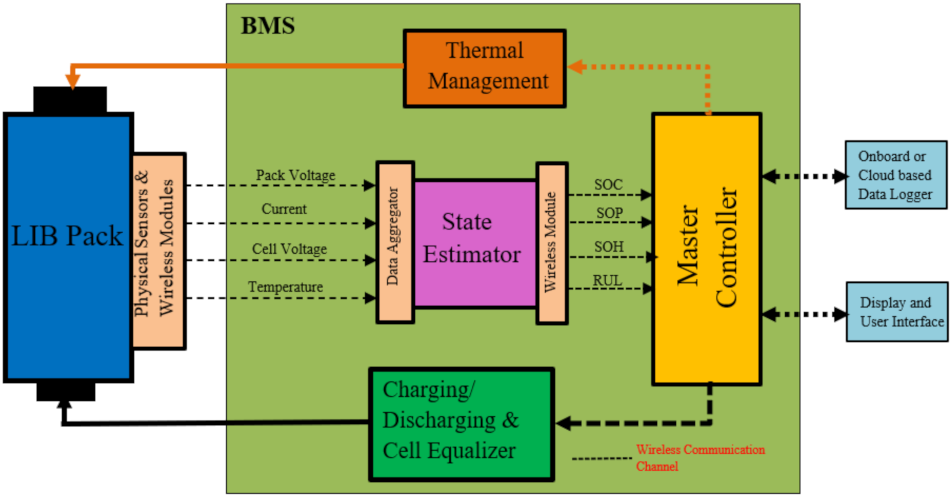
Figure 1 is a simplified model of a complete BMS architecture, including the ADC, MCU (microcontroller), battery cells, resistors, etc. Shown in the diagram are MOSFETs, a small, efficient field-effect transistor7. Working together with resistors to ensure voltage equalization by preventing overcharging and discharging. The ADC continuously extracts analog data from the cells and converts it into digital data, making it accessible to the central controller. The MCU retains and processes all information from the sensors by storing it in its memory, which is necessary for the BMS to run autonomously.
Voltage Monitoring
Voltage monitoring is one of the most important functions of a BMS because it ensures voltage balancing between cells to prevent overcharging and discharging. It is important that there are measures to prevent overcharging and discharging, as these situations can cause irreversible chemical and physical damage to the battery. For example, swelling and leakage, as well as capacity loss and safety hazards7. In environments like Lisbon’s historic trams, factors such as increased passenger loads, steep climbs, and longer routes cause large amounts of strain on the system’s batteries, especially due to the aging infrastructure. For instance, steep hills or loaded trams can cause increased current draw, leading to a sudden voltage drop because of the motor’s increased power demand. These variables and conditions create challenges in maintaining voltage balance between cells, as fluctuating power demands caused by a certain environment can lead to uneven charging and discharging across the entire system7.
An analog-to-digital converter (ADC) converts the analog signal to digital data that the BMS can interpret to manage the voltage of the pack safely and effectively7. According to Krishna et al. (2024), a DC-DC converter would effectively regulate voltage levels from 4.5 V to 36 V, providing a stable output voltage of around 12V, which is familiar and usable for many applications. However, such a DC-DC converter would not be sufficient for a historic tram system such as Lisbon’s, as its input voltages (provided by the catenary infrastructure) can reach hundreds of volts8. Lelie et al. (2018) explain that each battery cell contains only a few volts; thus, it would be more appropriate to use one DC-DC converter per string or sub-pack, as per-cell converters would be ineffective for a multi-kilowatt-hour tram pack.
In addition, to enable accurate measurements and estimations of these cell voltages, front-end monitoring chips dedicated to each string or cell could be connected to ADC inputs. Chips are designed to interact with each cell to monitor and record the voltage to then digitally transmit that data to the BMS. Additionally, some chips are also able to perform cell balancing7. By using this design, the main controller system is allowed to continuously measure the voltage of each cell or string, even in high-voltage scenarios, such as those common with historical tram battery packs.
Yet, this system carries uncertainties that must be addressed to enable fair judgment. Each cell in the pack can differ by as little as a few millivolts (mV), which makes the voltage measurements susceptible to electrical noise (from motors, converters, inverters, and switching circuits) before the ADC can convert them to digital data9. Thus, when converted to digital data, the BMS reading is likely to become inaccurate in comparison to the actual data. For instance, a noisy and hot environment, such as Lisbon’s, can cause collected data to become inconsistent and inaccurate. These false readings can cause significant issues and pose potential dangers, as the BMS may respond to a noisy signal, leading to an unnecessary shutdown, leading to congestion, or failing to act when a real fault occurs. Achieving these precise measurements may be more difficult in rusty environments with limited space and mixed electronics. Nevertheless, a solution to this problem could be to design the BMS to identify data outliers, recognizing that the data is unusable and inaccurate. For example, a hierarchical BMS design is mentioned, including a cell interface, power stack, and power interface to isolate noisy signals and enable the BMS to identify false readings.
Current Monitoring
Monitoring current is another key function of a BMS. This is because an excessive amount of current can lead to overheating, swelling, and potentially fire hazards. Conversely, if not enough current is supplied to the motor, it can cause the cells to degrade faster, causing the battery capacity to become reduced7.
The most conventional way to monitor and measure current is using “Hall effect” sensors connected to an ADC. When current flows through a conductor, it generates a magnetic field. A Hall element placed in that field, and driven by a small bias current, develops a Hall voltage proportional to the product of the magnetic flux density and the bias current7. The ADC reads the “Hall voltage” and converts it to digital data, which the BMS processes as current. Since this process is contactless, it is a safe way to measure current in high-voltage systems like the Lisbon trams.
Past studies written by K.-L. Chen and Chen10 in 2011 mentioned coreless Hall effect transformers (HCTs). HCTs have their iron cores removed which significantly reduces their cost and size, increasing their efficiency. K.-L. Chen and Chen concluded that HCTs improve measurement precision by reducing magnetic interference from a three-phase system. However their coreless design includes a limitation, they are more vulnerable to other high-current traces, which could interfere with the relevant measurements.
Electromagnetic interference (EMI) in current signals can interfere with data collection, thus it is vital that it is filtered using dedicated converter circuits. By analyzing both voltage and current data, the BMS can create an IV curve that portrays the system’s performance among other takeaways. Analysing voltage and current is a necessity to ensure efficiency. Together, these components allow the BMS to track and monitor the amount of current entering and exiting the battery, which brings numerous advantages such as fault detection and tracking the status of the pack6.
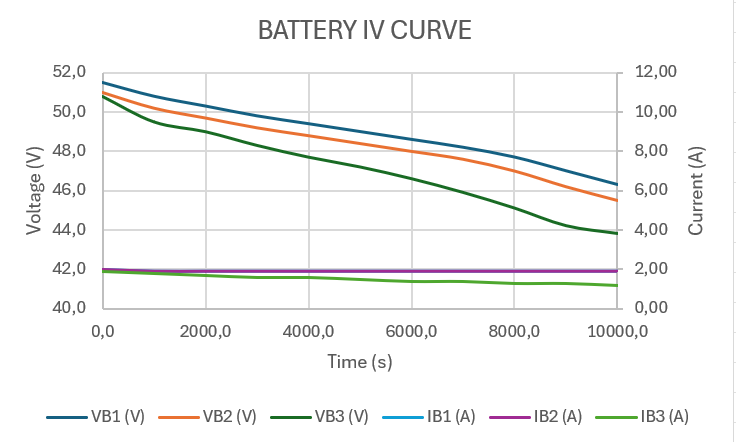
Figure 2 reveals the trend between the current and the voltage in an exemplary system. Adapted from Young et al.11, this graph shows that as the discharge current increases slightly, the voltage drops because of internal resistance. This is applicable to a BMS system, which would allow the controller to process immediate efficiency and power output.
Figure 2 is important as it demonstrates the battery’s basic behaviour. However, a study by Huang et al. (2024) shows that incremental capacity (IC) curves, a derivative of the IV curve, can reveal subtle details in lithium-ion battery cells that standard IV curves cannot12. One example is early degradation, which IV curves do not show when a similar occurrence happens. Because of the need to amplify weak yet important signals, the authors propose a new method to assess battery degradation that combines voltage data with a stacked bidirectional gated recurrent unit (SBiGRU) neural network and transfer learning. Combining IC curves with SBiGRU models allows the model to capture sensitive battery performance over time. Furthermore, because the IC curve peak shifts over time, these curves allow for better diagnostics due to their predictable trends, making them suitable for BMS integration for long-term SoH monitoring and other functions.
Huang et al. (2024) effectively show that IC curves combined with advanced voltage data and SBiGRU models enable the interpretation of subtle degradation that standard IV curves cannot identify. However, this hybrid model requires large amounts of computational power to operate as designed. Indeed, it was designed under laboratory-grade computing power and conditions. This makes it unrealistic to implement in a BMS because of the inability of the low-powered microcontrollers to adopt this technology. Because this model was tested on a specific data set, the method’s ability to be used in real-world conditions with inclines, regenerative braking, and fluctuating temperatures is unknown. Even though this technology could lead to future advancements in SoC predictions, future work in real-world scenarios, such as implementing this tool in trams and electric vehicles, must be conducted to ensure certainty.
Cell Balancing
As batteries degrade over time, capacity imbalances develop throughout the pack, which can lead to variations in cell characteristics such as internal resistance. This is problematic as it can cause voltage imbalance under charge and discharge, leading to safety hazards. It can also result in battery exposure, which can accelerate degradation because the cells are not uniform in voltage. Cell balancing is thus necessary to equalize the charge among the cells and prevent the weakest cell from experiencing over-discharge in operation, while healthy cells experience overcharge.
A BMS must be implemented to establish cell-balancing strategies, as described below, to ensure the battery pack remains reliable. Figure 3 represents a complete example of cell balancing methods such as passive, active, and hybrid balancing.
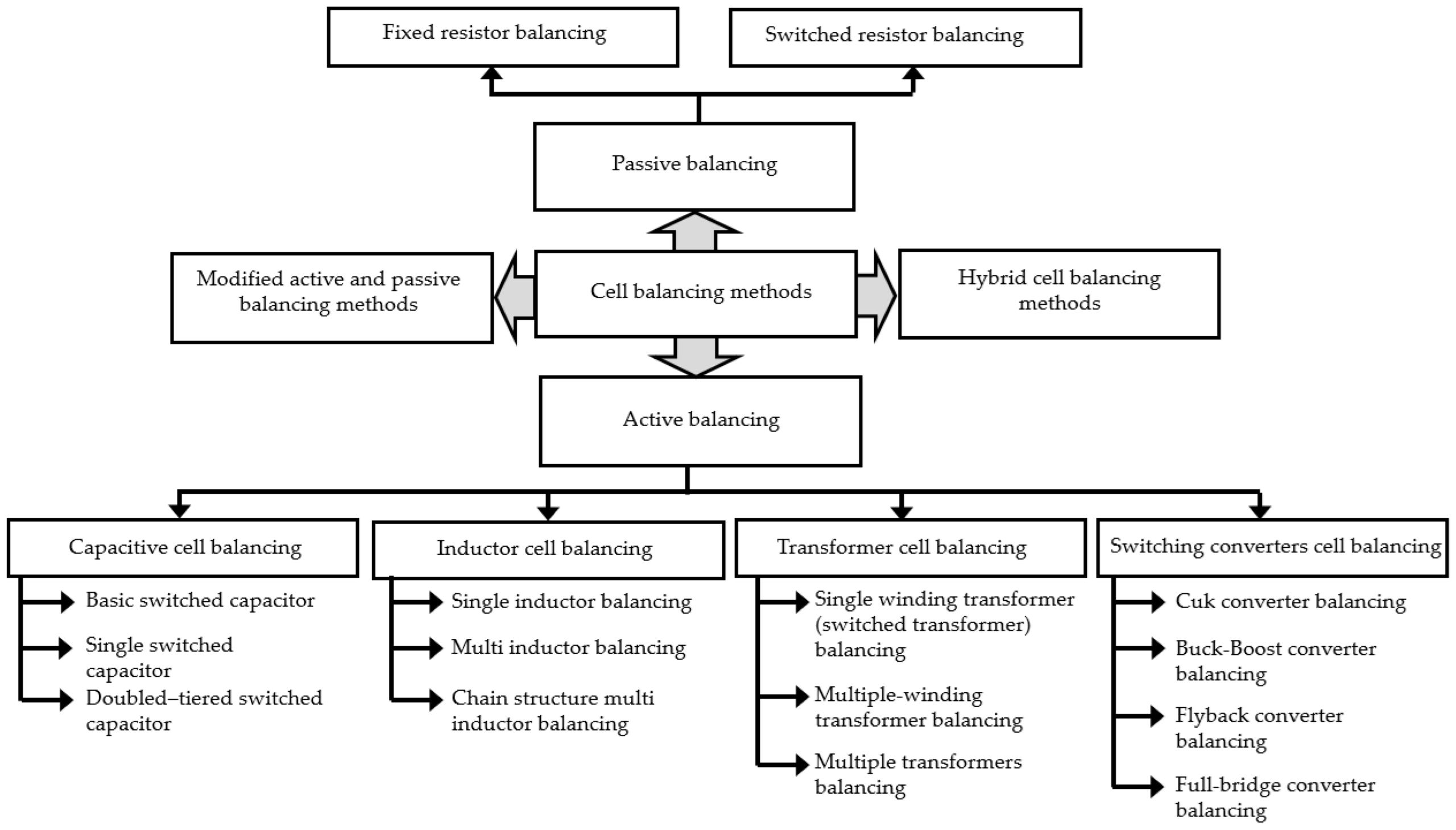
Passive balancing occurs when the system burns off any excess energy, turning it into waste, so that all the cells remain equal in voltage. Passive balancing can further be divided into fixed-resistor and switched-resistor balancing. Fixed resistor balancing requires a resistor to be permanently connected to a cell so that, when the battery reaches its voltage limit, excess energy can flow through the resistor. This is a simple process, but highly inefficient and unsustainable, as energy is constantly being wasted. On the other hand, switched resistor balancing uses the same principles as fixed resistor balancing, but with a MOSFET implemented. This means that the resistor is connected to the cell only when the switch is closed, rather than permanently. The resistor effectively has a switch that only activates when the battery cell reaches full charge.
Furthermore, actively balancing cells involves redistributing energy between them, saving energy. Several methods can be used for active balancing, such as capacitive, inductive, transformer-based, and converter-based methods13. These balancing approaches can be named by the components that are required for active balancing. For example, capacitive balancing uses single and/or double-tiered switched capacitors, which keep the process simple and improves its effectiveness but limits its speed.
Krishna et al.14 (2024) wrote about a “cell-to-cell” balancing method (converter-based balancing) which uses a DC-DC converter to directly charge the transfer from a high-voltage cell to a low-voltage cell. This study tested this method and tested parameters such as efficiency, duration, and voltage deviation. The results were generally positive, with 48 minutes needed to balance the charge of 12 lithium-ion batteries, with an efficiency of 89.85%. Moreover, the transformer’s turns ratio was 1:1 (ensuring the input is voltage directly transferred to the output side to charge the low-voltage cell), thus making the typical voltage deviation within a battery group less than 0.2 V. The algorithm for the DC-DC converter (which converts one direct current voltage level to another) would start by reading the voltages of all the cells. It would then identify the cell with the highest voltage (Vmax) and the cell with the lowest voltage (Vmin). The algorithm would constantly monitor voltages and balance current, all integrated into the BMS microcontroller.
Krishna et al. describe a cell-to-cell balancing method that requires controlled DC-DC energy transfer between cells. Similarly, Koutsouvelis et al.15 focus on a specific DC-DC design that could be relevant to cell balancing but requires monitoring to prevent excess current from entering the battery pack. The Cuk converter offers several advantages for cell balancing. For instance, it can increase or decrease a battery’s voltage to maintain a stable pack. It also allows for a consistent inductor current, which lowers electromagnetic interference (EMI), this suits the DC-DC converter’s need to operate in low-EMI areas. Except, without proper monitoring, the Cuk Converter can cause an increasing current into the battery during cell-to-cell balancing, in that case the current would only be controlled by simple internal resistors which could lead to consequences such as strain or stress on a battery cell. Krishna et al. monitored DC-DC method demonstrates why control and safety of switching battery cell voltage and current are important.
SoH and SoC
State of Charge (SoC)
State of charge (SoC) and state of health (SoH) are both fundamental indicators used by a BMS to control the condition of a lithium-ion battery pack. SoC can be defined as the ratio between the charge currently available in the pack and the maximum charge it can hold, under the same conditions4. It can often be expressed as the following percentage:
Inversely, the depth of discharge (DoD) indicates how much of the battery’s capacity has been consumed during use. It is represented mathematically by dividing the discharged capacity (Cdis) by the nominal capacity (Cnom), both measured in ampere-hours:
SoC is a necessary measurement for the BMS to safely and efficiently manage electric vehicles, as it tells the controller how much usable energy is still available in the battery pack16. Proper measurements of SoC allow a BMS to control specific voltage and current limits to ensure accurate range predictions in electric vehicles. DoD demonstrates the amount of the battery’s capacity which has been used in one single charge cycle. By monitoring DoD over time, the BMS can estimate several factors, such as the remaining battery life and when the power limits or when other settings should be adjusted. SoC shows the instantaneous state of charge of a battery pack, while SoH enables the BMS to assess the long-term degradation of the battery. Both measurements directly influence one another: cycling patterns (affected by the DoD) influence SoH deterioration, and SoH, in turn, affects SoC reliability.
SoC is a crucial quantity used by the BMS to ensure an ordered and safe operation of an electric vehicle. SoC assessment allows the BMS to determine and analyze various operational details, such as the potential energy of the battery and limiting discharge current16. Modern BMS systems consistently use SoC and SoH estimation to operate safely and prioritize long-term battery health17. However, since the energy storage in a battery is purely a chemical process, it cannot be directly obtained. As a result, SoC estimation becomes complicated, making it necessary to find an estimation process that is accurate (through noise filtering and calibration), as errors in the estimation can cause a negative chain effect in the SoH findings. SoC estimation is a key factor in determining the battery’s charge cycle. When the BMS estimates a high SoC, it draws back the charge current to prevent overvoltage and switches from constant current (CC) to constant voltage (CV). The system depends on SoC estimations to prevent overcharging and discharging. For instance, rejecting or accepting the current produced by regenerative braking allows the BMS to protect its battery, controlling temperature instability and Li-plating.
The Coulomb counting method estimates the battery’s SoC by measuring the current going in and out of the battery and integrating it over time16,17. Essentially, it measures the current entering or leaving the battery and adds or subtracts that value from the SoC. It is estimated from the charging and discharging current and the previous estimated SoC. This is because Coulomb counting only tracks the change in charge, so it requires a known initial SoC value, typically obtained from an open-circuit voltage measurement. The previous estimate, (SoC(t-1)), is used in the following equation:17
The equation expressed above is the “discrete time” version of Coulomb counting, where I(t) is the amount of current measured during each time interval. The sign on I(t) signifies whether the battery is charging or discharging, thus also affecting the output SoC estimation. Coulomb counting is simple to implement in hardware by using ADCs to integrate data to the central controller, and does not require rest periods, unlike open circuit voltage. Uncertainties arising from minor measurement errors will accumulate over time, making SoC estimations inaccurate. Coulomb counting continues to use the battery’s nominal capacity (Qn) instead of the present SoH. This results in a consistent error in the data whenever estimations are made18,19. Coulomb counting can be used adjacently with other estimation methods, such as Kalman filtering, to filter out uncertainties and the risk of unreliable data.
Oloyede et al.20 warn that current models for simulating and estimating SoC are limited when interchanging battery chemistries. For instance, one model may excel and provide accurate results, but when applied to another battery with a different battery chemistry, it lacks precision. Thus, state-of-the-art modelling and simulation tools are explored, like MATLAB/Simulink. This tool is widely used as a SoC estimation algorithm. It allows the user to estimate charging and discharging cycles, temperature fluctuations, and the interactions between SoC and SoH. Other programs, such as BLAST (NREL) and SAM (NREL), contain detailed information on the battery’s temperature, SoC depth, and degradation. These studies and reviews matter for SoC estimation because they show that accurate models are required to be able to chemically exchange, sense temperature changes, among others. SoC estimation models cannot only rely on methods such as Coulomb counting or OCV curves, simulation algorithms such as the ones mentioned above are necessary to handle drift, noise, etc.
State of Health (SoH)
SoH is a figure for a battery’s general condition relative to when it is new21. There are generally two perspectives on the definition of SoH. The first is the manufacturer’s perspective (SoHa), based on the full capacity in an ideal charge. However, it is also possible to consider the user’s perspective, which is based on realistic capacity (SoHav). For instance, a battery might only deliver 60-70% of its full capacity in real operation. Ideally, SoH is numerically expressed as the following4:
By estimating this value, the operator can schedule battery replacements, adjust the operating schedule, and ensure vehicle performance. When a vehicle has low SoH, more heat is generated due to the internal resistance, which leads to its power and range being gradually reduced. To prevent these faults, a modern BMS can determine SoH by comparing the actual capacity to the nominal capacity. However, SoH estimation is only reliable when it is combined with other methods, such as SoC estimation4. BMS uses temperature sensors to monitor heating patterns, as older batteries tend to heat up faster due to their higher resistance and then uses those results to approximate the SoH. As the battery ages, BMS is also able to start recognizing patterns due to its ability to self-learn; this is particularly useful as the parameters of the physical battery change over time.
To slow the aging process, the BMS uses these values to maintain functionality for as long as possible while prioritizing safety. If SoC is high and SoH is low, the controller recognizes the battery is weak, limiting or slowing the rate of the charging current by communicating to the power source and decides on the amount of current retained from regenerative braking, preventing overcharging4. On the other hand, when SoC and SoH are low, the controller lowers the amount of discharge current in the battery, which prevents the weakest cell in the pack from collapsing under a high load. It is also common to put the vehicle into a “low power mode” to extend the battery’s overall lifetime4. Ultimately, SoH determines the operational boundaries of the vehicle considering the mentioned limitations and capabilities.
Su et al.22 explore multiple methods for estimating SoH. The primary measurement categories include direct measurement, model based, data driven, and hybrid model-data methods. It is worth noting the different ways the models in these categories estimate SoH values. For example, empirical models use past knowledge about lithium-ion batteries to build degradation system. However, there is not as much research done on these models compared to others, primarily due to cell variance, which produces difficulty in calculating an accurate number. Moreover, a data-driven method called physics-informed neural networks (PINNs) combines data-driven models with physical battery laws to improve SoH estimation. There are multiple ways PINNs are used, like a deep hidden physics model (DeepHPM). DeepHPM uses a neural network with a physical degradation model, which applies differential equations while acknowledging features such as constant-voltage (CV) and IC curves. Another example is a recurrent neural network (RNN), which is trained on a physical constraint of the peak of the IC curve, forcing the same relationship between the peak and SoH. Incorporating physical knowledge in neural networks allows machines to learn accurate estimations that are better understood and interpreted.
Interaction between SoH and SoC
SoC and SoH depend on each other despite their two different definitions. SoC estimation methods assume that the actual capacity is given, the internal resistance of the battery is somewhat stable, and that the voltage corresponds to a familiar OCV-SOC curve. Nevertheless, as the battery ages, its capacity decreases. Waag4 describes how SoH is based on the comparison between actual capacity and nominal capacity, but over time, usable capacity becomes smaller than nominal capacity. The SoH estimation depends on an accurate SoC, which is why it is important to use a combination of estimation methods so as to not obtain inaccurate values for both. To estimate the capacity fade, the number of ampere-hours going in (charging) and out (discharging) the battery must be known4. Therefore, wrongly calculated capacity leads to inaccurate SoH, and drift in SoC measurements (error accumulation) leads to a slow progression of SoH drift. Hence, inaccurate SoC estimation leads to unreliable SoH predictions, and an aged SoH further increases the discrepancy between SoC and SoH. By combining techniques that involve current, voltage, and temperature, modern BMS can reduce the impact of this problem.
Advantages of implementing ML in BMS
To support BMS with measurement and estimation, ML technologies and innovations have been implemented. ML integration could improve BMS performance as it allows for data estimation, like SoH and SoC to potentially be more adaptive, so that it is able to refine its estimations over periods of time23. It also estimates SoH/SoC in real time and anticipates future patterns, enabling an efficient approach in laboratory conditions, and could potentially replicate these results in legacy tram conditions24. There have also been ML algorithms developed for sudden voltage drops, rapid overheating, and general fault detection, though these algorithms have not been validated in legacy tram models. ML has been preferred over conventional methods due to it being more precise in modelling non-linear battery behaviour, while also being resistant to noise and interference. However, studies have demonstrated these results under controlled laboratory conditions. Therefore, it would be beneficial to conduct tests to determine whether the results would be as accurate in legacy tram models25,24. ML is more versatile for SoC/SoH estimation; it can better handle nonlinear voltage-SoC curves than conventional methods such as Kalman filtering in research contexts26. Cell imbalances usually appear as inconsistent voltage and temperature readings across the battery pack.
Supervised and unsupervised algorithms are widely used for BMS applications27. Supervised learning uses labelled data, which includes inputs and known targets. Its task in a BMS is to predict the SoC and SoH of a battery27. Contrastingly, unsupervised learning utilizes unlabelled data, it is usually used in BMS to detect faults, outliers, and battery degradation27.
Common BMS systems are more likely to miss these outliers because of their methodical structure. Specific ML algorithms show promise in detecting degrading and collapsing cells earlier, reducing the likelihood of early battery pack failure25. A beneficial advantage of ML estimation methods is their potentially faster speed in estimating SoC and SoH, even under heavy loads, steep inclines, and temperature fluctuations. This prevents drifting and outliers, as ML does not require the resting periods required by other methods, such as OCV estimation. Moreover, ML models could leverage cloud computing and improve accuracy by processing large-scale datasets24. This new version would allow for the remote monitoring of the battery pack, which can be overseen by a team of service teams or engineers for faster fault detection and early intervention in case a fault does occur. It could further support long-term data storage, maintenance, strategic planning, and battery degradation by constantly monitoring cells.
It is important to compare conventional and modern methods because as time goes on, modern methods such as ML are being pushed to be implemented. Firstly, over time Coulomb counting accumulates error due to it committing minor errors every estimation without correction4. Moreover, when estimating it continuously uses the battery’s nominal capacity (Qn) even when the battery could be degraded4, therefore this would lead to inaccurate estimations since the method is not taking current SoH into account. Kalman filtering can also be used adjacently to reduce the uncertainty in Coulomb counting. Ardeshiri et al.26 (2020) have tested ML in laboratory conditions and concluded that ML algorithms model non-linear battery tendencies more accurately than traditional methods such as Coulomb counting and Kalman filtering. Similarly, in comparison to Kalman filtering, non-linear voltage-SoC curves are modelled better by ML, while also being more resistant to noise and interference signals. However, to operate ML it will require significantly more memory and high-quality training data in comparison to conventional methods which are cheap and easy to run on embedded microcontrollers24. The ability of historic tram models to carry ML becomes low due to their hardware, thus constraining deployment.
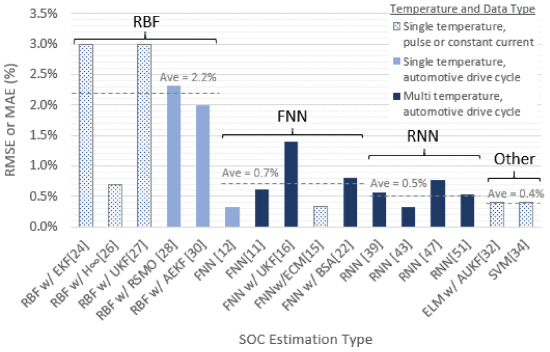
A recent study done by Vidal et al. shows that ML techniques drastically improve the reliability of SoH/SoC estimations. Figure 4 sorts the algorithms into four categories: radial basis function (RBF) networks, FNNs and RNNs, and other unspecified methods, with different inputs. These are single-temperature with a constant current, single-temperature with an automotive drive cycle, and multi-temperature with an automotive drive cycle. The comparison between the four categories shows a clear difference in average error, showing that, among the three neural-network families, RNNs have the lowest average error margin (0.5%), against 0.7% for FNNs and 2.2% for RBF networks. The heterogeneous “Other” category shows a lower average still (0.4%), although on a much smaller number of studies. Figure 4 also shows that the highest-performing algorithm was trained on varying temperatures and realistic automotive drive cycles, highlighting that those trained on realistic conditions are likely to perform better not only in simulations but also in real operation. ML accuracy depends on the quality and uniqueness of the data. Because a single temperature does not reflect realistic driving and operating conditions, it is essential for a proper, complete modern BMS model. Fig. 4 shows how ML not only offers better accuracy but as well as its ability to lessen assumptions, which would be much more common with traditional methods such as OCV and Coulomb counting.
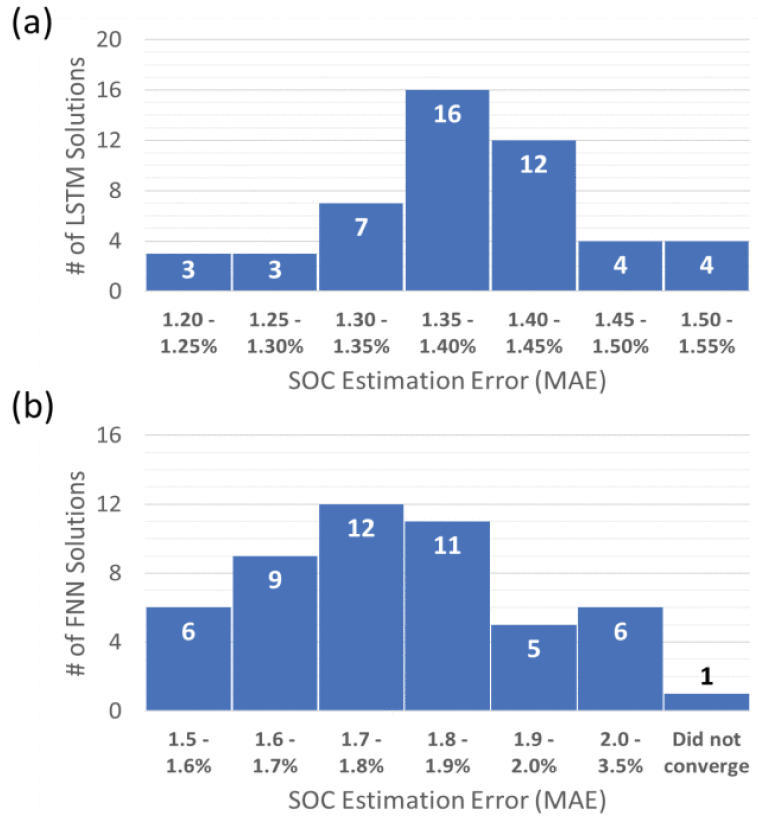
Both models in Fig. 5 were trained 50 times for 3000 epochs with the same parameters, but different initial parameter values. The figure shows histograms of the SoC estimation error (MAE) for three drive cycles, two charging profiles, and four temperatures. The LSTM model achieves lower error percentages (1.20-1.55%), whereas FNN models demonstrate higher error rates and a greater spread in percentage (1.5-3.5%), with one testing run not converging. This figure summarises why multiple testing and training runs are necessary when comparing ML models for computing and estimating SoC. Relying on a single run can lead to an inaccurate conclusion compared to several trials.
Limitations and Inaccuracies
Nevertheless, ML will continue to have uncertainties even with the training and testing phases of the development. Vidal et al.’s study (Figure 4) shows that the same FNN and LSTM produced different, inaccurate SoC results due to differences in local minima. The issue with incorporating ML into a BMS is that all algorithms depend on the data they are trained on. When operators do not have access to complex datasets, this leads to generalization. ML models are also trained on early battery life data, facilitating them to make false predictions later when the battery starts to age25. There could also be physical limitations when paired with software and algorithms. Larger, computationally intensive models require increasingly more computational power, which would be inconvenient to provide on a lightweight historic tram. As a result, the model may become inaccurate if the appropriate hardware is not installed.
The development of ML in modern BMS systems is a significant advancement in the capabilities and accuracy of SoC and SoH estimations and other factors. In theory, ML surpasses traditional estimation methods by improving the detection of noisy signals, handling shifting temperatures, and modelling realistic automotive driving cycles25. As shown by Vidal et al., ML algorithms are becoming increasingly accurate, as demonstrated in Figure 4, where different models exhibit progressively lower error margins. These models allow for service teams to control each vehicle and closely monitor each of its factors, thus allowing them to efficiently provide maintenance to ensure smooth operation of the vehicle. On the other hand, these models come with uncertainties and important considerations. Most models solely depend on data set quality, making them useless for operators who cannot obtain such high-quality data or that do not have the necessary resources to implement ML in their electric vehicles24. Moreover, appropriate hardware remains necessary to host these advanced algorithms and maintain these error margins as they are or lower. Overall, ML-integrated BMS offers a step into transforming BMS for faster, more efficient, and sustainable vehicles.
Conclusion
In conclusion, advancements in BMS technologies, which combine voltage, current, and SoC/SoH estimation with ML control, provide a safe and efficient system for the operations of high-demand public transport systems. Lisbon’s hilly terrain, changing temperatures, and the aging infrastructure of its iconic trams suggest that a hybrid system could offer operational advantages over a pure catenary-based system. The analysis of studies and articles suggests that a lithium-ion battery equipped with a modern BMS could help manage unexpected current spikes or voltage drops on steep hills and alert service operators to other problems, such as cell unbalancing, which all decrease the battery’s lifespan. Refined SoC/SoH estimations enable maintenance to strategically plan when to replace the battery, and how to do so, without disrupting service hours. SoC/SoH are necessary when dealing with heavy vehicles operating in noisy environments. According to studies reviewed in this paper, ML implementations have been reported to improve noise resistance and anomaly detection compared to conventional methods. It reportedly also excels at pattern recognition and would be useful in alerting when a safety issue occurs and predicting future faults25. These features show that a collaborative system combining a physical battery and overhead power would offer more advantages than overhead lines alone. For instance, in the event of a power outage, the hybrid system would allow the tram to stop in a safe area away from high-traffic urban areas and to maintain essential systems such as lighting and communication devices. In future work, the objective is to further bridge the gap of literature and research between ML implemented BMS and legacy tram models. An experimental procedure of collecting data to produce results about thermal management and SoH would allow for further worked upon conclusions. Moreover, other figures such as quantitative modelling of internal resistance effects and dynamic load responses would contribute to a finer conclusion. Overall, modern BMS technologies are beneficial for systems such as Lisbon trams, enhancing long-term efficiency, safety, and sustainability.
AI Usage Declaration
During the preparation of this work, the author used ChatGPT 5.0 by OpenAI and Grammarly to structure/organize thoughts/ideas and to find adequate sources. After using this tool, the author/s have reviewed and edited the content as needed and take full responsibility for the content of the submitted article.
References
- Liu, X., & Li, K. (2020). Energy storage devices in electrified railway systems: A review. Transportation Safety and Environment. https://doi.org/10.1093/tse/tdaa016 [↩]
- R. Suganya, Joseph, L. M. I. L., & Sreedhar Kollem. (2024). Understanding Lithium-Ion Battery Management Systems in Electric Vehicles: Environmental and Health Impacts, Comparative Study, and Future Trends: A Review. Results in Engineering, 103047–103047. https://doi.org/10.1016/j.rineng.2024.103047 [↩] [↩]
- Faruque, O., Faruq, O., & Alam, M. M. (2026). A comprehensive review of past and present developments of Li-ion batteries. Discover Sustainability, 7, Article 207. https://doi.org/10.1007/s43621-026-02920-8 [↩] [↩] [↩] [↩]
- Waag, W., & Sauer, D. U. (2009). Lead acid batteries: State of charge, state of health. In J. Garche, C. K. Dyer, P. T. Moseley, Z. Ogumi, D. A. J. Rand, & B. Scrosati (Eds.), Encyclopedia of electrochemical power sources (pp. 793–804). Elsevier. https://www.sciencedirect.com/science/article/pii/B9780444527455001490 [↩] [↩] [↩] [↩] [↩] [↩] [↩] [↩] [↩] [↩]
- Miraftabzadeh, S. M., Ranjgar, B., Niccolai, A., & Longo, M. (2024). Comparative analysis of sustainable electrification in Mediterranean public transportation. Sustainability, 16(7), 2645. https://doi.org/10.3390/su16072645 [↩]
- Gabbar, H. A., Othman, A. M., & Abdussami, M. R. (2021). Review of battery management systems (BMS) development and industrial standards. Technologies, 9(2), 28. https://doi.org/10.3390/technologies9020028 [↩] [↩] [↩]
- Lelie, M., Braun, T., Knips, M., Nordmann, H., Ringbeck, F., Zappen, H., & Sauer, D. U. (2018). Battery Management System Hardware Concepts: An Overview. Applied Sciences, 8(4), 534. https://doi.org/10.3390/app8040534 [↩] [↩] [↩] [↩] [↩] [↩] [↩] [↩]
- Schmid, F., Goodman, C. J., & Watson, C. (2015). Overview of Electric Railway Systems. 7th IET Professional Development Course on Railway Electrification Infrastructure and Systems (REIS 2015). https://doi.org/10.1049/ic.2015.0320 [↩]
- Krishna, T. N. V., Prabhu Deva Kumar, S. V. S. V., Rao, S. S., & Chang, L. (2024). Powering the future: Advanced battery management systems (BMS) for electric vehicles. Energies, 17(14), 3360. https://doi.org/10.3390/en17143360 [↩]
- Chen, K.-L., & Chen, N. (2011). A new method for power current measurement using a coreless Hall effect current transformer. IEEE Transactions on Instrumentation and Measurement, 60(1), 158–169. https://doi.org/10.1109/TIM.2010.2049234 [↩]
- Young, C.-M., Chu, N.-Y., Chen, L.-R., Hsiao, Y.-C., & Li, C.-Z. (2013). A single-phase multilevel inverter with battery balancing. IEEE Transactions on Industrial Electronics, 60(5), 1972–1978. https://doi.org/10.1109/TIE.2012.2207656 [↩]
- Huang, S., Wang, X., Kang, L., Xie, D., & Zhang, X. (2024). State of Health Estimation for Lithium-Ion Battery Using Partial Incremental Capacity Curve and Transfer Learning. Batteries, 10(9), 324. https://doi.org/10.3390/batteries10090324 [↩]
- Kurkin, A., Chivenkov, A., Aleshin, D., Trofimov, I., Shalukho, A., & Vilkov, D. (2025). Battery Management System for Electric Vehicles: Comprehensive Review of Circuitry Configuration and Algorithms. World Electric Vehicle Journal, 16(8), 451. https://doi.org/10.3390/wevj16080451 [↩] [↩]
- Krishna, T. N. V., Prabhu Deva Kumar, S. V. S. V., Rao, S. S., & Chang, L. (2024). Powering the future: Advanced battery management systems (BMS) for electric vehicles. Energies, 17(14), 3360. https://doi.org/10.3390/en17143360 [↩]
- Koutsouvelis, D., Vokas, G. A., & Ioannidis, G. C. (2021). Cell balancing using a modified Cuk converter. IET Conference Proceedings, 2020(5), 367–371. https://doi.org/10.1049/icp.2021.1288 [↩]
- Piller, S., Perrin, M., & Jossen, A. (2001). Methods for state-of-charge determination and their applications. Journal of Power Sources, 96(1), 113–120. https://doi.org/10.1016/S0378-7753(01)00560-2 [↩] [↩] [↩]
- Waag, W., & Sauer, D. U. (2009). Batteries – Battery Types – Lead-Acid Battery | State-of-Charge (SoC), State-of-Health (SoH). Encyclopedia of Electrochemical Power Sources, 420–432. https://doi.org/10.1016/b978-0-323-96022-9.00347-9 [↩] [↩] [↩]
- Chang, W. Y. (2013, July 23). The State of Charge Estimating Methods for Battery: A Review. Wiley Online Library. Retrieved November 18, 2025, from https://onlinelibrary.wiley.com/doi/10.1155/2013/953792 [↩]
- Liu, S., Cui, Y., Yuan, L., Xu, Z., & Jin, L. (2026). Joint State-of-Charge and State-of-Health Estimation Method Based on Equivalent Circuit Model and Data-Driven Model Fusion. Energies, 19(6), 1567. https://doi.org/10.3390/en19061567 [↩]
- Oloyede, M. O., Akpakwu, G. A., Myburgh, H. C., De Freitas, A., & Kunatsa, T. (2024). A Review on State-of-Charge Estimation Methods, Energy Storage Technologies and State-of-the-Art Simulators: Recent Developments and Challenges. World Electric Vehicle Journal, 15(9), 381. https://doi.org/10.3390/wevj15090381 [↩]
- Berecibar, M., Gandiaga, I., Villarreal, I., Omar, N., Van Mierlo, J., & Van den Bossche, P. (2016). Critical review of state of health estimation methods of Li-ion batteries for real applications. Renewable and Sustainable Energy Reviews, 56, 572–587. https://doi.org/10.1016/j.rser.2015.11.042 [↩]
- Su, L., Xu, Y., & Dong, Z. (n.d.). State-of-health estimation of lithium-ion batteries: A comprehensive literature review from cell to pack levels. ResearchGate. https://doi.org/10.1049/enc2.12125 [↩]
- Wu, Y., Bai, D., Zhang, K., Li, Y., & Yang, F. (2025). Advancements in the estimation of the state of charge of lithium-ion battery: a comprehensive review of traditional and deep learning approaches. Journal of Materials Informatics, 5(2). https://doi.org/10.20517/jmi.2024.84 [↩]
- Ghalkhani, M., & Habibi, S. (2022). Review of the Li-Ion Battery, Thermal Management, and AI-Based Battery Management System for EV Application. Energies, 16(1), 185. https://doi.org/10.3390/en16010185 [↩] [↩] [↩] [↩] [↩]
- Ardeshiri, R. R., Balagopal, B., Alsabbagh, A., Ma, C., & Chow, M. Y. (2020). ML approaches in battery management systems: State of the art. In Proceedings of the 2020 IEEE International Symposium on Industrial Electronics (pp. 1–7). IEEE. https://doi.org/10.1109/IESES45645.2020.9210642 [↩] [↩] [↩] [↩] [↩]
- Ardeshiri, R. R., Balagopal, B., Alsabbagh, A., Ma, C., & Chow, M. Y. (2020). Machine learning approaches in battery management systems: State of the art. In Proceedings of the 2020 IEEE International Symposium on Industrial Electronics (pp. 1–7). IEEE. https://doi.org/10.1109/IESES45645.2020.9210642 [↩] [↩]
- Shu, X., Shen, S., Shen, J., Zhang, Y., Li, G., Chen, Z., & Liu, Y. (2021). State of health prediction of lithium-ion batteries based on ML: Advances and perspectives. iScience, 24(11), 103265. https://doi.org/10.1016/j.isci.2021.103265 [↩] [↩] [↩]