

Abstract
One of the most promising frontiers in genetic medicine is in vivo gene editing, which enables the direct delivery of CRISPR-based tools into the body. In vivo gene editing enables permanent genetic changes within tissues, whereas traditional ex vivo strategies require removing a patient’s cells and engineering them in a lab outside the body. There are numerous ethical questions surrounding safety, fairness, and long-term impact, given the serious medical and social consequences of editing within the body. Within this paper, I’ve examined recent advances in delivery systems, therapeutic applications, technical challenges, and ethical considerations, drawing on various primary studies. These studies demonstrate that delivery systems, such as adeno-associated viruses (AAVs), lipid nanoparticles (LNPs), and viral-like particles (VLPs), are engineered to enhance tissue efficiency, targeting, and safety. The paper also accentuates emerging therapeutic applications across numerous disorders, including Duchenne muscular dystrophy, transthyretin amyloidosis, hemophilia, and inherited blindness. Clinical trials have demonstrated benefits from single-dose gene editing treatments, while animal studies suggest that this approach may be effective in treating patients with diseases such as sickle cell anemia and Pompe disease. Though the technology holds significant promise, major hurdles still exist, including off-target effects, immune reactions, and uncertain long-term consequences. Ethical concerns are equally pressing, ranging from fair access to the possibility of enhancement uses and germline modification. Overall, in vivo gene editing holds life-changing potential, but it depends on balancing innovation with responsible oversight.
Keywords: in vivo gene editing, AAV delivery, lipid nanoparticles, viral-like particles, CRISPR.
Introduction
Gene editing has been a common approach for several decades, starting with tools such as Zinc finger nucleases (ZFNs) and transcription activator-like effector nucleases (TALENs), but the discovery of CRISPR-Cas9 in 2012 made the process faster, cheaper, and more precise1. Clustered Regularly Interspaced Short Palindromic Repeats (CRISPR) works like a molecular scissor, which is guided by a customizable RNA sequence, eventually allowing scientists to cut and rewrite DNA at targeted spots in the genome2. Most early gene therapies used an ex vivo approach, where cells are taken out of the body, edited in a lab, and then returned to the patient2. Inversely, in vivo gene editing delivers CRISPR tools directly into the body, offering exciting potential by enabling genetic changes without removing or engineering cells outside2. Genetic medicine includes gene therapy as well as other approaches for treating diseases using genetic information or genetic methods. In comparison, gene editing is a special form of gene therapy that involves altering the sequences of DNA in the genome through methods like CRISPR, base editing, or prime editing. While this review primarily focuses on in vivo gene editing, selected examples of gene therapy are also discussed because many of the same delivery systems, safety challenges, and clinical considerations apply to both approaches. For clarity, the name “vector refers to the delivery mechanism of viruses, while “delivery vehicle” is employed in a wider context in this review to refer to any platform that delivers genetic material inside target cells. Such platforms include AAVs, LNPs, and VLPs. But not all cell types are equally easy to access for this purpose. Access to the CNS, for instance, is rather difficult due to the blood-brain barrier. Some studies prove that AAV9 can cross the barrier to deliver editing tools to the brain2. Meanwhile, blood-forming stem cells, specifically hematopoietic stem cells (HSCs), are edited outside the body. However, a 2023 study demonstrated that prime editing of HSCs within the body is possible in a mouse model of sickle cell disease3. While traditional Cas9 genome editing involves making double-strand breaks in the DNA, the prime editing technology allows for making more accurate edits without causing such breaks. This method is mostly used in fixing certain disease-related mutations since it can make the desired changes without creating unnecessary byproducts. In addition, base editing is used for single-base changes, while prime editing can do many other kinds of modifications. This indicates that gene correction in blood cells is becoming largely less invasive making it more adaptable for future treatments. In vivo editing is also prominent in skeletal muscle because of its large volume and ability to regenerate. Using AAV to deliver CRISPR, researchers restored dystrophin expression in up to 70% of muscle tissue in mouse models of Duchenne muscular dystrophy (DMD), which also improved muscle function4. In one study, researchers used CRISPR to correct a harmful mutation in the Myh6 gene in mice with inherited cardiomyopathy5. After treatment, the heart muscle improved in size and function, suggesting that even a one-time edit could help manage heart disease5. The eye is another promising target because it is considered immune privileged, meaning it generates a reduced immune response compared to many other tissues in the body, and is also easy to access with a small injection. In one clinical trial, researchers used a CRISPR treatment called EDIT-101 to edit the CEP-290 gene in people with Leber congenital amaurosis6. Results in both humans and primates showed the treatment was safe and stayed local to the eye6. Finally, the liver is one of the simplest organs to target with in vivo therapies because it is able to filter blood and naturally absorb lipid nanoparticles (LNPs) after IV injection. A key study tested on four monkeys demonstrated that LNPs could deliver base editors to the liver and effectively knock down the PCSK9 gene. This resulted in a 60 percent reduction in LDL cholesterol levels after a single dose. The effects lasted more than eight months7.
This paper examines how scientists are currently utilizing gene editing tools, such as CRISPR, directly in the body through various delivery methods, including AAVs, lipid nanoparticles (LNPs), and viral-like particles (VLPs). It will then highlight real-world therapeutic examples, both established and emerging, to demonstrate how in vivo editing is already being used to treat conditions like DMD and transthyretin amyloidosis, and where it is heading next. Finally, this paper addresses the primary technical hurdles, ethical implications and long-term safety risks associated with modifying human DNA, highlighting both the current state and future direction of in vivo gene editing.
Figure 1 below shows all 3 methods of in vivo gene delivery. This review will focus on adeno-associated viruses (AAVs), lipid nanoparticles (LNPs), and Virus-like particles (VLPs) as a representative set of delivery systems to compare the efficiency of in vivo gene editing and targeting in different tissues or organs, especially the liver and harder-to-target organs such as the central nervous system and the eye. These examples cover main trends rather than an exhaustive review.
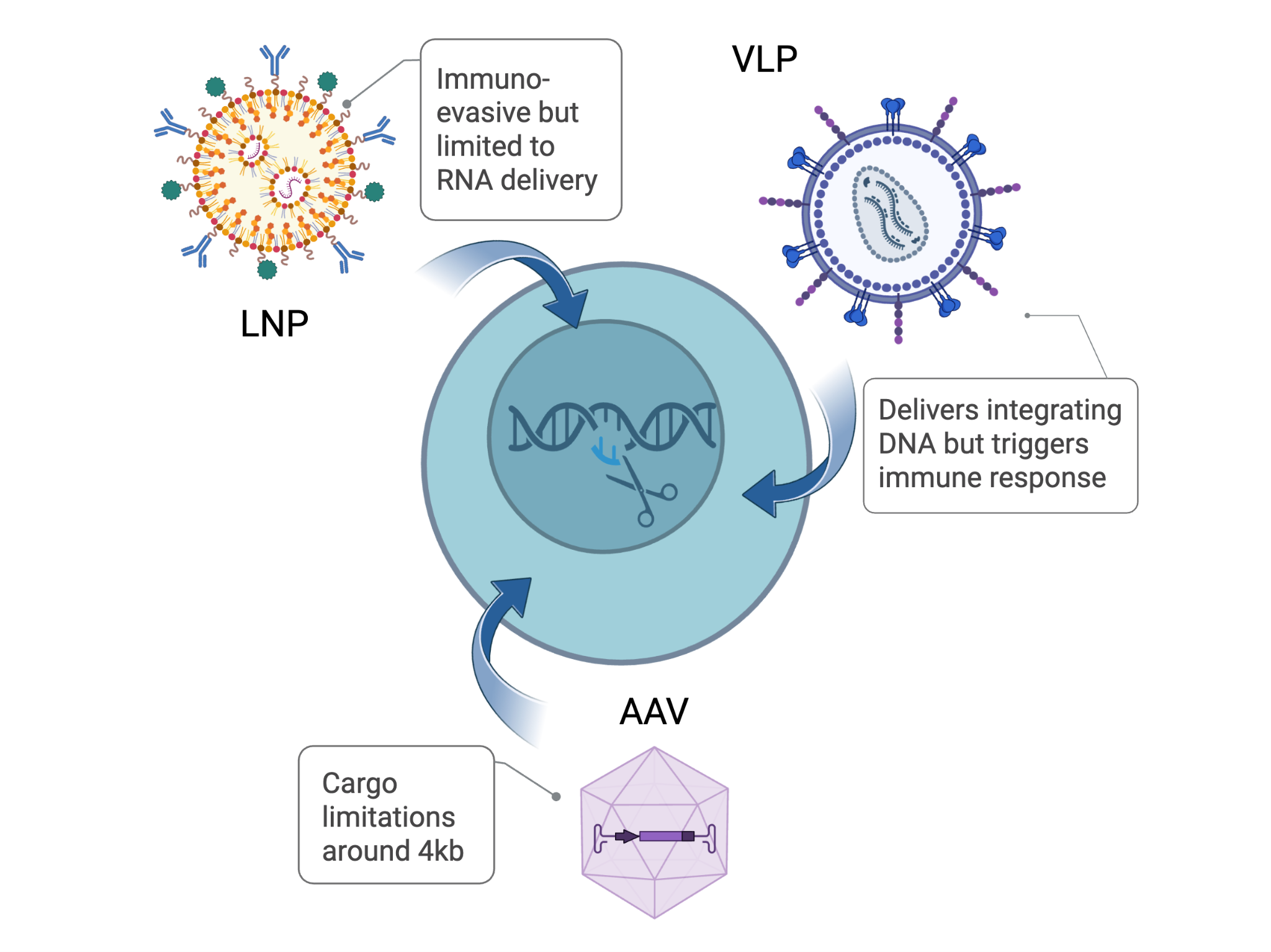
Method
This study was conducted as a literature review using primary research articles indexed in PubMed and searches were performed between June 2025 and August 2025 using combinations of keywords such as “in vivo gene editing,” “AAV delivery,” “lipid nanoparticles,” “viral-like particles,” “CRISPR clinical trial,” and disease-specific terms (ex: “Duchenne muscular dystrophy CRISPR,” “sickle cell gene therapy”). Search strings included combinations such as (“in vivo gene editing” AND AAV), (“CRISPR” AND “lipid nanoparticles”), and (“gene editing” AND “Duchenne muscular dystrophy”). The results were limited to peer-reviewed studies published between 2005 to 2025, stressing on recent publications and primary experimental data. Certain review articles were considered to provide additional context, but only the original research was included in the analysis of therapeutic outcomes. Inclusion criteria included peer-reviewed research on in vivo gene editing systems for delivery, applications, safety, and ethical issues. Exclusion criteria included non-English research articles, studies unrelated to the topic, and duplicate records. Each source was checked for relevance, including delivery vehicles/therapeutic applications, and the data were extracted on delivery method, target tissue, editing outcome, safety profile, and stage of development (preclinical or clinical). Sources were screened based on title and abstract relevance before inclusion in the review. Finally, the findings were compiled into sections corresponding to delivery vehicles, examples of therapeutics, technical challenges, and moral considerations.
Results
LNPs as Small Carriers Making Big Changes
Lipid Nanoparticles (LNPs) have been studied for over 30 years and originally developed as a delivery vehicle for cancer vaccines. Researchers have been studying how these tiny fat-based bubbles could carry genetic tools directly into living cells8. Since then, more promising delivery tools for gene therapy have been developed, particularly following the success of mRNA-based COVID-19 vaccines. Now, LNPs are used to deliver CRISPR editors, base editors, and even CAR-T instructions in vivo, without needing to take out or engineer cells in a lab9’7’10.
LNPs makeup includes four key ingredients: ionizable lipids (which help the cargo enter cells), helper lipids, cholesterol (which helps add structure), and PEG-lipids (which increase stability and reduce immune detection). These components come together through a controlled mixing process that wraps mRNA (or sometimes DNA or proteins) inside the nanoparticle11. Typically, the cargo consists of mRNA, which carries instructions for producing therapeutic proteins or gene editing tools, such as Cas9. The benefit of using mRNA is that it is transient; it produces the protein, then disappears, thereby reducing the risk of long-term or accidental changes. However, mRNA can also be fragile, and scientists are still figuring out how to deliver it to the exact right cells without it breaking down12. One of the most successful uses of LNPs so far is for treating liver-related diseases. In a well-known experiment, scientists delivered base editors to knock down the PCSK9 gene in monkeys, which contributed to a 60% drop in cholesterol levels after just one dose and the effect lasted over eight months7. Another study used a CRISPR-based editing treatment called VERVE-101 to target the same gene. Delivered to the liver, this treatment resulted in long-term reductions in LDL cholesterol with no permanent side effects, and it did not affect sperm in the reported study, indicating a low risk of germline transmission, although long-term effects remain uncertain13. These results suggest that LNPs can be precise and may show positive safety and durability in preclinical and early clinical trials; however, long-term effects are still under investigation. While most LNPs end up in the liver, scientists are learning how to redesign them. In the FIND study, over 250 different LNPs were tested to see if they could reach new cell types. Two variants, 7C2 and 7C3, were able to deliver gene-editing tools to endothelial cells and spleen tissue, not just the liver14. Although variants such as 7C2 and 7C3 impacted delivery to tissues outside the liver, the majority of systemically administered LNPs still accumulate in the liver, highlighting the ongoing challenge of achieving efficient extrahepatic targeting. This study gives scientists the ability to treat diseases in the heart, blood vessels, and immune system. Another study used biodegradable LNPs to deliver CRISPR-Cas9 to knock down a toxic protein in the liver12. After a single administration in CD-1 mice (n = 5 per group), serum TTR protein levels were reduced by more than 97 percent, with effects persisting for at least 12 months, demonstrating durable in vivo editing in a preclinical model12. This efficiency is what scientists hope for in a next-generation gene therapy. LNPs are also being used in a different way, specifically to create Chimeric Antigen Receptor (CAR) T-cells within the body. These reprogrammed T cells are designed to identify and eliminate specific targets, such as cancer or scar tissue. Traditionally, CAR-T therapy requires collecting a patient’s T cells and genetically modifying them using viral vectors outside the body to express a chimeric antigen receptor (CAR). These engineered cells are then expanded in a lab before it is reinfused back into the patient. With new LNP technologies, it may be possible to do this entirely in vivo. In a study from the University of Pennsylvania, scientists made antibody-targeted LNPs that delivered CAR mRNA straight into T cells inside living mice15. This led to a strong CAR expression and up to 90 percent depletion of B cells in vivo in mice, demonstrating effective immune cell targeting in a preclinical model15. Another team developed an LNP called NCtx that delivered both CAR DNA and transposase mRNA10. One IV injection in mice generated long-lasting CAR-T cells that reduced tumors and improved survival, proving that it is possible to make durable CAR-T therapies without removing a single cell from the body10. Historically, the majority of the in vivo delivery strategies used for CAR-T therapy rely on transient mRNA expression, meaning the engineered T cells may not persist long term, and their effects could decrease over time. This raises the possibility of relapse, especially compared to traditional ex vivo CAR-T therapies, where the cells are permanently modified and can survive in the body for years. More recently, Bimbo et al. developed the NCtx LNP platform, which produced durable CAR-T cells following a single intravenous injection in mice. While LNP-based systems may allow repeat dosing, the durability and long-term tracking of these responses are still to be studied. These kinds of innovations show how LNPs might soon let us treat not just genetic disorders, but also complex diseases like heart failure and cancer from the inside out. With the rise of in vivo CAR-T, LNPs may soon enable us to reprogram immune cells directly in patients, eliminating the need for labs, viruses, or complicated procedures. As the field advances, LNPs could be key to making gene editing safer, faster, and more accessible to people worldwide.
AAVs as Gene Editing Carriers
Adeno-associated viruses (AAVs) are some of the most widely used delivery vehicles in gene therapy. Discovered in the 1960s, AAVs were identified as non-pathogenic viruses and used as vital tools for DNA transfer into cells without triggering disease16. AAVs are appealing because of their ability to deliver therapeutic DNA directly into the nucleus, where the virus can remain active for extended periods without integrating into the genome, primarily through episomal persistence that enables sustained gene expression over time. This is key as they may provide lasting benefits with potentially fewer long-term risks than other viral vectors that permanently insert into the host DNA. The first major clinical breakthrough came with Luxturna, the first FDA-approved gene therapy in the US, which utilized AAV to deliver a functional RPE65 gene into the retinas of patients with Leber Congenital Amaurosis17. Patients saw a major improvement in their vision following a single treatment, establishing a major milestone for in vivo gene therapy. It is important to distinguish approved therapies like Luxturna and Zolgensma from the other gene editing therapies discussed later, since they are at very different stages of clinical use, safety data, and overall development. Quickly thereafter, AAVs became central to dozens of clinical trials, particularly for diseases caused by a single gene, known as monogenic disorders. Another major success came with spinal muscular atrophy (SMA), which is a severe neuromuscular disease. Zolgensma, an AAV9-based therapy, delivers a functional copy of the SMN1 gene to halt disease progression in infants with SMA18. Clinical trials proved that one dose significantly improved motor function and survival rate of treated infants18. AAVs can lead to severe side effects due to their tendency to accumulate in the liver. Further research conducted in 2018 concluded that AAVhu68, a variant, caused serious sensory neuron damage, liver inflammation, resulting in organ failure in mice. Since such side effects were not initiated by the immune system, it confirms that any change in AAV design can lead to substantial consequences19. To enhance both safety and delivery location precision, researchers have focused efforts on redesigning its protein shell, capsid, to control where the virus attaches in the body. A key innovation in this area is the CREATE platform, which screens for AAV variants that perform better in specific tissues. One version, called AAV-PHP.B, could easily cross the blood-brain barrier to deliver genetic tools to the brain. This version was up to 40 times more efficient in mice than older versions such as AAV9, and also showed success in human-derived neurons, opening the door for potential human treatments20. More recently, scientists developed a new method called TRACER to evolve AAV capsids in wild-type animals, not just genetically modified ones. This approach yields AAVs capable of targeting the brain with up to 400 times greater efficiency than AAV921. These kinds of innovations are incredibly promising for diseases like Huntington’s, Parkinson’s, which are conditions that affect the brain and have historically been hard to treat with gene therapy. Despite progress made in Capsid control, ensuring AAV safety is a top scientific priority. Since most AAVs still concentrate in the liver, high doses can increase toxicity risks. Researchers are working to avoid harmful side effects by optimizing dosage levels and further refining capsid designs19. Newer strategies to circumvent the cargo size maximum include using smaller gene editing tools (like base editors or prime editors) and modifying the genetic cargo to make treatments more compact and fit within the packaging limit of the AAV. Even with established safety and production challenges, AAVs have enabled new directions in genetic therapy and modern medicinal approaches. They have been used to restore vision, improve muscle function, and stop deadly diseases in their tracks, all from a single injection. In conditions like Duchenne Muscular Dystrophy (DMD), researchers are currently using AAVs to deliver shortened versions of the dystrophin gene directly into muscle tissue to slow disease progression22. As the field of in vivo editing continues to grow, AAVs will likely remain a core part of the delivery landscape, especially for neurological, muscular, and retinal disease. Advancements in capsid design, delivery efficiency, and dose precision are making gene editing a standard clinical solution.
VLPs Without the Viral Risk
Virus-like particles (VLPs) are delivery systems containing the same outer protein shell but don’t contain any genetic material. Since they cannot integrate DNA into the host genome, VLPs combine the cell entry of a virus with the safety of a non-viral system. VLPs can now be engineered to deliver CRISPR proteins and base editors directly within the cell in the form of ribonucleoprotein complexes. This reduces the likelihood of off-target effects or harmful immune reactions as the editing is short lived23. These advances build upon work with lentiviral vectors, used in ex vivo editing, such as CAR T-cells outside the body. Regular lentiviruses integrate into the host genome DNA, which is extremely useful for long-term gene expression, yet carries the risk of permanent off-target effects. However, although VLPs obtained from lentiviruses do not carry the viral genetic material like the lentivirus itself, they are able to penetrate cells and perform transient editing while not integrating stably into the cell genome. As such, lentivirus-derived VLPs are safer, though they still possess quite high efficiency in providing the required treatment24. Engineered VLPs have been shown to package base editors or Cas9 proteins instead of genetic material, enabling highly precise editing with minimal off-target effects. In one experiment, a single injection into mice achieved strong gene editing in the liver and restored vision in a model of genetic blindness25. By delivering the gene editing tools as proteins, it allowed for their activity to be short-lived, which minimized the risk of off-target changes yet still produced strong on-target accuracy. Nanoblades (VLPs that transport CRISPR-Cas9 complexes into a wide range of cell types), include difficult-to-edit stem cells. These particles also performed effectively in vivo in mouse models, producing edits without introducing any permanent genetic cargo. Their relatively simple and inexpensive production process makes them well-suited for both research and clinical applications, especially where scalability is important26. Precision has been achieved with Cas9 encapsidated delivery vehicles (EDVs), which are programmed with antibody fragments to recognize and enter specific cell types. In contrast to AAVs, whose tissue affinity is predetermined, these VLPs can be administered to many types of target cells due to their inherent antibody-based nature. In preclinical studies, they delivered editing tools exclusively to selected cells, including the generation of CAR T cells directly in humanized mice27. A related concept appears in cardiac disease research, where targeted lipid nanoparticles (LNPs) were used to deliver mRNA that temporarily reprogrammed T cells to fight heart fibrosis. These in vivo-generated CAR T-cells improved heart function and reduced scar tissue before naturally fading away, avoiding long-term risks28. This work demonstrates how combining precise, virus-free delivery with targeted immune cell engineering can complement VLP-based approaches in the future. The ability of VLPs to combine viral-level efficiency with non-viral safety makes them a versatile platform for in vivo gene editing. Their ability to avoid genome integration, allow for transient editing activity that lowers the risk of long-term side effects while also allowing for precise targeting. Remaining challenges include improving delivery efficiency to deep tissues, maintaining stability in circulation, and scaling production for clinical use. As engineering methods improve, VLPs could play a central role in delivering safe, targeted, and adaptable gene editing treatments across a broad range of diseases.
Where In-Vivo Editing Works Today
Experimental designs are being converted into clinical applications using delivery systems across therapeutic areas, starting with targeted treatments for the muscular system. In Duchenne muscular dystrophy, a single CRISPR-AAV injection in mice restored dystrophin expression and improved muscle function for over a year. However, stronger immune responses in adult animals suggest that treatment timing may be crucial for safety29. High-fidelity base editors packaged in AAV vectors have also corrected SMN2 mutations in mouse models of spinal muscular atrophy, restoring protein production with amazing precision30. The accessibility and immune privilege of the eye has made it well suited for in vivo editing. In Leber congenital amaurosis type 10, a dual AAV system deleted a harmful CEP290 mutation in mouse retinas, restoring gene expression despite the gene being too large for a single AAV vector. In these applications, self-limiting CRISPR designs are used to limit the active window of Cas9’s, in sensitive tissue. In RPGR-related retinitis pigmentosa, subretinal delivery of CRISPR preserved photoreceptors and maintained visual function in mice for up to a year31. Similar success has been demonstrated in treating systemic metabolic and protein folding diseases. In hereditary transthyretin amyloidosis, the LNP-based CRISPR therapy NTLA-2001 reduced circulating TTR protein by as much as 87% in human patients after just one dose, with only mild, temporary side effects32. In mouse models of hyperoxaluria type 1, LNP-mediated knockdown of the HAO1 gene effectively lowered toxic oxalate levels and improved kidney function for at least a year33. In hereditary tyrosinemia type 1, CRISPR Cas9 was used in mice to repair a liver-specific FAH gene mutation. Although only a small percentage of cells were edited, over time the edited cells expanded and reversed the disease symptoms34. Blood and clotting disorders present a major new focus for current gene editing research. In hemophilia B, infusion of a single AAV vector carrying the factor IX gene notably increased levels of clotting protein allowing most patients to reduce or stop replacement therapy entirely35. Sickle cell disease, which generally requires bone marrow transplants for cure, may benefit from in vivo correction strategies. In a mouse model, prime editing delivered by a viral vector replaced approximately 43 percent of sickle hemoglobin with normal adult hemoglobin and dramatically reduced symptoms36. High lipoprotein(a), a genetic cardiovascular risk factor, has been reduced in primates using LNP-delivered base editors to knock down the PCSK9 gene, resulting in a 60% reduction in LDL cholesterol for at least eight months7. Even the central nervous system, long considered a difficult target, is beginning to see breakthroughs with gene editing. In Canavan disease, minimal immune response was seen with direct injection of rAAV2 carrying the missing ASPA gene into patients’ brains showing promising biochemical improvements37. In neonatal Pompe disease, delivering an improved GAA enzyme gene to the liver via AAV enabled the organ to secrete the enzyme into the bloodstream. This led to clearing glycogen buildup in the muscle, heart, and brain of treated mice and improving both survival and motor skills38. These studies emphasize how delivery systems are expanding in vivo gene editing across multiple organ systems. Continued success demonstrated in a variety of initial studies and improvements in delivery precision affirm that one-time therapies could become mainstream clinical practices. To clarify differences in evidence strength, these studies are grouped in Table 1 by preclinical mouse models, non-human primates, and human clinical studies.
| Disease Name | Study Objective | Gene | Tissue Type | Delivery Vehicle / Editing Tool | Outcome | Evidence Level |
| Preclinical Studies – Mouse Models | ||||||
| Duchenne Muscular Dystrophy (DMD) | Restore dystrophin expression | Dystrophin | Muscle | AAV + CRISPR | Restored dystrophin; improved function | Mouse proof-of-concept |
| Spinal Muscular Atrophy | Restore SMN protein production | SMN1 and SMN2 | CNS | AAV + base editor | Restored SMN2 protein | Mouse proof-of-concept |
| Leber Congenital Amaurosis 10 (LCA10) | Correct CEP290 mutation | CEP290 | Eye | Dual AAV + CRISPR | Restored gene expression | Mouse proof-of-concept |
| RPGR Retinitis Pigmentosa | Preserve retinal function and vision | RPGR | Eye | AAV + CRISPR | Preserved vision for one year | Mouse proof-of-concept |
| Hyperoxaluria Type 1 | Reduce oxalate production | HAO1 | Liver | LNP + CRISPR | Lowered oxalate; kidney function increased | Mouse proof-of-concept |
| Hereditary Tyrosinemia | Correct FAH deficiency | FAH | Liver | AAV + CRISPR | Corrected FAH; disease reversed | Mouse proof-of-concept |
| Hemophilia B | Restore factor IX activity | FIX | Blood | Lentiviral vector + prime editor | 50 percent correction; symptoms reduced | Mouse proof-of-concept |
| Sickle Cell Disease | Correct sickle cell mutation | HBB | Blood | Lentiviral vector + prime editor | 50 percent correction; symptoms reduced | Mouse proof-of-concept |
| Pompe Disease | Restore GAA enzyme activity | GAA | Liver (systemic effect) | AAV | Cleared glycogen, improved survival | Mouse proof-of-concept |
| Preclinical Studies – Non-Human Primates | ||||||
| High Lp(a)/ Cholesterol | Lower LDL cholesterol levels | PCSK9 | Liver | LNP + base editor | LDL decreased by 60 percent for 8 months | Preclinical primate study |
| Clinical Studies – Human Patients | ||||||
| Canavan Disease | Restore ASPA function | ASPA | CNS | rAAV2 | Well tolerated; improved brain metabolism | Phase 1 human trial |
| hATTR Amyloidosis | Reduce TTR protein production | TTR | Liver | LNP + CRISPR | Single dose resulted in 87% TTR reduction | Phase 1 human trial |
The Main Safety Problems
Despite significant progress made in in vivo gene editing, safety and precision are two most important challenges. Genetic changes in unintended locations that could disrupt important genes or regulatory regions, called off-target edits, is one of the biggest challenges. CRISPR-Cas9 can sometimes cut genes in the incorrect place and most tools for detecting these errors are only effective in isolated cells or under laboratory conditions. New methods, such as DISCOVER-Seq, are starting to change this by utilizing the cell’s own DNA repair signals to map where cuts occur in real-time, even in live animals. However, they also highlight the complexity of fully understanding and controlling editing outcomes39. It is worth noting that the threshold for permissible off-target effects varies according to the nature of the target tissue and disease condition. For instance, off-target effects are acceptable in less sensitive and readily accessible tissues such as the liver, while editing in the CNS is very sensitive because any off-target effect might lead to permanent changes. Additionally, there will be differences in risk depending on the delivery mechanism, as a transient delivery system like LNPs limits exposure duration, while other persistent delivery methods like AAVs present risks due to accumulation of off-target effects over time. Another major safety consideration is the immune system’s reaction to the editing machines. Immune responses to the AAV capsid can reduce efficacy and often make repeat dosing difficult, as patients may develop antibodies after the first treatment. The Cas9 enzyme from bacteria has a different immune response effect that can result in inflammation or destruction of modified cells. Furthermore, the innate immune response to the nanoparticle delivery method or to RNA cargo can also affect how well the treatment works. Overall, these immune responses impact not only safety but also how effective the therapy is and whether it can be used multiple times. Getting treatment into difficult-to-reach organs such as the heart or brain makes things even more complicated because these tissues need special targeting and cannot handle high administration doses40. Also, even if edits are done correctly, there is still the question of the long-term repercussions. Scientists still don’t fully understand how permanent changes to DNA will influence health years or decades later, especially when they are made in tissues that do not regenerate. Large-scale studies using patient-derived tissues show just how unpredictable human biology can be; changes that look beneficial in the lab may behave differently in the body over time41. Similarly, in brain-targeted therapies, biological measurements do not always match real-world function; for example, psychological markers in PTSD patients may suggest improvement, even when symptoms remain unchanged42. Success in molecular terms therefore does not necessarily guarantee a meaningful outcome for patients. AAV vectors, among the most widely used delivery tools, can only carry approximately 4.7 kilobases of DNA, barely accommodate Cas9 and a guide RNA, and are too small for more complex systems like base editors or prime editors. The size constraint necessitates splitting components across multiple vectors, introducing trade-offs between efficiency and safety43. Researchers resolve challenges of safety and precision to advance future clinical use of in vivo gene editing. Addressing these requires improved targeting, discovering new tools that work within the delivery limits while fully comprehending the long-term impact of re-engineering the human genome.
The Big Ethical Questions
Even as in vivo gene editing inches closer to reframing therapies, the ethical questions surrounding its use are equally significant.
Current Somatic Therapy
For patients and families, ethics are deeply personal and important. A focus group of individuals affected by sickle cell disease expressed hope for life-improving cures, at the same time worried about fairness of treatment access, understanding of risks of joining a trial, and their safety44. This connects to larger differences in socioeconomic status: in China, gene therapy was endorsed mostly by educated young people, whereas people from poorer backgrounds or with chronic illnesses reacted skeptically, creating ethical issues regarding the growing healthcare inequalities45. Many other existing gene therapy procedures are also priced extremely high. To give an instance, certain sickle cell gene therapies are estimated to cost more than $1 million per procedure, which is relatively much more costly compared to the majority of the current treatments available. Even though such treatments must save some individuals significant amounts of health expenditure in the future, their initial cost makes their accessibility very difficult, particularly in poor and developing countries due to the limited availability of treatment facilities and other necessary health care resources46. An example that shows the ethical tightrope is Sarepta’s trial of Elevidys for Duchenne muscular dystrophy. While the therapy has shown meaningful improvement in many patients and offered hope against a devastating disease, two teenage boys tragically died from acute liver failure following the treatment. Supporters argue that the lives saved and extended represent a breakthrough worth pursuing, especially for children facing certain decline. Critics argue that, regardless of the potential benefits that may arise, without implementing better safeguards, including clear consent and transparency in the trials, the risks of fatal consequences cannot be ignored47.
Speculative Enhancement
These debates also touch on deeper philosophical questions: who gets to decide which traits are “normal” or “desirable,” and how do we protect diversity while alleviating suffering?48 Conditions like autism or deafness are often viewed as traits that are integral to ones identity, not defects that need to be erased. There is also the specter of “enhancement” uses, editing embryos for height, eye color, or cognitive ability, which could push society toward a new form of genetic inequality49. Some scholars worry that genome editing could increase stigma and social pressure for individuals who choose not to undergo editing, raising concerns about identity and narrowing societal definitions of what is considered “normal”50. Others point to the normalization of preventive editing, where interventions could be used not only to cure disease but to reduce even small risks of illness, potentially shifting society’s view of what counts as “healthy.”49. Furthermore, in vivo gene editing complications forensic identification and increases risk for genetic data privacy51.
Germline Editing and Governance
One of the most complex debates centers on germline editing, which is about changes passed down to future generations without their consent. People generally accept somatic editing that treats illness, but few support editing for traits like appearance or intelligence, and even fewer support germline changes that could be inherited52. Although Australians largely support gene editing for research and health benefits, they reject its use for cosmetic enhancements regardless of them being heritable. Interestingly, public concern focuses more on the genetic manipulation of embryos than on inheritance itself53. Adding to these concerns is the fact that the long-term effects remain unknown, especially when edits are made in reproductive cells. This uncertainty highlights the need for strong and consistent international regulations. If this does not occur, some countries with weak oversight may serve as test cases for high-risk and unethical practices.
In conclusion, the above points illustrate the extent of the ethical discussion. Overall, current evidence indicates a significant therapeutic potential; however, continued evaluation of safety, long-term effects, and ethical issues is needed.
Discussion
The studies reviewed in this paper demonstrate how quickly in vivo gene editing becomes not only a subject of research but also the basis for its first practical implementations in the clinic. As shown in Table 1, results differ in contents, means of delivery, and evidence obtained, while the outcomes of preclinical studies are better compared with the initial studies in humans. The performed studies in different physiological systems of animals have resulted in positive outcomes, even in comparative studies with humans, since it is possible to, for example, to reduce transthyretin protein levels in people suffering from amyloidosis or restore vision even for patients with genes causing their blindness. These indications that making genetic changes inside the human body is not only possible but also getting closer to becoming a reality. The delivery systems discussed here (AAVs, LNPs, and VLPs) have their own advantages as well as disadvantages. AAVs are the most established treatment option for muscle, eye, and blood diseases; however, are restricted due to limited loading capacity, and toxicity. While Lipid Nanoparticles (LNPs) were initially limited to the liver, new techniques allow them to reach other tissues and immune cells safely. VLPs offer effective delivery methods with low risk of integration. Addressing the complexity of human diseases requires using a wide range of approaches. However, these safety and ethical concerns demand that therapies advance through rigorous and phased clinical trials. Challenges like off-target side effects, immune responses, and unknown long-term risks continue to complicate these therapies. Advances like in vivo CAR-T generation and enzyme replacement therapy point towards a bright future for genetic therapies. Successful clinical transition of these therapies will ultimately depend on robust study design, clear communication of risks, and equitable healthcare access.
Conclusion
The development of in vivo gene editing has shifted from a concept to a clinical application. As this paper reviews recent developments regarding delivery mechanisms, therapeutic uses, and safety issues, it shows how changes in the factors that cause illness in the body are possible. Combining vectors such as LNPs and AAVs allows for targeted gene editing across organs and tissues, including muscle, blood, and eyes. Success in animals and humans shows that a single treatment can yield positive results and lead to good outcomes. Gene-editing risks highlight the need for a cautious, highly regulated approach to clinical use.
References
- M Pacesa , O Pelea , M Jinek . Past, present, and future of CRISPR genome editing technologies. Cell. 187(5):1076–100; 2024 Feb. DOI: 10.1016/j.cell.2024.01.042. [↩]
- T Torregrosa, S Lehman, S Hana, G Marsh, S Xu, K Koszka, et al. Use of CRISPR/Cas9-mediated disruption of CNS cell type genes to profile transduction of AAV by neonatal intracerebroventricular delivery in mice. Gene Ther. 28(7):456–468. 2021 Aug. DOI: 10.1038/s41434-021-00223-3. [↩] [↩] [↩] [↩]
- C Li , A Georgakopoulou, GA Newby, PJ Chen, KA Everette, K Paschoudi, et al. In vivo HSC prime editing rescues sickle cell disease in a mouse model. Blood. 141(17):2085–99; 2023 Apr 27. DOI: 10.1182/blood.2022018252. [↩]
- NE Bengtsson, JK Hall, GL Odom, MP Phelps, CR Andrus, RD Hawkins, et al. Muscle-specific CRISPR/Cas9 dystrophin gene editing ameliorates pathophysiology in a mouse model for Duchenne muscular dystrophy. Nat Commun. 8:14454;2017 Feb 14. DOI: 10.1038/ncomms14454. [↩]
- D Reichart, GA Newby, H Wakimoto, M Lun, JM Gorham, JJ Curran, et al. Efficient in vivo genome editing prevents hypertrophic cardiomyopathy in mice. Nat Med. 29(2):412–21;2023 Feb. DOI: 10.1038/s41591-022-02190-7. [↩] [↩]
- ML Maeder, M Stefanidakis, CJ Wilson, R Baral, LA Barrera, GS Bounoutas, et al. Development of a gene-editing approach to restore vision loss in Leber congenital amaurosis type 10. Nat Med. 25(2):229–33;2019 Feb. DOI: 10.1038/s41591-018-0327-9. [↩] [↩]
- K Musunuru, AC Chadwick, T Mizoguchi, SP Garcia, JE DeNizio, CW Reiss, et al. In vivo CRISPR base editing of PCSK9 durably lowers cholesterol in primates. Nature. 593(7859):429–34;2021 May. DOI: 10.1038/s41586-021-03534-y. [↩] [↩] [↩] [↩]
- B Wilson, KM Geetha. Lipid nanoparticles in the development of mRNA vaccines for COVID-19. J Drug Deliv Sci Technol. 74:103553;2022 Aug. DOI: 10.1016/j.jddst.2022.103553. [↩]
- JP Han JP, M Kim M, BS Choi, JH Lee, GS Lee, M Jeong, et al. In vivo delivery of CRISPR-Cas9 using lipid nanoparticles enables antithrombin gene editing for sustainable hemophilia A and B therapy. Sci Adv. 8(3):eabj6901;2022 Jan 21. DOI: 10.1126/sciadv.abj6901. [↩]
- JF Bimbo, E van Diest, DE Murphy, A Ashoti, MJW Evers, SA Narayanavari, et al. T cell-specific non-viral DNA delivery and in vivo CAR-T generation using targeted lipid nanoparticles. J Immunother Cancer. 13(7):e011759;2025 July 13. DOI: 10.1136/jitc-2025-011759. [↩] [↩] [↩]
- S Sabnis, ES Kumarasinghe, T Salerno, C Mihai, T Ketova, JJ Senn, et al. A Novel Amino Lipid Series for mRNA Delivery: Improved Endosomal Escape and Sustained Pharmacology and Safety in Non-human Primates. Mol Ther J Am Soc Gene Ther. 26(6):1509–19;2018 June 6. DOI: 10.1016/j.ymthe.2018.03.010. [↩]
- JD Finn, AR Smith, MC Patel, L Shaw, MR Youniss, J van Heteren, et al. A Single Administration of CRISPR/Cas9 Lipid Nanoparticles Achieves Robust and Persistent In Vivo Genome Editing. Cell Rep. 22(9):2227–35;2018 Feb 27. DOI: 10.1016/j.celrep.2018.02.014. [↩] [↩] [↩]
- RG Lee, AM Mazzola, MC Braun, C Platt, SB Vafai, S Kathiresan, et al. Efficacy and Safety of an Investigational Single-Course CRISPR Base-Editing Therapy Targeting PCSK9 in Nonhuman Primate and Mouse Models. Circulation. 2023 147(3):242–53;Jan 17. DOI: 10.1161/CIRCULATIONAHA.122.062132. [↩]
- CD Sago, MP Lokugamage, K Paunovska, DA Vanover, CM Monaco, NN Shah, et al. High-throughput in vivo screen of functional mRNA delivery identifies nanoparticles for endothelial cell gene editing. Proc Natl Acad Sci U S A. 115(42):E9944–52;2018 Oct 16. DOI: 10.1073/pnas.1811276115. [↩]
- MM Billingsley, N Gong, AJ Mukalel, AS Thatte, R El-Mayta, SK Patel, et al. In Vivo mRNA CAR T Cell Engineering via Targeted Ionizable Lipid Nanoparticles with Extrahepatic Tropism. Small Weinh Bergstr Ger. 20(11):e2304378;2024 Mar. DOI: 10.1002/smll.202304378. [↩] [↩]
- MF Naso, B Tomkowicz, WL Perry, WR Strohl. Adeno-Associated Virus (AAV) as a Vector for Gene Therapy. Biodrugs.31(4):317–34; 2017. DOI: 10.1007/s40259-017-0234-5. [↩]
- S Russell, J Bennett, JA Wellman, DC Chung, ZF Yu, A Tillman, et al. Efficacy and safety of voretigene neparvovec (AAV2-hRPE65v2) in patients with RPE65-mediated inherited retinal dystrophy: a randomised, controlled, open-label, phase 3 trial. Lancet Lond Engl. 390(10097):849–60;2017 Aug 26. DOI: 10.1016/S0140-6736(17)31868-8. [↩]
- JR Mendell, S Al-Zaidy, R Shell, WD Arnold, LR Rodino-Klapac, TW Prior, et al. Single-Dose Gene-Replacement Therapy for Spinal Muscular Atrophy. N Engl J Med. 377(18):1713–22;2017 Nov 2. DOI: 10.1056/NEJMoa1706198. [↩] [↩]
- C Hinderer, N Katz, EL Buza, C Dyer, T Goode, P Bell, et al. Severe Toxicity in Nonhuman Primates and Piglets Following High-Dose Intravenous Administration of an Adeno-Associated Virus Vector Expressing Human SMN. Hum Gene Ther. 29(3):285–98;2018 Mar. DOI: 10.1089/hum.2018.015. [↩] [↩]
- BE Deverman, PL Pravdo, BP Simpson, SR Kumar, KY Chan, A Banerjee, et al. Cre-dependent selection yields AAV variants for widespread gene transfer to the adult brain. Nat Biotechnol. 34(2):204–9;2016 Feb. DOI: 10.1038/nbt.3440. [↩]
- M Nonnenmacher, W Wang, MA Child, XQ Ren, C Huang, AZ Ren, et al. Rapid evolution of blood-brain-barrier-penetrating AAV capsids by RNA-driven biopanning. Mol Ther Methods Clin Dev. 20:366–78;2021 Mar 12. DOI: 10.1016/j.omtm.2020.12.006. [↩]
- NB Wasala, Y Yue, B Hu, JH Shin, A Srivastava, G Yao, et al. Lifelong Outcomes of Systemic Adeno-Associated Virus Micro-Dystrophin Gene Therapy in a Murine Duchenne Muscular Dystrophy Model. Hum Gene Ther. 34(9–10):449–58;2023 May. DOI: 10.1089/hum.2022.18. [↩]
- M An, A Raguram, SW Du, S Banskota, JR Davis, GA Newby, et al. Engineered virus-like particles for transient delivery of prime editor ribonucleoprotein complexes in vivo. Nat Biotechnol. 42(10):1526–37;2024 Oct. DOI: 10.1038/s41587-023-02078-y. [↩]
- J Haldrup, S Andersen, ARL Labial, JH Wolff, FP Frandsen, TW Skov, et al. Engineered lentivirus-derived nanoparticles (LVNPs) for delivery of CRISPR/Cas ribonucleoprotein complexes supporting base editing, prime editing and in vivo gene modification. Nucleic Acids Res. 51(18):10059–74;2023 Oct 13. DOI: 10.1093/nar/gkad676. [↩]
- S Banskota, A Raguram, S Suh, SW Du, JR Davis, EH Choi, et al. Engineered virus-like particles for efficient in vivo delivery of therapeutic proteins. Cell. 185(2):250-265.e16;2022 Jan 20. DOI: 10.1016/j.cell.2021.12.021. [↩]
- PE Mangeot, V Risson, F Fusil, A Marnef, E Laurent, J Blin, et al. Genome editing in primary cells and in vivo using viral-derived Nanoblades loaded with Cas9-sgRNA ribonucleoproteins. Nat Commun. 10(1):45;2019 Jan 3. DOI: 10.1038/s41467-018-07845-z. [↩]
- JR Hamilton, E Chen, BS Perez, CR Sandoval Espinoza, MH Kang, M Trinidad, et al. In vivo human T cell engineering with enveloped delivery vehicles. Nat Biotechnol. 42(11):1684–92;2024 Nov. DOI: 10.1038/s41587-023-02085-z. [↩]
- JG Rurik, I Tombácz, A Yadegari, PO Méndez Fernández, SV Shewale, L Li, et al. CAR T cells produced in vivo to treat cardiac injury. Science. 375(6576):91–6;2022 Jan 7. DOI: 10.1126/science.abm0594. [↩]
- CE Nelson, Y Wu, MP Gemberling, ML Oliver, MA Waller, JD Bohning, et al. Long-term evaluation of AAV-CRISPR genome editing for Duchenne muscular dystrophy. Nat Med. 25(3):427–32;2019 Mar. DOI: 10.1038/s41591-019-0344-3. [↩]
- CRR Alves, LL Ha, R Yaworski, CR Lazzarotto, KA Christie, A Reilly, et al. Base editing as a genetic treatment for spinal muscular atrophy. BioRxiv Prepr Serv Biol. 2023.01.20.524978;2023 Jan 21. DOI: 10.1101/2023.01.20.524978. [↩]
- S Hu, J Du, N Chen, R Jia, J Zhang, X Liu, et al. In Vivo CRISPR/Cas9-Mediated Genome Editing Mitigates Photoreceptor Degeneration in a Mouse Model of X-Linked Retinitis Pigmentosa. Invest Ophthalmol Vis Sci. 61(4):31;2020 Apr 9. DOI: 10.1167/iovs.61.4.31. [↩]
- JD Gillmore, E Gane, J Taubel, J Kao, M Fontana, ML Maitland, et al. CRISPR-Cas9 In Vivo Gene Editing for Transthyretin Amyloidosis. N Engl J Med. 385(6):493–502;2021 Aug 4. DOI: 10.1056/NEJMoa2107454. [↩]
- Y Jiang, S Chen, S Hsiao, H Zhang, D Xie, ZJ Wang , et al. Efficient and safe in vivo treatment of primary hyperoxaluria type 1 via LNP-CRISPR-Cas9-mediated glycolate oxidase disruption. Mol Ther J Am Soc Gene Ther. 33(1):104–18;2025 Jan 8. DOI: 10.1016/j.ymthe.2024.10.003. [↩]
- H Yin, W Xue, S Chen, RL Bogorad, E Benedetti, M Grompe, et al. Genome editing with Cas9 in adult mice corrects a disease mutation and phenotype. Nat Biotechnol. 32(6):551–3;2014 June. DOI: 10.1038/nbt.2884. [↩]
- AC Nathwani, EGD Tuddenham, S Rangarajan, C Rosales, J McIntosh, DC Linch, et al. Adenovirus-Associated Virus Vector–Mediated Gene Transfer in Hemophilia B. N Engl J Med. 365(25):2357–65;2011 Dec 22. DOI: 10.1056/NEJMoa1108046. [↩]
- C Li, A Georgakopoulou, GA Newby, PJ Chen, KA Everette, K Paschoudi, et al. In vivo HSC prime editing rescues sickle cell disease in a mouse model. Blood. 141(17):2085–9920;23 Apr 27. DOI: 10.1182/blood.2022018252. [↩]
- SWJ McPhee, CG Janson, C Li, RJ Samulski, AS Camp, J Francis, et al. Immune responses to AAV in a phase I study for Canavan disease. J Gene Med. 8(5):577–88;2006 May. DOI: 10.1002/jgm.885. [↩]
- F Puzzo, P Colella, MG Biferi, D Bali, NK Paulk, P Vidal, et al. Rescue of Pompe disease in mice by AAV-mediated liver delivery of secretable acid α-glucosidase. Sci Transl Med. 9(418):eaam6375;2017 Nov 29. DOI: 10.1126/scitranslmed.aam6375. [↩]
- B Wienert, SK Wyman, CD Richardson, CD Yeh, P Akcakaya, MJ Porritt, et al. Unbiased detection of CRISPR off-targets in vivo using DISCOVER-Seq. Science. 364(6437):286–9;2019 Apr 19. DOI: 10.1126/science.aav9023. [↩]
- RS Zou, Y Liu, OER Gaido, MF Konig, BJ Mog, LL Shen, et al. Improving the sensitivity of in vivo CRISPR off-target detection with DISCOVER-Seq. Nat Methods. 20(5):706–13;2023 May. DOI: 10.1038/s41592-023-01840-z. [↩]
- LD Fiore, H Rodriguez, CD Shriver. Collaboration to Accelerate Proteogenomics Cancer Care: The Department of Veterans Affairs, Department of Defense, and the National Cancer Institute’s Applied Proteogenomics OrganizationaL Learning and Outcomes (APOLLO) Network. Clin Pharmacol Ther. 101(5):619–21;2017 May. DOI: 0.1002/cpt.658. [↩]
- LM Ginton, E Vuong, MT Lake, RT Nhapi, HJ Zar, S Yrttiaho, et al. Investigating pupillometry to detect emotional regulation difficulties in post-traumatic stress disorder. World J Biol Psychiatry Off J World Fed Soc Biol Psychiatry. 23(2):127–35;2022 Feb. DOI: 10.1080/15622975.2021.1935316. [↩]
- Z Wu, H Yang, P Colosi. Effect of genome size on AAV vector packaging. Mol Ther J Am Soc Gene Ther. 18(1):80–6;2010 Jan. DOI: 10.1038/mt.2009.255. [↩]
- A Persaud, S Desine, K Blizinsky, VL Bonham. A CRISPR focus on attitudes and beliefs toward somatic genome editing from stakeholders within the sickle cell disease community. Genet Med Off J Am Coll Med Genet. 21(8):1726–34;2019 Aug. DOI: 10.1038/s41436-018-0409-6. [↩]
- Y Li, X Zhang, Z Xiang, T Chen, Z Hu, K Yang, et al. Public Attitudes About the Use of Gene Therapy in Mainland China. JAMA Netw Open. 6(8):e2328352;2023 Aug 1. DOI: 10.1001/jamanetworkopen.2023.28352. [↩]
- G Morgan, E Back, M Besser, TB Hallett, GF Guzauskas. The value-based price of transformative gene therapy for sickle cell disease: a modeling analysis. Sci Rep. 14(1):2739;2024 Feb 1. DOI: 10.1038/s41598-024-53121-0. [↩]
- U.S. Food and Drug Administration. FDA Investigating Deaths Due to Acute Liver Failure Following Treatment with Sarepta’s AAVrh74 Gene Therapies [Internet]. 2025 Jul 18 [cited 2026 Jul 4]. Available from: https://www.fda.gov/vaccines-blood-biologics/safety-availability-biologics/fda-investigating-deaths-due-acute-liver-failure-following-treatment-sareptas-aavrh74-gene-therapies. [↩]
- C Gyngell, H Bowman-Smart, J Savulescu. Moral reasons to edit the human genome: picking up from the Nuffield report. J Med Ethics. 45(8):514–23;2019 Aug. DOI: 10.1136/medethics-2018-105084. [↩]
- E Juengst, MA Flatt, JM Conley, A Davis, G Henderson, D MacKay, et al. Preventive Human Genome Editing and Enhancement: Candidate Criteria for Governance. Hastings Cent Rep. 54(5):14–23;2024 Sept. DOI: 10.1002/hast.4913. [↩] [↩]
- M Waltz, MA Flatt, RJ Cadigan. The stigma of seriousness: views of genome editing scientists and policy professionals on defining serious disease. J Community Genet. 16(5):615–617;2025 Jun 11. DOI: 10.1007/s12687-025-00808-0. [↩]
- M Wienroth, AO Amankwaa, C McCartney. Integrity, Trustworthiness, and Effectiveness: Towards an Ethos for Forensic Genetics. Genes. 13(8):1453;2022 Aug 16. DOI: 0.3390/genes13081453. [↩]
- PD Ramos, MS Almeida, IAS Olsson. What do people think about genetic engineering? A systematic review of questionnaire surveys before and after the introduction of CRISPR. Front Genome Ed. 5:1284547;2023. DOI: 10.3389/fgeed.2023.1284547. [↩]
- C Critchley, D Nicol, G Bruce, J Walshe, T Treleaven, B Tuch. Predicting Public Attitudes Toward Gene Editing of Germlines: The Impact of Moral and Hereditary Concern in Human and Animal Applications. Front Genet. 9:704;2019 Jan 9. DOI: 10.3389/fgene.2018.00704. [↩]