

Abstract
Parents’ beliefs about child development shape their parenting practices and children’s learning environments, yet little is known about how these beliefs vary among parents in culturally distinct, high-pressure educational settings. This study investigated two research questions among parents in Hong Kong international schools: (1) How do beliefs about the origins of ability (innate vs. effort) shape parenting approaches and perceptions of the educational environment? (2) What beliefs do parents hold about when and how abilities emerge, and are these beliefs consistent with empirical developmental milestones? A survey was completed by 60 parents of children aged 3–12 years. Quantitative items measured beliefs about ability origins, developmental priorities, responses to child struggle, and estimates of milestone timing; qualitative items elicited descriptors of the school environment. Parents were split into nature or nurture orientations towards learning, and these two groups were compared on other measures. Both groups rated executive function and social-relational skills as more important than academics overall. Based on the preliminary patterns within this exploratory sample, Nature-oriented parents expressed significantly greater concern about developmental delays and were more likely to encourage giving up when children struggled, whereas nurture-oriented parents were more likely to endorse “push through” strategies. Overall, within our exploratory sample of parents from Hong Kong international schools, it was found that they were more likely to overestimate the age of emergence for less observable cognitive abilities. However, these developmental misconceptions did not differ notably between nature and nurture-oriented groups. The exploratory findings reveal that parental belief systems may be partially contradictory and raise potential directions for future research.
Keywords: parenting, psychology, nature-nurture, parental beliefs, international schools
Introduction
Children’s learning environments are composed of a network of interdependent relationships — with teachers, peers, and most proximately, parents. Each of these groups hold beliefs about how children learn and develop, and these beliefs shape the nature of their interactions with them. Across different groups, their views of each other also underlie the way they teach children, and a deeper understanding is therefore essential for creating coherent educational environments. The present study focuses on a component of the larger system, parental beliefs about child development, which constitute a critical yet understudied mechanism shaping children’s developmental trajectories. It is commonly believed and theorized that these beliefs influence everyday parenting decisions, from the selection of extracurricular activities to responses to academic failure, and ultimately affect children’s long-term developmental outcomes as well as the broader design of education institutions1. In culturally diverse, high-pressure environments such as Hong Kong’s international school community, understanding the consistency and variation in parental beliefs is particularly urgent. International schools serve as a unique cultural bridge where constructive Western educational philosophies intersect with East Asian achievement-oriented values, potentially creating a distinct, contradictory, or blended set of parental belief systems. Existing developmental research has identified several core dimensions along which parental beliefs vary: (a) the origins of ability (whether success derives from innate fixed traits versus malleable effort2); (b) the optimal balance between child-led exploration and parent-directed instruction3; (c) the relative prioritization of academic, social-relational, and executive function skills4; and (d) beliefs about developmental timing—whether abilities emerge according to universal maturational schedules or are shaped by environmental input5. Despite extensive theoretical work, few studies have systematically examined how these dimensions measure within a single parent population, nor how differences in specific parental values may alter parenting approaches.The present study therefore addresses the following two primary research questions: “How do parents’ beliefs about the origins of ability (innate vs. learned) shape their overall approach to parenting and their perceptions of the educational environment?” as well as “What ideas of child development do parents hold regarding when and how abilities emerge, and are these theories consistent with established developmental milestones?”
Based on prior literature regarding the beliefs of east-asian parents, it was hypothesized that: (a) a majority of parents would endorse effort-based (nurture) theories of ability rather than fixed (innate) theories, consistent with Dweck’s2 findings in educational contexts; (b) parents would simultaneously prioritize both academic and social-emotional skills, reflecting the dual demands of international school environments; and (c) parental beliefs about developmental timing would show moderate alignment with empirical developmental milestones but also potentially show bias and inaccuracies, particularly regarding development of cognitive versus social abilities.
Method
Participants
Participants were 60 parents of children enrolled in international schools in Hong Kong. Criteria for participating required parents who had at least one child between the ages of 3 and 12 years attending the school. An initial recruitment message was sent to parent discussion groups then forwarded through snowball sampling. Around 85% of parents had 1 or 2 children, while 15% had 3. All participation was voluntary and anonymous, with no compensation provided.
Survey Instrument
A survey was developed comprising 10 quantitative and 2 qualitative questions. The survey was administered online via Google Forms and required approximately 10 to 15 minutes to complete.
Quantitative items used 7-point scales such as 1 = strongly disagree or not at all important, and 7 = strongly agree or extremely important. Several exploratory qualitative questions were also included, in which parents were asked to describe their child using three adjectives and to elaborate any additional beliefs about learning and development not captured in the quantitative questions. Full descriptions of the survey questions have been added to the Appendix section. Qualitative data was obtained but not considered further in the paper due to focus on analyzing the quantitative statistics. The questionnaire was reviewed and validated by two experts using English as their primary language before distribution to parents.
Procedure
The survey link was distributed via a parents communication platform and parents were asked if they could share the form with fellow parents once finished. Data collection occurred over a one-week period in February 2026. All participants were required to provide informed consent prior to participation in the survey. The study received ethical approval with school permission. Participants were provided with detailed information explaining the purpose of the study, the voluntary nature of their participation, the procedures involved, and their right to withdraw at any time without consequence. Anonymity was preserved through the use of unique participant codes rather than identifiable information, and no identifying information was available in the final dataset. Data was stored securely on password-protected sites accessible only to the research team.
Data Analysis
Data analysis was conducted using software programming on R-studio. Code was used to generate statistical values as well as graphs. Statistical analysis included mean, median, standard deviation, and range values, as well as t-tests. Qualitative data was measured using observations from the processed data.
Results
General Descriptive Overview – Parental Beliefs about the Origins of Ability and Educational Environment
Origins of ability
Parents showed substantial variability in beliefs about innate ability versus effort. The mean rating was 4.85 (SD = 1.32, range = 3–7). The distribution was bimodal: 43.3% (n=26) of parents scored ≤4 (nature-oriented), while 56.7% (n=34) scored ≥5 (nurture-oriented). A one-sample t-test comparing the mean to the scale midpoint of 4 revealed that the sample as a whole leaned slightly toward effort-based beliefs, but this difference was not significant, t(59) = 1.32, p =.19 .
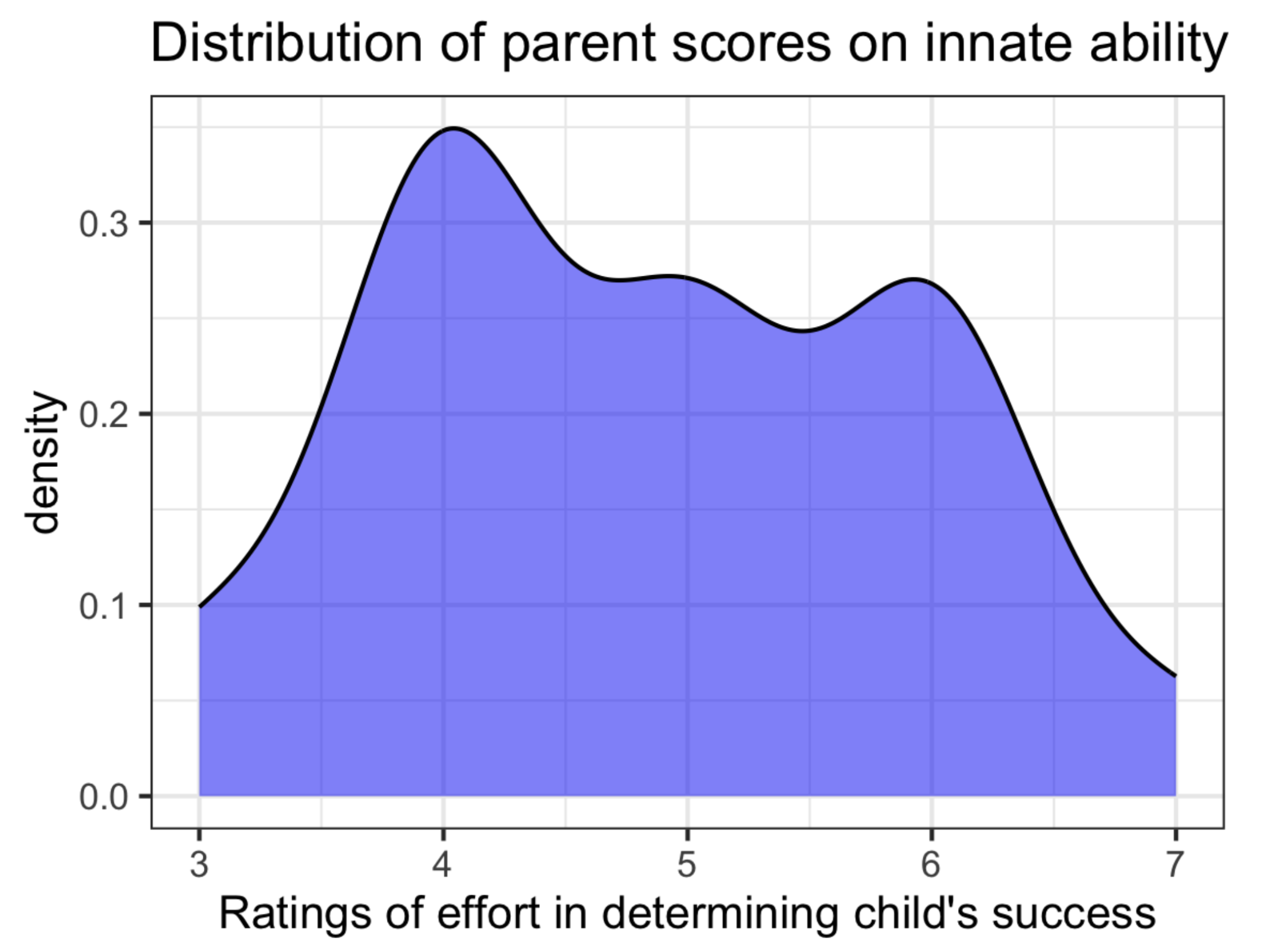
Looking at the density plot above (Figure 1), the most frequently selected value was the scale midpoint of 4, followed by two secondary peaks in 6 and then 5, which were slightly lower but still common. This indicates that a substantial number of parents hold a balanced or uncertain view, believing that neither effort or innate ability are completely dominant and determining. However, the two secondary peaks suggest that the proportion of parents leans toward effort based (nurture-based) beliefs in general. In contrast, values at the ends of the scale (3 and 7) were selected less frequently, with no parents selecting 1 or 2 at all. The small number of parents selecting the more extreme values of 3 and 7 indicates that polarized views (i.e either believing in complete innate ability or complete effort) are relatively rare in this sample. The presence of a substantial group at the midpoint however, reveals that the subsequent split into Nature-oriented and Nurture-oriented groups, particularly for the nature group, included more parents who felt balanced or mixed about both factors than parents who leaned towards believing in innate ability. The labels “Nature-oriented” and “Nurture-oriented” were applied to two groups based on psychological research on parental attributions and essentialism. Parents who rated effort as less influential and instead emphasized their child’s innate personality as the primary driver of success can be understood as endorsing a form of psychological essentialism, the belief that a child’s attributes are determined by a stable, inborn “essence”. This view corresponds with an “entity theory” of ability, where traits are seen as fixed. Conversely, parents who placed greater weight on the child’s efforts represent the contrasting “incremental theory” position, which views abilities as malleable through actions like effort and learning. Parents who scored a value of five or lower (belief in innate ability) on the first question and of six or higher (belief in child’s natural personality determining success) on the second question were grouped in “nature”, and parents who score a value of six or higher (belief in effort) on the first question and five or lower (belief in child’s natural personality determining success) were grouped into “nurture” parents. Thus, based on the parents’ ratings of effort and their beliefs on a child’s innate personality, a split group methodology was applied as a tool for analysis, allowing for a clear comparison of groups with a higher relative tendency toward one of the two validated theoretical frameworks. We acknowledge the limitations of this split and would require more substantiated multi-item analysis for further research based on preliminary patterns.
Prioritization of skill sets
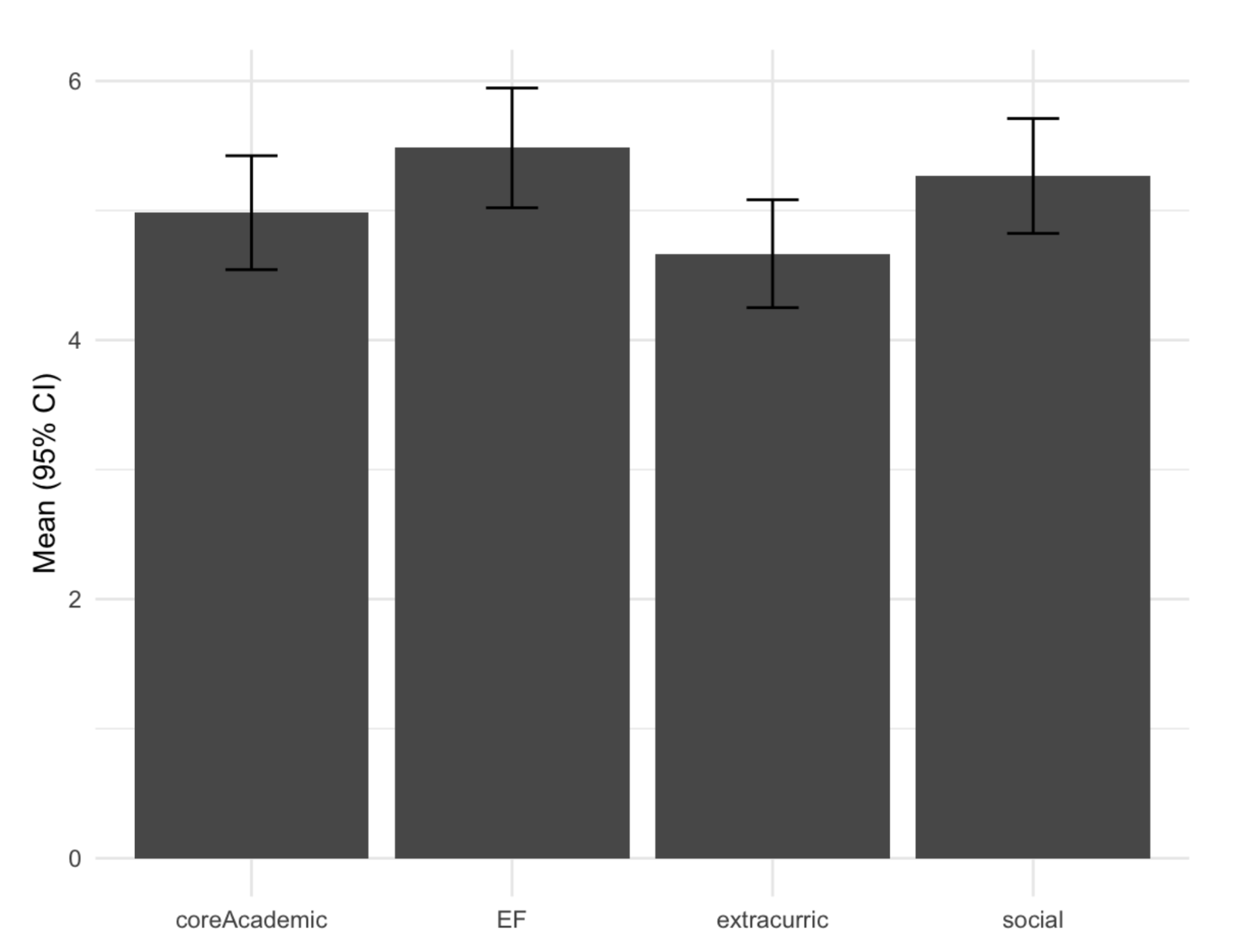
Mean importance ratings across developmental domains revealed a clear hierarchy (see Table 1 and Figure 1). Executive function (EF: M = 5.77, SD = 1.31) and social-relational skills (social: M = 5.63, SD = 1.34) were rated highest, followed by core academic skills (coreAcademic: M = 5.27, SD = 1.56) and extracurricular activities (extracurricular: M = 5.12, SD = 1.44). Paired t-tests confirmed that Executive Function was rated significantly higher than core academics, t(59) = 2.81, p = .007, and social skills were rated marginally higher than core academics, t(59) = 1.95, p = .056. It is important to note that overall, differences were fairly small, showing that parents generally rated all domains above the scale average and leaning towards the highly important end.
| Domain | Mean | Standard Deviation | 95% CI |
| Executive Function (EF) | 5.77 | 1.31 | [5.43, 6.11] |
| Social-Relational Skills | 5.63 | 1.34 | [5.29, 5.97] |
| Core Academic Skills | 5.27 | 1.56 | [4.87, 5.67] |
| Extracurricular Activities | 5.12 | 1.44 | [4.75, 5.49] |
Note: All items were rated on a 7-point scale (1 = least important, 7 = most important).
Perceived influences on child outcomes
When asked to rate the influence of various factors on long-term outcomes (1=no influence, 7=significant influence), parents ranked the child’s own natural personality highest (M = 5.83, SD = 1.24), followed by parenting choices (M = 5.32, SD = 1.29), school environment (M = 5.22, SD = 1.30), and friends/peers (M = 5.10, SD = 1.35). A paired t-test confirmed that natural personality was rated significantly higher than parenting, t(59) = 2.78, p = .007.
Developmental timing beliefs
Parents generally endorsed timing education to developmental level (devTiming: M = 5.43, SD = 1.45), with 71.7% of respondents scoring ≥5. This high agreement suggests a shared intuitive theory that developmental readiness matters.
Group Differences – Nature-Oriented vs. Nurture-Oriented Parents
A median split on the effort item created Nature-oriented (n=26, M = 3.96, SD = 0.56) and Nurture-oriented (n=34, M = 5.73, SD = 0.64) groups. Those who fell in the 5 range were split using a second column, NaturalPersonality, where higher numbers corresponded to being placed in the Nurture group, and lower numbers corresponded to the Nature group. Using these groups, analysis of the other columns were conducted which led to significantly differing values on several parenting beliefs and strategies (see Table 2 and Figure 2).
| Item | Nature-oriented (n=26) M (SD) | Nurture-oriented (n=34) M (SD) | t(df) | p | Cohen’s d |
| Concern about developmental delays | 5.69 (1.37) | 4.79 (1.64) | t(58)=2.25 | .028 | 0.59 |
| “Push through” when child struggles | 4.73 (1.93) | 5.82 (1.27) | t(58)=-2.57 | .013 | 0.67 |
| “Take a break and continue” | 5.54 (1.24) | 5.91 (1.06) | t(58)=-1.25 | .216 | 0.33 |
| “Help them myself” | 4.50 (1.70) | 5.09 (1.53) | t(58)=-1.39 | .171 | 0.36 |
| “Find additional resources” | 4.92 (1.83) | 5.44 (1.60) | t(58)=-1.17 | .247 | 0.30 |
| “Encourage giving up” | 3.38 (1.86) | 2.44 (1.48) | t(58)=2.16 | .035 | 0.56 |
Note. All items were rated on a 7-point scale. For concern about delays and giving up, higher scores indicate more concern/greater likelihood of correlation. For push through, higher scores indicate a greater likelihood of supporting persisting.
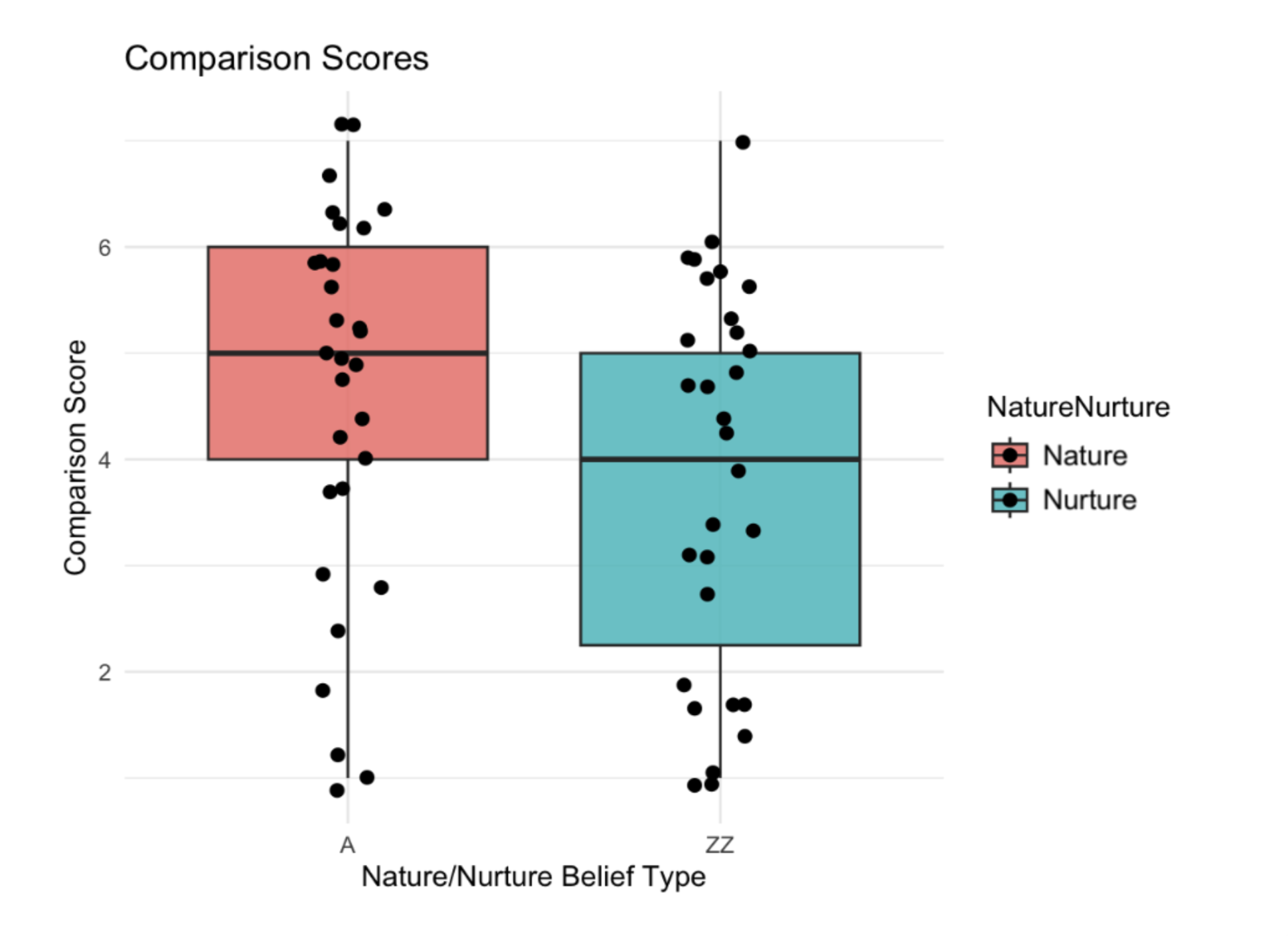
The boxplot above shows that nature-oriented parents have higher median concern scores (Mdn=5.0) and interquartile ranges than nurture-oriented parents (Mdn=4.0). The most striking differences between the split groups emerged for concern about developmental delays and encouragement of giving up. Nature-oriented parents expressed significantly greater concern if their child seemed to reach milestones later than peers, being more likely to endorse innate ability as the most influencing and important factor. Nurture-oriented parents showed less concern (still moderate, M=4.79) and were significantly more likely to endorse “push through” parental approach/strategy (M=5.82 vs. 4.73, p=.013) and significantly less likely to endorse “encourage giving up” (M=2.44 vs. 3.38, p=.035).
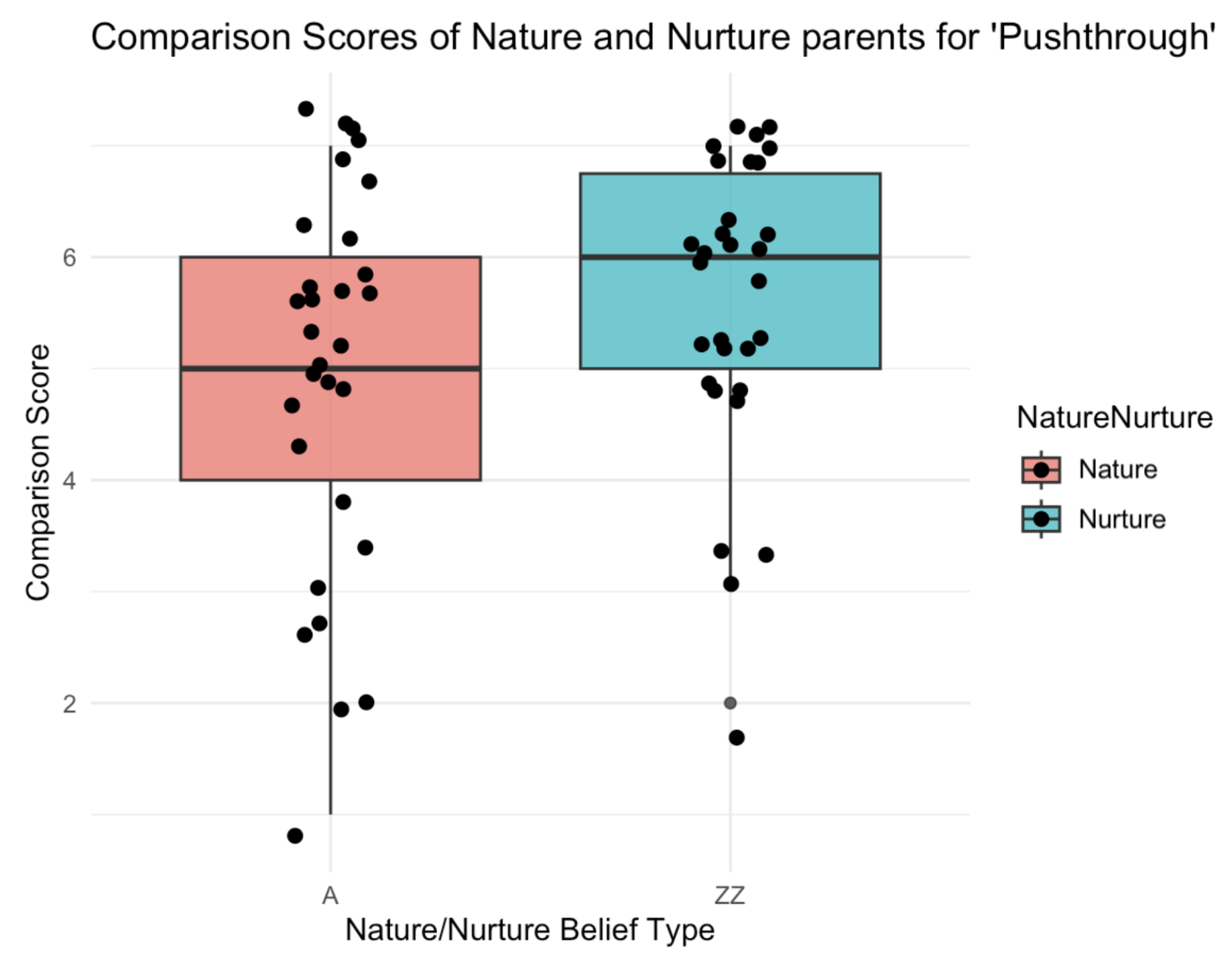
Additionally, the boxplot comparing nature and nurture-oriented parents’ choice to encourage their child to push through when facing difficulty shows the nurture group parents having higher median scores (Mdn=6.0) compared to nature group parents (Mdn=5.0). The presence of outliers in the nature group, particularly around six parents which chose 3 or under, shows that a group of the nature-oriented parents may strongly reject encouraging persistence as a response to their child struggling. This pattern reinforces the theoretical difference between innate and incremental beliefs, parents who view ability as fixed (nature-oriented) appear less likely to see value in persisting through difficulty, whereas parents who view ability as malleable (nurture-oriented) tend to view struggle as an opportunity for growth through continued effort.
Notably, no significant differences emerged between groups on the importance ratings for academic, social, EF, or extracurricular domains (all p > .20), suggesting that nature and nurture parents share similar values about what matters for development—they differ primarily in applications such as how they respond when children encounter difficulty.
Developmental Milestone Beliefs: Interpretations and comparison with Empirical Research
Parents’ estimates of age of emergence for seven abilities were compared to established developmental norms from the empirical literature. Table 3 presents the modal parent responses alongside descriptive empirical benchmarks. The milestone bins were used for exploratory purposes only and are not intended to draw definitive conclusions about whether parents were ‘right’ or ‘wrong’ in their beliefs. Our primary interest was simply to explore whether there were any observable differences in outcomes based on parental beliefs. Given that this study functions as an exploratory pilot, the milestone bin approach was used to help identify potentially promising variables worth following up on in the future. Accordingly, we report uncorrected p-values with the explicit understanding that any suggestive findings would need to be replicated in a new, preregistered sample before being interpreted conclusively. It is also worth noting that the normality assumption underlying the t-tests may not be fully met in our data. While we initially used t-tests to gain a general sense of the patterns, a more appropriate approach for future analyses, and one we would recommend if this line of inquiry is pursued further, would be to use Wilcoxon tests rather than t-tests, given their robustness to non-normality.
| Ability | Parent Modal Response | Established Norm (Empirical Source) |
| Object permanence | 3–5 years | 0–2 years6 |
| Social preferences | 3–5 years | 0–2 years7 |
| Number concepts | 3–5 years | 3–5 years (counting principles8) |
| Perspective-taking | 6–8 years | 4–6 years (theory of mind9) |
| Physical skills | 3–5 years | Variable by skill (e.g., walking 1–2 years) |
| Logical reasoning | 6–8 years | 5–7 years (concrete operations6) |
| Imagination | 3–5 years | 1–2 years (pretend play emergence10) |
As shown in Table 3, parental responses were broadly distributed, with modal estimates clustering around later preschool and early school-age years for most cognitive and social abilities. The modal response for five of the seven abilities fell in the 3–5 years or 6–8 years ranges.
For object permanence, 68% of parents estimated emergence at 3–5 years or later. This contrasts with Piaget’s6 original observations of emergence in the first two years, as well as more recent looking-time paradigms11 that suggest some forms of object knowledge are present in infancy. However, we acknowledge the difference in these constructs as laboratory measures of implicit expectation, such as through looking longer at impossible events, are not the same as a child’s explicit, observable ability to search for a hidden object in everyday contexts. Parents may reasonably interpret “object permanence” as a robust, observable behavioral milestone rather than the former laboratory research measure, which would substantially shift their estimates later. Thus, the discrepancy likely reflects a difference in definition rather than a straightforward misconception. For perspective-taking (theory of mind), parent responses were split: 38% selected 6–8 years and 35% selected 3–5 years. Wellman and colleagues’ meta-analysis9 indicates that children begin passing false-belief tasks around age 4–5, and these tasks measure a specific aspect of perspective-taking—understanding that others can hold false beliefs. Parents may be thinking of a broader, more observable capacity, such as consistently taking others’ perspectives in real-world social interactions, which does emerge later. For imagination, 57% of parents selected 3–5 years. While Harris10documents that pretend play emerges between 12 and 18 months, “imagination” is a far broader term that encompasses fantasy, creative thinking, and hypothetical reasoning, capacities that continue to develop well into the preschool years and beyond. A parent thinking of a child inventing elaborate imaginary scenarios is likely to report a later age than a researcher coding early object-substitution play. For social preferences, 40% of parents selected 3–5 years. Here too, the question is ambiguous since laboratory measures of social referencing, such as looking to caregivers for emotional information, emerge around 12–14 months7, but preferences for specific peers, friendship formation, and more complex social judgments develop much later. Parents’ estimates likely reflect this broader, more socially observable construct. Number concepts was the one domain where parental modal responses (3–5 years) aligned closely with empirical benchmarks for early counting principles8. Interestingly, this is a domain where developmental milestones are more visible in everyday parenting contexts (e.g., reciting numbers, counting objects).
Comparison between nature and nurture groups on milestone estimates
Independent-samples t-tests comparing nature and nurture parents on their numerical estimates (converted from ordinal categories: 0-2 yrs=1, 3-5 yrs=2, 6-8 yrs=3, 9-11 yrs=4, 12-14 yrs=5) revealed no significant differences for any milestone: object permanence, t(58)=0.42, p=.68; social preferences, t(58)=0.51, p=.61; numbers, t(58)=0.33, p=.74; logic, t(58)=0.19, p=.85; imagination, t(58)=0.67, p=.51. This pattern suggests that broad parental estimates of developmental timing were not strongly tied to their nature-nurture orientation.
Overall, these findings indicate that parents’ estimates were broadly distributed, with modal responses often clustering in later preschool or early school-age ranges for less concrete abilities. Rather than concluding that parents systematically “overestimate” by 2–3 years, we interpret these results as reflecting (a) genuine variability in what parents consider the meaningful emergence of a given ability, (b) the inherent ambiguity of the question wording, which did not distinguish between early laboratory-based competence and later observable behavior, and (c) the broad, everyday definitions parents may use for terms like “imagination” and “social preferences.” The absence of differences between nature- and nurture-oriented parents further suggests that these broad estimates reflect shared cultural assumptions rather than theory-driven predictions. Future work would benefit from more precise definitions of each ability, asking parents separately about early “signs” versus robust, observable mastery, to better capture the richness of their beliefs.
Qualitative Descriptors of the School Environment
Of the 60 participants, 58 provided descriptors of the Hong Kong international school environment. The most frequent descriptors were “Well Rounded” (n=42, 72%), “Supportive” (n=38, 66%), “Competitive” (n=31, 53%), “Collaborative” (n=28, 48%), and “Balanced” (n=24, 41%). Notably, “Extremely Competitive” appeared in 15 responses (26%), while “Stressful” appeared in 12 responses (21%), indicating that parents simultaneously perceive the environment as both supportive and high-pressure, a potential conflict/tension in findings that mirrors the quantitative findings about competing priorities. This will be discussed further in the general discussion section.
When asked for additional beliefs (n=12 responses), several parents emphasized executive function and self-regulation as foundational, with one parent writing: “Two keys for child’s learning and development: 1) nurturing an attitude of enjoying learning; 2) cultivating a good habit for self regulating and self management.” Another parent responded with a critique of the educational system: “I think the current education system in Hong Kong schools is seriously lagging behind… With the rise of AI, society will need differentiation, personality and creativity are more important.”
General Discussion
This study investigated parental beliefs about learning and development among international school parents in Hong Kong, with two primary research questions: (1.) How beliefs about the origins of ability shape parenting approaches, and (2.) whether parents hold accurate beliefs about developmental timing. Given the modest sample size (N = 60), these findings should be interpreted as exploratory rather than definitive. The study was designed to identify preliminary patterns that warrant replication in larger and more representative samples. The results reveal a complex landscape of findings that do not show a completely consistent trend, leading to possible explanations of external factors or potential misconception in parents.
How beliefs about Origins of Ability shape parenting approaches
Overall, the differences in parental beliefschallenges both the Western assumption that all educated parents endorse incremental theories and the East Asian stereotype of fixed-ability thinking. This split has direct consequences for parenting behavior, particularly when children face difficulty. Research has demonstrated that parents’ beliefs about failure, which are closely tied to their underlying mindset, can also shape their children’s beliefs about intelligence12. It demonstrates that parents’ attitudes, and thus their categorical “mindset,” are observable and impactful on their children, providing a strong direction for researching and understanding parents based on these belief profiles12. However, it is necessary to evaluate the basis of this split as data was categorized into groups based on labelling, and multi-item testing to confirm more grounded beliefs.
Nature-oriented parents expressed significantly greater concern about developmental delays. This finding is theoretically coherent, if one believes that ability is largely innate, then delayed milestone attainment may signal fixed lower potential, which has a greater likelihood of raising concern. Conversely, nurture-oriented parents, who believe effort drives success, may view delays as addressable through increased support and practice, thus showing less anxiety.Most strikingly, nature-oriented parents were significantly more likely to encourage giving up when children struggle, while nurture-oriented parents were more likely to endorse “push through” strategies. This pattern aligns with Dweck’s2framework of how entity theorists see difficulty as diagnostic of fixed low ability, leading to helpless responses, whereas incremental theorists see difficulty as a signal to increase effort. However, the present data refines this framework by showing that nature-oriented parents do not simply “give up” globally, since they are equally likely to endorse “take a break” strategies (M=5.54 vs. 5.91). The key difference is in the threshold for deciding that continued effort is futile. Nature-oriented parents appear to reach this threshold earlier, in particular when difficulty persists. Importantly, nature and nurture parents did not differ in their prioritization of academic, social, executive function, or extracurricular domains. Both groups rated executive function and social skills as more important than academics. This suggests that while parents diverge in their causal theories of ability development, they share similar values about what competencies matter most, a finding with potential practical implications for school-family communication.
Coherence and Potential Contradiction in Parental Belief Systems
A key question motivating this research was whether parents hold coherent, internally consistent belief systems or whether they entertain contradictory beliefs. Evidence for contradiction emerged when nurture-oriented parents, despite valuing effort (scoring M=5.73 on the effort item),still showed moderate concern about developmental delays (M=4.79, above the scale midpoint). If one truly believes that effort determines outcomes, concern about innate timing should be minimal. On a speculative level, this may suggest that even nurture-oriented parents hold residual essentialist beliefs about developmental windows, a form of “implicit essentialism” that potentially operates alongside explicit incremental theories. However, due to lack of substantive evidence, further research should use more advanced techniques to test these nuances, if we want to discover whether parents inevitability hold multiple coexisting reasonings and beliefs, despite what they present explicitly. Existing research has discovered parental implicit theories and the “bipolar continuum” on which they lie, suggesting that parents’ theories can be measured and categorized13. There is also a significant impact these categorized beliefs have on parental behavior, such as affecting learning interactions with children and their use of autonomy-support versus control13.
Similarly, both groups rated the child’s own natural personality as the most significant influence on outcomes (overall M=5.83), significantly higher than parenting (p=.007). This finding cuts across the nature-nurture divide because even parents who explicitly endorse effort-based theories implicitly grant substantial causal weight to child-intrinsic factors. This pattern mirrors findings from the implicit social cognition literature14, where explicit and implicit attitudes diverge, with implicit biases showing greater stability and resistance to change.
The coexistence of multiple beliefs and reasoning systems suggests that parental belief systems are not fully coherent or singular in the philosophical sense. Rather, parents operate with multiple, partially conflicting intuitive theories, activating different theories depending on the context (e.g., general values vs. specific concerns about delays). This is not a failure of reasoning but a reflection of the genuine complexity of development, where both innate constraints and environmental inputs matter. In fact, the most realistic answer lies in the middle of both. Children’s outcomes are a result of both innate and external factors, as well as the dynamic interconnections between them. Thus, purely nature-oriented or nurture-oriented factors are inherently incomplete without each other.
Real-World Applications – Parenting strategies when children face difficulty
The group differences in responses to child struggle reveal potential practical implications. When a child encounters difficulty, nature-oriented parents are more likely to interpret this difficulty as evidence of fixed low ability and consequently encourage disengagement. Nurture-oriented parents are more likely to interpret the same difficulty as a signal to increase effort and seek resources.
However, the data suggest that neither approach is universally optimal. The “take a break” strategy was endorsed by both groups (means 5.54 and 5.91), indicating a shared recognition by parents from both groups that rest and recovery are sometimes necessary. The critical difference lies in the threshold for giving up versus persisting.
Developmental research suggests that adaptive persistence requires calibration, suggesting that children should persist when effort can overcome the obstacle but disengage when the goal is genuinely unattainable or when the cost of persistence outweighs benefits15. Nature-oriented parents may set this threshold too low, encouraging disengagement prematurely. Nurture-oriented parents may set it too high, encouraging persistence when strategic withdrawal would be more adaptive. Neither group showed evidence of calibrated, context-sensitive reasoning about when persistence helps and when it harms, a potential limitation of the method and questions used. Studies have found parents who endorse a more “entity” theory report using more helpless-oriented strategies and less mastery-oriented strategies with their children. This evidence provides strong behavioral validation for the importance of distinguishing between these two categorical groups of parents based on their underlying beliefs16.
Furthermore, research has revealed that many parenting beliefs may predict parenting practices and behaviours, such as in consumption decisions for their children17. For instance, entity theorists are more likely to choose activities that are compatible with their child’s revealed character, while incremental theorists choose activities that balance or develop other skills, clearly validating the practical distinction between these two parental groups17.
Future interventions might help parents develop more nuanced strategies such as teaching children to distinguish between difficulties caused by insufficient effort (where persistence is appropriate) versus difficulties caused by mismatched task demands or genuine capacity limits (where strategic withdrawal or alternative approaches may be better). The qualitative data suggest some parents are already engaging in this kind of nuanced thinking, particularly around the tension between “following interests” versus “system rewards drilling.”
Further Extension and Comparative Literature Review
Within the Hong Kong context, several studies have addressed and challenged the assumption that parents from East Asian cultural backgrounds uniformly endorse effort-based theories while those from Western backgrounds favour innate ability. Phillipson’s study18 examined parent and child attributions for academic achievement across different school types in Hong Kong, including a sample from a British international school. The findings revealed a more nuanced picture than just the simple cultural dichotomy—Chinese children’s attributions varied by the socioeconomic status of their school, indicating that parental belief systems are shaped not only by broad cultural frameworks but also by the specific educational contexts in which families participate18. This variability is particularly relevant to the present study, as it suggests that the international school environment in Hong Kong, where Western educational philosophies intersect with local achievement-oriented values, may generate a distinctive, hybrid set of parental beliefs rather than a straightforward replication of either cultural prototype. The present study extends this line of inquiry by examining not only attributional beliefs but also how these beliefs relate to parenting strategies and perceptions of developmental timing.
Understanding how parental beliefs translate into parenting behaviours and, subsequently, child outcomes also requires further examination of the family processes that mediate these relationships. One study investigated how parental beliefs shape family processes among Hong Kong families, demonstrating that beliefs were significant predictors of parenting styles and parental control, which in turn influenced children’s achievement motivation and psychological competence19. This correlates with the present study’s findings regarding the relationship between nature-nurture orientations and parenting responses to child struggle. Future research building on these preliminary findings would benefit from incorporating the more comprehensive theoretical framework developed in this work.
Recent research from Hong Kong institutions has further complicated the traditional nature-nurture dichotomy by revealing that parental belief systems are often more ambivalent and contextually driven than previously theorised. A study in 202320 found that a substantial proportion of Hong Kong Chinese parents hold an “ambivalent mindset,” simultaneously endorsing both fixed and growth beliefs about personal qualities rather than aligning exclusively with either theoretical pole. Critically, it also demonstrated that this ambivalent mindset predicts specific parenting practices, such as the use of person praise and efforts to compensate for perceived low ability, providing a framework for understanding why Nature-oriented and Nurture-oriented parents in our sample showed different responses to child struggle despite sharing similar values about developmental priorities. Another study in 202421examined educational value priorities among Hong Kong parents using a large mixed-methods sample and found that parents’ concerns for child development frequently conflict with the school system’s academic focus, generating what they describe as a “value tension” that shapes parental decision-making and school-family dynamics. This tension mirrors the conflicting perceptions of the international school environment expressed by parents in our qualitative data, who simultaneously described the environment as “Supportive,” “Competitive,” and “Stressful.” Together, these recent studies suggest that the contradictions and tensions observed in the present exploratory sample reflect broader socio-cultural transformations occurring in Hong Kong’s educational landscape. These findings underscore the need for continued investigation into how parents navigate competing priorities and construct frameworks for supporting their children’s development in culturally distinct, high-pressure settings.
Limitations and future extension
Several limitations should be noted. The sample (N=60), while potentially adequate for detecting moderate-to-large effects, may have been insufficient for smaller effects. Some descriptive differences that did not reach significance might have become significant with a larger sample. Future research should recruit larger samples to detect smaller effect sizes as well as strengthen the confidence of moderate-to-large effects/findings. Using the preliminary findings from this study as a baseline, future studies should involve more multi-dimensional analysis using multi-item entity theories to investigate more in-depth psychological beliefs and complexity.
Participants were recruited through parent discussion groups and snowball sampling. Consequently, the sample likely overrepresents parents who are already actively engaged in educational discussions and thus limits its representation of the wider population of international school parents in Hong Kong. The sampling strategy limits external validity, and findings should therefore not be generalized beyond similar populations.
Important demographic variables including parental education, occupation, socioeconomic status, nationality, years residing in Hong Kong, and parental age were not collected. These variables may influence parental beliefs and therefore should be incorporated into future studies. As cultural demographics were not collected in the survey, it was not feasible to systematically analyze cultural context in this study. However, cultural frameworks are proven to influence how parents conceptualize success, ability, and the roles of effort and innate talent. Research has shown that parents from East Asian cultural backgrounds may place greater emphasis on effort and perseverance as pathways to achievement, reflecting a more incremental or “nurture-oriented” belief system22. Conversely, parents from Western individualistic cultures may be more inclined to attribute success to innate ability or fixed traits, aligning with an “entity” or “nature-oriented” perspective23. These cultural variations have been documented in studies examining parental attributions across different societies. We therefore acknowledge this as a key limitation of the current study. Future research should explicitly incorporate cultural demographics as a central variable of analysis. Detailed cultural background data, including parental country of origin, length of residence in the host country, and cultural identification, should be collected to examine whether the Nature and Nurture classification operates similarly across cultural groups.
Existing cross-cultural research has demonstrated that parental mindsets and their behavioral manifestations vary significantly across cultural contexts. One study comparing US and Danish parents found that while parents in both countries held similar ability and effort mindsets, they differed substantially in home-learning activities. US parents opted for more family learning activities and parental time investment, while Danish parents showed higher levels of school investment24. Additionally, cultural differences in parental attributions have been documented between Chinese-American and European-American mothers, with Chinese-American mothers showing stronger effort-related beliefs and their children demonstrating higher autonomy and school readiness scores25.
Given the exploratory nature of the study, the survey was designed and reviewed by a researcher using English as their primary language then sent to participants. If further research were to be conducted, revisions should be made with pilot testing, internal consistency measures, and validation procedures.The cross-sectional design of the survey prevents any causal inferences about how beliefs translate into actual parenting behavior. Self-report surveys are also subject to social desirability bias since parents may have over-endorsed effort-based beliefs and executive function values because these are socially valued in international school contexts as well as Chinese parenting culture. Future research directed at the topic could incorporate observational measures of parent-child interaction during challenging tasks and include designs testing implicit beliefs to examine how beliefs predict behavior and developmental outcomes over time.
The generalizability of these findings is limited to international school parents in Hong Kong and only reveal potential patterns that require further research. Particularly, those in the debate community from which most parents were recruited from. Finally, the developmental milestone questions asked parents for an age range of emergence, but developmental science recognizes that abilities emerge gradually and show substantial individual variation. Future research might ask parents for self-selected ranges or confidence ratings to better capture the complexity of their beliefs.
Practical Implications
The exploratory findings reveal patterns, leaving potential implications for parent education and communication. First, schools should recognize that parents hold divergent theories of ability, meaning communication about student progress should address both effort and individual variation/innate abilities of each child. For nature-oriented parents, explicitly noting that difficulty does not necessarily indicate fixed low ability may be important. Nature-oriented parents might benefit from strategies to postpone giving-up decisions, while nurture-oriented parents might benefit from learning to recognize when strategic withdrawal is adaptive. Overall, for both groups of parents, knowledge around developmental windows might contribute to a better understanding of child development and potentially less concern over observed behaviours.
Conclusion
Parents from Hong Kong’s international schools surveyed in the exploratory study potentially hold diverse, partially contradictory and mixed belief systems about child development. From the findings of this research survey, they are divided on whether innate ability or effort determines success, but also similarly position on beliefs, executive function and social skills over pure academics. They also show systematic developmental misconceptions about particularly developmental milestones that cut across nature-nurture divides. However, the nature-nurture divide demonstrates particular differences in applications where parents are asked for a choice to encourage persistence or strategic withdrawal for children facing a difficulty/challenge. Ultimately, understanding these parental beliefs exceeds sole academic research but may also extend to practical applications of designing parent education, communication, and better education environments that support both children’s learning and their well-being.
Acknowledgements
The author would like to thank parents who participated, anonymous reviewers, and Professor Yarrow Dunham for their contributions and insightful feedback. Words cannot express my gratitude to the support Professor Dunham has provided throughout the entire research journey. As well, I gratefully acknowledge the indispensable encouragement and support from my parents in making this project possible.
Appendix
A1. Survey Presentation:
Do you consent to taking part in the survey?
How many children do you have who go to international schools?
What grade level is your child in?
Q1. To what extent do you believe a child’s ultimate academic success is determined by their innate, natural ability versus their effort and perseverance? (1=Fully innate, 7=Fully effort)
Q2. How important is it for your child’s long-term success to focus on developing skills and competencies that lead to a competitive advantage (e.g., in university admissions, careers)?
Q3. Rate each of the following area’s importance for your child’s development: (1=Least Important, 7=Most Important)
(Core Academic Skills, Extracurricular Activities, Social-Relational Skills, Individual Management/Executive Function Skills)
Q4. How much do you agree with this statement: “Educational activities should be closely timed to my child’s specific developmental level or current competencies.”
Q5. How much influence do you believe your parenting choices have on your child’s long-term academic and life outcomes, compared to influences like the school, peers, or the child’s own personality? (1=No Influence, 7=Significant Influence)
(a. Your Influence as a Parent, b. Influence from School and Teachers, c. Influence from Friends and Peers, d. The Child’s own Personality and Natural Tendencies )
Q6. To what extent do you agree with the following statements: (1=Completely Disagree, 7=Completely Agree)
(a. “The competitive Hong Kong International School environment is highly competitive”, b. “The Hong Kong International School environment significantly shapes my educational beliefs for my child”, c. “When reflecting on my child’s progress, I prioritize their weaknesses/mistakes over strengths/successes” d. I am concerned if my child reaches developmental milestones (e.g., in reading, social behavior) later than their peers.”)
Q7. When your child struggles with a difficult task, how likely are you to… _____? (1=Very unlikely, 7=Very Likely)
(1. Encourage them to take a break and try again later, 2. Encourage them to push through, 3. Help them yourself, 4. Find other resources/support to help your child, 5.Support them to give up and try something else)
Q8. When considering my child’s development, how much am I influenced by the following factors: (1=Least influence, 7=Most influence)
(a. My own beliefs and observations, b. Scientific research or expert sources, c. Advice from school or teachers, d. Social Media, e. Discussions with other parents)
Q9. Based on your own beliefs, at what age do you think children can demonstrate the following abilities? (0-2 yrs, 3-5 yrs, 6-8 yrs, 9-11yrs, 12-14 yrs)
(1. Knowing objects exist outside their vision/what they see immediately in front of them, 2. Developing a social preference (eg. preferring a helpful person over someone unhelpful) 3. Understanding basic facts about numbers and quantities 4. Taking perspective of others 5. Develop physical/standard skills (eg. learning to bike, play an instrument, swim) 6. Solve logic problems through reasoning and deduction 7. Having the ability to imagine )
Q10. For the same abilities, what do you believe is the primary source of this ability when it first appears?
Q11. At what ages do you think it is most important for children to do the activities listed below? (check all that apply)
Q12. Words you would use to describe the Hong Kong international school environment are: (Select up to 5)
Q13. Is there anything else you would like to share about your beliefs on your child’s learning and development that the previous questions did not capture?
References
- Shachnai, R., Belluck, A., & Leonard, J. A. (2025). Parents underestimate young children’s abilities which may undermine their parenting practices. Proceedings of the 47th Annual Conference of the Cognitive Science Society, *47*(0). [↩]
- Dweck, C. S. (2006). Mindset: The new psychology of success. Random House. [↩] [↩] [↩]
- Correa-Chávez, M., & Rogoff, B. (2009). Children’s attention to interactions directed to others: Guatemalan Mayan and European American patterns. Developmental Psychology, 45(3), 630–641. [↩]
- Blair, C., & Raver, C. C. (2015). School readiness and self-regulation: A developmental psychobiological approach. Annual Review of Psychology, 66, 711–731. [↩]
- Sameroff, A. (2010). A unified theory of development: A dialectic integration of nature and nurture. Child Development, 81(1), 6–22. [↩]
- Piaget, J. (1954). The construction of reality in the child. Basic Books. [↩] [↩] [↩]
- Mumme, D. L., Fernald, A., & Herrera, C. (1996). Infants’ responses to facial and vocal emotional signals in a social referencing paradigm. Child Development, *67*(6), 3219–3237. [↩] [↩]
- Gelman, R., & Gallistel, C. R. (1978). The child’s understanding of number. Harvard University Press. [↩] [↩]
- Wellman, H. M., Cross, D., & Watson, J. (2001). Meta-analysis of theory-of-mind development: The truth about false belief. Child Development, *72*(3), 655–684. [↩] [↩]
- Harris, P. L. (2000). The work of the imagination. Blackwell. [↩] [↩]
- Baillargeon, R. (1987). Object permanence in 3½- and 4½-month-old infants. Developmental Psychology, *23*(5), 655–664. [↩]
- Haimovitz, K., & Dweck, C. S. (2016). Parents’ views of failure predict children’s fixed and growth intelligence mindsets. Psychological Science, *27*(6), 859–869. [↩] [↩]
- Matthes, J., & Stoeger, H. (2018). Do parents’ implicit theories of intelligence have an effect on their children’s self-regulated learning? Frontiers in Psychology, *9*, Article 1620. [↩] [↩]
- Dunham, Y., Baron, A. S., & Banaji, M. R. (2006). From American city to Japanese village: A cross-cultural investigation of implicit race attitudes. Child Development, *77*(5), 1268–1281. [↩]
- Heine, S. J., Kitayama, S., Lehman, D. R., Takata, T., Ide, E., Leung, C., & Matsumoto, H. (2001). Divergent consequences of success and failure in Japan and North America: An investigation of self-improving motivations and malleable selves. Journal of Personality and Social Psychology, *81*(4), 599–615. [↩]
- Moorman, E. A., & Pomerantz, E. M. (2010). Ability mindsets influence the quality of mothers’ involvement in children’s learning: An experimental investigation. Child Development, *81*(5), 1494–1509. [↩]
- Li, X. (2018). Parental implicit theories and child consumption decisions. National University of Singapore. [↩] [↩]
- Phillipson, S. (2006). Cultural variability in parent and child achievement attributions: A study from Hong Kong. Educational Psychology, *26*(5), 625–642. [↩] [↩]
- Leung, T. Y. J. (2012). Parents “make a difference”: Parental beliefs, family processes, achievement motivation and psychological competence of adolescents experiencing economic disadvantage in Hong Kong. PolyU Electronic Theses Database. [↩]
- Chiu, C.-Y., Tong, Y.-Y., Lee, S.-L., & Chan, H.-S. (2023). Personal qualities are malleable and fixed: Ambivalent mindset, capability ranking reinforcement, and parent-child relationship among Hong Kong Chinese parents. Journal of Pacific Rim Psychology, *17*, Article 18344909231166106. [↩]
- Lee, T. T.-L., & Chiu, S. W.-K. (2024). Educational value priorities of Chinese parents in a global city: A mixed-methods study in Hong Kong. Education and Urban Society, *56*(9), 1142–1161. [↩]
- Uttal, D. H. (1997). Beliefs about genetic influences on mathematics achievement: A cross-cultural comparison. Genetica, *99*(2-3), 165–172. [↩]
- Jose, P. E., & Bellamy, M. A. (2012). Relationships of parents’ theories of intelligence with children’s persistence/learned helplessness: A cross-cultural comparison. Journal of Cross-Cultural Psychology, *43*(6), 999–1018. [↩]
- Rowe, M. L., Ramani, G. B., & Pomerantz, E. M. (2020). Parents’ growth mindsets and home-learning activities: A cross-cultural comparison of Danish and US parents. Frontiers in Psychology, 11, Article 1365. [↩]
- Pomerantz, E. M., & Dong, W. (2006). Mothers’ achievement beliefs and behaviors and their children’s school readiness: A cultural comparison. Journal of Applied Developmental Psychology, 27(3), 215–237. [↩]