Abstract
This paper explores the persistence of police brutality against LGBTQ+ individuals in the United States. The central argument presented in this paper is that surface-level reforms frequently fail due to the fact that they do not address the very ideological foundation within the anti-gay rights movement and its history. The paper posits that homosexuality was strategically framed as an “anti-American” threat to various “traditional family values”; thus, this created a cultural script that became entrenched within law enforcement institutions. This “anti-American” script further exacerbates prejudice as it consequently allows police officers to justify violence as a defense of the social order. Using a dual-method qualitative approach, this paper investigates the roots of this ideological framing, from the Lavender Scare to the strategic reframing by the New Right in the late 1970s, alongside lived experiences through analysis of digital testimonies from LGBTQ+ police officers and various community advocates. The results show how this framing culminates in competitive police cultures where identity is weaponized, and in the systemic neglect and dehumanization of the LGBTQ+ community. It also analyzes policies adopted by the Trump administration, which provide contemporary context of this ideological script through the state. Lastly, it concludes that meaningful, permanent reform requires dismantling this persistent ideology that continues to frame the LGBTQ+ community as an existential threat. Moreover, proposals for more concrete measures to implement institutional accountability and a transformation of social order/cultural script regarding queer people are provided.
Keywords: police, law enforcement institutions, cultural script, LGBTQ+, discrimination, anti-gay rights movement
Introduction
Research Question & Literature Gap
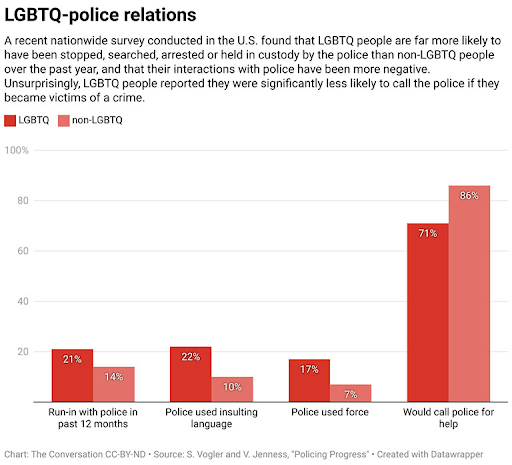
Even as reform efforts are implemented to mitigate bias against the LGBTQ+ community, research continually suggests the LGBTQ+ individuals face disproportionately negative encounters with law enforcement. For example, a 2024 survey states that one in four queer respondents report experiencing physical when interacting with law enforcement. This fact suggests a discrepancy between the lived experiences of the community as opposed to federal policy. Additionally, these statistics and experiences are considerably more prominent for transgender people of color. For instance, Black transgender respondents are stopped, searched, and subjected to physical force at the highest rates of any of the groups surveyed. Furthermore, nearly 40% of transgender individuals and 42% of Latine LGBTQ+ people report avoidance of calling police for help in the future1.
The ongoing persistence of this violence resultantly poses a question: How does the “Anti-American Script” affect and influence police brutality toward members of the LGBTQ+ community, in spite of formal governmental efforts to mitigate and reduce bias? Even as current federal directives like Executive Order 13988, which explicitly states that “every person should be treated with respect and dignity and should be able to live without fear, no matter who they are or whom they love,” empirical evidence continually suggests that even governmental protections are unable to effectively dismantle ingrained cultural scripts that guide experiences with law enforcement2.
The current research pertaining to ingrained homophobic norms within law enforcement provides foundational analysis to these concepts; however, they tend to primarily concentrate on perspectives of various victims as opposed to specified ideological drivers and motivators of law enforcement actors. The work of Patrick Farr’s Queer Victims provides strong context of this institutional framework and the resultant perceptions within queer communities through their catalogs and descriptions of police harassment, violence, and systemic discrimination experienced by the LGBTQ+ community. Moreover, Heather Panter’s “Heterosexism and Genderism within Policing” proves and locates the existence of homophobic and transphobic cultural norms and biases that remain present within law enforcement institutions3,4,5
Theoretical Framework
Michel Foucault coined the sociological concept of discourse as a system of linguistic, cultural ideas, and social practices that affect how individuals of certain historical situations and contexts will resultantly perceive the “truth.” Discourse within this context is not operated as verbal dialogue but rather instead a means of power to decide what or who is considered “normal” or conversely, “deviant.” Utilizing this concept of deviance versus normalcy, institutions have the capacity to either marginalize certain groups by framing them as “deviant” and henceforth opposed to a society or uplift certain actions or behavior under the guise of normalcy. These cultural perceptions can be used to aid and justify disciplinary action, discrimination, and potentially surveillance6.
Additionally, Antonio Gramsci’s theory of cultural hegemony refers to the process in which a “dominant” social class will attempt to maintain their respective power by shaping the culture, values, and beliefs of a society to spread and make their specific worldviews thoroughly accepted by other social classes, even such who are oppressed by those concepts. Gramsci describes the results as other social classes “consenting to oppression,” as these classes now perceive social hierarchies, worldviews, and the marginalization of others necessary or even beneficial for the state or society7.
Finally, Pierre Bourdieu’s concept of habitus discusses ingrained habits, opinions, and worldviews that are acquired through experiences in a particular social environment. Relevantly, institutional habitus refers to “unwritten rules” that dictate how the general population of that institution behaves, acts, and thinks. Bourdieu underscores specifically that these are subconscious decisions and beliefs that specifically occur without the people of the institution’s explicit knowledge or conscious consent. Thus, that results in them becoming “reflexive behaviors” that are learnt from the environment of their institution. Overall, institutional habitus causes those of an institution to act on, believe, and subconsciously internalize biases or “habits.’ This importantly aligns with covert or underlying worldviews within law enforcement institutions, and how they are able to bypass or persist despite reform efforts8.
Conclusively, these scholars share that sociocultural norms, unwritten rules, and subconscious behaviors and belief systems in a society can fundamentally alter the patterns and ideologies of both individuals as well as larger institutions; these are identified as cultural scripts that are guiding the thoughts and behaviors of the members of a society which most significantly in this paper includes law enforcement institutions. Due to these lasting influences on a society, cultural scripts remain unlikely to be adjusted or changed unless a powerful opposition to that narrative emerges.
Central Idea
This paper suggests that police brutality is the physical result of an anti-American cultural script that treats LGBTQ+ identity as an opposition of the social order, making the officer’s use of force not seen as a violation of the law, but as a defense of quintessentially American morals and values. The anti-American script successfully classifies the LGBTQ+ community as perceived enemies of the state and morality, thereby legitimizing and justifying harm towards them.
Methods
This paper utilizes a dual-method qualitative approach using secondary sources in order to establish the historical context of the discussed ideological foundations that systemically impact the LGBTQ+ community alongside first-hand digital testimonies. The secondary sourcing involves scholarly books as well as peer-reviewed articles in order to create timelines and connections between the anti-gay rights movement’s framing of homosexuality as a threat to “traditional family values” and social order, which was utilized to examine contemporary parallels. The digital testimonies were found through YouTube with targeted keyword searches: “gay police officer experiences,” “LGBTQ+ police testimony, ” and “transgender experience with police.” Videos were selected if they were firsthand testimony and relevant towards queer experiences with police or officers’ experiences on the topic at hand. Opinion-based videos that did not include firsthand experience were excluded resulting in a total sample of four videos for review. Furthermore, each sample video was watched and analyzed several times to ensure the accuracy of the content described in the paper.
Analysis
Overall, this paper examines how the sociopolitical structure of the late 20th-century in the United States was shaped by religious groups. These religious groups specifically framed the growing emergence and cultural presence of the LGBTQ+ community as a threat to American society by creating a cultural narrative across American communities. The results can be seen as parallel events are examined through accounts and figures of systemic police targeting LGBTQ+ people through the use of laws against cross-dressing, sodomy, and general “obscenity,” in order to show how the police regarded homosexuality as a “deviation” and were compelled to reject their identity as well as employ violence by raiding gay bars and arresting LGBTQ+ individuals.
Against this backdrop of the deliberate anti-American cultural script regarding the LGBTQ+ community as a threat to the social order, the visibility of the LGBTQ+ community continually increased as struggles over queer rights emerged increasingly relevant9,10. In 1969, the Stonewall movement, queer rights in New York City, gained momentum, allowing for the start of modern queer rights. For example,during the initial raid on the Stonewall Inn, in which patrons at the Stonewall bar, led by queer figures such as Marsha P. Johnson and Sylvia Rivera refused to present identification or genital inspections to police; instead, the patrons used physical force to trap the police inside the bar. This act of “trapping” law enforcement serves as a symbol of protest towards the state’s use of “gender policing” that criminalizes the community. This symbolic event transformed the community from secretly policed dark corners of American social order to visible, political struggle. This act directly revealed the legal structures that viewed the LGBTQ+ identity as criminalized enemies of American society11,4.
Prior to the Stonewall protests, federal policy had already considered homosexuality as a form of sickness, criminal behavior, and an example of disloyalty to the state and society. This can be seen in the 1950 Congressional report titled “Employment of Homosexuals and Other Sex Perverts in Government,” which stated that homosexuals were security risks due to their innate perversion. This report consequently caused mass firings and purges of federal employees perceived to be potentially or confirmed homosexual. This can further be seen in President Eisenhower’s 1953 Executive Order 10450: a ban on homosexuals from all federal jobs. This time period, marked by governmental opposition towards queer or those perceived as queer in governmental employment, became known as the “Lavender Scare”12,13,14.
In the following decade, the 1970s, a political framework focused on prioritizing the concept of “family values” began to receive national traction. This conservative sociopolitical framework can be seen under President Ronald Reagan who employed “family-friendly” policies that explicitly sought to uplift the nuclear family, heterosexual dynamic. This was done by framing this nuclear family as a key factor within American societal stability, in fact, it was oftentimes referred to as the “only” stable form of family in the United States2.
Throughout these sociopolitical, institutional frameworks, the American Psychiatric Association served as a scientific backdrop through their classification of homosexuality as a mental disorder providing further legitimacy to homophobic norms10. In total, this anti-queer rhetoric stemming both scientifically and governmentally culminated to create a strong state-sanctioned anti-American cultural script. This anti-American cultural script integrally defined LGBTQ+ people as threats to both national security as well as social order and the family unit. From this narrative, stemmed seemingly necessary and justified surveillance and violence towards the LGBTQ+ community.
The overall consolidation of an anti-gay script through both the prioritization of heterosexual dynamics as well as systemic alienation of queer individuals in goverment resulted in a more potent political force. This was due to a strategic pivot by the growing conservative political movement: The Religious Right. Historical sources theorize that the movement was initially concentrated on maintaining and defending racial segregation within private Christian schools after the post-Brown v. Board of Education IRS rulings; however, when this focus failed to garner national traction among audiences, figures like Paul Weyrich and Jerry Falwell, the founders of a Religious Right conservative Christian group, Moral Majority, shifted the movement’s focus towards abortion, communism, and most relevantly, LGBTQ+ rights. This transformation was done under the guise and reasoning of protecting American families. By incorporating numerous social fears of the time due to the history of the Cold War, they were able to successfully formulate a new political identity among the American public. Thus, the Moral Majority utilized this political identity to frame this rhetoric as protection of the “family” and defense of “traditional values” against a lecherous, concerning “gay agenda5.”
The political success and traction of the Religious Right can largely be attributed to vast financial infrastructures that allowed moral grievances to receive institutionalized responses. Examples of this financial infrastructure include Robison’s (2015) documents of $350 million solely for federal lobbying. Robison (2015) examines how these financial infrastructures encourage religious groups to enter the political sphere in litigation and lobbying. Moreover, “vast funding” allows these groups to overwhelm localized grassroots movements, further facilitating their efficacy in legislative policy15.
Another factor of their efficacy was the highly organized nature of these political groups. Figures like Anita Bryant and Jerry Falwell launched political campaigns designed to frame homosexuality as a “predatory danger” to children and Christian morality, with Anita Bryant even claiming LGBTQ+ groups “want to recruit your children and teach them the virtues of becoming a homosexual”16,17. These groups spread the idea that the LGBTQ+ community, particularly gay people, were actively trying to undermine the family framework and values that the nation relied on. By tying family values towards the nation, they connected that the nature of homosexuality harmed the United States. This political campaign was even further spread by creating pseudo‑scientific reports, financing mass‑mailing campaigns, and collaboration with influential media companies. Through these varying means, they successfully incorporated a large population of the American public in the movement. This shows how the movement did not solely emerge randomly or organically; it was a thoroughly designed, planned, and constructed political movement to frame the LGBTQ+ community as fundamentally opposed to national identity and patriotism. The movement created a powerful cultural script that associated being gay with Foucault’s description of “deviance.” The political efficacy of the Religious Right resulted in the institutionalization of this belief system, which cyclically also provided legitimacy since institutions are responsible for maintaining social order, most notably law enforcement institutions. Since the law enforcement institutions, which are considered to be“the guardians of communal norms and safety”8, began to legislatively discriminate against the LGBTQ+ community, a system of discriminatory policing was justified9,12. The political campaigning of homosexuality was opposed to family values and thus anti-American, then created a cultural pipeline which highly influenced institutions like law enforcement.
| Event | Mechanism of Discrimination | Consequences and Legacy |
| The Lavender Scare (1950) Senate Report: Employment of Homosexuals and Other Sex Perverts in Government (1950) | Governmental investigations deemed gay people as “unfit” for federal positions as well as potential threats to American security. | Linked homosexuality to disloyalty and national weakness. |
| Executive Order 10450 (1953) | Banned homosexuals under the guise of them being “sexual perverts” from all federal jobs, mandating invasive investigations. Institutionalized discrimination across the entire federal government. | Mandated investigations, gave discrimination institutional backing, and an estimated 5,000+ employees were fired (notably more than for alleged communist ties). |
| APA’s Classification (1952-1973) | Classified homosexuality as a “sociopathic personality disturbance” and later a “sexual deviation.” | Provided a medical/scientific justification to prejudice. Additionally, it also justified “treatments” for homosexuality. |
| Reframing by the Religious Right (Late 1970s) | Figures like Paul Weyrich and Jerry Falwell shifted from defending segregation in private schools to opposing gay rights, abortion, and communism as a “pro-family” agenda. | Successfully grouped societal worries into one political identity. This made opposition to LGBTQ+ rights central towards the conservative movement. |
| Impact of the Moral Majority (1979) | Political organization that mobilized conservative Christians. Additionally defined the queer movement as a “hostile enemy.” | Put the anti-American cultural script into action, resultantly transforming prejudice into a powerful political force of patriotism and nationalism. |
Contemporary Discrimination Against the LGBTQ+ Community
Digital testimonies of various firsthand accounts reveal the concurrent experiences of queer individuals. For example, a digital testimony of a gay SWAT officer in Tennessee reveals how social perceptions regarding queerness impact his workplace decisions. He specifically states how he strategically planned his “coming out,” due to stigma against queer individuals:
“I like to establish myself as a high performer in my field prior to letting people know about that part of me. Keeping in mind that my sexuality is a very small portion of who I am as a person.”
The need to prove his professional worth first before revealing his sexuality reflects the anti-gay rhetoric of ethics of queer communities. His experience also shows a competitive “high testosterone” culture in his field, “the one thing about this type of career field, whether it’s military [or] law enforcement, these high testosterone type A personality fields, it’s always a competition.” This competitive mindset alongside the history of institutionalized homophobia within law enforcement culminatingly exude the cultural script where differentiating can be perceived negatively or unfairly, a dynamic that highly intersects with ideologies surrounding the anti-gay script.
Moreover, his testimony reflects explicit oppression of LGBTQ+ individuals. For instance, a workplace rivalry resulted in this incident: “it got to the point…for him where he was so threatened by my performance that he did decide to violate my trust and out me.” This act of “outing” is perceived as a form of betrayal towards queer trust, thus revealing how sexuality, historically a method of othering, is leveraged tactically to incur negativity towards an individual. The outing of the gay SWAT officer was a strategic, politicized decision, which shows how the anti-American script can be activated contemporarily against the LGBTQ+ community15,18.
The legacy of this anti-American cultural script is also evident in firsthand accounts of the LGBTQ+ interactions with law enforcement institutions. Queer community members report feelings of lack of safety around law enforcement: One queer member of a Pride organization stated that they chose to exclude specifically uniformed officers from the parade because they “didn’t feel safe with law enforcement there” and decided that what “was best” was to “keep police out”. This shows the continued impact this anti-American cultural script has had on the perceptions of the LGBTQ+ community on interactions with law enforcement – even outside of criminal or legal contexts. Moreover, this testimony reveals a non-collaborative relationship and environment between law enforcement institutions as well as queer communities19.
Modern attempts at improving relationships between law enforcement and LGBTQ+ communities, like “implicit bias training” and “revised use-of-force policies,” will oftentimes struggle due to institutionalized fundamentals. Instead of addressing how the system’s foundations were constructed with the subjugation of the LGBTQ+ community, reform often concentrates on the individualized behaviors and conduct of police officers20.
Routinization of Police Brutality
Non-queer accounts pertaining to law enforcement, such as police administrators and scholars, also acknowledge and bear witness to the persistence of certain cultures within law enforcement as well as the struggles to reforming it. As Eugene A. Paoline notes the varying attitudes and perceptions within police departments stating:, “overestimating a single police culture has its drawbacks possibly as much as underestimating police culture”. A police chief conceded that “culture eats strategy for breakfast,” by criticizing universal reform strategies he acknowledges that individualized conduct responses can be rendered ineffective. The process is slow, as “you can’t send out a directive tomorrow and say…here’s how we’re going to change culture”21.
Simultaneously, the lived experiences as through digital testimonies, from transgender community members, reveal historical prejudice actively undermining the queer community today. An interview with a community advocate in Washington, D.C., provides testimony to this issue. He attests to noticing patterns of disproportionate case dismissals regarding transgender individuals: “for you not to investigate these cases that are cold or for you not to put the time in that you would rather give to something else… it’s ridiculous”. Neglect towards LGBTQ+ individuals in regards to the legal system reflects present-day institutionalized prejudice. Moreover, it also reflects ideologies concerning referring to LGBTQ+ individuals as anti-American. When the law enforcement is responsible for policing through Foucault’s moral deviance, the duty of “serving and protecting” has the capacity, due to past queer discrimination, to create a so-called hierarchy of victimhood.
The testimony cites a specific moment that from their eyes triggers discrimination: the officer’s “identity crisis” upon discovering a victim’s transgender identity. The advocate explains that this crisis leads officers to feel “that they don’t have to exercise as much ability or use their job ability because this person is less than a person”. This “identity crisis” is a precise example of the anti-American cultural script, as officers fail to view trans individuals as entirely legitimate. Professionalism and impartiality within law enforcement agencies are conflictingly intertwined with personal or cultural ideologies, resulting in “taking [of] their frustration out on a victim”22.
Through the lens of both historical context as well as firsthand testimony that reflects the current day, critiques levied against reform strategies like implicit bias training can be understood to intend to increase objectivity; however, they remain unable to prevent officers’ decisions to abdicate from duty, or as the advocate described, “they don’t have to exercise much ability” in regards to their professional promises. This testimony implies that this bias is partially conscious, not solely internalized behavior. Henceforth, these various digital testimonies attempt to provide examples of the paper’s central idea: the anti-American script has exacerbated police brutality against the LGBTQ+ community.
| Interview Subject | Theme | Representative Quotes | Significance |
| Gay SWAT Officer (YouTube: My Experience Being a Gay Police Officer) | Masculine, competitive cultureWeaponization of identityBetrayal of trust | “it got to the point…for him where he was so threatened by my performance that he did decide to violate my trust and out me.” | Demonstrates how the historical “deviant” script is weaponized internally within police culture. Homophobia as a tactic in a competitive environment. |
| Transgender Community Advocate | Systemic neglectDehumanizationOfficer “identity crisis”Relinquishing of duty | “For you not to investigate these cases that are cold or for you not to put the time in… it’s ridiculous.” | Demonstrates the impact on the external LGBTQ+ community impact of the historical framing. Also shows how discrimination and bias lead to justified lack of service and protection for queer victims. |
| Police Chief and Scholar Eugene Paoline | Lack of changeResistance to reform effortsChallenges with leadership | “Culture eats strategy.” “you can’t send out a directive tomorrow and say…here’s how we’re going to change culture” | Provides administrative perspective to the culture of law enforcement. Additionally highlights recognized, yet unresolved, struggle to substantially alter an institutional culture, especially one shaped by prejudice. |
State Purging of LGBTQ+
Today, we are privy to institutional parallels as through the deployment of National Guard troops to various American cities: During the current Trump administration, deployments were cited to be responses to civil “unrest” in “blue” cities which were described as “killing fields” by witnesses. For instance, in As You Are, a queer bar in Washington, D.C., the National Guard was stationed and decisively refused to move. This had the practical effect of intimidating patrons as well as the bar’s owners, noting that their presence had “seemingly had everything to do with the bar’s profoundly queer nature”. Advocates warn that such “militarized presence in our cities escalates rather than reduces the risk for queer and trans folk”. This action, enabled by invoking an obscure clause of federal law (Section 12406 of Title 10) to respond to a supposed “rebellion,” represents an example of how anti-American rhetoric surrounding the LGBTQ+ has resulted in state-sanctioned violence23.
Second, the administration has implemented executive orders that could further be seen as erasure of the LGBTQ+. For instance, current President Donald Trump has issued the executive order “Defending Women From Gender Ideology Extremism and Restoring Biological Truth to The Federal Government.” This order mandated that all federal agencies define sex solely as an “immutable biological classification” of male or female, essentially excluding the concept of gender identity24. Additionally, Executive Order 14183, “Prioritizing Military Excellence and Readiness,” banned transgender individuals from serving in the military. This order was done on the pretenses of trans individuals being incompatible with “military readiness” and “national security”. The Department of Defense further expanded on the reasoning for this order, stating that transgender people lacked the “selflessness and humility” necessary for service25. Finally, this administration systematically dismantled and eliminated several legal frameworks that were intended to protect minorities from discrimination, including the LGBTQ+ community. These executive orders revoked 20th century civil rights protections designed to shield federal employees and contractors from discrimination. A notably significant example of this being Executive Order 11246, “”Ending Illegal Discrimination and Restoring Merit-Based Opportunity,” initiated in 1965, prohibited those under federal employment or contact from discriminating on the basis of race and sex. Later, this executive order additionally banned discrimination on the basis of sexual orientation and gender identity, notably. The administration claimed these orders and protections themselves were a form of “illegal discrimination” and “dangerous… identity-based spoils system26 . These decisions show how the administration is potentially seeking to frame LGBTQ+ advocacy as a prime source of unfairness within American society, reflecting the anti-American script. Moreover, government sentiments are shown and explained to be reiterated by both federal agencies as well as institutions.
Historical context as well as contemporary examples convey and suggest how the anti-American cultural script regarding the queer community has both produced and facilitated police brutality as well as internalized institutional cultures of homophobia. The existence of which can be seen through police cultures in which sexual identities were weaponized in masculine, competitive environments. The effects of such can also be seen through lack of trust and relationships with law enforcement in the LGBTQ+ community. In fact, queer groups often fail to feel safe with very people designated to protect them.
Furthermore, the continued and institutional environments surrounding discriminatory policing effectively creates social desensitization to both discrimination and violence towards the LGBTQ+ community. When prejudice receives institutional approval, from the Lavender Scare to federal purges of queer employees, these repeated acts od discrimination normalize homophobia within police cultures, and henceforth American society16.
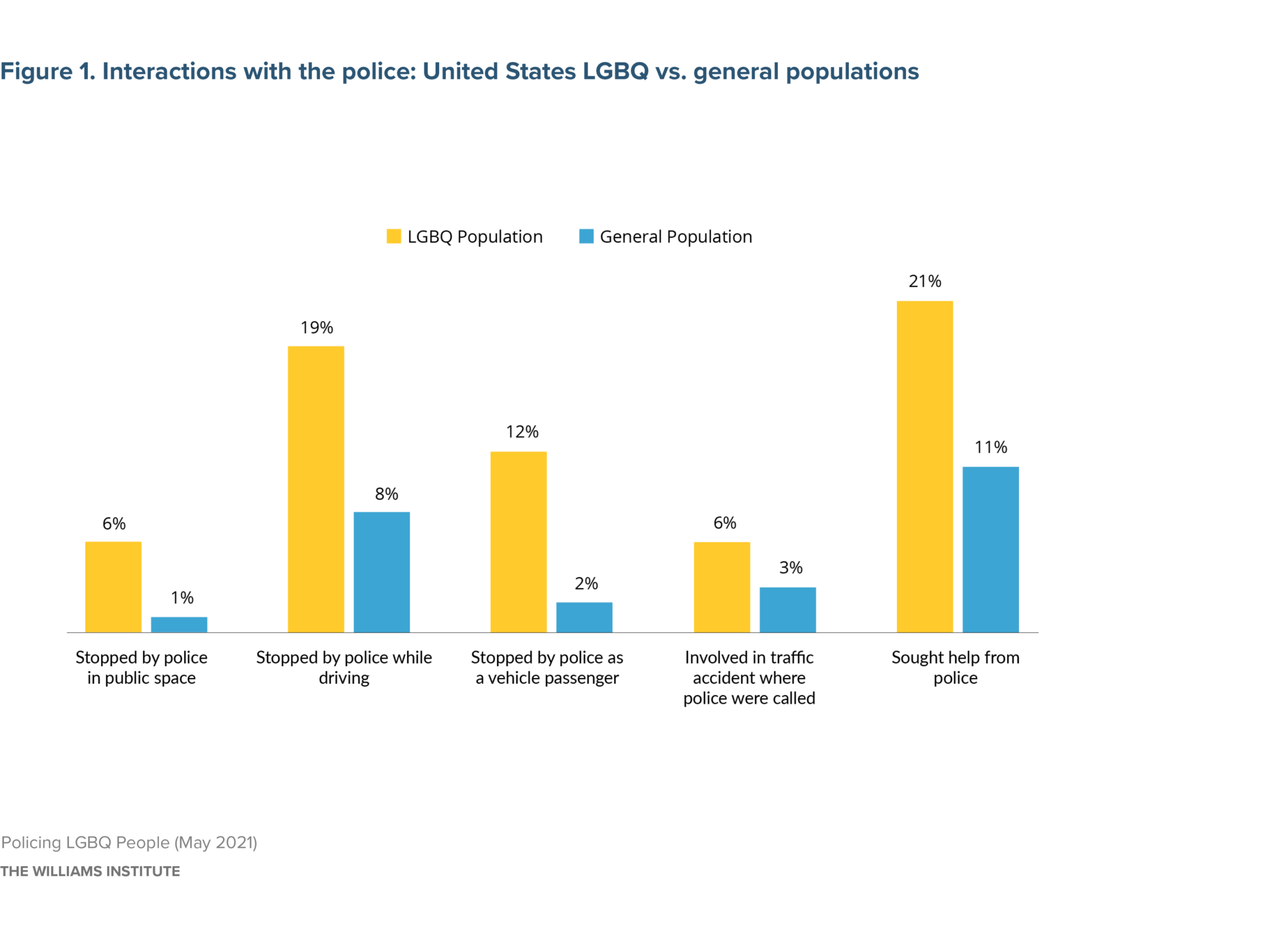
This desensitization was not organically formed but rather a clear result of the Religious Right and anti-gay movement’s political focuses on framing the LGBTQ+ community as “deviant” within American society. For instance, research suggests that negative interactions between the LGBTQ+ community and law enforcement have produced long-term effects on society. Specifically, the compiled data from Table 3 shows how LGBTQ+ people are 6 times more likely than the general public to be stopped by police and nearly 7 times more likely to be stopped for reasons unrelated to a vehicle. This increased surveillance has facilitated a notable trust gap within the community, as 22% of LGBTQ+ people (more than four times the general population) said that they would be unlikely to call the police when they were in need of help and 13% admit to not actual incidents of not calling the police when needed. Furthermore, this report indicates that history of police harassment and violence can be linked to health outcomes such as stress, depression, or substance abuse. Effectively, from these results, a cycle of harm is created in which historical criminalization of the LGBTQ+ community has culminated in discriminatory policing, which desensitizes the public from the severity of the harm27.
This anti-American framing of the LGBTQ+ community additionally exacerbates other systems of oppression, resulting in compounding forms of discrimination for individuals with multiple marginalized identities or backgrounds. A most notable example of this would be queer people of color, who exist in the intersection of both racism and homophobia. This compounding discrimination manifests numerous disparities. For example, queer people of color are even more likely to experience discriminatory policing from both multiple sources27. This intersectional discrimination underscores how all minority groups can be impacted by the anti-gay narrative, and therefore the anti-American script.
| Category | Policing disparities |
| Police Interactions | LGBQ people are 6 times more likely to be stopped in public and 7 times more likely to be stopped for non-vehicle reasons in comparison to the general public. |
| Trust Gaps | 22% of LGBTQ people are unlikely to contact police in the future (4 times the rate of the general population). |
| Reduced Protections | 13% of LGBTQ individuals reported not calling the police even when they required help. |
| Impacts for Intersectional Identities | LGBTQ+ people of color are even more likely to experience negative interactions with the police. |
| Health Impacts | Police harassment is linked to increased rates of stress, depression, or substance use. |
To see more meaningful progress, beyond acknowledgments of marginalization, concrete accountable measures must be incorporated. To bridge the gap between the queer community and law enforcement, society must confront the deep-seated ideologies that frame LGBTQ+ rights and struggle as anti-American. Without this, well-intentioned reforms will potentially risk being ignored in a persistently homophobic culture that continually discriminates against the people it ought to protect.
Some limitations of this paper include reliance on publicly available digital testimonies (e.g. YouTube videos) instead of directly collected or researched ethnographic accounts/data from police officers or law enforcement agencies. While the digital testimonies offer valuable firsthand accounts of how historical prejudices can manifest concurrently, they are limited in information and thus cannot fully detail internal justifications and occupational worldviews of officers themselves. Further research is required to better understand the rationalizations of officers maintaining institutional prejudice. Ideally, the research should reflect theoretical concepts of “deviance” through confidential interviews or long-term observations. Such information and research would be essential to design reform practices or interventions that successfully change foundational aspects of discriminatory policing in daily practice.
Conclusion
This paper examines a troubling timeline and continuum: from the Lavender Scare, then the Moral Majority’s pro-family agenda, to the more modern examples of militarized intervention in queer spaces. This continuum is presented to analyze how police brutality is both a result and exacerbation of the anti-American cultural script. With testimonies from a gay SWAT officer’s troubling experiences and queer advocates claims of systemic neglect, this paper strives to reveal an institution in which the LGBTQ+ identity is framed as anti-American and therefore “deviant.” Future attempts at reform should specifically target institutionalized cultural narratives, such as the anti-American, unlike current reform efforts that concentrate on individualized behaviors like implicit bias training.
Moreover, current reform efforts like implicit bias training’s lack of success can be explained by the fact that they target individual officer behaviors rather than deeper, institutionalized cultural scripts.
Truly impactful change likely necessitates systematic or foundational adaptations or adjustments. These adjustments are not limited to, but could include, independent, third-party oversight, significant modifications to officer training, and reconsidering the role of the police in the LGBTQ+ community. Without change, the underlying that queer rights and American morality are contrary will persist. Henceforth, well-meaning reform will continue to see significant results, leaving numerous Americans without true safety.
References
- J. Grasso, S. Vogler, and E. Greytak. Policing progress: findings from a national survey of LGBTQ+ people’s experiences with law enforcement, https://www.aclu.org/publications/policing-progress-findings-from-a-national-survey-of-lgbtq-peoples-experiences-with-law-enforcement, 2024. [↩]
- J. R. Biden. Preventing and combating discrimination on the basis of gender identity or sexual orientation. https://www.federalregister.gov/documents/2021/01/25/2021-01761/preventing-and-combating-discrimination-on-the-basis-of-gender-identity-or-sexual-orientation, 2021. [↩] [↩]
- H. Panter, Heterosexism and genderism within policing: A study of police culture in the US and the UK, 2015. [↩]
- N. G. Goldberg, C. Mallory, A. Hasenbush, L. Stemple, I. H. Meyer, Police and the criminalization of LGBT people, in The Cambridge handbook of policing in the United States, Cambridge University Press, pg. 374-391, 2019, doi: 10.1017/9781108354721.020. [↩] [↩]
- P. Farr. Queer victims: reports of violence by LGBTQI survivors result in violent assaults by police. Arizona State University. 2016, https://doi.org/10.1177/0095399716684888. [↩] [↩]
- M. Foucault. The archaeology of knowledge. Routledge. 2002. [↩]
- A. Gramsci. Prison notebooks. Columbia University Press, 2011. [↩]
- P. Bourdieu. The logic of practice. Stanford University Press, 1990. [↩] [↩]
- A. Afshar, The anti-gay rights movement in the United States: The framing of religion, Essex Human Rights Review. Vol. 3, pg. 64-79, 2006. [↩] [↩]
- J. Drescher. Out of DSM: depathologizing homosexuality. Behav. Sci. Vol. 5, pg. 565–575, 2015, DOI: 10.3390/bs5040565. [↩] [↩]
- A. Greene-Hayes. Street evangelists and transgender saints: Sylvia Rivera, Marsha P. Johnson, and the religions of the Afro-Americas. QTR: A Journal of Trans and Queer Studies in Religion. Vol. 1, pg. 32-52, 2024, https://doi.org/10.1215/29944724-11208911. [↩]
- S. M. Milkis, D. J. Tichenor, and L. Blessing. The historical presidency: “rallying force”: the modern presidency, social movements, and the transformation of American politics. Presidential Studies Quarterly. Vol. 43, pg. 641–670, 2013, DOI: 10.1111/psq.12050. [↩] [↩]
- C. Cunneen, Don’t police solve crime? in Defund the police: An international insurrection, Bristol University Press, pg. 42-61, 2023. [↩]
- P. Warren, The lavender scare legacy: A policy & law sourcebook on US Department of State employment and hiring discrimination against queer Americans, 2017. [↩]
- N. M. Elias. Constructing and implementing transgender policy for public administration. Administration & Society. Vol. 49, pg. 1340-1370, 2017, https://doi.org/10.1177/0095399716684888. [↩] [↩]
- P. S. Federman, N. M. Rishel Elias. Beyond the lavender scare: LGBT and heterosexual employees in the federal workplace. Public Integrity. Vol. 19, pg. 22-40, 2016, https://doi.org/10.1080/10999922.2016.1200410. [↩] [↩]
- A. Bryant, When the homosexuals burn the Holy Bible in public… how can I stand by silently, 1977. [↩]
- Coffee With Toast. My experience being a gay police officer | my coming out story, https://www.youtube.com/watch?v=mnGujSUS5dw, 2025. [↩]
- Channel 3000 / Recent News Service, It’s a start: police hold listening session for LGBT issues after being told they can’t march, https://www.youtube.com/watch?v=qM4NRfXE-dY, 2018. [↩]
- J. Colvin. Under the rainbow umbrella: identifying and explaining the LGBTQ health disparity. Sociology Compass. Vol. 10, pg. 483-493, 2016, https://doi.org/10.1111/soc4.12373 [↩]
- E. A. Paoline, J. T. Nolette, J. Burch, National Policing Institute. Understanding police culture – don’t all cops think alike?, https://www.youtube.com/watch?v=AhMd1QmsXUc, 2020. [↩]
- Stop Police Terror Project DC. Transgender experience with police in the district of columbia, https://www.youtube.com/watch?v=LqsJj2ZHSTI, 2019. [↩]
- J. Factora. LGBTQ+ people fear what’s next as Trump deploys national guard to major cities, https://www.them.us/story/lgbtq-national-guard-trump-deployment-federal-occupation-gay-bars, 2025. [↩]
- D. J. Trump. Defending women from gender ideology extremism and restoring biological truth to the federal government, https://www.whitehouse.gov/presidential-actions/2025/01/defending-women-from-gender-ideology-extremism-and-restoring-biological-truth-to-the-federal-government/, 2025. [↩]
- D. J. Trump. Prioritizing military excellence and readiness, https://www.whitehouse.gov/presidential-actions/2025/01/prioritizing-military-excellence-and-readiness/, 2025. [↩]
- D. J. Trump. Ending illegal discrimination and restoring merit-based opportunity, https://www.whitehouse.gov/presidential-actions/2025/01/ending-illegal-discrimination-and-restoring-merit-based-opportunity/, 2025. [↩]
- S. Mallory, A. J. Hasenbush, B. Sears. Discrimination and harassment by law enforcement officers in the LGBT community, https://williamsinstitute.law.ucla.edu/publications/law-enforcement-lgbtq-people/, 2015. [↩] [↩]