

Alice Jungyun Choi1, Hyeseon Noh1
1 American International School, Hong Kong
Abstract
Childhood abuse is a major public health concern associated with long-term difficulties in mental health and functioning. Post-traumatic stress disorder (PTSD) is a common outcome of early trauma, but it remains unclear whether the associations between childhood abuse and adult emotional dysregulation and functional impairment are stronger among those with a history of PTSD diagnosis. This study tested whether PTSD diagnosis moderates these relationships. Data were drawn from Wave IV (2007–2008) of the National Longitudinal Study of Adolescent to Adult Health (Add Health). Complete-case analyses included 4,732 adults. Childhood abuse, emotional dysregulation, functional impairment and PTSD diagnosis were assessed, with sex, age, education and household income included as control variables. Bivariate associations among study variables were examined, and moderated regression models tested childhood abuse × PTSD interactions. Childhood abuse was positively correlated with both emotional dysregulation and functional impairment. PTSD diagnosis was also positively associated with both outcomes. Moderation analyses indicated a significant abuse × PTSD interaction for emotional dysregulation; however, the interaction was not significant for functional impairment. Contrary to the hypothesis, the association between childhood abuse and emotional dysregulation was weaker among respondents with a PTSD diagnosis compared to those without a diagnosis. Childhood abuse and PTSD diagnosis were independently associated with higher emotional dysregulation and greater functional impairment, but a PTSD diagnosis did not amplify abuse-related associations in this sample. Future studies should replicate these findings using symptom-level PTSD measures and samples with higher PTSD prevalence, and examine mechanisms that may explain the attenuating interaction.
Keywords: Childhood Abuse, Emotional Dysregulation, Functional Impairment, PTSD, Moderation Analysis
Introduction
Childhood abuse is a widespread global public health concern, with meta-analytic evidence indicating substantial prevalence across regions and measurement approaches1. Exposure to abuse and other adverse childhood experiences (ACEs) is consistently associated with elevated risk for later mental and physical health problems, often showing a dose–response relationship with the number and severity of adverse experiences2. Although childhood abuse is strongly linked to post-traumatic stress disorder (PTSD), not all abuse-exposed individuals develop PTSD, and the mechanisms and conditions shaping heterogeneity in outcomes remain an important empirical question. The present study examines whether PTSD diagnosis moderates the association between childhood abuse and two key adult outcomes: emotional dysregulation and functional impairment.
Childhood Abuse and Adult Outcomes
Childhood abuse refers to acts of commission against a child, encompassing emotional, physical, and sexual abuse occurring before age 18, and is distinguished from neglect within the broader construct of childhood maltreatment3. In the current study, abuse is operationalised using retrospective items assessing emotional, physical, and sexual abuse, consistent with the available Add Health Wave IV measures. Across the literature, childhood abuse is associated with increased risk for multiple psychiatric outcomes, including PTSD, anxiety, and depression4. Early adversity is also linked to broader impairment through biological embedding and cumulative stress pathways (e.g., allostatic load), which can contribute to long-term mental and physical health risk5.
Beyond diagnostic outcomes, childhood abuse is theorised to influence core developmental processes relevant to emotional and functional adjustment. Dimensional models of adversity differentiate “threat” (e.g., abuse) from “deprivation” (e.g., neglect), proposing that threat-related exposures are especially likely to shape emotion-related learning, vigilance, and affective reactivity6,7. In this context, the current study focuses on emotional dysregulation and functional impairment as two outcomes that are theoretically and clinically relevant consequences of early abuse.
Emotional Dysregulation Following Childhood Abuse
Defining Emotional Dysregulation
Emotion regulation refers to processes through which individuals influence which emotions they have, when emotions occur, and how emotions are experienced and expressed8. Emotional dysregulation broadly reflects difficulties managing emotional responses and using adaptive regulation strategies, including elevated reactivity, impulsive responding under distress, and difficulty returning to baseline9. Meta-analytic work indicates that maladaptive emotion regulation strategies and regulation difficulties are consistently associated with a range of psychopathologies, supporting emotional dysregulation as a transdiagnostic construct10.
Link Between Childhood Abuse and Emotional Dysregulation
Childhood abuse may increase risk for emotional dysregulation through neurodevelopmental, learning-based, and stress-physiology mechanisms. Developmental psychopathology research shows that the timing and chronicity of abuse relate to differences in neurocognitive functioning and regulatory control11. Consistent with this, patterns of abuse have been shown to predict emotion processing and regulation into emerging adulthood12. At the level of mechanism, a meta-analysis indicates that emotion regulation processes partially mediate the association between childhood adversity and later psychopathology, suggesting that dysregulation is a central pathway linking early trauma to adult mental health outcomes13.
In addition, childhood abuse is associated with alterations in stress physiology and stress reactivity, which may contribute to heightened emotional reactivity and poor recovery from stressors5,14. Thus, these lines of evidence support the expectation that childhood abuse is associated with higher emotional dysregulation in adulthood.
Daily Functioning Impairments Following Childhood Abuse
Defining Daily Functioning
Daily functioning is often conceptualised as the ability to perform activities necessary for independent living. Classic measurement frameworks distinguish between basic activities of daily living (ADLs; e.g., bathing, dressing, toileting, transferring, continence, feeding)15 and instrumental activities of daily living (IADLs; e.g., managing finances, shopping, medication management)16. Impairments across these domains can substantially reduce quality of life and independence.
In population health research, functioning is also commonly operationalised as health-related limitations in physical activities, such as the physical functioning concept in the SF-3617. The present study uses a health-related physical limitation item (limitations in moderate activities), which is conceptually closer to physical functioning/health-related limitation than to comprehensive ADL/IADL assessment.
Link Between Childhood Abuse and Functional Impairment
Childhood abuse has been associated with impairments in adult functioning through several proposed pathways. First, abuse is associated with long-term differences in cognitive impacts, with potential implications for occupational and daily functioning. A prospective study found childhood abuse predicted differences in cognitive functioning from young adulthood into later midlife18. Second, abuse is associated with social functioning difficulties, including impaired interpersonal relations, with meta-analytic evidence in affective-disorder samples indicating abuse relates to poorer social functioning19.
Third, abuse is associated with increased risk for later physical health problems that can constrain physical functioning. Biological embedding models propose that early adversity can contribute to long-term dysregulation in stress and immune systems5, and meta-analytic evidence links childhood trauma to elevated inflammatory markers in adulthood20. Consistent with these pathways, adverse childhood experiences are associated with chronic pain risk21, and earlier meta-analytic work similarly found associations between self-reported childhood abuse and adult chronic pain outcomes22. Childhood abuse has also been linked prospectively to gastrointestinal symptoms, partially through psychological distress23. Thus, these findings suggest plausible psychological and biological routes from abuse to later functional impairment.
PTSD as a Moderating Factor
Defining PTSD and Why Moderation is Plausible
PTSD is characterised by intrusive re-experiencing, avoidance, negative alterations in cognition/mood, and hyperarousal following trauma exposure24. Cognitive and memory-based models propose that persistent PTSD is maintained by ongoing perceptions of current threat, trauma-related appraisals, and trauma memory disturbances25,26. Importantly, PTSD is not an inevitable outcome following abuse; resilience and recovery are common, supported by protective systems such as supportive relationships and adaptive coping processes27,28.
Because PTSD involves heightened arousal, threat monitoring, avoidance, and emotion-related symptoms, it is plausible that the association between childhood abuse and adult emotional and functional outcomes may be stronger among individuals with PTSD. Meta-analytic evidence shows PTSD symptoms are strongly associated with emotion regulation difficulties29. PTSD is also linked to broad functional impairment across domains, with a systematic review and meta-analysis indicating substantial functional limitations among individuals with PTSD30. Moreover, in certain somatic outcomes such as pain, PTSD has been shown to interact with documented childhood victimisation to predict adult pain risk decades later31. Collectively, these findings support the hypothesis that PTSD could act as a moderator that strengthens the relationship between childhood abuse and adult emotional dysregulation and functional impairment.
Moderation Logic and Gap
Despite extensive evidence linking childhood abuse to PTSD and to adult impairment, many studies treat PTSD as an outcome or examine it as a mediating pathway rather than directly testing moderation. For example, posttraumatic stress reactions have been examined as mediators linking abuse to physical health complaints32, and related work indicates trauma-related symptom profiles (including complex PTSD features) can statistically account for childhood trauma–physical health associations33. Mediation and moderation, however, address distinct questions. Mediation examines whether posttraumatic stress accounts for the pathway from abuse to later outcomes, whereas moderation examines whether the strength of abuse–outcome associations differs between those with and without PTSD34. A moderation framework follows from the cognitive and emotional features of PTSD. Because PTSD involves ongoing perceptions of current threat25 and difficulties in emotion regulation29, the difficulties associated with a given level of early abuse may be expressed more strongly among affected individuals. Direct evidence for such conditional associations exists for some outcomes, such as adult pain31. Few studies, however, have tested whether PTSD alters the strength of abuse–outcome associations for emotional dysregulation and functional impairment. Addressing this gap can clarify whether abuse-related difficulties are especially pronounced among those with PTSD.
Current Study and Hypotheses
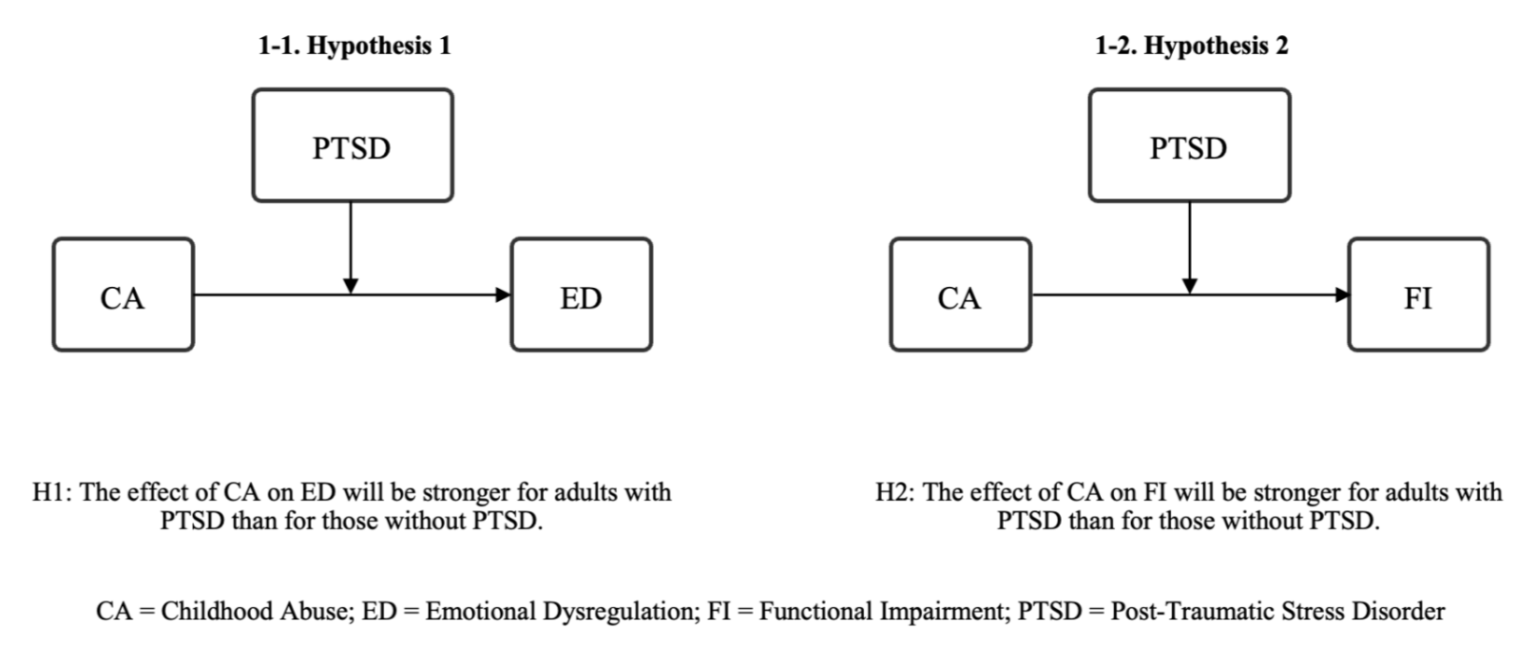
This study uses Add Health Wave IV to examine whether a history of PTSD diagnosis moderates associations between childhood abuse and (1) emotional dysregulation and (2) functional impairment. It was hypothesised that:
Hypothesis 1: The association between childhood abuse and emotional dysregulation will be stronger among adults with a PTSD diagnosis than among adults without a PTSD diagnosis.
Hypothesis 2: The association between childhood abuse and functional impairment will be stronger among adults with a PTSD diagnosis than among adults without a PTSD diagnosis.
Methods
Data
This study analysed secondary data from Wave IV (2007–2008) of the National Longitudinal Study of Adolescent to Adult Health (Add Health), a nationally representative longitudinal study that has followed participants from adolescence into adulthood since 199435. Wave IV was selected because it includes retrospective measures of childhood abuse and adult measures relevant to emotional regulation and health-related functioning, allowing examination of long-term associations between early adversity and adult outcomes. At Wave IV, respondents were aged 25–34 years (M = 29.00, SD = 1.78). The analytic dataset included 5,114 respondents with valid values for the key study variables. Due to missing data on household income, the sample size for correlation and regression (moderation) analyses was reduced to 4,732 following listwise deletion. Included and excluded participants did not differ in PTSD prevalence or age and differed only marginally in childhood abuse (p = .052); however, excluded participants reported lower educational attainment and slightly higher emotional dysregulation and functional impairment, suggesting that the data were not missing completely at random. The robustness of the complete-case estimates to this missingness was therefore evaluated using multiple imputation.
Measures
Childhood Abuse
Childhood abuse was measured using three retrospective items assessing adverse experiences before age 18: emotional abuse (“Before your 18th birthday, how often did a parent or other adult caregiver say things that really hurt your feelings or made you feel like you were not wanted or loved?”), physical abuse (“Before your 18th birthday, how often did a parent or adult caregiver hit you with a fist, kick you, or throw you down on the floor, into a wall, or down stairs?”), and sexual abuse (“How often did a parent or other adult caregiver touch you in a sexual way, force you to touch him or her in a sexual way, or force you to have sexual relations?”). Response options ranged from 0 (never happened) to 5 (more than ten times). A mean composite score was computed across the three items (M = .68, SD = .97), with higher scores indicating more frequent experiences of abuse (Cronbach’s α = .545).
Emotional Dysregulation
Emotional dysregulation was measured using four items from the Wave IV personality assessment: “I have frequent mood swings,” “I get stressed out easily,” “I get angry easily,” and “I lose my temper.” Response options ranged from 1 (strongly disagree) to 5 (strongly agree). A mean score was computed across the four items (M = 2.35, SD = .66), with higher scores indicating greater emotional dysregulation. Internal consistency was acceptable (Cronbach’s α = .795).
Functional Impairment
Functional impairment was measured using a single item assessing health-related limitation in moderate physical activities: “How much does your health now limit you in moderate activities, such as moving a table, pushing a vacuum cleaner, bowling, playing golf?” Response options were 1 (not limited), 2 (limited a little), and 3 (limited a lot). Higher scores indicated greater functional impairment (M = 1.12, SD = .39). Because this measure is ordinal, results should be interpreted as reflecting a graded increase in limitation.
PTSD Diagnosis
PTSD was measured using a single item asking whether a doctor, nurse, or other healthcare provider had ever told the respondent that they have or had PTSD. Responses were coded as 0 (no) and 1 (yes). This item indexes a lifetime history of professional diagnosis and does not assess current symptoms or clinically verified PTSD. In the complete-case sample, 3.1% of respondents (n = 149) reported a PTSD diagnosis.
Control Variables
Models controlled for sex, age, education, and household income. Sex was coded as 0 (male) and 1 (female), with 54% of respondents coded as female. Age ranged from 25 to 34 years (M = 29.00). Education was measured on a five-point scale: less than high school (1), high school (2), 2–4 year college (3), 4-year university (4), and graduate school or above (5). Household income was measured using 12 categories ranging from less than $5,000 (1) to $150,000 or more (12).
Table 1 presents descriptive statistics for all study variables.
| Variables | N (%) | Mean (SD) | Range |
| Childhood Abuse | .68 (.97) | 0–5 | |
| Emotional Dysregulation | 2.35 (.66) | 1–5 | |
| Functional Impairment | 1.12 (.39) | 1–3 | |
| PTSD (1 = yes) | 161 (3.1%) | – | 0–1 |
| Controls | |||
| Sex | 0–1 | ||
| Male | 2,353 (46.0%) | ||
| Female | 2,761 (54.0%) | ||
| Age | 29.00 (1.78) | 25–34 | |
| Education | 3.14 (1.08) | 1–5 | |
| Household Income | 8.00 (2.67) | 1–12 |
Analytic Strategy
First, descriptive statistics (means, standard deviations, and frequencies) were computed for all study variables. Second, bivariate associations among childhood abuse, emotional dysregulation, functional impairment, and PTSD diagnosis were examined, with each correlation estimated using a coefficient appropriate to the measurement level of the variable pair (Pearson’s r, point-biserial, rank-biserial, Spearman’s rho, or polychoric). Third, to test moderation hypotheses, two multiple regression models were estimated (one for emotional dysregulation and one for functional impairment). Each model included childhood abuse, PTSD diagnosis, covariates (sex, age, education, and household income), and the interaction term (childhood abuse × PTSD). A statistically significant interaction term was interpreted as evidence that PTSD moderates the association between childhood abuse and the outcome (Figure 1). As functional impairment was an ordinal variable, the corresponding moderation model was additionally estimated using ordinal (proportional-odds) logistic regression, and the complete-case results were evaluated against a multiple-imputation analysis (20 imputations, pooled using Rubin’s rules) addressing missing data, which occurred primarily on household income. All analyses were conducted in R (version 4.4.1), using the psych package for correlations and reliability, the MASS package for ordinal logistic regression, and the mice package for multiple imputation. Statistical significance was evaluated at α = .05 (two-tailed).
Results
Descriptive Analysis
Table 2 presents correlations among all study variables for the complete-case sample (n = 4,732), each estimated using a coefficient appropriate to the measurement level of the variables (see Table 2 note). Childhood abuse (CA) was positively associated with emotional dysregulation (ED) (r = .191, p < .001) and functional impairment (FI) (ρ = .089, p < .001). PTSD diagnosis was also positively associated with ED (r = .166, p < .001) and FI (r = .139, p < .001).
| Variables | 1 | 2 | 3 | 4 | 5 | 6 | 7 | 8 |
| 1. CA | – | |||||||
| 2. ED | .191*** | – | ||||||
| 3. FI | .089*** | .156*** | – | |||||
| 4. PTSD | .154*** | .166*** | .139*** | – | ||||
| 5. Sex | .100*** | .149*** | .075*** | .036* | – | |||
| 6. Age | –.022 | –.003 | .023 | –.010 | –.053*** | – | ||
| 7. Education | –.034* | –.196*** | –.180*** | –.035* | .125*** | –.011 | – | |
| 8. HH Income | –.080*** | –.153*** | –.187*** | –.044** | –.074*** | .057** | .347*** | – |
| Note. Analysis sample reduced due to listwise deletion; Coefficients match each variable pair: Pearson’s r (continuous–continuous), point-biserial (binary–continuous), rank-biserial (binary–ordinal), Spearman’s rho (ordinal–continuous), and polychoric (ordinal–ordinal); CA = Childhood Abuse; ED = Emotional Dysregulation; FI = Functional Impairment; HH Income = Household Income. *** p < .001, ** p < .01, * p < .05 | ||||||||
Moderation Analyses
Two moderation models were estimated to test whether PTSD diagnosis moderates the association between childhood abuse and (1) emotional dysregulation and (2) functional impairment. Sex, age, education, and household income were included as covariates in both models.
Emotional Dysregulation
As shown in Table 3, the regression model predicting emotional dysregulation was significant (R2 = .125). Childhood abuse was positively associated with emotional dysregulation (B = .104, SE = .010, p < .001), indicating that higher abuse exposure was associated with greater emotional dysregulation. PTSD diagnosis was also a significant predictor of emotional dysregulation (B = .547, SE = .059, p < .001), with respondents reporting a PTSD diagnosis showing higher emotional dysregulation on average.
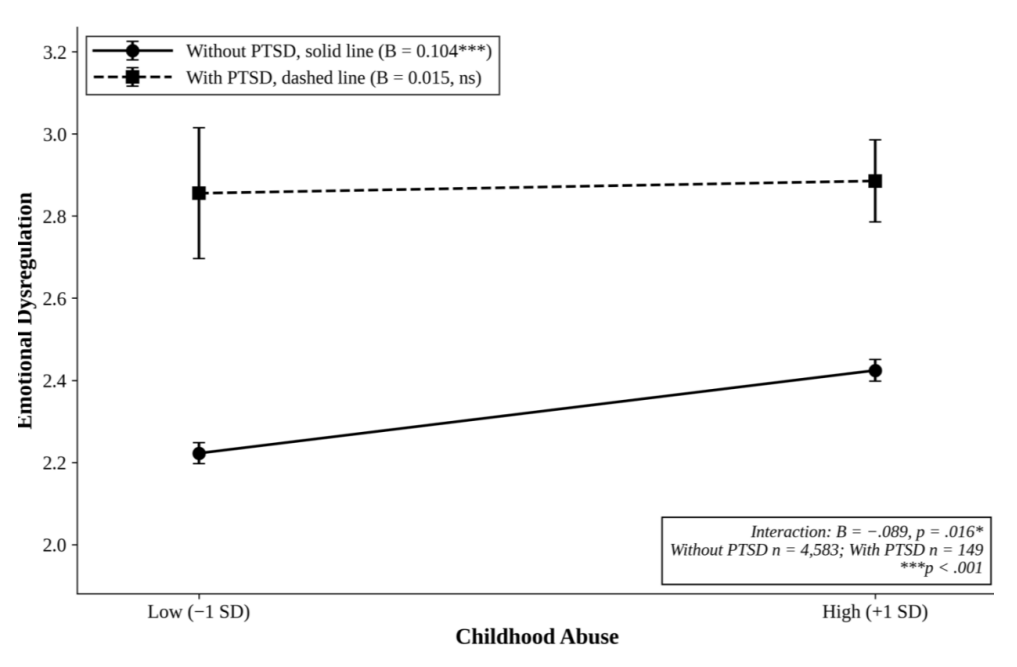
The CA × PTSD interaction was significant (B = −.089, SE = .037, p = .016), indicating that PTSD diagnosis moderated the association between childhood abuse and emotional dysregulation. However, the direction of moderation was opposite to Hypothesis 1: the association was weaker among respondents with a PTSD diagnosis. The simple slope for respondents without a PTSD diagnosis was B = .104, 95% CI [.085, .123], p < .001, whereas for respondents with a PTSD diagnosis it was B = .015, 95% CI [−.054, .085], p = .66, the latter interval including zero (Figure 2). Thus, the association between childhood abuse and emotional dysregulation was attenuated among respondents with a PTSD diagnosis. In standardized terms, these associations were small (CA, β = .149; PTSD, β = .145; interaction, β = −.023). The CA × PTSD interaction explained a statistically significant but negligible increment in variance (ΔR2 = .001, ΔF(1, 4724) = 5.86, p = .016). A power analysis indicated that statistical power to detect an interaction of the observed magnitude was limited (approximately .70), consistent with the small size of the PTSD subgroup (n = 149, 3.1%). The multiple-imputation analysis (n = 5,114) yielded a pooled CA × PTSD interaction estimate consistent with the complete-case result (B = −.078, SE = .036, p = .030).
To characterise this pattern, the distributions of childhood abuse and emotional dysregulation were examined by PTSD subgroup. Among respondents without a PTSD diagnosis (n = 4,583), childhood abuse (M = .66, SD = .94, range 0–5) and emotional dysregulation (M = 2.32, SD = .64, range 1–5) were observed, whereas among those with a PTSD diagnosis (n = 149), both childhood abuse (M = 1.51, SD = 1.43, range 0–5) and emotional dysregulation (M = 2.94, SD = .79, range 1.14–4.86) were higher.
| Variables | B | SE | β | t | p |
| CA | .104*** | .010 | .149 | 10.66 | < .001 |
| PTSD | .547*** | .059 | .145 | 9.25 | < .001 |
| CA × PTSD | -.089* | .037 | –.023 | –2.42 | .016 |
| Constant | 2.027 | .030 | — | 68.03 | < .001 |
| Controls | |||||
| Sex | .192*** | .018 | .143 | 10.45 | < .001 |
| Age | .005 | .005 | .012 | .91 | .365 |
| Education | –.108*** | .009 | –.171 | –11.94 | < .001 |
| Household Income | –.025*** | .004 | –.100 | –6.88 | < .001 |
| Note. Analysis sample reduced due to listwise deletion; R² = .125; β = standardized regression coefficient; CA = Childhood Abuse. *** p < .001, ** p < .01, * p < .05 | |||||
Functional Impairment
The functional impairment item was markedly skewed, with 91.2% of respondents (n = 4,315) reporting “not limited,” 6.4% (n = 305) “limited a little,” and 2.4% (n = 112) “limited a lot.” In view of this distribution, functional impairment was modeled using ordinal (proportional-odds) logistic regression (Table 4). Childhood abuse (OR = 1.17, p = .002) and PTSD diagnosis (OR = 5.29, p < .001) were each associated with greater functional impairment.
The CA × PTSD interaction was not statistically significant (OR = .84, p = .190), and Hypothesis 2 was therefore not supported. The same pattern was obtained under a linear specification (interaction ΔR2 = .0002, ΔF(1, 4724) = .81, p = .368), indicating that the non-significant interaction did not reflect the choice of model.
| Variables | B | SE | OR | z | p |
| CA | .159** | .052 | 1.17 | 3.04 | .002 |
| PTSD | 1.666*** | .274 | 5.29 | 6.08 | < .001 |
| CA × PTSD | –.176 | .134 | .84 | –1.31 | .190 |
| Controls | |||||
| Sex | .543*** | .112 | 1.72 | 4.85 | < .001 |
| Age | .063* | .030 | 1.07 | 2.13 | .033 |
| Education | –.254*** | .053 | .78 | –4.78 | < .001 |
| Household Income | –.089*** | .019 | .92 | –4.59 | < .001 |
| Note. Analysis sample reduced due to listwise deletion; OR = odds ratio; CA = Childhood Abuse. *** p < .001, ** p < .01, * p < .05 | |||||
Discussion and Conclusion
This study examined whether PTSD diagnosis moderates the associations between childhood abuse and two adult outcomes: emotional dysregulation and functional impairment. Childhood abuse was positively associated with both emotional dysregulation and functional impairment, and PTSD diagnosis showed independent positive associations with both outcomes. Hypothesis 1 proposed that a PTSD diagnosis would amplify the association between childhood abuse and emotional dysregulation. Although the interaction term was statistically significant, it was opposite in direction: the abuse–emotional dysregulation association was weaker among respondents with a PTSD diagnosis. Thus, Hypothesis 1 was not supported. Hypothesis 2 proposed that a PTSD diagnosis would amplify the association between childhood abuse and functional impairment; the interaction term was not significant, so Hypothesis 2 was not supported.
Childhood Abuse and Emotional Dysregulation
The positive association between childhood abuse and emotional dysregulation is consistent with emotion regulation theory and empirical evidence identifying dysregulated emotion processes as a key pathway linking childhood adversity to adult psychopathology8,10,13. Developmental research further suggests that the timing and chronicity of abuse relate to long-term differences in neurocognitive functioning relevant to regulatory control36.
Childhood Abuse, PTSD, and Functional Impairment
The association between childhood abuse and functional impairment aligns with life-course models proposing that early adversity becomes biologically embedded via cumulative stress-system changes and allostatic load, contributing to later health risk and functional limitations5. Meta-analytic evidence also links childhood trauma exposure to elevated inflammatory markers in adulthood, which may be relevant to long-term physical functioning and health-related limitations20. The independent association between PTSD diagnosis and functional impairment is consistent with meta-analytic evidence showing that PTSD is associated with substantial impairment across domains of functioning30, and with work suggesting functional impairment in trauma-exposed populations reflects processes beyond PTSD symptoms alone37.
Why Did PTSD Diagnosis Attenuate the Abuse–Emotional Dysregulation Association?
Although a PTSD diagnosis was expected to amplify abuse-related emotional dysregulation, the observed interaction suggested attenuation. The subgroup distributions reported above argue against two artifactual explanations: emotional dysregulation in the PTSD diagnosis group spanned nearly the full scale (1.14–4.86) and showed greater variability than in the no-PTSD diagnosis group, so neither a hard ceiling effect nor range restriction is evident. A more plausible account involves construct overlap between PTSD and emotional dysregulation: meta-analytic evidence indicates robust associations between emotion regulation difficulties and posttraumatic stress symptoms29. If dysregulation is elevated among diagnosed individuals across all levels of abuse exposure, variation in abuse explains less additional variance within the PTSD group, producing a smaller slope.
A second explanation relates to measurement and selection. PTSD was measured as a lifetime professional diagnosis (binary). Diagnosis-based measures can reflect not only symptom presence, but also factors such as help-seeking, healthcare access, and clinician recognition, which may introduce heterogeneity in the PTSD group. In addition, a lifetime PTSD diagnosis can stem from a wide range of traumas other than childhood abuse, including assaults, accidents, and disasters in adolescence or adulthood38; respondents in the PTSD group with low childhood abuse scores may therefore have experienced other index traumas, and this heterogeneity in trauma source would further weaken the within-group association between childhood abuse and emotional dysregulation. More generally, interaction effects are statistically difficult to estimate precisely, especially with an imbalanced moderator, because power to detect interactions is typically much lower than for main effects39. Replication using symptom-severity PTSD measures may clarify whether attenuation persists when PTSD is measured dimensionally rather than categorically.
Why was There No Moderation for Functional Impairment?
The absence of a significant interaction for functional impairment suggests that PTSD diagnosis did not change the strength of the abuse–functional impairment association in this sample. This pattern is consistent with a broader literature in which trauma-related symptom profiles often function as mediators rather than moderators of physical health outcomes. For example, posttraumatic stress reactions have been shown to statistically mediate associations between child abuse and later physical health complaints32, and related work suggests complex PTSD symptom profiles can account for childhood trauma–physical health associations33. Importantly, moderation may also be outcome-specific: PTSD has been shown to interact with documented childhood victimisation to predict some pain outcomes in adulthood31. The single-item functional impairment measure used here is broad and may be less sensitive to PTSD-specific amplification effects than more specific outcomes (e.g., pain interference, disability indices).
Implications
These findings reinforce that childhood abuse is associated with adult emotional dysregulation and functional impairment, supporting models that position emotion regulation as a central mechanism linking adversity to later adjustment13. Clinically, the attenuating interaction suggests that emotion dysregulation may be elevated among abuse-exposed individuals regardless of PTSD diagnosis, highlighting the value of assessing and addressing regulation difficulties even when PTSD is not present or not diagnosed. For functioning, significant main effects of both abuse and PTSD suggest that intervention and prevention efforts may need to address both trauma-related symptoms and broader health-related and psychosocial pathways that contribute to impairment30.
Limitations
Several limitations should be considered. First, PTSD was assessed with a single self-report item indicating a lifetime history of professional diagnosis. Such an item does not capture symptom severity, chronicity, or current status, and reflects help-seeking and access to healthcare as well as symptom burden; reported diagnoses may also be inaccurate. The findings therefore pertain to a history of PTSD diagnosis rather than to PTSD as a clinical construct. Second, the PTSD group was small (3.1%), which likely reduced precision for interaction estimates40. This prevalence is also lower than United States lifetime estimates of approximately 6 to 8 percent from nationally representative surveys41,38. Several features of the present study may contribute to this difference. The sample was restricted to adults aged 25 to 34, whereas national estimates cover the full adult age range. The Add Health sampling frame was school-based, which may underrepresent severely affected individuals. In addition, PTSD was indexed by a self-reported professional diagnosis rather than a structured diagnostic interview, so individuals who met criteria but never sought or received care are not captured, which would lower the observed prevalence. Third, childhood abuse was measured retrospectively with a brief three-item composite with low internal consistency (α = .545). Because the three items index distinct forms of abuse that need not co-occur, α may understate the reliability of the composite, which functions as a formative index of cumulative abuse exposure42. Sensitivity analyses entering each abuse item separately produced the same pattern of results as the composite (each item positively associated with emotional dysregulation, all p < .001; all CA × PTSD interaction coefficients negative and none indicating amplification; no significant interaction for functional impairment). Retrospective recall is a further source of measurement error and predominantly produces false negatives rather than false positives43. Both sources of error attenuate regression estimates, so the observed associations are likely conservative. The measure also excludes neglect; the findings therefore pertain to threat-related adversity (abuse) specifically and may not generalise to deprivation-related experiences. Fourth, functional impairment was measured with a single three-level ordinal item, which may be less sensitive than multi-item functioning measures. Fifth, although Add Health is a longitudinal study, the present analyses were cross-sectional, as childhood abuse was reported retrospectively and both outcomes were measured concurrently at Wave IV; the findings therefore reflect associations and do not permit causal inference. Sixth, the models adjusted for demographic covariates only. Conditions such as depression, anxiety disorders, substance use, and physical health problems were not included and may be related to both emotional dysregulation and functional impairment, so the possibility of residual confounding remains.
Future Directions
Future studies should replicate these findings in samples with higher PTSD prevalence and use validated symptom-level PTSD measures (e.g., the PCL-5 or CAPS-5) to test whether the attenuating interaction persists. It may also be informative to compare moderation models (PTSD changes the abuse–outcome slope) with mediation models (posttraumatic stress explains the pathway from abuse to functioning), given evidence supporting mediation in physical health outcomes44.
Conclusion
Childhood abuse and PTSD diagnosis were each associated with higher emotional dysregulation and greater functional impairment in adulthood. However, a PTSD diagnosis did not amplify abuse-related associations in this sample: moderation was attenuating for emotional dysregulation and non-significant for functional impairment. These findings suggest that abuse-related dysregulation and impairment may be important clinical targets regardless of PTSD diagnosis status, and that future work should clarify the mechanisms and measurement conditions under which the strength of abuse–outcome associations varies by PTSD status.
References
- M. Stoltenborgh, M. J. Bakermans-Kranenburg, L. R. A. Alink, M. H. van IJzendoorn. The prevalence of child maltreatment across the globe: Review of a series of meta-analyses. Child Abuse Review. Vol. 24, pg. 37–50, 2015, https://doi.org/10.1002/car.2353. [↩]
- K. Hughes, M. A. Bellis, K. A. Hardcastle, D. Sethi, A. Butchart, C. Mikton, L. Jones, M. P. Dunne. The effect of multiple adverse childhood experiences on health: A systematic review and meta-analysis. The Lancet Public Health. Vol. 2, pg. e356–e366, 2017, https://doi.org/10.1016/S2468-2667(17)30118-4. [↩]
- R. T. Leeb, L. J. Paulozzi, C. Melanson, T. R. Simon, I. Arias. Child Maltreatment Surveillance: Uniform Definitions for Public Health and Recommended Data Elements, Version 1.0. Centers for Disease Control and Prevention, National Center for Injury Prevention and Control, 2008. [↩]
- Y. D. Ahn, S. Jang, J. Shin, J. W. Kim. Psychological aspects of child maltreatment. Journal of Korean Neurosurgical Society. Vol. 65, pg. 408–414, 2022, https://doi.org/10.3340/jkns.2021.0300. [↩]
- A. Danese, B. S. McEwen. Adverse childhood experiences, allostasis, allostatic load, and age-related disease. Physiology & Behavior. Vol. 106, pg. 29–39, 2012, https://doi.org/10.1016/j.physbeh.2011.08.019. [↩] [↩] [↩] [↩]
- K. A. McLaughlin, M. A. Sheridan. Beyond cumulative risk: A dimensional approach to childhood adversity. Current Directions in Psychological Science. Vol. 25, pg. 239–245, 2016, https://doi.org/10.1177/0963721416655883. [↩]
- K. A. McLaughlin, M. A. Sheridan, H. K. Lambert. Childhood adversity and neural development: Deprivation and threat as distinct dimensions of early experience. Neuroscience & Biobehavioral Reviews. Vol. 47, pg. 578–591, 2014, https://doi.org/10.1016/j.neubiorev.2014.10.012. [↩]
- J. J. Gross. The emerging field of emotion regulation: An integrative review. Review of General Psychology. Vol. 2, pg. 271–299, 1998, https://doi.org/10.1037/1089-2680.2.3.271. [↩] [↩]
- K. L. Gratz, L. Roemer. Multidimensional assessment of emotion regulation and dysregulation: Development, factor structure, and initial validation of the Difficulties in Emotion Regulation Scale. Journal of Psychopathology and Behavioral Assessment. Vol. 26, pg. 41–54, 2004, https://doi.org/10.1023/B:JOBA.0000007455.08539.94. [↩]
- A. Aldao, S. Nolen-Hoeksema, S. Schweizer. Emotion-regulation strategies across psychopathology: A meta-analytic review. Clinical Psychology Review. Vol. 30, pg. 217–237, 2010, https://doi.org/10.1016/j.cpr.2009.11.004. [↩] [↩]
- R. A. Cowell, D. Cicchetti, F. A. Rogosch, S. L. Toth. Childhood maltreatment and its effect on neurocognitive functioning: Timing and chronicity matter. Development and Psychopathology. Vol. 27, pg. 521–533, 2015, https://doi.org/10.1017/S0954579415000139. [↩]
- J. M. Warmingham, E. B. Duprey, E. D. Handley, F. A. Rogosch, D. Cicchetti. Patterns of childhood maltreatment predict emotion processing and regulation in emerging adulthood. Development and Psychopathology. Vol. 35, pg. 766–781, 2023, https://doi.org/10.1017/S0954579422000025. [↩]
- A. C. Miu, A. Szentágotai-Tătar, R. Balázsi, D. Nechita, I. Bunea, S. D. Pollak. Emotion regulation as mediator between childhood adversity and psychopathology: A meta-analysis. Clinical Psychology Review. Vol. 93, pg. 102141, 2022, https://doi.org/10.1016/j.cpr.2022.102141. [↩] [↩] [↩]
- R. C. Brindle, A. Pearson, A. T. Ginty. Adverse childhood experiences (ACEs) relate to blunted cardiovascular and cortisol reactivity to acute laboratory stress: A systematic review and meta-analysis. Neuroscience & Biobehavioral Reviews. Vol. 134, pg. 104530, 2022, https://doi.org/10.1016/j.neubiorev.2022.104530. [↩]
- S. Katz, A. B. Ford, R. W. Moskowitz, B. A. Jackson, M. W. Jaffe. Studies of illness in the aged: The Index of ADL: A standardized measure of biological and psychosocial function. JAMA. Vol. 185, pg. 914–919, 1963, https://doi.org/10.1001/jama.1963.03060120024016. [↩]
- M. P. Lawton, E. M. Brody. Assessment of older people: Self-maintaining and instrumental activities of daily living. The Gerontologist. Vol. 9, pg. 179–186, 1969, https://doi.org/10.1093/geront/9.3_part_1.179. [↩]
- J. E. Ware Jr., C. D. Sherbourne. The MOS 36-item short-form health survey (SF-36): I. Conceptual framework and item selection. Medical Care. Vol. 30, pg. 473–483, 1992. [↩]
- M. Maxfield, K. Courtney, S. Assuras, J. J. Manly, C. S. Widom. Childhood maltreatment and cognitive functioning from young adulthood to late midlife: A prospective study. Neuropsychology. 2025, https://doi.org/10.1037/neu0001042. [↩]
- N. E. Fares-Otero, M. De Prisco, V. Oliva, J. Radua, S. L. Halligan, E. Vieta, A. Martinez-Aran. Association between childhood maltreatment and social functioning in individuals with affective disorders: A systematic review and meta-analysis. Acta Psychiatrica Scandinavica. Vol. 148, pg. 142–164, 2023, https://doi.org/10.1111/acps.13557. [↩]
- D. Baumeister, R. Akhtar, S. Ciufolini, C. M. Pariante, V. Mondelli. Childhood trauma and adulthood inflammation: A meta-analysis of peripheral C-reactive protein, interleukin-6 and tumour necrosis factor-α. Molecular Psychiatry. Vol. 21, pg. 642–649, 2016, https://doi.org/10.1038/mp.2015.67. [↩] [↩]
- A. Bussières, M. J. Hancock, A. Elklit, M. L. Ferreira, P. H. Ferreira, L. S. Stone, T. H. Wideman, J. T. Boruff, F. Al Zoubi, F. Chaudhry, R. Tolentino, J. Hartvigsen. Adverse childhood experience is associated with an increased risk of reporting chronic pain in adulthood: A systematic review and meta-analysis. European Journal of Psychotraumatology. Vol. 14, pg. 2284025, 2023, https://doi.org/10.1080/20008066.2023.2284025. [↩]
- D. A. Davis, L. J. Luecken, A. J. Zautra. Are reports of childhood abuse related to the experience of chronic pain in adulthood? A meta-analytic review of the literature. The Clinical Journal of Pain. Vol. 21, pg. 398–405, 2005, https://doi.org/10.1097/01.ajp.0000149795.08746.31. [↩]
- M. A. L. van Tilburg, D. K. Runyan, A. J. Zolotor, J. C. Graham, H. Dubowitz, A. J. Litrownik, E. Flaherty, D. K. Chitkara, W. E. Whitehead. Unexplained gastrointestinal symptoms after abuse in a prospective study of children at risk for abuse and neglect. Annals of Family Medicine. Vol. 8, pg. 134–140, 2010, https://doi.org/10.1370/afm.1053. [↩]
- American Psychiatric Association. Diagnostic and Statistical Manual of Mental Disorders, 5th ed. American Psychiatric Publishing, 2013, https://doi.org/10.1176/appi.books.9780890425596. [↩]
- A. Ehlers, D. M. Clark. A cognitive model of posttraumatic stress disorder. Behaviour Research and Therapy. Vol. 38, pg. 319–345, 2000, https://doi.org/10.1016/S0005-7967(99)00123-0. [↩] [↩]
- C. R. Brewin. Episodic memory, perceptual memory, and their interaction: Foundations for a theory of posttraumatic stress disorder. Psychological Bulletin. Vol. 140, pg. 69–97, 2014, https://doi.org/10.1037/a0033722. [↩]
- A. S. Masten. Ordinary magic: Resilience processes in development. American Psychologist. Vol. 56, pg. 227–238, 2001, https://doi.org/10.1037/0003-066X.56.3.227. [↩]
- G. A. Bonanno. Loss, trauma, and human resilience: Have we underestimated the human capacity to thrive after extremely aversive events? American Psychologist. Vol. 59, pg. 20–28, 2004, https://doi.org/10.1037/0003-066X.59.1.20. [↩]
- A. V. Seligowski, D. J. Lee, J. R. Bardeen, H. K. Orcutt. Emotion regulation and posttraumatic stress symptoms: A meta-analysis. Cognitive Behaviour Therapy. Vol. 44, pg. 87–102, 2015, https://doi.org/10.1080/16506073.2014.980753. [↩] [↩] [↩]
- L. Jellestad, N. A. Vital, J. Malamud, J. Taeymans, C. Mueller-Pfeiffer. Functional impairment in posttraumatic stress disorder: A systematic review and meta-analysis. Journal of Psychiatric Research. Vol. 136, pg. 14–22, 2021, https://doi.org/10.1016/j.jpsychires.2021.01.039. [↩] [↩] [↩]
- K. G. Raphael, C. S. Widom. Post-traumatic stress disorder moderates the relation between documented childhood victimization and pain 30 years later. Pain. Vol. 152, pg. 163–169, 2011, https://doi.org/10.1016/j.pain.2010.10.014. [↩] [↩] [↩]
- J. Rueness, M. C. Myhre, I. F. Strøm, T. Wentzel-Larsen, G. Dyb, S. Thoresen. The mediating role of posttraumatic stress reactions in the relationship between child abuse and physical health complaints in adolescence and young adulthood. European Journal of Psychotraumatology. Vol. 10, pg. 1608719, 2019, https://doi.org/10.1080/20008198.2019.1608719. [↩] [↩]
- G. W. K. Ho, T. Karatzias, F. Vallières, K. Bondjers, M. Shevlin, M. Cloitre, M. Ben-Ezra, J. I. Bisson, N. P. Roberts, L. Astill Wright, P. Hyland. Complex PTSD symptoms mediate the association between childhood trauma and physical health problems. Journal of Psychosomatic Research. Vol. 142, pg. 110358, 2021, https://doi.org/10.1016/j.jpsychores.2021.110358. [↩] [↩]
- R. M. Baron, D. A. Kenny. The moderator–mediator variable distinction in social psychological research: Conceptual, strategic, and statistical considerations. Journal of Personality and Social Psychology. Vol. 51, pg. 1173–1182, 1986, https://doi.org/10.1037/0022-3514.51.6.1173. [↩]
- K. M. Harris, C. T. Halpern, E. A. Whitsel, J. M. Hussey, L. A. Killeya-Jones, J. Tabor, S. C. Dean. Cohort Profile: The National Longitudinal Study of Adolescent to Adult Health (Add Health). International Journal of Epidemiology. Vol. 48, pg. 1415–1415k, 2019, https://doi.org/10.1093/ije/dyz115. [↩]
- R. A. Cowell, D. Cicchetti, F. A. Rogosch, S. L. Toth. Childhood maltreatment and its effect on neurocognitive functioning: Timing and chronicity matter. Development and Psychopathology. Vol. 27, pg. 521–533, 2015, https://doi.org/10.1017/S0954579415000139. [↩]
- M. Cloitre, R. Miranda, K. C. Stovall-McClough, H. Han. Beyond PTSD: Emotion regulation and interpersonal problems as predictors of functional impairment in survivors of childhood abuse. Behavior Therapy. Vol. 36, pg. 119–124, 2005, https://doi.org/10.1016/S0005-7894(05)80060-7. [↩]
- D. G. Kilpatrick, H. S. Resnick, M. E. Milanak, M. W. Miller, K. M. Keyes, M. J. Friedman. National estimates of exposure to traumatic events and PTSD prevalence using DSM-IV and DSM-5 criteria. Journal of Traumatic Stress. Vol. 26, pg. 537–547, 2013, https://doi.org/10.1002/jts.21848. [↩] [↩]
- D. A. A. Baranger, M. C. Finsaas, B. L. Goldstein, C. E. Vize, D. R. Lynam, T. M. Olino. Tutorial: Power analyses for interaction effects in cross-sectional regressions. Advances in Methods and Practices in Psychological Science. Vol. 6, article 10.1177/25152459231187531, 2023, https://doi.org/10.1177/25152459231187531. [↩]
- D. A. A. Baranger, M. C. Finsaas, B. L. Goldstein, C. E. Vize, D. R. Lynam, T. M. Olino. Tutorial: Power analyses for interaction effects in cross-sectional regressions. Advances in Methods and Practices in Psychological Science. Vol. 6, article 10.1177/25152459231187531, 2023, https://doi.org/10.1177/25152459231187531. [↩]
- R. B. Goldstein, S. M. Smith, S. P. Chou, T. D. Saha, J. Jung, H. Zhang, R. P. Pickering, W. J. Ruan, B. Huang, B. F. Grant. The epidemiology of DSM-5 posttraumatic stress disorder in the United States: Results from the National Epidemiologic Survey on Alcohol and Related Conditions-III. Social Psychiatry and Psychiatric Epidemiology. Vol. 51, pg. 1137–1148, 2016, https://doi.org/10.1007/s00127-016-1208-5. [↩]
- D. L. Streiner. Being inconsistent about consistency: When coefficient alpha does and doesn’t matter. Journal of Personality Assessment. Vol. 80, pg. 217–222, 2003, https://doi.org/10.1207/S15327752JPA8003_01. [↩]
- J. Hardt, M. Rutter. Validity of adult retrospective reports of adverse childhood experiences: Review of the evidence. Journal of Child Psychology and Psychiatry. Vol. 45, pg. 260–273, 2004, https://doi.org/10.1111/j.1469-7610.2004.00218.x. [↩]
- J. Rueness, M. C. Myhre, I. F. Strøm, T. Wentzel-Larsen, G. Dyb, S. Thoresen. The mediating role of posttraumatic stress reactions in the relationship between child abuse and physical health complaints in adolescence and young adulthood. European Journal of Psychotraumatology. Vol. 10, pg. 1608719, 2019, https://doi.org/10.1080/20008198.2019.1608719. [↩]