

Abstract
When governments pick winners, markets often fail. The history of US transportation policy reveals a recurring pattern in which efforts to accelerate technological transitions undermine competitive fairness. This pattern is consistent with predictable process equity failures defined as breakdowns in procedural fairness and structural neutrality within market competition. The objective of this paper is to analyze how failures to maintain fair process in market competition contribute to a dual crisis consisting of a macro-level Regulator-Firm crisis characterized by regulatory capture and rent-seeking and a micro-level Firm-consumer crisis characterized by information rents and consumer welfare loss. A qualitative comparative case study is used to synthesize established economic and policy literature. Two critical transportation policy interventions were selected as comparative case studies. A historical case analyzing the state-subsidized transition from rail to air travel, and a multi-tiered contemporary case examining battery versus hydrogen technologies alongside a cross-national comparison of China’s and the US’s electric vehicle (EV) subsidies. The analysis suggests that policy goals driven by short-term outcome equity or political convenience may contribute to market concentration and reduced competition. The literature suggests that these outcomes may be facilitated by the extraction of informational rents through opaque pricing in air travel and the suppression of innovation by alienating potentially superior technological alternatives (such as hydrogen in heavy trucking). Technology-neutral intervention, which maintains a balance between competing technologies over time with built-in mechanisms of review and correction, will prevent process equity failure.
Key words: process equity, dual crisis, technology neutrality, rent-seeking, regulatory failure, transportation policy.
Introduction
The transportation industry is the core of the US economy, moving over 20 billion tons of freight annually and employing millions1,2, yet chronic policy failures have been associated with repeated challenges to its stability and fairness. The strategic allocation of public funds and regulatory power determines not only how well an industry thrives, but also which citizens and communities have equitable access to efficient mobility.
Within this sector, process equity failure manifests as governments designing policies that favor a specific technology rather than maintaining neutral rules for all competition. Over time, such policy design may generate barriers to market entry, reduce competitive pressure, and limit the ability of alternative, potentially superior technologies to emerge. Once an oligopoly emerges from this process, consumers may face reduced choice, higher effective costs, and diminished innovation, outcomes this paper identifies as the micro-level dimension of the dual crisis.
Policymakers may prioritize short-term efficiency or political convenience when formulating regulation, rather than process equity. Existing frameworks have not fully captured both the macro regulatory failure and micro consumer harm. This paper integrates established concepts of regulatory capture, rent-seeking, and information asymmetry into a dual crisis framework to evaluate process equity failure across two transportation industries.
Two major cases are used to examine how patterns consistent with process equity failure may emerge from technology-specific policy design and to derive policy implications for future regulatory design. The first case is a historical one on the transition from passenger rail to passenger flight. The second case has two parts, the first examining how the US government’s subsidies in the green car energy industry have favored battery EVs without neutral evaluation of competing green technologies. Part two looks into the regulations which isolated Tesla in the US EV market, effectively excluding its most cost-competitive global rival Build Your Dreams Co. (BYD).
The cases are evaluated under the lenses of policy input, market structure and consumer impact. These three lenses provide a structured basis for identifying patterns of process equity failure across both cases. The overarching solution is that the government should design subsidies and regulations that preserve competitive balance rather than entrenching winners and build in automatic mechanisms that prevent capture over time.
This paper is normative, not just descriptive: it evaluates policy through the lens of process equity rather than efficiency alone, and the recommendations reflect that value judgment.
Methodology
The overall approach of the study is a qualitative comparative case study. This entails using a most-similar case selection in order to identify two cases which depict the pattern of government policies clearly “picking” a technological winner. Two interventions were chosen, one historical case (Rail vs. Air) and one contemporary case split into two analytical vectors: technology neutrality (Battery vs. Hydrogen) and market insulation (Chinese EV Tariffs). Since the examples are from different time periods and technology types, there is a broader and robust scope for analysis.
These two cases were selected not merely as illustrations, but because they represent paradigmatic instances of the phenomenon under study: each involves a clear, publicly documented act of government picking a technological winner, each produced measurable market concentration, and each spans a different era and technology (early-20th-century transportation infrastructure vs. 21st-century green energy policy). Their divergence in time period and technology, combined with convergence on the same underlying pattern, strengthens the claim that the identified mechanism is not incidental to either case individually.
Along with differentiation both involve the US government directly subsidizing one transportation technology over competitors, measurable market concentration, sufficient public policy documentation, and passenger and vehicle technology. This was followed by working through the timeline of each case and determining similar mechanisms across both, which led to their respective outcomes. The following three lenses were used for the analysis: policy input, market structure, and consumer impact. By ensuring that both cases are multi-billion-dollar federally regulated transport sectors, involve high capital expenditure infrastructure, involve consumer/passenger choices, and have corporate-state lobbying, the validity of the analysis was preserved.
To preserve these design boundaries, the US freight rail sector was excluded from this analysis. While freight rail is an industry deeply affected by government policies and market concentrations, it is strictly a business to business operation. Since it lacks direct effects to consumers (such as commercial airline ticket bundling) which is a part of defining the other cases, freight rail does not allow for a valid analysis. Therefore, its exclusions ensure the analytical framework remains tightly focused on consumer-centric technology.
Bus and maritime shipping were not chosen as cases since neither involves as clear or well-documented a case of the government picking one technology over another. Aviation-versus-rail and BEV-versus-hydrogen also have much more complete public data on subsidies and market share, which bus and shipping do not.
Sources were identified through targeted searches of government databases (.gov domains), federal legislative records, industry and financial news coverage, and peer-reviewed literature where available. Sources were included if they provided primary documentation of a policy, regulation, or dataset directly relevant to one of the two case studies; general commentary or opinion pieces without underlying data or documentation were excluded. Each case was analyzed along the same three lenses (policy input, market structure, consumer impact) to maintain a consistent unit of analysis across cases. Claims drawn from a single source were cross-checked against at least one independent source where possible to reduce reliance on any one source’s framing.
Because the technologies and policies examined in this analysis are relatively recent, the peer-reviewed literature directly addressing them remains limited; where academic sources were unavailable, this paper relies on government data, industry reporting, and financial journalism, cross-referenced across multiple outlets where possible.
Literature Review
Rent-Seeking and Regulatory Capture
Rent-seeking is the use of resources to obtain wealth through political influence, rather than creating new value. Firms attain favorable treatment by lobbying for subsidies, tariffs, and other policies that provide economic advantages. Rather than increasing profit margins by producing improved products, companies seek economic gains through political privilege in the form of rents. Because the resources are put towards redistributing wealth rather than creating new value, rent-seeking reduces overall economic efficiency. These political privileges often contribute to regulatory capture3. Regulatory capture occurs when policies implemented to regulate industries end up benefiting the firms they were intended to regulate. Industries often seek out regulations in order either to establish or maintain regulatory capture. Once capture is established, significant barriers to entry emerge, through strict licensing requirements, price controls, or production quotas. As a result, incumbents are protected while potential entrants face higher costs and resistance from the industry4.
Information Asymmetry and Consumer Welfare
Information asymmetries occur when firms possess more knowledge than consumers in a transaction, creating potential market failure and inefficient outcomes5. A separate issue arises when firms exploit consumer behavioral biases through non-transparent pricing: drip pricing and partitioned pricing. Drip pricing occurs when a firm initially markets an artificially low price and gradually reveals mandatory fees throughout the purchasing process of the product. Partitioned pricing differs slightly in that the hidden mandatory costs are disclosed simultaneously, but separated into different charges. This reduces market transparency and potentially lowers consumer welfare since consumers have difficulty determining the true cost of a product.
Technology Neutrality
Technology neutrality is a policy approach in which governments establish desired outcomes and performance standards rather than favoring specific technologies. Through this system competing companies can achieve these standards through any means they see fit. It is argued that this approach cultivates competition, encourages innovation, and reduces risk of governments prematurely “picking a winner” before the market has determined the most efficient solution. By allowing technologies to compete on their merits, neutrality increases the likelihood that the most efficient long term solution will emerge6. Proponents argue that preserving competition between technologies promotes dynamic efficiency by allowing innovation and market competition to identify the most cost-effective solution over time.
Technology neutrality is not a guaranteed fix, though. In new or highly capital-intensive markets, a neutral policy can still end up favoring whoever already has scale, since it does not correct for existing first-mover advantages. This paper treats technology neutrality as the better default, not a perfect solution.
Dynamic Efficiency
Dynamic efficiency is a firm’s ability to increase productivity while reducing long-term costs using innovation, investments, and research and development (R&D). This efficiency is strengthened when firms possess sufficient market power to absorb the risk of R&D investment, accelerating innovation. In a dynamically efficient industry competition works as a discovery process, also known as creative destruction which illustrates that new innovations continue to drive out the older technologies propelling forward long-term economic progress7 . Technology-neutral policies preserve the competitive dynamic by allowing multiple technologies to compete simultaneously. When governments pick winners, this process is short-circuited by removing the competitive pressure which drives innovation.
Subsidies are very necessary for infant industries in order to protect them, spark innovation, and offset the risk of research and development. The problem is not the subsidies themselves, rather, the government’s decision to make them technology-specific. Specifically in green technology industries subsidies are important since the market underinvests, because private firms can not capture the full social benefit of reducing emissions8. However, when these subsidies are technology-specific and persist past the infant industry stage, they risk entrenching the incumbents and undermining the competitive process which this paper identifies as a process equity failure.
Process Equity
Equity in modern policy making is distributional justice ensuring that benefits, burdens, risks, and opportunities are shared without being systematically skewed toward privileged groups9. Equity itself is an overarching goal with three parts: Access, Process, Outcome (APO). The APO framework defines the standard: access, all groups benefit from opportunities, services, and resources; process, the decision-making must meaningfully include voices of those affected and rules should not burden or exclude disadvantaged groups; outcome, after intervention the distribution of benefits and burdens should be such that no group is disproportionately harmed or excluded. This three part structure serves as the evaluative standard this paper applies to transportation policy interventions. The standard reveals a paradox: regulations that stimulate rent-seeking are fundamentally unfair (a violation of the NERRC’s Process Equity standard), and those that shield established players create entry barriers (a failure of Access Equity)9. For the purposes of this analysis, a process equity failure is defined as a policy intervention that departs from technological neutrality by extending differential treatment, funding, or regulatory relief to one technology or firm over comparable competitors, thereby altering competitive conditions independent of market performance.
Dual Crisis
A dual crisis occurs when process equity is not maintained. The first crisis is at macro level between the regulator and firm. The favored firm gains power to capture the regulator and will then lobby and use its political influence to protect its position rather than competing on merit. This first crisis creates the structural condition for the second. The second crisis is on a micro level between the firm and its consumers. Once the firm has captured the regulator there is now an information asymmetry. The firm now exploits it by implementing opaque pricing, hidden fees, and non-transparent costs, extracting the consumer surplus as profit. The resulting oligopoly or monopoly leaves consumers trapped with no viable alternative.
Results
The Rail-to-Air Transition
The Historical Conflict: Railroads vs. Airlines
Railroads have a long history in the US, being the main means of transportation for almost a century. They were the unchallenged backbone of long-distance passenger and freight transport, a status that began to erode in the 20th century. The decline of railway transportation is theoretically consistent with two factors: government investment in airway transportation and the over-regulation of the railway industry.
Aviation Subsidies and Railroad Regulation
Firstly, during the early 1900s, the US government began putting its eggs in the basket of aviation. They started off with the Air Commerce Act of 192610, which funded airports, navigation systems, and safety standards, all of which may have contributed to the development of the airway industry. This industry was developing at a rate that the Railway industry could not keep up with, especially without any government investment. Secondly, there was the Civil Aeronautics Act of 1938, which strongly supported and regulated commercial aviation, which may have supported airlines stabilization and expansion.
Aviation Subsidies (US Centennial of Flight Commission)
- Federal-Aid Airport Act of 1946: initiated the practice of federal grants-in-aid for public airports. This was critical in building the foundation of a modern airport and promoted safety with government assistance11.
- Airport and Airway Development Act of 1970: created the airport and airway trust fund (AATF), paid for by taxes on domestic passenger tickets, aviation fuel, and air cargo waybills, which was dedicated solely to financing air traffic control and airport development grants12.
- FAA Reauthorization Acts: Congress must regularly pass legislation (e.g., the recent FAA Reauthorization Act of 2024) to authorize the FAA to continue collecting and spending money from the Airport and Airway Trust Fund13.
- Infrastructure Legislation: Recent, large-scale bills like the Infrastructure Investment and Jobs Act (IIJA) provide supplemental, dedicated funding for major capital projects, including air traffic facilities and airport terminals, beyond the typical annual trust fund allocations14.
Airlines received a free, taxpayer-funded right-of-way, drastically cutting their fixed costs, while railroads had to pay taxes on all the land used, along with upkeep.
Railroad overregulation: The railroad industry was overregulated, which may have significantly constrained the industry’s efficiency.
The two biggest factors causing this were Interstate Commerce Commission (ICC)15 Regulations and the Transportation Act of 194016, which limited their ability to raise prices or cut services based on the distance, specifically, long-haul and short-haul journeys for trains could not charge different prices, while airplanes could charge based on distance15. Rail lines could not price tickets logically based on competition and demand which may have limited their ability to compete on price or efficiency.
While air transport had the advantage of guaranteed federal mail contracts, the federal government largely paid for airports and traffic control, and regulations were relatively focused on safety and growth. Rail transport had the disadvantages of paying entirely for its own tracks and right-of-way, plus property taxes, and heavy regulations (ICC) controlled rates and forced the continuation of money-losing services.
This pattern reflects a first instance of process equity failure: this asymmetric policy environment is consistent with theoretical predictions of market concentration of market concentration in the long-distance transportation sector within the long-distance transportation industry. When formulating regulations within an industry, it is necessary not to maximize efficiency but rather let some efficiency go and allow equity in order to protect the industry from harm (regulatory capture and unsustainable instability) in the long term17. The policy emphasis on aviation efficiency, without corresponding investment in rail, may have contributed to the long-term structural issues this analysis identifies.
The combination of limited investment and burdensome regulation is associated with a weakening of rail’s competitive position. These two big reasons, coupled with the lack of investment into railroads by the government, may have significantly weakened rail’s viability as a competitor in long-distance travel.
Funneling Deeper: Current Air Travel Inequities
Skipping to the late 1900s, the Rail Passenger Service Act of 1970 created the National Passenger Railroad Corporation (Amtrak as we know it today)18. It was created in order to preserve a national passenger rail network that was on the verge of collapsing, as explained above. But, with the boom in air travel, Amtrak began to lose out on passengers and saw maintaining passenger railroads as a costly burden. In order to keep the ticket fares relatively low, the rail companies would rely on freight train revenue, since it had very little government funding towards the end of its run.
Again, there was a failure in government funding, as policymakers continued to criticize Amtrak for a lack of profits, even as a lack of funding may have diminished the service. In 1995, Amtrak faced severe budget cuts by the federal government, forcing suspensions and reduced service across the country. The frequency of passenger service reduced from 7 days per week to 3 days per week19. Many routes were permanently removed, which had worse consequences for smaller towns and cities that became disconnected. After local leaders coalesced to push for a restoration of the many reduced services, Congress replaced the Board of Directors of Amtrak. Though the new board achieved short-lived profit gains, continued underinvestment undermined lasting progress.
Beyond underfunding, the government fails to enforce legal protections the railroad already has. The Amtrak Improvement Act of 1973 established that in all circumstances except in case of emergency Amtrak has preference over freight transportation in using a rail line, junction, or crossing20. Despite this law being in place for over 50 years, some freight carriers have failed to comply, and are responsible for 1 million minutes of delay to Amtrak passengers in 2019 alone21. The Department of Justice is responsible for enforcing it and has largely failed to, leaving Amtrak with limited practical recourse21. The unreliability of Amtrak lines can be associated with the freight carriers’ non-compliance and the reduction in consumer demand for rail which diverts passengers toward air travel. The government’s failure to enforce the legal protections may compound the structural disadvantage, potentially accelerating the elimination of a competitive alternative to air travel.
The continued absence of sufficient funding is associated with the broader decline of passenger rail. The decline of the railroad may have been detrimental for US citizens, since it was one of the only sufficient competitors for the airline industry. In the absence of sufficient competition, the airline industry may have faced reduced pressure to innovate or maintain transparent pricing. Consumers may also be affected by the limited alternatives beyond accepting the airline industry’s pricing terms.
The Current Failure
Efficiency Loss Through Distorted Cost Signals
Opaque pricing may prevent consumers from accurately comparing the total cost of ownership for a flight. The advertised price may function as an incomplete cost signal, potentially intended to secure engagement with the booking process. The true cost is only fully revealed late into the booking process, which is the base fare plus mandatory and quasi-mandatory ancillary fees. Since the market is an oligopoly, the airlines may retain sufficient pricing power without the threat of a competitor forcing price transparency. This is a suboptimal choice (market inefficiency), since there is no perfect information for the consumers, there is no longer efficiency. This may be advantageous for the airlines as it could allow them to capture informational rents through the tax advantage. If the true price had been seen on the fare, the airline would be forced to pay more ticket fare tax; this unbundling allows airlines to avoid the Federal Excise Tax22.
This dynamic is not merely theoretical; it is reflected in the airline industry’s own legal response to regulation. In April 2024, the Department of Transportation issued a rule requiring airlines to disclose baggage and change fees upfront alongside the base fare, specifically to end practices that disguise the true cost of a discounted flight. American, Delta, United, and several other carriers subsequently sued the DOT to block the rule, with their trade group calling it “arbitrary, capricious, an abuse of discretion and otherwise contrary to law”23. The DOT estimated that the rule would potentially save consumers over $500 million annually in fees currently being overpaid. Rather than competing on transparent pricing, dominant carriers attempted to use legal and political resources to preserve opacity, a pattern consistent with process equity failure.
Lack of Alternatives
The near-elimination of viable, high-quality passenger rail leaves consumers with no proper alternative modes of transportation for mid-to-long distances, trapping them into accepting the airline market’s terms. The long-term efficiency loss goes back to the lack of alternative modes of long-distance traveling. During the early stages of air travel development, the rail acted as an alternative, which fostered competition between the two forms and pushed for efficiency. But now the rail system is no longer strong enough to be sufficient competition for air transport, which leaves consumers with no alternative modes of long-distance transportation, trapping them to accept the airline market’s terms.
The initial process equity failure (favoring air over rail) may have contributed to a secondary, persistent process equity failure (consumer vulnerability to monopoly/oligopoly conditions). The main issue is the dual crisis, where airlines have located and are exploiting loopholes in efficiency-based regulations placed on the larger industry. By failing to maintain equity in the historical regulatory process, the absence of regulatory correction may have left consumers increasingly dependent on an industry that now maximizes its own efficiency and profits at the expense of equitable consumer pricing and choice.
Case Study: Electric Vehicle (EV) Subsidies
The Early Advantage: EV Subsidies and Market Concentration
The clear, desirable goal of EV subsidies was, and remains, reducing reliance on fossil fuels, promoting new technology and innovations, and mitigating climate change by decarbonizing the transportation sector.
Subsidy Design and Tesla’s Leap
Initially, the subsidy design was meant to offset the high production and purchase cost of early electric vehicles (EVs), in order to incentivise innovation within the industry. The tax credit amount was $2,500, and an additional amount was added based on the battery capacity, allowing the total credit to reach a maximum of $7,500 per EV (the amount depended on the battery capacity and then increased incrementally for each kWh of capacity above a certain threshold).
The most critical feature of this subsidy was the per-manufacturer sales limit, creating “first-mover advantage,” which Tesla grabbed. The credit was only available for the first 200,000 qualifying EVs sold by each manufacturer in the US. Once the manufacturer reached the car sales limit, the credit was phased out by reducing the credit per car over six quarters until it was zero24. Tesla’s early market entrance, combined with the subsidy structure, is consistent with its emergence as a dominant market player.
This type of supremacy by Tesla may make the US market harder to infiltrate by entrants, potentially stifling efficiency and raising equity concerns. Specifically in the US, Tesla dominates with nearly 50% of US EV sales in Q2 of 2025 compared to top competitor General Motors (GM) with 15.2% of sales, less than half that of Tesla25. The world EV market is going towards becoming an oligopoly with BYD (Chinese), Tesla (US), and Volkswagen (German) holding large shares of the world market as of 202526.
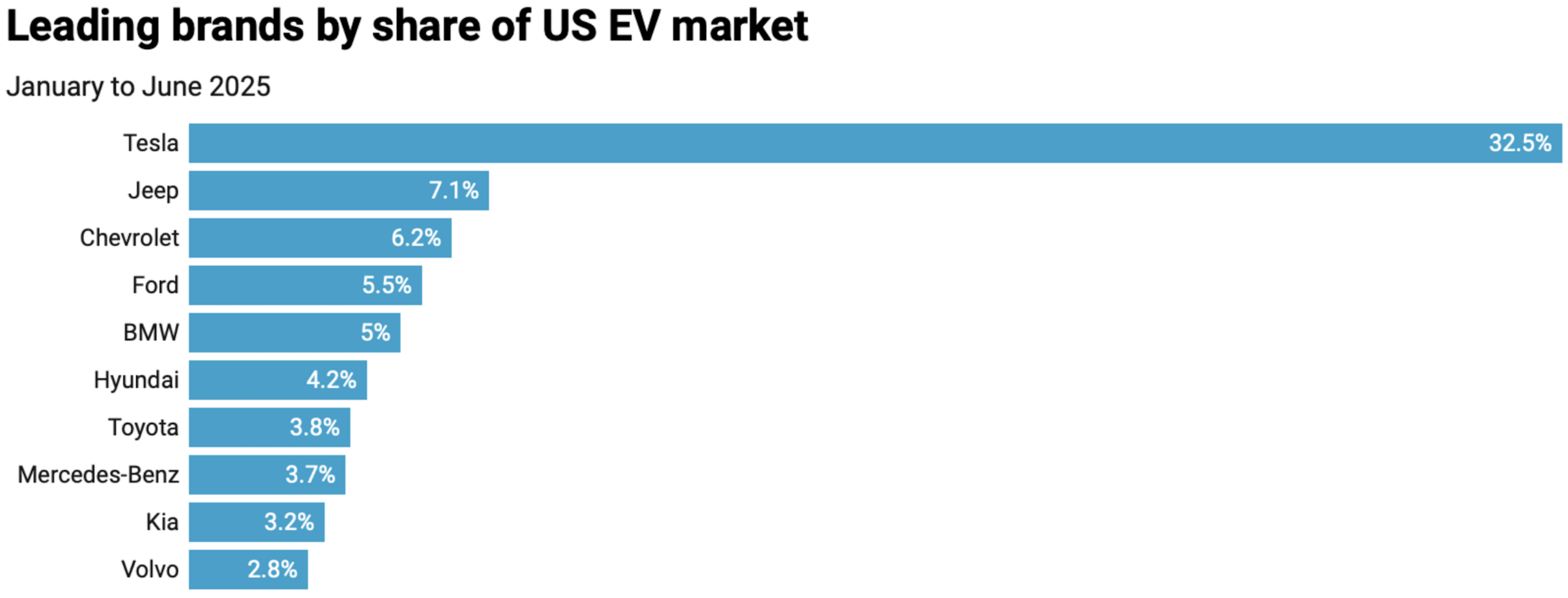
The chart shows Tesla’s 32.5% share is more than 4x its nearest competitor, Jeep, and bigger than the next five brands combined — a concentration pattern consistent with the market distortion described above.
The structure of the original subsidy disproportionately benefited Tesla (4x its closest competitor), which was first-to-market, creating a market distortion. This may have generated a significant early advantage for the market leader. Competitors and new entrants arriving later—who arguably needed the subsidy more to establish a market foothold—faced the challenge of competing against a dominant player whose buyers had already benefited from $7,500 discounts, or whose remaining buyers faced no credit at all. This lack of equitable timing may have made it harder for companies like Ford and startups to catch up.
The Lack of Broader Alternatives
The bulk of early subsidies focused narrowly on battery-electric vehicles, which may have hindered the growth of a diverse, equitable mix of green transportation solutions.
On a larger scale, there is also process equity failure when it comes to EVs as a whole vs. non-fossil powered cars like hydrogen and advanced biofuels. The US government has heavily invested in the EV industry, neglecting other types of fuel, which may have generated broader competition and innovation incentives. The government did not give equal opportunity in investments to different types of alternative fuel technologies; BEVs emerged as the dominant technology, with market share growing substantially.
The narrowing of billions of dollars into one solution, and more specifically unintentionally one specific company, the policy may have foregone dynamic efficiency gains by concentrating resources in a single technological pathway among alternative green technologies. If there had been an allocation of resources to many alternatives to fossil fuels, the most optimal green solution could have been found with organic competition, rather than the concentrated market structure that emerged.
For example, heavy-duty hydrogen trucks have reduced refueling time and fewer stops, resulting in higher efficiency and less downtime. The increased cargo capacity of heavy-duty hydrogen trucks provides more room for transporting goods. Another key advantage of the fuel cell truck is that it can carry more cargo, because the battery required by the battery electric truck (approximately 1000 kWh) causes a 4,000–20,000-pound loss in cargo capacity. Lost cargo capacity has a significant effect on fleet operations and profitability. Developing fueling infrastructure for heavy-duty hydrogen trucks may be easier and more cost-effective compared to traditional fueling infrastructure28. As the EV industry has grown relative to other green energy forms, potentially aided by government funding, these alternatives may face significant barriers to market entry. This outcome is consistent with the process equity failure pattern identified in this analysis.
The IRA and Continued Technology Specificity
The Inflation Reduction Act of 2022 (IRA)29 overhauled the EV credit structure by removing the 200,000 unit manufacturer cap, added new credits, and extended the phase-out program to a decade-long commitment. However, regardless of this expansion, the IRA remained technology-specific, continuing the direct subsidies toward battery electric vehicles (BEVs) instead of adopting a neutral standard across all low-emission alternatives. A technology-neutral alternative which targets the externality directly like a carbon price or emission standard would allow any technology meeting the threshold to compete on merit30. More specifically, by maintaining the technology-specific subsidies, the IRA may have reinforced the existing market concentration, and failed to include alternative green technologies which is consistent with the process equity failure pattern identified above.
The EV subsidies, though well-intentioned, morphed into a process equity failure by creating a market leader through the design of an initial cap, stifling alternative green technologies through resource concentration, and continuing subsidies beyond their utility via the IRA, entrenching dominance. Additionally, the IRA’s $7,500 tax credit is restricted to EVs with final assembly in North America, which may further disadvantage foreign manufacturers in the US market31.
Case Study: Chinese EV Market Insulation
Rather than directly subsidizing domestic production, U.S. trade policy has increasingly relied on restricting foreign competition to support the domestic EV market. The Section 301 tariffs function as a broad insulator, shielding all US-based EV manufacturers from cost-competitive international EVs. Initially, the tariff on EVs was set at 25% in 2018 under the Trump administration, before escalating to 100% under the Biden administration in 202432. The justifications for the increase were national security with regard to Chinese technology and protecting American manufacturing32. All US-based EV manufacturers may benefit, as the tariffs appear to price out their most cost-competitive foreign rival.
The competition between Build Your Dreams Co. (BYD), a Chinese-based company known for manufacturing batteries and EVs33 and Tesla, a US-based company known for EVs may illustrate a potential cost to American consumers associated with this tariff. BYD consistently undercuts Tesla’s pricing in non-Western countries. Across nine non-Western countries, BYD is on average $17,533 USD cheaper than Tesla34. Despite BYD being a formidable competitor of Tesla, it does not sell passenger vehicles in the United States as a result of the 100% tariff enacted in September 202434.
As of 2025, BYD has become the global EV leader, selling 2,256,71435 passenger BEV units compared to the 1,636,12936 units Tesla sold. Despite BYD having zero US passenger car presence, it has maintained its top position and its lack thereof may leave Tesla with no competitive pressure from its most cost-competitive global rival. BYD not only sells more units compared to Tesla, its cost-competitive vehicle is cheaper. Comparing a BYD Seal ($30,300 USD)37 to its closest match, the Tesla Model 3 ($38,380 USD)38, it becomes clear that the BYD is $8,080 USD cheaper than the Tesla Model 3. Though with the 100% tariff the new BYD price becomes $60,600 USD which effectively removes it as a real competitor in the US markets. This is consistent with the theoretical prediction that tariff-based market insulation may reduce competitive pressure on dominant domestic players.
In the US market where Tesla competes freely, American consumers may pay more for EVs than in a competitive market, since the lack of BYD in the US market may reduce Tesla’s competitive pressure to cut costs or innovate. The absence of a competitive market mechanism may be associated with domestic consumers bearing a higher price premium, potentially restricting access to more competitive pricing.
All US domestic manufactured EVs are correctly shielded from the strong competition international EVs provide. The Section 301 tariffs function as a broad market insulator. This case follows the same pattern as the rail-to-air and EV subsidies where governments do not follow technology neutrality and isolate a technology potentially allowing dominant players to consolidate without competitive constraint. This regulatory pattern is consistent with the dual crisis framework. Regulators implemented tariffs with the stated aim of protecting domestic manufacturing and national security, but regulators may have consolidated Tesla’s position as the dominant market incumbent. On a micro level Tesla faces reduced competitive pressure to lower prices or accelerate innovation, which the dual crisis framework suggests is consistent with consumer welfare loss.
Discussion
Policy Recommendations and The Government’s Role
The two case studies presented a common error in the US government’s policies and regulations when dealing with the transportation industry: a lack of foresight for possible oligopolies and a dual crisis of market power and consumer detriment.
The recurring pattern is that the government tends to put all its eggs into one basket, whether it be aviation or EVs, treating competing modes of transportation unequally, which is a fundamental process equity failure, by actively subsidizing one form of transport while simultaneously restricting or neglecting the established alternative. This pattern is theoretically associated with efficiency loss when concentrated market structures emerge, as there is no longer sufficient competition to further innovation and cost reduction, leading to market stagnation, as well as process equity failure, in which dominant players gain the power to extract extra profits through information rents or non-transparent pricing. Taxpayers may ultimately bear the cost of these regulatory gaps, only to be left with fewer viable alternatives and vulnerability to non-transparent terms set by the dominant industry.
These failures do not all come from the same place, and it’s worth separating them out to see where correction is actually possible. Some are institutional design failures, where the policy itself was flawed from the start, regardless of how well it was carried out. The original EV tax credit’s 200,000 unit manufacturer cap is a good example of this — the structure was going to reward whichever firm sold fastest no matter what, independent of product quality or long-term merit.
Others are implementation failures, where the policy itself may have been reasonable, but weak enforcement is what undermined it. The Amtrak Improvement Act gave passenger rail legal priority over freight lines, but since the Department of Justice largely failed to enforce that priority, the protection may have been more symbolic than real.
Then there are failures that may just come down to market dynamics that have nothing to do with the policy at all — the rise of interstate highways and personal car ownership likely contributed to rail’s decline too, separate from whatever aviation subsidies were doing. Separating out these three sources matters, since each one calls for a different fix: design failures mean rewriting the policy itself, implementation failures mean better enforcement, and market-driven outcomes might not be fixable through transportation policy in the first place.
Eliminating Subsidies for Mature, Concentrated Industries
This recommendation is made under the assumption that policymakers may prioritize political convenience over process equity (by yielding to lobbying) and argues that the resulting efficiency is so great that lobbying is a poor economic design for the nation as a whole.
The problem (rent-seeking cost): lobbying efforts aimed at securing permanent subsidies (uncapped EV subsidy) initiate rent-seeking. This causes a misallocation of billions of dollars of funds toward unproductive political maneuvering instead of innovation, creating a deadweight loss for the economy3. The policy: A framework that prescribes asymmetric regulations based on the specific firms is necessary to combat the issues presented5.
- New entrant/low share: have full subsidies/access to the policy goal, allowing for market entrance and innovation
- High return on investment (ROI) for productive activity (R&D)
- Mid-tier (competitive): reduced subsidy review, pushing for the maintenance of power
- Reduces the incentive to lobby, increases the incentive to compete on price/quality.
- Dominant Player (high share): zero subsidy, increased regulatory scrutiny to eliminate corporate welfare
- Eliminates profitable ROI on lobbying, since securing a subsidy is not a possibility.
If a dominant firm has high lobbying expenditures, this signals an intent to capture a policy. In response, the regulation should be asymmetrically harsh to disincentivize the behavior.
Sunset Clauses and Periodic Equity Review
The policy: Implement clear “sunset clauses” or mandatory, periodic process equity reviews for subsidies to ensure they do not become permanent entitlements once the market is established.
Mechanism: Tax credits and grants must automatically expire after a defined period (i.e., five years), or once a firm has reached a market-defined market share threshold, rather than an arbitrary production cap (like the original 200,000 unit limit).
Review: It must be required that the subsidized entity (the corporation) must prove that the public benefit outweighs the cost, and the policy eliminates the ROI for lobbying. The policy must also be periodically reviewed to ensure it is still necessary in the market, and has not been captured or is not on track to be captured.
Cost-Benefit Analysis (CBA) is a data-driven framework used to weigh the total expected costs of a project or decision against its projected benefits39. This type of rigorous review exists in federal regulatory requirements. This is not a new proposal, but an application of an existing tool to technology-specific subsidies. The tool would force agencies to quantify the costs and benefits of a proposed policy including second-order effects and unintended consequences and alternative policy designs before finalizing.
A rigorous CBA applied to the original EV subsidy structure would have flagged the first-mover advantage issue, and if applied before aviation policy would have flagged long-term consumer harm of eliminating rail competition. CBA frameworks tend to favor technology-neutral policies like carbon taxes or emission standards over technology-specific subsidies because neutral tools allow the market to identify the cheapest and most efficient solution as opposed to the government picking in advance. CBA is a strong institutional mechanism which directly addresses many of the leading causes of process equity failure.
Limitations
This analysis relies on a qualitative comparative case study design drawing on secondary sources rather than original data collection, interviews, or a formal causal identification strategy such as difference-in-differences or instrumental variable analysis. As a result, the patterns identified here should be read as associative and theoretically consistent with process equity failure, rather than as definitive proof of causation. The two-case design, while chosen for its paradigmatic clarity, limits generalizability to other transportation sectors or non-U.S. regulatory contexts. Additionally, because both case studies involve ongoing or recently concluded policy interventions, some outcomes—particularly in the EV and tariff cases—may still be evolving, and long-term effects cannot yet be fully assessed.
This paper also does not engage deeply with critical political economy or historical institutionalist theory, and does not formally define comparable variables (subsidy type, duration, capture mechanism) across cases. Both are opportunities for a more theoretically thorough treatment in future work.
Conclusion
The analysis of rail-to-air transition and EV subsidy structure reveals patterns consistent with prevalent process equity failure within the American transportation industry. The central argument remains that an exclusive focus on short-term efficiency may have significant long-term economic consequences, specifically the dual crisis. By focusing on efficiency, such policy no longer prioritizes optimal choices for consumers in the long term, since efficiency-based policies tend to be more susceptible to regulatory capture.
This paper’s main contribution is the dual crisis framework, which connects macro-level regulatory capture to micro-level consumer harm. Testing it across two very different cases — historical rail-to-air and modern EV subsidies — was meant to show the pattern is not just a fluke of one industry. Future research could apply this framework to other sectors or countries, or pair it with quantitative methods like event studies to test the causal claims this paper can only suggest.
It is necessary now more than ever, with the rise in oligopolies in many industries, that policymakers prioritize process equity rather than short-term efficiency or political ease (giving in to lobbying) when making regulations. Without these implementations in future policies, the economy may face further efficiency losses, and many more markets may fall to process equity failure.
References
- U.S. Department of Transportation, Bureau of Transportation Statistics. Freight analysis framework (faf). www.bts.gov/faf. 2023. [↩]
- Bureau of Transportation Statistics. Key transportation economic indicators. www.bts.gov/key-indicators. 2024. [↩]
- G. Tullock. The welfare costs of tariffs, monopolies, and theft. Western Economic Journal. Vol. 5, pg. 224-32, 1967, doi:10.1111/j.1465-7295.1967.tb01923.x. [↩] [↩]
- G. J. Stigler. The theory of economic regulation. The Bell Journal of Economics and Management Science. Vol. 2, pg. 3-21, 1971, doi:10.2307/3003126. [↩]
- J. Tirole. The Theory of Industrial Organization. MIT Press, 1988. [↩] [↩]
- A. Ojanen. Technology neutrality as a way to future-proof regulation: the case of the Artificial Intelligence Act. European Journal of Risk Regulation. Vol. 16, pg. 1440-1455, 2025, https://doi.org/10.1017/err.2025.10024. [↩]
- J. A. Schumpeter. Capitalism, socialism and democracy. Harper & Brothers, 1942. [↩]
- A. Bowen, S. Dietz, N. Hicks. Why do economists describe climate change as a market failure? https://www.lse.ac.uk/granthaminstitute/explainers/why-do-economists-describe-climate-change-as-a-market-failure/. 2014. [↩]
- G. Guibert, C. Doktycz, L. Edgemon, A. Savitt, A. Turner, J. Lewandowski, I. Hyde. Introduction to the access, process, and outcome framework for equity in economic development. www.eda.gov/sites/default/files/2023-06/NERRC_Quarterly_Equity_Research_Brief_Final.pdf. 2023. [↩] [↩]
- Federal Aviation Administration. A brief history of the FAA. https://www.faa.gov/about/history/brief_history. 2026. [↩]
- Federal Aviation Administration. Overview: what is AIP & what is eligible? https://www.faa.gov/airports/aip/overview. 2026. [↩]
- Federal Aviation Administration. Airport & airway trust fund (AATF). https://www.faa.gov/about/budget/aatf. 2026. [↩]
- Federal Aviation Administration. FAA reauthorization. https://www.faa.gov/about/reauthorization. 2024. [↩]
- Federal Aviation Administration. Infrastructure Investment and Jobs Act (IIJA) airport infrastructure grant funding amounts. https://www.faa.gov/iija/iija-airport-infrastructure-grant-funding-amounts. 2026. [↩]
- National Archives. Interstate Commerce Act. https://www.archives.gov/milestone-documents/interstate-commerce-act. 2022. [↩] [↩]
- U.S. Government Publishing Office. Transportation Act of 1940 (54 Stat. 898). Federal Register, Vol. 7. https://www.govinfo.gov/content/pkg/FR-1942-06-30/pdf/FR-1942-06-30.pdf. 1942. [↩]
- A. M. Okun. Equality and Efficiency: The Big Tradeoff. The Brookings Institution, 1975. https://www.brookings.edu/books/equality-and-efficiency/. [↩]
- Federal Railroad Administration. Amtrak. https://railroads.dot.gov/passenger-rail/amtrak/amtrak. 2022. [↩]
- Transportation for America. What happened to U.S. passenger rail. https://t4america.org/2024/05/22/what-happened-to-u-s-passenger-rail/. 2024. [↩]
- U.S. Congress. The Amtrak Improvement Act of 1973, 49 U.S.C. § 24308(c). https://www.law.cornell.edu/uscode/text/49/24308. 1973. [↩]
- Amtrak. Enforcing Amtrak’s legal right to preference. https://www.amtrak.com/content/dam/projects/dotcom/english/public/documents/corporate/HostRailroadReports/mythbusters-enforcing-amtraks-legal-right-to-preference.pdf. 2019. [↩] [↩]
- U.S. Government Accountability Office. Commercial Aviation: Consumers Could Benefit from Better Information about Airline-Imposed Fees and Refund Rights. GAO-10-785. https://gao.justia.com/department-of-agriculture/2010/7/commercial-aviation-gao-10-785. 2010. [↩]
- Frequent Business Traveler. Major U.S. airlines including American, United, Delta, and JetBlue file suit over new fee disclosure regulations. https://www.frequentbusinesstraveler.com/2024/05/major-u-s-airlines-including-american-united-delta-and-jetblue-file-suit-over-new-fee-disclosure-regulations/. 2024. [↩]
- R. Kelley. Electric vehicle tax credit should be narrowed, not expanded. https://www.ntu.org/publications/detail/electric-vehicle-tax-credit-should-be-narrowed-not-expanded. 2021. [↩]
- N. Venditti. Tesla still dominates with nearly 50% of u.s. ev sales. https://www.visualcapitalist.com/tesla-still-dominates-with-nearly-50-of-u-s-ev-sales/. 2025. [↩]
- D. Neufeld. The world’s top ev makers by market share. https://www.visualcapitalist.com/the-worlds-top-ev-makers-by-market-share/. 2025. [↩]
- T. Geggus. Which EV models and brands have been successful so far in 2025? Autovista24, https://autovista24.autovistagroup.com/news/which-ev-models-and-brands-have-been-successful-so-far-in-2025/. 2025. [↩]
- D. Y. Lee, A. Elgowainy, R. Vijayagopal. Life-cycle implications of hydrogen fuel cell electric vehicle technology for medium- and heavy-duty trucks. Journal of Power Sources. Vol. 393, pg. 217-229, 2018, https://doi.org/10.1016/j.jpowsour.2018.05.020. [↩]
- U.S. Department of Energy. Inflation Reduction Act of 2022. https://www.energy.gov/edf/inflation-reduction-act-2022. 2026. [↩]
- UNFCCC. About carbon pricing. https://unfccc.int/about-us/regional-collaboration-centres/the-ciaca/about-carbon-pricing. 2020. [↩]
- Bipartisan Policy Center. IRA EV tax credits: Requirements for domestic manufacturing. https://bipartisanpolicy.org/article/ira-ev-tax-credits/. 2022. [↩]
- Office of the United States Trade Representative. U.S. Trade Representative Katherine Tai to take further action on China tariffs after releasing statutory four-year review. https://ustr.gov/about-us/policy-offices/press-office/press-releases/2024/may/us-trade-representative-katherine-tai-take-further-action-china-tariffs-after-releasing-statutory. 2024. [↩] [↩]
- D. Vaughan. BYD: history, electric vehicles, batteries, & SkyRail. https://www.britannica.com/money/BYD-Co-Ltd. 2026. [↩]
- K. Alam. BYD is winning the global EV race by beating Tesla on price. https://restofworld.org/2025/byd-beats-tesla-on-price/. 2025. [↩] [↩]
- B. Krivevski. BYD closes 2025 strong globally as domestic demand softens. https://electriccarsreport.com/2026/01/byd-closes-2025-strong-globally-as-domestic-demand-softens/. 2026. [↩]
- S. Valdez Streaty. Despite Q4 collapse, 2025 EV sales decline only 2% versus 2024; policy shifts, new product set stage for next chapter. https://www.coxautoinc.com/insights/q4-2025-ev-sales-report-commentary/. 2026. [↩]
- U.S. Department of the Treasury. Treasury releases initial information on electric vehicle tax credit under newly enacted Inflation Reduction Act. https://home.treasury.gov/news/press-releases/jy0923. 2022. [↩]
- Kelley Blue Book. 2026 Tesla Model 3 price, reviews, pictures & more. https://www.kbb.com/tesla/model-3/. 2026. [↩]
- T. Stobierski. What is cost-benefit analysis? 4 step process. https://online.hbs.edu/blog/post/cost-benefit-analysis. 2019. [↩]