

Abstract
Cognitive decline and conditions characterized by cognitive decline such as Alzheimer’s disease (AD), Mild Cognitive Impairment (MCI), and types of dementia have become an increasing health concern in older populations around the world. Early detection of these conditions is crucial for effective intervention and treatment. Historically, the accuracy of traditional methods of diagnoses by clinicians and medical professionals are bound by the specific experience level of the person producing the diagnosis, and the effectiveness of clinical tests. The limitations of a medical professional’s memory and experience impact the accuracy of a diagnosis. However, recent artificial intelligence-driven tools have begun to offer novel solutions to these long-standing roadblocks. For example, Machine Learning (ML), Deep Learning (DL), and Natural Language Processing (NLP) models are systems that have displayed the ability to analyze and draw conclusions regarding patients from complex, multi-faceted data sets. The speed, accuracy, and accessibility of these developing systems present new opportunities for diagnosing the onset of cognitive decline, but they also come with unique challenges. Ethical and practical challenges around privacy, systemic bias, and equal access require equally novel solutions. Although these models do not come without their drawbacks, they have the potential to revolutionize modern medicine if integrated responsibly.
Keywords: Cognitive decline, artificial intelligence, early detection, machine learning, Alzheimer’s disease, Mild Cognitive Impairment, dementia
Introduction
Neurodegenerative diseases associated with cognitive decline such as AD, Parkinson’s disease (PD), MCI, and Lewy body dementia (LBD) have increased in prevalence in the older population in the past decade1. Relatedly, the number of older adults continues to rise. In the United States, the population of elderly adults aged 65 and older is projected to increase significantly, from 56 million in 2020 to approximately 95 million in 2060. This increase in demographic population will in turn increase the numbers of those suffering from neurodegenerative diseases. AD represents one of the leading causes of mortality among the elderly with a rate of 34 deaths per 100,000 people in the United States, which is a mortality rate of 0.034%1. As global life expectancy increases due to improvements in workplace safety standards, medicine, and nutrition, conditions associated with cognitive decline will become more common2.
In order to manage these conditions, tested, accurate methods of early detection are vital. Traditional approaches to early detection have many flaws, such as missing mild changes in a patient’s condition over time and a lack of access in terms of scanning technologies and qualified professionals in some rural areas3. Furthermore, traditional diagnostic methods of conditions such as dementia and AD, despite many advancements that have been made, have been unsuccessful in consistently identifying biomarkers during the early phases of such diseases. They are weaker in sensitivity, accuracy, and specificity. Traditional tests are susceptible to false positives or negatives, while AI driven ones have the potential to be extremely accurate and specific. AI driven models are able to make diagnoses faster, and early detection can lead to more treatment options. Cognitive tests that are commonly used in clinics, such as The Mini Mental State Examination (MMSE), which measures levels of cognitive impairment, have limited research confirming their accuracy and utility in clinics4. There is hope that AI models will allow for better intervention and treatments that result in better quality of life.
Artificial intelligence (AI) models are revolutionizing medicine with their precision, reliability, and analysis of complicated data patterns5. Emerging AI-enhanced methods of early detection, including neuroimaging, speech analysis, biomarker detection, and EHR analysis are offering higher accuracy, sensitivity, and specificity for patients6. These models enhance a 4P (Predictive, Preventive, Personalized, and Participatory) model of medicine, in which focus is placed on anticipating conditions in a personalized way for each patient, shifting from the old model of focusing on a patient after they have been diagnosed to before the fact7. Given the drawbacks of traditional methods of diagnosis, the medical field must adopt novel tools utilizing artificial intelligence, and responsibly integrate these methods in a holistic approach involving medical professionals, hospitals, medical organizations, and government bodies or agencies to ensure accuracy, safety, privacy, and equal access. The objective of this review is to explore the advantages of AI diagnostic methods over traditional approaches, while highlighting the challenges and risks of integrating a new technology into society.
Methods
The research papers discussed in this literature review were identified on Google Scholar using the search terms “traditional diagnostic methods cognitive decline,” “cognitive decline, AI-driven support tools,” “cognitive decline, AI early detection,” “cognitive decline, artificial intelligence,” “artificial intelligence in medicine,” “artificial intelligence, biomarker detection,” “machine learning models, cognitive decline,” “AI early detection, biomarkers,” and “AI early detection, neuroimaging.” My inclusion criterion were that the papers had to be about early detection of conditions associated with cognitive decline such as AD and MCI and that they were from high quality peer reviewed journals. My exclusion criteria was research papers not involving AI.
Discussion
Benchmark Datasets
Benchmark datasets such as Alzheimer’s Disease Neuroimaging Initiative (ADNI), Open Access Series of Imaging Studies (OASIS), Australian Imaging, Biomarkers and Lifestyle (AIBL), and Minimal Interval Resonance Imaging in Alzheimer’s Disease (MIRIAD) are major AD neuroimaging data sources that provide large volumes of raw material that DL models need to analyze patterns of cognitive decline8. Each of these types of datasets serve different purposes. Specifically, ADNI is a dataset from an observational study of elderly individuals with MCI or AD, with the purpose of watching how these diseases develop over time. An important step in creating this dataset was making sure all of the magnetic resonance imaging (MRI) scans across hospitals looked the same, so differences in data could not be attributed to different scanners. Scan errors were also corrected9. OASIS-3 is a free, public compilation of MRI and PET imaging and other clinical data of individuals at various stages of cognitive decline10. AIBL is an Australian study that studied factors such as blood, genetics, and lifestyle, along with brain scans in order to determine more about which factors can help predict AD11. MIRIAD is a smaller-scale study that was used to test brain-measuring software by observing differences when brain scans were taken of the same people at different interval. These benchmark datasets provide the data necessary to build and test DL models12.
MRI Preprocessing
MRI preprocessing pipelines are critical to ensuring reliable AI model performance in analyzing MRI images. Methods such as skull stripping, grad-warping, and intensity correction are used to remove scanner-related variability so that DL models can identify real disease-related patterns in the brain8. However, neuroimaging preprocessing is not a single, defined procedure. The preprocessing pipeline can differ depending on what algorithms and specific methods are used. These pipelines and methods remove issues and errors in MRI data so that the data can be easily and accurately analyzed and understood13.
Early Detection
Early detection is vital for proper treatment and recovery of patients with cognitive decline. Early detection has been improved by emerging AI-driven tools that improve biomarker detection and neuroimaging analysis. Biomarkers are biological markers that indicate biological processes in a patient. Biomarkers related to aging and cognitive decline can be found through brain imaging, blood tests, and cerebrospinal fluid (CSF) analysis. Biosensors and wearable devices can collect biomarker data from patients that AI and ML algorithms can then process and draw conclusions from14. Non-invasive, widely used neuroimaging techniques such as MRI and positron emission tomography (PET) scans are utilized to collect vital information about patients as well, tracking changes in brain function, measuring metabolic activity, observing brain structure, and examining longitudinal patterns of atrophy15. When a patient presenting symptoms approaches a doctor for diagnostic exams, the process can be long and involve discomfort and a long wait time. AI-driven tools have the potential to draw conclusions from less data and can recognize patterns and reach conclusions faster and more accurately.
Machine Learning Models
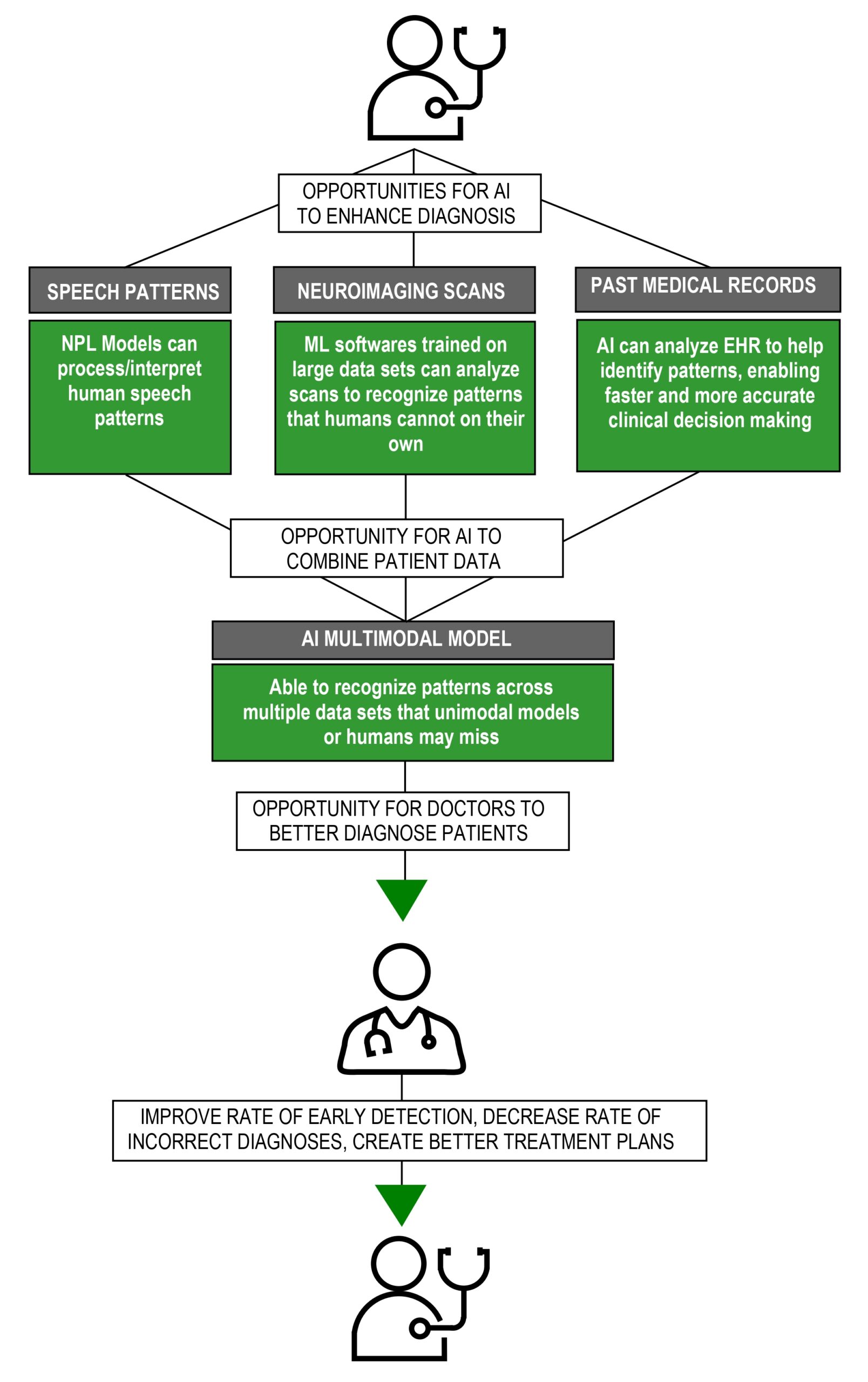
ML models are Artificial Intelligence (AI) models that can recognize patterns and have the ability to make predictions based on pre-existing data. ML models, such as NLPs, Convolutional Neural Networks (CNNs), and Multi-Layer Perceptrons (MLPs) are designed with large data sets to recognize patterns of conditions characterized by cognitive decline. ML softwares can analyze large amounts of data efficiently, recognize patterns that humans cannot on their own, and improve their diagnostic accuracy as they practice, which make them powerful tools in early diagnostic approaches3.
Traditional Methods of Diagnosis
Cognitive screening tools are essential for the early detection of neurocognitive disorders in older adults, yet challenges remain regarding their accuracy. Maduro et al.16 conducted a cross-sectional study comparing the diagnostic accuracy of the Mini-Mental State Examination (MMSE) and the Montreal Cognitive Assessment (MoCA) in 90 adults aged 60 years and older, using the Clinical Dementia Rating (CDR) scale as the reference standard. ROC curve analysis indicated that the MMSE achieved an area under the curve (AUC) of 0.826, with sensitivity of 78.4% and specificity of 76.9%. By comparison, the MoCA demonstrated better discriminative ability, with an AUC of 0.943, sensitivity of 90.2%, and specificity of 87.2%. When education-adjusted cut off scores were applied, MMSE diagnostic accuracy was 71.1%, while the MoCA achieved a higher accuracy of 87.8%. These findings indicated on Table 1 show the accuracy metrics of the MMSE and MoCA in comparison to AI driven models.
Deep Learning
DL models, which are a specialized subset of ML models, learn by being fed raw data and improve in pattern recognition through practice and experience. DL models are capable of identifying and detecting early signs of cognitive decline using Electronic Health Records (EHRs). DL models are restructuring early detection by discovering non-invasive biomarkers17.
An example illustrating the potential of Convolutional Neural Networks (CNN) was examined by Ghasemi Dakdareh and Abbasian. They evaluated three CNN architectures (AlexNet, DenseNet-BC, and CNN1D-LSTM) for classifying AD and MCI against healthy individuals using the ADNI dataset. AlexNet assessed MRI images, and achieved the highest overall accuracy (98.73%), with precision of 99.65%, sensitivity of 95.95%, and specificity of 99.86%18. These findings indicated on Table 1 demonstrate that pre-trained CNN architectures applied to neuroimaging data can serve as highly effective tools for early detection and diagnosis of neurodegenerative diseases.
Natural Language Processing
NLP models are able to process and interpret human speech patterns and language19. NLP technology can be used to examine patients and assist professionals with their decision-making in medical situations. These models are very powerful, with the ability to help extract data from Electronic Health Records and monitor patients20.
In a recent study, Liu et al. applied NLP to transcripts from Referential Communication Tasks (RCTs) to distinguish individuals with AD from cognitively healthy older adults. Using a BERT-based transfer learning model alongside traditional linguistic feature extraction, the study analyzed speech transcripts from 28 participants from a prior dataset. The BERT model achieved classification accuracy reaching 99.8%, sensitivity of 99.7%, and specificity of 100.0% when combining transcripts across all images21. These findings support RCTs as a promising non-invasive tool for early AD detection (Table 1).
Multimodal Models
Multimodal models are powerful AI models that combine multiple types of data such as speech patterns, neuroimaging scans, clinical assessments, behavioral data, and past medical history to develop conclusions and create predictions3. Cognitive decline and conditions characterized by cognitive decline such as AD and MCI can have different rates of progression and symptoms depending on the patient22. Multimodal models can recognize specific patterns across datasets to diagnose patients that unimodal models or humans may not have noticed. This can greatly improve rates of early detection and decrease rates of incorrect diagnoses23.
In one example of the utilization of multimodal models, Lee et al. tested whether combining different types of brain scans could help predict which patients with mild cognitive impairment would go on to develop AD within four years24. The researchers compared six different machine learning models trained on various combinations of MRI and amyloid PET imaging data, alongside basic patient demographic information such as age and sex. Of the models tested, the Gradient Boosting Model proved the most consistent and reliable. The best-performing combination used amyloid PET and structural MRI data together with patient demographics, achieving a strong accuracy of 92.3% with an AUC of 0.875, meaning the model correctly distinguished converters from non-converters the vast majority of the time. Performance of all variations of models tested can be seen in Table 1.
| Diagnostic Approach | Model | Dataset | Accuracy | Precision | AUC | Sensitivity/ Recall | Specificity | PPV | NPV | Source |
| Mini-Mental State Examination (MMSE) Non-AI diagnostic method, considered the most widely used and validated instrument in clinical and research settings. | N/A | Recruited original participants. 90 adults aged 60 years or older | 71.10% | N/A | .826 | 62.80% | 87.20% | 69.80% | 74.10% | Maduro et al. |
| Montreal Cognitive Assessment (MoCA) Alternative non-AI diagnostic tool, offering broader coverage of cognitive domains. | N/A | Recruited original participants. 90 adults aged 60 years or older | 87.80% | N/A | .943 | 74.50% | 94.90% | 84.50% | 93.80% | Maduro et al. |
| Convolutional Neural Networks (CNN) Study tested the efficacy of three different convolutional neural networks for diagnosing Alzheimer’s disease and MCI. | AlexNet | ADNI dataset | 98.73% | 99.65% | N/A | 95.95% | 99.86% | N/A | N/A | Dakdareh et al. |
| DensNet-BC | ADNI dataset | 88.37% | 88.46% | N/A | 74.63% | 95.18% | N/A | N/A | Dakdareh et al. | |
| CNN1D-LSTM | ADNI dataset | 91.89% | 79.72% | N/A | 90.11% | 92.47% | N/A | N/A | Dakdareh et al. | |
| Natural Language Processing (NLP) Study used Natural Language Processing to evaluate how well RCTs are able to distinguish between people with AD and cognitively healthy older adults. | Detecting Alzheimer’s Disease using BERT output | Secondary analysis of prior dataset. 28 adults | 90.9 – 99.8% | N/A | N/A | 84.7 – 99.7% | 79.2 – 100% | N/A | N/A | Liu et al. |
| Multimodal Models Study tested the efficacy of different combinations of AI models with demographic information. A= amyloid PET image features N= T1-weigted image features V= T2-FLAIR image features | Demographic only | 196 adults enrolled from four tertiary hospitals and the ADNI dataset | 76.8% (+/-10.9) | N/A | .830 (+/- .079) | 81.4% (+/ 17.0) | 72.1% (+/- 8.6) | N/A | N/A | Lee et al. |
| Demographic + A | 196 adults enrolled from four tertiary hospitals and the ADNI dataset | 87.8% (+/- 7.5) | N/A | .937 (+/- .065) | 92.5% (+/- 6.1) | 83.1% (+/- 14.7) | N/A | N/A | Lee et al. | |
| Demographic + AN | 196 adults enrolled from four tertiary hospitals and the ADNI dataset | 91.9% (+/- 4.8) | N/A | .977 (+/- .026) | 94.9% (+/- 5.9) | 88.9% (+/- 8.4) | N/A | N/A | Lee et al. | |
| Demographic + ANV | 196 adults enrolled from four tertiary hospitals and the ADNI dataset | 92.3% (+/- 5.3) | N/A | .984 (+/- .016) | 96.6% (+/- 4.4) | 88.1% (+/- 9.4) | N/A | N/A | Lee et al. |
Challenges
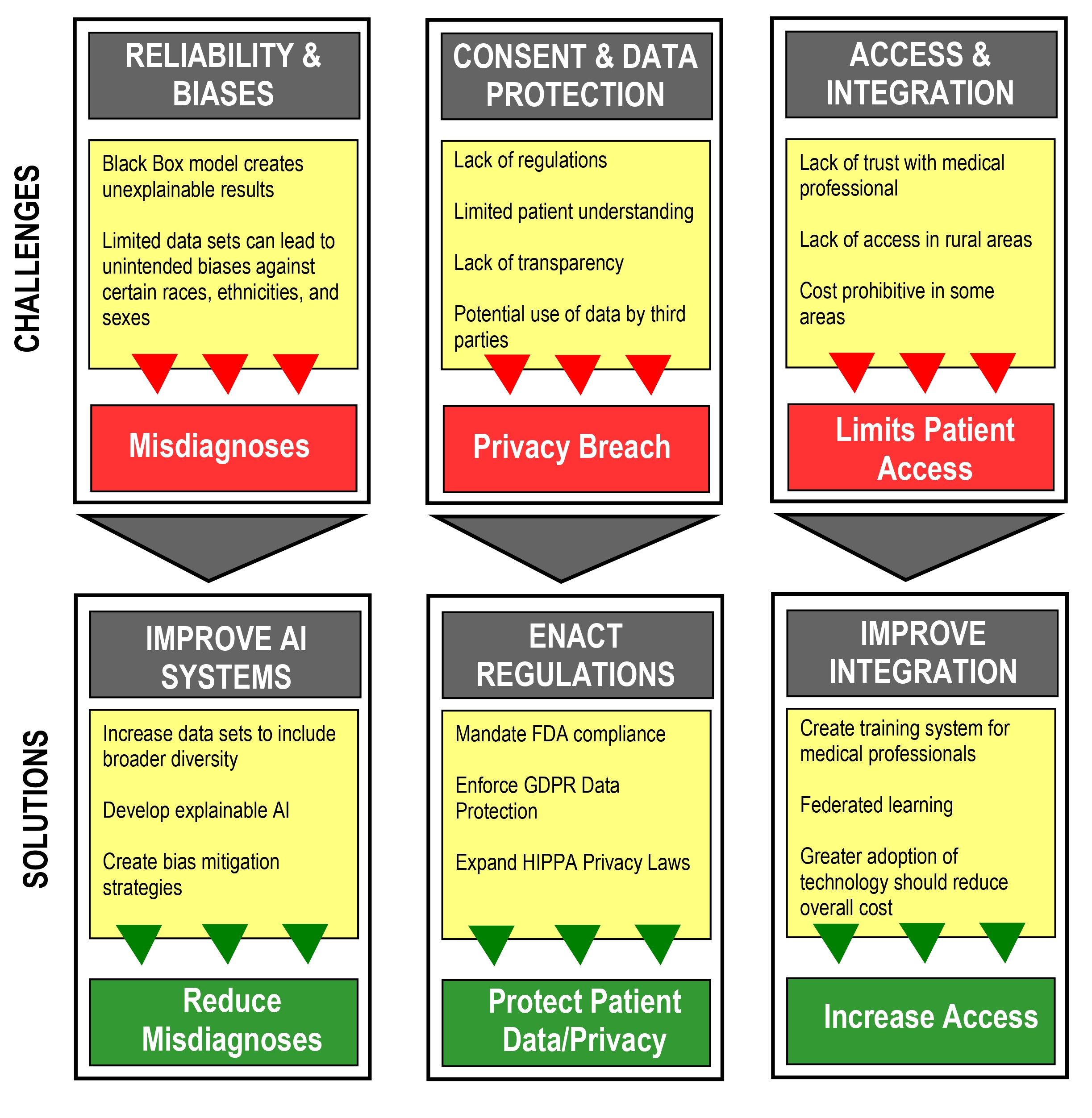
Despite the many advancements and possibilities with AI driven diagnostic tools, challenges and limitations remain, requiring further advancement of the technology, partnerships with medical professionals, and protections against improper use of personal data. Figure 1 illustrates these challenges and strategies to overcome them.
Reliability and Biases
AI models are trained to recognize patterns from existing sets of data. These datasets may have issues with data scarcity, lack of diversity, and inconsistent data quality and consistency. There needs to be a sufficient amount of high quality data with a wide variety and amount of people in order for the model to make accurate predictions. Individuals of all races, ethnicities, and sexes have the potential to be affected by conditions and diseases characterized by cognitive decline. In order for AI models to correctly respond to data from specific individuals, the AI model must be trained with a plethora of distinct patient profiles. If AI models are not trained properly, errors or inaccurate diagnoses can occur. For example, AI models that analyze speech patterns, such as NLP models, may have trouble with diagnosing patients from ethnic minorities associated with accents or specific dialects, or patients that are not native speakers of the language it was trained to detect. This creates a natural bias based on the language the AI was trained on, leading to inaccuracies, mistakes, and misdiagnoses. Also, with a poor data set, AI models can mistake normal aging as cognitive decline. Consequently, the predictions of AI models must be reviewed and checked by human medical professionals to ensure an AI diagnosis is not being determined by poor or inadequate data sets. Along with becoming biased, a model’s prediction error can also arise from a variance that is too high, which can lead to overfitting. The bias-variance tradeoff is a major challenge when calibrating ML models. Bias and variance must be balanced to create an optimal model.
The reliability of AI systems can be difficult to predict when the AI model is considered a “black box.” “Black box” is a term used to refer to AI models in which their internal computations are not easily understood by humans. It is not clear how these models achieved their output from the input of given data. These tools make predictions based on data patterns in patients, but they do not explain why a prediction or result was determined. Without clear insight into how the models generated their conclusions, humans have no way of checking the accuracy of their prediction and patients cannot understand why they received their diagnosis. Models that are labeled as “black boxes” can be unreliable and risky to use in medicine.
Access and Integration
In order for AI driven diagnoses to be successful, it must be appropriately integrated into diagnostic procedures and be equally accessible. AI systems becoming fully integrated into healthcare require medical professionals to adapt their schedules and methodology. Integration of these tools could slow down medical processes if medical professionals have a difficult time adapting the new technology into their practice, or if there is a lack of trust between the software and clinicians. In order to successfully apply AI models to all fields of medicine, new models must go through trials of clinical evaluation25.
Advanced AI systems that use large, multimodal data sets or those that perform complicated tasks can be expensive and become very costly to install and maintain. Not all medical facilities have access to the reliable, high-speed internet and devices to use these high-tech models. Clinics in smaller, rural, or low-income areas may not have the opportunities to use them. Future use of these tools will require widespread acceptance by the medical profession and deployment to those who need it.
Data Protection and Consent
When AI is used in healthcare, computers are given large amounts of protected patient health data. Sensitive information is yielded from neuroimaging scans such as MRI, PET, and CT scans, wearable devices, clinical assessments, speech patterns, and health records. This data can be used to make predictions or generate conclusions on cognitive health and future decline, which can lead to discrimination by insurance companies or clinics refusing service if obtained by insurance providers. Data breaches can also occur, and this information in the wrong hands can lead to data misuse and can potentially be very harmful for the patient if the data is sold to third-party users such as insurance companies. Insurance companies should not have access to the medical records of patients, as this can lead to them refusing to give insurance or raising their prices to specific individuals who are at higher risk of conditions or diseases.
Consent is vital in healthcare. Older adults, especially those experiencing cognitive decline may not understand what they are consenting to with AI systems because these systems are modern and can be complex. Some older adults may have never seen tools like these before, and those with cognitive impairments could be further confused. Moreover, there is always a risk of data leaks or unauthorized sharing of patient information, whether intentional or unintentional. Ethical use of these emerging tools requires human review and should be used to examine human diagnoses and predictions, not replace them. These AI systems should comply with healthcare regulations such as HIPAA and FDA laws in the United States and GDPR laws in Europe.
The uncontrollable bias of some AI models, uninformed consent, and models that are “black boxes” pose a challenge as well. In response to these obstacles, it is imperative that Explainable AI (XAI) models are developed, which explain how and why predications are made, unlike black boxes, which sometimes remain mysteries. Bias mitigation strategies, such as improving the quality of data sets during AI training, and federated learning to protect patient data privacy are promising solutions to these issues as well26.
Limitations
AI has many benefits, but are still many problems that must be solved before these models can be used to their full potential. Issues with overfitting, regularization, transfer learning, and data augmentation are limitations to this paper and should be studied further. The small number of patients included in some studies can interfere with obtaining correct data as well, but every model requires a different number of patients needed to diagnose.
Future Directions
While AI has changed healthcare and medicine for the better, it has its challenges. In the future, there are many more improvements that will need to be made and that researchers are already working toward. The gold standard for measuring conditions like AD is neuropathology. Researchers should cross validate results they receive using AI models using postmortem tissues. Advanced AI systems such as multimodal models that analyze many types of collected data together will have to be integrated fully and smoothly into clinics. In regards to integration, human professionals will have to undergo training to work alongside artificial intelligence because it is difficult for humans to understand the predictions of AI models at times, especially those that are considered “black boxes.” Additionally, in the near future, it is important to develop XAI models that can provide interpretable predictions and outputs.
When enough data is available, researchers should determine if AI predictions correlate with actual disease progression and how AI can predict changes in biomarkers overtime. Future work should look at the combination of biomarkers that is most predictive for cognitive decline.
Conclusions
In conclusion, society must quickly contend with a rapidly increasing elderly population and the healthcare issues that come with aging. AI has emerged as a powerful tool in the world of healthcare, capable of providing analysis beyond the capabilities of medical professionals. Models that use machine learning, deep learning, multimodal data, speech analysis, neuroimaging analysis, and wearable devices have improved the accuracy and speed of early detection for patients with conditions characterized by cognitive decline. This reduces the chance of inaccurate diagnoses from medical professionals with human limitations and increases the chance of catching diseases in their early stages, which leads to a better chance for proper treatment and recovery. The challenge for the healthcare industry and our government leaders is integrating this new technology in a manner that respects human decency while improving health outcomes.
References
- D. Shreya, P. N. Fish, D. Du, Navigating the future of elderly healthcare: A comprehensive analysis of aging populations and mortality trends using National Inpatient Sample (NIS) data (2010-2024). Cureus. 17(3), e80442 (2025). [↩]
- S. Sarraf, D. D. DeSouza, J. A. E. Anderson, G. Tofighi, DeepAD: Alzheimer’s disease classification via deep convolutional neural networks using MRI and fMRI. bioRxiv. (preprint), Article 070441 (2016). [↩]
- B. P. M. Masagali, The role of AI and ML in predicting cognitive decline and dementia progression. International Journal of Innovative Science and Research Technology. 10(1), 844–854 (2025). [↩] [↩] [↩]
- Kim, D., Lee, W. J., Jeon, D. H., & Cho, K., Education-Adjusted Interpretation of MMSE for Diagnostic Validity of Cognitive Disorders. Dementia and Geriatric Cognitive Disorders. 1–19 (2026). [↩]
- M. Allard, M. Husky, G. Catheline, A. Pelletier, B. Dilharreguy, H. Amieva, K. Pérès, A. Foubert-Samier, J.-F. Dartigues, J. Swendsen, Mobile technologies in the early detection of cognitive decline. PLOS ONE. 9(12), e112197 (2014). [↩]
- C. Formica, L. Bonanno, F. M. Giambò, G. Maresca, D. Latella, A. Marra, F. Cucinotta, C. Bonanno, M. Lombardo, O. Tomarchio, A. Quartarone, S. Marino, R. S. Calabrò, V. Lo Buono, Paving the way for predicting the progression of cognitive decline: The potential role of machine learning algorithms in the clinical management of neurodegenerative disorders. Journal of Personalized Medicine. 13(9), 1386 (2023). [↩]
- J.-E. Bibault, B. Chaix, P. Nectoux, A. Pienkowski, A. Guillemasé, B. Brouard, Healthcare ex Machina: Are conversational agents ready for prime time in oncology? Clinical and Translational Radiation Oncology. 16, 55–59 (2019). [↩]
- F. Salami, A. Bozorgi-Amiri, G. M. Hassan, R. Tavakkoli-Moghaddam, A. Datta, Designing a clinical decision support system for Alzheimer’s diagnosis on OASIS-3 data set. Biomedical Signal Processing and Control. 74, 103527 (2022). [↩] [↩]
- C. R. Jack Jr., M. A. Bernstein, N. C. Fox, P. Thompson, G. Alexander, D. Harvey, B. Borowski, P. J. Britson, J. L. Whitwell, C. Ward, A. M. Dale, J. P. Felmlee, J. L. Gunter, D. L. G. Hill, R. Killiany, N. Schuff, S. Fox-Bosetti, C. Lin, C. Studholme, C. S. DeCarli, G. Krueger, H. A. Ward, G. J. Metzger, K. T. Scott, R. Mallozzi, D. Blezek, J. Levy, J. P. Debbins, A. S. Fleisher, M. Albert, R. Green, G. Bartzokis, G. Glover, J. Mugler, M. W. Weiner, The Alzheimer’s Disease Neuroimaging Initiative (ADNI): MRI methods. J Magn Reson Imaging. 27, 685–691 (2008). [↩]
- P. J. LaMontagne, T. L. S. Benzinger, J. C. Morris, S. Keefe, R. Hornbeck, C. Xiong, E. Grant, J. Hassenstab, K. Moulder, A. G. Vlassenko, M. E. Raichle, C. Cruchaga, D. Marcus, OASIS-3: Longitudinal neuroimaging, clinical, and cognitive dataset for normal aging and Alzheimer disease. medRxiv. (preprint), Article 2019.12.13.19014902 (2019). [↩]
- K. A. Ellis, A. I. Bush, D. Darby, D. De Fazio, J. Foster, P. Hudson, N. T. Lautenschlager, N. Lenzo, R. N. Martins, P. Maruff, C. Masters, A. Milner, K. Pike, C. Rowe, G. Savage, C. Szoeke, K. Taddei, V. Villemagne, M. Woodward, D. Ames, The Australian Imaging, Biomarkers and Lifestyle (AIBL) study of aging: methodology and baseline characteristics of 1112 individuals recruited for a longitudinal study of Alzheimer’s disease. International Psychogeriatrics. 21(4), 672–687 (2009). [↩]
- I. B. Malone, D. Cash, G. R. Ridgway, D. G. MacManus, S. Ourselin, N. C. Fox, J. M. Schott, MIRIAD—Public release of a multiple time point Alzheimer’s MR imaging dataset. NeuroImage. 70, 33–36 (2013). [↩]
- N. Bhagwat, A. Barry, E. W. Dickie, S. T. Brown, G. A. Devenyi, K. Hatano, E. DuPre, A. Dagher, M. Chakravarty, C. M. T. Greenwood, B. Misic, D. N. Kennedy, J.-B. Poline, Understanding the impact of preprocessing pipelines on neuroimaging cortical surface analyses. GigaScience. 10(1), giaa155 (2021). [↩]
- T. Wasilewski, W. Kamysz, J. Gębicki, AI-assisted detection of biomarkers by sensors and biosensors for early diagnosis and monitoring. Biosensors (Basel). 14(7), 356 (2024). [↩]
- R. J. Borchert, T. Azevedo, A. Badhwar, J. Bernal, M. Betts, R. Bruffaerts, M. C. Burkhart, I. Dewachter, H. M. Gellersen, A. Low, I. Lourida, L. Machado, C. R. Madan, M. Malpetti, J. Mejia, S. Michopoulou, C. Muñoz-Neira, J. Pepys, M. Peres, V. Phillips, S. Ramanan, S. Tamburin, H. M. Tantiangco, L. Thakur, A. Tomassini, A. Vipin, E. Tang, D. Newby, J. M. Ranson, D. J. Llewellyn, M. Veldsman, T. Rittman, Artificial intelligence for diagnostic and prognostic neuroimaging in dementia: A systematic review. Alzheimer’s & Dementia. 19(12), 5885–5904 (2023). [↩]
- P. Andreatta Maduro, L. P. da Cruz Carvalho, L. A. R. Maduro, A. B. da Costa Rodrigues, A. S. L. Rocha, L. R. R. de Souza Matos, M. de Maio Nascimento, V. J. da Silva Nina, P. A. Schwingel. Accuracy of the Mini-Mental State Examination and Montreal Cognitive Assessment in Detecting Cognitive Impairment in Older Adults: A Comparative Study Adjusted for Educational Level. NeuroSci. Vol. 6, pg. 86, (2025). [↩]
- M. Kale, N. L. Wankhede, R. S. Pawar, S. Ballal, R. Kumawat, M. Goswami, M. Khalid, B. Taksande, A. Upaganlawar, M. Umekar, S. R. Kopalli, S. Koppula, AI-driven innovations in Alzheimer’s disease: Integrating early diagnosis, personalized treatment, and prognostic modelling. Ageing Research Reviews. 101, 102497 (2024). [↩]
- S. Ghasemi Dakdareh, K. Abbasian. Diagnosis of Alzheimer’s disease and mild cognitive impairment using convolutional neural networks. Journal of Alzheimer’s Disease Reports. Vol. 8, pg. 317–328, (2024). [↩]
- M. Chary, S. Parikh, A. F. Manini, E. W. Boyer, M. Radeos, A review of natural language processing in medical education. West J Emerg Med. 20(1), 78–86 (2019). [↩]
- W. Rojas-Carabali, R. Agrawal, L. Gutierrez-Sinisterra, S. L. Baxter, C. Cifuentes-González, Y. C. Wei, J. Abisheganaden, P. Kannapiran, S. Wong, B. Lee, A. de-la-Torre, R. Agrawal, Natural language processing in medicine and ophthalmology: A review for the 21st-century clinician. Asia Pac J Ophthalmol (Phila). 13(4), 100084 (2024). [↩]
- Z. Liu, E. J. Paek, S. O. Yoon, D. Casenhiser, W. Zhou, X. Zhao, Detecting Alzheimer’s disease using natural language processing of referential communication task transcripts. Journal of Alzheimer’s Disease. 86(3), 1385–1398 (2022). [↩]
- R. Shankar, A. Bundele, A. Mukhopadhyay. Natural language processing of electronic health records for early detection of cognitive decline: a systematic review. npj Digital Medicine. Vol. 8, pg. 133, (2025). [↩]
- S. Tascedda, P. Sarti, V. Rivi, C. Savia Guerrera, G. A. Platania, M. Santagati, F. Caraci, J. M. C. Blom, Advanced AI techniques for classifying Alzheimer’s disease and mild cognitive impairment. Front Aging Neurosci. 16, 1488050 (2024). [↩]
- M.-W. Lee, H. W. Kim, Y. S. Choe, H. S. Yang, J. Lee, H. Lee, J. H. Yong, D. Kim, M. Lee, D. W. Kang, S. Y. Jeon, S. J. Son, Y.-M. Lee, H.-G. Kim, R. E. Y. Kim, H. K. Lim, A multimodal machine learning model for predicting dementia conversion in Alzheimer’s disease. Sci Rep. 14, 12276 (2024). [↩]
- B. Lei, X. Zhang, Y. Zhang, Y. Zhao, Y. Liu, Y. Zhang, D. Zhang, Y. Wang, Auto-weighted centralised multi-task learning via deep neural networks for differential diagnosis of subjective cognitive decline and mild cognitive impairment. Neurocomputing. 463, 1–12 (2021). [↩]
- H. Ali, AI in neurodegenerative disease research: Early detection, cognitive decline prediction, and brain imaging biomarker identification. Int J Eng Technol Res Manag. 6(10), 1–12 (2022). [↩]