

Abstract
Introduction. Music, despite having little apparent biological value, can evoke pleasure and strong physical responses such as chills. Research has linked this to the mesolimbic reward system and dopaminergic signaling in the striatum. This narrative review examines the neural mechanisms of musical pleasure, focusing on reward circuitry, dopamine, and prediction.
Methods. PubMed and Google Scholar were searched using keywords combining music with terms including reward, pleasure, and prediction. Studies were screened using pre-specified inclusion and exclusion criteria, with additional sources used for context.
Results. Music engages reward circuitry similar to that involved in food and monetary rewards, and dopamine or frontostriatal manipulations can alter musical pleasure. Individual differences appear to depend more on connectivity between reward and auditory systems than on reward system activity alone. Predictive and reward prediction error (RPE) accounts receive support, but musical pleasure appears to arise from multiple interacting factors including surprise and uncertainty. Notably, however, the nucleus accumbens (NAc) tracked uncertainty and not surprise, challenging striatal RPE accounts.
Discussion. Dopamine and reward prediction are important but incomplete explanations of musical pleasure. Predictive, emotional, aesthetic, and embodied aspects suggest that musical pleasure is a dynamic process involving interactions across neural systems. Music therefore provides a useful model for understanding reward processing more broadly.
Keywords: “musical pleasure”, “musical reward”, “reward prediction”, “neural mechanisms”, “brain networks”, and “musical chills”
Introduction
Music is a universal feature throughout human history. Humans of all ages engage with music in diverse ways: sharing within communities, developing sounds and instruments unique to one’s culture, or simply listening to popular tunes. People often experience positive feelings when listening to their favorite or preferred music, and in some cases, music can evoke an intense pleasurable response, commonly known as a “chill”—a phenomenon involving physical sensations, such as shivers down the spine or involuntary goosebumps, alongside deeply felt emotional responses1.
In neuroscience, pleasure is usually understood as the subjective, hedonic component of reward. Rewarding stimuli evoke positive feelings that motivate individuals to repeat associated behaviors, which are often related to survival and reproduction2. While primary rewards, such as food, are essential for survival, and secondary rewards, such as money, gain value by indirectly leading to primary rewards, music does not fit neatly into either category3. It seems to provide little or no obvious adaptive benefit, cannot be quantified by amount, and its value depends on the listener’s memories, expectations, and cultural background rather than on the stimulus alone4. Yet, for many people, music is one of the largest sources of pleasure. This raises a compelling question: why do people find music pleasurable, and how does it produce such intense experiences of pleasure?
Over the past two decades, neuroimaging has shown that musical pleasure engages a similar brain circuitry to that involved in responding to primary and secondary rewards. This circuitry, broadly known as the mesolimbic reward system, involves key structures such as the nucleus accumbens (NAc), which receives dopaminergic projections from the ventral tegmental area (VTA) and whose activity accompanies the experience of pleasure and reinforces reward-seeking behavior2,5.
The aim of this narrative review is to synthesize and evaluate research on the neural mechanisms of musical pleasure, with particular attention to dopamine, reward circuitry, and predictive accounts. It assesses what is reliably known about the brain activity associated with musical pleasure while distinguishing correlational evidence from causal evidence. This review also considers the factors that influence the intensity of musical pleasure. It concludes by identifying the main open questions and emerging methods that could move the field forward.
Measurement of Musical Pleasure and Reward Value
Researchers have developed a variety of methods, ranging from self-report questionnaires to brain imaging, each capturing a different aspect of the experience while complementing each other. The most direct way to assess musical pleasure is self-report: subjects rate their pleasure continuously during listening, typically by pressing buttons corresponding to different intensities, or retrospectively after each excerpt6,7,8. Continuous rating shows how pleasure changes moment to moment. However, self-reported measures can sometimes be biased or inaccurate. People may report what they think the experimenter expects, and they may not have clear access to their own feelings.
Behavioral measures gauge how subjects act in response to music rather than what they say. In the auction paradigm, adapted to music research by Salimpoor and colleagues, subjects bid real money to purchase excerpts they have just heard9. Bids and pleasure ratings are usually interpreted as measuring wanting and liking respectively2, although in music studies the two tend to move together.
Because emotional responses to music involve the autonomic nervous system (ANS), physiological signals can provide objective measures of musical pleasure. Measurements that are commonly taken include heart rate, respiration, electromyogram (EMG) activity, and skin conductance response (SCR), which are often observed for correlation with emotional or chill response to music1,6.
Neural activity is commonly measured with positron emission tomography (PET), functional magnetic resonance imaging (fMRI), and electroencephalography (EEG), each with strengths and trade-offs between spatial and temporal resolution, and thus they ask non-identical questions.
Music Engages the Reward System: Correlational Studies
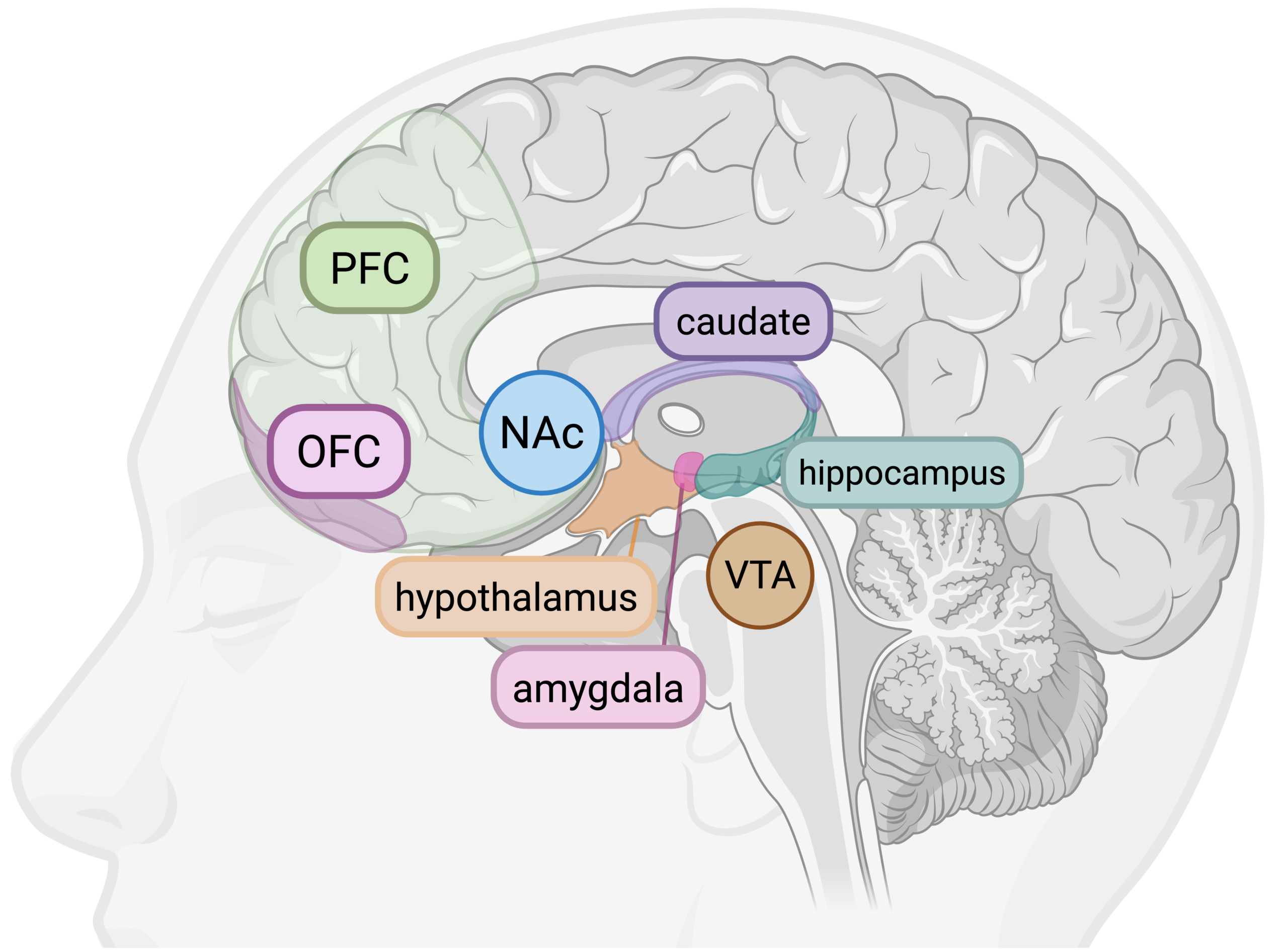
What happens in the brain when music evokes pleasure or even chills? Research on musical pleasure has implicated a distributed network of brain regions, including the auditory cortex, emotion-related areas, and most notably, the mesolimbic reward system centered on the nucleus accumbens (NAc), a subregion of the ventral striatum4,10. Figure 1 illustrates the approximate locations of several key regions on a midsagittal section.
Early neuroimaging studies manipulated the stimulus itself, comparing brain responses to pleasant versus unpleasant music. Two examples of manipulated stimuli include temporally scrambling naturalistic music excerpts or shifting pitch to generate dissonant versions11,12. Studies built on these different stimuli found that naturalistic, pleasant music led to greater activation in the mesolimbic reward network and auditory regions, including the NAc, OFC, inferior frontal cortex (IFC), hypothalamus, insula, Heschl’s gyrus, and anterior cingulate cortex (ACC), compared to their unpleasant, tampered counterparts. In Menon and Levitin’s study, NAc activity correlated with the VTA (r = 0.18) and hypothalamus (r = 0.36), and effective connectivity showed VTA-mediated interaction of the NAc with the hypothalamus, insula, and OFC. Yet one limitation of this type of paradigm is that the “unpleasant” condition is artificially degraded or dissonant stimuli, not music that listeners dislike. Sensory dissonance and displeasure are confounded, so these studies cannot establish that the reward-related activation reflects musical pleasure rather than perceptual properties.
Studies using self-selected music allow pleasure to arise from the listener’s own history rather than from stimulus properties. Music-evoked chills are useful here as discrete and measurable events marking peak pleasure that can be studied at the individual level1,13. A groundbreaking study by Blood and Zatorre measured chills alongside brain imaging to investigate the neural basis of music-evoked chills. In their study, ten participants selected for frequent, reproducible chills underwent PET scans while listening to self-selected pieces. Regional cerebral blood flow (rCBF) increases were observed in the ventral striatum (t = 3.86), dorsomedial midbrain (t = 3.70), insula (t = 4.78), OFC (t= 3.52), thalamus (t = 6.18), ACC (t = 4.03), supplementary motor area (SMA, t = 5.80), and cerebellum (t = 4.82), regions involved with reward and motor circuitry. There were negative correlations in the amygdala (t = -3.68), hippocampus (t = -4.04), and ventromedial prefrontal cortex (vmPFC, t = -4.55). The reward-related correlations were moderate (r = 0.49 for left ventral striatum) and were tested only in ten highly selected subjects, so the study is best read as a landmark that showed the question could be studied at all.
Salimpoor and colleagues extended this from regional blood flow to neurochemistry6. They used PET with [¹¹C]raclopride, a radioactive tracer that dopamine pushes off its receptors, so that less tracer binding means more dopamine was released. They observed significant dopamine release in the dorsal and ventral striatum, which included the caudate (d = 1.16) and NAc (d = 0.92), during pleasurable compared with neutral music. They further used fMRI to examine the temporal dynamics of dopaminergic activity within the reward circuit. Specifically, they distinguished between the “anticipation” (or pre-experience) and “experience” phases of musical pleasure to determine whether dopamine release is associated with the anticipation of a rewarding musical event or the pleasurable experience itself. fMRI scans revealed a temporal dissociation: the caudate nucleus was most active during the anticipation of an approaching peak, while the NAc was maximally engaged at the moment of chills itself. The relationship between behavior and PET scan data further supported a functional dissociation: the number of chills tracked the caudate (r = 0.71) but not the NAc, whereas chills intensity (r = 0.80) and overall pleasure (r = 0.84) tracked the NAc but not the caudate. The conclusion is reasonable, but it depends on converging inference across two scanning sessions.
Correlates of chills can also be recorded outside a scanner. A more recent study used high-density EEG to observe neural activity during pleasurable music listening14. Chills were accompanied by increased theta activity over the prefrontal regions, and source estimation implicated OFC, insula, SMA, and STG, regions previously reported for chills1. The agreement is encouraging, but EEG recorded from the scalp may not reliably locate orbitofrontal or insula sources.
Another study asked how novel, previously unheard music gains reward value by combining fMRI with an auction paradigm9. Participants listened to novel excerpts, and then placed bids indicating how much they would be willing to pay for each clip. The bid amounts were positively correlated with the magnitude of activity in the striatum, particularly the NAc, during the listening period. That is, greater NAc activity during listening predicted a higher bid placed subsequently. Additionally, they examined how the NAc interacted with other brain regions as music excerpts acquired reward value. They found that a stronger reward value, such as higher bids, was associated with increased functional connectivity between the NAc and auditory cortices during listening. NAc also showed increased functional connectivity with the vmPFC, OFC, amygdala, and hippocampus. This shifted the field’s focus from where pleasure is located to how regions interact, a topic discussed further below.
These diverse methodologies, including PET, EEG, and fMRI, ask non-identical questions and have individual limitations. Taken together, these studies show a reliable link between musical pleasure and activity in a mesolimbic-cortical network. A coordinate-based meta-analysis comparing pleasure from music and pleasure from food supports the generality of this network while also identifying regions that differ between the two, suggesting that music is not simply processed as a primary reward15. What none of these studies can show, however, is whether the reward-related activity is actually necessary for musical pleasure to happen.
Causal Studies: Pharmacology and Stimulation
The studies reviewed in the previous section demonstrated that musical pleasure correlates with dopamine release and activation of the mesolimbic reward circuit. This raises an important question: is dopamine actually necessary for musical pleasure, or is it merely present as a byproduct of a rewarding experience? The studies reviewed in this section investigate whether dopamine plays a causal role in musical pleasure by using pharmacological manipulation and brain stimulation to modulate dopaminergic activity and observe the effects on musical pleasure.
The most direct pharmacological test was conducted by Ferreri and colleagues7. Their study sought to manipulate dopamine signaling by either increasing dopamine availability or blocking dopamine receptors. In their double-blind, within-subject design, participants underwent three separate listening sessions after receiving levodopa, a dopamine precursor; risperidone, a dopamine receptor antagonist; or a placebo. Relative to risperidone, levodopa increased the time participants spent reporting high pleasure (Z = 1.968, P < 0.049; r = 0.38) and increased monetary bids (Z = 2.435, P = 0.015; r = 0.47). Among the 16 participants who experienced chills, time spent reporting chills was greater after levodopa than after risperidone (Z = 2.341, P < 0.019). Finally, pharmacological manipulation also influenced reward valuation. Electrodermal activity during high-pleasure states showed the corresponding difference between the two drugs (d = -0.44). These findings show a causal role of dopamine and suggest that dopamine modulates both the pleasurable experience of music and its motivational value. While this is the strongest pharmacological research currently available, there are some limitations. The statistics compare the two drug conditions rather than comparing each drug against placebo. Also, no dopamine was actually measured. The manipulation may not have been completely selective, as risperidone can also block other receptors. Therefore, it may not be accurate to conclude that dopamine alone is responsible for musical pleasure.
Another study by Mas-Herrero and colleagues used transcranial magnetic stimulation (TMS) to investigate the causal role of a brain region associated with dopaminergic processing8. Specifically, they applied TMS to the left dorsolateral prefrontal cortex (dlPFC), a region previously shown to induce dopamine release and modulate activity in the striatum when repetitively stimulated16. The researchers utilized two different TMS techniques: intermittent theta burst stimulation (iTBS), which excites activity in the targeted area, and continuous theta burst stimulation (cTBS), which inhibits it. Seventeen participants completed three sessions in which they received either iTBS, cTBS, or a control, sham stimulation before listening to music inside an fMRI scanner. Comparisons of sham-normalized changes between iTBS and cTBS showed differences in pleasure ratings (d = 0.81), chill number (d = 0.51), chill duration (d = 0.57), and monetary bids (d = 0.50). The fMRI data revealed that these behavioral changes were accompanied by corresponding changes in activity within the reward network. TMS-induced NAc changes correlated with changes in liking during experience (R2 = 0.44) and monetary bids during pre-experience (R2 = 0.47). Functional connectivity analysis further showed that TMS-induced changes in the connectivity between the dlPFC and the reward circuit predicted the degree of musical pleasure (r2 range 0.41 – 0.59). Participants who showed the largest difference in pleasure between the excitatory and inhibitory stimulation sessions also showed the greatest changes in connectivity strength between these regions immediately before experiencing intense pleasure. The authors concluded that dlPFC contributes causally to musical pleasure by modulating activity within the dopaminergic pathways. This study had several methodological strengths, including testing bidirectional effects within subjects, comparing them with a sham condition, and targeting a specific anatomical region. However, its main limitation is that the manipulation targets the cortex rather than the striatum, so the observed effects still remain inferential rather than fully causal.
Brain Networks and Connectivity
Across this literature, converging evidence suggests that musical pleasure is supported by interactions among distributed neural systems rather than by activity in any single brain region. In the 2013 study by Salimpoor and colleagues, musical reward value was associated both with NAc activity and with functional connectivity between the NAc and auditory cortex9. Several lines of evidence support this view. Functionally, individuals with specific musical anhedonia show reduced NAc responses to music while responding normally to monetary reward, and they also show weaker connectivity between the auditory cortex and NAc17. Structurally, diffusion imaging in thirty-eight subjects showed that the structure of the white matter tracts linking superior temporal, orbitofrontal, and ventral striatal regions predicts individual music reward sensitivity18. Diffusivity in the tract between the NAc and OFC predicted NAc responses to music but not to money, and a mediation analysis suggested that this tract modulates NAc activity and reward sensitivity. Another study with a smaller sample found greater white matter tract volume between posterior STG, anterior insula, and medial prefrontal cortex in listeners who experience chills19. Similarly, in the TMS study discussed earlier, stimulation-induced changes to frontostriatal connectivity predicted changes in musical pleasure, although it did examine a different pathway8.
In addition, the default mode network (DMN) has been shown to be related to musical emotion. Music listening modulates DMN activity, with sad music increasing mind-wandering and default mode connectivity and preferred music increasing connectivity between the DMN and hippocampus20,21. A review paper suggests that aesthetic experience of music arises from interactions among large-scale neural networks rather than from the activity of individual brain regions22. However, although several studies have implicated the DMN in music listening, emotion, and aesthetic experience, its specific contribution to the subjective experience of musical pleasure remains incompletely understood.
Overall, the literature suggests that musical pleasure does not reside in a single brain region but emerges from interactions across distributed neural systems. Future work should therefore focus less on where musical pleasure occurs and more on how these networks interact and how individual differences in their connectivity shape musical pleasure.
Factors Influencing Musical Pleasure
The sections above asked where and how musical pleasure arises in the brain. This section asks a different question: what makes a particular piece, or a particular moment in a piece, more or less pleasurable? Rather than being determined by a single factor, musical pleasure is likely influenced by multiple processes. Limiting the scope of this section to those supported by neural results, we will discuss the role of various factors, including surprise, uncertainty, novelty, familiarity, and reward prediction, in musical pleasure.
Terms will be defined before evaluating the evidence. A prediction is what a listener expects to hear next. It does not have to be a conscious guess; instead, it can develop automatically from the statistical patterns in music a person has heard before, as well as from their training and culture23. Uncertainty describes the listener’s situation before a musical event: how difficult it is to predict what will happen next. In computational models, uncertainty is often measured using entropy. Surprise describes what happens after the event: how unexpected the event actually was. It is often measured using information content (IC). Novelty simply means whether the music has been heard before, while familiarity refers to how well the music is already known. Novelty and surprise are not the same, because even a familiar piece of music can contain surprising moments. Finally, a positive prediction error is where an outcome is better than the listener predicted. Prediction error is signed, so it is different from surprise. An event can be unsurprising but still produce a positive prediction error, while a surprising event can produce a positive or negative prediction error depending on whether the outcome was better or worse than expected.
Separating these concepts is important because simple claims, such as “surprising music is more rewarding,” can hide important differences between these ideas. Musical surprise occurs when what a listener expects does not match the subsequent outcome24. Surprise can be pleasurable, neutral, or even aversive, depending on how the expectation compares to the actual experience. For example, unexpected musical events like an abrupt change or a dissonant chord can violate expectations as much as a satisfying resolution does, but they may feel uncomfortable rather than pleasant25. What determines the emotional response is therefore not surprise alone, but the context in which the surprise occurs. Neither factor alone determines whether the experience is pleasurable. The following studies suggest that how pleasurable a musical moment feels depends on two factors together: how uncertain the listener was about what was coming and how surprising the event turns out to be.
Cheung and colleagues used a model of Western harmony to quantify uncertainty and surprise in approximately 80,000 chords from 745 US Billboard pop songs26. They used the model to quantify the uncertainty and surprise of each chord in a set of pop songs. Thirty of those progressions were then rated for pleasantness by one group of participants and played to a different group while they underwent fMRI scanning. Surprise alone did not predict pleasure. Instead, the authors found that uncertainty and surprise interacted to determine musical pleasure. Chords elicited the most pleasure when they were surprising in a low-uncertainty context (i.e., when the listener had a clear expectation, which was subsequently violated), or when they were unsurprising in a high-uncertainty context (i.e., when an uncertain situation resolved in an expected way). Thus, the rewarding value of a surprising event depended on the level of uncertainty in the surrounding context. This interaction was also reflected in brain activity. The interaction between the two was observed in the amygdala, hippocampus, and auditory cortex. In contrast, activity in the NAc and caudate was related only to uncertainty, with no significant effect of surprise or its interaction with uncertainty. This result challenged accounts that locate musical prediction error signals in the striatum. The authors instead interpreted the NAc response to uncertainty as reflecting attention or incentive salience rather than pleasure.
With this result, a prominent theory in this field can be better understood. One goal of the brain is to anticipate reward—to make predictions about what is going to happen and update those predictions based on experience. The reward prediction error (RPE) theory proposes that dopamine neurons do not simply signal reward or pleasure itself but report the difference between the reward received and the reward expected27. Recordings from dopamine neurons in monkeys showed increased firing when a reward was better than expected, little change when it matched the expectation, and decreased firing when the outcome was worse than expected. Therefore, this signal does not directly reflect pleasure. Instead, it is thought to help the brain refine future predictions by learning from experience.
For music, however, it is difficult to measure the reward value of music objectively. What is “better than expected” in music? For rewards such as money or food, objective quantities can determine what is better or worse than expected23. Music, however, is an abstract stimulus, and quantity cannot define how one musical experience is better than another. What makes a musical passage better than another may depend on numerous qualitative features, including melody, harmony, chord progressions, rhythm, timbre, or even the performer’s style. To identify a positive RPE, one must consider not only whether an event was unexpected, but also how rewarding it was relative to the listener’s expectation. This is where the findings of Cheung and colleagues become relevant.
Two behavioral studies demonstrate that the same relationship between surprise, uncertainty, and pleasure also applies to whole melodies rather than isolated chords. Using a computational model of musical expectancy, Gold and colleagues found inverted U-shaped relationships between music liking and both surprise and uncertainty, suggesting that listeners tend to prefer intermediate complexity25. The interaction did not reach significance (P=0.06). The inverted U-shaped relationship was weaker when the data were analyzed within individuals than when they were analyzed across the group as a whole. Mas-Herrero and Marco-Pallarés then tested the interaction more directly in large samples of listeners from different countries, reproducing both the quadratic effect of surprise and the interaction between surprise and uncertainty28. However, both studies were purely behavioral and therefore did not show which brain systems were involved.
Stronger evidence that musical outcomes can drive learning in a way similar to other rewards with RPE signals in the striatum comes from a neuroimaging study. In a learning task, participants’ choices determined, with some probability, whether a musical ending was consonant or dissonant29. NAc activity tracked the prediction errors calculated by the RPE model, and the strength of that signal predicted how quickly participants learned to choose the consonant endings. This provides evidence that music can act as a reward signal that supports learning, rather than simply producing a pleasurable experience. However, critics of the study pointed out that an RPE concerns predicted reward value, whereas the musical expectancy literature is mainly concerned with sensory prediction, the expectation of what note or chord will come next30. Because participants’ predictions were cued by colored shapes and the music served as the reward, they interpreted the task as a reinforcement-learning task that happened to use music as its reward. Gold and colleagues argued in response that the two cannot be separable in music, since resolving sensory uncertainty may itself be something that the reward system values31. Either way, the study tells us relatively little about what happens when someone simply listens to music.
Moving from a controlled task to more natural listening, further studies have produced mixed results. Shany and colleagues had musically trained judges identify surprising moments in real piano pieces, and found that those moments were associated with greater activity in auditory cortex, insula, and ventral striatum in a separate group of participants24. They also found NAc responses were stronger among listeners who reported enjoying the music more. However, the high- and low-enjoyment groups were created after the experiment by clustering participants based on their own ratings, which makes it difficult to determine whether the neural differences actually caused differences in enjoyment. An EEG study found that frontal beta and gamma power tracked both subjective pleasure and melodic surprise, but the relationship between pleasure and surprise was quite weak (r = 0.0961, p < 0.01)32. Finally, a naturalistic neuroimaging study reproduced the interaction between uncertainty and surprise in liking ratings and found that liking was related to activity in the right STG, although the striatal findings were weaker33. After correction for multiple comparisons, only the interaction between liking and surprise in the right STG remained significant (t(23) = 2.92, corrected P = 0.023). Thus, inconsistency remains in terms of what ventral striatum activity reflects. Together, these studies suggest that the relationship between surprise and musical pleasure is not simple: surprise-related neural responses can be observed during natural listening, but the evidence for a direct relationship between surprise and subjective pleasure is inconsistent.
The role of familiarity is less straightforward. At first, it may seem contradictory to this framework. Pereira and colleagues found that familiar music was associated with stronger activity than unfamiliar music in the NAc, amygdala, putamen, anterior cingulate cortex, and thalamus34. In contrast, liking was related to activity only in frontal and motor regions, and this effect was significant only at an uncorrected threshold. If pleasure depended mainly on novelty and surprise, one might expect the pattern to be reversed. There are at least two reasons to be cautious about this interpretation. The first is methodological. The study corrected the familiarity comparison for multiple comparisons but reported the liking comparison at an uncorrected threshold. The second reason is theoretical. Familiarity is not the same as low surprise. Familiarity may reduce uncertainty, and the interaction model suggests that surprise can be especially pleasurable when uncertainty is low26. Music also has many dimensions that cannot be remembered perfectly, so even a familiar piece can contain small changes in timing, timbre, or performance against a background that the listener can predict with confidence23. Seen this way, familiarity does not necessarily contradict a predictive account of musical pleasure. Instead, it may place a listener in a particular combination of uncertainty and surprise.
Methods
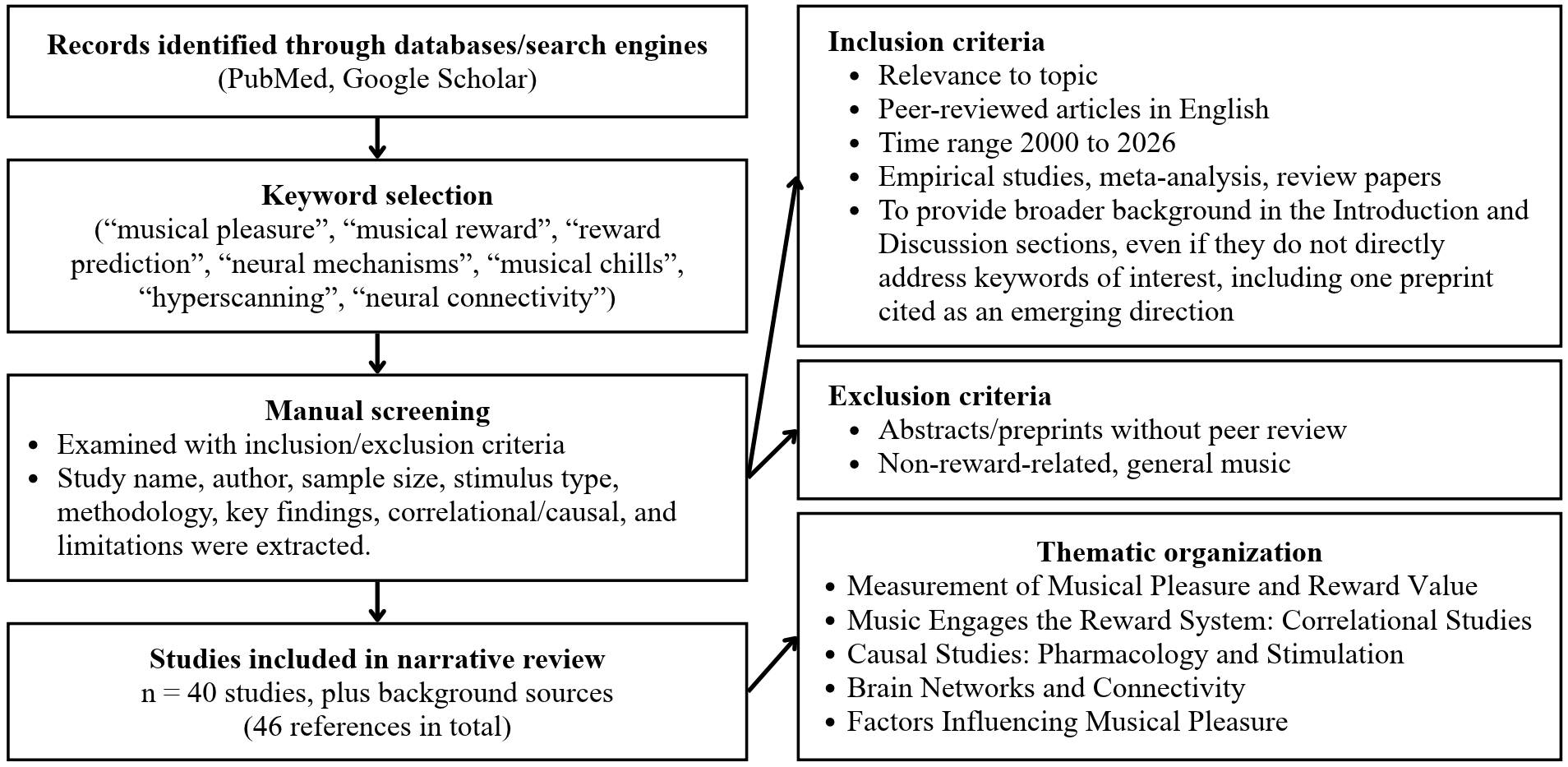
This paper uses a narrative review approach. Screening followed a PRISMA-like flow adapted for a narrative review—PRISMA-like in structure rather than in record counts, as a formal record count was not maintained; the search was iterative and included citation tracking. Searches were conducted on Google Scholar and PubMed, using combinations of keywords including “musical pleasure”, “musical reward”, “music-evoked chills”, “neural mechanisms”, “brain connectivity”, and “reward prediction”. Records were eligible if peer-reviewed, written in English, and reported original research investigating musical pleasure or reward using neuroscientific methods. Theoretical or review papers discussing relevant mechanisms were also eligible. Articles published between 2000 and 2026 were considered. Records were excluded if they were conference abstracts or preprints without peer review; if they investigated music perception without a hedonic or reward outcome; or if they otherwise did not meet inclusion criteria. Outside of this selection process, some references were cited in the Introduction and Discussion to provide broader background, even though they did not directly address the topics or keywords of interest. This workflow is shown in Figure 2.
For musical-reward-related empirical studies selected through this process, information on the title and author, sample size, stimulus type, methodology, key findings, whether the study was correlational or causal, and limitations were extracted. This information is summarized in Table 1. No formal appraisal tool was used; limitations were extracted per study and are integrated into the text and in Table 1. Findings were organized thematically around different key questions: what is measured and how, where musical pleasure correlates with brain activity, where such activity is causally necessary, how brain regions interact, and various factors or frameworks contributing to musical pleasure.
Effect sizes and test statistics were also reported for dopamine studies as Cohen’s d, t-values, or correlation coefficients. They were not calculated for voxelwise peaks as peak voxels are extreme. When not specified in the original study, they were derived using the corresponding Cohen’s  formula,
 , or correlation coefficient formula,
 .
| Authors | Sample Size | Stimulus Type | Methodology | Key Findings | Correlational or Causal? | Limitations |
| Blood and Zatorre (2001)1 | N=10 | Classical genre, participant-selected | PET; physiological measures; subjective chills rating | Blood flow rose with chills intensity in VS, dorsomedial midbrain, insula, OFC, ACC, and SMA, while it decreased in the amygdala. Physiological measurements were higher for chill-inducing pieces than controls. | Correlational | N=10 highly selected participants; Relatively low spatial resolution of PET |
| Salimpoor et al. (2013)9 | N=19 | Experimenter-selected | fMRI; subjective chills and pleasure rating; auction paradigm | The reward value of each musical excerpt correlated with observed activity in certain areas of the brain, especially the right NAc. Neural correlates were also associated with the reward value, determining whether or not the piece received a bid. | Correlational | Regression analysis used only 11 subjects who sufficiently spread their bids |
| Salimpoor et al. (2011)6 | N=8 | Participant-selected | [11C]raclopride PET; fMRI; physiological measures; subjective chills and pleasure rating | Increased dopamine transmission in caudate and NAc. caudate was most active during the anticipation phase, while NAc was during the experience phase. Chills number correlated with caudate binding potential, chills intensity and pleasure with NAc. | Correlational | N=8 highly selected participants; PET cannot resolve anticipation vs. experience |
| Ferreri et al. (2019)7 | N=27; chills analysis N=16 | Participant and experimenter-selected | Doses of levodopa and risperidone; auction paradigm, subjective chills; pleasure rating | After levodopa rather than risperidone, participants reported chills for more time and were more likely to report high- than low-pleasure ratings. | Causal | Drugs not neurochemically selective; No actual dopamine measured |
| Mas-Herrero et al. (2021)8 | N=17 | Participant and experimenter-selected | fMRI and TMS (iTBS, cTBS); subjective chills and pleasure rating; auction paradigm | iTBS over dlPFC led to a positive increase in pleasure ratings and chills, while cTBS led to a decrease. Participants bid more following iTBS than cTBS. Pleasure ratings positively correlated with reward system activity following iTBS and Sham only. | Causal | Stimulation targets cortex, not striatum |
| Menon & Levitin (2005)11 | N=13 | Classical vs temporally scrambled excerpts | fMRI | NAc, VTA, hypothalamus, IFC, OFC, and ACC had greater activation for pleasant (intact) music. Effective connectivity showed VTA-mediated NAc interaction with hypothalamus, insula, and OFC. | Correlational | Scanned participants gave no pleasantness ratings; Sensory dissonance and pleasure are confounded |
| Chabin et al. (2020)14 | N=18 | Participant-selected and excerpts selected by independent sample | High-density EEG; subjective chills and pleasure rating | Theta increased over right prefrontal for chills vs low pleasure. Frontal beta-to-alpha ratio increased. No alpha asymmetry patterns, suggesting that neural processing during chills is not related to approach or withdrawal. Source estimated in the insula, OFC, STG, and SMA. | Correlational | Source estimation may not reliably localize OFC, insula, or subcortical regions. |
| Martinez-Molina et al. (2016)17 | N=45 | Selected by independent sample | BMRQ scoring to sort hyperhedonic, hedonic, and anhedonic; fMRI; physiological measures; subjective rating | The anhedonia group had lower activity in NAc but normal activity for money. Lower connectivity between right STG and NAc in the anhedonia group. Anhedonic participants reported fewer chills and a lower skin conductance response magnitude compared to the hedonic and hyperhedonic participants. | Correlational | Musical anhedonic participants had difficulty in providing pleasurable music, so stimuli were selected by an independent group |
| Martínez-Molina et al. (2019)18 | N=38 | Selected by individual sample | DTI; fMRI; BMRQ; physiological measures; subjective chills and pleasure rating | Right axial diffusivity in the STG-OFC tract negatively correlated with music reward sensitivity. NAc-OFC diffusivity correlated with NAc BOLD during music but not during the monetary task, and mediated the relationship between NAc activation and music reward sensitivity. | Correlational | Structural and functional data come from separate sessions |
| Sachs et al. (2016)19 | N=20 | Participant-selected | Subjective chills and emotional rating; DTI; physiological measures | Greater tract volume between posterior STG and both anterior insula and mPFC in the chills group. Tract volume in the right hemisphere correlated with reported chills frequency. | Correlational | N=10 per group, selected extremes of a self-report scale; preliminary correlations |
| Shany et al. (2019)24 | N=26-30 (each piece) | Three real piano pieces | fMRI; subjective emotional valence and arousal rating | Surprising events elicited greater activation in STG, insula, and VS. NAc surprise responses were stronger in the high-pleasantness group. Surprise-related NAc-STG connectivity correlated with hedonic reaction to music. | Correlational | Only 3 musical stimuli; Groups formed by participants’ own pleasantness ratings |
| Gold et al. (2019) Journal of Neuroscience25 | N=43; 27 | Excerpts from real music on MIDI databases | Subjective liking/familiarity ratings; Information-theoretic model | There was a significant Wundt effect between liking and surprise as well as liking and entropy. The interaction was not significant. | Correlational | The effect was weaker within individuals |
| Cheung et al. (2019)26 | N=39; 40 | Chord progressions from 745 Billboard songs | fMRI; subjective chills and pleasure rating | Pleasure predicted by the interaction between uncertainty and surprise, reflected in amygdala, hippocampus, and auditory cortex. NAc and caudate showed only a main effect of uncertainty. | Correlational | Ratings and fMRI imaging came from different participants |
| Mas-Herrero & Marco-Pallarés (2025)28 | N=144; 262 | Computer-generated melodies; four Beethoven sonata excerpts | Pairwise preference choices; Pleasure ratings for sonata excerpts; BMRQ | A significant Wundt effect of surprise on liking. A significant interaction between surprise and uncertainty. PreSS and EwSS (individual preference for surprise and uncertainty) predicted genre preference and pleasure ratings for Beethoven excerpts. | Correlational | Main stimuli were computer-generated; restricts generalization to real music. |
| Gold et al. (2019) PNAS29 | N=23 (20 used) | Bach chorales with consonant/dissonant endings | Probabilistic decision making task; fMRI; reinforcement learning model | RPE-related activity in NAc. NAc signal predicted learning rate and music reward sensitivity. | Correlational | Unnatural listening condition; Reward and sensory prediction are not separated |
| Ueno & Shimada (2024)32 | N=32 (15 used) | Unfamiliar, experimenter-selected | Information Dynamics of Music (IDyOM); EEG; subjective rating | Both subjective pleasure and melodic surprise were associated with increased frontal beta and gamma power. Pleasure correlated with melodic surprise. | Correlational | Brain activity analyzed over musical events rather than participants |
| Gold et al. (2023)33 | N=24 | Naturalistic music of MIDI databases | Information Dynamics of Music (IDyOM) model, fMRI, subjective ratings | Surprise and uncertainty interacted in liking ratings; a surprise × liking interaction survived correction in right STG. | Correlational | Small effect sizes; NAc and prediction error is not supported formally |
| Pereira et al. (2011)34 | N=14 | Pop/rock songs, baseline morse code audio. | fMRI | Familiar > unfamiliar in NAc, amygdala, putamen, thalamus, and ACC. No significant effect for Liked vs Disliked after correction. | Correlational | Only a subset of subjects categorized FL, FD, UL, and UD |
Discussion
What the evidence supports
Based on the literature reviewed, several conclusions can be drawn. First, music reliably engages the same reward circuitry that responds to primary rewards. Second, changes in dopamine or frontostriatal function can alter the intensity of musical pleasure. Third, musical reward is better explained by interactions between brain systems than by the response of the reward system alone, with connections between the reward system and auditory cortex appearing particularly important. The factors that shape musical pleasure can be understood in part through the RPE framework. The evidence suggests that musical pleasure depends on the interactions between uncertainty and surprise, rather than on a single factor. Notably, however, this interaction appeared in the amygdala, hippocampus, and auditory cortex, while the NAc and caudate showed a main effect of uncertainty alone. This dissociation challenges accounts placing musical RPE in the striatum. Ultimately, musical pleasure appears to arise not simply from what we hear, but from how the brain anticipates, interprets, and assigns value to what we hear.
Alternative and complementary theoretical accounts
Because the dopamine and RPE framework has dominated this field, it is worth considering what other accounts can explain. The first is predictive processing, which treats the brain as a system that constantly predicts incoming sensory information and updates those predictions based on prediction errors35. In music, listeners can build internal models of meter, key, and other musical structures, allowing music to confirm or violate their expectations36. This may seem similar to an RPE, but they describe different processes. A predictive coding error concerns mismatches between predicted and actual sensory input and does not require a reward, whereas an RPE concerns the difference between expected and received reward. Predictive processing may also be limited by its reliance on Western tonal and metric structures, which may not apply well to unmetered or non-harmonic music. Predictive processing alone also cannot explain musical anhedonia, where musical expectation remains intact despite reduced pleasure17.
Active inference extends this idea by proposing that pleasure may come not simply from being correct, but from reducing prediction error37. From this perspective, reducing uncertainty itself can be rewarding, even without an external reward. This could help explain why completely predictable music can be boring, while highly unpredictable music can feel unpleasant. However, evidence for this account in music remains limited, and it has not yet been directly compared with simpler predictive models of pleasure.
Emotion-based accounts pose a broader challenge to prediction-based explanations. Juslin and Västfjäll proposed six mechanisms through which music can evoke emotion: brainstem reflexes, evaluative conditioning, emotional contagion, visual imagery, episodic memory, and musical expectancy38. Musical expectancy is therefore only one part of a larger picture. For example, a song may evoke strong emotion through personal memory even without substantial prediction error. However, this framework identifies several possible routes without fully explaining how they interact to produce a unified emotional experience.
Aesthetic appraisal accounts similarly argue that musical pleasure is not a single response. Brattico and Pearce distinguish between emotions recognized in music, emotions induced by music, aesthetic judgment, and overall liking or preference39. These responses depend not only on musical features but also on the listener’s expertise, personality, attention, and context. This matters because studies often use a single liking rating as a measure of musical pleasure and often treat it as a measure of the whole aesthetic response. Yet calling music beautiful is not necessarily the same as finding it pleasant, and these responses may not have the same neural basis.
Embodied accounts emphasize the role of bodily and motor responses in musical pleasure40. Groove provides a clear example, engaging motor and reward networks together41. This raises the possibility that some reward-related activity during enjoyable music may partly reflect motor engagement. Embodied accounts also highlight the social side of music through synchrony and shared movement, which may be overlooked by research focused on a single listener. However, groove is often measured using both pleasure and urge to move, making them difficult to separate, and this framework is less suited to explaining pleasure from slow or unmetered music.
Taken together, these findings suggest that dopamine is one part of a broader account of musical pleasure, rather than a complete explanation. Predictive processing and active inference describe how the brain may generate expectations, while dopamine signaling is one mechanism through which these processes may influence reward. Music can evoke emotion through multiple pathways, suggesting that prediction is only one route to musical pleasure.
Emerging methods and future directions
Several newer methods could help answer these questions. Intracranial recordings provide both high temporal resolution and precise anatomical information, and recent work has even reconstructed aspects of music from auditory cortex activity42. Simultaneous recordings from auditory and ventral striatal regions could therefore directly test how auditory and reward systems interact. Hyperscanning allows researchers to record brain activity simultaneously from more than one person, matching real-life situations where people listen to music together43. Interbrain synchrony during live music has been linked to both the number of people sharing pleasure and the strength of their reported pleasure, suggesting a way to study musical experiences that laboratory designs may miss44. Naturalistic listening with continuous, real music preserves the temporal structure of musical experiences and allows researchers to connect specific musical features with brain activity33.
Cross-cultural research is another important direction. Nearly all studies reviewed here used Western tonal music and participants familiar with this musical system. Yet musical expectations about rhythm and harmony vary across cultures45,46.
Conclusion
Musical pleasure is not a simple reaction to sound but may illustrate how the brain can turn prediction into value. Listeners anticipate what comes next, compare it with what happens, and evaluate it through systems shaped by memory, emotion, bodily response, and culture. Dopamine and reward circuitry are important, but they may be better understood as part of a larger network than as the source of musical pleasure alone. What makes music especially interesting is that it can recruit these systems without an obvious biological reward, while being emotionally rich, widely accessible, and shaped by individual experience and preference. Understanding why it becomes rewarding may reveal how the brain learns what is worth valuing.
References
- A. J. Blood, R. J. Zatorre. Intensely pleasurable responses to music correlate with activity in brain regions implicated in reward and emotion. Proceedings of the National Academy of Sciences. Vol. 98, pg. 11818–11823, 2001 https://doi.org/10.1073/pnas.191355898 [↩] [↩] [↩] [↩] [↩]
- K. C. Berridge, M. L. Kringelbach. Affective neuroscience of pleasure: reward in humans and animals. Psychopharmacology. Vol. 199, pg. 457–480, 2008 https://doi.org/10.1007/s00213-008-1099-6 [↩] [↩] [↩]
- G. Sescousse, X. Caldú, B. Segura, J.-C. Dreher. Processing of primary and secondary rewards: a quantitative meta-analysis and review of human functional neuroimaging studies. Neuroscience & Biobehavioral Reviews. Vol. 37, pg. 681–696, 2013 https://doi.org/10.1016/j.neubiorev.2013.02.002 [↩]
- R. J. Zatorre, V. N. Salimpoor. From perception to pleasure: music and its neural substrates. Proceedings of the National Academy of Sciences. Vol. 110, pg. 10430–10437, 2013 https://doi.org/10.1073/pnas.1301228110 [↩] [↩]
- S. N. Haber, B. Knutson. The reward circuit: linking primate anatomy and human imaging. Neuropsychopharmacology. Vol. 35, pg. 4–26, 2010 https://doi.org/10.1038/npp.2009.129 [↩]
- V. N. Salimpoor, M. Benovoy, K. Larcher, A. Dagher, R. J. Zatorre. Anatomically distinct dopamine release during anticipation and experience of peak emotion to music. Nature Neuroscience. Vol. 14, pg. 257–262, 2011 https://doi.org/10.1038/nn.2726 [↩] [↩] [↩] [↩]
- L. Ferreri, E. Mas-Herrero, R. J. Zatorre, P. Ripollés, A. Gomez-Andres, H. Alicart, G. Olivé, J. Marco-Pallarés, R. M. Antonijoan, M. Valle, J. Riba, A. Rodriguez-Fornells. Dopamine modulates the reward experiences elicited by music. Proceedings of the National Academy of Sciences. Vol. 116, pg. 3793–3798, 2019 https://doi.org/10.1073/pnas.1811878116 [↩] [↩] [↩]
- E. Mas-Herrero, A. Dagher, M. Farrés-Franch, R. J. Zatorre. Unraveling the temporal dynamics of reward signals in music-induced pleasure with TMS. The Journal of Neuroscience. Vol. 41, pg. 3889–3899, 2021 https://doi.org/10.1523/JNEUROSCI.0727-20.2020 [↩] [↩] [↩] [↩]
- V. N. Salimpoor, I. Van Den Bosch, N. Kovacevic, A. R. McIntosh, A. Dagher, R. J. Zatorre. Interactions between the nucleus accumbens and auditory cortices predict music reward value. Science. Vol. 340, pg. 216–219, 2013 https://doi.org/10.1126/science.1231059 [↩] [↩] [↩] [↩]
- S. Koelsch. Brain correlates of music-evoked emotions. Nature Reviews Neuroscience. Vol. 15, pg. 170–180, 2014 https://doi.org/10.1038/nrn3666 [↩]
- V. Menon, D. J. Levitin. The rewards of music listening: response and physiological connectivity of the mesolimbic system. NeuroImage. Vol. 28, pg. 175–184, 2005 https://doi.org/10.1016/j.neuroimage.2005.05.053 [↩] [↩]
- S. Koelsch, T. Fritz, D. Y. V. Cramon, K. Müller. Investigating emotion with music: an fMRI study. Human Brain Mapping. Vol. 27, pg. 239–250, 2006 https://doi.org/10.1002/hbm.20180 [↩]
- R. De Fleurian, M. T. Pearce. Chills in music: a systematic review. Psychological Bulletin. Vol. 147, pg. 890–920, 2021 https://doi.org/10.1037/bul0000341 [↩]
- T. Chabin, D. Gabriel, T. Chansophonkul, L. Michelant, C. Joucla, E. Haffen, T. Moulin, A. Comte, L. Pazart. Cortical patterns of pleasurable musical chills revealed by high-density EEG. Frontiers in Neuroscience. Vol. 14, pg. 565815, 2020 https://doi.org/10.3389/fnins.2020.565815 [↩] [↩]
- E. Mas-Herrero, L. Maini, G. Sescousse, R. J. Zatorre. Common and distinct neural correlates of music and food-induced pleasure: a coordinate-based meta-analysis of neuroimaging studies. Neuroscience & Biobehavioral Reviews. Vol. 123, pg. 61–71, 2021 https://doi.org/10.1016/j.neubiorev.2020.12.008 [↩]
- A. P. Strafella, T. Paus, J. Barrett, A. Dagher. Repetitive transcranial magnetic stimulation of the human prefrontal cortex induces dopamine release in the caudate nucleus. The Journal of Neuroscience. Vol. 21, pg. RC157–RC157, 2001 https://doi.org/10.1523/JNEUROSCI.21-15-j0003.2001 [↩]
- N. Martínez-Molina, E. Mas-Herrero, A. Rodríguez-Fornells, R. J. Zatorre, J. Marco-Pallarés. Neural correlates of specific musical anhedonia. Proceedings of the National Academy of Sciences. Vol. 113, 2016 https://doi.org/10.1073/pnas.1611211113 [↩] [↩] [↩]
- N. Martínez-Molina, E. Mas-Herrero, A. Rodríguez-Fornells, R. J. Zatorre, J. Marco-Pallarés. White matter microstructure reflects individual differences in music reward sensitivity. The Journal of Neuroscience. Vol. 39, pg. 5018–5027, 2019 https://doi.org/10.1523/JNEUROSCI.2020-18.2019 [↩] [↩]
- M. E. Sachs, R. J. Ellis, G. Schlaug, P. Loui. Brain connectivity reflects human aesthetic responses to music. Social Cognitive and Affective Neuroscience. Vol. 11, pg. 884–891, 2016 https://doi.org/10.1093/scan/nsw009 [↩] [↩]
- L. Taruffi, C. Pehrs, S. Skouras, S. Koelsch. Effects of sad and happy music on mind-wandering and the default mode network. Scientific Reports. Vol. 7, pg. 14396, 2017 https://doi.org/10.1038/s41598-017-14849-0 [↩]
- R. W. Wilkins, D. A. Hodges, P. J. Laurienti, M. Steen, J. H. Burdette. Network science and the effects of music preference on functional brain connectivity: from Beethoven to Eminem. Scientific Reports. Vol. 4, pg. 6130, 2014 https://doi.org/10.1038/srep06130 [↩]
- M. Reybrouck, P. Vuust, E. Brattico. Brain connectivity networks and the aesthetic experience of music. Brain Sciences. Vol. 8, pg. 107, 2018 https://doi.org/10.3390/brainsci8060107 [↩]
- V. N. Salimpoor, D. H. Zald, R. J. Zatorre, A. Dagher, A. R. McIntosh. Predictions and the brain: how musical sounds become rewarding. Trends in Cognitive Sciences. Vol. 19, pg. 86–91, 2015 https://doi.org/10.1016/j.tics.2014.12.001 [↩] [↩] [↩]
- O. Shany, N. Singer, B. P. Gold, N. Jacoby, R. Tarrasch, T. Hendler, R. Granot. Surprise-related activation in the nucleus accumbens interacts with music-induced pleasantness. Social Cognitive and Affective Neuroscience. Vol. 14, pg. 459–470, 2019 https://doi.org/10.1093/scan/nsz019 [↩] [↩] [↩]
- B. P. Gold, M. T. Pearce, E. Mas-Herrero, A. Dagher, R. J. Zatorre. Predictability and uncertainty in the pleasure of music: a reward for learning? The Journal of Neuroscience. Vol. 39, pg. 9397–9409, 2019 https://doi.org/10.1523/JNEUROSCI.0428-19.2019 [↩] [↩] [↩]
- V. K. M. Cheung, P. M. C. Harrison, L. Meyer, M. T. Pearce, J.-D. Haynes, S. Koelsch. Uncertainty and surprise jointly predict musical pleasure and amygdala, hippocampus, and auditory cortex activity. Current Biology. Vol. 29, pg. 4084-4092.e4, 2019 https://doi.org/10.1016/j.cub.2019.09.067 [↩] [↩] [↩]
- W. Schultz, P. Dayan, P. R. Montague. A neural substrate of prediction and reward. Science. Vol. 275, 1997 https://doi.org/10.1126/science.275.5306.1593 [↩]
- E. Mas-Herrero, J. Marco-Pallarés. Predictive processes shape individual musical preferences. Proceedings of the National Academy of Sciences. Vol. 122, pg. e2500494122, 2025 https://doi.org/10.1073/pnas.2500494122 [↩] [↩]
- B. P. Gold, E. Mas-Herrero, Y. Zeighami, M. Benovoy, A. Dagher, R. J. Zatorre. Musical RPEs engage the nucleus accumbens and motivate learning. Proceedings of the National Academy of Sciences. Vol. 116, pg. 3310–3315, 2019 https://doi.org/10.1073/pnas.1809855116 [↩] [↩]
- R. De Fleurian, P. M. C. Harrison, M. T. Pearce, D. R. Quiroga-Martinez. Reward prediction tells us less than expected about musical pleasure. Proceedings of the National Academy of Sciences. Vol. 116, pg. 20813–20814, 2019 https://doi.org/10.1073/pnas.1913244116 [↩]
- B. P. Gold, E. Mas-Herrero, A. Dagher, R. J. Zatorre. Reply to de Fleurian et al.: toward a fuller understanding of RPEs and their role in musical pleasure. Proceedings of the National Academy of Sciences. Vol. 116, pg. 20815–20816, 2019 https://doi.org/10.1073/pnas.1913835116 [↩]
- F. Ueno, S. Shimada. Neural mechanism of musical pleasure induced by prediction errors: an EEG study. Brain Sciences. Vol. 14, pg. 1130, 2024 https://doi.org/10.3390/brainsci14111130 [↩] [↩]
- B. P. Gold, M. T. Pearce, A. R. McIntosh, C. Chang, A. Dagher, R. J. Zatorre. Auditory and reward structures reflect the pleasure of musical expectancies during naturalistic listening. Frontiers in Neuroscience. Vol. 17, pg. 1209398, 2023 https://doi.org/10.3389/fnins.2023.1209398 [↩] [↩] [↩]
- C. S. Pereira, J. Teixeira, P. Figueiredo, J. Xavier, S. L. Castro, E. Brattico. Music and emotions in the brain: familiarity matters. PLoS ONE. Vol. 6, pg. e27241, 2011 https://doi.org/10.1371/journal.pone.0027241 [↩] [↩]
- A. Clark. Whatever next? predictive brains, situated agents, and the future of cognitive science. Behavioral and Brain Sciences. Vol. 36, pg. 181–204, 2013 https://doi.org/10.1017/S0140525X12000477 [↩]
- S. Koelsch, P. Vuust, K. Friston. Predictive processes and the peculiar case of music. Trends in Cognitive Sciences. Vol. 23, pg. 63–77, 2019 https://doi.org/10.1016/j.tics.2018.10.006 [↩]
- J. Kiverstein, M. Miller, E. Rietveld. The feeling of grip: novelty, error dynamics, and the predictive brain. Synthese. Vol. 196, pg. 2847–2869, 2019 https://doi.org/10.1007/s11229-017-1583-9 [↩]
- P. N. Juslin, D. Västfjäll. Emotional responses to music: the need to consider underlying mechanisms. Behavioral and Brain Sciences. Vol. 31, pg. 559–575, 2008 https://doi.org/10.1017/S0140525X08005293 [↩]
- E. Brattico, M. Pearce. The neuroaesthetics of music. Psychology of Aesthetics, Creativity, and the Arts. Vol. 7, pg. 48–61, 2013 https://doi.org/10.1037/a0031624 [↩]
- K. Overy, I. Molnar-Szakacs. Being together in time: musical experience and the mirror neuron system. Music Perception. Vol. 26, pg. 489–504, 2009 https://doi.org/10.1525/mp.2009.26.5.489 [↩]
- T. E. Matthews, M. A. G. Witek, T. Lund, P. Vuust, V. B. Penhune. The sensation of groove engages motor and reward networks. NeuroImage. Vol. 214, pg. 116768, 2020 https://doi.org/10.1016/j.neuroimage.2020.116768 [↩]
- L. Bellier, A. Llorens, D. Marciano, A. Gunduz, G. Schalk, P. Brunner, R. T. Knight. Music can be reconstructed from human auditory cortex activity using nonlinear decoding models. PLOS Biology. Vol. 21, pg. e3002176, 2023 https://doi.org/10.1371/journal.pbio.3002176 [↩]
- F. Curzel, B. Tillmann, A. Fournel, G. Novembre, L. Ferreri. Joint music listening enhances interpersonal affective and neural synchrony. Preprint at https://osf.io/xf9te_v1 2025 https://doi.org/10.31219/osf.io/xf9te_v1 [↩]
- T. Chabin, D. Gabriel, A. Comte, L. Pazart. Audience interbrain synchrony during live music is shaped by both the number of people sharing pleasure and the strength of this pleasure. Frontiers in Human Neuroscience. Vol. 16, pg. 855778, 2022 https://doi.org/10.3389/fnhum.2022.855778 [↩]
- J. H. McDermott, A. F. Schultz, E. A. Undurraga, R. A. Godoy. Indifference to dissonance in native Amazonians reveals cultural variation in music perception. Nature. Vol. 535, pg. 547–550, 2016 https://doi.org/10.1038/nature18635 [↩]
- N. Jacoby, R. Polak, J. A. Grahn, D. J. Cameron, K. M. Lee, R. Godoy, E. A. Undurraga, T. Huanca, T. Thalwitzer, N. Doumbia, D. Goldberg, E. H. Margulis, P. C. M. Wong, L. Jure, M. Rocamora, S. Fujii, P. E. Savage, J. Ajimi, R. Konno, S. Oishi, K. Jakubowski, A. Holzapfel, E. Mungan, E. Kaya, P. Rao, M. A. Rohit, S. Alladi, B. Tarr, M. Anglada-Tort, P. M. C. Harrison, M. J. McPherson, S. Dolan, A. Durango, J. H. McDermott. Commonality and variation in mental representations of music revealed by a cross-cultural comparison of rhythm priors in 15 countries. Nature Human Behaviour. Vol. 8, pg. 846–877, 2024 https://doi.org/10.1038/s41562-023-01800-9 [↩]