

Abstract
Background/Objective: Sickle cell disease (SCD) is one of the most common inherited blood disorders worldwide, concentrated in Sub-Saharan Africa and, within that region, Nigeria. Conventional management reduces complications but does not correct the mutation, and transplantation is limited by donor availability. Three autologous gene-therapy platforms — CRISPR/Cas9 genome editing, lentiviral gene addition, and base editing — have reached clinical testing with curative intent. This review compares them on efficacy, safety, ethics, and accessibility, with attention to Nigeria.
Methods: Clinical studies and health-technology-assessment reports published between January 2015 and March 2026 were identified through PubMed/MEDLINE, Embase, Cochrane CENTRAL, ClinicalTrials.gov, and the WHO ICTRP, screened against pre-specified criteria, and appraised using the ROBINS-I tool for non-randomised studies.
Results: In the pivotal phase 3 trial of the CRISPR/Cas9 therapy exagamglogene autotemcel (exa-cel), 29 of 30 evaluable patients (97%; 95% CI 83–100) among 44 treated were free of severe vaso-occlusive crises for at least 12 months. In the phase 1/2 lentiviral HGB-206 trial (n = 35), mean haemoglobin rose from 8.5 to 11 g/dL, though two patients on an early vector later developed acute myeloid leukaemia. Interim base-editing data (risto-cel) show comparable early biological responses in 31 patients but a less mature evidence base, including one conditioning-related death. List prices reach USD 2.2–3.1 million per patient.
Conclusions: CRISPR/Cas9 and lentiviral gene addition are now approved, evidence-supported curative options; base editing is promising but earlier-stage. Realising their benefit for the populations most affected by SCD will require substantial cost reductions and investment in transplant-capable infrastructure.
Keywords: sickle cell disease; gene therapy; CRISPR/Cas9; lentiviral vectors; base editing; haemoglobinopathies; Nigeria
Introduction
Background and context
Sickle cell disease is a hereditary haemoglobinopathy caused by a single missense mutation in the β-globin gene (HBB), producing abnormal haemoglobin S (HbS)1. Under low-oxygen conditions HbS polymerises, causing red blood cells to sickle, obstruct blood flow, and produce recurrent vaso-occlusive crises, chronic organ damage, and early mortality2. Geostatistical modelling based on national gene-frequency data estimated that roughly 300,000 infants are born with sickle cell anaemia each year worldwide, with the highest birth prevalence concentrated in west and central Sub-Saharan Africa1,3. A 2018 systematic review and meta-analysis of the same region reported a pooled birth prevalence near 1.1% and estimated that SCD contributes substantially to under-five mortality where newborn screening and comprehensive care are unavailable4,5. Global Burden of Disease modelling for 2021 similarly found that, once SCD is counted as a contributing rather than only an underlying cause of death, its true mortality burden is roughly eleven times higher than cause-specific estimates suggest, and is concentrated in children in the countries with the highest overall under-five mortality — a pattern that includes Nigeria6. A feasibility study that integrated point-of-care SCD screening into routine immunisation clinics in Abuja, Nigeria found that of 3,603 infants screened, 51 (1.4%) had sickle cell anaemia, illustrating both the scale of the problem and the practicality of low-cost screening strategies in a resource-limited setting7.
Problem statement and rationale
Although the genetic cause of SCD has been understood for decades, most available treatments remain symptomatic. Hydroxyurea, chronic transfusion, and supportive care reduce the frequency and severity of complications but do not correct the underlying mutation. Allogeneic haematopoietic stem-cell transplantation (HSCT) from a matched sibling donor remains the only long-established curative option, but its use is limited by donor availability, transplant-related risks such as graft-versus-host disease, and the scarcity of transplant-capable centres in the countries with the greatest disease burden8. These limitations motivate interest in autologous gene therapies, which use a patient’s own modified stem cells and so do not require a matched donor.
Significance and purpose
Three autologous gene-therapy platforms — CRISPR/Cas9 genome editing, lentiviral gene addition, and base editing — have now reached clinical testing, and two have received regulatory approval9,10,11,12,13. Because these platforms differ substantially in editing mechanism, manufacturing complexity, safety profile, and evidentiary maturity, a structured, evidence-anchored comparison is needed to inform clinicians, policymakers, and health systems considering how, and whether, to pursue access to these therapies, particularly in high-burden, low-resource settings such as Nigeria.
Objectives
This review compares CRISPR/Cas9 genome editing, lentiviral gene addition, and base editing for SCD across four pre-specified domains: clinical efficacy, safety, ethical considerations, and accessibility, drawing on peer-reviewed primary clinical studies and, where peer-reviewed data are not yet available, clearly labelled preliminary trial reports.
Scope and limitations
This review covers clinical and late-stage translational studies published between January 2015 and March 2026. It excludes early preclinical (in vitro or animal-model) studies, review articles used only as commentary rather than as sources of original data, and non-peer-reviewed promotional material. Because all three gene-therapy platforms rely on single-arm, open-label trial designs, cross-modality comparisons in this review are descriptive rather than based on formal meta-analytic or head-to-head statistical comparison; this constraint is discussed further in the Limitations subsection.
Methodology overview
A structured literature-review methodology, reported in line with the Preferred Reporting Items for Systematic Reviews and Meta-Analyses (PRISMA) 2020 statement, was used to identify, screen, and synthesise the evidence base14. Full methodological detail is provided in the Methods section below.
Methods
Search strategy
PubMed/MEDLINE, Embase, Cochrane CENTRAL, ClinicalTrials.gov, and the WHO International Clinical Trials Registry Platform were searched for records published between 1 January 2015 and 1 March 2026, in English. Search terms combined the concepts (“sickle cell disease” OR “sickle cell anaemia” OR “sickle cell anemia”) AND (“gene therapy” OR “CRISPR” OR “Cas9” OR “genome editing” OR “base editing” OR “lentiviral vector” OR “gene addition” OR “exagamglogene” OR “lovotibeglogene” OR “ristoglogene” OR “BCL11A”). Reference lists of retrieved articles and recent conference abstracts from the American Society of Hematology and European Hematology Association were hand-searched to capture trial updates not yet indexed in bibliographic databases.
Eligibility criteria
Studies were eligible if they reported original clinical data on patients with confirmed SCD of any age (Population) treated with CRISPR/Cas9 genome editing, lentiviral gene addition, or base-editing gene therapy (Intervention), compared against baseline, standard care, or across trial cohorts where reported (Comparator), for outcomes including vaso-occlusive crisis frequency, haemoglobin response, transfusion independence, and adverse events (Outcomes), in prospective clinical trials, trial-registry records, or peer-reviewed safety reports (Study design). Case reports were retained only where they represented first-in-human proof-of-concept data with no larger cohort yet available. Preclinical, in vitro, and animal-model studies were excluded, as were narrative commentaries, editorials, and non-peer-reviewed marketing material not linked to a registered trial.
Study selection
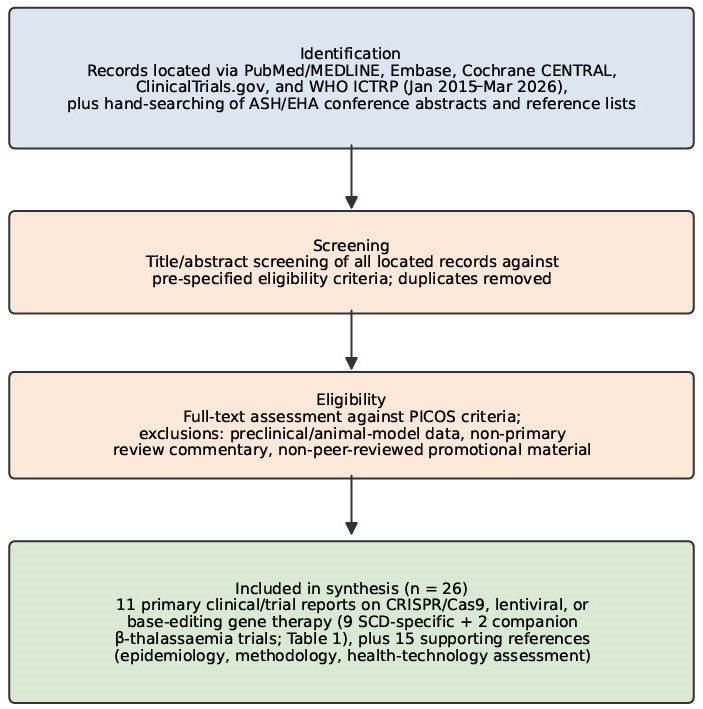
Records identified through the search strategy above were screened for duplicates and assessed against the eligibility criteria in two stages: a title/abstract screen followed by full-text review. Eleven primary clinical or trial reports met the eligibility criteria and form the evidentiary basis of the Results section — nine SCD-specific studies plus two companion β-thalassaemia trials retained as supporting mechanistic evidence — and fifteen additional records (epidemiological, methodological, and health-technology-assessment sources) were retained to support the Introduction and Discussion, for a total evidence base of 26 references. This process is summarised in Figure 1.
Quality and risk-of-bias assessment
Because every eligible primary trial used a single-arm, open-label design, the Cochrane ROBINS-I tool for non-randomised studies of interventions was used to assess risk of bias across its domains, including confounding, selection of participants, classification of intervention, deviations from intended intervention, missing data, measurement of outcomes, and selective reporting15. Each domain was rated low, moderate, serious, or critical risk of bias, and each study’s overall rating was set to the least favourable of its domain ratings, consistent with ROBINS-I guidance. Certainty of the body of evidence for each of the four comparison domains (efficacy, safety, ethics, accessibility) was additionally summarised using GRADE reasoning, which weighs risk of bias, imprecision, inconsistency, indirectness, and publication bias in assigning an overall certainty rating of high, moderate, low, or very low16. Any supporting review-type sources were themselves appraised using AMSTAR-2, although none were treated as primary evidence for an effect estimate17. Table 1 reports the ROBINS-I domain that most influenced each primary study’s overall rating.
Data extraction and synthesis
For each included primary study, the following items were extracted: first author and year, trial identifier, design, sample size, eligibility criteria, treatment modality and molecular target, follow-up duration, primary endpoint definition, principal efficacy result with its exact denominator and confidence interval where reported, key safety findings, funding source, and ROBINS-I rating. Because trial designs, endpoint definitions, and follow-up windows differ across the three modalities, results were synthesised narratively rather than pooled statistically; Table 1 presents the extracted items in a standardised format so that the three modalities can be compared like-for-like across the four-domain analytical framework introduced above.
Results
Lentiviral gene addition
Lentiviral gene addition was first demonstrated in a single adult patient with severe SCD, who received autologous CD34+ cells transduced with the LentiGlobin BB305 vector encoding an anti-sickling β-globin variant (HbAᵀ⁸⁷ᵀ); more than 15 months after infusion the patient remained free of vaso-occlusive events, providing initial proof of concept18. A related lentiviral programme in transfusion-dependent β-thalassaemia showed that most treated patients achieved transfusion independence, supporting the feasibility of the vector platform across haemoglobinopathies19. In SCD specifically, a separate lentiviral strategy using a short-hairpin-RNA vector (BCH-BB694) to silence BCL11A was tested in six patients; at a median follow-up of 18 months, all had engrafted and adverse events were consistent with the effects of preparative chemotherapy rather than the vector itself20. The largest lentiviral trial to date, HGB-206 (using the BB305 vector encoding HbAᵀ⁸⁷ᵀ), enrolled 35 patients with severe SCD (at least four vaso-occlusive events in the two years before enrolment); mean total haemoglobin increased from 8.5 to 11 g/dL, with HbAᵀ⁸⁷ᵀ comprising at least 40% of total haemoglobin11. A subsequent process-and-outcomes update of the same programme confirmed the durability of this response over longer follow-up21. However, two patients treated with an earlier, higher-titre version of the vector in the initial HGB-206 cohort later developed acute myeloid leukaemia; investigation implicated the specific early-generation vector and manufacturing process rather than the gene-addition strategy itself, and the protocol and vector were subsequently modified22. This safety signal contributed to a boxed warning on the FDA-approved lentiviral product, lovotibeglogene autotemcel (lovo-cel, marketed as Lyfgenia), which received US approval in December 2023 for patients 12 years and older with SCD and a history of vaso-occlusive events13.
CRISPR/Cas9 genome editing
CRISPR/Cas9 editing for SCD targets the erythroid-specific enhancer of BCL11A in autologous CD34+ cells, disrupting a transcriptional repressor of fetal haemoglobin (HbF) and thereby reactivating HbF production. The approach was first reported in a single patient with SCD and a single patient with transfusion-dependent β-thalassaemia, both of whom showed durable increases in HbF and freedom from vaso-occlusive crises after more than a year of follow-up9. This early-phase evidence matured into the pivotal phase 3 CLIMB SCD-121 trial of exagamglogene autotemcel (exa-cel), which enrolled patients aged 12–35 years with at least two severe vaso-occlusive crises in each of the two years before screening across 16 sites in the United States, Canada, France, and the United Kingdom. Among 44 patients who received exa-cel (median follow-up 19.3 months), 29 of 30 evaluable patients (97%; 95% CI 83–100) were free of severe vaso-occlusive crises for at least 12 consecutive months, and all 30 evaluable patients (100%; 95% CI 88–100) were free of related hospitalisations over the same period; no cancers were reported, and the safety profile was consistent with myeloablative busulfan conditioning and autologous transplantation more broadly10. A companion phase 3 trial of exa-cel in transfusion-dependent β-thalassaemia showed a similarly high rate of transfusion independence, reinforcing the platform’s mechanism across haemoglobinopathies23. On the strength of this evidence, exa-cel (marketed as Casgevy) received FDA approval in December 2023 as the first CRISPR/Cas9-based therapy approved for any indication13.
Base editing
Base editing uses a modified Cas9 enzyme fused to a deaminase to make a single-nucleotide change without generating a double-strand DNA break, in principle reducing the risk of the large structural rearrangements associated with nuclease-based editing. The investigational base-editing therapy ristoglogene autotemcel (risto-cel, formerly BEAM-101) edits the promoter regions of the HBG1 and HBG2 genes to block BCL11A binding and reactivate fetal haemoglobin. Interim data from the ongoing phase 1/2 BEACON trial, published in a peer-reviewed report in 2026, describe 31 treated patients with severe vaso-occlusive crises, all of whom achieved fetal-haemoglobin induction above 60% and sickle-haemoglobin reduction below 40%, with resolution of anaemia12. One patient died approximately four months after infusion of respiratory failure that investigators attributed to busulfan conditioning rather than to the base-editing product itself12,24. Because the BEACON trial is smaller, earlier in follow-up (up to approximately 20 months at last report), and, at the time of this review, supported by a single interim publication rather than a completed pivotal trial, the evidentiary base for base editing is materially less mature than for CRISPR/Cas9 or lentiviral gene addition; this difference in evidentiary maturity, not mechanism alone, should inform any comparative interpretation12,24.
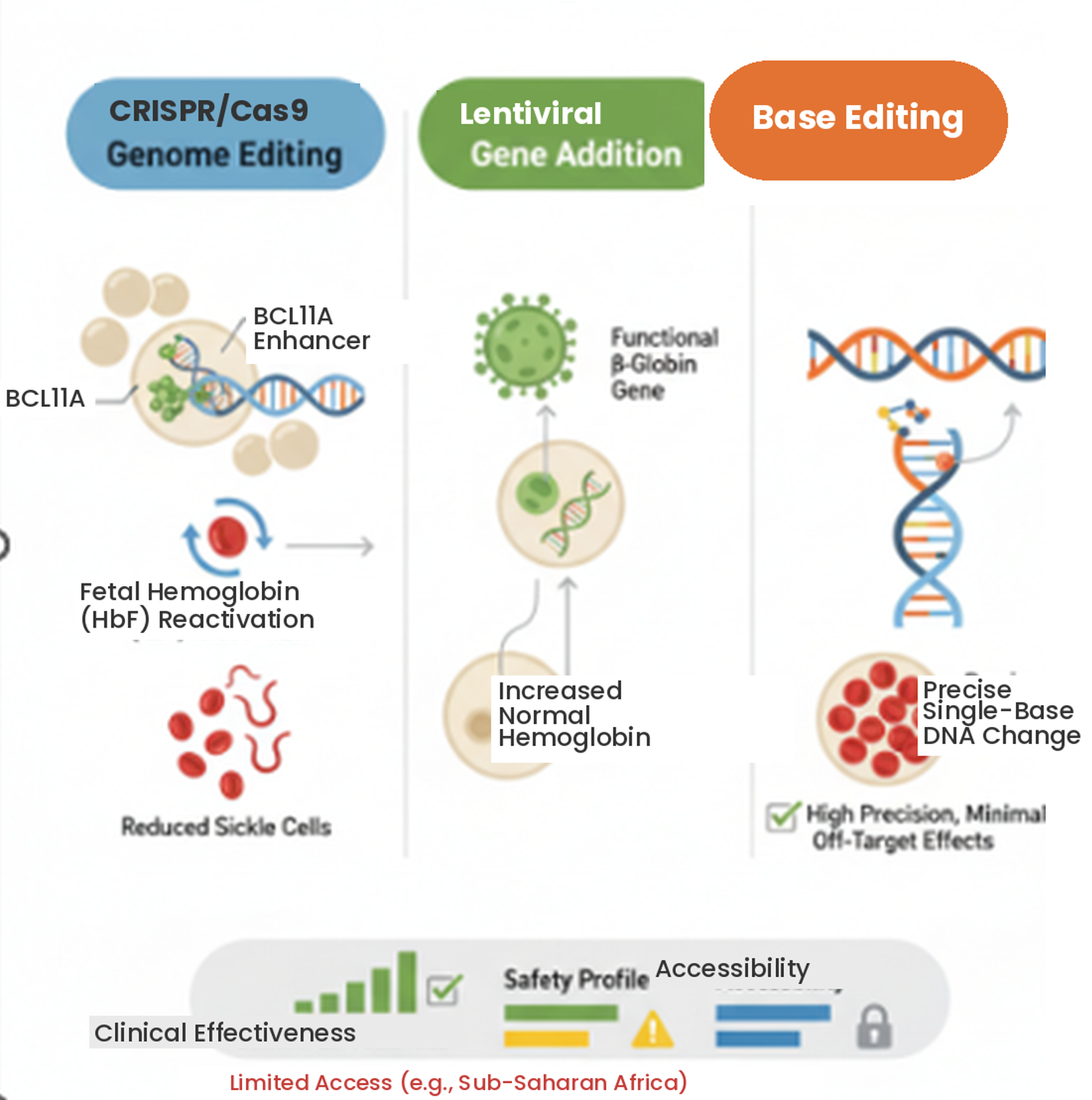
Figure 2 is a directly corrected version of the figure originally submitted with this manuscript. The original contained several errors identified during review: the panel heading read “CRISPP/Cas39” instead of “CRISPR/Cas9”; the gene symbol BCL11A was rendered as “BCL1A” in two places; “Lentiviral” was misspelled “Lentivirial”; “Haemoglobin” was misspelled “Hemobloom” in two places; the abbreviation “e.g.” was rendered “e.p” and “Sub-Saharan” was misspelled “Sub-Sahran” in the accessibility caption; and the descriptive text in the base-editing panel was cut off by its container, a formatting artefact. Figure 2 preserves the original three-panel layout, colour coding, and bottom legend bar (clinical effectiveness, safety profile, accessibility, and limited access in low-resource settings such as Sub-Saharan Africa) with all of the above corrected.
Standardised comparison of included primary studies
Table 1 summarises the eight SCD-specific primary trials and reports identified for this review using an identical set of extraction fields across all three modalities, together with the ROBINS-I domain most responsible for each study’s overall risk-of-bias rating. The two companion β-thalassaemia trials discussed above are mechanistic supporting evidence for the lentiviral and CRISPR/Cas9 platforms respectively and are not included in Table 1, as they do not evaluate SCD directly.
| Study (modality) | Design / N | Eligibility / follow-up | Efficacy result | Key safety findings | ROBINS-I rating* |
|---|---|---|---|---|---|
| Ribeil et al., 201718 — Lentiviral (LentiGlobin BB305) | Single-patient case report; N = 1 | Severe SCD; follow-up > 15 months | Vaso-occlusive-crisis-free from month 3 through last follow-up | No vector-related serious adverse events reported | Critical (single case, no comparator) |
| Esrick et al., 202120 — Lentiviral shRNA (BCH-BB694, BCL11A silencing) | Single-arm, single-centre pilot; N = 6 | Severe SCD; median follow-up 18 months (range 7–29) | All patients engrafted; clinical and haematological responses observed | Adverse events consistent with preparative chemotherapy | Serious (small n, no comparator) |
| Kanter et al., 2022 (HGB-206)11 — Lentiviral (BB305, HbAᵀ⁸⁷ᵀ) | Single-arm, multi-cohort phase 1/2; N = 35 | ≥ 4 severe vaso-occlusive events in prior 2 years | Mean total haemoglobin 8.5→11 g/dL; HbAᵀ⁸⁷ᵀ ≥ 40% of total haemoglobin | 2 cases of acute myeloid leukaemia in early-vector cohort (see Goyal et al., 2022) | Serious (single-arm; protocol/vector evolved across cohorts) |
| Kanter et al., 2023 (AJH update)21 — Lentiviral (BB305) | Process-and-outcomes update of HGB-206 cohorts | Same population as above | Durability of haemoglobin response confirmed at longer follow-up | Consistent with 2022 report | Serious |
| Goyal et al., 202222 — Lentiviral (early-generation vector) | Safety case series nested within HGB-206 | 2 of the initial HGB-206 cohort | Not applicable (safety report) | Acute myeloid leukaemia diagnosed in both cases; implicated vector/manufacturing process | Serious (targeted safety-signal report) |
| Frangoul et al., 20219 — CRISPR/Cas9 (BCL11A enhancer) | 2-patient case series (1 SCD, 1 β-thalassaemia) | Severe disease; follow-up > 12 months | Sustained HbF rise; SCD patient vaso-occlusive-crisis-free | No major treatment-related serious adverse events reported | Critical (n = 2) |
| Frangoul et al., 2024 (CLIMB SCD-121)10 — CRISPR/Cas9 (exa-cel) | Phase 3, single-arm; N = 44 | ≥ 2 severe VOC/year × 2 years; age 12–35; median follow-up 19.3 months | 29/30 evaluable (97%; 95% CI 83–100) free of severe VOC ≥ 12 months | No cancers reported; AEs consistent with busulfan conditioning/transplant | Serious (single-arm, no concurrent comparator) |
| Beam Therapeutics / BEACON, 2025–202612,24 — Base editing (risto-cel, HBG1/HBG2 promoters) | Phase 1/2, interim; N = 31 | Severe VOC; follow-up up to ≈ 20 months | HbF induction > 60%, HbS reduction < 40% in all patients; anaemia resolved | 1 conditioning-related death (respiratory failure) | Serious/Critical (small n, interim analysis, single death) |
*Risk of bias assessed with the ROBINS-I tool for non-randomised studies of interventions; rating shown is the overall study rating (least favourable domain).
Discussion
Comparative efficacy
The three modalities differ in both effect size and evidentiary maturity, and these two dimensions should be considered separately. CRISPR/Cas9 (exa-cel) is supported by a completed phase 3, single-arm registrational trial with a pre-specified endpoint (freedom from severe vaso-occlusive crisis for at least 12 consecutive months) and a precisely reported result (97%; 95% CI 83–100 of 30 evaluable patients among 44 treated)10; under GRADE reasoning this evidence merits a moderate certainty rating, downgraded from high primarily because of the single-arm design and modest sample size, but supported by a large and consistent effect16. Lentiviral gene addition (lovo-cel/HGB-206) has a longer track record but reports haematological response (mean total haemoglobin and percentage HbAᵀ⁸⁷ᵀ) rather than a formally adjudicated crisis-freedom endpoint in its primary 2022 publication, and its protocol and vector evolved across the trial’s cohorts, which together support only a low-to-moderate certainty rating11,16,21. Base editing (risto-cel) has shown a strong early biological signal — fetal-haemoglobin induction above 60% in all 31 treated patients — but has not yet reported a clinical crisis-freedom endpoint over the follow-up windows achieved by the other two platforms, so its certainty rating remains low pending longer follow-up and a larger, more mature dataset12,16.
Comparative safety
All three modalities require myeloablative busulfan conditioning and autologous haematopoietic stem-cell transplantation, and share the associated risks of infertility, prolonged cytopenia, and infection during engraftment. Beyond this shared risk, each platform carries a modality-specific safety signal. The clearest is the lentiviral programme’s insertional-mutagenesis risk: two patients treated with an early, higher-titre vector in the initial HGB-206 cohort developed acute myeloid leukaemia, a signal serious enough to prompt a vector and protocol change and an FDA boxed warning on the approved product22,13. No analogous malignancy signal has yet been reported for exa-cel, which reported no cancers among 44 patients over a median follow-up of 19.3 months10; however, this follow-up window remains short relative to the typical latency of therapy-related myeloid neoplasms, so the absence of a signal should be interpreted as reassuring rather than conclusive. The base-editing trial reported one death, attributed by investigators to busulfan-conditioning-related respiratory failure rather than to the base-editing product itself, in a cohort of 31 patients12,24; because this is the smallest and newest dataset of the three, a single serious adverse event carries disproportionate weight and underscores the need for larger, longer-term follow-up before firm safety conclusions can be drawn.
Ethical considerations
All three modalities edit only autologous, somatic (non-heritable) cells; none of the approaches reviewed here involves germline modification, and no heritable risk to future offspring has been reported. Beyond this shared reassurance, the platforms raise several modality-independent ethical questions with different weight in each. First, the myeloablative busulfan conditioning required for all three carries a well-documented risk of infertility, which raises informed-consent and fertility-preservation-counselling obligations that are particularly acute for the adolescent patients (as young as 12 years) eligible under current approvals. Second, the single-arm, no-comparator design used across every eligible trial in this review raises interpretive questions about how “success” is measured and communicated to prospective patients, since apparent benefit cannot be formally separated from the effects of conditioning, supportive care, or regression to the mean. Third, enrolment to date has been concentrated in a small number of high-income-country sites — the CLIMB SCD-121 trial, for example, enrolled across 16 sites in the United States, Canada, France, and the United Kingdom — raising a justice concern given that the disease burden is heaviest in Sub-Saharan Africa6,10. A review population drawn almost entirely from high-income settings limits the direct applicability of these trials’ safety and efficacy findings to the populations who stand to benefit the most.
Accessibility
The three modalities share, and differ modestly within, a common set of infrastructure demands: apheresis-based collection of haematopoietic stem and progenitor cells, centralised ex vivo manufacturing (vector production or base-editing reagent synthesis and quality control occur at a small number of manufacturing sites, with cells shipped to and from the treating centre), myeloablative busulfan conditioning, and extended, multi-month inpatient and outpatient monitoring in a transplant-capable centre. This infrastructure does not yet exist at scale even for allogeneic HSCT in most high-burden countries. In Nigeria specifically, coordinated newborn screening — a prerequisite for identifying and following any future gene-therapy candidate population — has not yet been implemented nationally, although pilot feasibility work has shown that low-cost point-of-care screening integrated into existing immunisation infrastructure is achievable7. Allogeneic bone marrow transplantation programmes, the closest existing infrastructure analogue to autologous gene therapy, also remain at an early stage of development in Nigeria. These accessibility gaps precede, and are largely independent of, the price of the therapies themselves.
Cost
Exa-cel and lovo-cel launched in the United States at list prices of USD 2.2 million and USD 3.1 million per patient, respectively, following FDA approval in December 202313. An independent health-technology assessment concluded that prices in the range of USD 1.35–2.05 million would meet conventional cost-effectiveness thresholds in a high-income health system, meaning both products launched above the range judged cost-effective even domestically, and before accounting for the additional cost of conditioning, hospitalisation, and post-infusion monitoring25. Commentators have noted that this pricing model, oriented toward a small number of wealthy national markets, is difficult to reconcile with a disease whose burden falls overwhelmingly on Sub-Saharan Africa, and have called for new financing and technology-transfer mechanisms if curative gene therapy is to reach the populations most affected26. Base-editing pricing has not yet been set, as risto-cel remains in clinical development.
Limitations of this review
This review has several limitations. First, because every eligible primary trial used a single-arm design, cross-modality comparisons remain descriptive rather than based on formal statistical comparison, and apparent differences in effect size may partly reflect differences in trial design, endpoint definition, or patient population rather than differences in therapeutic efficacy. Second, most included primary trials were industry-funded, which is a recognised source of potential reporting bias in the gene-therapy field generally. Third, the evidence base for base editing remains preliminary, resting on a single interim publication and conference abstracts rather than a completed pivotal trial; the comparative conclusions offered here for that modality should be treated as provisional and revisited as further data are published. Fourth, this review was conducted and screened by the study team rather than through independent, dual-reviewer screening and extraction as recommended for a full systematic review, and the identification and screening counts in Figure 1 reflect the compiled final evidence base rather than a fully itemised multi-database export log.
Conclusion
CRISPR/Cas9 genome editing and lentiviral gene addition are now FDA-approved, evidence-supported curative options for severe SCD, each carrying a distinct efficacy and safety profile: exa-cel is supported by the most complete registrational dataset with no malignancy signal reported to date, while lovo-cel has a longer track record but a known insertional-mutagenesis risk that led to a vector change and a boxed warning10,11,22,13. Base editing (risto-cel) shows a promising early biological signal but remains earlier in clinical development, with a materially smaller evidence base12. Across all three platforms, myeloablative conditioning, centralised manufacturing, and multi-million-dollar list prices place substantial infrastructure and financial barriers between the current evidence base and the populations who carry the greatest burden of SCD, including Nigeria6,25,7,13,26. Realising the transformative potential of gene therapy for SCD will depend as much on investment in screening, transplant-capable infrastructure, and equitable financing as on further advances in editing technology itself.
References
- F. B. Piel, A. P. Patil, R. E. Howes, O. A. Nyangiri, P. W. Gething, T. N. Williams, D. J. Weatherall, S. I. Hay. Global epidemiology of sickle haemoglobin in neonates: a contemporary geostatistical model-based map and population estimates. The Lancet. Vol. 381, pg. 142-151, 2013, https://doi.org/10.1016/S0140-6736(12)61229-X. [↩] [↩]
- World Health Organization. Sickle cell disease: key facts. https://www.who.int/news-room/fact-sheets/detail/sickle-cell-disease, 2023. [↩]
- F. B. Piel, S. I. Hay, S. Gupta, D. J. Weatherall, T. N. Williams. Global burden of sickle cell anaemia in children under five, 2010-2050: modelling based on demographics, excess mortality, and interventions. PLOS Medicine. Vol. 10, pg. e1001484, 2013, https://doi.org/10.1371/journal.pmed.1001484. [↩]
- S. D. Grosse, I. Odame, H. K. Atrash, D. D. Amendah, F. B. Piel, U. Ramakrishnan. Sickle cell disease in Africa: a neglected cause of early childhood mortality. American Journal of Preventive Medicine. Vol. 41, pg. S398-S405, 2011, https://doi.org/10.1016/j.amepre.2011.09.013. [↩]
- E. Wastnedge, D. Waters, S. Patel, K. Morrison, M. K. Goh, K. Adeloye, I. Rudan. The global burden of sickle cell disease in children under five years of age: a systematic review and meta-analysis. Journal of Global Health. Vol. 8, pg. 021103, 2018, https://doi.org/10.7189/jogh.08.021103. [↩]
- GBD 2021 Sickle Cell Disease Collaborators. Global, regional, and national prevalence and mortality burden of sickle cell disease, 2000–2021: a systematic analysis from the Global Burden of Disease Study 2021. The Lancet Haematology. Vol. 10, pg. e585-e599, 2023, https://doi.org/10.1016/S2352-3026(23)00118-7. [↩] [↩] [↩]
- O. E. Nnodu, A. Sopekan, U. Nnebe-Agumadu, C. Ohiaeri, A. Adeniran, G. Shedul, H. A. Isa, O. Owolabi, R. I. Chianumba, Y. Tanko, J. H. Iyobosa, A. D. Adekile, O. I. Olopade, F. B. Piel. Implementing newborn screening for sickle cell disease as part of immunisation programmes in Nigeria: a feasibility study. The Lancet Haematology. Vol. 7, pg. e534-e540, 2020, https://doi.org/10.1016/S2352-3026(20)30143-5. [↩] [↩] [↩]
- J. Kanter, C. Falcon. Gene therapy for sickle cell disease: where are we now? Hematology, American Society of Hematology Education Program. Vol. 2021, pg. 174-180, 2021. [↩]
- H. Frangoul, D. Altshuler, M. D. Cappellini, Y. Chen, J. Domm, B. K. Eustace, J. Foell, J. de la Fuente, S. Grupp, R. Handgretinger, T. W. Ho, A. Kattamis, A. Kernytsky, J. Lekstrom-Himes, A. M. Li, F. Locatelli, M. Y. Mapara, A. de Montalembert, D. Rondelli, A. Sharma, S. Sheth, S. Soni, M. H. Steinberg, D. Wall, A. Yen, S. Corbacioglu. CRISPR-Cas9 gene editing for sickle cell disease and β-thalassemia. The New England Journal of Medicine. Vol. 384, pg. 252-260, 2021, https://doi.org/10.1056/NEJMoa2031054. [↩] [↩] [↩]
- H. Frangoul, F. Locatelli, A. Sharma, M. Bhatia, M. Mapara, L. Molinari, D. Wall, R. I. Liem, P. Telfer, A. J. Shah, M. Cavazzana, S. Corbacioglu, D. Rondelli, R. Meisel, L. Dedeken, S. Lobitz, M. de Montalembert, M. H. Steinberg, M. C. Walters, M. J. Eckrich, S. Imren, L. Bower, C. Simard, W. Zhou, F. Xuan, P. K. Morrow, W. E. Hobbs, S. A. Grupp. Exagamglogene autotemcel for severe sickle cell disease. The New England Journal of Medicine. Vol. 390, pg. 1649-1662, 2024, https://doi.org/10.1056/NEJMoa2309676. [↩] [↩] [↩] [↩] [↩] [↩] [↩]
- J. Kanter, M. C. Walters, L. Krishnamurti, W. Y. Mapara, S. Kwiatkowski, S. Rifkin-Zenenberg, B. Aygun, K. H. M. Kasow, S. P. Pierciey, F. J. Bonner, D. A. Miller, J. A. Ribeil, D. Davidson, M. Asmal, A. A. Thompson. Biologic and clinical efficacy of lentiviral gene therapy for sickle cell disease. The New England Journal of Medicine. Vol. 386, pg. 617-628, 2022, https://doi.org/10.1056/NEJMoa2117175. [↩] [↩] [↩] [↩] [↩]
- Beam Therapeutics BEACON Trial Investigators. Base editing of HBG1 and HBG2 promoters for sickle cell disease. The New England Journal of Medicine. 2026, https://doi.org/10.1056/NEJMoa2504835. [↩] [↩] [↩] [↩] [↩] [↩] [↩] [↩]
- US Food and Drug Administration. FDA approves first gene therapies to treat patients with sickle cell disease. https://www.fda.gov/news-events/press-announcements/fda-approves-first-gene-therapies-treat-patients-sickle-cell-disease, 2023. [↩] [↩] [↩] [↩] [↩] [↩] [↩]
- M. J. Page, J. E. McKenzie, P. M. Bossuyt, I. Boutron, T. C. Hoffmann, C. D. Mulrow, L. Shamseer, J. M. Tetzlaff, D. Moher. The PRISMA 2020 statement: an updated guideline for reporting systematic reviews. The BMJ. Vol. 372, pg. n71, 2021, https://doi.org/10.1136/bmj.n71. [↩]
- J. A. C. Sterne, M. A. Hernán, B. C. Reeves, J. Savović, N. D. Berkman, M. Viswanathan, H. Henry, D. G. Altman, M. T. Ansari, I. Boutron, J. R. Carpenter, A.-W. Chan, R. Churchill, J. J. Deeks, A. Hróbjartsson, J. Kirkham, P. Jüni, Y. K. Loke, T. D. Pigott, C. R. Ramsay, D. Regidor, H. R. Rothstein, L. Sandhu, P. L. Santaguida, H. J. Schünemann, B. Shea, I. Shrier, P. Tugwell, L. Turner, J. C. Valentine, H. Waddington, E. Waters, G. A. Wells, P. F. Whiting, J. P. T. Higgins. ROBINS-I: a tool for assessing risk of bias in non-randomised studies of interventions. The BMJ. Vol. 355, pg. i4919, 2016, https://doi.org/10.1136/bmj.i4919. [↩]
- G. H. Guyatt, A. D. Oxman, G. E. Vist, R. Kunz, Y. Falck-Ytter, P. Alonso-Coello, H. J. Schünemann. GRADE: an emerging consensus on rating quality of evidence and strength of recommendations. The BMJ. Vol. 336, pg. 924-926, 2008, https://doi.org/10.1136/bmj.39489.470347.AD. [↩] [↩] [↩] [↩]
- B. J. Shea, B. C. Reeves, G. Wells, M. Thuku, C. Hamel, J. Moran, D. Moher, P. Tugwell, V. Welch, E. Kristjansson, D. A. Henry. AMSTAR 2: a critical appraisal tool for systematic reviews that include randomised or non-randomised studies of healthcare interventions, or both. The BMJ. Vol. 358, pg. j4008, 2017, https://doi.org/10.1136/bmj.j4008. [↩]
- J. A. Ribeil, S. Hacein-Bey-Abina, E. Payen, A. Magnani, M. Semeraro, E. Magrin, L. Caccavelli, B. Neven, P. Bourget, W. El Nemer, P. Bartolucci, L. Weber, H. Puy, J.-F. Meritet, D. Grevent, Y. Beuzard, S. Chrétien, T. Lefebvre, R. W. Ross, O. Negre, G. Veres, L. Sandler, S. Soni, M. de Montalembert, S. Blanche, P. Leboulch, M. Cavazzana. Gene therapy in a patient with sickle cell disease. The New England Journal of Medicine. Vol. 376, pg. 848-855, 2017, https://doi.org/10.1056/NEJMoa1609677. [↩] [↩]
- A. A. Thompson, M. C. Walters, J. Kwiatkowski, J. E. J. Rasko, J.-A. Ribeil, S. Hongeng, E. Magrin, G. J. Schiller, E. Payen, M. Semeraro, D. Moshous, B. Lefrere, H. Puy, C. Bourget, A. Magnani, L. Caccavelli, R. Diana, S. Suarez, F. Monpoux, V. Brousse, C. Poirot, C. Brouzes, J.-F. Meritet, D. Pondarré, Y. Beuzard, S. Chrétien, T. Lefebvre, D. T. Teachey, U. Anurathapan, P. J. Ho, C. von Kalle, M. Kletzel, E. Vichinsky, S. Soni, G. Veres, O. Negre, R. W. Ross, D. Davidson, A. Petrusich, L. Sandler, M. Asmal, B. J. Hermine, C. De Montalembert, S. Hollis, P. Boelens, P. Leboulch, J.-A. Ribeil. Gene therapy in patients with transfusion-dependent β-thalassemia. The New England Journal of Medicine. Vol. 378, pg. 1479-1493, 2018, https://doi.org/10.1056/NEJMoa1705342. [↩]
- E. B. Esrick, L. E. Lehmann, A. Biffi, M. Achebe, C. Brendel, M. F. Ciuculescu, H. Daley, B. MacKinnon, E. Morris, A. Federico, F. Abriss, K. Boardman, R. Reynolds, R. Shaw, N. Adegbola, W. B. London, S. Airewele, L. Balf-Soran, J. Fisher, C. Nikiforow, L. Silberstein, D. E. Bauer, D. A. Williams. Post-transcriptional genetic silencing of BCL11A to treat sickle cell disease. The New England Journal of Medicine. Vol. 384, pg. 205-215, 2021, https://doi.org/10.1056/NEJMoa2029392. [↩] [↩]
- J. Kanter, A. A. Thompson, F. J. Pierciey Jr., M. Hsieh, N. Uchida, P. Leboulch, M. Schmidt, M. Bonner, R. Guo, A. Miller, J.-A. Ribeil, D. Davidson, M. Asmal, M. C. Walters, J. F. Tisdale. Lovo-cel gene therapy for sickle cell disease: treatment process evolution and outcomes in the initial groups of the HGB-206 study. American Journal of Hematology. Vol. 98, pg. 11-22, 2023, https://doi.org/10.1002/ajh.26741. [↩] [↩] [↩]
- S. Goyal, J. Tisdale, M. Schmidt, S. Kanter, F. Pierciey, K. Kwiatkowski, M. Owortwe, C. Colvin, M. Chi, M. Yeager, D. Davidson, M. Asmal. Acute myeloid leukemia case after gene therapy for sickle cell disease. The New England Journal of Medicine. Vol. 386, pg. 138-147, 2022. [↩] [↩] [↩] [↩]
- F. Locatelli, P. Lang, D. Wall, J. L. Meisel, A. A. Thompson, M. de Montalembert, J. Kwiatkowski, M. Cavazzana, S. Corbacioglu, M. C. Walters, J. Rasko, H. Frangoul. Exagamglogene autotemcel for transfusion-dependent β-thalassemia. The New England Journal of Medicine. Vol. 390, pg. 1663-1676, 2024. [↩]
- Beam Therapeutics. Updated data from the BEACON phase 1/2 clinical trial of ristoglogene autotemcel (risto-cel) in sickle cell disease. Presented at the American Society of Hematology Annual Meeting, Orlando, FL, December 6-9, 2025, Abstract 2532. [↩] [↩] [↩] [↩]
- Institute for Clinical and Economic Review. Sickle cell disease: an assessment of two gene therapies — exagamglogene autotemcel and lovotibeglogene autotemcel. Final evidence report. https://icer.org/assessment/sickle-cell-disease-2023/, 2023. [↩] [↩]
- E. R. S. Cliff, F. A. Tessema. The double-edged sword of extremely high prices for gene therapies in sickle cell disease. JAMA. 2024, https://doi.org/10.1001/jama.2024.11703. [↩] [↩]