

Abstract
Youth-crime prevention is often deterrence-oriented, on the premise that vivid enough consequences will lead a young person to choose differently. A review of Scared Straight and similar juvenile-awareness programs found that they instead increased subsequent offending. In Aotearoa New Zealand, police action against young people has fallen while Māori over-representation has not, which makes the country a useful case for asking who prevention works for. This narrative review evaluates whether applied drama and psychodrama-informed practice reduce offending, drawing on a critical search of medical, education, and criminal-justice research databases. Nine controlled studies were identified, published between 1973 and 2026. Only one measured later offending. The remaining studies measured behaviors and capacities thought to precede it, and improvements were reported only by programs providing more than a single session. Effects on aggression and bullying were inconsistent at every level of contact, and where teachers and students rated the same construct, only the teacher-report effect reached significance. Two programs delivered a single performance and found no full-sample effects. Using a standard risk-of-bias tool, one study was rated strong and five of nine were rated weak, and the studies reporting the clearest positive effects were among the weakest. No study reported outcomes by ethnicity, and none was conducted in Aotearoa New Zealand. A four-stage sequence is proposed for future work in which participants witness a dilemma, interrupt it, rehearse an alternative, and transfer it beyond the session. This model has not been tested. Whether drama-based prevention reduces offending remains unknown.
Keywords: youth crime, applied drama, forum theater psychodrama, behavioral rehearsal, violence prevention
Introduction
Youth-crime prevention is frequently imagined as a problem of insufficient warning. If young people could see the prison cell, hear a victim’s pain, or understand the length of a criminal sentence, the argument goes, they would avoid offending. Scared Straight and related juvenile-awareness programs act on that logic, taking young people into prisons to observe conditions there and to be confronted by adult inmates1. A review of nine of these programs concluded that they increased subsequent offending compared to if no intervention had been delivered1. If warnings of this kind do not work, it remains unclear what might work instead, and for whom.
Adolescence is a key period for prevention, with peer relationships playing a central role. Susceptibility to peer influence is greatest in early adolescence and declines through the teenage years2. Peer influence may be more commonly imagined as a direct form of influence, such as through verbal input or watching others’ behavior, but it is also present in more indirect ways as well. In a simulated driving task, the presence of peers increased risk-taking among adolescents but not adults, with heightened activity in reward-related brain regions when adolescents were observed by friends3,4. Younger adolescents (13 and younger) also more readily accept smaller immediate rewards over larger delayed ones compared to older adolescents (16 and older)5. Taken together, these findings describe a period in which the immediate social environment carries particular weight in the decision-making process.
Adolescence is also when the relevant decision-making capacities are still developing, which is why identifying effective prevention at this stage is particularly necessary. Effective programs should focus on equipping young people with skills to make faster and better decisions in the presence of peer pressure, or on altering a group’s social expectations in a more prosocial direction. The same social environment that increases risk-taking when peers are watching may also be used to shift those expectations. Drama-based prevention, which for the purposes of this review includes applied drama and psychodrama-informed practice, is one avenue through which these skills and norms might be developed.
Applied drama refers here to participatory theatrical work undertaken for educational or social purposes. It includes improvisation, role-play, and forum theater, in which a scene is replayed and participants intervene instead of watching. Psychodrama is a structured therapeutic method in which participants use enactment, role reversal, doubling, and mirroring to explore relationships, emotions, and possible action6. Psychodrama-informed practice means that a facilitator borrows selected psychodrama techniques for educational work without offering psychodrama as treatment. Applied drama and psychodrama-informed practice differ in intensity and in what they ask of a facilitator, so this review treats them separately.
Whether a prevention method works equally well for all young people is a separate question, and Aotearoa New Zealand is a useful case study. Rates of police action against children and young people there have been falling7. In the year to June 2025 the number of children police took action against fell 23 percent, to 58 per 10,000 children, and the number of young people fell 13 percent, to 220 per 10,000. Rates for tamariki and rangatahi Māori, meaning Māori children aged 10 to 13 and young people aged 14 to 17, fell by similar amounts, from 179 to 144 and from 528 to 467. However, these rates are still twice those for the total population. Māori are over-represented at every stage of the youth justice system, from police apprehension through to court appearance and remand, and the Ministry of Justice reports that offense seriousness and offending history do not fully account for this over-representation7. Lowering rates overall has not closed that gap, and prevention that could close it has not yet been identified.
This review has three objectives. The first is to evaluate and summarize the current state of the literature on drama-based prevention programs. The second is to establish what is currently known about the distinct contribution of each technique, and about whether these methods work equally well across different populations and cultural settings, including for rangatahi Māori. The third is to establish whether the psychological mechanisms proposed for drama-based prevention have been tested, and to develop an exploratory framework for future testing. This is intended for teachers, drama practitioners, youth justice services, and researchers working with young people at risk of offending.
Methods
Search Strategy
Four sources were searched on 19 August 2026: PubMed, the Education Resources Information Center (ERIC), the Campbell Collaboration Library, and the Youth Endowment Fund Toolkit. No date limits were applied. Only English-language records were screened.
Search terms used in PubMed were: (psychodrama[tiab] OR sociodrama[tiab] OR “drama therapy”[tiab]) AND (adolescent*[tiab] OR youth[tiab] OR child*[tiab]); and (“applied theatre” OR “applied drama” OR “forum theater” OR “participatory theater”) AND (violence OR offend* OR delinquent* OR bullying). Search terms used in ERIC, with the “peer-reviewed only” filter applied were: (drama OR theater OR theatre) AND (delinquency OR “violence prevention” OR “juvenile justice”); and “role playing” AND adolescents AND (“behavior change” OR “conflict resolution”). Titles of all reviews listed by the Campbell Collaboration Library Crime and Justice group were screened, and the Youth Endowment Fund Toolkit was searched by navigating to the Violence Prevention Toolkit Arts Programs technical report. Reference lists of included sources and of the systematic reviews they cited were also checked.
Inclusion and Exclusion Criteria
Studies were included if they evaluated a participatory drama, theater, drama-therapy, psychodrama, or sociodrama intervention delivered to participants aged approximately 8 to 25 and reported a behavioral, psychosocial, or offending outcome, or if they collected primary data on how such an intervention was delivered. Systematic reviews of these interventions were also included. Studies were excluded if (1) the intervention was delivered to adults or to health professionals, (2) psychodrama or drama therapy was applied to a clinical population without a behavioral or offending outcome, or (3) the record reported no primary data, as in commentary, policy description, and content analysis.
Screening
Searches returned 131 records from both PubMed (85 and 14, respectively by search) and ERIC (21 and 11, respectively by search). After one duplicate was removed, 130 titles and abstracts were screened and 13 full texts were assessed against the criteria above. Nine were retained: seven controlled evaluations and two qualitative studies of delivery. None of the 70 Campbell Collaboration reviews evaluated a drama or theater intervention, and one systematic review was identified from the Youth Endowment Fund Toolkit. Checking reference lists added two further controlled evaluations, two qualitative studies of delivery, and two systematic reviews. Screening was carried out by a single reviewer. Studies identified within the three systematic reviews were screened by title and description.
Risk of Bias
Each controlled study was assessed using the Quality Assessment Tool for Quantitative Studies developed by the Effective Public Health Practice Projec8,9. The tool rates six domains (selection bias, study design, confounders, blinding, data collection methods, and withdrawals and dropouts) as strong, moderate or weak. A global rating of strong is assigned when no domain is rated as weak, moderate if one domain is rated as weak, and weak when two or more are rated as weak. This tool was selected for its ability to standardize rating criteria across both randomized and non-randomized tools and for its use in previous reviews in this subject area.6,10.
Data Extraction and Synthesis
The following data were extracted from each study: the characteristics of the sample, the form and amount of intervention delivered, the outcomes measured, and the reported results. Outcomes were sorted into three groups. Offending was measured through official police or court records. Intermediate behaviors included aggression, bullying, and school incidents. Proximal outcomes were psychological capacities close to the activity itself, such as role-taking, perspective-taking, and self-efficacy.
Because the studies differed in design, population, and outcome measure, their findings were summarized in words, grouped by the studies identified, the interventions they delivered, the outcomes they measured, and the populations they were tested in.
Program labels were inconsistent across the studies. Some interventions described as theater programs included counseling or social-emotional curricula, and some psychodrama studies combined psychodrama with other therapies. Contact time proved to be the most consistently reported and most comparable feature, and is used here as the organizing variable.
Results
Characteristics of the Identified Studies
Sixteen sources were retained based on the inclusion criteria: nine controlled evaluations of drama-based prevention, four qualitative studies of delivery, and three systematic reviews. The nine controlled studies were published between 1973 and 2026 and appeared in journals of developmental psychology, adolescent development, school violence, drama and arts education, health promotion, and mental health. No additional controlled evaluations of drama-based prevention were identified through screening of reference lists. Two of the studies retained here appear within these reviews: Carpenter and Sandberg11 within Berghs et al.’s6 review of psychodrama, and Fullchange and Sharkey12 within Mansfield et al.’s13 review of arts interventions. Both are reported once, as individual studies, and their findings are not counted again as review-level evidence.
Study designs varied. Agley et al.14 randomly assigned 76 classrooms across twelve schools to receive a theater performance or to continue with teaching as usual. In Kisida et al.15, all students in eight schools saw the performance, and students were assigned by birth month to complete the outcome survey either before or after the performance, allowing the pre-performance survey group to serve as the comparison group. Chandler16 randomly assigned 45 delinquent boys aged 11 to 13 to three groups of fifteen: one received drama and video film-making with structured role-taking practice, one made films without any role-taking element, and one received no program. Catterall17 compared 71 program participants with 84 students who had wanted to join the program but could not be given a place, so both groups showed the same willingness to participate. The remaining studies compared participants with matched classes or groups who did not receive the program.
Samples in the controlled studies ranged from 20 to 1,571 young people. Most studies worked in mainstream schools. Kisiel et al.18, Zucker et al.19, Joronen et al.20, Agley et al.14, and Kisida et al.15 all recruited whole classrooms. Two studies worked with young people already involved with the justice system. Chandler16 recruited through police records and Carpenter and Sandberg11 through probation referral. Şimşek et al.21 recruited adolescents referred by school guidance services for social adaptation problems whose families were involved in crime. These three studies were also the smallest, with 45, 21 and 20 participants. Studies were conducted in the United States, Finland, the United Kingdom, and Turkey.
Participant characteristics were reported unevenly. Caterall17 did not report sex demographics, Carpenter and Sandberg11 described their sample only as being of both sexes, Chandler’s16 sample was entirely male, and the remaining studies reported samples comprised of between 44% and 56% female. Age was provided as a mean in five studies, and presented as a school grade or range in four. Socioeconomic status was measured in two studies through parental education or family economic status, reported as the proportion of participants from low-income families in one, described through the demographic of the neighborhood or school setting in four, and absent from two. Six studies reported the ethnic composition of their samples, one reported it only at the school level and two reported none. No study disaggregated its results by ethnicity.
Four further sources report on how these programs are delivered. Turner22 and Barone et al.23 studied theater in a court-referred program and in a youth detention center, Fullchange and Sharkey12 studied a partnership between probation-involved young people and university students, and Gilbert et al.24 interviewed staff delivering a school forum-theater program.
Three systematic reviews cover the wider literature. Mansfield et al.13 reviewed arts interventions for young people at risk of offending or who had offended, and Berghs et al.6,10 reviewed drama therapy and psychodrama for children and adolescents. Table 1 sets out the allocation method, intervention schedule, outcome, and result for each controlled study, ordered by contact time.
| Study | Allocation | Intervention Schedule | Outcome measured | Result |
|---|---|---|---|---|
| Agley et al. (2021)14 | Randomized at classroom level, 1:1, sequence concealment until assignment; 76 classrooms, 12 schools, 1,571 students | 1 session, 60 minutes (1 hour) | Social-emotional competence; bullying perpetration and victimization | No effect on social-emotional competence; mixed bullying findings, none favoring the intervention in primary analyses |
| Kisida et al. (2026)15 | Randomized assignment of survey timing by birth month; all students saw the performance, with those surveyed beforehand serving as controls; 393 students, 8 schools | 1 session, 60 minutes (1 hour) | Six bystander-intervention domains | No significant effects on any composite scale; analyses of male and female students separately favored the intervention on five items |
| Joronen et al. (2012)20 | Two matched Finnish schools; 78 intervention, 56 control | 4-9 sessions, 90 minutes (6-13.5 hours) | Social relationships; bullying and victimization | Group-by-time interaction p = 0.065 overall, p = 0.011 in a post-hoc subgroup of three classes; no significant effect on bullying or victimization |
| Kisiel et al. (2006)18 | Matched control classrooms; 77 vs 63, eight classrooms, five inner-city schools | 9 weeks of 75-minute sessions (11.25 hours) | Aggression; prosocial behavior; attention and engagement | Significant teacher-reported effects on aggression, prosocial behavior and attention/engagement; no significant effects on student-reported measures |
| Zucker et al. (2010)19 | Four arms separating drama and classroom curriculum; 260 students, 15 classrooms, 6 schools | 9 weeks of 75-minute sessions; additional ~2 hours per week teacher curriculum in one arm (29 hours combined) | As Kisiel et al. | Combined program (UI + TC) significantly better than basic UI on teacher-rated prosocial behavior and attention; no significant effect on aggression in any arm; no significant effects on any student-reported measure |
| Carpenter & Sandberg (1985)11 | Non-randomized; 11 allocated (7 completers) vs 10 untreated controls, all referred for group therapy, aged 14–16 | 12 weeks of 1.5-hour sessions (18 hours) | Jesness asocial index; ego strength; introversion–extraversion | Significant reduction in Jesness Asocial Index; significant difference in ego strength; introversion-extraversion changed, with controls becoming more extraverted and the experimental group more introverted |
| Şimşek et al. (2026)21 | Non-randomized; volunteers formed the intervention group and those declining formed the control; 8 vs 8, aged 12-14, families involved in crime, Turkey | 10 weeks of 2-hour sessions (20 hours) | Aggression (physical, verbal, anger, hostility, indirect); Social adaptation | Significant reduction in aggression and improvement in social adaptation favoring the intervention group |
| Chandler (1973)16 | Randomized, three groups of 15 (drama with role-taking, film-making placebo, control with no treatment); 45 delinquent boys aged 11–13 | 10 weeks of 3-hour sessions (30 hours) | Role-taking (egocentrism); police and court records | Role-taking improved significantly more in experimental group than in combined control and placebo, or control/placebo independently. Offenses decreased in all groups at 18-month follow-up, with experimental group committing nearly half as many, significant against combined control/placebo only |
| Catterall (2007)17 | Comparison group of students who had signed up but could not be placed; 71 vs 84, three Los Angeles middle schools | 24 weeks of 90-minute workshops (36 hours) | Prosocial behavior, learning dispositions, and attitude to drama (seven self-report scales) | Significant net gains over comparison group on 5 of 7 scales |
Quality of the Identified Studies
One study was rated strong, using random assignment with blinded outcome assessment. Three rated moderate all used randomized or controlled designs with adequate reporting of attrition. Five were rated weak.
Selection bias was rated weak in the two studies that recruited classrooms chosen by a school district based on prior collaborations, and the remaining studies were rated as moderate. No study reported data regarding number of schools or participants approached to number agreeing to participate. Three studies used random or quasi-random allocation, and the remaining studies used matched or non-randomized comparison groups. Confounding was rated strong in four studies reporting no important baseline differences, moderate in two, and weak in three studies, with two forming their groups from adolescents who self-selected into the intervention, and one which did not report any evaluation of baseline group characteristics. Blinding was rated strong in one study, with assessors unaware of treatment status, and weak in the remaining eight, where outcomes were reported either by participants who knew they had seen the program or by teachers who knew the allocation. Data collection was rated strong in two studies using measures shown to be both valid and reliable in the sample, moderate in four, and weak in three reporting internal consistency below acceptable levels for measures used for the primary outcomes. Withdrawals were reported by number and reason in four studies, three with completion rates between 65-79% and one measuring outcomes only once, and five were rated as weak with no reported numbers. Ratings are reported in Table 2.
| Study | Selection | Design | Confounders | Blinding | Data collection | Withdrawals | Global |
|---|---|---|---|---|---|---|---|
| Agley et al. (2021)14 | Moderate | Strong | Strong | Weak | Moderate | Moderate | Moderate |
| Kisida et al. (2026)15 | Moderate | Strong | Strong | Weak | Moderate | Moderate | Moderate |
| Joronen et al. (2012)20 | Moderate | Moderate | Moderate | Weak | Moderate | Moderate | Moderate |
| Kisiel et al. (2006)18 | Weak | Moderate | Strong | Weak | Strong | Weak | Weak |
| Zucker et al. (2010)19 | Weak | Moderate | Moderate | Weak | Moderate | Weak | Weak |
| Carpenter & Sandberg (1985)11 | Moderate | Moderate | Weak | Weak | Weak | Weak | Weak |
| Şimşek et al. (2026)21 | Moderate | Moderate | Weak | Weak | Weak | Weak | Weak |
| Chandler (1973)16 | Moderate | Strong | Strong | Strong | Strong | Moderate | Strong |
| Catterall (2007)17 | Moderate | Moderate | Weak | Weak | Weak | Weak | Weak |
Outcomes Measured and Results Reported
Only one controlled study measured offending. Chandler16 checked police and court records for the eighteen months before the program and the eighteen months after. Offences fell in all three groups, with the drama group committing about half as many as before, and the overall difference between groups was highly significant (H = 17.9, p < 0.001). Role-taking also improved in all three groups, and significantly more in the drama group than in either comparison group. The drop in offenses was statistically significant only when the two comparison groups were combined, so the study cannot show that drama outperformed either one on its own. Additionally, records could be traced for only 33 of the 45 boys, due to the high mobility in this group. Şimşek et al.21 reported reductions in physical aggression, anger, and indirect aggression, and improvement in social adaptation. However, the intervention group was made up of adolescents who wanted to take part, while those who declined formed the comparison group. Any difference between the groups could therefore reflect their willingness to change rather than the psychodrama itself.
The remaining studies did not measure offending, but behaviors and capacities which are thought to precede it, such as aggression, prosocial behavior and role-taking. The programs providing more than a single session reported improvements, though mainly on teacher-rated measures. Kisiel et al.18 found significant teacher-reported effects on aggression, prosocial behavior, and classroom engagement, with the intervention group maintaining or improving while controls deteriorated. Overall social skills moved from the 36th to the 48th percentile in the intervention group and from the 48th to the 37th in controls. No significant effects were found on the parallel student-report measures. Zucker et al.19 found that the combination produced larger gains in teacher-rated prosocial behavior and attention than either drama or the curriculum on its own. As in Kisiel et al.18, the student-report measures showed nothing, and no arm changed aggression.
Catterall17 reported significant gains over the comparison group on five of seven self-report scales, one of which measured enjoyment of acting. Within the program group, effect sizes for problem resolution and self-efficacy were d = 0.47 and d = 0.62, respectively. Carpenter and Sandberg11 reported a significant reduction in Jesness Asocial Index scores and a significant difference in ego strength, though only seven of eleven participants completed the twelve sessions. Introversion also changed significantly, with the control group becoming more extraverted and the intervention group more introverted; the authors interpret this as a positive result, though the direction of benefit is not established.
The two one-hour programs found nothing at the level of the full sample. Agley et al.14 enrolled 1,571 students and found no improvement in social-emotional competence. Bullying results were mixed enough that the authors declined to attribute them causally: physical bullying victimization fell more in the control arm, and one of four models suggested a slight increase in physical bullying perpetration among students who saw the performance. Kisida et al.15 found no statistically significant effects on any of their six composite scales. Five individual items reached significance when male and female students were analyzed separately, all favoring the intervention.
Joronen et al.20 found a between-group difference in social relationships whose confidence interval spanned zero across the whole intervention group (p = 0.065), but reached p = 0.011 in a post-hoc subgroup of three classes described as higher intensity. Self-reported experience of being bullied fell 20.7 percentage points in the intervention group, though this group began with significantly higher victimisation than controls (58.8% against 37.7%, p = 0.021), the two groups did not differ at post-test, and once baseline levels were taken into account, the program did not predict victimization. Working within one study avoids differences in sample size, publication date, and allocation method between studies. However, Joronen et al.20 did not allocate classrooms to a treatment intensity, and teachers delivered between four and nine sessions against the prescribed eight. Therefore, the effect of contact time cannot be separated from other variables, such as classroom or teacher differences, that facilitated the delivery of more sessions.
The systematic reviews covered a wider body of arts interventions. Mansfield et al.13 included 43 studies, of which five contributed to a quantitative synthesis with 304 participants between them. No included study measured offending behavior, and for the outcomes that were measured the evidence was judged insufficient to support or refute an effect. All five quantitative studies evaluated music, so the review contains no controlled evidence about drama. Berghs et al.6,10 reviewed drama therapy and psychodrama for children and adolescents and reported positive psychosocial change across studies rated mostly weak in quality, with aggression findings inconsistent. Two of the studies in the psychodrama review measured delinquent behavior. One reported a reduction among adolescent offenders and the other found no change.
Populations in Which the Interventions Were Tested
No study reported outcomes by ethnicity, and none was conducted in Aotearoa New Zealand. Samples were drawn from inner-city schools in the United States, mainstream primary schools in Finland, and custodial or court-referred settings in the United States and the United Kingdom, and a public education center in Turkey. Several studies described their samples as disadvantaged, and Catterall17 noted that more than 80 percent of participants were low-income and that two of three schools were among the lowest-performing in the city, but no study disaggregated results by cultural background.
The two studies that worked with young people already in the justice system are also among the smallest, with 45 and 21 participants. The larger trials all delivered universal programm to whole classrooms. Şimşek et al.21 is the one recent study in a population defined by family involvement in crime, rather than direct involvement in crime. Sixteen of twenty adolescents completed, and groups were formed by whether they wanted to take part, so willingness to change cannot be separated from the effects of the intervention.
Discussion
This narrative review found that drama-based interventions rarely report long-term effects on future offending, and the most rigorously designed study is also the oldest and has one of the smallest sample sizes. Nine controlled studies of drama-based prevention of criminal offending have been published since 1973, and only one study longitudinally measured future offenses. This study was small, with 45 participants, only included males, and was published over 50 years ago. Studies conducted with adolescents in the justice system are limited by small sample size, while the largest study was conducted within community schools and used a single one-hour intervention. No study reported outcomes by ethnicity or cultural setting, and none has specifically been conducted in Aotearoa, New Zealand. Interpretation of the current evidence is limited by small sample sizes, heterogenous intervention type and trial designs, and lack of long-term follow-up.
Most of the improvements reported were associated with program contact time. The programs offering more than a single session reported gains in role-taking, prosocial behavior, and teacher-rated classroom conduct, while the two offering a single performance reported none. Effects on aggression and bullying did not follow that pattern and were inconsistent at every level of contact. Three explanations are plausible. Rehearsal may require repetition, so an hour may be too little time to change what a young person does under pressure. Alternatively, the two one-hour studies are by far the largest, with 1,571 and 393 participants against a maximum of 260 elsewhere, so a small effect would have been easier to detect in these studies than in others. A third possibility, mentioned by the authors of both one-hour trials, is that their null results are due to ceiling effects given that baseline scores were already so high. Agley et al.14 suggested that a sample with lower baseline social-emotional competence, compared to a general school population sample, is an area for future exploration. Joronen et al.20 found a stronger effect when the classes receiving the fewest sessions were excluded, which is consistent with the first explanation. However, classes may have also differed in variables such as teacher commitment, and the average rises regardless when a subgroup with a weaker response is removed, so it cannot conclude that contact time alone resulted in these improvements. Regardless, none of these outcomes were future offending behavior, and a single performance has not been shown to reduce it.
There also was a notable relationship between study quality and reported findings. The two studies reporting the clearest positive effects11,21 were identified as having four weak domains in risk-of-bias analysis, including confounding present in both cases. Carpenter and Sandberg11 compared self-selected study volunteers with separately referred controls, and Şimşek et al.21 formed their groups based on whether adolescents wanted to take part in the intervention or not. The three studies rated moderate for global risk of bias reported the fewest effects. Chandler16, the only study rated strong, reported a positive effect of the intervention on reductions in offending, but was conducted more than 50 years ago and was only able to retrieve criminal records for 33 out of the total 45 participants. Longer programs also happened to be evaluated less rigorously than the one-hour trials, which were larger, better allocated, and more fully reported. Therefore, the association between intervention contact time and reported benefit must be interpreted with caution.
Almost all significant findings reported above were measured by teachers rather than by the young people themselves. When the same construct was measured by both teachers and students, only the teacher-report effect reached significance, in Kisiel et al.18 and again in Zucker et al.19. Teachers may detect changes in cooperation and self-control that a young person does not notice in themselves. Equally, in every study reporting teacher-rated outcomes, teachers knew which classes had received the program, and the expected direction of effect was obvious. Raters who expect an improvement tend to report one, and that would produce this pattern. The two explanations produce similar findings. A teacher who correctly notices that a child has become more cooperative and a teacher who expects improvement prior to observing it will both record a higher score. Nothing in the measure distinguishes between these two cases. Only blinded assessment, or an outcome recorded independently of the rater, can separate them. Chandler16 is the only study in this review to have done either. Scorers were unaware of treatment status, and offending was taken from police and court records. The remaining eight studies were rated weak on blinding.
Research on school-based social and emotional learning and on offender programs indicates what an effective program looks like. In a meta-analysis of 213 school-based programs, those following four recommended practices (sequenced activities, active learning, a component devoted to skill development, and explicitly targeted skills) produced significant effects across all six outcome categories examined, ranging from social-emotional skills to academic performance, while those that did not produced effects in three25. Programs reporting no implementation problems produced effects in all six categories, against two for those that did report some difficulties25. Among programs for offenders, the only factors independently related to effect size were the risk level of participants, how well the treatment was implemented, and the presence of particular components (i.e., anger control and interpersonal problem solving were associated with larger effects, and victim impact with smaller ones)26. Neither body of research is specific to drama, and both raise the same question about whether a drama-delivered component adds anything to a well-implemented program that could be delivered another way.
Distinct Contributions of Each Technique
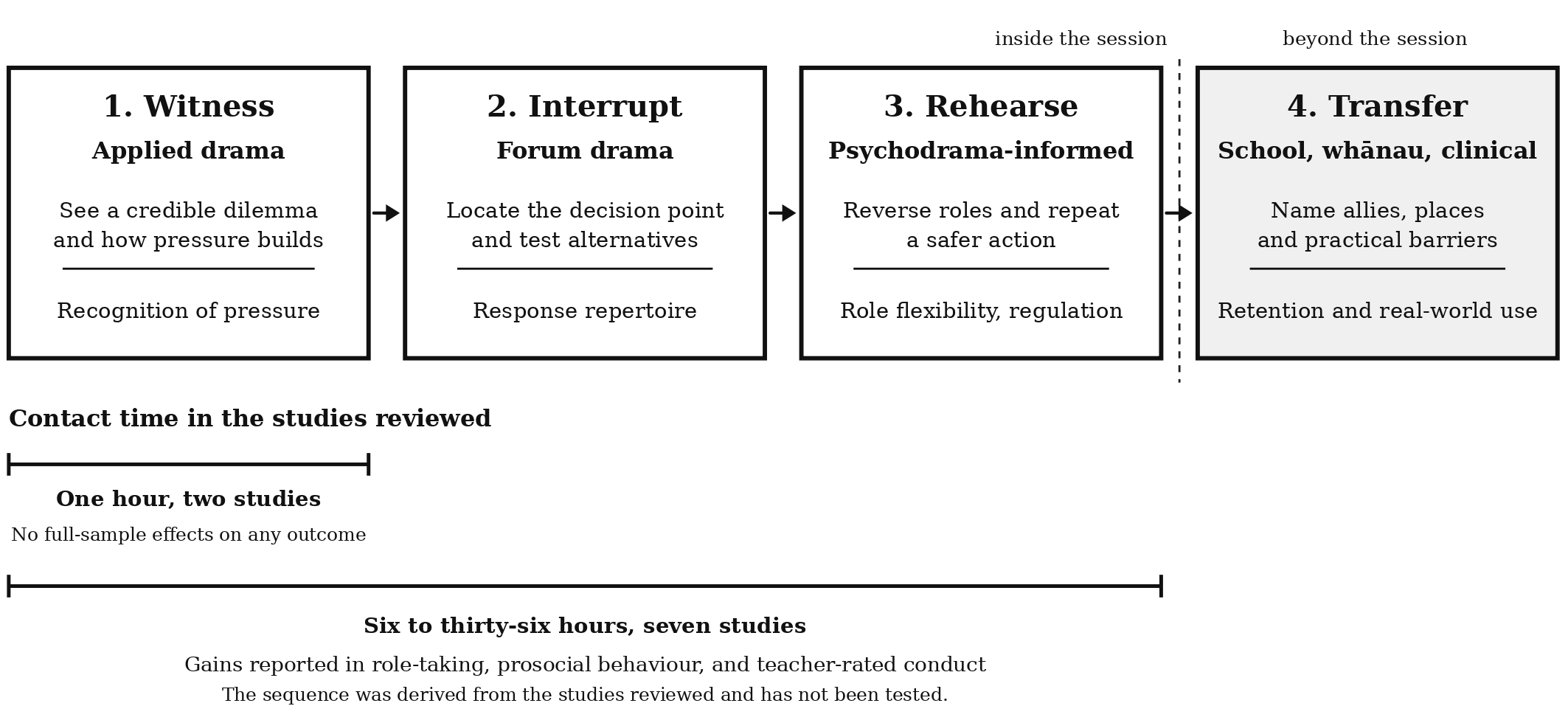
The programs that reported effects shared a sequence of activities that the single-session programs did not. Figure 1 sets out that sequence in four stages, Witness–Interrupt–Rehearse–Transfer, with a different technique suited to each.
In the first stage, applied drama presents a fictional situation in which pressure builds towards a harmful choice, and the group watches it together. In the second, forum theater stops the scene and asks the audience to find the moment where a different decision was possible, then try one. In the third, psychodrama-informed techniques such as role reversal and repeated enactment let participants practice that decision more than once, in front of the peers. The fourth stage happens after the session, when teachers, caregivers, and youth workers reinforce the same response, and when the group that rehearsed it together can practice these skills in the real world. Conditions such as unsafe housing or school exclusion also shape whether a young person offends, and a drama program cannot change them.
The four stages describe what the programs reporting changes in proximal outcomes had in common and what the two single-session programs left out. A single performance delivers the first stage. No study set out to test whether the four stages matter, or whether some matter more than others, so the sequence is a description of what these programs did rather than evidence that each stage is necessary. The group delivery format used throughout all the studies in this review is also untested. It is unclear the effect of group delivery on outcomes, or if they would be just as effective on an individual level.
Maximizing Usefulness for Different Groups
Seven of the nine controlled studies evaluated applied drama or theater and two evaluated psychodramas. Both psychodrama studies11,21 were rated weak for risk of bias, both formed their groups from adolescents who self-selected into the study, and both worked with samples no larger than 21 adolescents involved in the justice system. The applied drama studies are larger and better rated methodologically, but were delivered in mainstream schools. Applied drama and psychodrama have therefore been tested in different populations, at different scales, and to different methodological standards, so their findings cannot be pooled or appropriately compared.
No study compared applied drama with psychodrama-informed practice directly. Applied drama can remain fictional and low-disclosure, which suits delivery to a whole school population or to a group identified as at raised risk. Psychodrama-informed practice asks more of participants and of facilitators, and its greater intensity calls for containment, trained facilitation, and a referral pathway, which suits smaller groups already showing difficulties. Any program should be delivered by someone whose training matches its intensity, a distinction the Office of Juvenile Justice and Delinquency Prevention draws between arts-based programs, which are educational, and arts therapies, which require certified practitioners27. Table 3 compares the two forms across delivery setting, disclosure, facilitator training, and risk.
| Applied drama | Psychodrama-informed practice | |
|---|---|---|
| Delivered to | Whole classes or groups at raised risk | Small groups already showing difficulties |
| Disclosure | Stays fictional; low personal disclosure | Higher emotional intensity; personal material possible |
| Facilitator | Theater practitioner with safeguarding training | Qualified practitioner with supervision |
| Main risks | Moralizing, passive watching, unrealistic solutions | Distress, unintended disclosure, situations beyond the facilitator’s training |
More intensive work is not better by default, and Table 3 sets out the risks that come with it. Some programs will not be able to reach the contact time provided by the studies that reported effects. Such a program can reasonably claim to raise awareness, but it should not be presented as a programme shown to reduce offending.
One further caution applies to programs for young people already at risk. Grouping high-risk adolescents together can reward antisocial talk and create harmful relationships28. Where possible, intensive work should be delivered in mixed groups, and the facilitator should be able to recognize when a group starts rewarding offense talk and step in. No study compared mixed groups with groups selected for risk. How to weigh this caution against the case for reaching those at highest risk is therefore untested.
No study reported outcomes by ethnicity or cultural setting, so whether these methods work equally well across groups is unknown, and whether they apply to rangatahi Māori is untested. The content of these methods comes from participants rather than from a fixed curriculum, so scenes reflect pressures and relationships recognised by a particular group. Whether that makes them more transferable across cultural settings has not been tested.
A program intended for rangatahi Māori would need to meet the standards set out in Te Ara Tika, which describes a progression from consultation at a minimum, through substantial engagement with Māori communities, to research designed and conducted by Māori with Māori as co-constructors of the project29. The over-representation described earlier reflects not only what young people do, but decisions made about them, including whether police take formal action, whether a case reaches court, and whether a young person is remanded. A program that changes only the young people would leave those decisions untouched.
Limitations
This review is narrative. The search was not exhaustive and was not registered in advance, so relevant work may have been missed, and no pooled effect size can be estimated here. Only English-language material was read, which may under-represent work published in other languages, and the studies retrieved were conducted in North America, Europe, and Turkey. This review draws on published systematic reviews, so any errors in their appraisals carry through here. Studies within those reviews were screened solely by title and description, so a study meeting the criteria may have been missed. Screening, selection and risk-of-bias assessment were carried out by a single reviewer, with no second screener and no measure of inter-rater agreement. Additionally, small studies reporting no effect are published less often than those that do, so the studies available for this review may over-represent positive findings.
Contact time and reported results are described here as a pattern across nine studies that differed in design, population, and outcome measure. No study tested the relationship directly, and nine studies are too few to test it statistically. The youth justice figures can also move for reasons other than a change in offending, since small populations produce unstable rates, and reporting practices and the system itself both change over time.
Directions for Future Research
The most useful trial would hold content and contact constant while varying only the drama component. A factorial design would go further, separating four elements that no study in this review isolated: whether the material is delivered through drama, whether participants rehearse or only watch a response, who facilitates the program and with what training, and how many hours are provided. Zucker et al.19 ran a version of this comparison but not against a verified offending outcome. Outcomes could be scored by people who do not know which students took part, watching how each young person responds to a situation they have not rehearsed. When offending is the outcome of interest, official records would remove the rater from the outcome altogether. A longer-term follow-up would allow durability of effect to be measured.
Three reporting practices would make the literature comparable. Studies should report contact time in hours, not sessions, and treat it as a variable to be tested. Outcomes should be distinguished by level, separating psychological capacities from intermediate behaviors and from offending, so that a change in attitude is not reported as a reduction in offending. Measures taken at the group level, such as classroom norms, would allow the group mechanism to be tested. Finally, outcome raters should be blind to condition wherever possible, since the studies reviewed here relied on teachers who knew which classes had received the program.
Whether contact time explains the pattern across these studies could be answered by a trial varying only the length of a program. Additionally, whether the method works differently for different groups would need studies reporting outcomes by ethnicity and cultural setting.
Conclusion
A young person may know the safer option and still be unable to choose it when friends are watching. Applied drama can stage that moment and give a group the chance to stop and examine it. Psychodrama-informed practice can go further, letting participants take other roles and repeat a response until it becomes familiar. Whether either reduces future offending is not yet known, because the question has barely been asked. What can be said is that drama gives young people a place to practice a safer response, and that practicing a response has not been shown to reduce offending.
References
- A. Petrosino, C. Turpin-Petrosino, M. E. Hollis-Peel, J. G. Lavenberg. Scared straight and other juvenile awareness programs for preventing juvenile delinquency. Cochrane Database of Systematic Reviews. pg. CD002796, 2013 https://doi.org/10.1002/14651858.CD002796.pub2 [↩] [↩]
- S. Ahmed, L. Foulkes, J. T. Leung, C. Griffin, A. Sakhardande, M. Bennett, D. L. Dunning, K. Griffiths, J. Parker, W. Kuyken, J. M. G. Williams, T. Dalgleish, S. J. Blakemore. Susceptibility to prosocial and antisocial influence in adolescence. Journal of Adolescence. Vol. 84, pg. 56–68, 2020 https://doi.org/10.1016/j.adolescence.2020.07.012 [↩]
- J. Chein, D. Albert, L. O’Brien, K. Uckert, L. Steinberg. Peers increase adolescent risk taking by enhancing activity in the brain’s reward circuitry. Developmental Science. Vol. 14, pg. F1–F10, 2011 https://doi.org/10.1111/j.1467-7687.2010.01035.x [↩]
- M. Gardner, L. Steinberg. Peer influence on risk taking, risk preference, and risky decision making in adolescence and adulthood: an experimental study. Developmental Psychology. Vol. 41, pg. 625–635, 2005 https://doi.org/10.1037/0012-1649.41.4.625 [↩]
- L. Steinberg, S. Graham, L. O’Brien, J. Woolard, E. Cauffman, M. Banich. Age differences in future orientation and delay discounting. Child Development. Vol. 80, pg. 28–44, 2009 https://doi.org/10.1111/j.1467-8624.2008.01244.x [↩]
- M. Berghs, C. Henquet, C. Vissers, S. Van Hooren. Psychodrama for children and adolescents: a systematic review of therapeutic effects, changes and underlying processes. Children and Youth Services Review. Vol. 181, pg. 108733, 2026 https://doi.org/10.1016/j.childyouth.2025.108733 [↩] [↩] [↩] [↩] [↩]
- Ministry of Justice. Youth justice indicators summary report. https://www.justice.govt.nz/justice-sector-policy/research-data/justice-statistics/youth-justice-indicators/ 2026 [↩] [↩]
- Effective Public Health Practice Project. Quality assessment tool for quantitative studies. Effective Public Health Practice Project https://www.ephpp.ca/quality-assessment-tool-for-quantitative-studies/ 1998 [↩]
- B. H. Thomas, D. Ciliska, M. Dobbins, S. Micucci. A process for systematically reviewing the literature: providing the research evidence for public health nursing interventions. Worldviews on Evidence-Based Nursing. Vol. 1, pg. 176–184, 2004 https://doi.org/10.1111/j.1524-475X.2004.04006.x [↩]
- M. Berghs, A.-E. J. C. Prick, C. Vissers, S. van Hooren. Drama therapy for children and adolescents with psychosocial problems: a systematic review on effects, means, therapeutic attitude, and supposed mechanisms of change. Children. Vol. 9, pg. 1358, 2022 https://doi.org/10.3390/children9091358 [↩] [↩] [↩]
- P. Carpenter, S. Sandberg. Further psychodrama with delinquent adolescents. Adolescence. Vol. 20, pg. 599–604, 1985 [↩] [↩] [↩] [↩] [↩] [↩] [↩] [↩] [↩]
- A. Fullchange, J. D. Sharkey. Experience and outcomes of a theatre intervention for youth on probation and their university peers. Applied Psychology in Criminal Justice. Vol. 14, pg. 70–85, 2018 [↩] [↩]
- L. Mansfield, N. Daykin, N. E. O’Connell, D. Bailey, L. Forde, R. Smith, J. Gifford, G. Ashdown-Franks. A mixed methods systematic review on the effects of arts interventions for children and young people at-risk of offending, or who have offended on behavioural, psychosocial, cognitive and offending outcomes. Campbell Systematic Reviews. Vol. 20, pg. e1377, 2024 https://doi.org/10.1002/cl2.1377 [↩] [↩] [↩]
- J. Agley, M. Jun, L. Eldridge, D. L. Agley, Y. Xiao, S. Sussman, L. Golzarri-Arroyo, S. L. Dickinson, W. Jayawardene, R. Gassman. Effects of Act Out! social issue theater on social-emotional competence and bullying in youth and adolescents: cluster randomized controlled trial. JMIR Mental Health. Vol. 8, pg. e25860, 2021 https://doi.org/10.2196/25860 [↩] [↩] [↩] [↩] [↩] [↩]
- B. Kisida, D. H. Bowen, A. Diemer, G. Frankel. Say something, do something: the impact of participatory theater on preventing and reducing violence and bullying. Arts Education Policy Review. Vol. 127, pg. 120–128, 2026 https://doi.org/10.1080/10632913.2025.2476958 [↩] [↩] [↩] [↩] [↩]
- M. J. Chandler. Egocentrism and antisocial behavior: the assessment and training of social perspective-taking skills. Developmental Psychology. Vol. 9, pg. 326–332, 1973 https://doi.org/10.1037/h0034974 [↩] [↩] [↩] [↩] [↩] [↩] [↩] [↩]
- J. S. Catterall. Enhancing peer conflict resolution skills through drama: an experimental study. Research in Drama Education. Vol. 12, pg. 163–178, 2007 https://doi.org/10.1080/13569780701321013 [↩] [↩] [↩] [↩] [↩] [↩]
- C. Kisiel, M. Blaustein, J. Spinazzola, C. S. Schmidt, M. Zucker, B. van der Kolk. Evaluation of a theater-based youth violence prevention program for elementary school children. Journal of School Violence. Vol. 5, pg. 19–36, 2006 https://doi.org/10.1300/J202v05n02_03 [↩] [↩] [↩] [↩] [↩] [↩]
- M. Zucker, J. Spinazzola, A. A. Pollack, L. Pepe, S. Barry, L. Zhang, B. van der Kolk. Getting teachers in on the act: evaluation of a theater- and classroom-based youth violence prevention program. Journal of School Violence. Vol. 9, pg. 117–135, 2010 https://doi.org/10.1080/15388220903479628 [↩] [↩] [↩] [↩] [↩] [↩]
- K. Joronen, A. Konu, H. S. Rankin, P. Åstedt-Kurki. An evaluation of a drama program to enhance social relationships and anti-bullying at elementary school: a controlled study. Health Promotion International. Vol. 27, pg. 5–14, 2012 https://doi.org/10.1093/heapro/dar012 [↩] [↩] [↩] [↩] [↩] [↩]
- Ç. Şimşek, L. Küçük, E. A. Yıldırım. The effect of psychodrama on the tendency to violence and social adaptation in adolescents whose families are involved in crime. Journal of Academic Research in Nursing. Vol. 12, pg. 24–30, 2026 https://doi.org/10.55646/jaren.galenos.2026.04379 [↩] [↩] [↩] [↩] [↩] [↩] [↩] [↩]
- J. Turner. Making amends: an interventionist theatre programme with young offenders. Research in Drama Education. Vol. 12, pg. 179–194, 2007 https://doi.org/10.1080/13569780701321062 [↩]
- P. Barone, V. Berni, C. Palmieri, S. Vaccaro. ‘Like an earthquake in a submarine’: the social and institutional impact of a theatre laboratory programme at the ‘C. Beccaria’ youth detention centre in Milan. Research in Drama Education. Vol. 26, pg. 542–560, 2021 https://doi.org/10.1080/13569783.2021.1944803 [↩]
- K. L. Gilbert, E. A. Baker, K. Bain, J. Flood, J. Wolbers. Say something, do something: evaluating a forum theater production to activate youth violence prevention strategies in schools. International Journal of Environmental Research and Public Health. Vol. 21, pg. 39, 2024 https://doi.org/10.3390/ijerph21010039 [↩]
- J. A. Durlak, R. P. Weissberg, A. B. Dymnicki, R. D. Taylor, K. B. Schellinger. The impact of enhancing students’ social and emotional learning: a meta-analysis of school-based universal interventions. Child Development. Vol. 82, pg. 405–432, 2011 https://doi.org/10.1111/j.1467-8624.2010.01564.x [↩] [↩]
- M. W. Lipsey, N. A. Landenberger, S. J. Wilson. Effects of cognitive-behavioral programs for criminal offenders. Campbell Systematic Reviews. Vol. 3, pg. 1–27, 2007 https://doi.org/10.4073/csr.2007.6 [↩]
- Office of Juvenile Justice and Delinquency Prevention. Arts-based programs and arts therapies for at-risk, justice-involved, and traumatized youths. https://ojjdp.ojp.gov/model-programs-guide/literature-reviews/arts-based-programs-and-arts-therapies-risk-justice-involved-and-traumatized 2021 [↩]
- T. J. Dishion, J. McCord, F. Poulin. When interventions harm: peer groups and problem behavior. American Psychologist. Vol. 54, pg. 755–764, 1999 https://doi.org/10.1037/0003-066X.54.9.755 [↩]
- Pūtaiora Writing Group. Te Ara Tika guidelines for Māori research ethics: a framework for researchers and ethics committee members. https://www.hrc.govt.nz/sites/default/files/2019-06/Resource%20Library%20PDF%20-%20Te%20Ara%20Tika%20Guidelines%20for%20Maori%20Research%20Ethics_0.pdf 2010 [↩]