
Abstract
Artificial intelligence (AI) and digital technologies are increasingly being integrated into school education. However, access to technology does not automatically translate into meaningful educational use or equivalent learning opportunities. This study examines the conditions surrounding the educational application of technology—beyond access—within the context of AI education policy for primary and secondary schools in South Korea. The study reviews AI and digital education policy documents. It synthesizes 18 domestic empirical studies published since 2022, categorizing findings by student, teacher, school, and socioeconomic levels. The analysis distinguishes between the expectations and the outcomes reported in empirical research; policy goals themselves are not treated as evidence of educational impact. South Korea’s AI education policy encompasses not only the provision of technology but also personalized learning, the enhancement of teacher competencies, leading-school initiatives, and broader institutional support for schools. A synthesis of the literature identifies conditions: students’ AI and digital use capabilities, teachers’ capacity for lesson design, assessment, and feedback, and the technical and organizational support environments within schools. It cannot be concluded that these conditions causally improve students’ educational outcomes or educational equity. This study proposes a “conditional explanatory framework” that distinguishes between access to technology, actual use, pedagogical integration, meaningful learning experiences, and educational opportunities and outcomes. The findings suggest that when evaluating equity in AI education, it is essential to consider not merely the provision of technology, but also the quality and distribution of the conditions that enable technology to be used meaningfully.
Keywords: AI education; educational inequality; digital divide; education policy; pedagogical integration; implementation conditions
Introduction
Research Background and Problem Statement
Artificial intelligence and digital technology are changing school education. Data provision and learning diagnosis methods are becoming different. Feedback and lesson design methods are also changing. In related tools, there are generative AI and learning analytics. There are also AI-based courseware and digital textbooks. These tools can analyze students’ responses and learning records. They can also provide materials by level. These functions can support personalized learning1,2. In Korea also, AI digital textbook policy was promoted. Digital-based lesson innovation was also promoted together. The policy combined teacher capacity strengthening and school infrastructure expansion3. Device, network, platform access is the basic condition of AI education participation. If there is no necessary technology, it is difficult to participate in related learning activities. There is a need to reduce the access difference of school and home. This is the work of securing the formal foundation of educational opportunity. OECD also emphasizesa stable connection network and high-quality digital resources. It presents these as the condition of a fair digital education system4. Accessibility expansion and educational utilization are not identical. Even if students use devices frequently, information search, evaluation, production ability can be different. Competency to review AI results can also be different. Only with a teacher’s technology use experience, it is difficult to judge professionalism. We must separately look at AI-based lesson design competency. We must also look at learning data interpretation and feedback competency5,6. We must analyze the use method and support conditions after access. Otherwise, we can misunderstand supply or use as educational opportunity expansion. Digital divide research expanded beyond physical access. It has also dealt with the difference of utilization and results. van Dijk7 divided access, utilization ability, use into a continuous process. Ragnedda and Ruiu8 paid attention to the conversion of resources. Educational and social benefits of technology are combined with an individual’s resources. Cultural, economic, social resources correspond to this. Equity of AI education also is not limited to technology possession status. It must also include the distribution of competency and support to convert into learning opportunity.
The Ministry of Education policy document connects accessibility expansion and customized learning. It presents learning information analysis of AI digital textbooks. It also presents data provision by level and feedback provision. It demands lesson adjustment utilizing learning information from teachers. Teacher training and leading school operation are also included in the plan. Digital infrastructure support is also included3. Therefore, it cannot be seen as a policy that emphasized only device supply. The path between policy instruments and expected results has not been sufficiently concrete. With only AI tool provision, students’ utilization capability cannot be guaranteed. Ability to critically judge results is needed. Domestic empirical research shows differences in execution conditions. Student research distinguished daily use and learning-related literacy. In generative AI utilization, the problem of prompt composition was reported. Reliability judgment of results and the necessity of teacher feedback were also reported9,10. Teacher research divided AI and digital competency into several areas. These areas included not only technology utilization but also instructional design, evaluation, and feedback. Professional collaboration was also included. Collaboration between teachers was related to digital competency. Usefulness of school resources was also a related condition11. These studies do not directly prove the educational gap mitigation effect of the policy. They do not directly prove the educational gap expansion effect either. The majority are based on self-report surveys or perception surveys. There are also studies that used short-term programs or qualitative interviews. Measurement data of long-term achievement and equity changes between schools are limited. Therefore, results of accessibility expansion cannot be concluded. There is a need to distinguish conditions reported after access. Conditions regarding actual use and transition into learning opportunities are the targets. AI education is not separated from the existing educational gap. Korea’s academic achievement and educational path have been related to family background. Household income, parental education, private education expenses, and region are related conditions12,13. In the relationship between online learning and achievement, there was a need to consider household income. There was a need to consider parent and teacher relationships together as well14. These studies did not directly verify the AI utilization gap. They just show an educational environment with differences in resources and support. AI-based learning is introduced to this environment. This research analyzes the accessibility goal of the policy and execution conditions of empirical research together. This distinction prevents misunderstanding policy input as results. Generalizing limited research as the effect of the whole policy is also guarded against.
This study separates technology access from educational equity. It integrates post-access implementation conditions across student, teacher, school, and socioeconomic levels. It also distinguishes policy goals from empirically observed outcomes. It identifies processes and conditions for subsequent empirical testing.
Research Purpose and Research Questions
This study examined AI education policies for primary and secondary schools in South Korea. It focused on educational application following access to technology. It also examined conditions related to learning opportunities. The study identified the relationship between technology access and personalized learning within policy documents. It also investigated the roles of teachers and school support. Domestic empirical studies were reviewed to compare factors related to students, teachers, schools, and socioeconomic conditions. By analyzing both sources together, the study outlined the conditions following technology access. Based on this, a conditional explanatory framework was constructed. This framework serves as an analytical tool for future empirical research. This study did not test causal effects between variables.
RQ1. How does South Korea’s AI education policy link access to technology with personalized learning and educational equity? What implementation conditions are assumed at the student, teacher, and school levels in this process?
RQ2. How do students’ AI and digital use capabilities, teacher professional capacity, school implementation capacity, and socioeconomic conditions appear in domestic empirical studies?
RQ3. When policy analysis and domestic empirical research are synthesized, how can educational use following technology access be organized into a conditional structure?
Theoretical Background
From Access Gap to Utilization Gap
Early digital divide discussions focused on computer and internet access. Device possession and network connection determined participation status. Use cost was also an important physical condition. This access gap is also important in digital education. After technology supply, it became difficult to explain inequality only with access. Even if people use similar devices and services, the use purpose can be different. Utilization ability and obtained benefits can also differ by individual and group. van Dijk7 explained the gap as a continuous process. It is a process where motivation, material access, utilization ability, and actual use follow. Accessibility does not guarantee use ability or utilization performance. In AI education, the distinction between access and utilization is more important. Generative AI and learning analytics go beyond information reading. They also participate in performance diagnosis and feedback provision. Even if students use the same tool, learning experiences can differ depending on the activity level. Even if the access gap decreases, the utilization gap can persist.
Ragnedda and Ruiu8 paid attention to the benefits of digital technology. Benefits are combined with an individual’s social, cultural, economic resources. Technology access alone cannot guarantee the same conversion ability. The ability to convert into useful information and learning opportunities is different. In the educational environment also, technology does not operate independently. Self-regulation, parents’ learning support, school teaching environment can also be related. The perspective of digital capital does not attribute utilization differences only to individual ability.
Pedagogical and Learning Nature of AI education
The educational value of AI depends on the role it plays in teaching and learning. It cannot be judged only by the function of technology. AI can diagnose the learning state. It can also recommend materials or provide immediate reactions. The degree of educational help depends on lesson goals and task structures. It also depends on the teacher’s judgment and student participation method.
Holmes et al.1 presented the educational utilization possibility of AI. Learner support, evaluation, and teaching activities are the targets. However, application must be made within the professional judgment of the teacher. Educational goals must also become the standard.
AI education is interpreted as a social and institutional process15. Meaningful integration is a process of connecting technology functions and subject contents. Teaching methods and learner characteristics also interlock together. It means the case where technology supports rather than replaces existing lessons.
Lesson application requires an understanding of the functions and limitations of technology. Teachers must be able to connect this to subject contents and teaching methods. Professionalism is not limited to tool manipulation ability. It also includes the ability to interpret learning data and evaluate AI recommendations. Activities must be designed appropriately for student levels and lesson goals. Feedback must also be able to be designed appropriately for them. Teacher professionalism is difficult to separate from the organizational conditions of the school. A school’s institutional execution capacity is organizational ability. It is the ability to convert policies and technology into daily educational activities. Stability of devices and networks is included. Administrator adjustment, teacher collaboration, and lesson research conditions also correspond to this. Selwyn16 emphasizes a school’s institution, culture, and practice. It means that educational technology must be analyzed in that context. Technology failure must not be explained only by teachers’ attitude or ability.
Socioeconomic Conditions and Educational Equity
AI and digital learning are introduced into an environment where existing educational inequality exists. Household income, parental education level, and private education are related conditions. Region and school resources are also related. They are also related to the educational experiences that can be used. Socioeconomic conditions cannot be concluded to be the direct cause of AI educational performance. Domestic data that measured family background and AI utilization together are limited.
Derivation of Analytical Categories
This study examined the conditions for AI education across four levels. The first is the student level. It looked at AI and digital literacy. It also included the ability to make critical judgments and self-regulation, as well as subject-matter knowledge.
The second is the teacher level. It examined lesson design and the interpretation of learning data. Competencies in assessment and feedback were also considered.
The third is the school level. It included school infrastructure and technical support. Administrative support and teachers’ professional learning were also examined. Collaboration among teachers was also viewed as a condition at the school level.
The fourth is the socio-economic level. It considered household resources and parental support for learning. It also included learning environments outside of school. The four levels were not viewed as conditions operating independently of one another.
They were used as analytical categories to examine the educational application of technology across various levels. The relationships between these categories are addressed within a conditional explanatory framework.
Table 1 summarizes the operational definitions of the core analytical concepts, indicators identifiable in existing research, and directions for future measurement. Capability-based inequality is not treated as an observed outcome of this study. It is a concept for future testing of whether disparities in use and learning opportunities emerge among students or schools with similar levels of access.
| Core concept | Operational definition in this study | Indicators identified in the current literature | Examples of measurement in future empirical research |
| Technology access | A state in which students and teachers can actually access AI and digital learning resources | Availability of devices, connectivity, and platforms | Student-level device access, connection stability, account availability, and actual login records |
| Student use capabilities / actual use | The ability to generate, evaluate, revise, and use AI outputs in accordance with learning purposes | AI and digital literacy, critical evaluation, prompting, self-regulation | Performance-based AI literacy assessment, prompt and revision logs, analysis of actual student work |
| Teacher professional capacity | Professional capacity to connect AI technology with subject goals, learner characteristics, assessment, and feedback | AI and digital competence, instructional design, data interpretation, feedback capability | Validated teacher-competence scales, lesson-plan analysis, observation-based assessment, training completion and performance |
| School implementation capacity | A school’s organizational capacity to translate teacher capabilities and technological resources into sustained instructional implementation | Infrastructure, technical support, administrative support, training, collaboration | IT support personnel, collaboration time, administrative support, training hours, infrastructure stability |
| Pedagogical integration | The extent to which AI is intentionally connected to subject goals, explanation, tasks, assessment, and feedback rather than merely used | Design of personalized activities, use of learning data, feedback, instructional adjustment | Classroom-observation rubric, lesson plans, AI-supported tasks, teacher feedback records |
| Socioeconomic conditions | The distribution of household and regional resources that may differentiate opportunities for AI-based learning inside and outside school | Household income, parental education, private education, relational support | Income, parental education, private-education expenditure, region, home devices and learning space |
| Meaningful learning experiences | Learning experiences that go beyond access and involve cognitive engagement, evaluation of outputs, and use of feedback | Engagement, perceived usefulness, use of feedback, self-regulation | Behavioral logs, performance tasks, classroom participation, rate of feedback incorporation |
| Capability-based inequality | A proposed outcome concept for future testing: group differences in the capabilities and supports associated with educational use under comparable levels of technology access | Not directly measured in the current studies | Compare patterns of access, educational use, and learning outcomes across socioeconomic groups and schools |
Note. ‘Examples of future measurement’ are not data used in this study but candidate measures for future empirical testing of the framework.
Research Methods
Research Design
This research is a conceptual policy analysis. It analyzes the accessibility and equity relationship of Korean AI and digital education policies. It also synthesizes the execution conditions of domestic empirical research. It combined policy document analysis and structured literature synthesis. Independent survey, experiment, interview, and comparison data between schools were not collected.
The analysis proceeded in three stages. First, we analyzed policy documents. Next, we synthesized domestic primary empirical research. Finally, we composed a conditional explanatory framework.
Here, “conditional” refers to the possibility that the expected results of the policy differ by condition. Student, teacher, school, and socioeconomic conditions are the targets. It does not mean that causal effects between variables have been verified.
Selection and Analysis of Policy Documents
This study examined government documents related to AI education in South Korean elementary and secondary schools. A key document is the Ministry of Education’s “Plan for Digital-Based Education Innovation.” This document includes provisions for AI-powered digital textbooks. It also covers teacher capacity building and school support. Strategies for integrating digital technology into classroom instruction are presented as well.
The analysis began by identifying the problems the policy aims to address. Next, the study examined the proposed methods for expanding access to technology and the envisioned roles of AI and digital technology in education. The study also looked at teacher roles, school support, and student participation. The study further examined the link between technological access and educational opportunities and equity.
A distinction was made between the content explicitly stated in the documents and the researcher’s interpretations. Relationships explicitly presented in the documents were classified as “explicit policy logic.” Relationships inferred from the document’s structure or content were classified as “implicit policy logic.” In such cases, it was clearly noted that the findings represented the researcher’s interpretation.
The documents analyzed and the necessary supporting evidence are summarized in Table 2. To ensure the accuracy of the data, they were cross-checked against official government sources.
| Document title | Issuing institution | Publication date | Language | Scope/location analyzed | Inclusion criterion | Evidence extracted | Analytical role | URL/DOI |
| Digital-based education Innovation Plan | Ministry of Education, Republic of Korea | 2023. 2. 23. | Korean | Policy Tasks 1–5 and corresponding items in the official Policy Briefing announcement | Official central-government document directly presenting the goals, instruments, and implementation support of Korea’s elementary and secondary AI and digital education policy | AI digital textbooks, personalized learning, teacher roles, T.O.U.C.H. teacher group, leading schools, infrastructure and school support | Identifies the goals, policy instruments, and implementation-support structure of Korean policy. Policy goals are not used as evidence of actual educational effects. | https://www.moe.go.kr/boardCnts/viewRenew.do?boardID=72769&boardSeq=94551&lev=0&se= |
| OECD Digital Education Outlook 2023: Towards an Effective Digital Education Ecosystem | OECD | 2023. 12. 13. | English | Executive Summary and chapters/sections related to the digital ecosystem, teacher competence, and equitable use of AI | Official report addressing access, use, governance, and teacher competence in AI and digital education from an international comparative perspective | Access, teacher competence, curriculum integration, data and governance, effective and equitable use of AI | Provides international context and analytical categories for interpreting Korean policy | DOI: 10.1787/c74f03de-en |
| Shaping Digital Education: Enabling Factors for Quality, Equity and Efficiency | OECD | 2023. 7. 11. | English | Executive Summary; sections on equity, infrastructure, competence, and evaluation in Chapters 1, 3, 6, 7, and 9 | Official report systematically addressing quality, equity, efficiency, and enabling policy conditions in digital education | Need for connectivity and access to digital resources, pedagogical integration, infrastructure, capacity building, monitoring | Contextual source for balanced interpretation of the role of access and the need for post-access implementation conditions | DOI: 10.1787/bac4dc9f-en |
| Guidance for Generative AI in Education and Research17 | UNESCO | 2023. 9. | English | Chapters/sections on teacher roles, AI literacy, accuracy, bias, privacy, and human-centered use | Official UNESCO guidance addressing conditions and risks associated with the educational use of generative AI | Teacher judgment, evaluation of AI outputs, ethics and privacy, AI literacy, human-centered use | Contextual source specifying judgment and capability conditions required for translating AI’s technical functions into educational use | DOI: 10.54675/EWZM9535 |
Note. ‘Scope/location analyzed’ indicates the pages, policy tasks, chapters, or sections actually reviewed. Because page numbering in the Ministry of Education HWP/HWPX files may vary depending on the viewing environment, policy tasks and section titles were used as location markers instead of fixed page numbers. OECD and UNESCO materials were used as contextual sources for interpreting access, equity, teacher roles, and implementation conditions, not as evidence of the effects of Korea’s AI education policy. Goals and expectations stated in policy documents were distinguished from observed student outcomes.
Selection of Domestic Empirical Studies
The final search and bibliographic verification were performed. The period was from July 1 to July 15, 2026. Korea Citation Index (KCI) was used as the primary data source. RISS and Google Scholar were auxiliary data sources. They were utilized to cross-check original texts and bibliographic information. Search terms were composed as follows. ‘AI education’, ‘generative AI’, ‘AI digital textbook’ were used. ‘Student AI literacy’, ‘digital literacy’ were also used. ‘Teacher AI competency’, ‘teacher digital competency’ were also included. ‘School support’, ‘technology integration’, ‘learning analytics dashboard’ were also used. ‘Online learning’, ‘educational gap’, ‘household income’, ‘parental education’ were also included. Each search term was used alone or in an AND combination.
DOIs were cross-checked in the journal original text and KCI registration information. DOI connection information was also confirmed. This procedure does not claim a complete systematic literature review. It is a procedure to secure the selection ground and traceability of the research. For this, structured re-search and verification were performed. Inclusion criteria are as follows. It is primary research that analyzed Korean primary and secondary student, teacher, and school data. The sample and method must be clear. It must be related to AI and digital utilization or student experience. Studies related to teacher professionalism, school support, and educational inequality are also included. Original text and DOI or official bibliographic information must be checkable. Conceptual papers, policy proposals, and literature reviews were excluded. Technology development performance evaluation was also excluded. Research targeting only university students and adult learners was also excluded. We secured 20 candidate papers from the search and existing citation list. We reviewed the full text. Exclusion criteria were two types. (a) Cases where the original text or research design could not be reliably specified. (b) Cases where comparison of the bibliographic record with the actual study content showed that the study did not meet the analytical scope. The 2 excluded papers corresponded to one of the two criteria. With existing records, the number of papers by reason could not be confirmed. Therefore, numerical figures by reason were not presented. The final analysis target is 18 domestic primary empirical studies. The analysis included 6 papers on student experience and 6 papers on teacher professionalism. 4 papers on school execution environment and 2 papers on socioeconomic educational gap were also included. One main category was assigned to each study. The same standard was applied to research related to multiple categories as well. The main research question and measurement target were taken as the classification standard.
Table 3 arranges the 18 papers into four analysis levels. It is an arrangement to track the conversion after access by level. Student research deals with actual use and utilization competency. Teacher research deals with instructional design and data interpretation. School research deals with organizational conditions that support execution. Socioeconomic research provides the context of the existing educational gap. The four categories are not data measuring the same effect. Therefore, they were not summed up by effect size. The connection possibility between conditions was compared within the scope allowed by each study.
| Category | Study | Sample / method | Key variables / indicators | Key findings | Analytical role in this study |
| Student | Lee9 | 378 high school students; survey | Types/frequency of digital activities, digital literacy self-efficacy | Everyday entertainment and communication activities were common, while learning and information activities showed relatively stronger associations with self-efficacy | Distinguishing access from use |
| Student | Seo & Kim18 | 47 teachers and 446 students; needs analysis | Instructional preferences, activity grouping, devices, and expected benefits | Both groups favored combining chatbots with regular lessons. Reported preferences also concerned activity grouping and devices. | User needs |
| Student | Beik & Kwag14 | 1,145 low-income and 996 high-income 11th-grade students; panel data and structural modeling | Online learning, student–parent and student–teacher relationships, academic achievement, household income | Structural relationships among online learning, relationships, and achievement may differ across income groups | Socioeconomic context |
| Student | Lee & Jun19 | 1,034 middle school students; pre–post survey | Perceptions of generative AI, educational experience, expectations for use | Changes in AI-related perceptions were observed after short-term education, but interpretation as long-term competence improvement is limited | Short-term educational change |
| Student | Choi10 | 12 high school students; in-depth interviews | Generative AI writing, immediate feedback, prompting, reliability, self-regulation | Immediate feedback was evaluated positively, but concerns were raised about output reliability, prompting, and differences in students’ use capabilities | Actual use experience |
| Student | Ha & Jung20 | 3,959 middle and high school students; survey and school-level comparison | Critical evaluation, communication, creative and ethical competence, perceived learning usefulness | Multiple dimensions of AI literacy were associated with perceived learning usefulness, with differences analyzed by school level and experience | Structure of use capabilities |
| Teacher | Heo et al.5 | Includes 1,432 teachers nationwide; instrument development and validation | Three domains, nine competencies, and 30 behavioral indicators of AI and digital competence | Teachers’ AI and digital competence was organized into multidimensional behavioral indicators, and the measurement instrument was validated | Conceptualizing professional capacity |
| Teacher | Lee et al.6 | 1,617 teachers nationwide; training-needs analysis | Current and required competence, instructional design, personalized activities, feedback | High training needs were reported for designing personalized learning activities and feedback-related competencies | Training priorities |
| Teacher | Jang & Song11 | 3,231 teachers in Gyeonggi Province; survey and hierarchical regression | Digital competence, teacher collaboration, TPACK, motivational support, school resources | Teacher collaboration, TPACK, motivational support, and usefulness of school resources were associated with digital competence | Link to school conditions |
| Teacher | Hong et al.21 | 226 elementary and secondary teachers; survey | Tool-use experience, expectations for personalized learning, concerns about adoption, preparation needs | Expectations for personalized learning were reported alongside needs for teacher preparation and support | Policy–practice gap |
| Teacher | Kim & Kim22 | 130 secondary mathematics teachers; survey | Diagnostic and dashboard functions, personalized-learning functions, preparation burden, concerns about interaction | Expectations regarding technological functions coexisted with preparation burden and concerns about reduced interaction | Challenges of instructional integration |
| Teacher | Jung et al.23 | 4,713 teachers nationwide; survey and group comparison | AI and digital education implementation, knowledge and skills, student management, training needs | Differences by school level were reported in implementation difficulties, knowledge and skills, and training needs | Implementation status |
| School | Jung & Jeong24 | 1,000 teachers nationwide; latent-profile analysis and regression | Technology perception and use profiles, administrator and colleague receptiveness, infrastructure, training support | Heterogeneity in teacher-use profiles was identified, and school receptiveness and support environments were associated with profile membership | Types of support environments |
| School | Lim, Hong, and Lim25 | 226 AIEDAP master and leader teachers; survey | Infrastructure and space, workload, differences in student capabilities, training and support needs | Even actively involved teachers reported infrastructure, workload, student differences, and insufficient support as implementation constraints | Implementation constraints |
| School | Kim et al.26 | 56 teachers using AI digital textbooks; grounded-theory interviews | Digital environment, teacher and student factors, platform needs, instructional adjustment | Early implementation involved interactions among technological environment, teacher, student, and platform conditions, shaping adjustment processes | Early implementation process |
| School | Do et al.27 | 10 in-service teachers; case study and interviews | Dashboard use, interpretation of learning data, feedback | The study distinguished access to learning data from teachers’ interpretation and use of those data for feedback and personalized support | Use of data |
| Socioeconomic | Kim12 | Two longitudinal education cohorts; longitudinal comparison | Household income, parental education, private education expenditure, region, achievement and educational pathways | Differences in achievement and educational pathways by student background were observed across both periods | Context of pre-existing inequality |
| Socioeconomic | Lim, An, and Lee13 | Seoul Education Longitudinal Study cohorts 1 and 2; longitudinal data and FGI | Gender, family background, subject-specific achievement gaps | Family background was associated with achievement gaps in elementary and middle school, and changes over time were analyzed | Family–school conditions |
Data Extraction and Analysis
We extracted author, year, research target, and sample size from each study. School level and region were also recorded. We extracted research design, analysis method, and measurement concept. Core results and limitations were also confirmed. The analytical role in this research was also recorded.
Associations found in cross-sectional surveys and regression analyses were described as associations. They were not interpreted as causal relationships. Demands, expectations, and concerns were distinguished from actual performance or educational effects. Short-term pre- and post-changes were not interpreted as long-term performance. Interviews and grounded theory research were utilized to explain the execution process. However, the results were not generalized. Educational sociology research was used as the existing socioeconomic context. This is because the research did not directly verify AI and digital educational gaps. Research results were compared by analysis category instead of being summarized in individual paper order.
Integration of Policy Analysis and Empirical Research
Policy documents and empirical research have different data characteristics. We compared them after analyzing each. Policy documents show goals and policy instruments. Empirical research shows experiences and relevance of specific samples and viewpoints. First, we extracted the structure of access and expected results from policy documents. We identified the student, teacher, and school conditions that the structure presupposes. Afterwards, we compared these conditions with the results of domestic empirical research. The reported results regarding each condition were the targets of comparison. Technology access and actual use were distinguished. Teaching and learning integration and learning experience were also distinguished. Educational results were placed separately. Conditions to be related to stage transitions were structured as an explanatory framework.
Reliability and Limitations of the Analysis
This research is not a meta-analysis. The size of influence by condition cannot be compared. Each study has different samples and measurement tools. The proportion of self-report surveys is also high. Research directly connecting socioeconomic conditions and AI utilization is insufficient. Research results are a conceptual explanation regarding the execution process after access. This research does not definitively evaluate the effects of Korean AI and digital education policies.
Accessibility and equity logic of Korean AI and digital education policies
Policy Goals and Main Instruments
This section analyzes the plan of the 2023 policy document. It distinguishes the plan from field execution or observed performance. The Ministry of Education’s “Digital-based Education Innovation Plan” aims for customized education. It is education tailored to the student’s learning level and characteristics. For this, it proposes the utilization of digital technology. Policy instruments include the introduction of AI digital textbooks. Digital-based lesson innovation and teacher capacity strengthening are also included. Leading school operation and digital infrastructure expansion are also presented3 (policy tasks 1–5). The policy sets the AI digital textbook as a learning support tool. It presents learning information analysis and content provision by level. It also includes diagnosis and feedback provision in the plan. It demands the interpretation of learning data from teachers. It is the role of grasping the student’s understanding level. By that interpretation, lessons and feedback are to be adjusted. This is a role specified in the policy. It is not a result confirming actual performance3 (Ⅱ, p. 3; policy task 1). The policy does not state that AI replaces teachers. It presents teachers as learning designers and facilitators. It includes leading teacher cultivation and teacher training in the plan. Spread of lesson cases is also presented as a promotion task3 (policy tasks 2–3). The OECD distinguishes elements of an effective digital education system. Technology infrastructure and teacher capacity are included. Curriculum integration and data governance are also included2,4.
Policy Assumptions on Accessibility Expansion and Equity
In the policy, accessibility goes beyond device and network possession. It also includes the opportunity to use AI learning resources within schools. The provision of national-level platforms and textbooks is the policy instrument. This is interpreted as the provision of common learning tools. The policy document does not directly state that accessibility expansion reduces inequality. What this research confirmed is the arrangement of policy instruments. AI digital textbooks and common digital resources are presented. Customized learning, teacher capacity strengthening, and school support are also arranged together. The connection between accessibility expansion and equity improvement is interpreted as implicit policy logic. It is not interpreted as a definitive effect specified in the document. However, the actual conversion condition into learning opportunities needs separate verification. Accessibility means the possibility for students to use technology.
Execution Conditions Included in the Policy
Korean policy presents teacher training and leading teachers. Lesson model development and digital leading schools are also included. School-based improvement is also presented together3 (policy tasks 2–5). The Ministry of Education policy emphasizes teachers’ interpretation of learning information. The role of reflecting it in lessons and feedback is also presented3 (policy tasks 1–3). UNESCO guidelines emphasize accuracy review of generative AI. Bias and privacy problems are also presented as targets of review17. Whether actual performance occurs must be confirmed separately. Student utilization competency is less concrete than teacher and school conditions. The policy presents the importance of digital literacy and information education. However, the education and evaluation methods of the ability to review AI results are unclear.
Analytical Gaps Confirmed in Policy Design
Korean policy includes accessibility, teacher professionalism, and school support. It also includes customized learning. Therefore, it cannot be simplified as a policy that emphasized only technology supply. The relationship between policy instruments and expected results has not been sufficiently concrete. Teacher capacity cannot be judged with policy documents alone. Execution conditions between schools or learning performance cannot be judged either. The structure set by policy and field experiences must be distinguished.
Execution Conditions of AI and Digital Education Confirmed in Domestic Empirical Research
Utilization Competency and Learning Experience at the Student Level
This section includes AI-specific studies and broader digital education studies. The broader studies provide related evidence on post-access use and implementation. They are not direct evidence of AI education effects.
Student research distinguishes device possession and digital literacy. Use time also does not immediately mean high literacy. Lee9 surveyed 378 high school students nationwide. The main activity was watching smartphone videos. Messenger and social network service use was also high. Watching learning content showed a relatively high relevance with literacy efficacy. Information search and online text reading did so too. A similar difference is confirmed in students’ AI utilization. Lee and Jun19 surveyed 1,034 middle school students. They analyzed perception changes before and after generative AI education. However, it was difficult to view that it settled as a repetitive and systematic learning tool. Choi10 conducted in-depth interviews with 12 high school students. Students positively evaluated immediate AI feedback. However, they pointed out appropriate prompt composition as a problem. Judging the reliability of answers was also pointed out as a problem. Differences in learning competency by student were also pointed out. Seo and Kim18 compared the demands of teachers and students. It is the demand regarding English lessons utilizing AI chatbots. Students’ demands were related to lesson composition rather than technology functions. They were also related to interaction methods. Ha and Jung20 analyzed generative AI literacy. The targets were middle and high school students. They looked at the relationship with learning usefulness perception. They distinguished critical evaluation and communication. Creative utilization and ethical competency were also distinguished. Beik and Kwag14 analyzed high school students’ online learning. They dealt with parent and teacher relationships and academic achievement together. The structural relationship of these variables could differ depending on income groups. Teachers’ guidance and relational support can also be related. Whether this difference leads to long-term educational inequality has not been proven.
Teachers’ AI and Digital Competency and Teaching and Learning Integration
Teacher research does not limit AI and digital competency to tool manipulation. Heo et al.5 performed a multi-stage validation study. It is a study including teachers nationwide. They composed teachers’ AI and digital competency into several areas. Behavioral indicators by area were also presented. Lee et al.6 analyzed teachers’ educational demands. High demands were reported in customized learning activity design. High demands also appeared in feedback competency. Understanding tool functions and lesson application are different. Professionalism is needed for application tailored to subject contents, learner characteristics, and evaluation methods. Jang and Song11 surveyed 3,231 teachers. The targets were Gyeonggi-do primary, middle, and high school teachers. Teacher collaboration and TPACK were related to digital competency. Motivational support was also a related condition. Usefulness of school resources was also related to digital competency. These cross-sectional associations do not establish causal determinants. Hong et al.21 surveyed 226 primary and secondary teachers. They looked at AI and digital tool utilization experiences. Expectations and concerns about AI digital textbooks were also surveyed. Teachers expected the possibility of customized learning. The necessity of introduction preparation and competency support was also presented together. Kim and Kim22 surveyed secondary mathematics teachers. Expectations for diagnosis and dashboard functions appeared. Concerns about lesson preparation burden and interaction degradation also appeared. This database supports the distinction between technology functions and actual teaching and learning integration.
Jung et al.23 surveyed teachers nationwide. Lack of knowledge and technology utilization ability differed by school level. Differences by school level also appeared in student management and training demands. Teacher research distinguishes technology use experience and lesson design competency. The design of evaluation and feedback is also included. School collaboration and training can also be related.
School Level’s Institutional Execution Capacity
School implementation capacity refers to organizational conditions that support lessons. Digital devices, networks, and technical support are included. Training participation conditions, teacher collaboration, and lesson material sharing are also included. Jung and Jeong24 analyzed 1,000 teachers nationwide. Perception and utilization types of digital technology were the analysis targets. Heterogeneity within the teacher group was confirmed. The school principal’s and peers’ acceptability was related to utilization types. Infrastructure and training support were also related conditions. Lim, Hong, and Lim25 analyzed 226 teachers. It was the response of AIEDAP master and leader teachers. They looked at responses regarding infrastructure, space, and work burden. Student competency differences and training demands were also analyzed. This sample does not represent the entirety of general teachers. However, actively participating teachers also had constraints in execution. Kim et al.26 analyzed the early experiences of 56 teachers. They were teachers who directly utilized AI digital textbooks. They used grounded theory for analysis. Platform functions and lesson adjustment also participated in the execution process. Do et al.27 analyzed learning analytics dashboard utilization and teacher perception. They distinguished data provision and educational utilization. Teachers’ interpretation was needed for the transition to customized support. Teachers’ feedback was also needed in the transition process. School execution capacity does not mean only the amount of technology resources. Direct verification of the effect of school conditions on student performance is limited.
Socioeconomic and Relational Conditions
Kim12 compared two cohorts of the Korean Education Longitudinal Study. The study looked at household income, parental education, private education expenses, and region. These conditions were related to differences in academic achievement and educational paths. Lim, An, and Lee13 analyzed the Seoul Education Longitudinal Study. They looked at the relationship between family background and primary and middle school achievement gaps.
These studies did not directly verify the AI and digital educational gap. It cannot be concluded that socioeconomic background determines AI utilization performance. However, they show an unequal distribution of existing educational resources and support. AI-based learning is introduced to this environment.
Cross-Level Synthesis: Implementation Conditions after Access
Studies focusing on students examined their capacity to utilize technology for learning. Studies focusing on teachers examined lesson design and data interpretation. Competencies related to assessment and feedback were also considered. Studies at the school level examined organizational conditions, such as technical support and collaboration. Socio-economic studies examined disparities in existing educational environments. Differences were also observed regarding household resources and learning support.
Each study used different samples and measures. Research methodologies also varied. Consequently, the results cannot be consolidated into a single causal pathway. Nor can the magnitude of effects across different conditions be directly compared. Changes in educational outcomes cannot be determined based solely on current evidence. Educational utilization following technology access requires separate examination. This study synthesized conditions across multiple levels. By linking these to policy analysis results, a conditional explanatory framework was constructed.
Conditional Explanatory Framework
Rationale for the Conditional Explanatory Framework
This study considered both policy analysis and domestic empirical research. Based on this, a conditional explanatory framework was proposed. This framework aims to outline the processes that follow the stage of gaining access to technology. A distinction was made between access to technology and its actual utilization. The connection to classroom instruction was also examined separately. The process of learners using the technology meaningfully was also distinguished. Educational opportunities and outcomes were designated as areas for future investigation. Student, teacher, school, and socioeconomic conditions were taken into account. These conditions may be associated with variations at each stage. This framework is not a model designed to verify causal effects.
Transitions in the Teaching and Learning Process
This model begins with access to technology. Then it considers actual use. Next, pedagogical integration and meaningful learning experiences are included. It also takes into account educational opportunities and outcomes.
Access to technology does not guarantee educational use. AI can provide diagnostic information. That is a function of the technology itself. Teachers then interpret that information. This is a separate process. Using those interpretations for instruction or feedback is another process. Receiving AI-generated outputs is different from evaluating them. Revising or modifying those outputs is also different. Applying them to learning should also be considered separately.
Existing studies have not examined all of these processes together. Therefore, this is not a causal model. It is an analytical framework. It shows the processes that require further examination and empirical testing.
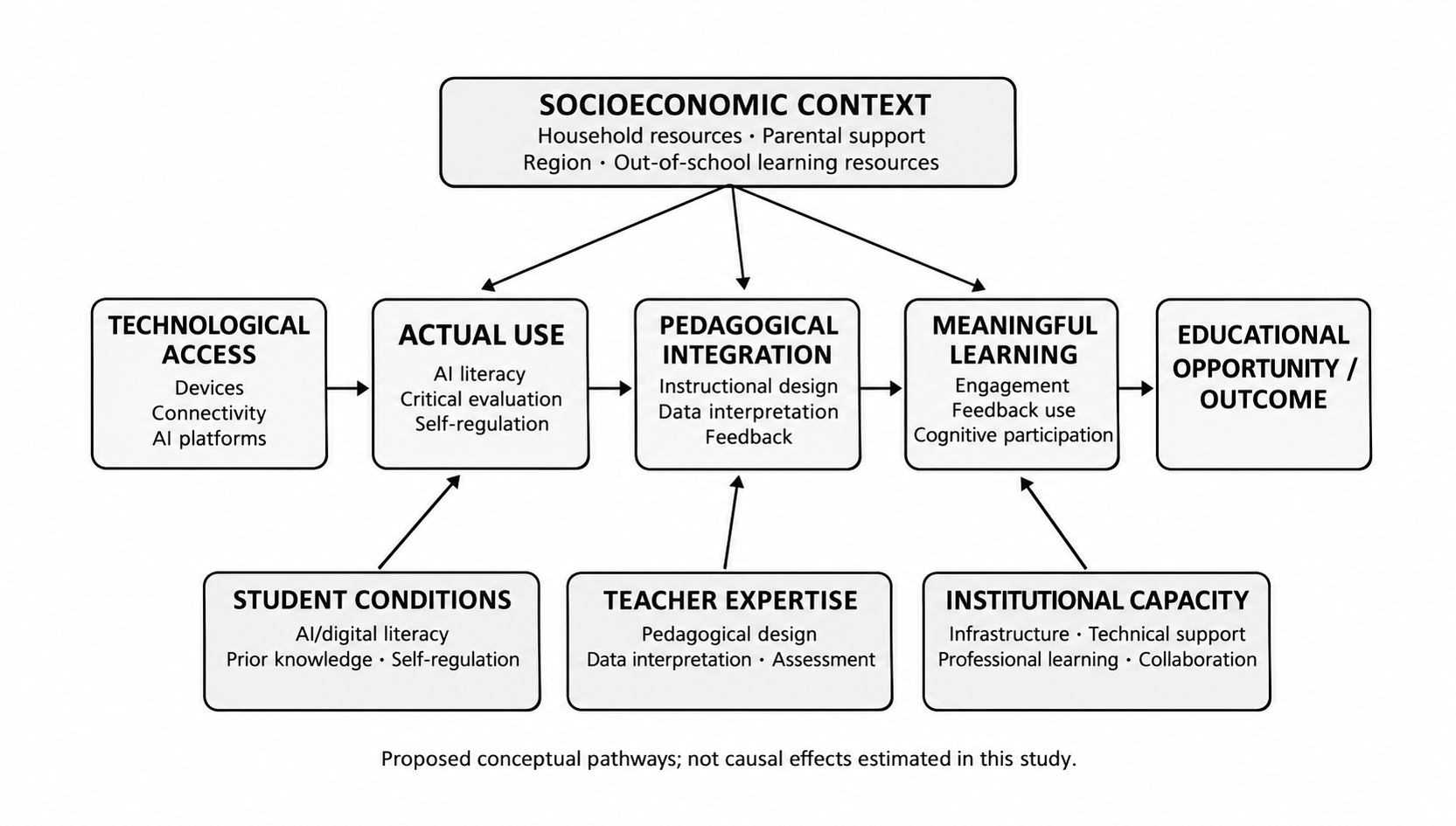
Note. The arrows represent analytical pathways derived from the synthesis of policy analysis and existing empirical studies; they do not represent causal effects estimated or validated in this study.
Interpretation of the Framework and Analytical Propositions
Student, teacher, school, and socioeconomic conditions are positioned in the framework as factors that may be associated with transitions across stages. Domestic studies report associations between students’ use experiences and teacher guidance or instructional design. They also report associations between teachers’ digital competence and school collaboration or resources. These relationships have not been tested as a continuous causal pathway within a single dataset. The framework therefore does not assume that any one condition necessarily produces a particular outcome. Instead, it directs attention to variation in actual use, pedagogical integration, and learning experience under similar levels of technological access. It also considers how that variation may relate to conditions at different analytical levels. Four analytical propositions follow.
Proposition 1. Actual learning activity after technology access may be associated with students’ AI and digital use capabilities.
Proposition 2. Pedagogical integration of AI may be associated with teachers’ instructional design, data interpretation, assessment, and feedback capabilities.
Proposition 3. The extent to which teacher professional capacity is enacted in classrooms may be associated with school technical support, collaboration, professional learning, and organizational support.
Proposition 4. Socioeconomic conditions may be associated with students’ in- and out-of-school learning opportunities and AI-use environments. The relationship between post-access differences in use and educational opportunities or outcomes requires direct empirical testing.
These propositions are analytical directions for future empirical research derived from the synthesis. They are not hypotheses tested in the present study.
Discussion and Conclusion
From an Access-Centered Perspective to a Conditions-Centered Perspective
South Korea’s AI education policy extends beyond mere access to technology. It encompasses AI-powered digital textbooks and infrastructure, as well as personalized learning, teacher capacity building, leading-school initiatives, and institutional support. While access to technology serves as a crucial foundation for participation in AI education, the provision of technology is not synonymous with its educational use. Domestic research suggests that a distinction should be made between access, implementation, and educational use. Even when students have similar levels of access to technology, their actual use and learning experiences may vary significantly. Such differences may be related to student capabilities, teacher professional capacity, the implementation environment within schools, and broader socioeconomic conditions. When adequate support systems are in place, access to technology can serve as a basis for broader learning opportunities. Conversely, if conditions following the provision of technology are unequal, gaps in use and learning opportunities may persist, even if the initial gap in access has narrowed. This is a conditional interpretation derived from a synthesis of existing literature, rather than a conclusion based on proven causal effects. Therefore, while both access to technology and the conditions for its subsequent implementation must be considered, they should remain analytically distinct.
Theoretical Contribution and Scope of Application
Research on the digital divide views digital inequality not merely as a disparity in physical access, but as a multi-stage process that encompasses differences in skills, use, and outcomes following initial access7,8. This study applies this framework to AI education policy. Rather than attributing post-access disparities solely to individual student capabilities, this study also examines teachers’ pedagogical judgments and schools’ organizational implementation as distinct levels of analysis. This approach reflects the specific characteristics of AI-based education. Since generative AI, learning analytics, and AI-driven learning tools can be utilized for purposes such as diagnosis, recommendation, feedback, and the provision of information, it is important to analyze how the functionalities of these technologies are actually applied within educational settings. The theoretical contribution of this study lies in extending the established “access–skills–use–outcomes” framework to the pedagogical and institutional contexts of AI education. However, this model does not specify the magnitude of effects, nor does it establish a definitive causal sequence. It can serve as an analytical framework that distinguishes between various stages and levels, facilitating their empirical examination in future research. This model may also be relevant to educational policies in countries other than South Korea—for instance, those that integrate AI-based learning materials or public platforms with teacher support and personalized learning2,4,17. Nevertheless, because factors such as teacher autonomy, curriculum implementation, the digital environment within schools, and educational resources available at home vary across education systems, cross-national application requires that specific indicators and relationships be adjusted to fit each institutional context and subsequently validated through empirical research.
Implications for Policy Evaluation
AI education policies should not be evaluated solely based on the provision of technology. Educational application and outcomes must also be considered. To this end, a distinction can be made between inputs, processes, and outcomes.
Inputs involve the provision of devices and networks. This includes the provision of user accounts and AI learning resources. Teacher training and school support are also factors to consider. These indicators demonstrate the foundation for participation. However, they do not directly reflect the quality of usage or educational outcomes.
Processes involve actual usage during lessons and learning activities. One can observe the purposes for which students use AI. It is also possible to see whether students review or modify AI-generated results. Teachers’ lesson design and data interpretation can also be examined. How these elements link to assessment and feedback is crucial. School-level technical support and collaboration are also included.
Outcomes can include performance-based AI literacy. Learning engagement and learning opportunities can also be assessed. Academic achievement and disparities between groups can be examined. This study did not verify the policy effects regarding these outcomes. Equal provision differs from need-based support. Policy evaluation must consider both implementation and outcomes following the provision of technology.
Limitations and Future Research
The explanatory framework for this study was constructed based on policy documents and existing research. The entire causal pathway was not tested using a single dataset. There is a lack of domestic research data measuring multiple conditions simultaneously. Studies examining changes over time are also insufficient.
Future research needs to measure each element as a distinct variable. Studies linking students, teachers, and schools are required. Research utilizing longitudinal data is also necessary. The relationship between technology access and actual usage needs to be examined. The connection between integration into instruction and learning experiences should also be explored. The relationship between school support and teacher professional capacity can also be investigated. Measurement methods that do not rely solely on self-reported data are also necessary. Platform usage records can be utilized. Students’ prompts and revision histories can also be used. Actual student assignments can be examined. Teachers’ lesson plans and feedback can be incorporated. Classroom observations and performance-based AI literacy assessments are also possible.
Socioeconomic conditions must be measured as well. Factors such as household income and parental education levels can be included. Private education and the home digital learning environment can also be assessed. AI usage and learning outcomes need to be measured together. Comparisons based on school level, subject, region, and school type are also required. The framework should also be examined across countries.
Conclusion
This study analyzed AI education policies for primary and secondary schools in Korea. It examined the relationship between access to technology and its educational application. Eighteen domestic empirical studies were also reviewed. Student, teacher, school, and socioeconomic levels were analyzed separately. Based on current evidence alone, it cannot be asserted that existing policies or implementation conditions enhance learning outcomes. Nor can it be concluded that the educational gap is narrowing. Therefore, an explanatory framework was proposed to categorize the conditions following access to technology. This study did not estimate causal effects. Equity in AI education should not be evaluated solely based on the provision of technology. Conditions enabling students to use the technology meaningfully must also be considered. What matters is not merely the provision of technology, but the opportunity for its actual educational application.
References
- W. Holmes, M. Bialik, C. Fadel. Artificial intelligence in education: Promises and implications for teaching and learning. Center for Curriculum Redesign, 2019. [↩] [↩]
- Organisation for Economic Co-operation and Development. OECD digital education outlook 2023: Towards an effective digital education ecosystem. OECD Publishing, 2023, https://doi.org/10.1787/c74f03de-en. [↩] [↩] [↩]
- Ministry of Education, Republic of Korea. Digital-based education innovation plan. Ministry of Education, 2023, https://www.moe.go.kr/boardCnts/viewRenew.do?boardID=72769&boardSeq=94551&lev=0&se=. [↩] [↩] [↩] [↩] [↩] [↩] [↩]
- Organisation for Economic Co-operation and Development. Shaping digital education: Enabling factors for quality, equity and efficiency. OECD Publishing, 2023, https://doi.org/10.1787/bac4dc9f-en. [↩] [↩] [↩]
- H. O. Heo, J. H. Seo, K. Y. Lim, K. H. Lim, H. W. Lee, S. C. Kang. Development and validation of an assessment instrument for teachers’ AI-digital competencies. Journal of Korean Association for Educational Information and Media. Vol. 30, pg. 497–521, 2024, https://doi.org/10.15833/KAFEIAM.30.2.497. [↩] [↩] [↩]
- H. W. Lee, M. G. Jang, K. Y. Lim, J. H. Seo, H. O. Heo. Needs assessment for teachers’ AI-digital competencies. Journal of Korean Association for Educational Information and Media. Vol. 30, pg. 955–980, 2024, https://doi.org/10.15833/KAFEIAM.30.3.955. [↩] [↩] [↩]
- J. A. G. M. van Dijk. The digital divide. Polity Press, 2020. [↩] [↩] [↩]
- M. Ragnedda, M. L. Ruiu. Digital capital: A Bourdieusian perspective on the digital divide. Emerald Publishing, 2020, https://doi.org/10.1108/9781839095504. [↩] [↩] [↩]
- C. H. Lee. A survey of digital literacies of high school students: Focusing on digital literacy activities and efficacy. Korean Language Education Research. Vol. 58, pg. 101–132, 2023, https://doi.org/10.20880/kler.2023.58.3.101. [↩] [↩] [↩]
- J. Y. Choi. High school students’ perceptions of GenAI writing. Writing Research. No. 64, pg. 43–91, 2025, https://doi.org/10.31565/korrow.2025..64.002. [↩] [↩] [↩]
- J. H. Jang, Y. M. Song. Analysis of teachers’ digital competency and influencing factors. Journal of Educational Technology. Vol. 40, pg. 783–820, 2024, https://doi.org/10.17232/KSET.40.3.783. [↩] [↩] [↩]
- S. S. Kim. A study on changes in the educational gap in relation to student background: A comparison between 2005–2009 and 2015–2019. CNU Journal of Educational Studies. Vol. 43, pg. 167–192, 2022, https://doi.org/10.18612/cnujes.2022.43.1.167. [↩] [↩] [↩]
- H. Lim, Y. An, H. Lee. A study on the change in educational disparities in elementary and middle schools in Seoul region: Focusing on the influence of gender and family background. The Journal of Local Education Management. Vol. 27, pg. 275–305, 2024, https://doi.org/10.23196/tjlem.2024.27.2.011. [↩] [↩] [↩]
- A. R. Beik, Y. Kwag. The structural relationships of high school students’ online learning, academic achievement, and relationships with parents and teachers: Focusing on household income differences. Asian Journal of Education. Vol. 25, pg. 499–525, 2024, https://doi.org/10.15753/aje.2024.9.25.3.499. [↩] [↩] [↩]
- B. Williamson, R. Eynon. Historical threads, missing links, and future directions in AI in education. Learning, Media and Technology. Vol. 45, pg. 223–235, 2020, https://doi.org/10.1080/17439884.2020.1798995. [↩]
- N. Selwyn. Education and technology: Key issues and debates. 3rd ed. Bloomsbury Academic, 2022. [↩]
- F. Miao, W. Holmes. Guidance for generative AI in education and research. UNESCO, 2023, https://doi.org/10.54675/EWZM9535. [↩] [↩] [↩]
- S. D. Seo, J. R. Kim. A needs analysis of teachers and students for instructional design in English education using an AI chatbot. Teacher Education Research. Vol. 63, pg. 65–76, 2024, https://doi.org/10.15812/ter.63.1.202403.65. [↩] [↩]
- J. H. Lee, D. Y. Jun. A study on the perception changes of middle school students regarding AI through generative AI education. Journal of Creative Information Culture. Vol. 11, pg. 123–134, 2025, https://doi.org/10.32823/jcic.11.1.202502.123. [↩] [↩]
- O. S. Ha, J. W. Jung. A comparative study of middle and high school students on the relationship between generative AI literacy and perceived learning usefulness. The Journal of Yeolin Education. Vol. 34, pg. 515–537, 2026, https://doi.org/10.18230/tjye.2026.34.2.515. [↩] [↩]
- S. J. Hong, Y. Hwang, Y. Park, S. M. Lee. Expectations and concerns about adopting AI digital textbooks: Based on investigation of teachers’ use of AI and digital tools. The Journal of Studies in Language. Vol. 40, pg. 7–20, 2024, https://doi.org/10.18627/jslg.40.1.202405.7. [↩] [↩]
- H. J. Kim, W. Kim. Secondary school mathematics teachers’ perceptions of AI digital textbooks: Implications and challenges for adaptive learning. Journal of the Korean School Mathematics Society. Vol. 27, pg. 417–452, 2024, https://doi.org/10.30807/ksms.2024.27.3.007. [↩] [↩]
- J. Y. Jung, W. S. Shin, Y. H. Joo. Analysis of perceptions and current status on the AI and digital utilization education for elementary and secondary school teachers. The Korean Journal of Educational Methodology Studies. Vol. 37, pg. 485–509, 2025, https://doi.org/10.17927/tkjems.2025.37.4.485. [↩] [↩]
- H. J. Jung, S. M. Jeong. Exploring teachers’ perceptions and utilization types of digital technology in education and their predictive factors. The Journal of Korean Teacher Education. Vol. 41, pg. 195–225, 2024, https://doi.org/10.24211/tjkte.2024.41.3.195. [↩] [↩]
- E. Lim, S. J. Hong, J. Y. Lim. Exploring the direction of support based on the current status and needs of teachers’ use of AI and digital devices. Journal of Korean Association for Educational Information and Media. Vol. 30, pg. 303–323, 2024, https://doi.org/10.15833/KAFEIAM.30.2.303. [↩] [↩]
- G. E. Kim, Y. I. Kim, H. Kim, D. Lee. An analysis of elementary and middle school teachers’ early instructional experiences with AI digital textbooks: A grounded theory approach. Journal of Educational Technology. Vol. 41, pg. 987–1022, 2025, https://doi.org/10.17232/KSET.41.3.987. [↩] [↩]
- J. Do, J. Eur, Y. J. Na, S. Kim. A study of teachers’ use and perception of learning analytics based dashboard for customized education. The Journal of Korean Teacher Education. Vol. 39, pg. 261–289, 2022, https://doi.org/10.24211/tjkte.2022.39.4.261. [↩] [↩]