Abstract
Anterior cruciate ligament (ACL) tears are among the most clinically significant knee injuries in alpine skiing. These injuries result from complex interactions among several factors such as equipment, skier reaction, and neuromuscular control. This narrative review examines the mechanisms of ACL injuries, treatment considerations, and prevention strategies in alpine skiing. Peer-reviewed literature was selected through PubMed, Google Scholar, Harvard Library resources, and citation tracking with search terms related to alpine skiing injuries, ACL skiing mechanism, prevention, and knee ligament treatment. English-language peer-reviewed studies published through December 2025 were considered for inclusion. Several non-contact mechanisms of skiing-related ACL injuries were identified, shaped by interactions among several factors, such as the skier population, equipment, body position, and neuromuscular control. The predominant ACL injury mechanisms may differ between recreational and competitive skiers, implying the need to consider skier context in ACL injuries. Treatment decisions may also be individualized according to the skier’s injury severity, knee instability, and return-to-sport goals. Skiing-specific intervention evidence was limited. Nonrandomized programs were associated with fewer serious knee sprains among trained ski-area staff or fewer ACL injuries among adolescent competitive skiers, but the outcomes, populations, and intervention components differed. Evidence for equipment modification, fatigue management, environmental measures, and mechatronic bindings was observational, indirect, or conceptual. These findings support a population-specific interpretation of skiing-related ACL injury and caution against treating single cases, small video series, and larger retrospective studies as equally generalizable evidence.
Keywords: alpine skiing, anterior cruciate ligament, ACL injury, knee injury, injury mechanisms, injury prevention, neuromuscular training
Introduction
Alpine skiing is a high-speed sport in which accidents can occur suddenly, often leaving little time for skiers to correct their movement or respond to dangerous situations. These risks affect both recreational skiers and competitive athletes, although injury patterns may differ depending on skier characteristics, equipment geometry, and injury context.
The anterior cruciate ligament (ACL) is a major stabilizing structure of the knee that connects the thighbone (femur) to the shinbone (tibia), limits excessive anterior tibial translation and helps control rotation. Complete midsubstance rupture has limited intrinsic healing capacity, particularly within the intra-articular environment1.
Injury estimates depend on both the skier population and the denominator used. Among adult recreational alpine skiers, the knee is the most frequently injured region, accounting for roughly one-third of all injuries, and ACL rupture is the most common knee injury, representing 15-21% of all injuries1,2. In elite ski racing, the denominator is different: ACL injury accounts for close to half of all knee injuries2. These percentages describe different outcomes and should not be interpreted as equivalent incidence estimates. In World Cup surveillance covering 521 athletes and 191 acute injuries, injury rates rose with the speed of the discipline, with the speed events carrying higher rates than the technical events3. Figures describing recreational skiers and figures describing racers therefore should not be read as versions of the same statistic.
Historical reviews describe a shift from MCL-predominant toward ACL-predominant knee injuries during the period in which carving skis became common4. Before the introduction of carving skis, which are shorter, narrower at the waist, and more deeply sidecut than the skis they replaced, medial collateral ligament (MCL) sprains were reported as the most common knee injury in skiing 1,4. However, this is a temporal association observed across successive injury cohorts rather than a demonstrated causal relationship. Ski design changed alongside boot design, binding standards, slope preparation, and skier demographics.
That equipment alone does not account for injury risk is suggested by longer-term data. Across 379 elite French national-team skiers followed from 1980 to 2005, the overall ACL injury incidence was 8.5 per 100 skier-seasons and the primary ACL injury rate was 5.7 per 100 skier-seasons; the prevalence of same-knee reinjury was 19%, and injury rates remained constant over time5. The study did not test why the rates remained constant or isolate the effects of changes in equipment or training. Understanding and preventing ski injury requires attention to the skier as well as hardware, and invites collaboration among clinicians, biomechanical researchers, engineers, and skiers themselves.
This narrative review synthesizes current evidence on ski-related ACL injury mechanisms, treatment, and prevention. MCL, meniscal, chondral, and other knee injuries are discussed only when they clarify associated pathology or clinical management of ACL injury. Findings are interpreted according to skier population, study design, and the directness of the evidence.
Methods
Review Design
This article is a narrative review. To improve transparency during revision, we conducted a structured, PRISMA-informed source-identification and verification audit and then synthesized the retained literature narratively. The review was not preregistered, and the audit should not be interpreted as a prospectively conducted systematic review or meta-analysis.
Search Strategy
The revision-stage audit was conducted on July 30, 2026. PubMed was searched for English-language records published from January 1, 1994 through December 31, 2025 using the following query:
(“alpine skiing”[Title] OR “alpine skier”[Title] OR “alpine skiers”[Title] OR “alpine ski racing”[Title] OR “ski racing”[Title]) AND (“anterior cruciate ligament”[Title] OR ACL[Title] OR “knee injury”[Title] OR “knee injuries”[Title]) AND (“1994/01/01”[Date – Publication] : “2025/12/31”[Date – Publication]) AND english[Language]
The publication end date matched the manuscript’s stated evidence cutoff; 2026 publications were not eligible. The 35-source bibliography assembled during the original drafting process from PubMed, Google Scholar, library searching, mentor-seeded references, and citation tracking was also audited by DOI and title. Because the original Google Scholar and library searches were iterative and were not prospectively logged, their result counts, sorting settings, and pages screened cannot be reconstructed reliably and are not presented as systematic database results.
Eligibility and Source Selection
Peer-reviewed English-language sources were eligible when they directly addressed ACL injury mechanism, epidemiology, treatment, rehabilitation, return to skiing, prevention, equipment, or associated knee pathology in alpine skiing. MCL, meniscal, chondral, and other knee evidence was retained only when it clarified ACL-associated pathology or management. General non-ski ACL guidelines and studies were retained only when skiing-specific evidence was unavailable and were treated as indirect clinical context. Sources were not retained when they concerned non-alpine snow sports, lacked ACL or knee relevance, were not peer reviewed, duplicated an included report without a distinct contribution, or did not add information relevant to the narrowed synthesis.
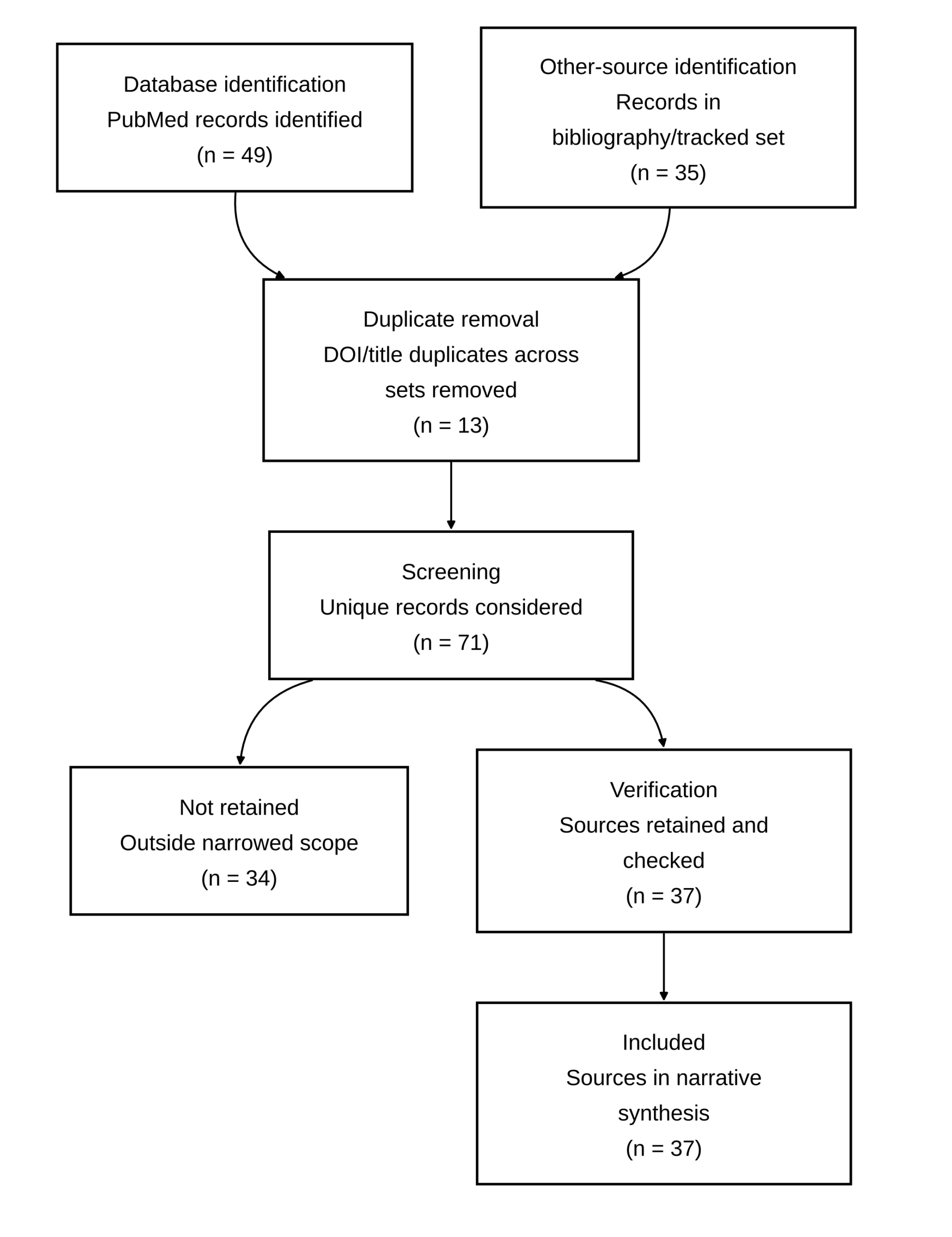
The PubMed search returned 49 records. The final bibliography contained 35 sources, 13 of which overlapped with the PubMed results by DOI or title. After deduplication, 71 unique records were considered. Thirty-four records were not retained after title/abstract or source-level relevance screening because they fell outside the narrowed synthesis or did not add a distinct contribution beyond a retained source. Thirty-seven sources were retained and claim-checked for the narrative synthesis (Figure 1). Independent duplicate screening was not performed.
Data extraction, evidence appraisal, and synthesis
For each retained source, study design, skier or patient population, sample size, outcome, evidence directness, principal finding, and key limitation were extracted. Evidence was appraised qualitatively using transparent domains: study design and comparator, sample size, measurement method, directness of the outcome, and applicability to the population discussed. Controlled or comparative injury-outcome studies, observational epidemiology, retrospective self-report, video case series, instrumented single cases, simulations, clinical guidelines, and secondary or indirect evidence were not treated as equivalent. No pooled numerical quality score was calculated. The appraisal is reported in Supplementary Table 1, and findings were synthesized narratively because study populations, exposures, designs, and outcomes were too heterogeneous for quantitative pooling.
Results
Epidemiological Context by Population
The mechanism studies reviewed here primarily concern non-contact injury situations. However, the available sources do not provide a single population-wide estimate of the proportion of all skiing-related ACL injuries that are non-contact2. Evidence from recreational skiers derives largely from retrospective questionnaires in which the fall is described by memory. Evidence from competitive skiers comes largely from expert analysis of video recordings captured during competition. The first reaches large samples but cannot accurately measure what happened at the knee; the second observes the event directly but is confined to small numbers of elite athletes.
Concomitant injury was common in the two selected clinical cohorts reviewed here.. Among 282 recreational skiers presenting to an Austrian sport clinic with a knee injury diagnosed by magnetic resonance imaging, 182 knees (64.5%) had ACL injury with concomitant damage and 100 (35.5%) had an isolated ACL tear; the most frequent associated diagnoses were MCL injury (50.5%), medial meniscus tear (40.1%), and lateral collateral ligament (LCL) injury (22.5%)1. In that cohort every recorded knee injury involved the ACL, but this reflects the composition of a clinic sample of skiers whose knee injuries were serious enough to warrant imaging and admission, and it is not a statement about knee injury in skiing generally. Among 28 primary ACL reconstruction operative reports from elite racers, 23 knees (82%) had concurrent pathology and 9 (32%) had multi-ligament injury6. As this finding is from athletes experiencing ACL reconstruction, it should not be generalized to all elite skiers without operation or recreational skiers.
Mechanisms reported by Recreational Skiers
Forward twisting fall
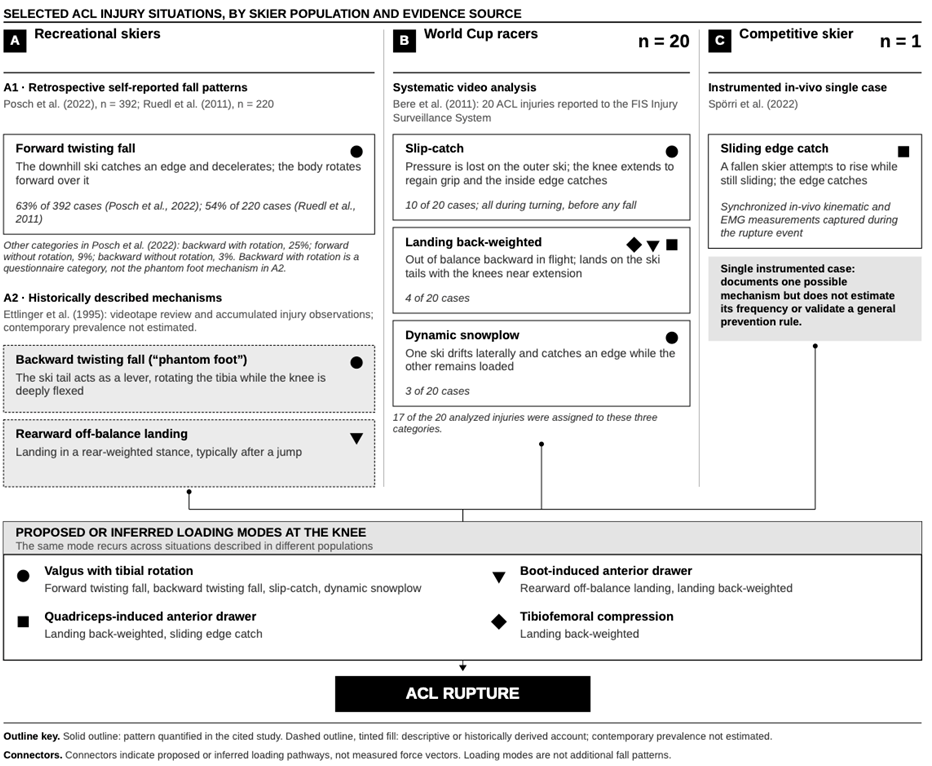
Commonly referred to as a forward fall with body rotation, the forward twisting fall is the most common mechanism of ACL injury among recreational skiers in one study7. Among 392 ACL-injured recreational skiers, the forward fall with body rotation was the most frequently self-reported fall category, accounting for approximately 63% of cases, and roughly three-quarters of these involved catching an edge7. An earlier questionnaire of 220 ACL-injured recreational carving skiers similarly found forward twisting falls to be the most common reported mechanism in both women and men8. In this pattern, the downhill ski catches the snow unexpectedly and decelerates while the skier’s body continues forward and rotates over it; the knee is thought to be loaded in combined flexion, external rotation, and valgus loading8. Edge catching may be relevant to the forward twisting fall because it can force the skier into a reactive maneuver that can place additional strain on the ACL. Because both studies rely on skiers recalling how they fell, the distribution of mechanisms is better supported than the description of what occurred at the knee, which is inferred rather than measured. These studies support the frequency of a recalled fall pattern, not a directly measured knee-loading sequence.
Backward Twisting Fall
Known as “phantom foot,” backward twisting fall occurs when a skier falls backward with weight on the inside edge of the tail of the downhill ski. The tail acts as a lever, contributing to tibial rotation, while the knee is deeply flexed, and an instinctive attempt to recover balance may add load9. The phantom-foot description was developed from 10 representative injury videotapes and accumulated injury observations from more than 1,400 ACL injuries9. It is a historically derived mechanism rather than a contemporary prevalence estimate or direct joint-load measurement. Although it has been influential in skier education, its share of contemporary recreational ACL injuries has not been re-measured.
Boot-Induced Anterior Drawer Injury
Boot-induced anterior drawer describes a proposed loading mode during a backward, rear-weighted landing rather than an independently quantified fall-pattern category. This injury has been proposed to occur immediately after an off-balance landing in a rearward stance, in which the rigid rear spoiler of the boot drives the proximal tibia anteriorly on the femur, reproducing the motion of an anterior drawer test9. Here too, equipment design and skier’s body position may work in a way that increases ACL loading. This is a biomechanical explanation rather than an independently quantified mechanism, and it has not been separately measured in diverse skier populations.
Mechanisms Observed in Competitive Skiers
Systematic video analysis of 20 ACL injuries reported to the International Ski Federation (FIS) Injury Surveillance System across three World Cup seasons identified three mechanism categories10. The following categories describe expert interpretations of 20 recorded World Cup injuries; they are not directly measured joint-load data or prevalence estimates for recreational skiing.
Slip-catch
The slip-catch accounted for half of the cases (10 of 20). Pressure is lost on the outer ski during a turn; as the skier extends the outer knee to regain grip, the inside edge of that ski catches abruptly in the snow, forcing the knee into internal rotation and valgus10. All ten cases occurred during turning, without or before a fall.
Landing Back-Weighted
Four of the 20 cases occurred when the skier was out of balance backward in flight after a jump and landed on the ski tails with the knees close to extension10. The loading was attributed to a combination of tibiofemoral compression, boot-induced anterior drawer, and quadriceps-induced anterior drawer acting together. These loads were reconstructed from video rather than measured directly.
Dynamic Snowplow
This category comprised three cases, in which one ski drifts laterally while the other remains loaded10. When the drifting ski catches an edge, the loaded knee is forced into internal rotation and valgus10. This loading pattern is similar to that of the slip-catch.
Sliding Edge Catch
This pattern was documented in a competitive skier who lost balance, slid sideways, and attempted to stand before coming to a complete stop11. The ACL ruptured as the ski edge caught, and synchronized measurement showed pronounced vastus medialis activation recorded at that moment. The authors suggested that quadriceps contraction drove the tibia anteriorly past the ligament’s tolerance. Single rupture event recorded with synchronized video, EMG, inertial sensors, and pressure insoles11. ACL force and strain were not measured directly, and the proposed loading pathway remains an inference from one case; mechanism frequency is unknown. It should be interpreted as an important cautionary case and requires further investigation before being applied as a general prevention guideline.
Separating Fall Patterns from Loading Modes
The patterns above describe how the skier lost control and fell. A separate set of terms, such as boot-induced anterior drawer, quadriceps-induced anterior drawer, tibiofemoral compression, and valgus with tibial rotation, describes how the ligament was loaded once that situation developed.
The distinction matters because the same loading mode appears inside more than one fall pattern. Quadriceps-induced anterior drawer was proposed as one component of the landing back-weighted category in World Cup racers10 and was also recorded in the single instrumented sliding edge catch11; it is not a fall pattern standing alongside them. Similarly, valgus with internal rotation is the loading pattern shared by the slip-catch and the dynamic snowplow. Treating loading modes as though they were additional fall categories inflates the apparent number of distinct mechanisms and implies more independent evidence than exists. Table 1 and Figure 2 therefore separate fall patterns from loading modes and identify the population, study design, and sample size behind each mechanism.
| Pathway | Loading mode at the knee | Skier population | Evidence base and weight | Clinical consideration | Prevention evidence / Proposed measure |
| A. Recreational skiers — self-reported fall patterns and historically proposed mechanisms (Figure 2, panels A1-A2) | |||||
| Forward twisting fall | Valgus with tibial rotation; the knee is loaded in flexion, rotation, and valgus as the ski decelerates | Adult recreational skiers on carving skis | Retrospective self-report: most frequent pattern in 392 injured skiers, about 63% of cases7; corroborated in 220 skiers8. Kinematics inferred from recall, not measured. | Image before assuming an isolated tear: 64.5% carried concomitant damage in a recreational cohort1. Reconstruction weighed on instability and activity goals. | Awareness training provides general guidance, while conventional bindings offer limited protection against valgus-torsional loading; no forward-twisting-specific trial was identified. |
| Backward twisting fall (“phantom foot”) | Valgus with tibial rotation at deep flexion; the ski tail levers the tibia | Adult recreational skiers | Descriptive mechanism from field injury-prevention work9; current share of recreational injuries unknown. | As above. Deep flexion at the moment of injury makes a combined pattern more likely than an isolated tear. | Awareness training included keeping the arms forward and remaining down after a fall, but these instructions were not tested separately. |
| Boot-induced anterior drawer | Proposed boot-induced anterior drawer: the rear spoiler may drive the proximal tibia forward. | Recreational skiers; also a proposed component of the elite landing back-weighted pattern | Biomechanical inference rather than a measured mechanism9, later invoked for elite landing injuries10. Not independently quantified in any population. | Anterior drawer loading near extension makes an isolated ACL tear more likely; examine for chondral involvement after a hard landing. | Rearward-stance recovery and equipment modification remain untested proposals; no mechanism-specific trial was identified. |
| B. World Cup racers — patterns identified by systematic video analysis of 20 cases (Figure 2, panel B) | |||||
| Slip-catch | Valgus with internal tibial rotation as the inside edge of the extending outer ski catches | World Cup racers | Largest category in the video series, 10 of 20 cases, all during turning before any fall10. Largest retained ski-specific mechanism series in skiing, but expert interpretation of a small series. | Concurrent pathology was common in this selected cohort: 82% of elite reconstructions involved additional damage, 32% multiligament6. Reconstruction usual where racing is intended. | Course-setting, ski-geometry, and neuromuscular strategies provide indirect evidence only12,13,14; no slip-catch-specific trial was identified. |
| Landing back-weighted | Proposed combination of tibiofemoral compression, boot-induced anterior drawer, and quadriceps-induced anterior drawer. | World Cup racers | 4 of 20 cases10. A small subgroup of an already small series; the loading account is reconstructed, not measured. | Expect a high-energy injury; screen for chondral and meniscal damage alongside the ACL. | Landing technique and course-design changes remain mechanism-derived proposals; no pattern-specific trial was identified. |
| Dynamic snowplow | Valgus with internal tibial rotation; the same loading as the slip-catch | World Cup racers | 3 of 20 cases10, the smallest elite category. Its shared loading with the slip-catch means the two are usually addressed together. | Managed as for the slip-catch. | Valgus-control training provides indirect evidence only; no dynamic-snowplow-specific trial was identified. |
| C. Competitive skier — single in-vivo instrumented case (Figure 2, panel C) | |||||
| Sliding edge catch | Proposed quadriceps-induced anterior drawer during the edge catch, inferred from vastus medialis activation. | One competitive skier, instrumented at the moment of rupture | Single rupture recorded with synchronized video, EMG, inertial sensors, and pressure insoles. ACL force and strain were not measured directly11, and one case cannot estimate frequency. | Treated as any complete rupture; the mechanism does not alter the decision. | The advice to remain down until sliding stops is consistent with one instrumented case, not a prevention trial. |
| D. Associated knee structures | |||||
| MCL injury | Valgus loading, usually with a rotational component; frequently combined rather than isolated | Recreational and competitive skiers | Present in 50.5% of recreational ACL injuries with concomitant damage1; grading from clinical review15. Prevalence clinic-based; guidance general orthopedic. | Most isolated Grade I-II tears are treated nonoperatively; Grade III management depends on residual valgus instability and associated injury. | No MCL-specific skiing prevention trial was identified; valgus-control training provides indirect evidence only. |
| Medial meniscus tear | Rotational and valgus loading, typically within an ACL injury event | Skiers sustaining ACL-related knee trauma | Present in 40.1% of recreational ACL injuries with concomitant damage1; among the most common findings at reconstruction in elite racers6. | Preserve and repair viable meniscal tissue when possible; treatment depends on tear pattern, vascularity, and repairability16. | No lesion-specific skiing prevention study was identified. |
| Full-thickness chondral lesion | Compressive and shear loading during high-energy knee trauma | Skiers with complex knee trauma; outcome data come from elite racers | Uncontrolled single-surgeon case series of 20 elite racers; 19 returned to competitive skiing at a mean 13.4 months17. | Microfracture may permit return to skiing, but repair tissue is fibrocartilage18 and long-term durability remains uncertain. | No lesion-specific skiing prevention study was identified. |
| LCL and posterolateral injury | Varus and rotational loading | Recreational and competitive skiers; uncommon in isolation | Reported in 22.5% of ACL-injured recreational skiers with concomitant damage1; isolated-LCL guidance comes from an older clinical review rather than a primary cohort19. | Assess for associated cruciate and posterolateral-corner injury rather than treating the LCL finding in isolation. | No ski-specific evidence was identified. |
Sex-Related Findings
Sex-related findings vary by skier population and study design. In a French national-team cohort, primary ACL injury rates were similar between women and men5. In World Cup surveillance, the overall injury rate was higher in men, whereas knee injury rates did not differ significantly by sex3; this result was not an ACL-specific incidence estimate. A later six-season World Cup cohort reported no sex difference in knee/ACL injury risk21. Among ACL-injured recreational skiers, self-reported binding nonrelease was more frequent in women than men, but this injured-only retrospective design cannot estimate incidence or establish that nonrelease caused the injury22.
The explanations offered are not mutually exclusive. Anatomical, hormonal, and neuromuscular differences have been proposed. Equipment factors have also been implicated: among 498 ACL-injured recreational skiers, self-reported failures of binding-release were more common in women and were reported more often at lower perceived speeds22. Training exposure, terrain selection, and risk-taking behavior differ as well, and are not evenly distributed between the sexes in recreational skiing. The available evidence does not permit these to be separated. The binding-release study sampled only injured skiers and relied on recalled rather than tested release, so it cannot establish that non-release contributes causally to the difference in rates22.
Associated Knee Injuries
Medial Collateral Ligament
The medial collateral ligament (MCL) is a broad, flat band on the medial side of the knee that resists valgus force15. In the recreational clinic cohort described above, MCL injury was the most frequent concomitant diagnosis, present in 50.5% of skiers with associated injuries1. MCL tears are classified based on the extent of medial joint opening: Grade I represents mild stretching with 0-5 mm of joint opening, Grade II a partial tear with 5-10 mm, and Grade III a complete rupture with more than 10 mm15.
Meniscus
Meniscal tears frequently accompany ACL injury in skiing. In the recreational cohort, medial meniscus injury was present in 40.1% of skiers with concomitant damage1. Among elite racers undergoing ACL reconstruction, meniscal injury was among the most common concurrent findings at surgery6.
Articular Cartilage
Chondral lesions of any grade were documented in 15 of 28 knees (54%) in one case series of elite ski racers undergoing primary ACL reconstruction6. This finding should not be interpreted as the prevalence of full-thickness cartilage defects. Outcomes after microfracture for full-thickness chondral defects were reported separately in a small single-surgeon case series of professional alpine ski racers17.
Lateral Collateral Ligament
Isolated LCL injury is uncommon in alpine skiing, and when an LCL injury occurs, cruciate ligament or posterolateral structures’ damage should be considered19. In the recreational cohort, LCL injury was recorded in 22.5% of skiers with concomitant injuries1.
Treatment
Knee Ligament Treatment
For active skiers with complete ACL rupture and knee instability who want to return to competitive skiing, surgical reconstruction is often considered2,23. However, nonoperative rehabilitation may be appropriate for patients without persistent instability and with low-demand activity goals. Treatment decisions should be made based on the rupture severity, knee instability, associated injuries, return-to-sport goals, and expected activity level23.
Structured nonoperative rehabilitation is an acceptable option for patients who can function without recurrent instability and who accept lower pivoting demand. A skiing-specific case series suggests a limited nonoperative pathway. Hetsroni et al. (2013) reevaluated recreational skiers 6-12 weeks after ACL rupture; patients with a grade 0-1+ Lachman test and negative pivot shift were observed without surgery, and 11 available at more than two years had good subjective function and near normal anterior laxity24. Mean subjective knee function was high, although the median Marx activity score declined from 6 before injury to 4 at follow-up24. The small, selected Level IV series and loss to follow-up support re-evaluation and shared decision-making, not nonoperative superiority.
ACL reconstruction is considered when functional instability or giving-way persists or when the patient plans to return to high-demand pivoting sport23. For patients undergoing reconstruction, autograft from the patient’s own tissue is generally favored over allograft among active patients, and common autograft choices include a bone-patellar tendon-bone graft and a hamstring tendon graft. Bone-patellar tendon-bone graft may reduce risk of infection or graft failure, while hamstring grafts may reduce anterior knee pain postoperatively. Therefore, the type of graft should be decided based on the patient’s characteristics, activity level, return-to-sport goals, and preferences25.
Rehabilitation Timing
Postoperative rehabilitation and return-to-sport progression should be criteria-based and guided by comprehensive assessment. The early rehabilitation phase involves efforts to reduce pain and swelling, restore range of motion and re-engage and strengthen the quadriceps. Later phases include neuromuscular training, sport-specific movements, and psychological readiness assessment23. These later stages are critical for skiers because return to such high-demand activity should consider recovery of dynamic balance, lower-limb strength, neuromuscular control, and readiness for high-activity demands2.
Ski performance after ACL reconstruction
Even after ACL reconstruction and recovery, neuromuscular deficits may persist and returning to a previous competition level does not by itself indicate restored performance2. Among 30 competitive ski racers followed after reconstruction, 27 of 30 (90%) returned to their pre-injury competition levels within the three-year observation period. However, 16 (53%) improved their FIS points and 13 (43%) improved their FIS rank, compared with 18 of 30 and 19 of 30, respectively, in a one-to-one matched control group26.
Psychological Readiness
Psychological readiness is also an important consideration. In a non-ski pilot cohort of 40 athletes assessed at return-to-sport clearance, greater fear was associated with lower activity, poorer single-leg hop performance, lower quadriceps strength, and a higher risk of a second ACL injury within two years27. A TSK-11 score of at least 19 was associated with a relative risk of 13.0, but the confidence interval was very wide (95% CI 2.1-81.0), reflecting substantial imprecision27. Return to competition therefore should not be treated as identical to recovery of performance, although the small observational sample does not establish a causal performance deficit.
Medial Collateral Ligament
Isolated Grade I and II MCL tears are generally managed nonoperatively, with rest, protected motion, early range-of-motion exercises, quadriceps strengthening, and functional rehabilitation15,19. Some isolated Grade III tears may also be managed nonoperatively; surgery is considered where valgus instability persists or where certain avulsion patterns are present15. The contrast with the ACL is anatomical: the MCL lies outside the joint capsule in a well-vascularized environment that favors healing, whereas the intra-articular ACL has more limited intrinsic healing15. For skiers, rehabilitation should restore mobility, strength, and knee stability before return to snow19.
Meniscus
For meniscal injury, tears in the peripheral vascular zone have greater healing potential and can often be repaired arthroscopically, whereas tears in the inner avascular zone heal poorly and partial meniscectomy may be considered where repair is not feasible. Because meniscectomy is associated with later degenerative change, tissue removal should be minimized and functional meniscal tissue should be preserved28. Rehabilitation should address range of motion, strength, motor control, and limb endurance29. These MCL, meniscal, and rehabilitation principles are drawn primarily from general orthopedic sources rather than skiing-specific comparative trials.
Articular Cartilage
Where full-thickness cartilage defects are present, microfracture is one option. Small perforations are created in the subchondral bone, allowing marrow-derived cells to migrate into the damaged area; the repair tissue that forms is fibrocartilage rather than the native hyaline cartilage18. In a single-surgeon case series of 20 professional alpine ski racers treated with microfracture for full-thickness chondral defects, 19 returned to competitive skiing at a mean of 13.4 months; minimum two-year follow-up data were available for 18 racers17. Without a comparison group, the study cannot establish that microfracture is superior to another treatment or predict outcomes in recreational skiers.
Prevention Strategies
Prevention strategies for ACL injuries in alpine skiing vary in the type and strength of supporting evidence. Nonrandomized educational and multicomponent training interventions were supported by the most direct skiing-specific evidence9,14. Equipment-related adjustments and recommendations were supported by qualitative and biomechanical evidence, whereas mechatronic binding technologies remain developing22,30,13. Fatigue awareness and environmental measures are more context-dependent because the published studies focused on fatigue patterns or associations with ACL injury risk rather than validated ACL-prevention effects31,7.
Education and Awareness Training
Skier education has the longest-standing controlled evidence. In a controlled field intervention across 20 intervention and 22 control ski areas, an awareness training program addressing the phantom-foot and boot-induced anterior drawer mechanisms was followed by 62% decline in serious knee sprains among trained ski-area staff, with no comparable decline in controls9. Two qualifications apply: the outcome measured was serious knee sprains rather than imaging-confirmed ACL tears, and participants were experienced ski professionals rather than novice recreational skiers.
Education has also been delivered in combination with physical training. Among 305 adolescent competitive skiers exposed to a combined video-education and neuromuscular program, 12 ACL injuries occurred, versus 35 among 431 historical controls; the authors reported a 45% lower ACL injury incidence rate14. Because the program components were delivered together and the comparison was historical, the study does not identify which component produced the association.
Physical Conditioning and Neuromuscular Training
The Injury Screening and Prevention-Alpine Skiing (ISPAInt) program is the most directly skiing-specific neuromuscular program evaluated in the included literature32. It is a 20-minute weekly home program involving eccentric hamstring exercises, leg axis stability work, and trunk stability exercises, intended respectively to reduce anterior tibial translation, address valgus collapse, and improve trunk control32. A controlled 12-month study compared 71 U16 racers offered the ISPAInt program with 58 historical controls32. Mean adherence was only 0.8 ± 0.6 sessions per week, and the outcomes were overall traumatic and overuse injuries rather than ACL injury specifically32.
Dosing guidance is available only from outside skiing. A meta-analysis of 16 youth-sport trials reported a 42% lower rate of lower-extremity injury, with larger effects for of 10-15-minute sessions performed two to three times weekly and at 20-60 total sessions delivered over less than six months28. Because the included trials were heterogeneous and none were conducted in skiing, these dose findings provide indirect context and do not establish a skiing-specific ACL effect14. Taken together, the ski-specific neuromuscular evidence is encouraging, but it is primarily based on non-randomized designs with historical controls and incomplete adherence data, and no trial has yet isolated an ACL-specific effect of neuromuscular training in skiing.
Equipment Adjustment and Ski Geometry
Correct ski-boot-binding adjustment remains a baseline lower-leg safety measure. Calibration to International Organization for Standardization (ISO) and American Society for Testing and Materials (ASTM) standards is intended to retain the boot during normal skiing and to release under defined loading conditions. Adherence to these standards is among the better-established means of reducing lower-leg injury4. The relevant limitation for the present review is that standard toe-heel bindings are not designed to respond to the combined valgus and torsional loading that underlies many ACL injuries, so calibration should not be presented as ACL protection4.
Other equipment variables have been associated with ACL injury. In a case-control study of 1,817 recreational skiers including 392 with ACL injury, a higher front-to-rear binding standing height ratio was independently associated with ACL injury33. This is an observed association; no finding has shown that adjusting the ratio prevents ACL injury.
Ski geometry has been examined through surrogate outcomes. In on-snow testing of five European Cup giant slalom racers, skis with a larger sidecut radius were associated with lower average kinetic energy across a six-gate section13. In a laboratory simulator study, wider-waisted skis increased external knee rotation and biceps femoris activation, while external knee torque did not change34. Consistent with this, ski-geometric parameters did not differ significantly between ACL injury mechanisms in 392 ACL-injured recreational skiers, which suggests that ski design is one element of a broader mechanical environment rather than a determinant of mechanism7. Equipment studies identify plausible associations and biomechanical surrogates, but none of the cited geometry experiments demonstrates that a specific equipment modification prevents ACL injury in a clinical or field trial.
Fatigue Awareness
Fatigue is frequently proposed as a modifiable risk factor, but the supporting evidence is indirect. Among 38 recreational women over 40 years monitored by electromyography during a day of skiing, the authors reported no regenerative effect of a 45-minute lunch break31. No injuries were measured. The sample was narrow in age and sex, and no injuries were recorded, so the study cannot establish a fatigue-management prevention rule. In broader non-ski ACL literature, fatigue protocols have not consistently altered the lower-limb biomechanical variables presumed to increase ACL risk35.
Environmental Factors
In a matched case-control study of 392 ACL-injured and 392 uninjured recreational skiers, ACL injury was associated with fresh and grippy snow, icy surfaces, perceived cold, and easy slopes36. The study did not test whether these environmental conditions caused an edge catch or whether countermeasures such as warming breaks or schedule changes prevent ACL injury36.
Regulatory Measures
At the regulatory level, FIS has amended equipment rules in response to developments in ski hardware, including minimum sidecut radii and ski lengths intended to reduce the mechanical aggressiveness of carving designs12. Across nine World Cup seasons compared before and after these regulations, overall injury rates were lower in the three post-regulation seasons, but knee and ACL injury rates did not decline significantly, and the pattern differed between female and male athletes12. The before-and-after design cannot isolate equipment regulation from concurrent changes in exposure, courses, reporting, or athlete behavior. The regulations therefore have not been shown to reduce ACL injury, and continued monitoring is warranted as designs and practices change12,11.
Emerging Technologies
A mechatronic binding system has been proposed to address limitations of conventional bindings by integrating mechanical load sensing with kinematic and physiological inputs30. The paper is conceptual and does not report or validate a working ACL-prevention device.
Discussion
This review suggests that ski-related ACL injuries occur within biomechanical context shaped by ski equipment, skier movement, and terrain. Advances in ski technology may alter the biomechanical demands placed on the skier’s body, and some equipment parameters have been associated with ACL injury; however, these studies do not establish a causal relationship33,13,34. In addition, ski-geometric parameters did not significantly differ among the ACL injury mechanisms, so the equipment geometry alone does not explain the variation in mechanism-specific injury risk7. Instead, ski equipment interacts with skier movement and terrain. Several non-contact ACL injury mechanisms involve the interaction between the skier’s reactive neuromuscular response and externally imposed forces by their equipment and terrain10,11. This observation suggests that ACL injuries may occur from the skier’s reactions to regain control or balance. This insight has implications for prevention: equipment modification alone may not be sufficient; neuromuscular training is a candidate for further skiing-specific testing, but the current studies do not isolate an ACL-specific effect across skier populations14,32. Much of the skiing-specific intervention evidence comes from youth competitive skiers, whereas mechanism evidence spans retrospective recreational cohorts, a small World Cup video series, and a single instrumented case.
Sex differences in ACL injuries
The higher ACL injury rates have been reported among female recreational skiers and discussed in relation to anatomical, hormonal, and neuromuscular variables2,4. Yet, a lack of consistent sex differences among competitive athletes suggests that the difference is not adequately explained by biological factors alone2,37. Equipment-related factors may also contribute; a higher rate of binding-release failure among female recreational skiers was reported22. However, the study relied on retrospective self-reports, so it is limited in establishing a causal relationship between binding-release failure and female recreational skiers’ injuries22. These studies address different populations and outcomes and do not establish a single biological or equipment explanation. Future studies should test, rather than assume, whether sex-specific binding calibration or neuromuscular programs reduce ACL incidence among recreational skiers.
MCL and ACL injuries
The different clinical courses of MCL and ACL injuries reflect how ligament anatomy and injury context influence treatment and rehabilitation. The MCL’s extra-articular position and favorable vascularity allow many isolated MCL injuries to be managed nonoperatively when the ACL is intact and valgus instability is absent15,19. Reconstruction is therefore often considered for skiers with complete ACL rupture, knee instability, and the goal of returning to high-demand skiing2,23. The prolonged rehabilitation after ACL reconstruction2,23 and the variation in ski racers’ performance after return26 show that return to competitive skiing does not necessarily mean recovery of preinjury performance. Psychological factors may also influence rehabilitation outcomes. In a 40-participant non-ski pilot cohort, greater fear at return to sport was associated with lower activity, poorer hop and quadriceps performance, and a higher risk of ipsilateral second ACL injury; the small sample and wide uncertainty limit generalization27. Although this evidence is not specific to skiing, this finding supports the integration of psychological readiness assessment and, when appropriate, psychological support into ACL rehabilitation.
Prevention Strategies
Among the prevention strategies reviewed, education and awareness training have shown promising results in certain skiing populations. In the controlled field program, trained ski-area staff experienced a 62% decline in serious knee sprains, with no comparable decline in control areas9. The outcome was not restricted to imaging-confirmed ACL tears, the ski areas were not randomized, and the participants were experienced staff rather than a general recreational sample and thereby its effect in recreational skiers remains uncertain. In a study of adolescent competitive skiers, the 45% reduction in ACL injuries was associated with a combined program of video-based education and neuromuscular training, compared with historical controls14. This finding suggests that prevention education and body conditioning may contribute to injury prevention14. However, because the intervention combined several components, the independent effect of neuromuscular training, education, coach engagement, and adherence could not be determined.
Emerging injury prevention technologies include proposed mechatronic ski bindings that integrate mechanical load sensing with real-time kinematic and muscle-state information30. In principle, these devices would need to distinguish potentially injurious loading from the great forces generated during normal or competitive skiing. However, the cited study proposed a conceptual system rather than a validated prototype, as incomplete knowledge of skiing injury mechanisms and necessary input variables is a major challenge30. As mechatronic ski bindings remain under development, education, neuromuscular training, and equipment adjustment remain candidate components of ski-injury prevention, but the present literature does not establish their independent ACL-specific effects across skier populations. Mechatronic bindings should be treated as a research proposal rather than a current prevention option.
Regulatory measures may address skiing-related injury risk. FIS regulations on sidecut radius and ski lengths12 were implemented to reduce equipment-related injury risk. While overall injury rates decreased in the three seasons after implementation, lower-extremity, including ACL, injury rates did not decline significantly12. Therefore, the effectiveness of such regulations for ACL injury prevention remains unclear, and constant monitoring is required as ski designs and practices change11,12.
Limitations
This narrative review used a retrospective, revision-stage source audit rather than a preregistered systematic-review protocol. The original Google Scholar and library searches were not prospectively logged, independent duplicate screening was not performed, and evidence was weighted qualitatively rather than with a validated numerical risk-of-bias instrument. Restriction to English-language publications may have excluded relevant work, given how much alpine skiing research originates in German-, French-, and Italian-speaking countries. The reviewed studies are heterogeneous in designs, population, and outcome measures, which limit how far their findings can be combined. Several of the strongest mechanism findings rest on small samples: 20 video-analyzed cases in the elite literature, and a single instrumented rupture.
Proposal for future work
Future research should prioritize four goals. First, prevention trials in skiing would benefit from randomized or concurrently controlled designs with ACL-specific outcomes and recorded adherence, which would allow the education and neuromuscular components of combined programs to be separated. Second, mechanism research in recreational skiers currently depends on recall; instrumented or video-based measurement in this population would test whether the fall patterns reported in questionnaires correspond to the loading assumed. Third, development of mechatronic binding systems requires prior work establishing which input variables distinguish injurious from intentional loading, and would benefit from collaboration between engineers, biomechanists, and skiers30. Fourth, psychological dimensions of injury prevention warrant intervention studies that evaluate cognitive-behavioral strategies upon integration into standard rehabilitation and training programs. Research on sex differences may be most productive where it targets modifiable factors, such as binding calibration standards and neuromuscular preparation, rather than seeking a single explanatory mechanism.
Conclusion
Overall, ACL injuries in alpine skiing should be viewed within population-specific and mechanism-specific contexts. ACL injury patterns may differ based on skier populations because of interactions among biological, equipment-related, training-related, and behavioral factors. The type and strength of evidence vary considerably across studies. Education-only and combined education-plus-training programs were associated with fewer serious knee sprains or ACL injuries in selected skiing populations, but the studies were nonrandomized or historically controlled and often could not isolate individual program components. Environmental factors, fatigue-related factors, equipment regulations, and emerging technologies remain unvalidated as ACL-prevention measures. Treatment and return-to-skiing decisions should therefore account for knee stability, associated injury, activity demand, skier goals, and the strength and applicability of the supporting evidence.
Acknowledgments
I am grateful to my advisor at Indian Mountain School for guidance, feedback, and patient line-edits throughout this project.
Supplementary Information
References
- M. Posch, A. Schranz, M. Lener, K. Tecklenburg, M. Burtscher, G. Ruedl. In recreational alpine skiing, the acl is predominantly injured in all knee injuries needing hospitalisation. Knee Surgery, Sports Traumatology, Arthroscopy. Vol. 29, pg. 1790–1796, 2021, https://doi.org/10.1007/s00167-020-06221-z. [↩] [↩] [↩] [↩] [↩] [↩] [↩] [↩] [↩] [↩]
- M. J. Jordan, P. Aagaard, W. Herzog. Anterior cruciate ligament injury/reinjury in alpine ski racing: a narrative review. Open Access Journal of Sports Medicine. Vol. 8, pg. 71–83, 2017, https://doi.org/10.2147/OAJSM.S106699. [↩] [↩] [↩] [↩] [↩] [↩] [↩] [↩] [↩] [↩]
- T. W. Flørenes, T. Bere, L. Nordsletten, S. Heir, R. Bahr. Injuries among male and female world cup alpine skiers. British Journal of Sports Medicine. Vol. 43, pg. 973–978, 2009, https://doi.org/10.1136/bjsm.2009.068759. [↩] [↩]
- A. Davey, N. K. Endres, R. J. Johnson, J. E. Shealy. Alpine skiing injuries. Sports Health. Vol. 11, pg. 18–26, 2019, https://doi.org/10.1177/1941738118813051. [↩] [↩] [↩] [↩] [↩]
- N. Pujol, M. P. R. Blanchi, P. Chambat. The incidence of anterior cruciate ligament injuries among competitive alpine skiers: a 25-year investigation. The American Journal of Sports Medicine. Vol. 35, pg. 1070–1074, 2007, https://doi.org/10.1177/0363546507301083. [↩] [↩]
- M. J. Jordan, P. Doyle-Baker, M. Heard, P. Aagaard, W. Herzog. A retrospective analysis of concurrent pathology in acl-reconstructed knees of elite alpine ski racers. Orthopaedic Journal of Sports Medicine. Vol. 5, pg. 2325967117714756, 2017, https://doi.org/10.1177/2325967117714756. [↩] [↩] [↩] [↩] [↩]
- M. Posch, G. Ruedl, K. Greier, M. Faulhaber, K. Tecklenburg, A. Schranz. Ski-geometric parameters do not differ between acl injury mechanisms in recreational alpine skiing. Knee Surgery, Sports Traumatology, Arthroscopy. Vol. 30, pg. 2141–2148, 2022, https://doi.org/10.1007/s00167-021-06852-w. [↩] [↩] [↩] [↩] [↩] [↩] [↩]
- G. Ruedl, M. Webhofer, I. Linortner, A. Schranz, C. Fink, C. Patterson, W. Nachbauer, M. Burtscher. ACL injury mechanisms and related factors in male and female carving skiers: a retrospective study. International Journal of Sports Medicine. Vol. 32, pg. 801–806, 2011, https://doi.org/10.1055/s-0031-1279719. [↩] [↩] [↩]
- C. F. Ettlinger, R. J. Johnson, J. E. Shealy. A method to help reduce the risk of serious knee sprains incurred in alpine skiing. The American Journal of Sports Medicine. Vol. 23, pg. 531–537, 1995, https://doi.org/10.1177/036354659502300503. [↩] [↩] [↩] [↩] [↩] [↩] [↩] [↩]
- T. Bere, T. W. Flørenes, T. Krosshaug, H. Koga, L. Nordsletten, C. Irving, E. Müller, R. C. Reid, V. Senner, R. Bahr. Mechanisms of anterior cruciate ligament injury in world cup alpine skiing: a systematic video analysis of 20 cases. The American Journal of Sports Medicine. Vol. 39, pg. 1421–1429, 2011, https://doi.org/10.1177/0363546511405147. [↩] [↩] [↩] [↩] [↩] [↩] [↩] [↩] [↩] [↩] [↩] [↩]
- J. Spörri, E. Müller, J. Kröll. “When you’re down, stay down”: a lesson for all competitive alpine skiers supported by an acl rupture measured in vivo. Journal of Sport and Health Science. Vol. 11, pg. 14–20, 2022, https://doi.org/10.1016/j.jshs.2021.11.004. [↩] [↩] [↩] [↩] [↩] [↩] [↩] [↩]
- B. Haaland, S. E. Steenstrup, T. Bere, R. Bahr, L. Nordsletten. Injury rate and injury patterns in fis world cup alpine skiing (2006–2015): have the new ski regulations made an impact? British Journal of Sports Medicine. Vol. 50, pg. 32–36, 2016, https://doi.org/10.1136/bjsports-2015-095467. [↩] [↩] [↩] [↩] [↩] [↩] [↩]
- J. Kröll, J. Spörri, M. Gilgien, H. Schwameder, E. Müller. Sidecut radius and kinetic energy: equipment designed to reduce risk of severe traumatic knee injuries in alpine giant slalom ski racing. British Journal of Sports Medicine. Vol. 50, pg. 26–31, 2016, https://doi.org/10.1136/bjsports-2015-095463. [↩] [↩] [↩] [↩]
- M. Westin, M. L. Harringe, B. Engström, M. Alricsson, S. Werner. Prevention of anterior cruciate ligament injuries in competitive adolescent alpine skiers. Frontiers in Sports and Active Living. Vol. 2, pg. 11, 2020, https://doi.org/10.3389/fspor.2020.00011. [↩] [↩] [↩] [↩] [↩] [↩] [↩]
- L. Chen, P. D. Kim, C. S. Ahmad, W. N. Levine. Medial collateral ligament injuries of the knee: current treatment concepts. Current Reviews in Musculoskeletal Medicine. Vol. 1, pg. 108–113, 2008, https://doi.org/10.1007/s12178-007-9016-x. [↩] [↩] [↩] [↩] [↩] [↩] [↩]
- R. Simonetta, A. Russo, M. Palco, G. G. Costa, P. P. Mariani. Meniscus tears treatment: the good, the bad and the ugly-patterns classification and practical guide. World Journal of Orthopedics. Vol. 14, pg. 171–185, 2023, https://doi.org/10.5312/wjo.v14.i4.171. [↩]
- J. R. Steadman, C. M. Hanson, Karen K. Briggs, L. M. Matheny, E. W. James, A. Guillet. Outcomes after knee microfracture of chondral defects in alpine ski racers. Journal of Knee Surgery. Vol. 27, pg. 407–410, 2014, https://doi.org/10.1055/s-0034-1376330. [↩] [↩] [↩]
- M. L. Redondo, A. J. Beer, A. B. Yanke. Cartilage restoration: microfracture and osteochondral autograft transplantation. Journal of Knee Surgery. Vol. 31, pg. 231–238, 2018, https://doi.org/10.1055/s-0037-1618592. [↩] [↩]
- G. A. Paletta, R. F. Warren. Knee injuries and alpine skiing: treatment and rehabilitation. Sports Medicine. Vol. 17, pg. 411–423, 1994, https://doi.org/10.2165/00007256-199417060-00006. [↩] [↩] [↩] [↩] [↩]
- C. F. Ettlinger, R. J. Johnson, J. E. Shealy. A method to help reduce the risk of serious knee sprains incurred in alpine skiing. The American Journal of Sports Medicine. Vol. 23, pg. 531–537, 1995, https://doi.org/10.1177/036354659502300503. [↩]
- T. Bere, T. W. Flørenes, L. Nordsletten, R. Bahr. Sex differences in the risk of injury in world cup alpine skiers: a 6-year cohort study. British Journal of Sports Medicine. Vol. 48, pg. 36–40, 2014, https://doi.org/10.1136/bjsports-2013-092206. [↩]
- G. Ruedl, K. Helle, K. Tecklenburg, A. Schranz, C. Fink, M. Burtscher. Factors associated with self-reported failure of binding release among acl-injured male and female recreational skiers: a catalyst to change iso binding standards? British Journal of Sports Medicine. Vol. 50, pg. 37–40, 2016, https://doi.org/10.1136/bjsports-2015-095482. [↩] [↩] [↩] [↩] [↩] [↩]
- T. Diermeier, B. B. Rothrauff, L. Engebretsen, A. D. Lynch, O. R. Ayeni, M. V. Paterno, J. W. Xerogeanes, F. H. Fu, J. Karlsson, V. Musahl, E. Svantesson, E. Hamrin Senorski, T. Rauer, S. J. Meredith. Treatment after anterior cruciate ligament injury: panther symposium acl treatment consensus group. Knee Surgery, Sports Traumatology, Arthroscopy. Vol. 28, pg. 2390–2402, 2020, https://doi.org/10.1007/s00167-020-06012-6. [↩] [↩] [↩] [↩] [↩] [↩]
- I. Hetsroni, D. Delos, G. Fives, B. W. Boyle, K. Lillemoe, R. G. Marx. Nonoperative treatment for anterior cruciate ligament injury in recreational alpine skiers. Knee Surgery, Sports Traumatology, Arthroscopy. Vol. 21, pg. 1910–1914, 2013, https://doi.org/10.1007/s00167-012-2324-8. [↩] [↩]
- R. H. Brophy, K. J. Lowry. American academy of orthopaedic surgeons clinical practice guideline summary: management of anterior cruciate ligament injuries. Journal of the American Academy of Orthopaedic Surgeons. Vol. 31, pg. 531–537, 2023, https://doi.org/10.5435/JAAOS-D-22-01020. [↩]
- N. Morris, R. da Silva Torres, M. Heard, P. Doyle-Baker, W. Herzog, M. J. Jordan. Return to on-snow performance in ski racing after anterior cruciate ligament reconstruction. The American Journal of Sports Medicine. Vol. 53, pg. 640–648, 2025, https://doi.org/10.1177/03635465241307212. [↩] [↩]
- M. V. Paterno, K. Flynn, S. Thomas, L. C. Schmitt. Self-reported fear predicts functional performance and second acl injury after acl reconstruction and return to sport: a pilot study. Sports Health. Vol. 10, pg. 228–233, 2018, https://doi.org/10.1177/1941738117745806. [↩] [↩] [↩]
- S. Steib, A. L. Rahlf, K. Pfeifer, A. Zech. Dose-response relationship of neuromuscular training for injury prevention in youth athletes: a meta-analysis. Frontiers in Physiology. Vol. 8, pg. 920, 2017, https://doi.org/10.3389/fphys.2017.00920. [↩] [↩]
- D. S. Logerstedt, D. A. Scalzitti, K. L. Bennell, R. S. Hinman, H. Silvers-Granelli, J. Ebert, K. Hambly, J. L. Carey, L. Snyder-Mackler, M. J. Axe, C. M. McDonough. Knee pain and mobility impairments: meniscal and articular cartilage lesions revision 2018. Journal of Orthopaedic & Sports Physical Therapy. Vol. 48, pg. A1–A50, 2018, https://doi.org/10.2519/jospt.2018.0301. [↩]
- A. Hermann, V. Senner. Knee injury prevention in alpine skiing: a technological paradigm shift towards a mechatronic ski binding. Journal of Science and Medicine in Sport. Vol. 24, pg. 1038–1043, 2021, https://doi.org/10.1016/j.jsams.2020.06.009. [↩] [↩] [↩] [↩] [↩]
- A. Hermann, V. Christl, V. Hastreiter, P. Carqueville, L. Ellenberger, V. Senner. Muscular fatigue and quadriceps-to-hamstring ratio in alpine skiing in women over 40 years. International Journal of Environmental Research and Public Health. Vol. 20, pg. 5486, 2023, https://doi.org/10.3390/ijerph20085486. [↩] [↩]
- T. Schoeb, S. Fröhlich, W. O. Frey, E. Verhagen, M. Farshad, J. Spörri. The ispaint injury prevention programme for youth competitive alpine skiers: a controlled 12-month experimental study in a real-world training setting. Frontiers in Physiology. Vol. 13, pg. 826212, 2022, https://doi.org/10.3389/fphys.2022.826212. [↩] [↩] [↩] [↩] [↩]
- G. Ruedl, M. Posch, K. Tecklenburg, A. Schranz, K. Greier, M. Faulhaber, I. Scher, M. Burtscher. Impact of ski geometry data and standing height ratio on the acl injury risk and its use for prevention in recreational skiers. British Journal of Sports Medicine. Vol. 56, pg. 1104–1109, 2022, https://doi.org/10.1136/bjsports-2021-105221. [↩] [↩]
- M. Zorko, B. Nemec, Z. Matjačić, A. Olenšek, K. Tomazin, M. Supej. Wide skis as a potential knee injury risk factor in alpine skiing. Frontiers in Sports and Active Living. Vol. 2, pg. 7, 2020, https://doi.org/10.3389/fspor.2020.00007. [↩] [↩]
- M. N. Bourne, K. E. Webster, T. E. Hewett. Is fatigue a risk factor for anterior cruciate ligament rupture? Sports Medicine. Vol. 49, pg. 1629–1635, 2019, https://doi.org/10.1007/s40279-019-01134-5. [↩]
- M. Posch, G. Ruedl, K. Greier, M. Faulhaber, K. Tecklenburg, A. Schranz, B. Schliernzauer, M. Burtscher. Impact of environmental factors on the acl injury risk in recreational alpine skiing. International Journal of Sports Medicine. Vol. 44, pg. 1003–1008, 2023, https://doi.org/10.1055/a-2134-3908. [↩] [↩]
- M. C. Tarka, A. Davey, G. C. Lonza, C. M. O’Brien, J. P. Delaney, N. K. Endres. Alpine ski racing injuries. Sports Health. Vol. 11, pg. 265–271, 2019, https://doi.org/10.1177/1941738119825842. [↩]