
Abstract
TOI-700 d is an Earth-sized exoplanet located within the habitable zone of an M-dwarf star, with physical and orbital parameters suggesting the possibility of temperate surface conditions. This study investigates plausible atmospheric compositions, including Earth-like N₂/O₂ mixtures and CO₂-dominated scenarios, and analyses the chemical equilibria of key prebiotic molecules that may support the emergence of life. Using algebraic equilibrium modelling coupled with synthetic spectral analysis via NASA’s Planetary Spectrum Generator (PSG), the planet’s capacity to sustain prebiotic chemistry and the potential presence of biosignature gases are assessed. The modelled transmission and emission spectra show strong H₂O and CO₂ absorption features, while reduced species such as CH₄ and NH₃ remain at trace levels, consistent with suppression in oxidised secondary atmospheres. Planet-to-star flux contrasts of ≤10 ppm place the diagnostic features below the practical sensitivity of current instrumentation for a target of this size. These results suggest that disequilibrium processes — such as volcanism or impacts — would be required to elevate prebiotic-molecule abundances to detectable levels, and they are consistent with both recent 1D photochemistry–climate modelling of TOI-700 d and the non-detection of atmospheres on comparable rocky M-dwarf planets by JWST. Framing TOI-700 d as a worked example, the study also addresses the broader question posed in the title — whether synthetic spectra can predict the prebiotic chemical equilibria of exoplanets in the era of JWST — and concludes that the equilibrium abundances of H₂O and CO₂ are readily predicted, whereas the prebiotically informative reduced species remain below practical detection thresholds for small M-dwarf planets.
Keywords: TOI-700 d, exoplanet habitability, prebiotic chemistry, chemical equilibrium, biosignatures, M-dwarf, atmospheric spectroscopy, NASA PSG
Introduction
Discoveries of terrestrial-sized exoplanets located in the habitable zones of their host stars have significantly expanded the search for environments beyond Earth that could support life. One such compelling target is TOI-700 d, an Earth-sized exoplanet orbiting within the habitable zone of the relatively quiet M-dwarf star TOI-700, approximately 100 light-years away. TOI-700 d has a radius of 1.144 R⊕ and a mass of 2.42 M⊕. It receives about 88% of the solar flux Earth receives, resulting in an estimated equilibrium temperature near 269 K (≈−4.3°C), a regime favourable for the stable presence of liquid water — a fundamental prerequisite for life as we know it1,2,3.
TOI-700 d is an especially promising candidate for biosignature studies due to several unique factors. Its rocky composition and location within the habitable zone make it well-suited for supporting the geological and chemical processes associated with surface habitability. Importantly, the host star TOI-700 is atypically inactive for an M-dwarf, exhibiting low flare and X-ray activity. This greatly reduces the risk of atmospheric erosion and supports long-term atmospheric retention, which is critical for the development and preservation of life2,4,5. This point is central, because photoevaporation and stellar-wind stripping during the extended pre-main-sequence phase of M-dwarfs can desiccate close-in planets and drive abiotic oxygen build-up through water loss, a process that both threatens habitability and complicates biosignature interpretation6. The planet’s size and near-edge-on orbital orientation (iₚ ≈ 90°) yield frequent transits (P_orb ≈ 37.4 days) and a favourable planet-to-star contrast, strengthening prospects for atmospheric characterisation with instruments such as the James Webb Space Telescope (JWST) and the Extremely Large Telescope (ELT)7,4.
Understanding TOI-700 d’s potential habitability hinges on assessing its atmospheric composition and the chemical processes that could occur within it. The atmospheric environment determines whether the planet can sustain prebiotic chemistry — the natural formation of organic molecules that are the building blocks of life. Prebiotic conditions typically refer to the presence of molecules such as water vapour, methane, hydrogen cyanide, and ammonia, which participate in chemical pathways leading to the complex chemistry associated with the origins of life5,8,9,10. On planets orbiting M-dwarfs, a recurring difficulty is that the quiescent near-ultraviolet flux is often too low to drive the photochemical networks proposed for RNA-precursor synthesis, so prebiotic productivity may depend sensitively on flares, impact delivery, or surface geochemistry rather than on steady-state stellar UV alone11,8,12. Investigating these conditions involves modelling chemical equilibria and photochemical networks describing how key molecules form, interact, and survive under varying atmospheric pressures, stellar UV flux, and surface temperatures3,13,14.
Another crucial aspect of studying TOI-700 d is the search for biosignatures — atmospheric indicators that might signal the presence of life. Biosignatures can include gases such as oxygen, methane, ozone, and nitrous oxide in specific ratios and contexts, or spectral features detectable by JWST instruments, particularly the near-infrared spectrographs NIRSpec and NIRISS15,16,17,18. The detectability and reliability of these biosignatures depend on the atmosphere of the planet, the formation of clouds and haze, the pressure, and the UV emission of the host star. For temperate M-dwarf worlds, recent modelling shows that photochemical hazes and pressure-dependent ozone shielding play a dual role: protecting the surface from harmful UV while potentially masking or, through increased scattering, enhancing key features in transmission spectra19,13. Because several non-biological pathways can mimic canonical biosignatures — for example abiotic O₂ from water photolysis or CO-rich atmospheres — any claimed detection must be interpreted within its full atmospheric context15,20. These interacting effects make TOI-700 d a valuable “best-case” laboratory to assess both habitability and biosignature detection in M-dwarf systems, the settings believed to host the majority of potentially habitable worlds in our galaxy4.
Therefore, detailed atmospheric and spectral modelling, combined with robust observational efforts, is essential to interpret future data and evaluate the true potential of TOI-700 d as a life-supporting world. The scope of this study is limited to equilibrium-chemistry modelling and synthetic spectral simulation; it does not include 3D climate modelling, photochemical kinetics, or observational data acquisition. This deliberately minimal approach provides a transparent, first-order baseline against which more complex models — and, eventually, real spectra — can be compared. Framed as a single guiding question, this study asks whether synthetic spectra can be used to predict the prebiotic chemical equilibria of exoplanets in the era of JWST, using TOI-700 d as a representative temperate M-dwarf test case.
Methods
Planetary and Atmospheric Characteristics
TOI-700 d has a radius of R ≈ 1.144 R⊕ and a mass of M ≈ 2.42 M⊕. Receiving approximately 88% of Earth’s insolation, the planet’s equilibrium temperature is near 268.8 K (−4.3°C). Atmospheres considered include Earth-like (N₂/O₂) and CO₂-dominated cases, with atmospheric retention influenced by the presence of a magnetic field and by stellar activity. Magnetohydrodynamic escape modelling suggests that CO₂-rich atmospheres are more stable on gigayear timescales than N₂/O₂ analogues21.
Chemical Equilibrium Modelling
Chemical equilibria for prebiotic molecules were modelled by considering three key reactions:
Water formation: 2 H₂ + O₂ ⇌ 2 H₂O
Methane synthesis: CO₂ + 4 H₂ ⇌ CH₄ + 2 H₂O
Ammonia synthesis: N₂ + 3 H₂ ⇌ 2 NH₃
Equilibrium constants Kᵢ were used to express mole-fraction relationships incorporating the total atmospheric pressure P:
![K_1 = x(\mathrm{H_2O}) \,/\, \left[\, x(\mathrm{H_2}) \cdot x(\mathrm{O_2})^{1/2} \cdot P^{-1/2} \,\right]](https://nhsjs.com/wp-content/ql-cache/quicklatex.com-d826485bf2388e2eb3abaa66e24b0402_l3.png "Rendered by QuickLaTeX.com")
![K_2 = x(\mathrm{CH_4}) \cdot x(\mathrm{H_2O})^{2} \,/\, \left[\, x(\mathrm{CO_2}) \cdot x(\mathrm{H_2})^{4} \cdot P \,\right]](https://nhsjs.com/wp-content/ql-cache/quicklatex.com-47028881e6af57cf01862b3e324614eb_l3.png "Rendered by QuickLaTeX.com")
![K_3 = x(\mathrm{NH_3})^{2} \,/\, \left[\, x(\mathrm{N_2}) \cdot x(\mathrm{H_2})^{3} \cdot P \,\right]](https://nhsjs.com/wp-content/ql-cache/quicklatex.com-095c0910bc1c52ac9ab35f6b5b505334_l3.png "Rendered by QuickLaTeX.com")
Elemental mass-balance equations for C, H, O, and N, together with the normalisation constraint Σⱼ xⱼ = 1, form a coupled nonlinear system. This system was solved numerically using the fsolve routine from the SciPy library in Python (version 1.11), which implements a hybrid Powell method for systems of nonlinear equations. Convergence was enforced by requiring relative changes in all mole fractions between successive iterations to fall below 10⁻⁸. Multiple initial guesses were tested to verify the robustness and uniqueness of the solution. All computations were performed in double precision, and final solutions were verified a posteriori to ensure that elemental mass-balance and normalisation constraints were satisfied to within machine precision.
The equilibrium constants K₁, K₂, and K₃ require temperature-dependent, experimentally validated values derived from standard thermochemical databases (e.g., NIST-JANAF) at the planet’s estimated equilibrium temperature of ≈269 K. The placeholder values used during code development (K = 1.0) are illustrative only and must be replaced with physically derived values for quantitative conclusions; this constraint is carried through the interpretation of results below.
This minimal three-reaction network captures the dominant pathways for H₂O, CH₄, and NH₃ formation in a hydrogen-bearing secondary atmosphere. A full atmospheric-chemistry network would additionally include CO formation, nitrogen oxides, and photochemically driven disequilibrium species; however, the simplified model provides a first-order estimate of equilibrium abundances under the assumed conditions and is appropriate given the exploratory scope of this study.
To construct model atmospheres for TOI-700 d, published surface mixing ratios of major atmospheric species were compiled from recent photochemistry–climate studies21,19. The modern Earth-like case was used as a baseline reference. A surface pressure of 1 bar was assumed, consistent with the Earth-analogue scenarios explored in prior TOI-700 d modelling7,21. The input gas abundances are summarised in Table 1.
| Species | Surface Mixing Ratio |
| N₂ | 0.78 |
| O₂ | 0.21 |
| H₂O | ~0.01 |
| CO₂ | 3.85 × 10⁻⁴ |
| CH₄ | 1.8 × 10⁻⁶ |
| CO | 1.5 × 10⁻⁷ |
| H₂ | 5.7 × 10⁻⁷ |
| NH₃ | <1 × 10⁻⁹ |
| H₂S | <1 × 10⁻¹² |
| He | <1 × 10⁻¹² |
Note: Water vapour varies with pressure/temperature but is typically ~1% near the surface
Spectral Modelling with PSG
Accurate spectral and atmospheric modelling of TOI-700 d requires well-established physical and orbital properties, which were sourced from NASA’s Exoplanet Archive and peer-reviewed observational analyses2,3. Synthetic transmission and emission spectra were generated with NASA’s Planetary Spectrum Generator (PSG), a line-by-line radiative-transfer suite that couples molecular opacities, collision-induced absorption, and scattering for planetary atmospheres22. Molecular line data underpinning PSG are drawn from the HITRAN compilation; the current release, HITRAN2020, provides the updated line lists and cross-sections relevant to the infrared bands modelled here23. The parameters adopted are summarised in Table 2.
| Parameter | Value |
| Planetary Mass (Mₚ) | 2.42 MÅ |
| Planetary Radius (Rₚ) | 1.144 RÅ |
| Density (ρₚ) | 7.0 ± 1.4 g cm⁻³ |
| Diameter | 14,600 ± 200 km |
| RV Amplitude (K) | 1.13 ± 0.22 m s⁻¹ |
| Orbital Period | 37.4267 ± 0.0011 days |
| Semi-major Axis | 0.1630 ± 0.0017 AU |
| Parent Star Type | M2.5 V |
| Stellar Temperature (T*) | 3480 ± 135 K |
| Stellar Radius (R*) | 0.419 ± 0.015 R⊕ |
Results
Transmission Spectrum
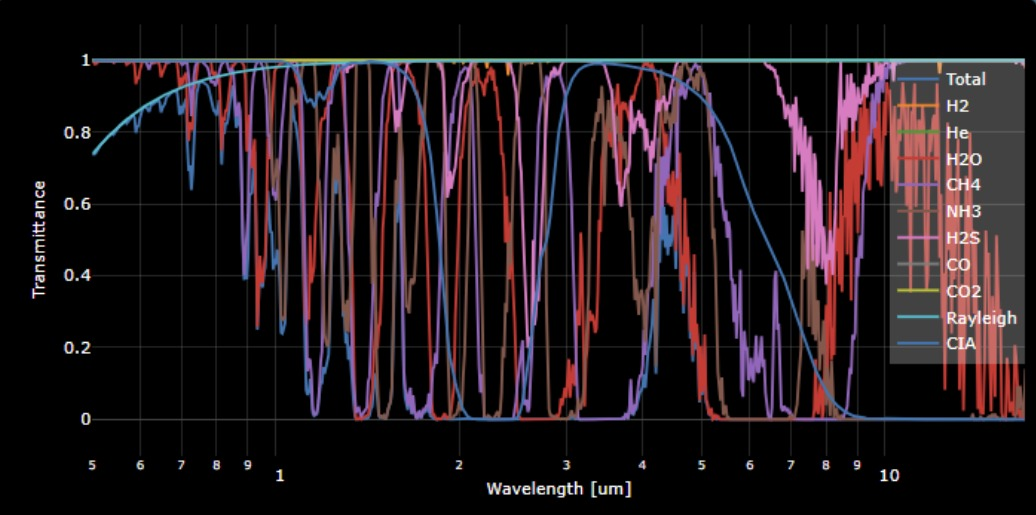
The simulated transmission spectrum for TOI-700 d reveals distinct absorption bands that map directly onto the atmospheric composition supplied to PSG (Table 1). Water vapour (H₂O) exhibits prominent absorption near 1.4, 1.9, and 2.7 µm, together with broader structure across 5–8 µm. Carbon dioxide (CO₂) produces deep bands centred near 4.3 and 15 µm, where transmittance is strongly suppressed. Additional shallow bands are attributable to methane (CH₄), ammonia (NH₃), and carbon monoxide (CO); their limited depth is a direct consequence of the low equilibrium abundances returned by the chemical model rather than of any intrinsic weakness in their cross-sections.
The dominance of H₂O and CO₂ reflects two compounding factors: both molecules possess numerous strong infrared bands, and both are present at mole fractions (≈10⁻² and ≈4×10⁻⁴) far above those of the reduced species. The equilibrium calculation is therefore not merely reproduced by the spectrum — it is legible in it. The methane and ammonia synthesis equilibria (K₂, K₃) are driven strongly toward their reactants under the oxidised, O₂/CO₂-rich, hydrogen-poor conditions of the modern Earth-like case, leaving CH₄ and NH₃ at mole fractions ≤10⁻⁶; at those abundances their otherwise sharp features contribute only marginally to the total optical depth, which is why the modelled bands are shallow. This coupling between the computed equilibrium state and the emergent band depths is the central quantitative link in the study: the spectrum is a readout of the chemistry.
Beyond molecular absorbers, two physical processes shape the continuum. Rayleigh scattering dominates the short-wavelength region; its steep ∝ 1/λ⁴ dependence scatters blue and near-UV light far more efficiently than red light. Collision-induced absorption (CIA) arises when symmetric molecules such as N₂ and O₂ acquire transient dipoles during close collisions, raising opacity across roughly 5–12 µm and shaping the thermal spectrum22. Because N₂ and O₂ together comprise 99% of the modelled atmosphere, this continuum contribution is significant even though neither gas produces a discrete band. The modelled feature amplitudes correspond to transit-depth variations at or below the ≤10 ppm level for a planet of this radius — a point returned to in the Discussion, because it governs whether any of this structure is observable in practice.
Emission (Radiance) Spectrum
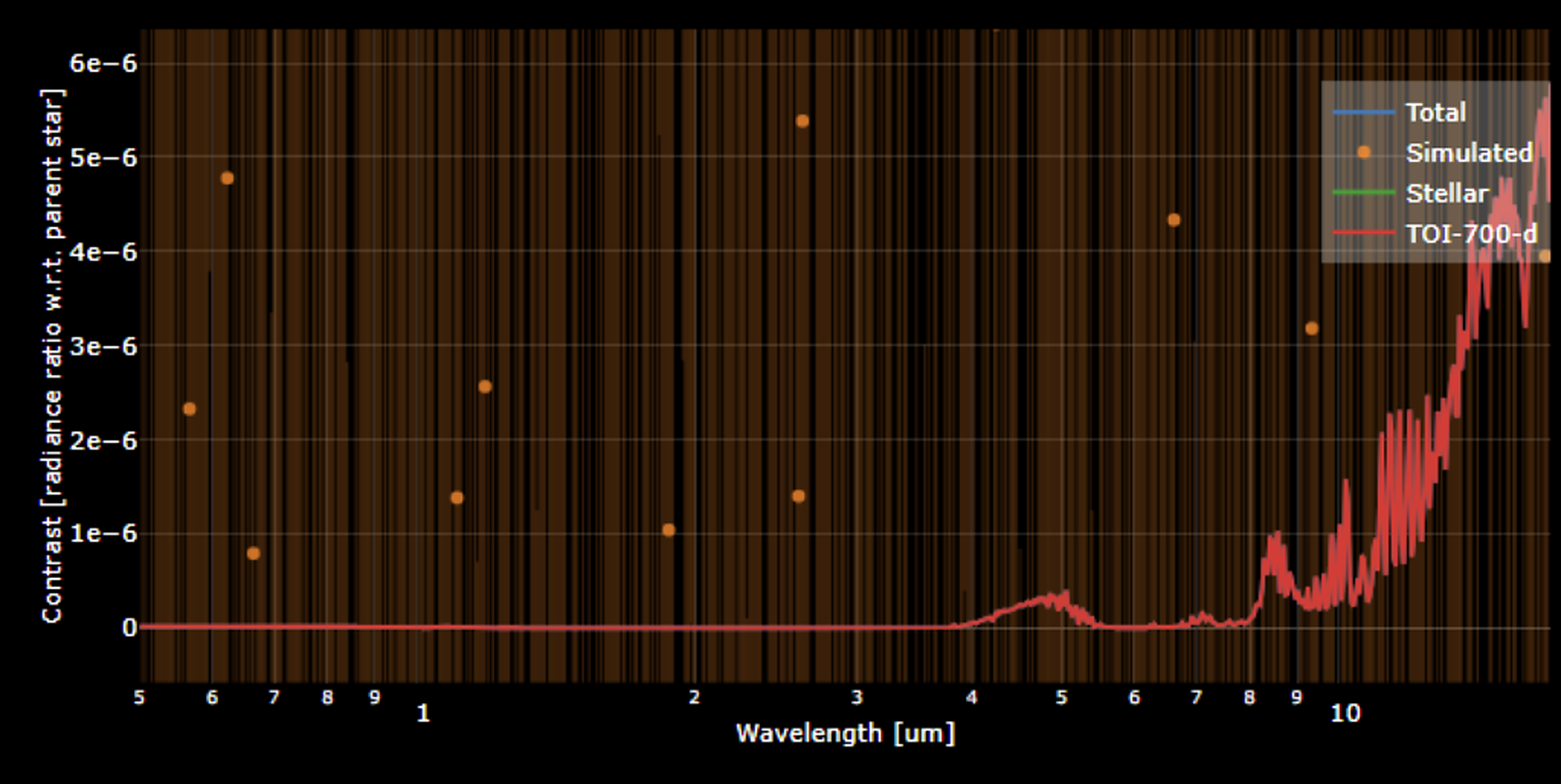
The emission spectrum shows the modelled planet-to-star flux contrast as a function of wavelength. The sharp rise beyond 8 µm is consistent with thermal emission from a planet at ≈269 K: Wien’s displacement law (λ_max = b/T, b = 2898 µm·K) gives a blackbody peak near 10.8 µm. The overall envelope therefore approximates a ≈269 K blackbody, onto which molecular absorption is imprinted as depressions where the atmosphere is opaque.
Those depressions are diagnostic. Where CO₂ and H₂O absorb strongly, radiation escapes from higher, cooler layers, lowering the emergent brightness temperature and carving absorption features into the continuum. The deep bands near 4.3 and 15 µm coincide with CO₂’s vibrational modes, while the 5–8 µm depression tracks water vapour — both consistent with laboratory spectroscopy and Solar System observations20,22. The 15 µm CO₂ band is especially important: it is the same feature used to infer the presence or absence of atmospheres on rocky M-dwarf planets from thermal emission, and in the oxidised model it is deep, indicating a CO₂-bearing atmosphere would meaningfully depress the dayside brightness temperature relative to a bare rock24,25.
Read together, the two spectra describe an atmosphere whose radiative behaviour is governed by H₂O and CO₂, with reduced prebiotic species present only at trace levels. In terms of composition, the results are consistent with a temperate, oxidised, CO₂-bearing secondary atmosphere rather than a reducing one. In terms of habitability, they are encouraging on surface temperature — the ≈269 K regime supports liquid water — but discouraging on an active prebiotic inventory, since the very oxidising conditions that make the atmosphere spectrally “clean” also suppress the reduced molecules most prebiotic pathways require.
Discussion
The modelled spectra show H₂O and CO₂ dominating TOI-700 d’s transmission and emission signatures, consistent with equilibrium chemistry in the oxidised, secondary atmospheres expected in M-dwarf habitable zones21,15. CH₄ and NH₃ produce only trace features (≤10⁻⁶ mole fractions), suppressed by the O₂/CO₂-rich background. Equilibrium chemistry alone therefore cannot sustain the reduced-gas abundances required for robust organic synthesis; disequilibrium sources such as volcanism, impacts, or lightning would be necessary to elevate CH₄ and NH₃ (and precursors such as HCN) to prebiotically or observationally relevant levels26,9,10. Because the diagnostic feature depths sit at or below ≈10 ppm, biosignature retrieval on this target would demand sensitivity beyond what is realistic for a planet of this size in the near term19,22.
Comparison with Prior Studies
These results agree closely with the most directly comparable prior work. Dong et al.21 found that a CO₂-rich atmosphere is far more resilient than an Earth-like N₂/O₂ one — consistent with our result that the composition most likely to persist is also the one whose spectrum we model. Suissa et al.7 showed with 3D general-circulation models that temperature profiles compatible with surface liquid water are achievable, in line with the ≈269 K regime here. Most directly, the recent 1D photochemistry–climate study of Sumida et al.19 found TOI-700 d can maintain liquid-water surface temperatures across a range of UV levels and pressures, and independently reported spectral-feature contrasts below ≈15 ppm — quantitatively consistent with the ≤10 ppm amplitudes obtained here — while emphasising the dual role of haze in shielding the surface and complicating biosignature detection.
The equilibrium suppression of reduced species is consistent with the broader photochemical literature: Ranjan et al.14 found anoxic CO₂–N₂ atmospheres suppress methane unless disequilibrium or active geology is present, and Arney et al.13 and Meadows et al.15 established that hazes can both shield surfaces and obscure biosignatures. The reduced prebiotic inventory we obtain also dovetails with origin-of-life constraints for M-dwarf planets, where quiescent UV is often insufficient to drive HCN-based prebiotic photochemistry11,8,12,10,27. On the observational side, our conclusion that even a favourable rocky M-dwarf target is hard to characterise is empirically reinforced by JWST results for the seven-planet TRAPPIST-1 system28, where thermal-emission and transmission measurements are most consistent with little or no atmosphere and provide no detection of the CO₂ bands our model predicts would be diagnostic24,29,30,25. By contrast, JWST has detected carbon-bearing molecules in warmer, larger sub-Neptunes31 and constrained flat spectra for other rocky worlds32; this pattern frames TOI-700 d as a target at or beyond the current sensitivity frontier.
Where our results differ from these studies, the differences are traceable to modelling choices rather than physical disagreement. The photochemistry–climate and escape models7,21,19,14 resolve vertical structure, kinetics, and stellar-driven disequilibrium (e.g. haze and ozone build-up) that our equilibrium framework omits. Our approach instead isolates the equilibrium baseline and shows explicitly how far it lies from a detectable prebiotic state — a complementary rather than competing result. The trace CH₄/NH₃ abundances we report are lower than in scenarios that inject volcanic or biological fluxes precisely because no such source is included, making the equilibrium model a conservative lower bound on reduced-gas abundance.
Strengths and Limitations
The principal strength of this approach is transparency: the three-reaction network is small enough to be fully specified, reproduced, and audited, and it couples directly to a validated radiative-transfer engine (PSG) so chemistry and spectrum can be interpreted together. This suits its intended role as a fast, first-order screen that establishes the equilibrium baseline before more expensive photochemical or 3D climate models are applied; its consistency with independent escape, climate, and photochemistry studies of TOI-700 d7,21,19 indicates it captures the dominant behaviour of an oxidised secondary atmosphere.
The limitations are equally clear. First, the equilibrium constants K₁–K₃ were treated as illustrative placeholders rather than temperature-specific NIST-JANAF values at ≈269 K, so absolute CH₄ and NH₃ mole fractions are order-of-magnitude estimates. Second, a single 1-bar surface pressure was assumed; because band depths and CIA scale with column abundance, results should be tested across a pressure grid, as Sumida et al.19 have done. Third, clouds and photochemical hazes are not included. Fourth, spectral degeneracy has not been assessed through retrieval. Fifth, equilibrium chemistry cannot represent the photochemical and kinetic disequilibrium that governs both real biosignatures and prebiotic productivity. These bound the quantitative reach of the central finding — that an oxidised, temperate TOI-700 d would present an H₂O/CO₂-dominated, prebiotically quiet, observationally challenging spectrum — and define the path for future work.
Conclusion
This study modelled chemical equilibria and synthetic atmospheric spectra for TOI-700 d to assess its potential habitability. The key findings are that H₂O and CO₂ dominate the modelled signatures; that prebiotic reduced gases (CH₄, NH₃) are strongly suppressed under equilibrium conditions; and that planet-to-star flux contrasts of ≤10 ppm present significant observational challenges for biosignature detection. These results are consistent with prior photochemical, climate, and escape modelling of TOI-700 d7,21,19, with the broader biosignature and prebiotic-chemistry literature15,13,14,11, and with the empirical difficulty of characterising comparable rocky M-dwarf planets demonstrated by JWST24,29,30. In direct answer to the question posed by the title, synthetic spectra can reliably predict the equilibrium chemical state of a temperate exoplanet atmosphere — here, an H₂O/CO₂-dominated, prebiotically quiet composition — but in the present JWST era those predictions cannot yet be observationally confirmed for a target of this size, which is itself an informative result for prioritising future targets.
Limitations. The model uses a simplified three-reaction equilibrium network, assumes a fixed 1-bar surface pressure, adopts Earth-like mixing ratios as a baseline, omits clouds and haze, and employs placeholder equilibrium constants pending thermochemical validation. Future work should replace the placeholder constants, expand the reaction network to include CO and nitrogen oxides, perform sensitivity analysis across pressure and composition space, and incorporate photochemical disequilibrium.
Acknowledgements
This paper was written through the Polygence Project program. Advisors included Mrs. Becca Spejcher from University of Colorado Boulder. The paper was reviewed by the National High School Journal of Science.
References
- E. A. Gilbert, T. Barclay, J. E. Schlieder, et al. The First Habitable-zone Earth-sized Planet from TESS. I. Validation of the TOI-700 System. AJ. Vol. 160(3), pg. 116, 2020. [↩]
- J. E. Rodriguez, A. Vanderburg, S. Zieba, et al. The First Habitable-zone Earth-sized Planet from TESS. II. Spitzer Confirms TOI-700 d. AJ. Vol. 160(3), pg. 117, 2020. [↩] [↩] [↩]
- E. A. Gilbert, A. Vanderburg, J. E. Rodriguez, et al. A Second Earth-Sized Planet in the Habitable Zone of the M Dwarf, TOI-700. ApJL. Vol. 944(2), pg. L35, 2023. [↩] [↩] [↩]
- A. L. Shields, S. Ballard, J. A. Johnson. The Habitability of Planets Orbiting M-dwarf Stars. Physics Reports. Vol. 663, pg. 1-38, 2016. [↩] [↩] [↩]
- V. S. Airapetian, A. Glocer, G. Gronoff, et al. Prebiotic Chemistry and Atmospheric Warming of Early Earth by an Active Young Sun. Nature Geoscience. Vol. 9, pg. 452-455, 2016. [↩] [↩]
- R. Luger, R. Barnes. Extreme Water Loss and Abiotic O2 Buildup on Planets throughout the Habitable Zones of M Dwarfs. Astrobiology. Vol. 15(2), pg. 119-143, 2015. [↩]
- G. Suissa, E. T. Wolf, R. K. Kopparapu, et al. The First Habitable-zone Earth-sized Planet from TESS. III. Climate States and Characterization Prospects for TOI-700 d. AJ. Vol. 160(3), pg. 118, 2020. [↩] [↩] [↩] [↩] [↩] [↩]
- P. B. Rimmer, J. Xu, S. J. Thompson, et al. The Origin of RNA Precursors on Exoplanets. Science Advances. Vol. 4(8), pg. eaar3302, 2018. [↩] [↩] [↩]
- J. D. Sutherland. Studies on the Origin of Life – the End of the Beginning. Nature Reviews Chemistry. Vol. 1(1), pg. 0012, 2017. [↩] [↩]
- M. Ferus, P. Kubelik, A. Knizek, et al. High-energy Radical Chemistry Formation of HCN-rich Atmospheres on Early Earth. Scientific Reports. Vol. 7, pg. 6275, 2017. [↩] [↩] [↩]
- S. Ranjan, R. Wordsworth, D. D. Sasselov. The Surface UV Environment on Planets Orbiting M Dwarfs. ApJ. Vol. 843(2), pg. 110, 2017. [↩] [↩] [↩]
- J. Xu, D. J. Ritson, S. Ranjan, et al. Photochemical Reductive Homologation of Hydrogen Cyanide Using Sulfite and Ferrocyanide. Chem. Commun. Vol. 54(44), pg. 5566-5569, 2018. [↩] [↩]
- G. N. Arney, S. D. Domagal-Goldman, V. S. Meadows, et al. The Pale Orange Dot: The Spectrum and Habitability of Hazy Archean Earth. Astrobiology. Vol. 16(11), pg. 873-899, 2016. [↩] [↩] [↩] [↩]
- S. Ranjan, E. W. Schwieterman, C. Harman, et al. Photochemistry of Anoxic Abiotic Habitable Planet Atmospheres: Impact of New H2O Cross Sections. ApJ. Vol. 896(2), pg. 148, 2020. [↩] [↩] [↩] [↩]
- V. S. Meadows, C. T. Reinhard, G. N. Arney, et al. Exoplanet Biosignatures: Understanding Oxygen as a Biosignature in the Context of Its Environment. Astrobiology. Vol. 18(6), pg. 630-662, 2018. [↩] [↩] [↩] [↩] [↩]
- E. W. Schwieterman, N. Y. Kiang, M. N. Parenteau, et al. Exoplanet Biosignatures: A Review of Remotely Detectable Signs of Life. Astrobiology. Vol. 18(6), pg. 663-708, 2018. [↩]
- M. A. Thompson, J. Krissansen-Totton, N. Wogan, et al. The Case and Context for Atmospheric Methane as an Exoplanet Biosignature. PNAS. Vol. 119(14), pg. e2117933119, 2022. [↩]
- A. Tokadjian, R. Hu, M. Damiano. The Detectability of CH4/CO2/CO and N2O Biosignatures through Reflection Spectroscopy of Terrestrial Exoplanets. AJ. Vol. 168(6), pg. 292, 2024. [↩]
- V. Y. D. Sumida, R. Estrela, A. Valio. Evaluating Habitability and Biosignature Detection on TOI-700 d: The Role of UV Environment and Atmospheric Pressure. ApJ. Vol. 994(2), pg. 241, 2025, https://doi.org/10.3847/1538-4357/ae1230. [↩] [↩] [↩] [↩] [↩] [↩] [↩] [↩]
- V. S. Meadows. Reflections on O2 as a Biosignature in Exoplanetary Atmospheres. Astrobiology. Vol. 17(10), pg. 1022-1052, 2017. [↩] [↩]
- C. Dong, M. Jin, M. Lingam, et al. Atmospheric Escape from TOI-700 d: Venus versus Earth Analogs. ApJL. Vol. 896(2), pg. L24, 2020. [↩] [↩] [↩] [↩] [↩] [↩] [↩] [↩]
- G. L. Villanueva, M. D. Smith, S. Protopapa, et al. Planetary Spectrum Generator. JQSRT. Vol. 217, pg. 86-104, 2018. [↩] [↩] [↩] [↩]
- I. E. Gordon, L. S. Rothman, R. J. Hargreaves, et al. The HITRAN2020 Molecular Spectroscopic Database. JQSRT. Vol. 277, pg. 107949, 2022. [↩]
- T. P. Greene, T. J. Bell, E. Ducrot, et al. Thermal Emission from the Earth-sized Exoplanet TRAPPIST-1 b Using JWST. Nature. Vol. 618(7963), pg. 39-42, 2023. [↩] [↩] [↩]
- A. P. Lincowski, V. S. Meadows, S. Zieba, et al. Potential Atmospheric Compositions of TRAPPIST-1 c Constrained by JWST/MIRI. ApJL. Vol. 955(1), pg. L7, 2023. [↩] [↩]
- J. Krissansen-Totton, G. N. Arney, D. C. Catling. Disequilibrium Biosignatures over Earth History and Implications for Detecting Exoplanet Life. Science Advances. Vol. 4(1), pg. eaao5747, 2018. [↩]
- Z. R. Todd, G. G. Lozano, C. L. Kufner, et al. UV Transmission in Prebiotic Environments on Early Earth. Astrobiology. 2024, https://doi.org/10.1089/ast.2023.0077. [↩]
- M. Gillon, A. H. M. J. Triaud, B.-O. Demory, et al. Seven Temperate Terrestrial Planets around the Nearby Ultracool Dwarf Star TRAPPIST-1. Nature. Vol. 542(7642), pg. 456-460, 2017. [↩]
- S. Zieba, L. Kreidberg, E. Ducrot, et al. No Thick Carbon Dioxide Atmosphere on the Rocky Exoplanet TRAPPIST-1 c. Nature. Vol. 620(7975), pg. 746-749, 2023. [↩] [↩]
- O. Lim, B. Benneke, R. Doyon, et al. Atmospheric Reconnaissance of TRAPPIST-1 b with JWST/NIRISS. ApJL. Vol. 955(1), pg. L22, 2023. [↩] [↩]
- N. Madhusudhan, S. Sarkar, S. Constantinou, et al. Carbon-bearing Molecules in a Possible Hycean Atmosphere. ApJL. Vol. 956(1), pg. L13, 2023. [↩]
- J. Lustig-Yaeger, G. Fu, E. M. May, et al. A JWST Transmission Spectrum of the Nearby Earth-sized Exoplanet LHS 475 b. Nature Astronomy. Vol. 7, pg. 1317-1328, 2023. [↩]