

Abstract
Background/Objective: Artificial intelligence is changing which jobs require which tasks, and it is unclear whether the systems built to support displaced workers were designed to handle this kind of abrupt change.
Methods: The amount of work needed for jobs has drastically changed due to artificial intelligence, but the American safety net for workers who lose their jobs has been designed to deal with cyclical unemployment rather than structural changes in the labor market that occur because of technology. This paper investigates the extent to which unemployment benefits, re-training programs, and wage insurance can adapt to the impacts of AI-based labor market changes, and what would need to change if they can’t.
Results: The discrepancy exists across all four fronts. Government data on changes in the job market come late, after major damages have already occurred, unemployment insurance pays the salary but doesn’t replace the lost skills, the lone federal program that paid workers while they retrained was shut down in 2022, and the reasons behind the layoffs are obtained through employers’ statements. Exposure to AI is moderately correlated with salaries paid, the opposite of what would be expected if exposure meant elimination, although the case with underpaid clerks is an exception to this. There is no statistically significant relationship present between how exposed the workforce within a certain state is and how generous its unemployment benefits are.
Conclusions: Exposure assessment serves as a warning of the possibility of job losses. The real issue is that the US system did not have to end up with weak worker protections. It was a choice. Other countries have created better systems, so it is clearly possible, not just something the US is stuck with.
Keywords: task-based technological change, institutional mismatch, unemployment insurance, wage insurance, flexicurity, active labor market policy
Introduction
People continue to debate on whether artificial intelligence will destroy jobs before the actual evidence is accumulated. The main question being asked in these debates stems from the possibility of AI eliminating jobs. However, asking this question misses out on a more relevant and more answerable question – whether the systems currently in place to help workers transition from one job to another have been designed for the type of changes expected from AI1. The paper uses task-based theory, which says technology impacts on the tasks that make up the job instead of the job as a unit of work1. The impact of technology on employment will depend on whether tasks get taken away or new ones get created. In this paper, I will use that framework to approach the examination of institutions enabling workers to move from one job to another.
The difference is significant because it shows that current research talks about what AI could do instead of what it actually does do. The most commonly used estimates are that approximately 15% of all worker tasks in the United States could be completed significantly faster at the same quality using large language models. With software built on top of these models, that figure rises to between 47% and 56%.2. These estimates are of technological exposure instead of job loss predictions. There is already a lot of existing work that measures exposure and there is also older research that talks about how to design job market programs. However, none of these works connects the measured exposure and the systems designed. Existing explanations normally look either at the technology or the policy, but even when both aspects are discussed, policy is treated as a simple list of ideas instead of a system with its own regulations, funding, need for information and reaction. That is the gap this paper tries to fill, by looking closely at the safety net itself and comparing it to measured exposure.
The idea of an institutional mismatch is essentially a program that was originally designed to solve one problem but is now facing a different problem. This paper identifies four dimensions. The first dimension, temporal mismatch, occurs when an institution reacts to a situation late, or after damages have already occurred. The second dimension is a narrow mismatch, which means that the program that is designed solves a different problem than the one the workers already have. An example of this would be the safety net being able to compensate for employee wages, but it is unable to compensate for the time and money spent on learning skills. Financial mismatch is when funding is not allocated based on how much of the population is actually affected. Last but not least is an informational mismatch, which means that the data that is collected to create these systems is not provided, unreliable, or provided by two different entities with two different views. All four types of mismatch can happen independently and can be treated as separate.
This paper is not designed to measure or predict exactly how much AI displacement will occur and neither is it designed to prove that more generous policies will directly lead to better outcomes. It is a primarily qualitative institutional analysis that makes use of simple administrative data and two exploratory quantitative tests. Its findings are limited to discussions of institutional architecture and descriptive correlation rather than predicting or establishing cause and effect. However, what this paper does offer is an explanation regarding what safety nets should look like in different scenarios, along with evidence that America’s current safety net is due to policy choices and not a result of circumstances.
Literature Review
Task-based technological change
The task-based approach stems from the comparison of routine and non-routine job content. In particular, it examines how the presence of computers has replaced human labor in line with rules, while helping out with tasks that need unbiased judgment or communication1. This turned into a model where production is made up of tasks that could either be done by labor or capital (AI), with capital influencing the way tasks are distributed3. Automation and the use of artificial intelligence takes tasks away from workers, cutting labor demand. However, with automation come new tasks, which bring labor back and raise demand again. The interaction of these two forces determines the aggregate demand, but a formal framework shows that it also shapes how income is split between labor and capital, not only the level of employment4.
When this theory was tested on industrial robots in the U.S., it was robots actually arriving in an area, not just the possibility of them, that hurt local jobs and wages. 5. This distinction between capability and the actual use is what truly matters, as the effects are only visible once something is actually implemented. The ability of automation to create new jobs in other areas is a big part of why the total employment hasn’t completely collapsed already.
This material provides a framework which this paper follows. The first stage of technical task exposure outlines the possible technical capabilities of technology. The second stage relates to actual technology adoption, the practices used by companies. The third stage of observed changes in labor demand includes hiring, hours of operation, and salaries. The last stage of realized displacement outlines cases when employees are laid off. One of the biggest problems in the debate on AI and its effects on employment is that evidence that is found at one of these stages is used to make claims about other stages, which wouldn’t actually be a valid claim.
Measuring exposure to artificial intelligence
There have been various efforts made to determine how much work can be negatively affected by automation, getting very different answers, mostly because of the difference in methods used and not because of the actual data collected. The initial method used analyzed all the jobs to see how likely they are to be computerized and showed that a lot of jobs in the USA are at risk of being automated6. This study is heavily criticized because each job is made up of many different tasks, a lot of which cannot be automated. However, in this case, because one or more tasks in the job can be computerized, it is determined that the entire job can be automated, skewing the results. Newer approaches look at the problem at an individual task level. One technique analyzes the task descriptions and compares them to what can be done by large language models (LLMs). As a result, it was found that approximately 80% of American workers have at least 10% of their work tasks affected, with 19% of workers having nearly half of their tasks affected2. Another technique looks at changes in AI capabilities and links them with the changes in job requirements to build occupational, regional, and industry exposure scores.7. Both of these methods rank jobs differently, and both of them don’t show the real employment effects, but instead show the estimates of potential effects.
Evidence on adoption and task transformation
While real-world evidence regarding AI usage is not as substantial as research on predicting use, it provides better insight into the process of AI usage. A randomized experiment determined that AI decreased the time taken to complete writing tasks by 0.8 standard deviations and improved the quality of writing by about 0.4 standard deviations8.On the other hand, a research project involving customer service staff showed that using an AI increased the number of issues that the employees dealt with per hour by about 14%9. In both studies, AI helped the less experienced workers more than it helped veterans, so the skill gap within each field actually shrank.
These results are extremely important for 2 reasons. Both studies show that AI changing tasks within jobs still exists, which is different from past studies showing that if one task could be automated, the whole job could be automated. The skill-compression phenomenon directly contradicts the argument that less skilled workers are automatically hurt by AI adoption. The limitation here is that neither study dealt with the actual separations within jobs, and because both studies are done on a few occupations within designated timeframes, you cannot generalize the results to all other occupations or the entire job market.
Adaptive capacity
More modern studies have built composite scores on how well workers could cope with job changes based on factors such as savings, skills that can be transferred, age, and labor market density10. This approach allows researchers to separate age, transferable skills, and the density of the labor market. It is important to note two limitations. First and most important, this research is still theoretical and remains unproven. Second, because it is made at the occupational level, it only captures averages, not the individual circumstances of each individual employee.
The costs of displacement
The basis for transition help stems from a strong belief that job losses result in significant and long lasting financial harm. Studies that track the actual income records show that displaced workers’ earnings stay significantly lower than when they were employed even after many years from layoff11. Newer research has discovered that such income losses are not uniform. For example, job losses occurring in a labor market downturn produce much larger and longer-lasting reductions in lifetime earnings than job losses occurring in stronger labor markets12.
These studies show why asking the correct question is so important. If AI causes actual job separation rather than alteration of tasks in jobs, the costs aren’t limited to a short benefits period. They stay with a person for the entirety of their career. It also means that timing of the institution’s response matters just as much as the generosity of the response, since a layoff in a weak labor market costs a worker far more than the same layoff in a strong one.
Income data alone is unable to capture everything. Qualitative research shows costs that are unable to be measured in terms of dollars. In an ethnographic study of the lives of displaced professionals, it was found that job loss not only leads to a loss of professional identity but also leaves workers dependent on unequally distributed resources.13. A similar study done on IT professionals that were laid off because of AI found the same thing, a loss of identity coupled with the anxiety of their skills becoming less useful overnight14. Although these studies were not about US clerical workers, they still show something important. They show that skills that built careers were no longer valued, which in turn cost workers more than just income. It cost them a part of who they were. Any response from a policy level should take that into account.
Unemployment insurance design and evidence
The literature surrounding unemployment insurance has shown what this financial aid can and cannot achieve. UI research distinguishes between the “moral hazard” (benefits make it cheaper to stay unemployed for a longer period of time) and “liquidity” (benefits relieve financial pressure so the people do not have to accept the first job offered out of desperation) effects15. Most of the effects that were observed on unemployment duration come from liquidity. This means that UI isn’t just insurance. It also changes people’s behavior during their job search. A review paper published later summarizes experiments that make these controlled comparisons instead of assigning people to different groups (quasi-experimental research) on how benefit levels and benefit duration affect labor supply and overall welfare.16
However, this literature doesn’t address the relevance of a person’s skill. It assumes that a worker’s existing skills aren’t the issue.
Active labor market policy and comparative institutions
The best evidence regarding transition support comes from current active labor market policies. A meta analysis shows that the effects vary a lot by program type. Job search assistance can work well quickly, while training programs are a lot more beneficial over the medium term than the short term.17. This timing matters a lot for AI, especially because certain skills no longer being valuable is a skills problem and programs focused on building these skills are the ones that take the longest to show results.
Comparative welfare state studies present a second case of evidence. Denmark’s flexicurity model is a combination of weak job protection laws, strong income security, and heavy investment in active programs that actually help the workers. The evaluation shows that the combination is what makes the model work, as Denmark spends more on active programs than almost any OECD country18. Short-time work programs are another institutional type, providing subsidies for reductions in working hours rather than payments for separation. The evidence from the Great Recession shows that these programs reduced unemployment in countries that already had these programs, even though the number of jobs that were actually saved was lower than the number of people who enrolled19.
Wage insurance (otherwise known as “topping up to pay for workers that were re-employed at lower wages”) has been studied through the Trade Adjustment Assistance program in the US. This analysis found that it increased employment and earnings in the long term and eventually paid for itself through higher tax revenue and lower benefit costs20.
In contrast, not all programs actually work. A long term study from the Netherlands found that many programs slightly raise employment, but only the job placement services and training were deemed cost effective after accounting for the short term dip caused by the people that searched for jobs less while enrolled21. A Canadian program that gave income supplements to displaced workers had only a small effect22. South Korea’s UI payments showed programs that could be implemented quickly in a crisis while carrying some risks. One of these risks includes creating a split where some people cannot access these systems. 23. The commonality across all three programs is that income support alone does not do much. The design of the program is what determines success.
Competing accounts
Currently, not everyone agrees that displacement will be severe. The task based model itself actually predicts a “reinstatement effect,” the idea that when automation takes over some tasks, it also tends to create new tasks and new types of work that didn’t exist before.3. Historically, most jobs today didn’t exist in the early or mid 20th century, showing constant job creation24. Research on job polarization shows that technology has reshaped the job market (mostly the higher and lower skill jobs) rather than outright shrinking it25. A broader view creates a new argument, where automation actually makes workers more productive and increases labor demand, meaning fears about job loss are inflated because people pay more attention to the jobs being replaced than to the jobs being created26 only.
I didn’t set aside these counterarguments, but rather built them into the analysis because they also matter for how institutions should respond to unemployment. Different situations need different responses. For example, task changes within one job need different support compared to full job separation. Labor market polarization also needs another kind of response, because with polarization, the question changes. It isn’t whether people move jobs, it’s where they end up.
Methods
The particular study is mostly qualitative, matching institutional design features to the actual analytical framework, while including the statistics. Along with this are two small quantitative exploratory analyses that analyze the correlations between exposure scores and wages/benefits. These are not meant to create claims regarding causation, they are designed to be descriptive only. Using the four mismatch types given earlier, the analytic approach looked at three institutional contexts, including providing some form of income replacement through unemployment compensation, providing some transitional assistance through retraining or wage insurance, and determining what federal statistical infrastructure would permit patterns to be recognized and acted on. For each case, I considered what assumptions it makes about job loss, how it is funded, who qualifies, and what information is available. Those answers were then compared against what the task based framework says should be happening. Five countries were chosen specifically because they differ a lot institutionally and have been thoroughly studied, telling us whether a problem is due to the technology or due to the specific institutional choices.
There are two pieces within the primarily qualitative argument. First, linking AI occupational exposure to average wages by occupation code. The second compares state unemployment benefits using the legal maximum benefit rather than what people actually receive. State exposure uses the employment data instead of metropolitan area data, mostly in order to avoid the measurement problem that was caught earlier. The state legislation info comes from Department of Labor data, which is taken as is. The broader evidence base also includes interviews with displaced workers, plus peer reviewed evaluations of the three systems mentioned before (Dutch, Canadian and South Korean) in order to go beyond just data from Denmark and Germany.
Results
Temporal mismatch
Statistics from the government take a lot of time to detect occupational changes in comparison to how quickly the change itself actually happens.27. The main federal survey takes years and years to collect data, and the response rates to these surveys have been falling every year, making the response time even longer.27. An institution that only notices the problem after workers that were affected have already left the labor market can’t help workers when it really matters. Ironically, the best programs are the ones that take the most time to set up.17. This delay carries a real cost, because workers laid off during a weak market lose much more over their careers than those laid off in a strong one.12.
Narrow mismatch
Unemployment insurance is built to replace income during unemployment and ease financial pressure.15. It assumes that the skills workers have are still marketable and that they will find a similar job. On the contrary, if your occupation’s tasks get handed to automation, there is a skills problem, not a job search problem, and UI currently has no tool for that. Comparative evidence directly backs this up, as evaluations of Denmark show income security along with flexibility isn’t enough without active programs28. The US has income security but weak active programs, the exact combination that the evidence shows doesn’t work.
There is a large difference between the benefit parameters in each state. For example, weekly maximums range from $235 in Mississippi to $1,152 in Washington.29. However, that range alone is not enough to tell you about actual income protection. You can’t tell what people really receive, since the nominal maximums cover very different shares of income, depending on wage levels within each state. It’s also unclear if these maximums include child benefits. Some states also use conditional rules instead of a flat cap.29. To really compare states you’d need the replacement rate data for each state built from average weekly wages, along with exhaustion and duration rates, using methods that already exist16. The point here is purely to show that benefit design happens at the state level.
Financial mismatch
Trade Adjustment Assistance used to combine retraining with income support and had great results20, but it expired in 2022. Immediately afterwards the Dislocated Worker Program became the only federal system for the displaced under the Workforce Innovation and Opportunity Act, and it offers no guaranteed income support during retraining. Needs-related payments exist under 20 CFR 680.950, but they are discretionary, locally funded, and far more limited than the Trade Readjustment Allowances that TAA provided30. This means that there is currently no system that lets a displaced worker retrain for a longer period of time without losing significant amounts of income, which is exactly what is needed for skills based displacement. Proposals for an AI dedicated program suggest around $700 million a year, which is similar to what TAA spent annually30. Trade Adjustment Assistance, however, was meant for people affected by import competition, which is a much smaller group of people, while AI exposure covers many more occupations2, meaning that the same funding would just be facing more demand.
Informational mismatch
As of now, whether a layoff gets blamed on AI depends almost entirely on what employers say, and employers lay off employees for different reasons. Some might exaggerate the role of AI to deflect from other business issues. Others might avoid the topic entirely in order to avoid legal backlash/exposure. Either way, this bias cannot really be fixed using data itself, and we are left with no independent way to accurately measure AI driven layoffs. Therefore, any policy that is built on these kinds of results is built on data that cannot be trusted.
An exploratory test: exposure and occupational wages
To further dig into the distinction between exposure and displacement, this paper compares AI Occupational Exposure (AIOE) Scores against wage data, accompanied by occupation codes that cover 667 occupations. As stated before, this isn’t meant to show direct causation. It is just to describe the relationship between exposure and pay.
Exposure and salaries across jobs are positively correlated (Pearson r = 0.52, p < 0.001; Spearman rho = 0.55). A simple linear regression suggests that a one standard deviation increase in exposure is associated with to about a $14,000 increase in median annual salaries and exposure alone explains 27% of the variance in occupational pay. Median wages rise across exposure quartiles, from around $39,900 in the first quartile to $77,600 in the fourth (Figure 1). That is the opposite of what would normally be expected. This shows that exposure is really just tracking cognitively demanding, well paid jobs rather than jobs that are about to be eliminated7.
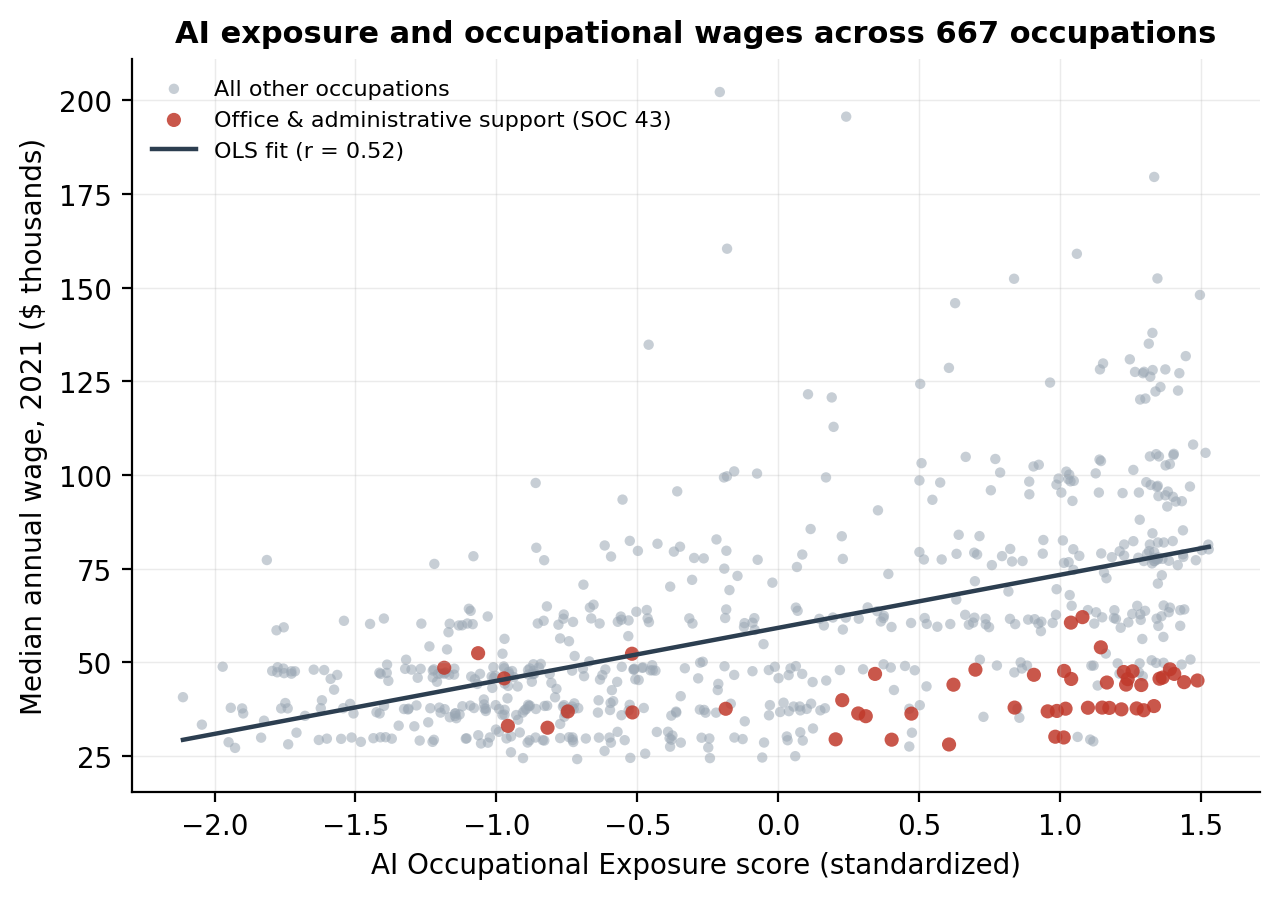
There is an important exception to this, however. Office or admin support occupations have high exposure and low pay, as they average $41,900, which is below the overall average, the opposite pattern from all other occupations. This example fits the polarization theory. It means policymakers cannot just rely on the exposure scores alone because the correlation hides vulnerable groups that have both high exposure and few resources. The limitations of this example are that it uses only one measure of exposure from one year, and does not account for the existing insurance/labor policy.
A second test: state exposure and benefit generosity
I extended the analysis to the state level, using 2025 occupational employment data7,31, to build an employment weighted exposure score for each state and comparing it to each state’s maximum UI benefit in effect January 2026.29 This analysis covers all 50 states plus the District of Columbia and Puerto Rico, and 28,485 occupation by state combinations.
If there was actually a link between AI exposure risk and benefit generosity, more exposed states would offer significantly more support, which is not what the data shows. The correlation between the two is weak and not at all statistically significant, with exposure only explaining 3% of the variation in benefit levels between states (Figure 2). Of 26 highly exposed states, 12 offer benefits below the median, a disorganized pattern instead of a systematic one. This suggests that benefit generosity reflects state politics and budgets rather than AI exposure.
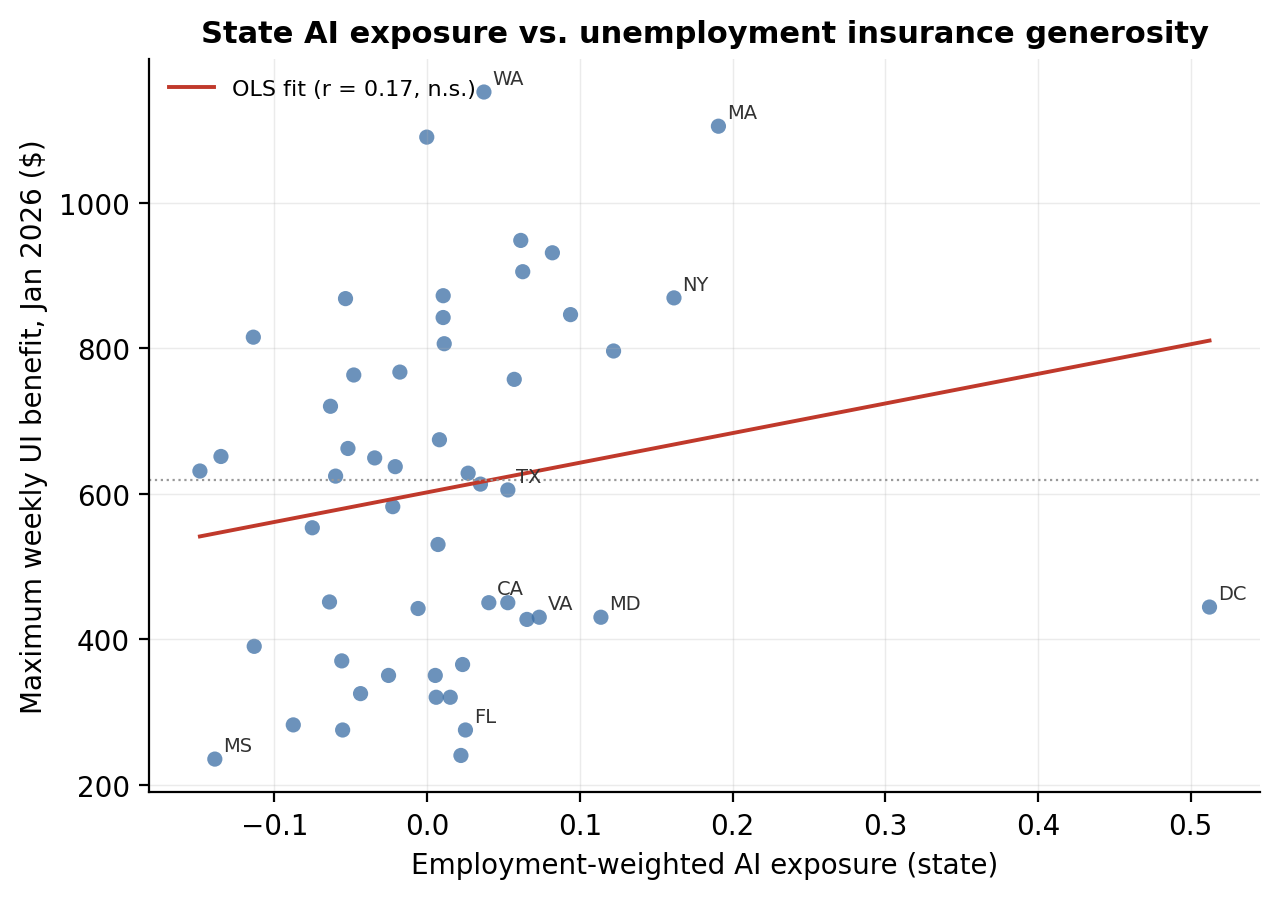
There are two aspects of this study that should be viewed with caution. DC is an outlier (with an almost entirely professional workforce), and removing it strengthens the relationship a little bit, but it is still extremely weak and not statistically significant. Along with that, this only measures the maximum benefits, not the replacement rates, so it doesn’t measure real income protection.
Where vulnerability would concentrate
Roughly six million workers are in occupations that are both highly exposed and in a poor position to adapt, mostly clerical/admin roles, of whom 86% are women.10. However, it must be noted that while the statistics are correct, they should be examined more closely, as these numbers only matter if displacement actually occurs, and I can’t establish that it will as the definition of exposure and adaptability remains narrow.
Discussion
The four types of mismatch in this paper each build upon each other. Informational mismatch makes temporal mismatch worse. Narrow mismatch worsens financial mismatch, since the same tool that is used to address skills being less valued in the job market isn’t available at the national level anymore.
Are these problems unavoidable given the technology, or a choice? The evidence says choice. For example, Denmark gets much better transition outcomes through a mix of income replacement and heavy active programming,18 while short run work, in Germany and other areas reduced job loss during the Great Recession by subsidizing reduced hours instead of paying out severance. 19. That model is relevant to artificial intelligence specifically because the evidence shows that AI changes jobs, not their overall availability. 8,9Yet the US currently has no mechanism to adjust hours/jobs in the middle of contracts. Neither the Danish model, nor the short term work can be copied directly here, as Denmark’s model is expensive and enforcement heavy, and the short term work is dependent on other institutions and can be inefficient at times.19. However, it is still true that the American mismatch is due to the institutional choices, as similar countries have chosen differently in very similar situations.
Alternative policy responses
Extending these existing programs is one option, and how well it works depends significantly on the chosen model and when it goes into effect. Universal basic income completely detaches income from employment, but only addresses income instead of labor market access. Reducing work hours (spreading the same amount of work across more people) only works if the bottleneck is the quantity of labor, not the type of skills needed for the labor. An automations tax could technically slow down the pace of automation but it would also reduce productivity gains. The argument in favor of the expansion of the social insurance system is built on the simple idea that the AI driven change is mostly about tasks being reallocated within occupations, not job elimination. Under that assumption, the real challenge is helping people transition instead of job scarcity itself. However, if labor demand were to actually fall, transition assistance alone will never be able to fix things, regardless of how it is designed. Although this paper does not predict which scenario is more likely, it shows that current transition support tools clearly need improvement, since they are currently incomplete, and too slow to show results.
Limitations
These conclusions are limited by a number of different constraints. The research is descriptive, not causal. The institutional weaknesses exist alongside the patterns of exposure vulnerability, but the paper does not prove that one directly causes the other. Most of the adaptive capacity evidence rests on a singular study with one exposure measure. Different measures might change which occupations look the most affected, as current evidence covers only a few occupations over short periods and does not capture job separations. Therefore, it is unable to tell us exactly what AI adoption will ultimately do to employment. The five countries compared in this paper were picked for their different systems. Future research done using primary cross country data would strengthen this further.
Conclusion
By examining whether US institutions built to help workers displaced from their jobs can handle AI driven labor market change using task based frameworks and a four part mismatch analysis, the paper found gaps in all four areas. These gaps are statistics that detect change too late, income replacement that ignores skills that are no longer needed in the job market, no federal mechanism since 2022 to fund retraining income, and layoff attribution based on data from groups with different interests on the topic. This is analytical work, not an empirical study. By separating technical exposure from policy design, the paper shows that a lot of existing work incorrectly treats exposure data as if it were as meaningful as actual displacement data. Posing the safety net as its own institutional system, with its own logic, helps clarify the different types of mismatch it has, especially around timing and bad information.
There are three directions of research that can stem from this paper. First, longitudinal studies that link employer level exposure to actual job or salary changes over time, to test whether exposure really predicts labor market outcomes. Second, comparing the results from the adaptive capacity measures and the transition process in order to test the validity of this concept. Finally, a comparative analysis across all countries that have different systems to understand why transition outcomes differ.
These conclusions do not depend upon how serious the effect of AI induced job dislocation will turn out to be, as fixing these institutional problems takes a long time either way, which makes it even more worth it to start now rather than waiting to see how bad things can get.
References
- D. H. Autor, F. Levy, R. J. Murnane. The skill content of recent technological change: an empirical exploration. Quarterly Journal of Economics. Vol. 118, pg. 1279-1333, 2003, https://doi.org/10.1162/003355303322552801. [↩] [↩] [↩]
- T. Eloundou, S. Manning, P. Mishkin, D. Rock. GPTs are GPTs: An early look at the labor market impact potential of large language models. Science. Vol. 384, pg. 1306-1308, 2024, https://doi.org/10.1126/science.adj0998. [↩] [↩] [↩]
- D. Acemoglu, P. Restrepo. Automation and new tasks: how technology displaces and reinstates labor. Journal of Economic Perspectives. Vol. 33, pg. 3-30, 2019, https://doi.org/10.1257/jep.33.2.3. [↩] [↩]
- D. Acemoglu, P. Restrepo. The race between man and machine: implications of technology for growth, factor shares, and employment. American Economic Review. Vol. 108, pg. 1488-1542, 2018, https://doi.org/10.1257/aer.20160696. [↩]
- D. Acemoglu, P. Restrepo. Robots and jobs: evidence from US labor markets. Journal of Political Economy. Vol. 128, pg. 2188-2244, 2020, https://doi.org/10.1086/705716. [↩]
- C. B. Frey, M. A. Osborne. The future of employment: how susceptible are jobs to computerisation? Technological Forecasting and Social Change. Vol. 114, pg. 254-280, 2017, https://doi.org/10.1016/j.techfore.2016.08.019. [↩]
- E. W. Felten, M. Raj, R. Seamans. Occupational, industry, and geographic exposure to artificial intelligence: a novel dataset and its potential uses. Strategic Management Journal. Vol. 42, pg. 2195-2217, 2021, https://doi.org/10.1002/smj.3286. [↩] [↩] [↩]
- S. Noy, W. Zhang. Experimental evidence on the productivity effects of generative artificial intelligence. Science. Vol. 381, pg. 187-192, 2023, https://doi.org/10.1126/science.adh2586. [↩] [↩]
- E. Brynjolfsson, D. Li, L. R. Raymond. Generative AI at work. Quarterly Journal of Economics. Vol. 140, pg. 889-942, 2025, https://doi.org/10.1093/qje/qjae044. [↩] [↩]
- S. Manning, T. Aguirre, M. Muro, S. Methkupally. Measuring US workers’ capacity to adapt to AI-driven job displacement. Brookings Institution. https://www.brookings.edu/articles/measuring-us-workers-capacity-to-adapt-to-ai-driven-job-displacement/, 2026. [↩] [↩]
- L. S. Jacobson, R. J. LaLonde, D. G. Sullivan. Earnings losses of displaced workers. American Economic Review. Vol. 83, pg. 685-709, 1993. [↩]
- S. J. Davis, T. von Wachter. Recessions and the costs of job loss. Brookings Papers on Economic Activity. Vol. 42, pg. 1-72, 2011, https://doi.org/10.1353/eca.2011.0016. [↩] [↩]
- R. Garrett-Peters. If I don’t have to work anymore, who am I? Job loss and collaborative self-concept repair. Journal of Contemporary Ethnography. Vol. 38, pg. 547-583, 2009, https://doi.org/10.1177/0891241609342104. [↩]
- V. Sharma, S. Deb, Y. Mahajan, A. Ghosal, M. Kapse. Psychological impacts of AI-induced job displacement among Indian IT professionals: a Delphi-validated thematic analysis. International Journal of Qualitative Studies on Health and Well-being. Vol. 20, article 2556445, 2025, https://doi.org/10.1080/17482631.2025.2556445. [↩]
- R. Chetty. Moral hazard versus liquidity and optimal unemployment insurance. Journal of Political Economy. Vol. 116, pg. 173-234, 2008, https://doi.org/10.1086/588585. [↩] [↩]
- J. F. Schmieder, T. von Wachter. The effects of unemployment insurance benefits: new evidence and interpretation. Annual Review of Economics. Vol. 8, pg. 547-581, 2016, https://doi.org/10.1146/annurev-economics-080614-115758. [↩] [↩]
- D. Card, J. Kluve, A. Weber. Active labour market policy evaluations: a meta-analysis. Economic Journal. Vol. 120, pg. F452-F477, 2010, https://doi.org/10.1111/j.1468-0297.2010.02387.x. [↩] [↩]
- C. T. Kreiner, M. Svarer. Danish flexicurity: rights and duties. Journal of Economic Perspectives. Vol. 36, pg. 81-102, 2022, https://doi.org/10.1257/jep.36.4.81. [↩] [↩]
- T. Boeri, H. Bruecker. Short-time work benefits revisited: some lessons from the Great Recession. Economic Policy. Vol. 26, pg. 697-765, 2011, https://doi.org/10.1111/j.1468-0327.2011.271.x. [↩] [↩] [↩]
- B. Hyman, B. Kovak, A. Leive. Wage insurance for displaced workers. Federal Reserve Bank of New York Staff Reports. no. 1105, 2024, https://doi.org/10.59576/sr.1105. [↩] [↩]
- M. Lammers, L. Kok. Are active labor market policies (cost-)effective in the long run? Evidence from the Netherlands. Empirical Economics. Vol. 60, pg. 1719-1746, 2021, https://doi.org/10.1007/s00181-019-01812-3. [↩]
- H. Bloom, S. Schwartz, S. Lui-Gurr, S. Lee. Testing a financial incentive to promote re-employment among displaced workers: the Canadian Earnings Supplement Project. Journal of Policy Analysis and Management. Vol. 20, pg. 505-523, 2001, https://doi.org/10.1002/pam.1006. [↩]
- W. S. Kim, S. J. Shi. East Asian approaches of activation: the politics of labor market policies in South Korea and Taiwan. Policy and Society. Vol. 39, pg. 226-246, 2020, https://doi.org/10.1080/14494035.2019.1657672. [↩]
- D. Autor, C. Chin, A. Salomons, B. Seegmiller. New frontiers: the origins and content of new work, 1940-2018. Quarterly Journal of Economics. Vol. 139, pg. 1399-1465, 2024, https://doi.org/10.1093/qje/qjae008. [↩]
- M. Goos, A. Manning, A. Salomons. Explaining job polarization: routine-biased technological change and offshoring. American Economic Review. Vol. 104, pg. 2509-2526, 2014, https://doi.org/10.1257/aer.104.8.2509. [↩]
- D. H. Autor. Why are there still so many jobs? The history and future of workplace automation. Journal of Economic Perspectives. Vol. 29, pg. 3-30, 2015, https://doi.org/10.1257/jep.29.3.3. [↩]
- E. W. Handwerker. The role of employer reports in understanding labor markets. Congressional Research Service In Focus IF13238. https://www.congress.gov/crs-product/IF13238, 2026. [↩] [↩]
- C. T. Kreiner, M. Svarer. Danish flexibility: rights and duties. Journal of Economic Perspectives. Vol. 36, pg. 81-102, 2022, https://doi.org/10.1257/jep.36.4.81. [↩]
- U.S. Department of Labor, Employment and Training Administration, Office of Unemployment Insurance. Significant provisions of state unemployment insurance laws, effective January 2026. https://oui.doleta.gov/unemploy/content/sigpros/2020-2029/January2026.pdf, 2026. [↩] [↩] [↩]
- U.S. Code of Federal Regulations. Adult and dislocated worker activities under Title I of the Workforce Innovation and Opportunity Act. 20 CFR Part 680. https://www.ecfr.gov/current/title-20/chapter-V/part-680, 2025. [↩] [↩]
- U.S. Bureau of Labor Statistics. Occupational employment and wage statistics: state occupational employment and wage estimates, May 2025. https://www.bls.gov/oes/tables.htm, 2025. [↩]