

Abstract
Background: Autistic girls are frequently overlooked in clinical settings because many utilise social compensation strategies, such as masking or camouflaging, to fit in with peers. While masking may facilitate short-term social integration, sustained camouflaging has increasingly been linked to psychological strain and autistic burnout. This review aims to examine how prolonged masking during adolescence is associated with burnout in autistic girls.
Methods: This study used a narrative review approach, following a structured search of PubMed, PsycINFO, Scopus, and Google Scholar. Articles published from 2005 to 2025 were included if they focused on autism, masking, camouflaging, stress, or burnout. In total, 27 peer-reviewed studies met the inclusion criteria. Findings were synthesized narratively rather than through quantitative meta-analysis
Results: Evidence across studies suggests that autistic girls engage in higher levels of camouflaging than males, while experiencing equal or greater internal distress. Masking is associated with anxiety, depression, and emotional exhaustion. Neuroimaging studies indicatethat brain regions involved in executive control and self-monitoring are activated during social integration. This suggests that long-term masking can require a significant amount of mental effort. Physiological studies also suggest potential alterations in the body’s stress response system (e.g., cortisol patterns) during pubertal development.
Conclusions: Autistic burnout is associated with prolonged social compensation and developmental stressors, and their cumulative outcome. However, the current evidence is largely correlational, and causal relationships cannot be definitively established. To better support autistic adolescent girls, it is essential to develop frameworks for early identification of masking. Gender-sensitive frameworks may play an important role in supporting the long-term well-being of autistic adolescent girls.
Keywords: autism spectrum disorder; camouflaging; masking; autistic burnout; adolescent girls; stress physiology; HPA axis; allostatic load.
Introduction
Background and Context
Autism Spectrum Disorder (ASD) is a lifelong neurodevelopmental condition characterized by differences in social communication, sensory processing, executive functioning, and emotional regulation1. Although autism affects all genders, diagnostic frameworks have traditionally focused on male-typical presentation, leading to under-identification in females2. Consequently, girls and women with autism are often underdiagnosed or misdiagnosed with other mental disorders such as anxiety, depression, or eating disorders3.
A primary factor contributing to this diagnostic gap is social compensation, commonly referred to as masking or camouflaging3. This phenomenon refers to the use of various techniques to hide autistic characteristics and adopt social norms. Such techniques include practicing conversations, mimicking social behaviors, and suppressing self-stimulatory actions3. Although these strategies support short-term social inclusion, they often require significant cognitive and emotional effort4
Problem Statement and Rationale
Many autistic girls experience psychological and emotional strain when these compensatory techniques become difficult to maintain over time. According to recent studies, the practice of masking has been linked to increased psychological strain and burnout among autistic people5,6. Autistic burnout involves chronic exhaustion, decreased sensory tolerance, and inability to manage daily tasks7. Although scientific research is ongoing, the concept is receiving growing attention as a possible consequence of prolonged masking. Adolescence is a particularly vulnerable stage in this respect. At this stage, social pressure increases; at the same time, the maturation process takes place both at the level of the brain and the hormonal stress system (HPA axis)8. The HPA axis is a system of hormones that regulates processes related to stress, energy expenditure, and mood changes. This system releases high levels of cortisol in response to prolonged periods of stress8. The activation of the HPA axis as a result of frequent social adaptation leads to allostatic overload. The concept of allostatic load refers to the long-term biological wear and tear on the body and brain from chronic stress6. The cumulative physiological strain of masking increases the chances of experiencing fatigue, anxiety, and depression among autistic girls9.
This narrative review examines how prolonged masking and sustained camouflaging behaviors can lead to chronic stress, emotional exhaustion, and burnout among autistic girls. It also explores the psychological and physiological factors linked to these experiences.
Significance and Purpose
This study is significant because it questions the presumption of a positive correlation between successful adaptation and mental health. Instead, it demonstrates masking as a costly coping mechanism that incurs potential long-term costs. Therefore, by exploring the issue from behavioral, neurological, and sociocultural perspectives, this narrative literature review aims to contribute to a better understanding of the experiences of autistic females.
Objectives
This narrative review explores the relationship between social compensation and burnout syndrome in young females with autism. The paper analyzes gender differences associated with autism symptoms and investigates how social expectations affect masking. Furthermore, it examines how masking acts as a developmental mechanism that contributes to anxiety, emotional exhaustion, and gender identity issues.Finally, it discusses neurobiological and physiological features, such as cognitive effort and stress responses, alongside sociocultural factors like diagnostic biases and access to support services
Scope and Limitations
In this narrative review, only peer-reviewed articles on autistic females aged 10 to 19 were considered. Therefore, the selected literature is based on sex-disaggregated data relevant to the female population. However, several papers covering broader age groups or adults were included as there is not enough information specifically related to adolescents in particular6,10.
Methodology
Study Design
This study used a narrative review methodology to synthesize existing data on the behavioral, psychological, and physiological aspects of social masking and autistic burnout in adolescent girls. Because this design is interpretive and conceptual rather than strictly quantitative or exhaustive, it does not require PRISMA flowcharts11,12. Instead, the review emphasizes thematic synthesis and conceptual interpretation to provide an integrative understanding of the relationship between social masking and burnout, rather than a quantitative comparison of effect sizes13,14.
Search Strategy and Data Sources
Relevant literature was identified through searches of PubMed, PsycINFO, Scopus, and Google Scholar using combinations of keywords such as “autism spectrum disorder,” “masking,” “camouflaging,” “autistic burnout,” “stress,” “cortisol,” and “psychological factors.” The literature search was conducted between December 2026 and February 2026.
Eligibility Criteria
The study considered articles published between 2005 and 2025. The selected studies comprised peer-reviewed sources—including observational, neuroimaging, and clinical studies—which investigated masking behaviors, stress, and burnout among autistic individuals.
Studies were included based on their consideration of the relationship between autism and masking or camouflaging behavior, their assessment of psychological symptoms (such as anxiety, depression, and emotional exhaustion), and their inclusion of female participants or sex-disaggregated findings. Articles were excluded if they considered only male participants or if their outcomes were not directly related to the objectives of the paper.
Considering the focus of the paper on adolescents, preference was given to articles that examined participants aged 10–19. Due to a lack of adequate literature on adolescent samples, other age categories and adults were considered if their results were relevant to the research question.
Screening and Selection Process
Duplicate records were manually removed before screening. Titles and abstracts were screened according to predefined eligibility criteria, followed by a full-text review of potentially relevant studies. Study selection and data extraction were conducted manually by the author.
The literature search yielded approximately 154 studies. After removal of duplicates and screening, 45 full-text articles were assessed, of which 27 met the inclusion criteria and were included in the final synthesis. Review articles were used to support conceptual understanding but were not treated as primary evidence.
Data Synthesis and Analysis
The review followed a structured thematic synthesis approach to identify recurring patterns and conceptual relationships across the 27 included studies13. For each study, key details were extracted and mapped, including sample characteristics, study design, focus area, and main findings on masking, stress, and burnout. Because this review followed a narrative framework, formal quality scoring and statistical pooling were not conducted.
| Author (Year) | Study Type | Population / Sample | Focus Area | Key Findings Relevant to Review | Notes / Limitations |
| M.-C. Lai et al. (2015)2 | Review | Mixed ASD populations | Sex/gender differences in autism | Highlighted that autistic females are often underdiagnosed and may present differently than males | Broad conceptual review; limited empirical data |
| L. Hull et al. (2017)3 | Quantitative | Autistic adults | Social camouflaging | Found that autistic females reported higher levels of camouflaging than males | Adult sample; relied on self-report measures |
| A. Pearson & K. Rose (2021)5 | Conceptual analysis | Mixed populations | Masking and stigma | Masking was associated with stigma, identity conflict, and social pressure | Theoretical paper; no primary data |
| J. Mantzalas et al. (2022)6 | Conceptual model | Autistic individuals | Autistic burnout | Proposed risk and protective factors contributing to autistic burnout | Conceptual framework; limited empirical testing |
| D. M. Raymaker et al. (2020)7 | Qualitative | Autistic adults | Autistic burnout definition | Defined autistic burnout as chronic exhaustion, reduced functioning, and loss of coping skills | Adult-focused sample |
| M. Gunnar & K. Quevedo (2007)8 | Review | General developmental populations | Stress neurobiology | Chronic stress affects emotional, cognitive, and physiological development | Not autism-specific |
| M.-C. Lai et al. (2017)10 | Quantitative | Autistic men and women | Camouflaging measurement | Females showed greater camouflaging behaviours than males | Cross-sectional design |
| H. Wood-Downie et al. (2021)15 | Quantitative | Children and adolescents with autism | Gender differences in camouflaging | Girls demonstrated higher social camouflaging than boys | Younger age group only |
| M. Dean et al. (2017)16 | Observational study | Girls and boys with ASD | Social behaviour differences | Girls used more socially adaptive behaviours to blend with peers | Small sample size |
| E. Cage & Z. Troxell-Whitman (2019)17 | Qualitative | Autistic adults | Costs and reasons for camouflaging | Camouflaging was linked to exhaustion, anxiety, and social acceptance pressures | Adult retrospective accounts |
| L. Hull et al. (2021)18 | Quantitative | Autistic adults | Camouflaging and mental health | Social camouflaging was associated with anxiety and depression | Correlational study |
| M. Solomon et al. (2012)19 | Quantitative | Girls and boys with ASD | Internalizing symptoms | Girls with autism showed higher internalizing difficulties such as anxiety | Early study with limited female representation |
| R. Loomes et al. (2017)20 | Systematic review and meta-analysis | ASD populations | Male-to-female autism ratio | Suggested autism may be underidentified in females | Diagnostic bias may influence estimates |
| J. Mantzalas et al. (2022)6 | Thematic analysis | Online autistic communities | Experiences of autistic burnout | Participants described emotional exhaustion and reduced functioning linked to social demands | Based on online self-reports |
| L. A. Livingston & F. Happé (2017)21 | Conceptual review | Neurodevelopmental disorders | Compensation in autism | Compensation strategies may conceal autistic traits and delay diagnosis | Theoretical discussion |
| D. Ali et al. (2025)22 | Systematic review | Autistic individuals | Autistic burnout | Burnout was associated with chronic masking, stress, and reduced wellbeing | Emerging research area |
| C. D. Frith & U. Frith (2007)23 | Review | General populations | Social cognition | Explained neural mechanisms involved in understanding social interactions | Not autism-specific |
| L. Q. Uddin (2021)24 | Review | Adolescents with ASD | Flexible cognition and behaviour | Identified brain mechanisms affecting adaptability and social behaviour | Focused on adolescents |
| M. Schulte-Rüther et al. (2011)25 | fMRI study | Adults with ASD | Empathy-related brain networks | Found atypical brain network activity linked to empathy difficulties | Small neuroimaging sample |
| M. V. Lombardo et al. (2011)26 | Neuroimaging study | Individuals with ASD | Mentalizing and social impairments | Reduced specialization in brain regions associated with social understanding | Brain imaging limitations |
| G. Bush et al. (2000)27 | Review | General populations | Emotional and cognitive regulation | Anterior cingulate cortex plays a role in emotional regulation and stress response | General neuroscience focus |
| S. Baron-Cohen et al. (2005)28 | Review | General populations | Sex differences in the brain | Discussed neurological sex differences relevant to autism theories | Theory-based interpretation |
| L. Q. Uddin & V. Menon (2009)29 | Review | Individuals with ASD | Anterior insula functioning | Identified altered connectivity in brain regions related to emotion and social awareness | Limited direct clinical implications |
| A. Di Martino et al. (2009)30 | Meta-analysis | ASD populations | Social and nonsocial brain processes | Identified altered brain activation patterns in autism | Heterogeneity across studies |
| B. A. Corbett et al. (2010)31 | Quantitative | Children with autism | Cortisol and social stress | Elevated cortisol levels were linked with social engagement stress | Small child sample |
| B. A. Corbett et al. (2009)32 | Quantitative | Children with autism | Stress and sensory sensitivity | Children with autism showed increased stress and sensory sensitivity | Limited generalizability |
| K. Urbaniak & M. D’Amico (2025)33 | Systematic review | Autistic girls in secondary education | Educational barriers | Identified social, educational, and disability-related barriers faced by autistic girls | Focused specifically on school settings |
Results
Social Compensation and Mental Health Outcomes
The literature reviewed reveals that females diagnosed with ASD exhibit much greater social compensation practices than their male counterparts, particularly through camouflaging mechanisms10,15,16. While these mechanisms can help people to adjust socially in the short term, they are strongly associated with heightened anxiety, depression, and exhaustion17,18. Long-term engagement in camouflaging is also associated with autistic burnout6.
In addition, researchers reported a higher occurrence of anxiety and mood disorders in autistic females compared to males2,19. Studies also suggest that autism is often identified later in females, meaning they may go unsupported for a considerable period of time16,20. While many articles discuss the connection between camouflaging and burnout in autistic females, current evidence remains largely based on cross-sectional and self-report measures. Therefore, existing findings demonstrate associations rather than direct causal relationships and cannot determine which factor develops first17,18.
| Domain | Reported Trend in Females | Supporting Studies |
| Camouflaging behaviors | Higher levels of masking and social compensation compared to males | Hull et al. (2017)3; Wood-Downie et al. (2021)15; Dean et al. (2017)16 |
| Anxiety symptoms | Increased internalizing symptoms reported in autistic girls | Cage et al. (2019)17; Hull et al. (2021)18 |
| Mood-related difficulties | Greater emotional distress and depressive symptoms observed in females | Allison et al. (2021)18; Solomon et al. (2012)19 |
| Delayed diagnosis | Females often identified later than males | Loomes et al. (2017)20; Dean et al. (2017)16 |
| Burnout-related exhaustion | Sustained masking associated with emotional exhaustion and distress | Mantzalas et al. (2022)34; Pearson & Rose (2021)5 |
Pathway from Masking to Burnout
Autistic girls often face significant pressure to meet behavioral standards accepted within society, and thus are likely to engage in masking or camouflaging strategies to fit in with peers2,15. While these strategies may help with short-term social acceptance, they require continuous self-monitoring, imitation, and the suppression of natural behaviors3,21. Over time, this constant effort consumes substantial mental energy and increases cognitive load21. Consequently, several studies suggest that prolonged masking is directly associated with autistic burnout, which is driven by these combined cognitive, emotional, and physiological stressors5,6,34.
Alongside this mental strain, prolonged masking leads to emotions such as anxiety, identity disturbance, and constant fatigue5,17. Long-term emotional stress resulting from camouflaging can also activate the body’s stress response system, known as the hypothalamic–pituitary–adrenal (HPA) axis6, potentially contributing to chronic stress dysregulation and fatigue8. If this high level of stress continues without sufficient rest, recovery becomes difficult, preventing a person from regaining emotional and mental strength22. Finally, the result of constant mental overload, emotional exhaustion, and chronic stress can cause autistic burnout syndrome—a condition characterized by extreme exhaustion, impaired functioning, heightened sensory sensitivity, and an inability to manage everyday tasks7,34,22.
The figure below represents a conceptual model illustrating how sustained social masking may be associated with increased cognitive load, emotional strain, and prolonged stress activation, which may contribute to reduced recovery capacity and burnout over time.
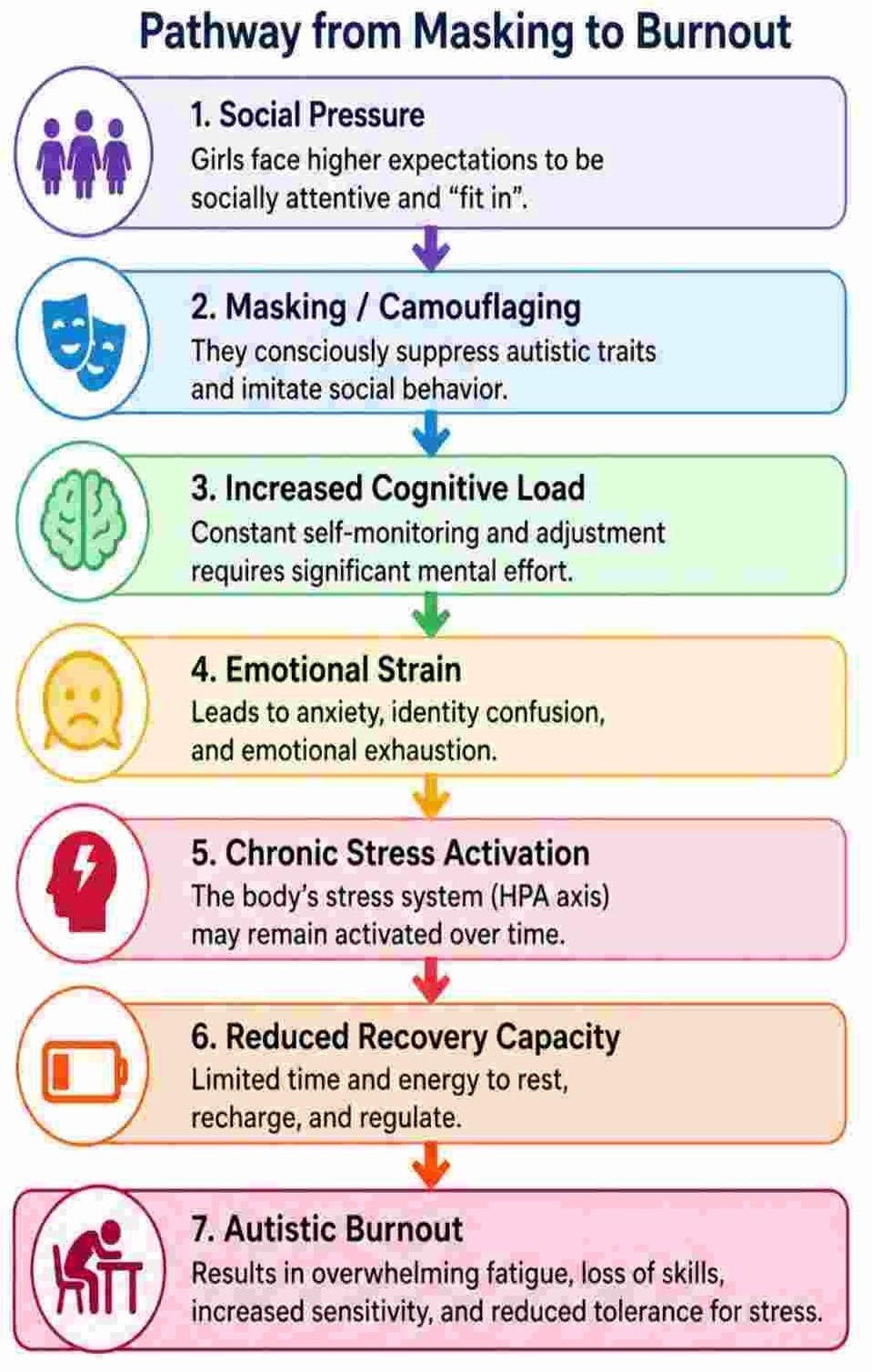
This figure presents a conceptual pathway based on patterns observed across studies and should not be interpreted as evidence of a direct causal mechanism.
Neurobiological Considerations
Beyond behavioral experiences, researchers have also explored possible neurobiological explanations for masking-related stress. According to neuroimaging research, several brain regions participate together in social interaction, emotional regulation, self-monitoring, and decision-making tasks23,24,25. These regions include the medial prefrontal cortex (mPFC), anterior cingulate cortex (ACC), amygdala, insula, and superior temporal sulcus (STS). The mPFC is located in the front part of the brain and is engaged in thinking, decision-making, and understanding emotions and intentions of others23,26. Research suggests that people with autism can have different social functioning mechanisms as a result of abnormal functional connections in their mPFC and other social processes26.
The ACC, being medial and positioned between two cerebral hemispheres, assists in controlling attention, regulating emotions, and managing difficult situations27. The amygdala is found in the temporal lobe and is responsible for processing emotions and responding to stress26,28. The STS participates in recognizing faces, eye contact, and other social signals23,28; meanwhile, the insula is involved in interoception and experiencing internal bodily sensations29,30.
Some studies suggest that there is greater activation of these regions when individuals engage socially. Moreover, their excessive involvement can reveal additional mental efforts that children with ASD require to perform social interaction and hide their difficulties21,25,26. It is suggested that continuous utilization of such neurosystems in masking behavior may contribute to mental and emotional exhaustion7,22. However, most of the neuroimaging literature refers to adult participants, and there is limited data available about autistic adolescent girls specifically.
| Brain Region | Primary Functional Role | Reported Findings in Autism Research | Representative Sources | Potential Relevance to Burnout |
| Medial Prefrontal Cortex (mPFC) | Self-monitoring and social cognition | Increased activation during social processing tasks | Schulte-Rüther et al. (2011)25; Frith & Frith (2007)23 | Sustained cognitive effort |
| Anterior Cingulate Cortex (ACC) | Cognitive control and conflict monitoring | Greater recruitment during socially demanding tasks | Schulte-Rüther et al. (2011)25; Bush et al. (2000)27 | Mental fatigue and overload |
| Amygdala | Emotional processing and stress response | Increased activation during emotional/social tasks | Baron-Cohen et al. (2005)28; Lombardo et al. (2011)26 | Chronic emotional stress |
| Superior Temporal Sulcus (STS) | Social perception and interpretation of social cues | Compensatory activation during social decoding | Frith & Frith (2007)23; Baron-Cohen et al. (2005)28 | Effortful social processing |
| Insula | Emotional awareness and sensory integration | Altered activation during emotional and social processing tasks | Uddin & Menon (2009)29; Di Martino et al. (2009)30 | Heightened emotional and sensory strain |
This table provides an overview of brain regions commonly associated with social cognition, emotional regulation, and self-monitoring, based on individual neuroimaging and theoretical studies. The findings are intended to clarify the potential cognitive demands of masking behaviors. Because the evidence is limited and mainly from mixed or adult populations, these findings should not be viewed as direct or causal evidence linking neural activation to autistic burnout.
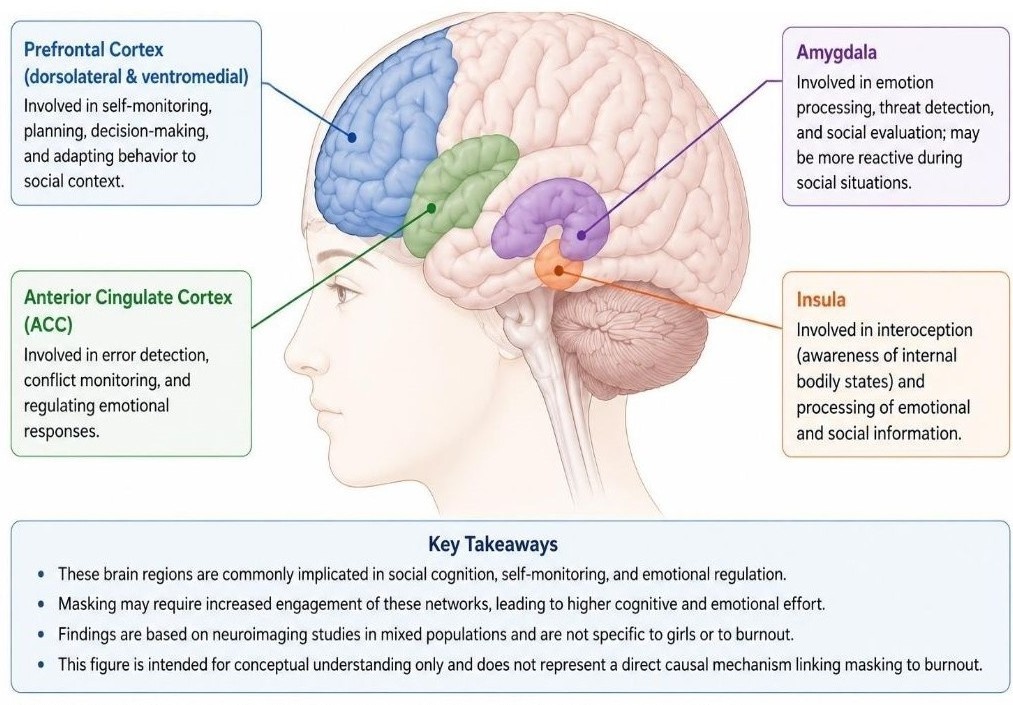
Note: This figure is illustrative and based on findings from neuroimaging research in autism spectrum populations. It does not indicate that all individuals show the same patterns, nor does it confirm causation.
This figure highlights brain regions commonly implicated in social cognition, self-monitoring, and emotional processing, including the medial prefrontal cortex, anterior cingulate cortex, amygdala, and insula. Increased activation in these regions has been observed in neuroimaging studies during socially demanding tasks, suggesting increased cognitive effort.
However, these findings are based on studies in mixed populations and are not specific to adolescent girls or directly linked to autistic burnout. This figure is intended for conceptual understanding only and does not represent a confirmed biological mechanism.
Stress Physiology and Developmental Factors
In addition to cognitive demands, prolonged masking may also influence physiological stress responses. Previous studies have shown that individuals diagnosed as autistic experience abnormal functioning of the stress physiology, involving cortisol levels and the hypothalamus-pituitary-adrenal axis8,31,32. The hypothalamus-pituitary-adrenal axis is the most important neuroendocrine pathway in relation to the body’s stress reaction where it controls the brain and body’s reactions to stressors. It has been observed that certain autistic individuals tend to have unusual cortisol levels such as higher baseline levels of cortisol, irregularities in normal diurnal cortisol fluctuations, and delayed recovery from stress31. Such abnormalities could impair recovery in chronic stress and lead to fatigue6,7.
However, most of these physiological studies have relied on mixed gender samples or adults; hence, it is difficult to understand the effects of such stress physiology on adolescent autistic females with masking tendencies.
| Stress-Related Indicator | Reported Pattern in Literature | Potential Functional Implication | Representative Sources |
| Baseline cortisol levels | Elevated or variable cortisol responses reported in some autistic populations | Persistent physiological stress activation | Corbett et al. (2010);31; Gunnar & Quevedo (2007)8 |
| Diurnal cortisol rhythm | Altered or flattened daily cortisol patterns | Reduced recovery from prolonged stress | Corbett et al. (2009)32 |
| HPA axis responsivity | Dysregulated stress-response activity | Increased stress sensitivity | Gunnar & Quevedo (2007)8; Mantzalas et al. (2022)6 |
| Allostatic load | Increased cumulative stress burden discussed conceptually | Emotional and cognitive exhaustion | Raymaker et al. (2020)7; Mantzalas et al. (2022)6 |
| Stress recovery | Prolonged recovery following stress exposure | Increased vulnerability to fatigue and burnout | Mantzalas et al. (2022)6; Cage & Troxell-Whitman (2019)17 |
This table summarizes stress-related physiological indicators discussed across individual studies and conceptual reviews examining autism and chronic stress responses. The findings highlight possible mechanisms through which prolonged stress exposure may influence emotional and cognitive functioning. However, these observations are based on heterogeneous study populations and methodologies, and should not be interpreted as direct evidence linking masking behaviors to physiological dysregulation or autistic burnout.
In summary, the existing literature suggests that masking is common among autistic females and has often been associated with emotional exhaustion, cognitive fatigue, and stress2,15,33.
While biological and physiological perspectives can help explain these phenomena, the present state of knowledge is still insufficient and mostly consists of cross-sectional studies. Additional studies conducted over an extended period are needed to analyze the effects of persistent masking on the development of stress-related coping mechanisms among autistic adolescent females.
Discussion
This paper synthesizes existing knowledge about the association between social masking and autistic burnout among adolescent females through behavioral, neurobiological, and sociocultural perspectives2,5,21. In fact, it has been established that social masking is not only used as an effective strategy in dealing with social situations but is also seen as a strenuous coping strategy associated with significant cognitive and psychological difficulties6,18. However, most of the research available at the moment uses cross-sectional study designs and self-reports, often excluding adolescent girls from study sample groups, making these relationships mainly correlational6,15. There is a clear need for longitudinal studies to examine how puberty and secondary education affect social masking in girls15.
Interpretation of Key Findings
One of the major considerations discussed in this review is the discrepancy between the social appearance of autistic girls and their internal experiences. As has been found earlier, many autistic girls can be viewed as socially adept owing to the imitation of other people’s actions, the use of rehearsed scripts, and the suppression of autistic traits15,16. However, this type of outward appearance often conceals serious emotional and psychological challenges. According to recent research findings, the “camouflage gap”—the difference between autistic traits and socially appropriate actions—is significantly larger among females than in males10. Even though autistic females seem to interact socially better than autistic males16, they often expend considerable effort to appear neurotypical10. While such behavior may help with socializing for a short time, it takes a lot of energy to constantly monitor oneself and control one’s emotions3. Thus, the above findings make it easier to explain why numerous autistic girls experience anxiety, emotional exhaustion, and identity confusion even when they appear socially successful6,17,18. At the same time, this finding also highlights concerns related to the late diagnosis of autism among girls, whose masking abilities prevent educators and clinicians from identifying social and psychological problems2,20.
Findings from Neurobiology explain why masking requires significant amounts of mental energy. Socializing involves activation of neural pathways responsible for emotional processing, language, and social cognition, including medial prefrontal cortex and the right temporoparietal junction23,26. Autistic people often use these functions less automatically, which means that girls in particular have to rely on conscious thought to understand the interactions that take place and control themselves. This greater reliance on effortful processing is likely to increase mental load and even cause neural fatigue28. Moreover, neuroimaging studies indicate increased activity in certain regions, such as the medial prefrontal cortex, amygdala, insula, anterior cingulate cortex, and superior temporal sulcus during social interaction and masking29,30. The increase in neural activity suggests that autistic individuals use more conscious and effortful strategies to understand social situations and regulate their behaviour, whereas neurotypical individuals tend to do these things automatically25. This can make autistic girls look socially adequate while being under constant stress and anxiety internally19, because they do not use their innate skills, but instead engage in compensating behaviors3,34. However, these findings should be interpreted cautiously, as most neuroimaging studies focus on adults rather than adolescent girls.
From a physiological perspective, research on the hypothalamic-pituitary-adrenal (HPA) axis shows that autistic individuals react to stress differently and often take more time to recover after stressful situations31. Because of this, repeated social stress and constant masking can affect both the mind and body over time. This is linked to the concept of allostatic load, which means the physical and emotional strain caused by long-term stress and continuous activation of the body’s stress system35. In many cases, the stress caused by masking is not easily noticed by parents, teachers, or clinicians because autistic girls may appear socially well-adjusted on the outside2. As a result, this stress can continue to build for years without proper support or recognition. During adolescence, when social pressure becomes stronger, this long-term hidden stress may lead to extreme emotional, mental, and physical exhaustion, often referred to as autistic burnout7.
The sociocultural environment also has a significant effect on the tendency for masking behaviour2,5. Many autistic girls feel that they need to be socially engaged and emotionally expressive; therefore, they try hard to engage in expected behaviours’, leading to higher levels of camouflaging2,15. Usually, this pressure becomes stronger as the child enters adolescence. Such tendencies are related to environments where autistic females are expected to be emotionally aware, socially active, and well-behaved. Due to these pressures and expectations within society, many autistic girls behave in ways that match socially accepted gender roles2. To avoid being judged or excluded, they hide their autistic traits and utilize different masking strategies in social situations. As a result, autistic girls often use more complex and frequent camouflaging behaviours than autistic boys15.
However, masking alone cannot be considered the sole reason for autistic burnout. It develops when masking occurs alongside other stress factors, such as sensory overload, academic pressure, social difficulties, and limited emotional support21. Family environment and social isolation also influence how strongly these pressures affect autistic adolescents17,19. When these difficulties continue for a long time, they may lead to severe emotional, mental, and physical exhaustion.
Current research provides strong behavioural and neurobiological explanations for why autistic adolescent girls experience exhaustion and burnout. However, existing studies do not yet prove that masking alone directly causes burnout21. Instead, burnout is likely caused by the combined effect of social pressure, sensory stress, environmental challenges, and long-term emotional strain. More longitudinal research is still needed to clearly understand how continuous masking contributes to burnout over time22.
Implications for Research and Practice
According to the review presented above, several critical issues need to be considered for the improvement of outcomes among autistic adolescent girls. First, longitudinal studies focused on the development of camouflaging throughout the adolescent years will be critical, as they could help determine whether high camouflaging at an early age is associated with clinical burnout in late adolescence. It is important to ensure that assessment procedures do not focus solely on the presence of visible social difficulties, but rather on the mental and emotional effort required by the student during social interactions, regardless of their surface-level competence.
In addition, educational interventions need to reduce the focus on social skills training, since it often encourages the masking process. In this regard, it will be important to develop neuroaffirming approaches that support authenticity and individual well-being. For example, sensory-regulating tools, as well as the creation of quiet environments where a student can withdraw and relieve their emotional and social exhaustion, can help achieve this goal. Furthermore, future research should utilize physiological indicators of stress, such as cortisol levels, to explain the mechanisms underlying the effects of masking. Ultimately, the implementation of gender-informed interventions and support strategies would help uncover the hidden distress that leads to burnout as a consequence of gender-based diagnostic criteria.
Conclusion
To sum up, this literature review suggests that social masking in autistic girls and women is often related to the experience of psychological distress. Continuous effort to mask requires significant mental and emotional effort, resulting in exhaustion and increased stress levels. The neurobiological and physiological research provides an early framework to understand these experiences, but the current evidence is still exploratory and mostly correlational.
Overall, based on these conclusions, it becomes evident that social masking plays an important role in the life experience described by many autistic girls and women, and it should not be mistaken for true well-being. There are still several important gaps in the literature, especially regarding teenagers and long-term studies. It is necessary to conduct additional research to understand how social masking affects mental and physical health in the long term and its relationship with preventing autistic burnout.
Importantly, burnout cannot be viewed as the result of masking alone, as various other factors such as a stressful environment, sensory issues, academic requirements, and limited access to social support can significantly contribute to emotional exhaustion in autistic teenagers. In conclusion, the review highlights the need to conduct gender-based assessments, achieve earlier identification of autism in girls, and build supportive, neuroaffirming environments that prioritize psychological well-being over social adjustment.
Refrences
- C. Lord, M. Elsabbagh, G. Baird, J. Veenstra-Vanderweele. Autism spectrum disorder. The Lancet. Vol. 392, pg. 508-520, 2018, https://doi.org/10.1016/S0140-6736(18)31129-2. [↩]
- M.-C. Lai, M. V. Lombardo, B. Auyeung, B. Chakrabarti, S. Baron-Cohen. Sex/gender differences and autism: setting the scene for future research. J Am Acad Child Adolesc Psychiatry. Vol. 54, pg. 11-24, 2015, https://doi.org/10.1016/j.jaac.2014.10.003. [↩] [↩] [↩] [↩] [↩] [↩] [↩] [↩] [↩] [↩] [↩]
- L. Hull, K. V. Petrides, C. Allison, P. Smith, S. Baron-Cohen, P. L. Lai, W. Mandy. “Putting on my best normal”: Social camouflaging in adults with autism spectrum conditions. J Autism Dev Disord. Vol. 47, pg. 2519-2534, 2017, https://doi.org/10.1007/s10803-017-3166-5. [↩] [↩] [↩] [↩] [↩] [↩] [↩] [↩]
- J. Halsall, C. Clarke, L. Crane. “Camouflaging” by adolescent autistic girls who attend both mainstream and specialist resource classes: perspectives of girls, their mothers and their educators. Autism. Vol. 25, pg. 2074-2086, 2021, https://doi.org/10.1177/13623613211012819. [↩]
- A. Pearson, K. Rose. A conceptual analysis of autistic masking: understanding the narrative of stigma and the illusion of choice. Autism Adulthood. Vol. 3, pg. 52-60, 2021, https://doi.org/10.1089/aut.2020.0043. [↩] [↩] [↩] [↩] [↩] [↩] [↩]
- J. Mantzalas, A. L. Richdale, C. Dissanayake. A conceptual model of risk and protective factors for autistic burnout. Autism Res. Vol. 15, pg. 976-987, 2022, https://doi.org/10.1002/aur.2722. [↩] [↩] [↩] [↩] [↩] [↩] [↩] [↩] [↩] [↩] [↩] [↩] [↩] [↩] [↩]
- D. M. Raymaker, A. R. Teo, N. A. Steckler, B. Lentz, M. Scharer, A. Delos Santos, S. K. Kapp, M. Hunter, A. Joyce, K. E. Nicolaidis. “Having all of your internal resources exhausted beyond measure and being left with no clean-up crew”: defining autistic burnout. Autism Adulthood. Vol. 2, pg. 132-143, 2020, https://doi.org/10.1089/aut.2019.0079. [↩] [↩] [↩] [↩] [↩] [↩] [↩]
- M. Gunnar, K. Quevedo. The neurobiology of stress and development. Annu Rev Psychol. Vol. 58, pg. 145-173, 2007, https://doi.org/10.1146/annurev.psych.58.110405.085605. [↩] [↩] [↩] [↩] [↩] [↩] [↩]
- J. Lei, K. Cooper, M. J. Hollocks. Psychological interventions for autistic adolescents with co-occurring anxiety and depression: considerations linked to autism social identity and masking. Autism Adulthood. Vol. 7, pg. 663-670, 2025, https://doi.org/10.1089/aut.2024.0005. [↩]
- M.-C. Lai, M. V. Lombardo, G. Ruigrok, B. Chakrabarti, B. Auyeung, J. Szatmari, M. C. Happé, S. Baron-Cohen. Quantifying and exploring camouflaging in men and women with autism. Autism. Vol. 21, pg. 690-702, 2017, https://doi.org/10.1177/1362361316671012. [↩] [↩] [↩] [↩] [↩]
- R. Ferrari. Writing narrative style literature reviews. Medical Writing. Vol. 24, pg. 230-235, 2015, https://doi.org/10.1179/2047480615Z.000000000329. [↩]
- M. J. Grant, A. Booth. A typology of reviews: an analysis of 14 review types and associated methodologies. Health Info Libraries J. Vol. 26, pg. 91-108, 2009, https://doi.org/10.1111/j.1471-1842.2009.00848.x. [↩]
- V. Braun, V. Clarke. Using thematic analysis in psychology. Qualitative Research in Psychology. Vol. 3, pg. 77-101, 2006, https://doi.org/10.1191/1478088706qp063oa. [↩] [↩]
- B. N. Green, C. D. Johnson, A. Adams. Writing narrative literature reviews for peer-reviewed journals: secrets of the trade. J Chiropr Med. Vol. 5, pg. 101-117, 2006, https://doi.org/10.1016/S0899-3467(07)60142-6. [↩]
- H. Wood-Downie, B. Wong, H. Kovshoff, W. Mandy, L. Hull, J. A. Hadwin. Sex/gender differences in camouflaging in children and adolescents with autism. J Autism Dev Disord. Vol. 51, pg. 1353-1364, 2021, https://doi.org/10.1007/s10803-020-04615-z. [↩] [↩] [↩] [↩] [↩] [↩] [↩] [↩] [↩] [↩]
- M. Dean, R. Harwood, C. Kasari. The art of camouflage: Gender differences in the social behaviors of girls and boys with autism spectrum disorder. Autism. Vol. 21, pg. 678-689, 2017, https://doi.org/10.1177/1362361316671845. [↩] [↩] [↩] [↩] [↩] [↩] [↩]
- E. Cage, Z. Troxell-Whitman. Understanding the reasons, contexts and costs of camouflaging for autistic adults. J Autism Dev Disord. Vol. 49, pg. 1899-1911, 2019, https://doi.org/10.1007/s10803-018-03878-x. [↩] [↩] [↩] [↩] [↩] [↩] [↩] [↩]
- L. Hull, W. Mandy, J. L. Kompalla, L. Crane, K. V. Petersen, J. Allison, S. Baron-Cohen, P. Chiocchetti, B. S. Freitag, L. S. Halladay. Is social camouflaging associated with anxiety and depression in autistic adults? Molecular Autism. Vol. 12, pg. 13, 2021, https://doi.org/10.1186/s13229-021-00421-1. [↩] [↩] [↩] [↩] [↩] [↩] [↩]
- M. Solomon, M. Miller, S. L. Taylor, S. P. Hinshaw, C. S. Carter. Autism symptoms and internalizing psychopathology in girls and boys with autism spectrum disorders. J Autism Dev Disord. Vol. 42, pg. 48-59, 2012, https://doi.org/10.1007/s10803-011-1215-z. [↩] [↩] [↩] [↩] [↩]
- R. Loomes, L. Hull, W. P. L. Mandy. What is the male-to-female ratio in autism spectrum disorder? A systematic review and meta-analysis. Journal of the American Academy of Child & Adolescent Psychiatry. Vol. 56, pg. 466-474, 2017, https://doi.org/10.1016/j.jaac.2017.03.013. [↩] [↩] [↩] [↩]
- L. A. Livingston, F. Happé. Conceptualising compensation in neurodevelopmental disorders: reflections from autism spectrum disorder. Neuroscience & Biobehavioral Reviews. Vol. 80, pg. 729-742, 2017, https://doi.org/10.1016/j.neubiorev.2017.06.005. [↩] [↩] [↩] [↩] [↩] [↩] [↩]
- D. Ali, R. J. Brown, J. P. Taylor, J. L. Drabble, M. J. Hollocks. Burnout as experienced by autistic people: a systematic review. Clinical Psychology Review. Vol. 122, pg. 102669, 2025, https://doi.org/10.1016/j.cpr.2025.102669. [↩] [↩] [↩] [↩] [↩]
- C. D. Frith, U. Frith. Social cognition in humans. Current Biology. Vol. 17, pg. R724–R732, 2007, https://doi.org/10.1016/j.cub.2007.05.068. [↩] [↩] [↩] [↩] [↩] [↩] [↩]
- L. Q. Uddin. Brain mechanisms supporting flexible cognition and behavior in adolescents with autism spectrum disorder. Biol Psychiatry. Vol. 89, pg. 172-183, 2021, https://doi.org/10.1016/j.biopsych.2020.05.010. [↩] [↩]
- M. Schulte-Rüther, H. J. Markowitsch, G. R. Fink, K. Piefke. Dysfunctions in brain networks supporting empathy: an fMRI study in adults with autism spectrum disorders. Soc Neurosci. Vol. 6, pg. 1-21, 2011, https://doi.org/10.1080/17470911003708032. [↩] [↩] [↩] [↩] [↩] [↩]
- M. V. Lombardo, B. Chakrabarti, E. T. Bullmore, S. Baron-Cohen. Specialization of right temporo-parietal junction for mentalizing and its relation to social impairments in autism. NeuroImage. Vol. 56, pg. 1832-1838, 2011, https://doi.org/10.1016/j.neuroimage.2011.02.067. [↩] [↩] [↩] [↩] [↩] [↩] [↩]
- G. Bush, P. Luu, M. I. Posner. Cognitive and emotional influences in anterior cingulate cortex. Trends Cogn Sci. Vol. 4, pg. 215-222, 2000, https://doi.org/10.1016/s1364-6613(00)01483-2. [↩] [↩] [↩]
- S. Baron-Cohen, R. C. Knickmeyer, M. K. Belmonte. Sex differences in the brain: implications for explaining autism. Science. Vol. 310, pg. 819-823, 2005, https://doi.org/10.1126/science.1115455. [↩] [↩] [↩] [↩] [↩] [↩]
- L. Q. Uddin, V. Menon. The anterior insula in autism: under-connected and under-examined. Neuroscience & Biobehavioral Reviews. Vol. 33, pg. 1198-1203, 2009, https://doi.org/10.1016/j.neubiorev.2009.06.002. [↩] [↩] [↩] [↩]
- A. Di Martino, K. Ross, L. Q. Uddin, A. B. Sklar, F. X. Castellanos, M. P. Milham. Functional brain correlates of social and nonsocial processes in autism spectrum disorders: an activation likelihood estimation meta-analysis. Biological Psychiatry. Vol. 65, pg. 63-74, 2009, https://doi.org/10.1016/j.biopsych.2008.09.022. [↩] [↩] [↩] [↩]
- B. A. Corbett, C. W. Schupp, D. Simon, N. Ryan, S. Mendoza. Elevated cortisol during play is associated with age and social engagement in children with autism. Mol Autism. Vol. 1, pg. 13, 2010, https://doi.org/10.1186/2040-2392-1-13. [↩] [↩] [↩] [↩] [↩]
- B. A. Corbett, C. W. Schupp, S. Levine, S. Mendoza. Comparing cortisol, stress, and sensory sensitivity in children with autism. Autism Res. Vol. 2, pg. 39-49, 2009, https://doi.org/10.1002/aur.64. [↩] [↩] [↩]
- K. Urbaniak, M. D’Amico. Disability barriers autistic girls face in secondary education: a systematic review. Autism. Vol. 29, pg. 1019-1033, 2025, https://doi.org/10.1177/13623613241294189. [↩] [↩]
- J. Mantzalas, A. L. Richdale, A. Adikari, J. Lowe, C. Dissanayake. What is autistic burnout? A thematic analysis of posts on two online platforms. Autism Adulthood. Vol. 4, pg. 52-65, 2022, https://doi.org/10.1089/aut.2021.0021. [↩] [↩] [↩] [↩]
- B. S. McEwen. Mood disorders and allostatic load. Biological Psychiatry. Vol. 54, pg. 200-207, 2003, https://doi.org/10.1016/S0006-3223(03)00177-X. [↩]