

Abstract
Current literature suggests musical interventions may facilitate enhanced cognition, but the available evidence spans several distinct forms of musical exposure and a wide range of outcome measures, and the scope and consistency of that evidence have not been mapped. This scoping review charts published research on relationships between music exposure and four cognitive domains: attention, memory, visuospatial ability, and executive functions. A structured search of PubMed and Google Scholar was conducted through 19 October 2025. Eligible studies included peer-reviewed articles that investigated the impact of musical intervention on at least one of the specified cognitive domains in human participants of any age. Studies were excluded if they lacked clear methodology, did not report relevant cognitive outcomes, or did not indicate musical intervention. Twenty sources met the inclusion criteria, spanning passive listening, structured music training, music-based therapy, and pre-existing musical expertise. Results were synthesized narratively due to heterogeneity in research methodologies and outcomes. Coverage was numerically similar across domains, at five sources for attention, five for memory, four for visuospatial ability, and five for executive functions, with one further source charted as bimanual coordination and reported as unclassified, but the type of evidence differed markedly between them: most attention sources manipulated music exposure directly, whereas the majority of visuospatial sources were cross-sectional comparisons of musicians and non-musicians or prior syntheses rather than exposure studies. Four sources in total compared musicians with non-musicians and therefore address a different question from intervention studies, and two were secondary syntheses of primary literature also represented here. Only one source assessed outcomes after the intervention period had ended, and a single observational dataset contributes approximately 91 percent of the total participant count. Limitations include methodological heterogeneity and potential publication bias. Across the four domains, reported findings were predominantly favourable, but they rest largely on single time-point assessments in studies without randomised allocation, and the evidence therefore supports associations between music exposure and cognitive performance rather than durable cognitive enhancement. Further research reporting effect estimates with uncertainty intervals, using randomised allocation and follow-up beyond the exposure period, is needed before conclusions about cognitive benefit can be drawn.
Keywords: cognition, memory, music, music cognition, neuroplasticity, neuroscience
Introduction
Music is present in nearly every human society and is conventionally organized into genres such as classical, pop, and rock, categories that group works by instrumentation, tradition, and audience as much as by any single acoustic property1. A genre label therefore bundles together tempo, rhythmic complexity, loudness, lyrical content, familiarity, and emotional connotation, properties that vary independently of one another. This bundling matters for research on music and cognition, because studies that describe their materials by genre alone may differ on several of these properties simultaneously, making it difficult to attribute any observed outcome to a specific characteristic of the music.
For most of history, hearing skilled musical performance required attending a live event, which constrained both who could listen and how often2. Recording and, more recently, streaming removed that constraint, and music is now available on demand during nearly any activity. One consequence is that listening frequently occurs alongside cognitively demanding tasks rather than as an activity in its own right. Survey evidence indicates that individuals deliberately select music while studying and report doing so in order to manage focus and mood3. Whether such listening measurably affects cognitive performance, as distinct from perceived performance, is an open empirical question.
Several mechanisms have been proposed to explain how music might influence cognition. Musically induced pleasure is associated with dopaminergic activity4, and dopamine availability has been linked to the coupling of attention-related brain networks in humans5, which offers a plausible route by which music might relate to attentional performance. Active music performance elevates pain thresholds, an effect attributed to endorphin release, although endorphin levels were inferred from the behavioral result rather than measured directly6. In a randomised controlled trial, patients who listened to soothing music during postoperative bed rest showed increased oxytocin levels relative to controls7. Taken together, these findings identify candidate pathways linking music to arousal, affect, and physiological state. They do not establish a causal pathway to cognitive performance, and none of these studies measured cognitive outcomes.
Substantial uncertainty remains. First, the term musical intervention covers exposures that are not equivalent: brief passive listening, sustained structured training, clinical music therapy, and pre-existing musical expertise. Expertise comparisons in particular are cross-sectional and cannot separate any effect of training from pre-existing differences that may have led certain individuals to pursue music in the first place. Second, reported findings are not uniformly favourable, and some studies report no advantage on their primary performance measures even where secondary or self-reported measures shift8. Third, most reported outcomes are acute, assessed immediately after exposure, leaving the durability of any relationship unresolved. Fourth, outcome measures differ widely across studies and are frequently reported under the general heading of cognition rather than the specific construct assessed, which obscures whether findings across studies concern comparable abilities.
Prior reviews have examined music and cognition, but generally within a single exposure type or a single population9. Reviews of music therapy in dementia, of music training in children, and of background music during task performance each address a different question, and their conclusions are not directly comparable. What has not been established is how the available evidence is distributed across these exposure types, which cognitive constructs have actually been measured rather than inferred, and where the evidence base is dense or sparse. A scoping review is the appropriate design for this question, since its purpose is to map the extent, range, and nature of available evidence rather than to estimate a pooled effect.
The objective of this review is to map the available evidence on relationships between music exposure and outcomes in four cognitive domains: attention, memory, visuospatial ability, and executive function. Music exposure here spans passive listening, structured music training, music-based therapy, and pre-existing musical expertise. These four domains were selected because they are the outcomes most frequently reported in this literature and because standardized, well-validated instruments exist for each, allowing outcomes to be compared across heterogeneous studies. Language, social cognition, and emotion regulation were excluded, as the measures used for these constructs vary too widely across the relevant literature to support meaningful charting. The review includes both healthy and clinical populations, since music-based interventions have been applied in each and the balance of evidence between them is itself part of what this review seeks to characterize. Rather than estimating a pooled effect, this review characterizes what has been studied, in which populations, using which designs and outcome measures, and identifies where evidence is concentrated and where it remains sparse.
Methods
Search Strategy
A structured search was conducted in PubMed and Google Scholar. PubMed was selected for indexed biomedical coverage and Google Scholar for interdisciplinary reach, since this literature spans neuroscience, psychology, and education. Restricting the search to two databases is a limitation and is addressed in the Discussion. Because Google Scholar indexes non-peer-reviewed material, peer-review status was verified individually for every record retrieved from that source.
Searches were conducted between December 8, 2024, and October 19, 2025, and results reflect publications available up to the final search date. The following string was run in both databases: (“music” OR “musical intervention” OR “music therapy” OR “musical training”) AND (“attention” OR “attention span” OR “memory” OR “memory retention” OR “visuospatial ability” OR “executive function” OR “cognition”). The search relied on free-text terms only; no database-specific indexing terms were used and MeSH headings were not applied in PubMed. No language filters were applied at the search stage, and English-language publication was applied as an eligibility criterion at screening. No automation tools were used at any stage of the selection process. Search field settings and per-database filters were not documented at the time of searching and cannot be reported; this limits exact replication and is noted as a limitation.
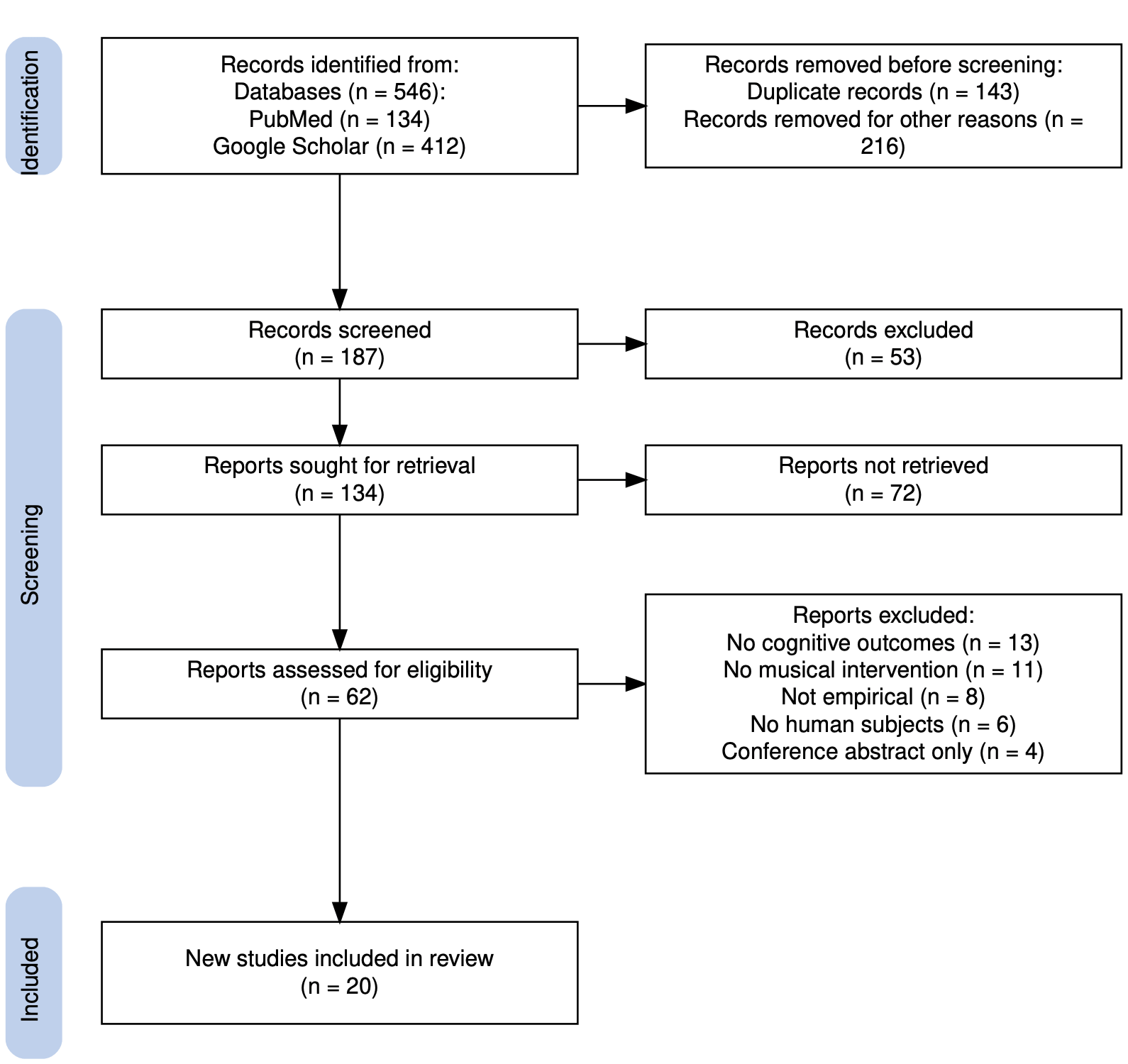
The search returned 546 records, comprising 134 from PubMed and 412 from Google Scholar. Before screening, 143 duplicates were removed, along with 216 records that were not full research articles or fell outside the subject scope on inspection of title and source. This left 187 records screened on title and abstract, of which 53 were excluded. Full texts were sought for 134 records; 62 were retrieved and 72 could not be obtained, either because no full text was accessible or because the article was not available in English. Of the 62 assessed for eligibility, 42 were excluded: 13 reported no cognitive outcome, 11 involved no musical intervention, 8 were not empirical, 6 used no human subjects, and 4 were conference abstracts without full data. Twenty sources met all criteria (Figure 1). Reporting follows the PRISMA extension for scoping reviews (PRISMA-ScR).
Inclusion Criteria
Studies were eligible for inclusion if they were peer-reviewed original research or meta-analyses published in English; examined the relation between some form of musical intervention (such as music therapy, passive listening, or active performance) and at least one of the four specified cognitive domains, and included measurable cognitive outcomes in human participants. One included source is an unpublished doctoral dissertation rather than a peer-reviewed article. It was retained because it reports primary data relevant to the review question, and its status is noted wherever it is discussed. Musical intervention was defined as any protocol in which participants were exposed to, produced, or trained in music under conditions specified by the investigators, encompassing passive listening to recorded music, structured music training delivered over a defined period, and clinical music therapy. Sources comparing individuals by pre-existing musical expertise were also eligible, since they address the same question of whether musical engagement relates to cognitive outcomes, but they involve no investigator-controlled exposure and are charted and reported separately throughout. Meta-analyses and systematic reviews were eligible because mapping the existing synthesis landscape forms part of this review’s objective. Their inclusion alongside primary studies introduces potential overlap of underlying evidence, which is reported in Results. For sources used to form primary conclusions, inclusion was limited to publications from 2000 to October 2025 to ensure contemporary applicability. Articles solely used for background or informational purposes (such as explaining the baseline physiological role of dopamine) had no restriction on publication date. Studies were explicitly excluded if they focused solely on musical intervention or cognitive outcomes without their counterpart, did not use human subjects, lacked empirical data, or were conference abstracts or proceedings without full data available. Screening was conducted by the author. Titles and abstracts were screened first, followed by full-text review against the prescribed inclusion criteria. A second individual was consulted on records where eligibility was unclear but did not independently screen the full record set. Inter-reviewer agreement was not calculated.
Data Extraction
Outcomes charted were the study’s reported performance measures within the four specified domains, recorded with their direction, magnitude, and reported uncertainty where available. No attempt was made to contact study authors for missing data.
Outcomes were mapped to cognitive domains using a rule specified before charting began. Measures indexing alerting, orienting, selective, or sustained attentional control were charted as attention; measures of encoding, retention, or retrieval of previously presented material as memory; measures of perception, mental manipulation, or memory of spatial relations as visuospatial ability; and measures isolating inhibition, set-shifting, updating, or planning as executive function. Tasks whose primary dependent variable was speed or accuracy of coordinated movement were charted as motor or visuomotor coordination and not assigned to executive function. Where an intervention combined music with another activity, only the music-specific contrast was charted. No outcome was assigned to a domain on the grounds that its construct appeared theoretically related to that domain; measures matching no rule were charted as unclassified and reported separately. Every outcome is reported using the name of the construct actually measured rather than under the general heading of cognition. Sources reporting outcomes in more than one domain contribute a separate charted outcome to each.
Synthesis Method
This review was registered on the Open Science Framework prior to data synthesis. Pooled effect estimation was outside the scope of this review; consistent with scoping review methodology, results were charted and synthesised narratively rather than meta-analysed.
Charting recorded study design, participant characteristics and sample size, exposure type, cognitive domain, outcome measures, and reported findings for each source. Where sources reported effect estimates, these are noted. Structured extraction of allocation method, baseline balance, attrition, and uncertainty intervals was not performed, and these fields are therefore not reported.
Quality Assessment
Formal critical appraisal is an optional component of scoping review methodology and was not conducted for this review. During screening and charting, general methodological features of each source were considered, including study design, sample size, presence of a comparator, and whether outcomes were objectively measured. These features are reported descriptively in Table 1. No standardized appraisal instrument was applied, no per-item quality judgments were recorded, and no summary quality ratings were assigned. Findings should therefore be interpreted without the benefit of a formal risk-of-bias assessment.
Results
Attention
Attention is a multifaceted process and a key factor in cognition10. It supports performance in academic, workplace, and everyday settings11. Five sources charted outcomes in this domain.
Kiss & Linnell8 tested 40 adults aged 19 to 32 on a Psychomotor Vigilance Task variant with and without preferred background music, in a within-subjects design8. The outcome was sustained attention, measured by reaction time and by subjective thought probes classifying attentional state. The proportion of task-focused states was higher and mind-wandering lower under music, but reaction time did not differ from the silent condition8. The self-reported measure shifted while the performance measure did not.
In a younger clinical population, a study by Jacob et al.12 assigned 50 children with mild intellectual disability to music therapy, pictorial illustration, or control. Attention was measured using the Moss Attention Rating Scale (MARS) before and after intervention12. Post-test MARS means were 24.160 in the music therapy group and 14.373 in the control group12. Allocation method and baseline equivalence were not reported, and no effect estimate with an uncertainty interval was available.
Woods et al.13 manipulated the amplitude-modulation rate and depth of background music and measured sustained attention using the Sustained Attention to Response Task (SART) across four experiments involving behavioural, fMRI, and EEG components13. Amplitude-modulated music improved SART performance, but only when presented first in the experimental sequence, suggesting a primacy rather than a sustained effect. In a parametric manipulation of modulation rate, 16 Hz modulation at medium depth was associated with the best performance, but this effect was specific to participants with higher ADHD symptom scores on the Adult ADHD Self-Report Scale; no significant effects were found for the modulation depth manipulation13. This is the only included source that manipulated a defined acoustic property rather than a genre or exposure category.
Kumar et al.14 surveyed 200 medical undergraduates on their study habits, music preferences, and perceived concentration and academic performance14. Respondents who reported listening to soft or instrumental music also reported higher concentration, while music with lyrics or complex rhythmic sequences was reported as distracting14. All outcomes were self-reported and cross-sectional; no attentional performance was measured.
Fernandez et al.15 presented 52 participants with classical excerpts selected to evoke tenderness, joy, sadness, or tension, and measured selective attention using a modified Attention Network Test with concurrent fMRI15. Selective attention scores were higher under joyful, high-arousal excerpts, and fronto-parietal control networks showed greater engagement in that condition15. Arousal and valence were manipulated within a single genre.
Across the five sources, three manipulated music exposure directly and two were cross-sectional or self-report. Outcomes spanned sustained attention, selective attention, and perceived concentration, which are not interchangeable measures. Reported directions were favourable in four sources; one reported a favourable shift on a self-report measure alongside no difference on the performance measure. No source in this domain assessed attention after exposure ended.
Memory
Memory allows information to be encoded, retained, and retrieved, with the dorsolateral prefrontal cortex implicated in working memory16. Five sources charted outcomes in this domain.
Wang17 examined positive, neutral, and negative music during encoding in 63 older adults17. Working memory was measured using subtests adapted from the Wechsler Adult Intelligence Scale, Fourth Edition (WAIS-IV). Verbal working memory recall scores were higher following positive music than following neutral or negative music17. This source is an unpublished dissertation and was not peer reviewed. Its use of self-reported valence categories parallels the categorical approach taken by Kumar et al.14.
George & Coch18 compared 32 undergraduates with extensive musical training against those with little or none, using a modified Test of Memory and Learning, Second Edition, with concurrent ERP recording18. P300 amplitude was larger on average in the trained group18. The design is cross-sectional and compares groups defined by prior training, so it cannot separate training from pre-existing differences.
Ferreri et al.19 had 20 undergraduates encode 45 nouns under instrumental music, silence, and environmental sound, then identify those words among 90 and recall the encoding context19. Recognition exceeded chance in all conditions, and source memory accuracy was highest under instrumental music. Both this source and Wang report higher memory scores under conditions involving music17,19.
Palisson et al.20 tested 12 patients with Alzheimer’s disease on spoken word lists presented with and without music, matched for linguistic complexity, with immediate and delayed recall assessed20. Delayed verbal episodic recall was higher in the musical association condition than in both the nonmusical association condition (56.4 percent vs 46.6 percent, Hedges’s g = 0.30) and the spoken alone condition (56.4 percent vs 32.2 percent, Hedges’s g = 0.78). Immediate recall followed the same pattern. Working memory correlated with the size of the musical encoding benefit (r = .62, p = .03), and musical expertise was not a significant covariate. That subgroup pattern parallels the trained-versus-untrained difference reported by George & Coch, though both are cross-sectional comparisons18,20. With 12 participants, this is the smallest sample in the review.
Bottiroli et al.21 tested 65 adults aged 60 to 84 on word recall and phonemic fluency under four conditions: no music, white noise, Mozart, and Mahler21. Episodic recall and phonemic fluency scores were higher under both music conditions than under white noise or silence. The two music conditions differed in tempo and valence but were not separated by any single acoustic variable.
Across the five sources, outcomes spanned working memory, source memory, verbal episodic recall, and phonemic fluency, which the review charts separately rather than as a single memory construct. Two were cross-sectional expertise comparisons and one was an unpublished dissertation. Reported directions were favourable in all five, though sample sizes ranged from 12 to 65 and no source reported an effect estimate with an uncertainty interval.
Visuospatial Ability
Visuospatial skill involves locating and processing stimuli in space and engages regions including the parietal-occipital junction22. Four sources charted outcomes in this domain.
Zhang23 asked 30 university students aged 18 to 22 to complete Raven’s Progressive Matrices under self-selected background music23. Spatial reasoning scores were higher under self-selected music than without23. Because participants chose their own music, genre and tempo varied uncontrolled across participants and were not analysed as variables. This is the only source in this domain that manipulated exposure in a non-expert sample.
Hetland24 conducted a meta-analysis of music instruction studies, examining instruction type, participant age, and methodological characteristics24. Pooled effects on spatial-temporal reasoning were of moderate size and were larger in children, though this age difference did not consistently reach conventional significance thresholds24. This is a secondary synthesis, and its underlying primary studies may overlap with other included sources.
Brochard et al.25 compared 10 musicians with 10 non-musicians on a perceptual dot-location task and a mental imagery task tracking a line after its disappearance25. Musicians responded faster than non-musicians on both tasks, with mean reaction times of 380 ms and 440 ms respectively. Across both groups, horizontal-axis judgements were faster than vertical-axis judgements, at 343 ms and 477 ms25. The design is cross-sectional, and with 20 participants it is among the smallest in the review.
Weiss et al.26 compared 42 musicians with 33 non-musicians or individuals with under three years of formal training. Participants completed a syllable span task, on which musicians scored higher26. Under a sequential presentation condition requiring recall of stimulus order, musicians showed higher spatial frequency discrimination than non-musicians26. The charted outcome is spatial-sequence memory rather than spatial vision alone, since the group difference emerged under memory demand. This design is also cross-sectional.
Of the four sources in this domain, two are cross-sectional expertise comparisons, one is a secondary synthesis, and one is a single small exposure study. This domain therefore contains the least direct evidence on music exposure of the four, despite a comparable number of sources.
Executive Function
Executive functions are higher-order processes supporting adaptation to novel conditions, including planning, inhibition, and goal-directed decision-making27. Six sources were charted in this section. Five contributed outcomes charted as executive function; one contributed an outcome charted as bimanual coordination and reported as unclassified.
Jaschke et al.28 followed 147 primary school children longitudinally, with 109 in arts intervention groups, either music or visual arts, and 37 receiving no intervention. Participants unable to complete the intervention or testing were excluded28. Inhibition and planning scores increased in the intervention groups and not in the control group, and the study reported the music and visual-arts contrasts separately28. Only the music-specific contrast is charted here. This is one of two longitudinal sources in the review.
Ito et al.9 synthesised randomised controlled trials of music-based intervention in mild cognitive impairment and dementia. Executive function was assessed across the included trials using the Verbal Fluency Test and the Frontal Assessment Battery9. Pooled results favoured music-based intervention on executive function measures, with larger pooled estimates for active than for passive intervention9. This is the only included source drawing exclusively on randomised trials, and it is a secondary synthesis.
Wang et al.29 compared 20 pianists, 18 string musicians, and 19 non-musicians aged 16 to 27 on a Bimanual Key Pressing task performed in response to visual stimuli29. Pianists showed the highest accuracy and shortest response times, followed by string musicians, then controls29. The task measures bimanual coordination and the oscillatory activity accompanying it, and the outcome is charted at that level rather than as executive function. The difference between pianists and string players is consistent with the differing coordination demands of the two instrument families, and the design is cross-sectional.
Gustavson et al.30 conducted a secondary analysis of the Adolescent Brain Cognitive Development study, using parent-reported musical experience for children aged 9 to 10 across 11,876 participants30. Instrument playing was associated with higher composite executive function and language scores30. The design is observational and correlational, with no manipulated exposure. This source contributes approximately 91 percent of the total participant count across the review.
Shen et al.31 assigned 60 preschool children to a 60-day music training programme and 60 to no intervention, with digit span and dot matrix tasks administered before, during, and after the programme31. Cognitive flexibility and inhibitory control scores increased in the training group relative to control, and the study reported that children in that group continued practising after the programme ended. This is the only included source assessing outcomes after the intervention period concluded.
Kim et al.32 reported a multiple case study of patients over 80 with early-stage Alzheimer’s disease completing a six-week dual-task drum tapping intervention with musical cueing. Outcomes were assessed using a contrasting task, the Go/No-Go Test, and the Trail Making Test Part A32. Scores rose across cases, with variation attributed to differing engagement levels32. There was no control condition and the analysed sample size was not consistently reported.
Across the six sources, charted outcomes included inhibition, planning, verbal fluency, cognitive flexibility, and inhibitory control, alongside one bimanual coordination outcome charted outside the domain. Two were longitudinal or included follow-up, one was a secondary synthesis of randomised trials, one was correlational, and one was an uncontrolled case series. Reported directions were favourable throughout, but design strength varies widely within this domain.
Key Findings
This review charted 20 sources: five contributing attention outcomes, five memory, four visuospatial, and five executive function, with one further source charted as bimanual coordination outside the four domains. Charted outcomes included sustained and selective attention, perceived concentration, working memory, source memory, verbal episodic recall, phonemic fluency, spatial reasoning, spatial-sequence memory, inhibition, planning, cognitive flexibility, and bimanual coordination. These measures are not interchangeable, and each is reported at the level it was measured rather than as cognition. Design strength varies widely. Four sources compared musicians with non-musicians rather than manipulating exposure, two were secondary syntheses whose primary studies may overlap with other included sources, one was an unpublished dissertation, and one an uncontrolled case series. Only one assessed outcome after the exposure period ended, and a single observational dataset contributes approximately 91 percent of the total participant count. Evidence is unevenly distributed: most attention sources manipulated exposure directly, whereas three of the four visuospatial sources were expert comparisons or a prior meta-analysis. Reported directions were predominantly favourable across all four domains, with one source reporting a favourable shift on a self-report measure alongside no difference on the corresponding performance measure. Musical variables were not charted, as sources described their materials by genre, valence category, participant self-selection, or composer, and only one manipulated a defined acoustic property.
Discussion
The primary result of this review is a map of an uneven evidence base. Across 20 sources, reported directions of effect were predominantly favourable in all four domains, but the designs supporting those reports differ enough that the domains cannot be discussed with equal confidence. Attention shows the most consistent evidence from investigator-controlled exposure, with three of five sources manipulating exposure directly, though it also contains the review’s clearest divergence between a self-report measure and a performance measure within a single study. Executive function rests on stronger designs overall, including the only synthesis of randomised trials and the only source with post-intervention follow-up, but its remaining sources include a large correlational dataset and an uncontrolled case series, so it is strong at one end and weak at the other rather than uniformly supported. Memory findings were uniformly favourable but derive from samples of 12 to 65 participants, two cross-sectional expertise comparisons, and one unpublished dissertation. Visuospatial ability has the weakest base: three of its four sources involve no manipulated exposure, leaving one small study as the only direct evidence. Where the weaker designs are set aside, favourable findings remain in attention and executive function but become sparse in visuospatial ability. The apparent uniformity across domains therefore reflects differences in what was studied and how, rather than convergence, and these are trends in what has been studied rather than conclusions about whether music affects cognition.
Design also constrains what any individual trend can mean. Four sources compared musicians with non-musicians, and because individuals who pursue sustained training may differ beforehand in ways relevant to the outcomes measured, these designs cannot attribute a group difference to training. The two secondary syntheses carry more design strength than most individual sources, but their underlying primary studies may overlap with other included sources, so the evidence base is less independent than the source count implies.
An interesting trend noticed across the studies, such as that of Alan Wang17, is that music categorised by researchers as calming or positively valenced is associated with larger reported differences than music categorised otherwise. These categories were assigned by study authors rather than measured, and no included source varied valence, arousal, tempo, and loudness independently, so the property behind the pattern cannot be identified. The observation also warrants caution given potential placebo and novelty effects: participants may respond favorably to expectations surrounding music or to the novelty of the intervention rather than the music itself, and improved mood, increased motivation, and reduced stress remain plausible alternatives that no included source ruled out. Future studies should include placebo controls, such as non-musical auditory stimuli or silent conditions, to isolate the specific effects of music.
Nearly all included sources collected data immediately following exposure, and only one assessed outcomes after the intervention period. The present evidence therefore reflects acute effects, and durable cognitive enhancement cannot be inferred. Randomized and controlled longitudinal experiments would clarify whether any relationship persists and whether sustained or repeated exposure is necessary to maintain it.
Cross-cultural variation poses a further challenge to researcher-assigned labels. Musical perception differs between individuals who speak tone languages, in which pitch conveys word meaning, and those who speak non-tone languages, where pitch does not play any such role33. What is treated as uplifting in one cultural context may not be perceived similarly in another. Together with the absence of charted musical variables here, this indicates that measurable properties such as tempo, amplitude-modulation rate, mode, loudness, and lyrical content should be reported directly rather than approximated through genre or valence labels. Only one included source manipulated such a property.
Task specificity is a further consideration. Music associated with higher performance in one context may be associated with lower performance in another, particularly when linguistic content interferes with verbal working memory tasks or when high-arousal music competes with sustained attention. The measures charted here, spanning sustained attention, selective attention, source memory, verbal fluency, inhibition, working memory, spatial-sequence memory, and bimanual coordination, are not interchangeable, and reporting them jointly as cognition obscures where relationships hold. Future work should adopt domain-specific frameworks rather than composite outcomes.
Several mechanisms have been proposed and are not mutually exclusive. Arousal and affective state may modulate task engagement; acoustic entrainment offers a separate account, supported by the single source that manipulated amplitude-modulation rate; expectancy and novelty may operate independently of the music itself. Dopaminergic modulation has been advanced as a substrate potentially common to several of these routes, and levodopa-mediated enhancement of dopaminergic transmission has been shown to alter the reward experience elicited by music34. That study measured musical reward rather than cognitive performance, so it establishes a candidate pathway rather than a demonstrated one. No included source tested a mechanism directly.
These findings are broadly consistent with prior reviews in reporting favourable associations alongside substantial heterogeneity. Ito et al. reported pooled benefits of music-based intervention on executive function in mild cognitive impairment and dementia while noting variation across trials9, and Hetland reported moderate pooled effects of music instruction on spatial-temporal reasoning with variation by age and methodological characteristics24. Each addresses a single exposure type in a single population, and their conclusions are not directly comparable. This review adds a cross-cutting view of how the evidence is distributed across exposure types and identifies where that distribution is thin. Because the included evidence is largely acute, frequently non-randomised, and unevenly distributed, recommendations for clinical or educational implementation would be premature. Higher-quality randomised trials with follow-up beyond the exposure period, reporting effect estimates with uncertainty intervals and describing musical materials by measurable properties, are needed before conclusions about cognitive benefit can be drawn.
This review has some limitations. The search covered only two databases and did not include PsycINFO, Embase, or ERIC, so relevant work, particularly in music education, is likely to have been missed; no grey literature or unpublished work was searched, and because studies with favourable results are more likely to be published, the predominance of favourable findings here should not be read as evidence that unfavourable findings are rare. Search field settings were not documented at the time of searching and cannot be reported, preventing exact replication, and of 134 full texts sought, 72 could not be obtained, meaning the included set was shaped partly by access rather than eligibility alone. Screening and charting were performed by a single reviewer rather than in duplicate, and because no formal appraisal instrument was applied, this review cannot distinguish findings supported by strong designs from those resting on weaker ones. Features of the included evidence further constrain interpretation: few sources used randomised allocation, only one assessed outcomes after the exposure period ended, and reporting of effect estimates and uncertainty intervals was inconsistent, so direction of findings could often be charted where magnitude and precision could not. Four sources compared musicians with non-musicians rather than manipulating exposure and cannot separate consequences of training from pre-existing differences; two were secondary syntheses whose primary studies may overlap with other included sources. A single observational dataset contributes approximately 91 percent of the total participant count, so aggregate participant numbers overstate the independence of the evidence base. Charting did not extract allocation methods, baseline balance, attrition, or uncertainty intervals systematically, so the review cannot report these fields for every source. Finally, this review maps evidence at a fixed point and its coverage will become incomplete as new work appears.
| Author (Year) | Sample (N & Population) | Age Range | Intervention Type | Cognitive Domain(s) | Outcome Measures | Key Findings |
| Kiss & Linnell (2021)8 | N = 40 undergraduate students who completed the PVT variation | 19-32 | Preferred / self-selected background music | Attention (sustained) | Psychomotor Vigilance Task variant; subjective thought probes | Music increased the proportion of task-focused states; no RT reduction vs silence |
| Jacob et al. (2021)12 | N = 50 (children with mild intellectual disability) – 3 groups (music therapy, pictorial illustration, control) | children (mean age ≈11.6 reported) | Music therapy vs pictorial illustration vs control | Attention | Moss Attention Rating Scale (MARS) pre/post | Post-test MARS means 24.160 (music therapy) vs 14.373 (control); no effect estimate reported |
| Woods et al. (2024)13 | N = 175 | adults (broad sample) | Amplitude-modulated background music (manipulated rate & depth) | Attention (SART / sustained attention) | SART; behavioral measures; EEG/fMRI in subset | 16 Hz modulation benefited high-ADHD-symptom participants; primacy effect observed; no significant depth effect |
| Kumar et al. (2016)14 | N = 200 (medical undergraduate students) — cross-sectional survey | ~18–24 | Listening to different music types while studying (self-report) | Attention/concentration (self-report) | Survey/self-report concentration measures | The majority reported that soft music helps; lyrical music may distract; descriptive results |
| Fernandez, Trost & Vuilleumier (2020)15 | N = 52 adults (young & older groups included) | adults (young & older groups included) | Classical music excerpts with different emotional valences | Attention (selective) | Attention Network Test; fMRI | Joyful/high-arousal music improved selective attention and engaged fronto-parietal control networks |
| Wang A. (2013 dissertation)17 | N = 63 (older adults) — dissertation reporting working memory tests | older adults (reported ages) | Positive vs neutral vs negative music during encoding | Memory (working / verbal) | WAIS-IV subtests (working memory measures) | Positive music improved verbal working memory recall |
| George & Coch (2011)18 | N = 32 (undergraduates) — split by prior musical training | 18–22 | Musical training history (musicians vs non-musicians) | Memory (working memory / ERP) | ERP (P300 amplitude/latency) & modified memory tasks | Musicians showed larger P300 amplitudes, suggestive of enhanced WM |
| Ferreri et al. (2015)19 | N = 20 (undergraduates) | 18–22 | Instrumental music vs silence vs environmental sounds | Memory (source memory / episodic) | Encoding of nouns; recognition + source memory | Instrumental music increased source memory performance vs other conditions |
| Palisson et al. (2015)20 | N = 12 (Alzheimer’s patients) | older clinical sample (reported ages 70–85) | Music during encoding (spoken lists + music vs no music) | Memory (verbal episodic recall) | Immediate & delayed recall; EEG theta activity reported | Improved delayed recall under music; increased theta |
| Bottiroli et al. (2014)21 | N = 65 (older adults) | 60–84 | Mozart & Mahler vs white noise & silence | Memory (episodic & semantic) | Word recall tasks; phonemic fluency | Mozart/Mahler improved episodic & semantic tasks vs white/no music |
| Zhang (2023)23 | N = 30 (university students) | 18–22 | Self-selected background music | Visuospatial | Raven’s Progressive Matrices (spatial reasoning) | Self-selected BGM improved spatial reasoning (extension of the Mozart effect) |
| Hetland (2000)24 | Meta-analysis; multiple childhood samples | children | Music instruction (various programs) | Visuospatial & spatial-temporal reasoning | Meta-analytic effect sizes | Moderate improvement in spatial-temporal reasoning in children after music instruction |
| Brochard et al. (2004)25 | N = 20 (10 musicians, 10 non-musicians) | 18–30 | Prior musical training (musicians vs non) | Visuospatial | Perceptual dot-location task; mental imagery task; RTs | Musicians had faster RTs & better imagery accuracy |
| Weiss et al. (2014)26 | N = 75 (42 musicians, 33 non-musicians) | adults | Musical expertise vs non | Visuospatial (when memory plays a role) | Syllable span, sequential presentation, and spatial tasks | Musicians are superior on spatial tasks with memory demands |
| Jaschke et al. (2018)28 | N = 147 (primary school children) | 6–10 | Music education vs arts vs control | Executive function | Inhibition & planning tasks (longitudinal) | Arts/music group showed improvements in inhibition & planning |
| Ito et al. (2022)9 | Systematic review/meta-analysis of RCTs (multiple samples) | elderly w/ MCI or dementia (varied Ns across RCTs) | Music-based interventions (active & passive) | Executive function & general cognition | Verbal fluency, FAB, and episodic memory | Active music interventions often show improvements in exec function in clinical populations |
| Wang J. et al. (2022)29 | N = 57 total (20 pianists, 18 string players, 19 controls) | 16–27 | Different music training types (piano vs string) | Bimanual coordination (unclassified) | Bimanual Key-Press (BKP) task | Pianists best accuracy & RT; string players also better than controls |
| Gustavson et al. (2023)35 | N = 11,876 (ABCD dataset) | 9–10 (children) | Naturalistic music engagement (parent reports) | Executive function & language | ABCD battery (composite EF measures) | Music playing correlated with higher EF & language scores (correlational) |
| Shen et al. (2019)31 | N = 120 total (60 music intervention, 60 control) | preschoolers | 60-day music training program | Executive function | Digit span; dot matrix | Music group improved cognitive flexibility & inhibitory control |
| Kim et al. (2022)32 | N = small multiple-case / small sample (case series N not consistently reported in abstract) – elderly early-stage Alzheimer’s | 80+ | Dual-task drum tapping music therapy | Executive | Go/No-Go; Trail Making Test (TMT-A) | Improvements observed in basic cognitive tasks across cases |
Conflict of Interest
The author declares no conflict of interest. No funding was received for this work. The review protocol was registered on the Open Science Framework prior to data synthesis.
References
- R. A. Berk. Music and music technology in college teaching: Classical to hip hop across the curriculum. International Journal of Technology in Teaching and Learning. Vol. 4, pg. 45-67, 2008. [↩]
- T. Gracyk. Listening to music: Performances and recordings. Journal of Aesthetics and Art Criticism. Vol. 55, pg. 139–150, 1997, https://doi.org/10.2307/431260. [↩]
- F. Goltz, M. Sadakata. Do you listen to music while studying? A portrait of how people use music to optimize their cognitive performance. Acta Psychologica. Vol. 220, pg. 103417, 2021. [↩]
- C. A. Marsden. Dopamine: The rewarding years. British Journal of Pharmacology. Vol. 147, pg. S136-S144, 2006, https://doi.org/10.1038/sj.bjp.0706473. [↩]
- L. C. Dang, J. P. O’Neil, W. J. Jagust. Dopamine supports coupling of attention-related networks. Journal of Neuroscience. Vol. 32, pg. 9582–9587, 2012, https://doi.org/10.1523/JNEUROSCI.0909-12.2012. [↩]
- R. I. M. Dunbar, K. Kaskatis, I. MacDonald, V. Barra. Performance of music elevates pain threshold and positive affect: Implications for the evolutionary function of music. Evolutionary Psychology. Vol. 10, pg. 688-702, 2012, https://doi.org/10.1177/147470491201000403. [↩]
- U. Nilsson. Soothing music can increase oxytocin levels during bed rest after open-heart surgery: A randomised control trial. Journal of Clinical Nursing. Vol. 18, pg. 2153–2161, 2009, https://doi.org/10.1111/j.1365-2702.2008.02718.x. [↩]
- L. Kiss, K. J. Linnell. The effect of preferred background music on task-focus in sustained attention. Psychological Research. Vol. 85, pg. 2313–2325, 2021, https://doi.org/10.1007/s00426-020-01400-6. [↩] [↩] [↩] [↩] [↩]
- E. Ito, R. Nouchi, J. Dinet, C. H. Cheng, B. S. Husebø. The effect of music-based intervention on general cognitive and executive functions, and episodic memory in people with mild cognitive impairment and dementia: A systematic review and meta-analysis of recent randomized controlled trials. Healthcare (Basel). Vol. 10, pg. 1462, 2022, https://doi.org/10.3390/healthcare10081462. [↩] [↩] [↩] [↩] [↩] [↩]
- J. K. Tsotsos. Attention: The messy reality. Yale Journal of Biology and Medicine. Vol. 92, pg. 127–137, 2019. [↩]
- M. V. Peelen, S. Kastner. Attention in the real world: Toward understanding its neural basis. Trends in Cognitive Sciences. Vol. 18, pg. 242–250, 2014, https://doi.org/10.1016/j.tics.2014.02.004. [↩]
- U. S. Jacob, J. Pillay, E. O. Oyefeso. Attention span of children with mild intellectual disability: Does music therapy and pictorial illustration play any significant role? Frontiers in Psychology. Vol. 12, pg. 677703, 2021, https://doi.org/10.3389/fpsyg.2021.677703. [↩] [↩] [↩] [↩]
- K. J. P. Woods, G. Sampaio, T. James, E. Przysinda, B. Cordovez, A. Hewett, A. E. Spencer, B. Morillon, P. Loui. Rapid modulation in music supports attention in listeners with attentional difficulties. Communications Biology. Vol. 7, pg. 1376, 2024, https://doi.org/10.1038/s42003-024-07026-3. [↩] [↩] [↩] [↩]
- N. Kumar, M. A. Wajidi, Y. T. Chian, S. Vishroothi, S. Ravindra, A. P. Aithal. The effect of listening to music on concentration and academic performance of the student: Cross-sectional study on medical undergraduate students. Research Journal of Pharmaceutical, Biological and Chemical Sciences. Vol. 7, pg. 1190–1195, 2016. [↩] [↩] [↩] [↩] [↩]
- N. B. Fernandez, W. J. Trost, P. Vuilleumier. Brain networks mediating the influence of background music on selective attention. Social Cognitive and Affective Neuroscience. Vol. 14, pg. 1441–1452, 2020, https://doi.org/10.1093/scan/nsaa004. [↩] [↩] [↩] [↩]
- T. Sawaguchi, P. S. Goldman-Rakic. D1 dopamine receptors in prefrontal cortex: Involvement in working memory. Science. Vol. 251, pg. 947-950, 1991, https://doi.org/10.1126/science.1825731. [↩]
- A. Wang. Cognitive effects of music: Working memory is enhanced in healthy older adults after listening to music. https://hdl.handle.net/10150/281781, 2013. [↩] [↩] [↩] [↩] [↩] [↩]
- E. M. George, D. Coch. Music training and working memory: An ERP study. Neuropsychologia. Vol. 49, pg. 1083–1094, 2011, 10.1016/j.neuropsychologia.2011.02.001. [↩] [↩] [↩] [↩] [↩]
- L. Ferreri, E. Bigand, A. Bugaiska. The positive effect of music on source memory. Musicae Scientiae. Vol. 19, pg. 402-411, 2015, https://doi.org/10.1177/1029864915604684. [↩] [↩] [↩] [↩]
- J. Palisson, C. Roussel-Baclet, D. Maillet, C. Belin, J. Ankri, P. Narme. Music enhances verbal episodic memory in Alzheimer’s disease. Journal of Clinical and Experimental Neuropsychology. Vol. 37, pg. 503–517, 2015, https://doi.org/10.1080/13803395.2015.1026802. [↩] [↩] [↩] [↩]
- S. Bottiroli, A. Rosi, R. Russo, T. Vecchi, E. Cavallini. The cognitive effects of listening to background music on older adults: Processing speed improves with upbeat music, while memory seems to benefit from both upbeat and downbeat music. Frontiers in Aging Neuroscience. Vol. 6, pg. 284, 2014, https://doi.org/10.3389/fnagi.2014.00284. [↩] [↩] [↩]
- A. Pal, A. Biswas, A. Pandit, A. Roy, D. Guin, G. Gangopadhyay, A. K. Senapati. Study of visuospatial skill in patients with dementia. Annals of Indian Academy of Neurology. Vol. 19, pg. 83–88, 2016, https://doi.org/10.4103/0972-2327.168636. [↩]
- W. Zhang. The effect of self-selected background music on spatial reasoning ability—An extension of the Mozart effect. Proceedings of the 2023 5th International Conference on Literature, Art and Human Development. Vol. 24, pg. 150-160, 2023, https://doi.org/10.2991/978-2-38476-170-8_24. [↩] [↩] [↩] [↩]
- L. Hetland. Learning to make music enhances spatial reasoning. Journal of Aesthetic Education. Vol. 34, pg. 179–238, 2000, https://doi.org/10.2307/3333643. [↩] [↩] [↩] [↩] [↩]
- R. Brochard, A. Dufour, O. Després. Effect of musical expertise on visuospatial abilities: Evidence from reaction times and mental imagery. Brain and Cognition. Vol. 54, pg. 103-109, 2004, https://doi.org/10.1016/S0278-2626(03)00264-1. [↩] [↩] [↩] [↩]
- A. H. Weiss, T. Biron, I. Lieder, R. Y. Granot, A. Ahissar. Spatial vision is superior in musicians when memory plays a role. Journal of Vision. Vol. 14, pg. 18, 2014, https://doi.org/10.1167/14.9.18. [↩] [↩] [↩] [↩]
- S. J. Gilbert, P. W. Burgess. Executive function. Current Biology. Vol. 18, pg. R110–R114, 2008. [↩]
- A. Jaschke, H. Honing, E. J. Scherder. Longitudinal analysis of music education on executive functions in primary school children. Frontiers in Neuroscience. Vol. 12, pg. 103, 2018, https://doi.org/10.3389/fnins.2018.00103. [↩] [↩] [↩] [↩]
- J. Wang, R. Xu, G. Xue, S. Guo, J. Zhou, J. Lu, D. Yao. Different music training modulates theta brain oscillations associated with executive function. Brain Sciences. Vol. 12, pg. 1304, 2022, https://doi.org/10.3390/brainsci12101304. [↩] [↩] [↩] [↩]
- D. E. Gustavson, S. Nayak, P. L. Coleman, J. I. Iversen, M. D. Lense, R. L. Gordon, H. H. Maes. Heritability of childhood music engagement and associations with language and executive function: Insights from the adolescent brain cognitive development (ABCD) study. Behavior Genetics. Vol. 53, pg. 189–207, 2023, https://doi.org/10.1007/s10519-023-10135-0. [↩] [↩] [↩]
- Y. Shen, Y. Lin, S. Liu, L. Fang, G. Liu. Sustained effect of music training on the enhancement of executive function in preschool children. Frontiers in Psychology. Vol. 10, pg. 1910, 2019, https://doi.org/10.3389/fpsyg.2019.01910. [↩] [↩] [↩]
- S. J. Kim, J. K. Park, M. S. Yeo. Dual-task-based music therapy to improve executive functioning of elderly patients with early-stage Alzheimer’s disease: A multiple case study. International Journal of Environmental Research and Public Health. Vol. 19, pg. 11940, 2022, https://doi.org/10.3390/ijerph191911940. [↩] [↩] [↩] [↩]
- P. C. M. Wong, V. Ciocca, A. H. D. Chan, L. Y. Y. Ha, L-H. Tan, I. Peretz. Effects of culture on musical pitch perception. PLoS One. Vol. 7, pg. e33424, 2012, https://doi.org/10.1371/journal.pone.0033424. [↩]
- L. Ferreri, E. Mas-Herrero, R. J. Zatorre, P. Ripollés, A. Gómez-Andrés, H. Alicart, G. Olivé, J. Marco-Pallarés, R. Antonijoan, M. Valle, J. Riba, A. Rodriguez-Fornells. Dopamine modulates the reward experiences elicited by music. Proceedings of the National Academy of Sciences of the United States of America. Vol. 116, pg. 3793–3798, 2019, https://doi.org/10.1073/pnas.1811878116. [↩]
- D. E. Gustavson, S. Nayak, P. L. Coleman, J. I. Iversen, M. D. Lense, R. L. Gordon, H. H. Maes. Heritability of childhood music engagement and associations with language and executive function: Insights from the adolescent brain cognitive development (ABCD) study. Behavior Genetics. Vol. 53, pg. 189–207, 2023, https://doi.org/10.1007/s10519-023-10135-0. [↩]