
Abstract
The rapid integration of Artificial Intelligence (AI) in the labor market has generated widespread uncertainty about future job security. While studies have examined AI-related anxiety among current employees in the workforce, little is known about the psychological impacts of AI automation concerns among college students. This study used a cross-sectional survey design to examine the dual outcomes of AI anxiety (i.e., depression/anxiety symptoms and human capital investment behaviors) among 70 college students, with intolerance of uncertainty (IU) examined as a moderator of both pathways. Path analysis revealed that although AI anxiety was significantly associated with depression and anxiety symptoms at the bivariate level, this relationship became nonsignificant when controlling for IU. Notably, IU moderated the relationship between AI anxiety and human capital investment: for students with low IU, greater AI anxiety can serve as a productive motivator when students can tolerate uncertainty. Conversely, among students with high IU, this relationship was attenuated, consistent with a pattern of decisional paralysis. Overall, interventions targeting both AI anxiety and IU may be more effective in supporting students’ adaptive responses to the AI-transformed labor market.
Introduction
The emergence of artificial intelligence (AI) as an increasingly dominant force in the global economy has contributed to a widespread concern about the future of work. In fact, empirical forecasts regarding AI’s long-term effects remain highly contested within academic literature. Some scholars hold more optimistic views on AI’s ability to lower operational costs and ultimately stimulate net job creation through a productivity effect. On the other hand, the ambiguous effects AI will bring to the labor market, such as changes in labor demand, have reshaped the viewson education and career planning. For emerging adults, specifically, these uncertainties can feel as high stakes. Unlike current workers who possess established professional identities, college students have yet made concrete decisions on their career paths.
This vulnerability stems from the developmental nature of the period itself. Emerging adulthood, roughly ranging ages from 18 to 25, is characterized by identity exploration, instability, and undecided life’s direction1. It is also a period in which mental health problems such as depression and anxiety commonly first appear2. When both identity instability and psychological vulnerability are combined, it can easily culminate into an uncertainty about the future1. Despite this heightening uncertainty, they are in the middle of taking the first, consequential steps of securing a place in the workforce: choosing majors, developing career identities, and making early commitments. The gravity of making career choices, therefore, can feel even heavier when AI threatens to disrupt. For this reason, studying AI anxiety in this age group is pertinent, as AI’s unpredictable nature can significantly amplify the preexisting vulnerability and psychological distress among emerging adults more than any other age group.
In spite of the heated debates surrounding implications of AI adoptions on labor market, the psychological and behavioral consequences of AI-related concerns among college students are still poorly understood. Although prior studies have found the prevalence and correlates of AI anxiety (i.e., broadly defined as apprehension and worry about the impact of artificial intelligence on one’s livelihood, skill relevance, and economic future), their samples included exclusively current employees, and their focuses were mainly on how those individuals navigate automation risks within existing career3. Far less studies centered around college students and individuals at a pivotal stage of development, in which educational decisions can directly impact their future career in the labor market.
The present study aims to address this gap by investigating the associations between AI anxiety and depression/anxiety symptoms and human capital investment behaviors among college students. Based on human capital theory4 and emerging research on automation risk and adaptive behavior, the study proposes that AI anxiety may simultaneously function as a psychological burden and a motivation: while the AI anxiety can elevate symptoms of depression and anxiety, it can also prompt proactive investment in education and developing skills. In addition to these associations, the study examines intolerance of uncertainty (IU) as a moderating variable that may translate AI anxiety into psychological distress, adaptive action, or neither. Identified as a shared risk factor for a range of anxiety disorders5, IU is the tendency to find uncertainty distressing, threatening, and unacceptable. It may, thus, play a critical role in shaping how students respond to the inherently ambiguous landscape of AI-driven changes in the labor market.
Literature Review
A recent study reports that the speed of Large Language Models (LLMs) adoption, exemplified by commercial applications exceeds that of personal computers and the internet. In the U.S. workforce as of the summer of 2024, 31% of employed respondents, aged 18–64, had used generative AI in their jobs6. Eloundou et al. (2023) find that 80% of U.S. workers might be affected using LLMs, suggesting that the potential job market implications could be significant7. The study, using a large-scale business survey by the U.S. Census Bureau, estimates that these numbers will grow further in the future8. At the global level, Goldman Sachs reported that AI could automate an estimated 300 million full-time jobs8,9. The report even speculated that AI could boost global labor productivity and increase annual GDP by 7%, although its effect depends on the industrial structure of the economy9.
Whether or not AI automation will lead to job losses, scholars agree on significant changes AI will bring to the labor market. Based on the online job-post data between 2010 and 2018, Acemoglu et al. (2022) conclude that AI adoption at the firm level significantly changes the demand for skills10. With substantial changes in the job market, scholars share ambivalent views toward AI adoption in the workforce. For instance, some experts11 show more optimistic expectations on the potential benefits of AI, while also cautioning the uncertainty it poses to individuals. A recent Gallup poll indicated that 75% of U.S. adults believe AI will lead to fewer jobs over the next 10 years11.
It is important to recognize that AI anxiety is different from concerns related to technology and economic issues. According to Wang and Wang’s (2019) validated AI Anxiety Scale, AI anxiety refers specifically to worries about artificial intelligence and its impact. This type of anxiety is distinct from general discomfort with technology (technophobia) and from broader concerns about financial security (economic anxiety)12. While technophobia may focus on the general use and operation of technology, AI anxiety specifically relates to the fear of losing human skills and jobs. Economic anxiety concerns financial insecurity from any source, whereas AI anxiety is tied to a particularly perceived cause. When AI anxiety is treated as a distinct construct and not blended it in with broader categories, unique correlates and boundary conditions can be examined.
There are only a few studies that have been conducted to assess the level of anxiety associated with AI among college students. In 2024, Uçar and colleagues found a moderate correlation between a higher level of AI anxiety and a higher level of unemployment among 476 college students13. The participants in this study were from one university, and this limits the generalizability to other college communities. Another study found a positive link between AI anxiety and Job-Seeking stress, which lowers students’ Career Self-Efficacy, or their belief in their ability to successfully manage their career14. The study also found that students who have high Planned Happenstance Skills, who are able to turn unplanned events into opportunities, are more resilient under anxiety14. Yet, it is worth noting that the study did not consider how different sources of AI anxiety impact Job-Seeking stress and rather generalized them into one broad category14. In Li et al.’s study, researchers found that students with high AI literacy, or the ability to understand and apply artificial intelligence technologies, tend to experience lower Job-Seeking Anxiety and are more prepared to face challenges in the AI-driven labor market15. It is crucial to note that this study had a small sample size with Chinese university students, which limits its generalizability. Nevertheless, its findings highlight a critical implication: the importance of guidance by policymakers and educators to foster better attitudes and AI literacy15. Other studies show that international students experienced higher levels of anxiety due to additional pressure to obtain permanent residence16.
Taken together, these studies establish that AI anxiety is associated with career-related distresses such as unemployment anxiety, job-seeking stress, and reduced career self-efficacy. The key limitations in research design and sample size, however, constrain causal inference of findings as well as their generalizability. For example, most studies rely on cross-sectional, self-report designs that cannot establish temporal order; samples are often drawn from single institutions or countries; and findings are not thoroughly broken down to analyze which students are most affected. To understand how these career-related anxieties influence student behaviors, it is important to identify the kind of framework that guides the choices students make. The term human capital4 refers to the knowledge, skills, and competencies that individuals acquire through education and training to increase their productivity and earning potential in the job market. People invest in themselves when they believe that the investments will pay off in terms of better jobs, higher wages, or more secure employment. This is the basic principle of human capital theory.
From a psychological view, these strategic investments are closely related to individuals’ emotional processes that shape how individuals perceive uncertainty, risk, and future opportunities. For instance, those with an internal locus of control tend to invest more in human capital than those who do not feel in control of their lives. The trait of impatience can also play a role in making educational investment and attainment more unstable. Individuals’ differing risk preferences can vary their investment in human capital as well.
The rapid integration of AI and technologies into the current workforce has complicated these human capital investment decisions. As AI reshapes the demand for certain skills, making some potentially obsolete, individuals face increasing pressure to adapt their educational tracks accordingly. Yet, emerging evidence suggests that perceived risk of automation may motivate greater investment in human capital. Innocenti and Golin (2022) used survey data of workers in 16 countries and found that workers’ perceived automation risk is positively associated with workers’ intentions to invest in training activities outside of their workplace, even after controlling for individual differences in locus of control, risk preferences, and impatience3.
These findings indicate that people who consider their current skills as vulnerable to technological displacement are more likely to engage in adaptive responses, such as proactive upskilling and reskilling behaviors. However, the existing literature on automation-driven human capital investment has focused exclusively on current workers and how they respond to perceived threats within established careers. We know far less about how AI-related concerns affect the educational investment decisions of emerging adults who are still in the process of making foundational career choices. College students occupy a unique developmental position in which their educational decisions (e.g., selecting a major, adding minors or second majors, pursuing certifications, enrolling in technology-related coursework) represent their primary available mechanisms for preparing for the anticipated labor market disruption. For these individuals, human capital investment is an integral first step of entering the uncertain and rapidly evolving labor market.
Examining the human capital investment behaviors among college students, the present study adds an interdisciplinary perspective to existing literature. In the context of AI anxiety, human capital investment behavior may be viewed as being proactive and strategic in response to concerns about AI and automation. Changing or considering changing one’s major, adding supplementary credentials, enrolling in AI or technology-focused courses, and pursuing certifications beyond one’s degree program are possible examples of proactive education strategies. Predicated on human capital theory4 and Innocenti and Golin’s study (demonstrated the empirical link between automation risk perception and retraining intentions)3, it is hypothesized that students who experience greater AI anxiety will be more likely to engage in these adaptive educational behaviors as a way to enhance their perceived competitiveness in the job market.
These structural and labor market variables are not sufficient to assert the definitive relationship. Individual psychological traits, particularly how a student manages ambiguity, can pivot this association. In fact, studies have shown the close relationship between IU and anxiety. Specifically, in Chen et al.’s experiment, individuals with higher IU levels had higher levels of both anxiety and worry regardless of the situation, concluding that IU has been identified as a cognitive vulnerability factor associated with anxiety17. In another study, IU has been consistently linked to elevated depression and anxiety symptoms18. More recent studies have shown that beliefs about the situation play a significant role in the relationship between IU and anxiety. Individuals with high IU often believe that uncertain situations are out of their control19. In relation to career choices, lack of readiness, lack of information, and inconsistent information triggered those with a high level of IU, suggesting an association between IU and career indecision20. Few studies have explored the influence of IU on individuals’ AI anxiety levels. In Li et al.’s study, graduate students, who have a better understanding of their values and strengths, can easily set goals and manage their behaviors, leading to lower perceived stress and, ultimately, less AI anxiety21. Another study found that individuals with a fixed mindset, meaning they believe their abilities or intelligence are static, are more susceptible to AI anxiety than those with a growth mindset; yet the level of IU mediated these associations of AI anxiety with both fixed and growth mindsets22.
Although researchers have mostly studied AI anxiety, IU, and human capital investment separately, they share one major commonality: each focuses on how people deal with unpredictable situations. Students may not know whether the skills they are building will still be valuable, which career paths will survive, or how fast any of this will happen. Without knowing the exact ramifications of AI and automation, it is difficult to discern the kind of decisions or actions that are appropriate and necessary. This ambiguity is exactly what makes it difficult for people who struggle to tolerate uncertainty.
First and foremost, it is crucial to understand the distinctive nature in the usage of terms AI anxiety and IU. AI anxiety is used only in a specific circumstance, namely the effect of AI on one’s own prospects. IU, on the other hand, is a more general term describing how much a person feels distressed by uncertainty itself, and this need not derive from a particular cause. This distinction becomes important as both outcomes are examined in the study later. For depression/anxiety symptoms, IU is expected to be the major factor. Since students’ AI anxiety is one expression of a broader difficulty with uncertainty, controlling for IU should weaken the link between AI anxiety and depression/anxiety symptoms.
The behavioral side may work differently, though. In accordance with human capital theory, students who feel uncertain about their prospects can adopt a practical response. That is, they invest in education and training to improve their footing. Whether AI worry leads to that investment, however, should depend on IU. What is known as a component of IU, inhibitory anxiety, is the feeling of being stuck when a decision must be made under uncertain conditions. Students high in this tendency may want to act but find it difficult to actualize it into action, such as committing to a major, a credential, or a course of study. On the contrary, students low in this tendency can sit with the ambiguity long enough and even make a strategic move. In such a case, the role of IU should not simply be considered as being additive to distress. Instead, IU may determine whether AI anxiety would influence individuals to take useful action or be stalled in indecision. For this reason, examining how IU plays a role in halves of the model is valuable. Not only does it amplify how badly students feel, but it also decides whether their worry turns into something productive. Although the present model is centered on IU, other psychological variables such as resilience, perceived career control, and coping strategies also deserve equivalent focus in shaping these pathways, which are considered in the Discussion.
Present Study
Given only a few empirical studies about AI anxiety on psychological wellbeing and educational decision-making of college students, the present study bridges this gap by investigating the relationships among AI anxiety, IU, depression and anxiety symptoms, and human capital investment behaviors among college students.
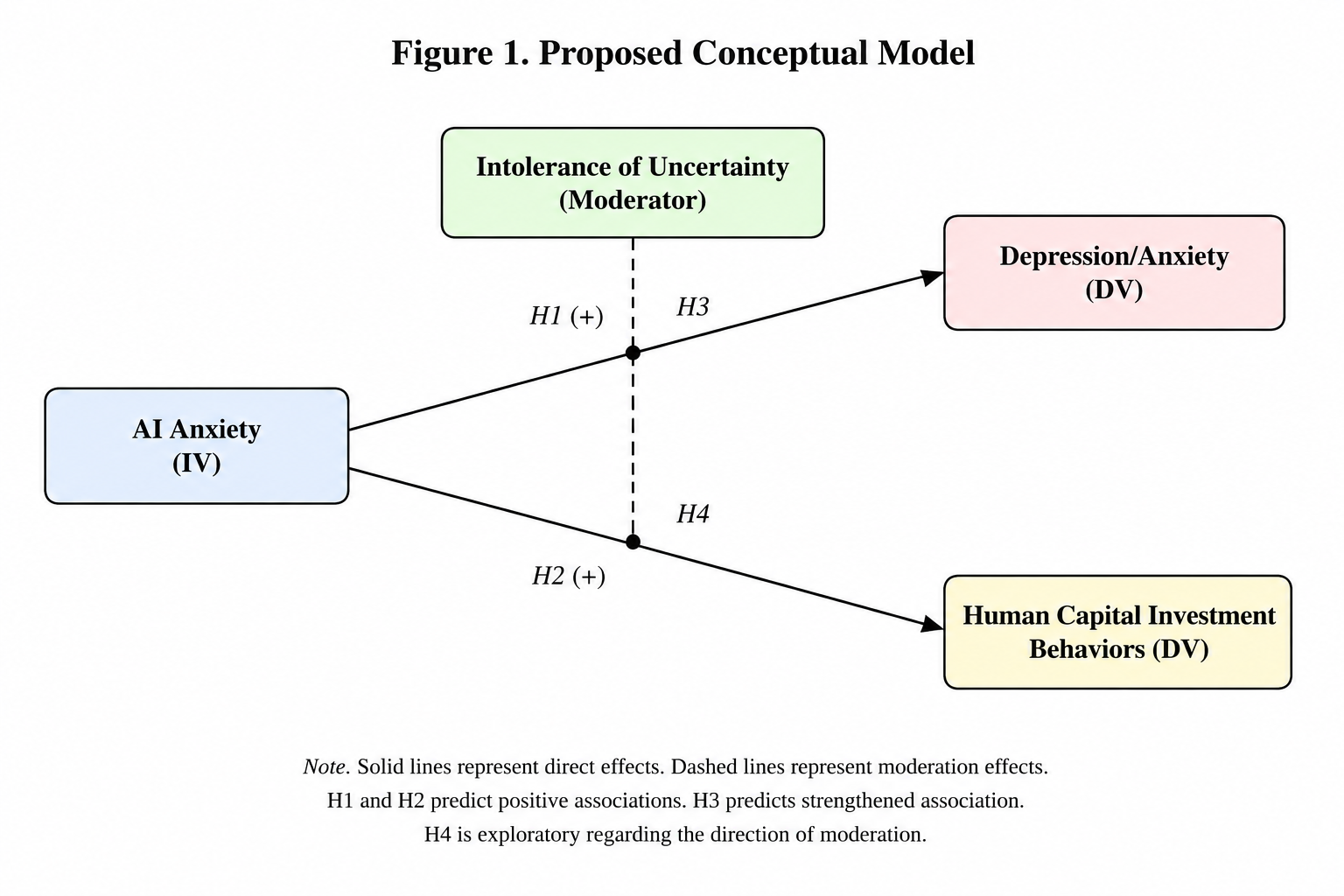
Drawing on human capital theory4 and Innocenti & Golin empirical research on automation risk and adaptive behavior3, the present study proposes a dual-outcome moderation model in which AI anxiety is associated with two distinct consequences: increased depression/anxiety symptoms and greater engagement in proactive human capital investment behaviors. Moreover, IU is examined as a moderator that may amplify the impact of AI anxiety on both outcomes. This framework recognizes that AI anxiety may simultaneously be associated with psychological distress while also motivating adaptive educational responses, and that individual differences in tolerance for uncertainty may shape the strength of both pathways. Specifically, the following hypotheses are proposed:
H1: AI anxiety will be positively associated with depression and anxiety symptoms. Students who report greater AI anxiety will report higher levels of depression/anxiety symptoms.
H2: AI anxiety will be positively associated with human capital investment behaviors. Students with greater AI anxiety will be more likely to engage in proactive educational strategies (e.g., changing majors, pursuing additional credentials, enrolling in technology-related courses).
H3: IU will moderate the relationship between AI anxiety and depression/anxiety symptoms, such that the positive association will be stronger among students with higher IU.
H4: IU will moderate the relationship between AI anxiety and human capital investment behaviors.
From H4, two competing phenomena can be predicted. On one hand, students with high IU may attempt to resolve or avoid uncertainty by engaging with human investment behaviors, which, in this case, AI anxiety can function as a motivation. On the other hand, when such action is required under uncertain conditions, some students may freeze and refuse to make any educational decisions, which exposes the inhibitory anxiety component of IU. In such scenario, IU would instead weaken the link between AI concern and proactive investment among high-IU students. Because this phenomenon can both occur in opposite directions, the form of this moderation is examined as an open question rather than a directional hypothesis.
As shown in the proposed conceptual model, Figure 1, AI anxiety serves as the independent variable predicting two dependent variables: (a) depression and anxiety symptoms, specifically from AI-related job market concerns, and (b) human capital investment behaviors, showing adaptive educational responses to those same concerns. IU is hypothesized to moderate both pathways, as described in H3 and H4. Higher IU is expected to strengthen the association between AI anxiety and depression/anxiety in H3. The moderating role of IU on the behavioral pathway (H4), though, is examined as exploratory: IU may either amplify proactive behavior, as a way to resolve uncertainty through action, or inhibit it through decisional paralysis.
Method
Participants: The study sample consisted of 70 college students (Mage = 20.10 years, SD = 1.55, range = 18–26). Participants were predominantly female (61.4%) and Asian (61.4%), with most identifying as U.S.-born (72.9%) and primarily as students (78.6%). Other demographic characteristics, education, employment, and household income, are shown in Table 1.
Procedure: Participants were recruited for three weeks using snowball sampling starting from February 1. The survey was distributed through word of mouth and through social networks among college students. Eligibility required participants to be at least 18 years of age and currently enrolled as a student in higher education at a U.S. institution. Along with small number of graduate and post-baccalaureate students, the sample included primarily college students as shown numerically in the educational-background distribution (Table 1). Survey responses were collected over a three-week period (February 1 -February 21, 2026), via Google Forms. Because the survey was distributed via social media, the exact response rate cannot be calculated. A total of 70 complete responses were obtained. The study was approved by the Institutional Review Board at Bergen County Academies (OMB 0990-0279). The study implemented human-subjects protection protocols by utilizing an electronic informed-consent procedure via JotForm Sign. Before participating, college subjects were fully informed of the study’s purpose as well as potential risk, including potential discomfort from asking sensitive mental health questions. They were also apprised of right to withdraw at any time without penalty. No names or institutional affiliations were included in the final report. This is to protect participant data privacy throughout the study. Finally, immediate mental health resource referrals were provided at the end of every page of the form. These referrals explicitly direct participants to the 988 Suicide & Crisis Lifeline for 24/7 confidential support.
Measures
Demographics. Participants reported their age, gender, race/ethnicity, year in college, current major, and other relevant background characteristics.
Artificial Intelligence (AI) Anxiety. Drawing on the conceptual dimensions of AI anxiety identified by Wang and Wang12, an 8-item AI anxiety scale was developed exclusively for college students in the context of their career decision-making process. Items were designed to capture anxiety about the AI’s impact on the labor market, relevance to one’s own skills, and societal change. Participants rated their level of agreement with statements indicating uncertainty and concern about the impact of AI on society and the job market (e.g., “I feel apprehensive about using AI”, “I worry about AI making decisions that affect my life”, “I am nervous about competing with AI in the job market”). Participants’ responses were measured on a 5-point Likert scale ranging from 1 (Strongly Disagree) to 5 (Strongly Agree). Higher scores meant more anxiety about AI. The internal consistency for this 8-item scale was α = .92. Because these items were adapted specifically for the present study, they have not undergone full psychometric validation yet. This measure is therefore treated as preliminary, and its factor structure and construct validity are identified as limitations the future work should prioritize in addressing (see Limitations).
Human Capital Investment Behaviors. Given the absence of validated instruments measuring educational and career-related behavioral responses to AI-driven labor market concerns, a 5-item measure of human capital investment behaviors was developed for the present study. This item development was grounded in human capital theory4, which argues that individuals make strategic investments in education and training to enhance their future productivity and job market competitiveness, along with the recent empirical work demonstrating a positive association between perceived automation risk and workers’ intentions to invest in retraining1. In this 5-item measure of human capital investment behaviors, items were created to measure how students may actively participate in educational strategies to adapt to job market concerns related to AI, such as changing or considering changing one’s major, adding a second major or minor, taking AI or technology-related courses, and obtaining certificates outside of one’s degree program (e.g., “I have changed my major because of concerns about AI or automation,” “I have enrolled in courses specifically to learn AI or technology skills”). Responses were recorded on a 5-point Likert scale ranging from 1 (Strongly Disagree) to 5 (Strongly Agree). Higher scores indicate greater engagement in human capital investment behaviors. The scale demonstrated an internal consistency of α = .78. As a newly developed instrument, validations against established educational-behavior and career-adaptability measures have not yet been accomplished. As such, this scale should be treated as preliminary.
Intolerance of Uncertainty. IU was measured using the 12-item IU Scale–Short Form5. The IUS-12 assesses the extent to which individuals find uncertainty distressing and unacceptable, capturing both prospective anxiety (e.g., “Unforeseen events upset me greatly”) and inhibitory anxiety (e.g., “When it’s time to act, uncertainty paralyses me”). Responses were recorded on a 5-point Likert scale ranging from 1 (Not at All Characteristic of Me) to 5 (Entirely Characteristic of Me). Higher scores indicate greater IU. Internal consistency for the IUS-12 was α = .93.
Depressive and Anxiety Symptoms. Depressive and anxiety symptoms were measured using the 21-item Depression Anxiety Stress Scales23, which has demonstrated validity in a wide variety of samples24. Items were rated on a 4-point scale ranging from 0 (never) to 3 (almost always), with a sample item reading, “I felt that I had nothing to look forward to.” Once computed, the final sum scores were multiplied by two in order to align with the scoring metric of the full 42-item version. These sum scores ranged from 0 to 126, in which higher values reflected greater depression and anxiety symptoms. The combined 21-item scale showed good internal consistency of α = .93.
Prior to the analysis, all variables were adequately screened and evaluated for missing data, outliers, and normality. Skewness and kurtosis values for all variables were within acceptable ranges (skewness < |2.00|, kurtosis < |7.00|). Categorical covariates (gender and nativity) were dummy-coded, and household income and education level were treated as ordinal variables. Participants who did not answer the questions asking gender (n = 3) or household income (N = 70) were excluded pairwise from bivariate Pearson correlations. Analyses were conducted in R (version 4.5.2) by using both the psych and interactions packages. To preserve degrees of freedom relative to the sample size (N = 70), two multiple regression models were evaluated rather than a latent-variable path model. Predictors were mean centered prior to creating interaction terms, and simple slopes were evaluated at 1 SD and the mean. Age, gender, nativity, and education were included as covariates; income was excluded due to a 40% nonresponse rate. Covariates did not alter the pattern of results and were non-significant. Sensitivity analysis (N = 67, α = .05, 7 predictors) indicated 80% power to detect an overall-model effect of f² = 0.24 and a single-predictor effect of f² =0.13, meaning the study was underpowered for small effects (such as the observed interaction, f² =0.08). Regression diagnostics indicated no multicollinearity (VIFs: 1.04–1.41) and no influential cases (maximum Cook’s D = .24 and .09). Breusch-Pagan tests supported homoscedasticity for both the depression/anxiety (LM = 8.20, p = .315) and human capital models (LM = 9.05, p = .249). Shapiro-Wilk tests indicated normally distributed residuals for the depression/anxiety model (W = .98, p = .304) and a mild departure for the human capital model (W = .95, p = .010) due to a restricted range.
Results
Preliminary Analyses: Preliminary analyses were conducted to examine the study measures, descriptive statistics, and bivariate associations among key variables. The analytic sample consisted of 70 college students (Mage = 20.10, SD = 1.55, range = 18–26). Descriptive statistics for all study variables are presented in Table 2. Skewness and kurtosis values for all variables fell within acceptable ranges (skewness < |2.00|, kurtosis < |7.00|) , supporting the assumption of approximate normality25.
Bivariate Correlations: Table 2 shows the bivariate correlations between demographic and study variables. Interestingly, none were significantly associated with the primary study variables (AI anxiety, IU, depression, anxiety, or human capital investment), except for a marginally significant positive association between gender and anxiety symptoms (r = .19, p = .127). This could indicate a trend of increased anxiety among female-identified participants. Age was significantly correlated with nativity (r = .25, p = .035) and education level (r = .26, p = .030), but not with any of the primary study variables. AI anxiety was significantly and positively correlated with depression (r = .31, p = .010) and anxiety (r = .26, p = .029), AI anxiety, however, was not significantly correlated with human capital investment (r = .19, p = .121). IU was strongly and positively associated with depression (r = .65, p < .001), anxiety (r = .55, p < .001), and AI anxiety (r = .50, p < .001). The correlation between IU and human capital investment approached but did not reach conventional significance (r = .21, p = .080). Depression and anxiety were highly correlated (r = .84, p < .001), supporting the decision to combine these subscales into a single depression/anxiety symptom composite for the path analysis.
Hypothesis 1: AI Anxiety and Depression/Anxiety Symptoms. The overall model examining associations with depression/anxiety symptoms was statistically significant, R² = .42, F(7, 59) = 6.02, p < .001, indicating that the set of predictors accounted for approximately 42% of the variance in depressive/anxiety symptoms. Contrary to Hypothesis 1, AI anxiety was not a significant unique predictor of depression/anxiety symptoms after accounting for IU and demographic covariates (b = −0.44, SE = 1.40, t = −0.32, p = .754, 95% CI [−3.25, 2.37]) as detailed in Table 1, and its unique contribution was negligible (f² = 0.002). IU emerged as the only variable significantly associated with depression depression/anxiety symptoms (b = 8.99, SE = 1.64, t = 5.50, p < .001, 95% CI [5.72, 12.26]), representing a large effect (f² = 0.51) and accounting for the substantial majority of explained variance. None of the demographic covariates were statistically significant. Notably, although the bivariate correlation between AI anxiety and depression/anxiety symptoms was significant (r = .31, p = .010, explaining roughly 10% of variance), the regression matrix in Table 1 demonstrates that this association became nonsignificant once IU was included in the model, indicating that it was almost entirely attributable to shared variance with IU (see Table 3).
Hypothesis 2: AI Anxiety and Human Capital Investment. The second regression model, also summarized in Table 3, examined associations with human capital investment was not statistically significant at conventional levels, R² = .15, F (7, 59) = 1.45, p = .203. The data did not support Hypothesis 2, as AI anxiety was not significantly associated with human capital investment behaviors (b = 0.09, SE = 0.12, t = 0.73, p = .471, 95% CI [−0.16, 0.33]). IU was also nonsignificant as a main effect predictor (b = 0.19, SE = 0.14, t = 1.31, p = .195, 95% CI [−0.10, 0.47]). No demographic covariates were statistically significant.
Hypothesis 3: IU as a Moderator of the AI Anxiety–Depression/Anxiety Link. Hypothesis 3 proposed that IU would moderate the association between AI anxiety and depression/anxiety symptoms, such that the positive relationship would be stronger among students with higher IU. The data did not support this hypothesis. As shown in the primary outcome model (Table 3), the AI Anxiety × IU interaction term was not statistically significant (b = −0.12, SE = 1.28, t = −0.09, p = .926, 95% CI [−2.67, 2.44]).
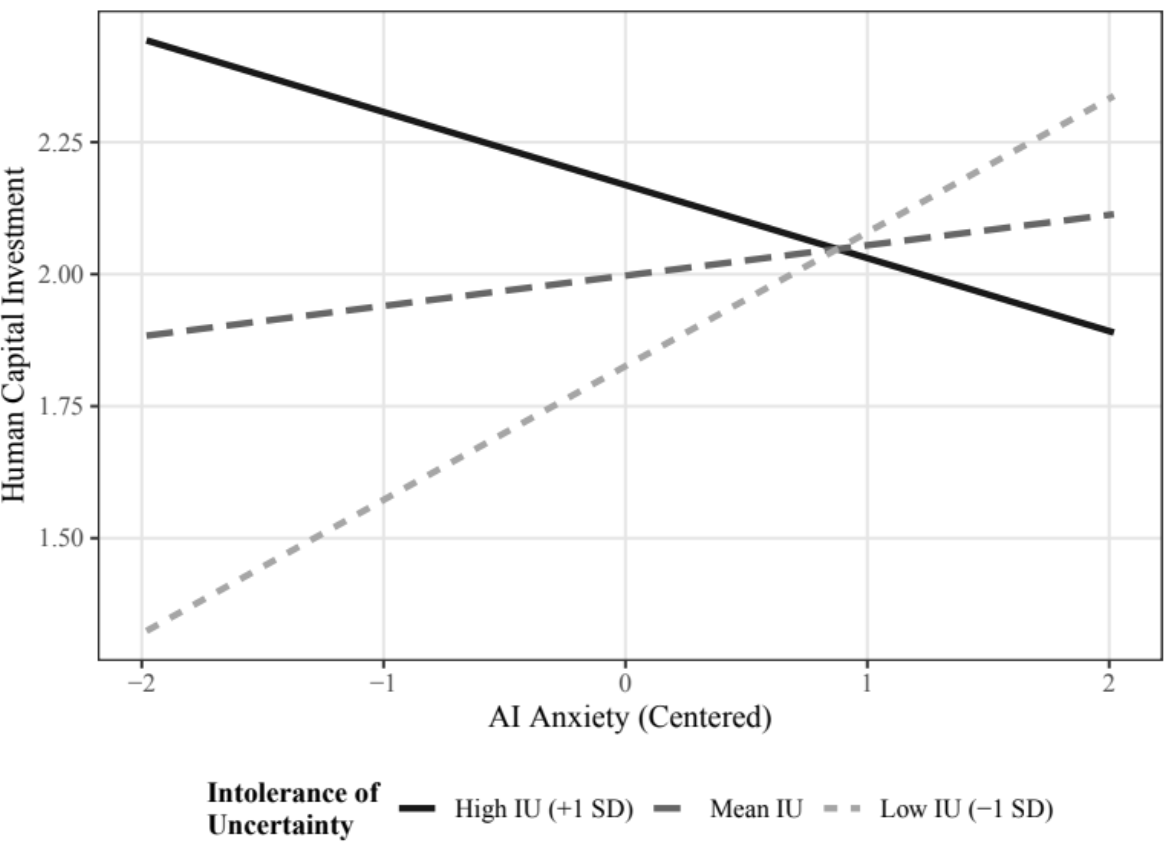
Hypothesis 4 (Exploratory): IU as a Moderator of the AI Anxiety–Human Capital Investment Link. The exploratory hypothesis examining whether IU moderated the relationship between AI anxiety and human capital investment was supported. The final row of Table 3 indicates that AI Anxiety × IU interaction was statistically significant (b = −0.24, SE = 0.11, t = −2.15, p = .036, 95% CI [−0.46, −0.02]). The interaction represented a small effect by conventional benchmarks (f² = 0.08), consistent with its emergence within an overall nonsignificant model, which explains why it should be regarded as a preliminary, small-magnitude effect.
As illustrated in Figure 2, simple slopes of AI anxiety on human capital investment were examined at low (−1 SD), mean, and high (+1 SD) levels of IU. At low levels of IU, the association between AI anxiety and human capital investment was positive and statistically significant (b = 0.29, SE = 0.14, t = 2.02, p = .048, 95% CI [0.003, 0.58]), indicating that students with lower IU who experienced greater AI anxiety engaged in significantly more proactive human capital investment behaviors. At the Mean of IU, the association was nonsignificant (b = 0.09, SE = 0.12, t = 0.73, p = .471). At high levels of IU, the association reversed in direction but remained nonsignificant (b = −0.11, SE = 0.16, t = −0.69, p = .495). At low IU, the positive slope (b = 0.29) indicates that a one-point increase in AI anxiety was associated with roughly a one-third-point increase in human capital investment on the five-point scale, a modest but non-trivial behavioral difference. This pattern indicates that IU weakened the association between positive human capital investment behavior and AI anxiety. Among students with lower IU, greater AI-related concern was channeled into adaptive educational action, whereas among students with higher IU, this proactive behavioral response was attenuated and reversed, consistent with a pattern of decisional paralysis (i.e., the inability to commit to a course of action under uncertain conditions) in which heightened uncertainty intolerance inhibits rather than facilitates action.
Discussion
The present study offers preliminary insights into the emerging literature on AI anxiety. Whereas existing research has focused on current workers responding to automation threats within established careers1, this study shifts focus to current college students whose concerns would center on initial career positioning rather than reskilling. Furthermore, the dual-outcome framework moves beyond viewing AI anxiety as uniformly harmful by exploring how it may also motivate adaptive educational behavior under certain conditions. Given the constrained sample size and mostly nonsignificant models, these preliminary findings should be interpreted strictly as exploratory and hypothesis-generating that require further testing in the future study.
Contrary to H1, AI anxiety was not a statistically significant factor of depression and anxiety symptoms, controlling IU and demographic covariates. While AI anxiety was significantly associated with depressive/anxiety symptoms, the link was attenuated once IU entered the model, with IU emerging as the sole variable uniquely associated with depression and anxiety symptoms. It may be that students with greater AI-related worries may also be more likely to be less tolerant of uncertainty. That is, it may be the general cognitive vulnerability, rather than AI anxiety per se, that accounts for their elevated distress. Moreover, AI anxiety may not be an independent correlate of depressive/anxiety symptoms. Clinically, this reframing points to important implications. For example, it may not be enough to worry about AI specifically if the underlying issue is that a person generally finds it hard to tolerate uncertainty. Therefore, students with IU difficulties may be more likely to feel distressed regardless of specific uncertainty. Statistical limitations may also explain the nonsignificant unique effect of AI anxiety. With a relatively small sample size (N = 70) and seven predictors in the model, the analysis did not have sufficient statistical power to detect unique relationships and therefore increases the risk of a Type II error.
Similarly, the findings failed to support H2, as AI anxiety had no significant association with human capital investment behaviors. The weak association between AI anxiety level and educational behaviors raises questions for Becker’s human capital theory4 and the empirical findings of Innocenti & Golin3. The two studies have shown a close relationship between automation risk perception and adaptive educational behaviors. However, these conclusions were not supported in this study. The conflicting nature can be explained by the delay in individuals’ responses to the uncertain situation, including potential job losses in the advent of AI. High AI anxiety may have been present in those who perceived the threat of f automation but did not act on what they thought or believed. Therefore, the results of this study might not have completely shown the planned actions of the individuals to the perceived risk, which might have led to a difference with previous Additionally, the measurement of human capital investment behaviors likely suffered from a restriction of range. Because the sample was limited to college students who are all actively pursuing education, the homogeneity of the group minimized variance in the outcome variable. This sparks the possibility that the lack of data spread and a small sample size may have left the analysis underpowered. Accordingly, the null result of H2 may be attributed to low statistical power and restricted range.
H3 was not supported, as the AI Anxiety × IU interaction was nonsignificant. Given that IU was strongly correlated with depression/anxiety symptoms (r = .65) and emerged as the primary factor associated with distress, it may have accounted for so much variance in the outcome that little remained for an interaction effect to emerge. That is, IU showed a strong association with distress in this sample, rather than as a moderator that selectively increases distress in the presence of AI anxiety specifically. Furthermore, IU can be understood as a general vulnerability that works broadly rather than being specific to certain stressors. Testing these interaction effects often requires a much larger sample size compared to simple direct relationships. Having only 70 participants, which is considered as relatively small in sample size, limits the statistical power necessary to detect the moderation effect proposed in H3. Therefore, the nonsignificant finding likely resulted by another Type II error.
While H4 yielded a statistically significant interaction term, this finding occurred within an overall model predicting human capital investment that was nonsignificant. For this reason, the observed pattern from the finding should be best interpreted as a preliminary, hypothesis-generating finding, rather than a definite effect. That said, the data shows an insightful pattern: the effects of AI anxiety on behavior are conditional on individual differences in IU. Students with lower IU were able to channel AI concern into more proactive action; those with higher IU exhibited a behavioral pattern consistent with decisional paralysis. Finally, the attenuation of the AI anxiety and distress association after controlling for IU suggests the possibility that AI anxiety may not be a direct risk factor for distress. It may be indicative of a broader difficulty coping with uncertainty, instead. Therefore, it might be more effective to intervene in students’ ability to manage uncertainty more broadly rather than addressing AI-specific worries alone. Collectively, with larger and more diverse samples, longitudinal designs, and validated measures, this exploratory study can extend into more valuable future research and meaningfully contribute to the college student community.
Implications
The findings of the present study have several important implications for college student support services, academic advising, and mental health interventions. The central role of IU in both pathways observed in this study suggests that the effective tool to address current uncertainties may lie in students’ general capacity to tolerate uncertainty, and not in AI-specific concerns. For this reason, cognitive-behavioral approaches that directly target the IU may be more beneficial for students to manage psychological and behavioral consequences of labor market uncertainty at the same time. Academic advisors and counselors should be aware that students who appear to be inconsistent, such as expressing AI-related anxiety but appearing behaviorally inactive may not simply lack motivation. It could be that they are experiencing inhibitory anxiety that impedes action-taking. Specific and concrete career planning guidance may be more effective than advising approaches focused solely on information provision. The present model focused on IU as the central individual difference shaping the consequences of AI anxiety, but other psychological variables likely play a role and were beyond the scope of the current study. For example, resilience, defined as the capacity to adapt in the face of adversity, may buffer the link between AI anxiety and distress; it could possibly explain why some students experience AI-related concern without elevated symptoms. Students’ sense of influence on career outcomes, often known as perceived career control, may also play a role in channeling AI anxiety as a motivation for investment or helplessness. This may be a parallel or alternative mechanism to the inhibitory mechanism suggested in this study. Coping strategies, mainly problem-focused coping and avoidant coping, can offer another possible pathway. While problem-focused coping may directly face the AI concern and channel it into proactive educational action, avoidant coping may suppress it. These constructs can function as mediators like IU that clarify how AI anxiety leads to its psychological and behavioral outcomes. The mechanisms linking AI anxiety to wellbeing and adaptive behavior would become clearer when future models include other psychological variables as above.
Limitations
Limitations of the present study should be acknowledged. First, the sample size was relatively small (N = 70). This small sample size limits statistical power to detect possible small-to-medium effects. It may have even weakened the significance of findings for several pathways hypothesized in the study. The small sample also limits the complexity of models. For instance, path analysis with multiple predictors, interaction terms, and covariates may be underpowered in a sample of this size. In particular, the significant moderation effect observed for H4 emerged within an overall nonsignificant model. This means the findings from this model should only be regarded as preliminary until it can be replicated in a larger, independent sample. Future research with much larger representative samples will enable more rigorous tests of the proposed moderation model. Secondly, snowball sampling was demographically imbalanced with predominance of Asian (61.4%) and female (61.4%) participants recruited, which limits generalizability. The patterns observed in the present study should be considered specific to a predominantly Asian and female college sample until they are replicated in more representative samples. The findings cannot be generalized to the U.S. college at large. Although the high proportion of Asian American participants is informative in or of itself for understanding AI anxiety among this specific population demographic, the limited representation of other racial or ethnic groups limits conclusions about whether observed patterns generalize across different student populations. Stratified or probability-based sampling approaches must be employed in future study to ensure fuller representation across demographic groups. Third, the present study is a cross-sectional survey design, and no conclusions can be drawn about cause and effect. All observed relationships should be interpreted as associations with unknown temporal order. For instance, preexisting depression or anxiety may have increased the perceived threat of AI, and not the other way. Likewise, rather than AI anxiety prompting certain behaviors, students who have already taken a course of action, such as changing majors, may report lower AI anxiety levels as a consequence of having taken that action. For these reasons, longitudinal designs are needed, instead of a cross-sectional survey design, to establish temporal ordering. Additionally, all constructs were assessed through self-report in a single administration, raising the possibility of common method variance. The pattern of results is not fully consistent with method bias as a primary driver, as several key associations were nonsignificant rather than uniformly inflated; nonetheless, future work should incorporate behavioral indicators (e.g., course-enrollment or major-change records), informant or observational data, and longitudinal assessment to reduce shared-method variance.
Fourth, the AI Anxiety and Human Capital Investment scales, which were developed newly for this study, lack validation beyond internal consistency. Given the exploratory nature of this study, these measures should be viewed as an initial step in assessing AI anxiety and human capital investment among college students. The psychometric properties of the scales can become more established when their factor structure and convergent validity are examined by future research. Fifth, several potentially important confounding variables were not assessed. Potential confounds, including prior mental-health history, general academic stress, and AI knowledge or literacy were not identified or controlled throughout the study. Each could relate independently to both distress and educational behavior; AI literacy is a particularly notable omission given evidence that it may attenuate AI-related anxiety15, and prior mental-health status could account for part of the association between intolerance of uncertainty and distress. These variables should be measured and modeled in future work. Sixth, because 40% of the participants declined to report household income, this variable could not be included as a covariate. Not having enough data about socioeconomic status may have precluded the model from showcasing its potential link with other variables observed in the study. One possible scenario could have been the socioeconomic status affecting the AI anxiety directly or initiating the proactive behaviors as it provides greater capacity to pursue additional credentials, representing a meaningful gap in the present analysis. Future studies should require multiple imputations in a larger sample to improve income measurement and handle nonresponse. Seventh, several potentially important confounds, including prior mental-health history, general academic stress, and AI knowledge or literacy, were not assessed and therefore could not be controlled. Each could relate independently to both distress and educational behavior; AI literacy is a particularly notable omission given evidence that it may attenuate AI-related anxiety26, and prior mental-health status could account for part of the association between intolerance of uncertainty and distress. These variables should be measured and modeled in future work. Finally, data were collected during a three-week window in early 2026. Noting the rapidly evolving public attitudes toward AI during this time period, the findings should be understood within this specific temporal context.
Conclusion
The rapid advancement of AI technologies has spawned a new and consequential source of uncertainty for college students as they navigate through their educational and career decisions. Across both outcomes examined here, intolerance of uncertainty, not AI anxiety itself, emerged as the more important factor. AI-related anxiety only showed little relevance to symptoms once a student’s general difficulty with uncertainty was taken into account. This delivers intriguing message: what looks like AI-specific distress may largely reflect a broader trait. On the behavioral side, the same AI concern appeared to bring different effects depending on the students’ tolerance with uncertainty: while it prompts more actions for some students, it can also stall decision-making process for others, staying rather inactive. The value of this study lies less in statistical estimates. Instead, its value derives from excavating the central role of individual students’ disposition that influences how one responds to AI anxiety.
Future work should focus on following aspects. First, longitudinal designs can be more effective to divulge the temporal ordering among AI anxiety, IU, and both psychological (depression/anxiety symptoms) and behavioral outcomes (human capital investment behaviors), since the present cross-sectional data cannot establish one-way direction—whether AI anxiety precedes distress or instead reflects a preexisting difficulty with uncertainty. Second, larger and more demographically diverse samples should be recruited when replicating this moderation model. In this way, adequately powered tests of the interaction and full psychometric validation of the AI anxiety and human capital measures can be accomplished. This can eventually generate results with greater significance and reliability. Third, and most actionable, intervention research should test whether approaches that build general tolerance for uncertainty work better than interventions aimed narrowly at AI-specific concerns. Comparing these approaches experimentally would help determine whether the dispositional pathway identified here is a viable point of intervention. For instance, if directly targeting tolerance of uncertainty is deemed more effective, psychological intervention through cognitive-behavioral techniques can help to reduce distress while supporting adaptive educational decisions at the same time. As AI continues to change the labor market, research that continually seeks to identify which students are most vulnerable and which support most effectively helps them act rather than freeze will be integral for the future young adults during this critical period.
Appendix
| Characteristic | Category | n | % |
| Age | Mean (SD), range | 20.10 | — |
| Gender | Female | 43 | 61.4 |
| Male | 24 | 34.3 | |
| Prefer not to say | 3 | 4.3 | |
| Race/Ethnicity | Asian | 43 | 61.4 |
| White | 10 | 14.3 | |
| Two or more races | 8 | 11.4 | |
| Hispanic or Latino | 5 | 7.1 | |
| Middle Eastern or North African | 2 | 2.9 | |
| Black or African American | 1 | 1.4 | |
| Prefer not to respond | 1 | 1.4 | |
| Nativity | U.S.-born | 51 | 72.9 |
| Foreign-born | 19 | 27.1 | |
| └ South Korea (largest foreign-born subgroup) | 11 | — | |
| Educational Background | High school diploma/GED | 27 | 38.6 |
| Some college coursework | 22 | 31.4 | |
| 4-year degree | 18 | 25.7 | |
| Graduate degree | 3 | 4.3 | |
| Primary Role | Student | 55 | 78.6 |
| Part-time employment | 12 | 17.1 | |
| Full-time employment | 2 | 2.9 | |
| Self-employed | 1 | 1.4 | |
| Household Income Reporting | Declined to report | 28 | 40.0 |
| Variable | M | SD | 1 | 2 | 3 | 4 | 5 | 6 | 7 | 8 | 9 | 10 |
| 1. Age | 20.10 | 1.55 | — | |||||||||
| 2. Gender | 0.64 | 0.48 | 0.04 | — | ||||||||
| 3. Nativity | 0.27 | 0.45 | 0.25* | -0.15 | — | |||||||
| 4. Income | 3.36 | 1.96 | -0.10 | -0.14 | 0.06 | — | ||||||
| 5. Education | 3.96 | 0.91 | 0.26* | -0.07 | 0.06 | -0.07 | — | |||||
| 6. AI Anxiety | 2.98 | 0.99 | -0.05 | 0.06 | -0.12 | -0.16 | 0.00 | (0.92) | ||||
| 7. IU | 2.99 | 0.82 | 0.08 | 0.05 | -0.06 | 0.11 | -0.03 | 0.49*** | (0.93) | |||
| 8. Depression | 15.79 | 6.18 | 0.02 | 0.06 | -0.02 | 0.07 | -0.08 | 0.31* | 0.65*** | (0.89) | ||
| 9. Anxiety | 15.71 | 5.80 | 0.05 | 0.19 | -0.03 | -0.01 | -0.10 | 0.26* | 0.55*** | 0.84*** | (0.84) | |
| 10. HC | 1.90 | 0.83 | 0.11 | -0.06 | 0.04 | -0.12 | 0.10 | 0.19 | 0.21 | -0.04 | -0.03 | (0.78) |
Note. Cronbach’s alpha coefficients are presented on the diagonal in parentheses for multi-item scales. Gender coded as 0 = male, 1 = female; three participants who selected “prefer not to say” were excluded from correlations involving gender (n = 67). Nativity coded as 0 = U.S.-born, 1 = foreign-born. Income coded from 1 (less than $25,000) to 6 ($150,000 or more); 28 participants who selected “prefer not to answer” were excluded from correlations involving income (n = 42). Education coded from 3 (high school degree or GED) to 6 (graduate degree). IU = intolerance of uncertainty; HC = human capital investment. Depression and Anxiety are DASS-21 subscale sum scores; AI Anxiety, IU, and HC are mean scores. *p < .05. **p < .01. ***p < .001.
| Predictor | b | SE | t | p | 95% CI |
| Depression/Anxiety Symptoms (R² = .416) | |||||
| AI Anxiety | -0.442 | 1.403 | -0.315 | 0.754 | [-3.25, 2.37] |
| IU | 8.991*** | 1.635 | 5.498 | < .001 | [5.72, 12.26] |
| AI Anxiety × IU | -0.119 | 1.276 | -0.093 | 0.926 | [-2.67, 2.44] |
| Age | -0.033 | 0.800 | -0.041 | 0.967 | [-1.63, 1.57] |
| Gender | 2.369 | 2.455 | 0.965 | 0.338 | [-2.54, 7.28] |
| Nativity | 1.045 | 2.710 | 0.386 | 0.701 | [-4.38, 6.47] |
| Education | -0.888 | 1.319 | -0.673 | 0.503 | [-3.53, 1.75] |
| Human Capital Investment (R² = .147) | |||||
| AI Anxiety | 0.088 | 0.122 | 0.725 | 0.471 | [-0.15, 0.33] |
| IU | 0.186 | 0.142 | 1.310 | 0.195 | [-0.10, 0.47] |
| AI Anxiety × IU | -0.238* | 0.111 | -2.149 | 0.036 | [-0.46, -0.02] |
| Age | 0.045 | 0.070 | 0.647 | 0.520 | [-0.09, 0.18] |
| Gender | -0.101 | 0.213 | -0.473 | 0.638 | [-0.53, 0.33] |
| Nativity | -0.040 | 0.235 | -0.168 | 0.867 | [-0.51, 0.43] |
| Education | 0.042 | 0.115 | 0.369 | 0.714 | [-0.19, 0.27] |
Note. All continuous predictors are mean-centered. IU = intolerance of uncertainty. CI = confidence interval. Gender coded as 0 = male, 1 = female. Nativity coded as 0 = U.S.-born, 1 = foreign-born. Education coded from 3 (high school/GED) to 6 (graduate degree). Household income was excluded as a covariate due to high nonresponse (40%). *p < .05. **p < .01. ***p < .001.
References
- J. J. Arnett. Emerging adulthood: a theory of development from the late teens through the twenties. American Psychologist. Vol. 55, pg. 469–480, 2000 https://doi.org/10.1037/0003-066X.55.5.469. [↩] [↩]
- R. C. Kessler, P. Berglund, O. Demler, R. Jin, K. R. Merikangas, E. E. Walters. Lifetime prevalence and age-of-onset distributions of DSM-IV disorders in the national comorbidity survey replication. Archives of General Psychiatry. Vol. 62, pg. 593, 2005 https://doi.org/10.1001/archpsyc.62.6.593. [↩]
- S. Innocenti, M. Golin. Human capital investment and perceived automation risks: evidence from 16 countries. Journal of Economic Behavior & Organization. Vol. 195, pg. 27–41, 2022 https://doi.org/10.1016/j.jebo.2021.12.027. [↩] [↩] [↩] [↩] [↩]
- G. S. . Becker. Human capital : a theoretical and empirical analysis, with special reference to education. National Bureau of Economic Research : Distributed by Columbia University Press, 1975. [↩] [↩] [↩] [↩] [↩]
- R. N. Carleton, M. A. P. J. Norton, G. J. G. Asmundson. Fearing the unknown: a short version of the intolerance of uncertainty scale. Journal of Anxiety Disorders. Vol. 21, pg. 105–117, 2007 https://doi.org/10.1016/J.JANXDIS.2006.03.014. [↩] [↩]
- A. Bick, A. Blandin, D. Deming. The Rapid Adoption of Generative AI. 2024 https://doi.org/10.3386/w32966. [↩]
- T. Eloundou, S. Manning, P. Mishkin, D. Rock. GPTs are GPTs: An Early Look at the Labor Market Impact Potential of Large Language Models. arXiv 2023. [↩]
- K. Bonney, C. Breaux, C. Buffington, E. Dinlersoz, L. Foster, N. Goldschlag, J. Haltiwanger, Z. Kroff, K. Savage. The impact of AI on the workforce: tasks versus jobs? Economics Letters. Vol. 244, pg. 111971, 2024 https://doi.org/10.1016/j.econlet.2024.111971. [↩] [↩]
- J. Hatzius, J. Briggs, D. Kodnani, G. Pierdomenico. The potentially large effects of artificial intelligence on economic growth. Goldman Sachs. 2023. [↩] [↩]
- D. Acemoglu, D. Autor, J. Hazell, P. Restrepo. Artificial intelligence and jobs: evidence from online vacancies. Journal of Labor Economics. Vol. 40, pg. S293–S340, 2022 https://doi.org/10.1086/718327. [↩]
- S. Marken, T. Nicola. Three in four Americans believe AI will reduce jobs. Gallup.Com. 2023. [↩]
- Y. Y. Wang, Y. S. Wang. Development and validation of an artificial intelligence anxiety scale: an initial application in predicting motivated learning behavior. Interactive Learning Environments. Vol. 30, pg. 619–634, 2022 https://doi.org/10.1080/10494820.2019.1674887. [↩] [↩]
- M. Uçar, H. Çapuk, M. F. Yiğit. The relationship between artificial intelligence anxiety and unemployment anxiety among university students. WORK: A Journal of Prevention, Assessment & Rehabilitation. Vol. 80, pg. 701–710, 2025 https://doi.org/10.1177/10519815241290648. [↩]
- S. Park, J. Kim, E. Chung. The effects of college students’ perceived AI anxiety on career self-efficacy: the mediating effects of job seeking stress and planned happenstances skills. Korean Association of Coaching Psychology. Vol. 8, pg. 59–86, 2024 [↩] [↩] [↩]
- R. Li, J. Ouyang, J. Lin, S. Ouyang. Mediating effect of AI attitudes and AI literacy on the relationship between career self-efficacy and job-seeking anxiety. BMC Psychology. Vol. 13, 2025 https://doi.org/10.1186/S40359-025-02757-2. [↩] [↩] [↩]
- D. Farooqi, G. Pu, S. Paudel, S. Sultana, S. I. Ahmed. Job anxiety in post-secondary computer science students caused by artificial intelligence. ArXi. 2026. [↩]
- S. Chen, N. Yao, M. Qian. The influence of uncertainty and intolerance of uncertainty on anxiety. Journal of Behavior Therapy and Experimental Psychiatry. Vol. 61, pg. 60–65, 2018 https://doi.org/10.1016/j.jbtep.2018.06.005. [↩]
- K. A. Dar, N. Iqbal, A. Mushtaq. Intolerance of uncertainty, depression, and anxiety: examining the indirect and moderating effects of worry. Asian Journal of Psychiatry. Vol. 29, pg. 129–133, 2017 https://doi.org/10.1016/j.ajp.2017.04.017. [↩]
- R. Becerra, K. Gainey, K. Murray, D. A. Preece. Intolerance of uncertainty and anxiety: the role of beliefs about emotions. Journal of Affective Disorders. Vol. 324, pg. 349–353, 2023 https://doi.org/10.1016/j.jad.2022.12.064. [↩]
- C. Arbona, W. Fan, A. Phang, N. Olvera, M. Dios. Intolerance of uncertainty, anxiety, and career indecision: a mediation model. Journal of Career Assessment. Vol. 29, pg. 699–716, 2021 https://doi.org/10.1177/10690727211002564. [↩]
- Q. Li, Y. Chen, M. Zhang, J. Zhang, Z. Fu, F. Ye. Self-concept clarity and ai anxiety in graduate students: mediating roles of intentional self-regulation and perceived stress and moderating role of intolerance of uncertainty. Behavioral Sciences. Vol. 16, pg. 171, 2026 https://doi.org/10.3390/bs16020171. [↩]
- B. Kaya, H. Çelebi. Uncertainty in the age of AI: exploring the mediating effect of intolerance of uncertainty between mindsets and AI anxiety. International Journal of Human–Computer Interaction. Vol. 42, pg. 7438–7448, 2026 https://doi.org/10.1080/10447318.2025.2558043. [↩]
- P. F. Lovibond, S. H. Lovibond. The structure of negative emotional states: comparison of the depression anxiety stress scales (DASS) with the beck depression and anxiety inventories. Behaviour Research and Therapy. Vol. 33, pg. 335–343, 1995 https://doi.org/10.1016/0005-7967(94)00075-U. [↩]
- T. P. S. Oei, S. Sawang, Y. W. Goh, F. Mukhtar. Using the depression anxiety stress scale 21 (DASS-21) across cultures. International Journal of Psychology. Vol. 48, pg. 1018–1029, 2013 https://doi.org/10.1080/00207594.2012.755535. [↩]
- R. B. Kline. Response to Leslie Hayduk’s review of principles and practice of structural equation modeling,1 4th edition. Canadian Studies in Population. Vol. 45, pg. 188–195, 2018 https://doi.org/10.25336/CSP29418. [↩]
- R. Li, J. Ouyang, J. Lin, S. Ouyang. Mediating effect of AI attitudes and AI literacy on the relationship between career self-efficacy and job-seeking anxiety. BMC Psychology. Vol. 13, 2025 https://doi.org/10.1186/S40359-025-02757-2. [↩]