
Abstract
This study evaluates whether the final patient-reported outcome differs among three biologic osteoarthritis treatments: Platelet-Rich Plasma (PRP), AGF Prime (an autologous growth factor therapy), and Stem cell + AGF Prime, hereinafter SC+AGF, (adipose-derived stem cells combined with AGF). We retrospectively analyzed a cohort of 73 patients with osteoarthritis in a non-randomized observational study, the majority of whom were treated at the knee and each of whom received three doses of one intervention and self-rated pain/function on a 1–5 scale (1 = “Very bad”, 5 = “Excellent”) at baseline, after the 2nd dose, and after the 3rd dose, after 15 days of each dose. Nonparametric tests assessed improvements and between-group differences. All 73 patients improved. Baseline scores were uniformly 1.00 (“Very bad”), but mean feedback scores increased to 2.88 after the 2nd dose and 3.99 after the 3rd dose. Within each group, Friedman tests showed significant score improvements across doses (PRP: χ²=66.000, p<0.001; AGF Prime: χ²=40.000, p<0.001; SC+AGF: χ²=40.000, p<0.001). At final follow-up, a Kruskal–Wallis test revealed a significant difference between treatments (χ²=7.948, p=0.019), with AGF Prime having the highest mean rank. Pairwise Mann–Whitney tests indicated that AGF Prime scores were significantly higher than PRP (p=0.005), while differences involving the SC+AGF group were not statistically significant. We conclude that all three interventions were associated with improved patient-reported outcomes, with AGF Prime demonstrating higher final scores than PRP in this cohort.
Keywords: Platelet-rich plasma (PRP); Autologous growth factor (AGF); Stem cell + Autologous growth factor (SC+AGF); Osteoarthritis; Regenerative medicine; Patient-reported outcomes.
Introduction
Osteoarthritis (OA) is a degenerative joint condition characterized by progressive cartilage breakdown, joint inflammation, and structural changes in the surrounding bone. Clinically, knee osteoarthritis is one of the most common forms of OA and often results in chronic pain and reduced mobility1.
Current non-operative osteoarthritis guidelines continue to prioritize exercise-based therapy, weight management, and standard analgesic or injection-based care, which is why biologic injections are generally considered adjunctive rather than first-line treatment2.
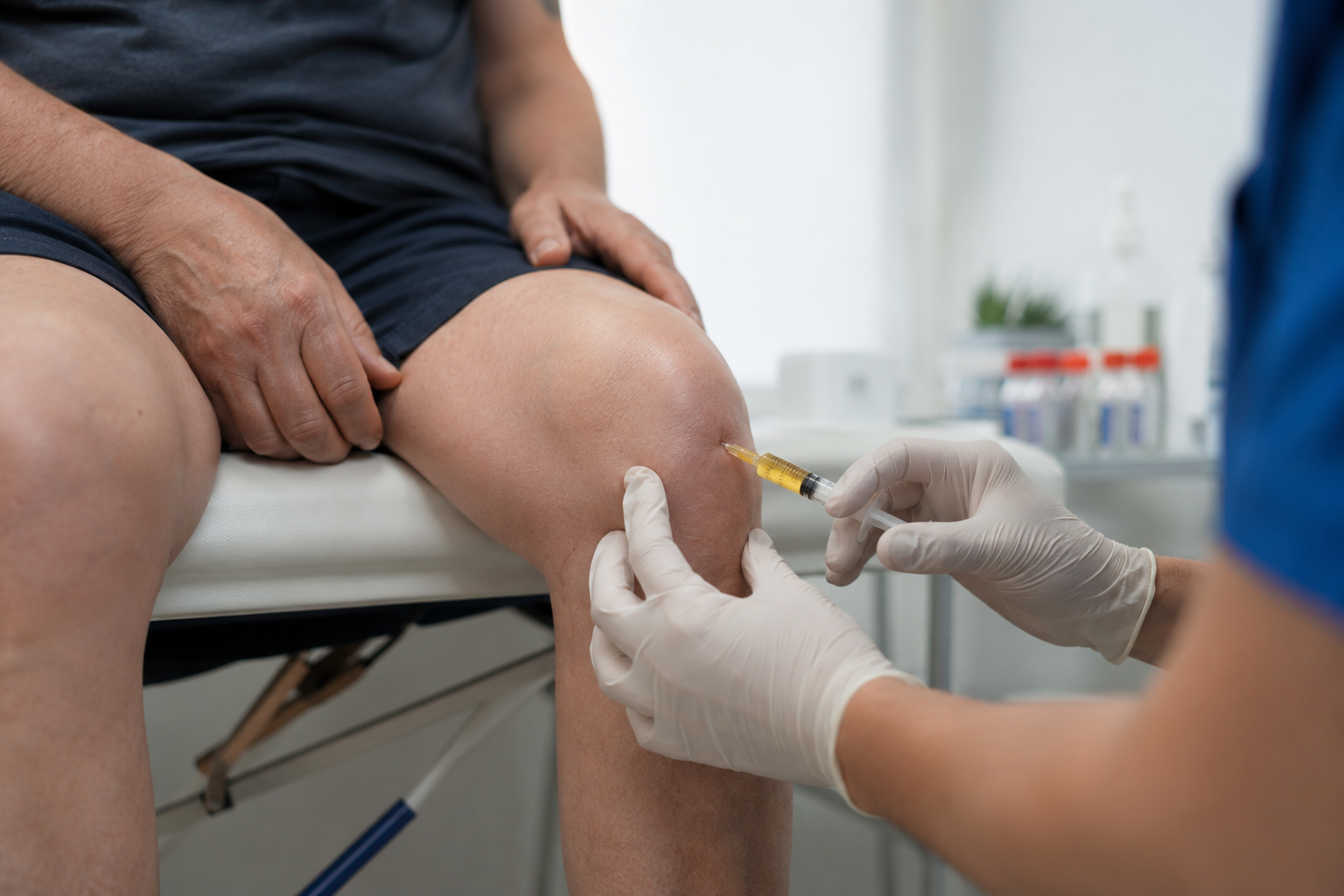
This has led to an interest in regenerative medicine therapies that might restore joint health. Platelet-Rich Plasma (PRP), an autologous concentration of platelets injected into joints to promote healing, is the leading treatment used in regenerative therapy of osteoarthritis. It is prepared by concentrating platelets from a patient’s own blood. When injected into the joint, it releases activated platelets, which release growth factors such as platelet-derived growth factor (PDGF) and transforming growth factor-β (TGF-β), which can modulate inflammation and stimulate tissue repair3. The biological effects of PRP are mediated through complex interactions between platelet-derived growth factors, inflammatory mediators, and the joint microenvironment. These interactions may promote chondroprotection, regulate inflammation, enhance angiogenesis, and influence tissue repair, although the precise mechanisms underlying clinical improvement remain incompletely understood4 . Clinical studies and meta-analyses suggest that PRP injections may provide greater symptomatic benefit than hyaluronic acid injections in some patients with knee osteoarthritis5,6,7, often with 6–12 months of relief. A retrospective study suggests the effectiveness of PRP for treatment of knee osteoarthritis is approximately 60% and the PRP efficacy was not affected by age, sex, body weight, or platelet count8. Although platelet-rich plasma is widely used in osteoarthritis, a randomized clinical trial found no clear advantage over placebo for knee pain or medial tibial cartilage volume, suggesting that PRP response is not universal across patients9. A placebo-controlled trial in ankle osteoarthritis likewise failed to show a strong PRP advantage10. The reported benefit of PRP can vary with preparation method, leukocyte content, and injection protocol, which may help explain the heterogeneity of clinical results across studies11. Mesenchymal stem cell therapies have been investigated as potential treatments for osteoarthritis, although evidence remains limited12. Early clinical studies have also evaluated the safety and potential therapeutic effects of intra-articular mesenchymal stem cell administration in orthopedic patients13. Adipose and bone marrow-derived cell therapies have also been explored as potential biologic treatments for osteoarthritis14,15. AGF Prime is a proprietary autologous growth-factor preparation derived from the patient’s own blood. Through a specialized “priming” process intended to enhance the availability of growth factors it may support tissue healing and modulate inflammation. Combining it with adipose-derived stem cells is proposed to further augment healing, though evidence is limited.
Prior studies have not directly compared patient-reported outcomes across PRP, AGF Prime, and SC+AGF. Patient feedback is often captured by ordinal Likert scales for pain/function. In this study, a 5-point patient feedback scale (1 = “Very bad” to 5 = “Excellent”) was used to quantify outcomes. Our objective was to determine whether final (post-third dose) patient-reported scores differ between these three treatment arms.
Methods
This retrospective, non-randomized observational study included 73 patients with osteoarthritis in a clinical setting.
Participants
Patients included in this study had a clinical diagnosis of osteoarthritis, which was established by the treating physician based on clinical evaluation and imaging findings. X-rays were used as the primary diagnostic modality, with magnetic resonance imaging (MRI) utilized when additional assessment was clinically indicated. Patients who completed all three treatment doses and had complete outcome records at baseline, after the second dose, and after the third dose were included in the analysis. Patients with incomplete treatment or outcome records were excluded.
Treatment Preparation and Administration
PRP was prepared using autologous blood collected from the patient. Approximately 22 mL of venous blood was centrifuged at 4,000 rpm for 10 minutes to separate the platelet-rich plasma fraction, which was then injected into the affected joint.
AGF Prime was prepared using the proprietary AGF Prime protocol routinely employed at the study site. The resulting growth-factor-rich preparation was administered by intra-articular injection into the affected joint. Detailed information regarding growth-factor concentrations and processing parameters was proprietary and therefore not available to the investigators.
For the SC+AGF treatment, adipose-derived stem cells were combined with AGF Prime prior to administration. The combined preparation was then injected into the affected joint according to routine clinical practice.
Data collection
The data was collected during clinical routine practice. All patients completed three injections of their assigned treatment and provided self-rated feedback at baseline (before the first injection), after the second injection, and after the third injection. The time taken to record the self-reported data was 45 days for each patient, with an interval of 15 days after each dose. Because patients were enrolled sequentially and not at the same time, the overall data collection period was approximately 3–4 months. There were no missing data for any patient, every patient had a recorded treatment type, site (e.g. right or left knee), and all three outcome ratings. Patients were grouped by treatment: PRP (n=33, 45.2%), AGF Prime (n=20, 27.4%), and SC+AGF (n=20, 27.4%). Table 1 (in the Results) summarizes these distributions. Majority of the treatments targeted knee joints, with a small number of ankle and wrist cases; bilateral involvement was infrequent (only 3 patients with both knees affected). The cohort consisted of adults aged 30-70 and included both sexes. Patients were not randomized to groups; therapy choice was determined clinically based on physician recommendation and patient preference. All treatments were performed as part of routine clinical care, and patients provided informed consent prior to treatment. Adverse events, if present, would have been documented in routine clinical records and follow-up visits.
Outcome Measures
The primary outcome was patient-reported feedback, recorded as an ordinal score: 1 (“Very bad” pain/function) through 5 (“Excellent”). At baseline, all patients were in the worst category (score = 1), reflecting severe symptoms. After 15 days of each injection, patients were asked to report their score using the 5-point patient-reported outcome scale shown in Figure 1. Patients were classified as “Improved” if their final outcome score was greater than their baseline score. These scores were recorded in an excel sheet with the respective site involvement and the dose number.
Statistical Analysis
For statistical analysis, we used nonparametric tests appropriate for ordinal data and small samples. Descriptive statistics (means, standard deviations, and percentiles) were computed for each group at each time point (see Table 2). Within each treatment arm, the Friedman test was used to assess whether patient scores changed significantly across the three time points. Pairwise Wilcoxon signed-rank tests compared score changes between specific visits (baseline vs 2nd dose, baseline vs 3rd dose, 2nd vs 3rd). To compare outcomes between the three treatment groups at each time point, we applied the Kruskal–Wallis test. For any significant Kruskal–Wallis result, we performed post-hoc pairwise Mann–Whitney U tests to identify which groups differed. For example, we compared PRP vs AGF Prime, PRP vs SC+AGF, and AGF Prime vs SC+AGF at each visit. A significance level of p<0.05 was used throughout. Reported pairwise p-values are Bonferroni-adjusted. All analyses were performed using R and cross-verified from SPSS (version 26).

Results
Participants & Treatments: Seventy-three patients met inclusion criteria. As noted, 33 (45.2%) received PRP, 20 (27.4%) received AGF Prime, and 20 (27.4%) received SC+AGF. Knee involvement was predominantly unilateral: right knee only (53.4%), left knee only (38.4%), both knees (4.1%), with ankle(1.4%) and wrist(2.7%) cases. All 73 patients completed the three-dose regimen.
| Count | Column N % | ||
| Treatment Type | PRP | 33 | 45.2 |
| AGF Prime | 20 | 27.4 | |
| SC+AGF | 20 | 27.4 | |
| Site Involvement | RT Knee | 39 | 53.4 |
| LT Knee | 28 | 38.4 | |
| Both Knee | 3 | 4.1 | |
| Ankle | 1 | 1.4 | |
| Wrist | 2 | 2.7 | |
| Outcome | Improved | 73 | 100.0 |
| Unimproved | 0 | .0 | |
Baseline Scores: At baseline, every patient rated their pain/function as “Very bad” (score = 1). Thus the mean score was 1.00 (SD 0.00) in all groups (see Table 2). Because there was no variability at baseline, group comparisons at baseline were trivial (no statistical difference).
Overall Improvement: By descriptive summaries, patient feedback improved steadily. After the 2nd dose, the mean overall score rose to 2.88 (SD 0.60); after the 3rd dose it was 3.99 (SD 0.54). Categorically, after the 2nd dose most patients rated “Fair” or “Good,” and after the 3rd dose the majority rated “Good” or “Excellent” (see Table 3). Importantly, all 73 patients were ultimately categorized as “Improved” by the final follow-up (100%), (see Table 1).
| Minimum | Maximum | Median | Mean | Standard Deviation | ||||||||
| Baseline | 1 | 1 | 1 | 1 | 0 | |||||||
| Feedback After 2nd Dose | 2 | 4 | 3 | 3 | .600 | |||||||
| Feedback After 3rd Dose | 3 | 5 | 4 | 4 | .540 | |||||||
| N | Mean | Std. Deviation | Minimum | Maximum | Percentiles | |||
| 25th | 50th (Median) | 75th | ||||||
| Baseline | 73 | 1.00 | .000 | 1 | 1 | 1.00 | 1.00 | 1.00 |
| Feedback After 2nd Dose | 73 | 2.88 | .600 | 2 | 4 | 2.50 | 3.00 | 3.00 |
| Feedback After 3rd Dose | 73 | 3.99 | .540 | 3 | 5 | 4.00 | 4.00 | 4.00 |
Within-Group Changes: Friedman tests confirmed that each treatment group experienced significant improvements over time. For PRP (n=33), scores changed significantly (χ² = 66.000, df = 2, p < 0.001); mean rank progressed from 1.00 (baseline) to 2.00 (after 2nd) to 3.00 (after 3rd). Similarly, for AGF Prime (n=20) χ² = 40.000 (df=2, p<0.001), and for SC+AGF (n=20) χ² = 40.000 (df=2, p<0.001). These results indicate significant within-patient improvement in each treatment site (see Figure 2). Wilcoxon signed-rank tests also showed that scores after the 2nd dose were significantly higher than baseline (Z = −7.680, p < 0.001) and that after the 3rd dose were higher than baseline (Z = −7.783, p < 0.001) and higher than the 2nd dose (Z = −8.165, p < 0.001).
Within-Group Changes: Friedman tests confirmed that each treatment group experienced significant improvements over time. For PRP (n=33), scores changed significantly (χ² = 66.000, df = 2, p < 0.001); mean rank progressed from 1.00 (baseline) to 2.00 (after 2nd) to 3.00 (after 3rd). Similarly, for AGF Prime (n=20) χ² = 40.000 (df=2, p<0.001), and for SC+AGF (n=20) χ² = 40.000 (df=2, p<0.001). These results indicate significant within-patient improvement in each treatment site (see Figure 2). Wilcoxon signed-rank tests also showed that scores after the 2nd dose were significantly higher than baseline (Z = −7.680, p < 0.001) and that after the 3rd dose were higher than baseline (Z = −7.783, p < 0.001) and higher than the 2nd dose (Z = −8.165, p < 0.001).
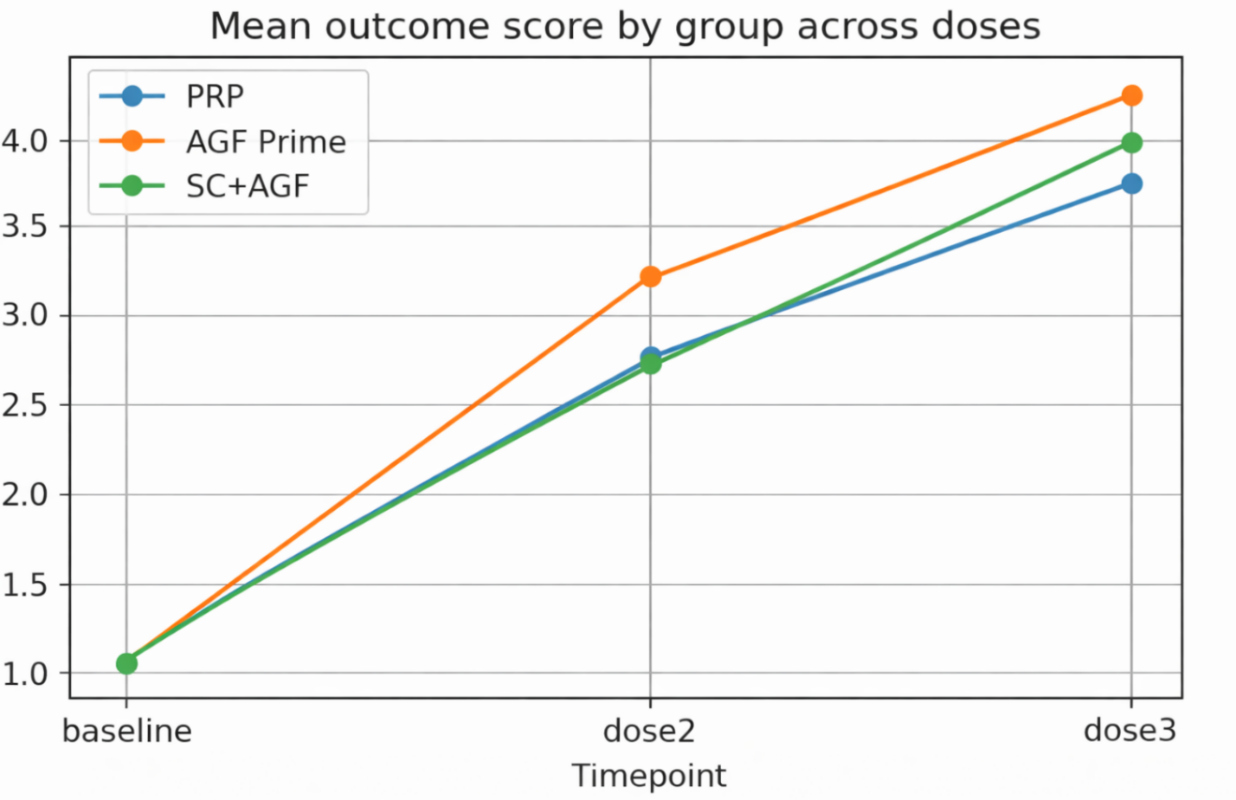
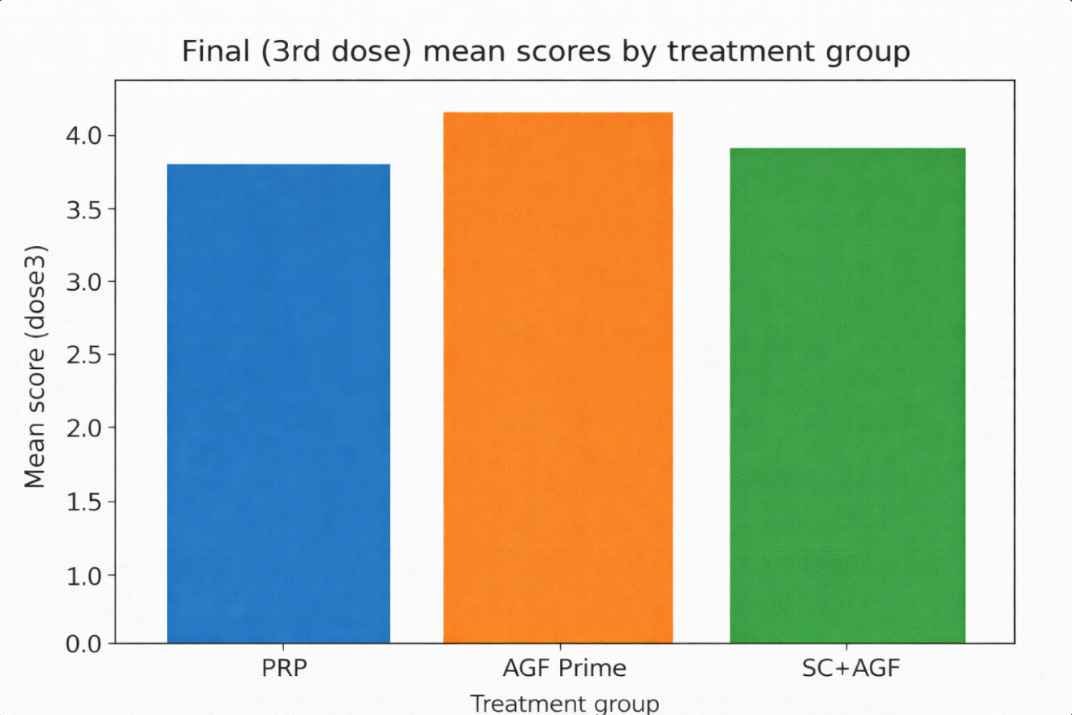
Between-Group Comparisons: We next compared the three treatment arms at each time point. At baseline, all scores were identical (p = 1.000) and no difference was expected. After the 2nd dose, the Kruskal–Wallis test showed no significant difference between groups (p = 0.068). However, after the 3rd dose (final outcome), there was a significant difference across treatments (χ² = 7.948, df = 2, p = 0.019). Mean rank ordering was AGF Prime highest (45.23), SC+AGF middle (37.43), and PRP lowest (31.76), suggesting that on average AGF Prime patients reported higher final scores than PRP or combined therapy (see Figure 3).
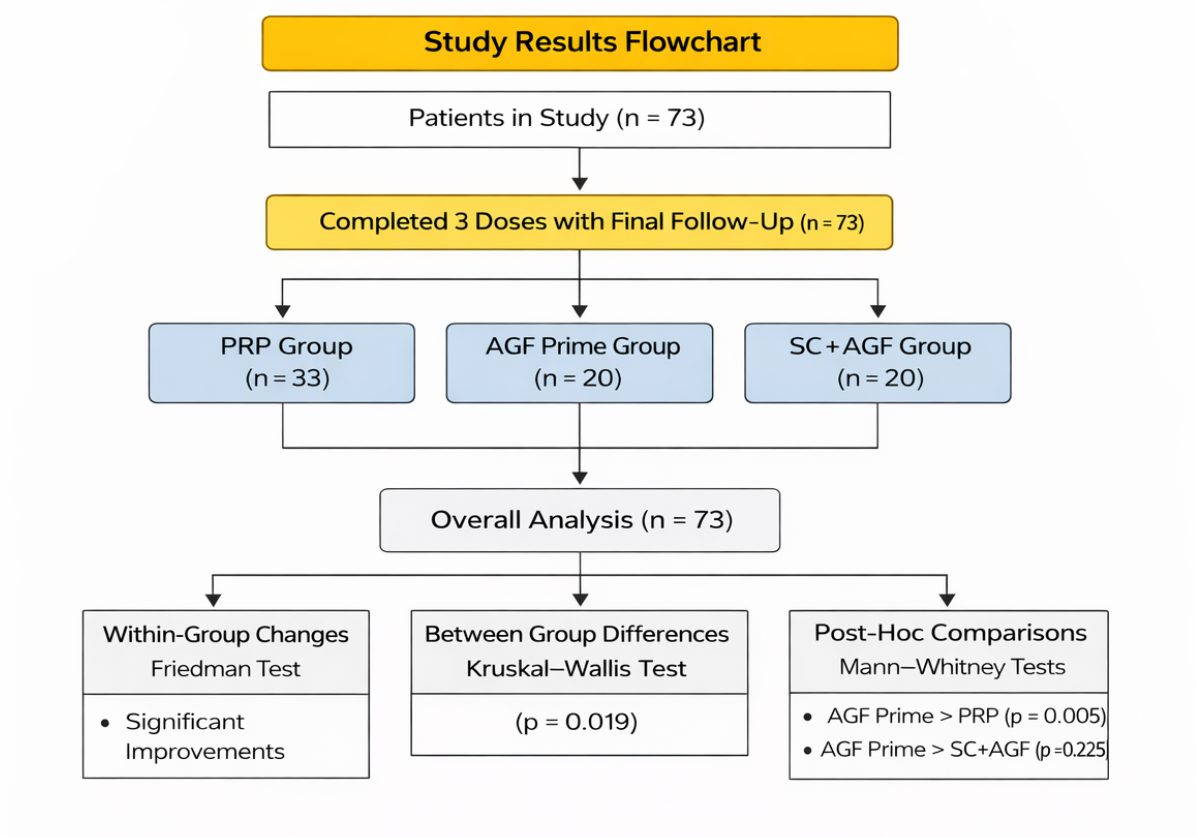
Post-Hoc Pairwise Tests: We performed Mann–Whitney U tests between each pair of treatments. At baseline none differed (all U tests p = 1.000). After the 2nd dose, AGF Prime vs PRP showed a significant advantage for AGF (U = 233.0, p = 0.034), whereas PRP vs SC+AGF (p = 0.707) and AGF vs SC+AGF (p = 0.062) did not reach significance. After the 3rd dose, the PRP vs AGF Prime comparison remained significant (U = 208.0, p = 0.005), indicating AGF Prime scores were higher than PRP. PRP vs SC+AGF was non-significant (p = 0.225), and AGF Prime vs SC+AGF also was not significant (U = 157.5, p = 0.163). In summary, AGF Prime was associated with higher patient-reported scores than PRP at the final follow-up(p = 0.005), but adding stem cells to AGF did not significantly change outcomes relative to AGF alone or PRP (see Figure 4).
Adverse Events: No adverse events were recorded in the available clinical records during the study period. However, because this was a retrospective review, minor or delayed adverse events may have been underreported.
Discussion
In this study of 73 mixed-joint osteoarthritis patients, all three treatments (PRP, AGF Prime, SC+AGF) were associated with improvements in patient-reported outcome scores. By the final (third) dose, average scores were near “Good” to “Excellent” (mean ~4.0 on a 1–5 scale) in every group, and every patient was classified as improved. This result aligns with prior reports that PRP treatment is associated with improvements in patient-reported outcomes16,17, and in our cohort essentially 100% improved. Previous randomized trials and clinical studies have reported symptomatic improvement following PRP treatment in knee osteoarthritis6,18,19,20. Clinical studies of mesenchymal stem cell therapies have also reported improvements in osteoarthritis outcomes, although findings have varied across studies21,22. A randomized clinical trial comparing expanded mesenchymal stromal cells alone with mesenchymal stromal stem cells combined with platelet-rich plasma demonstrated that both approaches were safe and associated with clinical improvement, but adding PRP to MSCs did not provide additional benefit23. It should be noted that the cohort consisted of small number of non-knee osteoarthritis cases (one ankle and two wrist cases); therefore, the findings may not be fully specific to knee osteoarthritis.
Notably, we found a statistically significant difference in outcomes between treatments by the end. AGF Prime patients had the highest final scores (mean 4.25), compared to PRP (3.82) and SC+AGF (4.00). The Kruskal–Wallis test on final scores was significant (p=0.019), and post-hoc tests showed that AGF Prime was associated with higher patient-reported scores than PRP (p=0.005). Interestingly, combining stem cells with AGF did not add a significant benefit – the SC+AGF group’s results fell between the other two and did not differ significantly from AGF alone (p=0.163). In fact, at some time points PRP vs SC+AGF showed no difference at all. The addition of stem cells may not have provided a measurable short-term benefit within the 45-day follow-up period. One possible explanation is that combining stem cells with AGF may alter the relative availability of growth factors compared with AGF alone. Also, previous clinical studies of adipose-derived mesenchymal stem cell therapies have reported variable outcomes, suggesting that treatment response may depend on factors such as cell preparation, dose, and patient characteristics24. Additionally, the likely reason SC+AGF has higher reported scores than PRP might be due to the relative concentration of AGF present in the combined therapy. A randomized double-blind trial found that variation in platelet-rich plasma composition influences clinical outcomes, suggesting that growth factor delivery may affect treatment efficacy25.
A possible hypothesis for the higher reported scores of AGF Prime group is that it may provide a higher or more concentrated delivery of growth factors. However, growth-factor concentrations were not directly measured in this study. PRP releases growth factors from activated platelets, their availability may be shorter-lived and more variable depending on preparation methods. A more concentrated or controlled growth factor formulation in AGF Prime may therefore produce stronger signaling that enhances joint recovery and improves patient-reported outcomes.
PRP may still be preferred in clinical practice because of its low cost. For example, at the hospital the study was conducted in, the cost of all three PRP doses was approximately INR 20,000-25,000. AGF was almost twice as expensive, costing approximately INR 40,000-50,000, while SC+AGF was even higher. It is also generally easier to prepare compared to other treatments. Since PRP can still provide meaningful symptomatic improvement for many patients, its lower cost and accessibility make it a widely preferred treatment option.
A literature review of intra-articular therapies in osteoarthritis found that comparative evidence remains mixed, reinforcing the view that biologic injections should be interpreted as evolving rather than settled treatments26
Despite the limitations, the project still demonstrates valuable points. Clinically, it shows that all three biologic regimens substantially improved osteoarthritis, consistent with the regenerative medicine literature. That AGF Prime appeared slightly superior is hypothesis-generating and might interest clinicians or researchers exploring combination therapies.
Limitations and Future Directions:
While the study demonstrated meaningful improvements in patient-reported outcomes across all treatment groups, several limitations need to be considered. The sample size within each treatment group was relatively small, which limits the statistical confidence and generalizability of the findings. The follow-up period of approximately 45 days was also short, and it may not fully capture the long-term clinical outcome of these therapies. Time-course analyses of PRP in knee osteoarthritis suggest that the magnitude of benefit may depend on when outcome assessment is performed, which makes short follow-up windows vulnerable to underestimating later symptom change27. Important patient-level variables, including BMI, Kellgren-Lawrence grade, symptom duration, prior treatments, medication use, and comorbidities, were not available in the retrospective dataset. Consequently, propensity-score matching or adjusted regression analyses could not be performed. Because treatment allocation was not randomized, differences between groups may have been influenced by patient preference, physician recommendation, treatment cost, baseline disease severity, and other unmeasured confounders.
Furthermore, outcomes were measured using a non-validated 5-point patient-reported scale rather than a validated standardized clinical scoring system. Another limitation is the absence of baseline variability, as all patients were assigned a score of 1 (“Very bad”) at study entry. The floor effect caused may have amplified the apparent magnitude of improvement and limited the ability to assess differences between patients at baseline. Future studies should consider larger patient cohorts, longer follow-up periods, and the use of validated clinical outcome measures to better evaluate the comparative effectiveness of regenerative therapies for osteoarthritis.
Conclusion
This study evaluated patient-reported outcomes following three regenerative treatments, PRP, AGF Prime, and SC+AGF, in patients with osteoarthritis. All three therapies demonstrated significant improvements in patient reported outcome scores over the treatment period, indicating that regenerative therapies can provide symptomatic benefit in degenerative joint conditions. However, AGF Prime produced the highest final patient-reported outcomes, with statistical analysis showing significant results compared with PRP, while the addition of stem cells to AGF did not produce a statistically significant advantage. These findings suggest that differences in biologic composition may contribute to variations in patient-reported outcomes; however, it should be noted that the underlying mechanisms were not directly evaluated in this study. Although these results were found, larger controlled studies with longer follow-up periods are needed to confirm these observations and better understand the comparative roles of regenerative therapies in osteoarthritis management.
References
- D. J. Hunter, S. Bierma-Zeinstra. Osteoarthritis. Lancet. Vol. 393, pg. 1745–1759, 2019. DOI:10.1016/S0140-6736(19)30417-9. Available at: https://doi.org/10.1016/S0140-6736(19)30417-9 [↩]
- Kolasinski SL, Neogi T, Hochberg MC, Oatis C, Guyatt G, Block J, Callahan L, Copenhaver C, Dodge C, Felson D, Gellar K, Harvey WF, Hawker G, Herzig E, Kwoh CK, Nelson AE, Samuels J, Scanzello C, White D, Wise B, Altman RD, DiRenzo D, Fontanarosa J, Giradi G, Ishimori M, Misra D, Shah AA, Shmagel AK, Thoma LM, Turgunbaev M, Turner AS, Reston J. 2019 American College of Rheumatology/Arthritis Foundation Guideline for the Management of Osteoarthritis of the Hand, Hip, and Knee. Arthritis Care Res (Hoboken). 2020 Feb;72(2):149-162. doi: 10.1002/acr.24131. Epub 2020 Jan 6. Erratum in: Arthritis Care Res (Hoboken). 2021 May;73(5):764. doi: 10.1002/acr.24615. PMID: 31908149; PMCID: PMC11488261. Available at: https://doi.org/10.1002/acr.24131 [↩]
- E. Anitua, I. Andia, B. Ardanza, P. Nurden, A. T. Nurden. Autologous platelets as a source of proteins for healing and tissue regeneration. Thrombosis and Haemostasis. Vol. 91, pg. 4–15, 2004. DOI:10.1160/TH03-07-0440. Available at: https://doi.org/10.1160/TH03-07-0440 [↩]
- Andia I, Sánchez M, Maffulli N. Joint pathology and platelet-rich plasma therapies. Expert Opin Biol Ther. 2012 Jan;12(1):7-22. doi: 10.1517/14712598.2012.632765. PMID: 22171664. Available at: https://doi.org/10.1517/14712598.2012.632765 [↩]
- E. Kon, L. Mandelbaum, M. Buda, M. Filardo, G. Delcogliano, G. Timoncini, M. Fornasari, M. Giannini, S. Marcacci. Platelet-rich plasma intra-articular injection versus hyaluronic acid viscosupplementation as treatments for cartilage pathology: from early degeneration to osteoarthritis. Arthroscopy. Vol. 27, pg. 1490–1501, 2011. DOI:10.1016/j.arthro.2011.05.011. Available at: https://doi.org/10.1016/j.arthro.2011.05.011 [↩]
- F. Cerza, S. Carni, A. Carcangiu, M. Di Vavo, A. Schiavilla, A. Pecora, M. De Biasi, A. Ciuffreda. Comparison between hyaluronic acid and platelet-rich plasma, intra-articular infiltration in the treatment of gonarthrosis. The American Journal of Sports Medicine. Vol. 40, pg. 2822–2827, 2012. DOI:10.1177/0363546512461902. Available at: https://doi.org/10.1177/0363546512461902 [↩] [↩]
- J. W. Belk, M. A. Kraeutler, T. Houck, J. M. Goodrich, J. T. McCarty. Platelet-Rich Plasma Versus Hyaluronic Acid for Knee Osteoarthritis: A Systematic Review and Meta-analysis of Randomized Controlled Trials. The American Journal of Sports Medicine. Vol. 49, pg. 249–260, 2021. DOI:10.1177/0363546520909397. Available at: https://doi.org/10.1177/0363546520909397 [↩]
- Y. Saita, T. Ishijima, H. Mogami, Y. Kubota, K. Baba, M. Takazawa, Y. Ikeda, Y. Kaneko, M. Takazawa, Y. Sakamoto. Predictors of Effectiveness of Platelet-Rich Plasma Therapy for Knee Osteoarthritis: A Retrospective Cohort Study. Journal of Clinical Medicine. Vol. 10, pg. 4514, 2021. DOI:10.3390/jcm10194514. Available at: https://doi.org/10.3390/jcm10194514 [↩]
- Bennell KL, Paterson KL, Metcalf BR, Duong V, Eyles J, Kasza J, Wang Y, Cicuttini F, Buchbinder R, Forbes A, Harris A, Yu SP, Connell D, Linklater J, Wang BH, Oo WM, Hunter DJ. Effect of Intra-articular Platelet-Rich Plasma vs Placebo Injection on Pain and Medial Tibial Cartilage Volume in Patients With Knee Osteoarthritis: The RESTORE Randomized Clinical Trial. JAMA. 2021 Nov 23;326(20):2021-2030. doi: 10.1001/jama.2021.19415. PMID: 34812863; PMCID: PMC8611484. Available at: https://doi.org/10.1001/jama.2021.19415 [↩]
- Paget LDA, Reurink G, de Vos RJ, Weir A, Moen MH, Bierma-Zeinstra SMA, Stufkens SAS, Kerkhoffs GMMJ, Tol JL; PRIMA Study Group. Effect of Platelet-Rich Plasma Injections vs Placebo on Ankle Symptoms and Function in Patients With Ankle Osteoarthritis: A Randomized Clinical Trial. JAMA. 2021 Oct 26;326(16):1595-1605. doi: 10.1001/jama.2021.16602. PMID: 34698782; PMCID: PMC8548954. Available at: https://doi.org/10.1001/jama.2021.16602 [↩]
- Foster TE, Puskas BL, Mandelbaum BR, Gerhardt MB, Rodeo SA. Platelet-rich plasma: from basic science to clinical applications. Am J Sports Med. 2009 Nov;37(11):2259-72. doi: 10.1177/0363546509349921. PMID: 19875361. Available at: https://journals.sagepub.com/doi/10.1177/0363546509349921 [↩]
- C. H. Jo, Y. G. Lee, W. H. Shin, H. Chai, E. C. Jeong, J. E. Kim, S. Y. Shim, K. S. Shin, H. N. Yoon, J. H. Kim. Intra-articular injection of mesenchymal stem cells for the treatment of osteoarthritis of the knee: a proof-of-concept clinical trial. Stem Cells. Vol. 32, pg. 1254–1266, 2014. DOI:10.1002/stem.1634. Available at: https://doi.org/10.1002/stem.1634 [↩]
- C. T. Vangsness Jr., P. Farr, J. Boyd, D. Dellaero, K. Mills, M. LeRoux-Williams. Adult human mesenchymal stem cells delivered via intra-articular injection to the knee following partial medial meniscectomy: a randomized, double-blind, controlled study. Journal of Bone and Joint Surgery. Vol. 96, pg. 90–98, 2014. DOI:10.2106/JBJS.M.00058. Available at: https://doi.org/10.2106/JBJS.M.00058 [↩]
- Y. G. Koh, Y. J. Choi, Y. S. Kwon, Y. S. Kim. Mesenchymal stem cell injections improve symptoms of knee osteoarthritis. Arthroscopy. Vol. 29, pg. 748–755, 2013. DOI:10.1016/j.arthro.2012.11.017. Available at: https://doi.org/10.1016/j.arthro.2012.11.017 [↩]
- W. S. Lee, H. J. Kim, K. I. Kim, G. B. Kim, W. Jin. Intra-Articular Injection of Autologous Adipose Tissue-Derived Mesenchymal Stem Cells for the Treatment of Knee Osteoarthritis: A Phase IIb, Randomized, Placebo-Controlled Clinical Trial. Stem Cells Translational Medicine. Vol. 8, pg. 504–511, 2019. DOI:10.1002/sctm.18-0122. Available at: https://doi.org/10.1002/sctm.18-0122 [↩]
- W. L. Dai, A. G. Zhou, H. Zhang, J. Zhang. Efficacy of Platelet-Rich Plasma in the Treatment of Knee Osteoarthritis: A Meta-analysis of Randomized Controlled Trials. Arthroscopy. Vol. 33, pg. 659–670.e1, 2017. DOI:10.1016/j.arthro.2016.09.024. Available at: https://doi.org/10.1016/j.arthro.2016.09.024 [↩]
- P. A. Smith. Intra-articular Autologous Conditioned Plasma Injections Provide Safe and Efficacious Treatment for Knee Osteoarthritis: An FDA-Sanctioned, Randomized, Double-blind, Placebo-controlled Clinical Trial. The American Journal of Sports Medicine. Vol. 44, pg. 884–891, 2016. DOI:10.1177/0363546515624678. Available at: https://doi.org/10.1177/0363546515624678 [↩]
- S. Patel, M. S. Dhillon, S. Aggarwal, N. Marwaha, A. Jain. Treatment with platelet-rich plasma is more effective than placebo for knee osteoarthritis: a prospective, double-blind, randomized trial. The American Journal of Sports Medicine. Vol. 41, pg. 356–364, 2013. DOI:10.1177/0363546512471299. Available at: https://doi.org/10.1177/0363546512471299 [↩]
- M. Sánchez, E. Anitua, J. Azofra, J. J. Aguirre, I. Andia. Intra-articular injection of an autologous preparation rich in growth factors for the treatment of knee OA: a retrospective cohort study. Clinical and Experimental Rheumatology. Vol. 26, pg. 910–913, 2008. Available at: https://www.clinexprheumatol.org/article.asp?a=3498 [↩]
- G. Filardo, E. Kon, R. Buda, M. Di Martino, A. Timoncini, M. Cenacchi, S. Fornasari, M. Giannini, S. Marcacci. Platelet-rich plasma intra-articular knee injections for the treatment of degenerative cartilage lesions and osteoarthritis. Knee Surgery, Sports Traumatology, Arthroscopy. Vol. 19, pg. 528–535, 2011. DOI:10.1007/s00167-010-1238-6. Available at: https://doi.org/10.1007/s00167-010-1238-6 [↩]
- A. Vega, M. A. Martín-Ferrero, F. Del Canto, A. Alberca, J. García, L. Munar, E. Orozco, A. Soler, J. Fuertes, E. Huguet, J. Sánchez, J. García-Sancho. Treatment of Knee Osteoarthritis With Allogeneic Bone Marrow Mesenchymal Stem Cells: A Randomized Controlled Trial. Transplantation. Vol. 99, pg. 1681–1690, 2015. DOI:10.1097/TP.0000000000000678. Available at: https://doi.org/10.1097/TP.0000000000000678 [↩]
- M. Emadedin, A. Labibzadeh, H. Liastani, S. Karimi, M. Jaroughi, N. Bolurieh, A. Hosseini, A. Baharvand, H. Aghdami. Long-Term Follow-up of Intra-articular Injection of Autologous Mesenchymal Stem Cells in Patients with Knee, Ankle, or Hip Osteoarthritis. Archives of Iranian Medicine. Vol. 18, pg. 336–344, 2015. Available at: https://pubmed.ncbi.nlm.nih.gov/26024666/ [↩]
- Bastos R, Mathias M, Andrade R, Bastos R, Balduino A, Schott V, Rodeo S, Espregueira-Mendes J. Intra-articular injections of expanded mesenchymal stem cells with and without addition of platelet-rich plasma are safe and effective for knee osteoarthritis. Knee Surg Sports Traumatol Arthrosc. 2018 Nov;26(11):3342-3350. doi: 10.1007/s00167-018-4883-9. Epub 2018 Mar 6. PMID: 29511819. Available at: https://doi.org/10.1007/s00167-018-4883-9 [↩]
- Y. M. Pers, J. Rackwitz, R. Ferreira, C. Pullig, S. Delfour, A. Barry, S. Sensebé, C. Casteilla, C. Fleury-Cappellesso, J. F. Petit, C. Jorgensen, D. Noël. Adipose Mesenchymal Stromal Cell-Based Therapy for Severe Osteoarthritis of the Knee: A Phase I Dose-Escalation Trial. Stem Cells Translational Medicine. Vol. 5, pg. 847–856, 2016. DOI:10.5966/sctm.2015-0245. Available at: https://doi.org/10.5966/sctm.2015-0245 [↩]
- Louis ML, Magalon J, Jouve E, Bornet CE, Mattei JC, Chagnaud C, Rochwerger A, Veran J, Sabatier F. Growth Factors Levels Determine Efficacy of Platelets Rich Plasma Injection in Knee Osteoarthritis: A Randomized Double Blind Noninferiority Trial Compared With Viscosupplementation. Arthroscopy. 2018 May;34(5):1530-1540.e2. doi: 10.1016/j.arthro.2017.11.035. Epub 2018 Feb 1. PMID: 29366744. Available at: https://doi.org/10.1016/j.arthro.2017.11.035 [↩]
- Wehling P, Evans C, Wehling J, Maixner W. Effectiveness of intra-articular therapies in osteoarthritis: a literature review. Ther Adv Musculoskelet Dis. 2017 Aug;9(8):183-196. doi: 10.1177/1759720X17712695. Epub 2017 Jun 20. PMID: 28835778; PMCID: PMC5557186. Available at: https://doi.org/10.1177/1759720X17712695 [↩]
- Shen L, Yuan T, Chen S, Xie X, Zhang C. The temporal effect of platelet-rich plasma on pain and physical function in the treatment of knee osteoarthritis: systematic review and meta-analysis of randomized controlled trials. J Orthop Surg Res. 2017 Jan 23;12(1):16. doi: 10.1186/s13018-017-0521-3. PMID: 28115016; PMCID: PMC5260061. Available at: https://doi.org/10.1186/s13018-017-0521-3 [↩]