Abstract
While the positive effect of exercise on health is widely accepted, little is known about the cognitive and emotional changes that occur immediately after short-term exercise among adolescents. Many research conducted on the topic is unclear about the methodologies used. This study aims to examine the effect of four levels of short-term exercise intensity on Stroop test performance, evaluating the precision and speed of resolving cognitive conflicts together with mood states of adolescents. A within-subjects design with eight high school students (6 males, 2 females) consisted of four 3-minute running sessions at different intensity levels, determined by percentage of maximum heart rate (HRmax) = 220 – age. The Stroop performance indices (PI) were assessed at 0, 5, 10, and 15 minutes after exercise. The mood of the subjects was assessed by the Profile of Mood States (POMS) Total Mood Disturbance (TMD) at 1, 6, 11, and 16 minutes after exercise. The results suggest that mood was decreasing steadily, cognitive function improved for all measures during the 15-minute exercise period. The mean Stroop PI rose from 51.378 to 54.109 within 15 minutes. Mean POMS TMD decreased from 43.156 to 30.156 over 16 minutes, the average number of completed items increased from 32.5 to 37.278. While we found no significant linear or quadratic inverted-U associations between exercise intensity and Stroop performance (F=0.30, p=0.876; quadratic p=0.515). POMS mood scores exhibited a significant quadratic intensity relationship (F=3.35, p=0.020; quadratic t=−2.571, p=0.0145).
Keywords: Adolescent cognition, Stroop test, exercise intensity, heart rate, inverted-U theory, POMS, Maximum heart rate, HRmax
Introduction
Firstly, the findings of Peruyero et al. (2017)1 reveal that exercise intensity has a role in inhibitory control, signifying that the benefits of exercise on the cognitive domain might be dependent on exercise. Secondly, Ludyga et al. (2017)2 revealed the positive impact of aerobic exercise on executive functions, but the effect size differed in different studies. Thirdly, recently, a study carried out in Frontiers in Psychology (2025)3 found that acute exercise resulted in better attention, memory, and executive functions in adolescents. This finding supports the present study’s hypothesis about the influence of exercise on improving cognitive performance in students. Thus, it is reasonable to investigate the effects of different exercise intensities on cognitive performance. Another research carried out by Tsukamoto et al. (2024)4 revealed that exercising before performing a stressful Stroop task improved adolescents’ performance and the dorsolateral prefrontal cortex activation. This provides support to the results obtained in the current research about the positive influence of exercise on cognitive performance. Complementing this, Naito et al. (2024)5 found a significant increase in oxygenated hemoglobin in multiple prefrontal regions during all forms of exercise compared to rest, suggesting that even light-intensity exercise is sufficient to elevate prefrontal blood flow. Furthermore, Nieuwenhuis (2024)67offered neurobiological support for the inverted-U framework, demonstrating that peak cognitive performance in decision-making tasks is reached at moderate arousal levels, with a computational model explaining the inverted-U-shaped relationship between arousal and performance. However, there are also inconsistencies in the findings of previous works. For instance, Alexandrino et al. (2026)8 did not reveal any significant increase in the level of executive function and inhibitory control after six weeks of HIIT exercise training. At the same time, Wang (2026)9 revealed that the high-intensity interval exercise resulted in more significant improvements in inhibitory control in adolescents with obesity than moderate-intensity exercise. Finally, Shen et al. (2024)10 found that the prefrontal cortex oxygenation was directly related to executive functions. Regarding mood, Wang et al. (2024)11 meta-analyzed RCTs and found that physical exercise alleviates negative emotions and reduces the risk of mental illness in adolescents, providing broader support for the POMS findings in the present study. Together, these studies provide evidence that acute exercise can enhance cognition while also highlighting uncertainties regarding the consistency of these effects in adolescents. Combined, these studies demonstrate how acute exercise may be capable of increasing cognitive functioning, but they also create uncertainty on the reliability of such an effect.
The current study aims to advance this body of research through its exploration of the connection between exercise and cognitive performance in adolescents using an exercise protocol that can be easily replicated. Therefore, the current study is an extension of this research because it measures cognitive performance in an adolescent sample utilizing a standardized exercise protocol.
Furthermore, understanding the immediate effects of exercise of varying intensities on adolescent emotions (such as energy, tension, and fatigue) could provide precise solutions for using exercise interventions to alleviate immediate stress (such as test anxiety) and improve mood if further studies were done in the future.
One such possible application of this is that acute exercise interventions may be utilized for contexts requiring heightened attention and cognitive control; an individual could carry out high-intensity physical activity in order to improve the degree of cognitive capability and increase alertness. In addition, this paper aims to lay the groundwork for further research in this area by providing preliminary exploratory data.
Therefore, the objective of this investigation is to discover the optimal physical exertion intensity and optimal length of time after exercise that allows the maximum cognitive alertness and awareness since they were unknown.1213
The hypothesis of our investigation is that cognitive performance on the Stroop test will follow an inverted-U relationship with exercise intensity; performance will improve from very light to moderate intensity but will significantly decline during vigorous intensity.3 This phenomenon can be attributed to the brain experiencing optimal oxygenation and stimulation, sharpening additional focus and boosting executive function. However, at high levels of intensity, the brain is flooded with stress hormones and metabolic fatigue, causing cognitive decline.
This prediction was derived from prior sport psychology literature documenting the individual zones of optimal arousal, without presupposing biological mechanisms. No directional causal claims were made and the hypothesis only anticipated consistent correlational trends across graded exertion levels within the sample.
The study was based on exercise physiology principles; they explain the physiological mechanisms of the effects of different intensities of exercise on the bodies of adolescents. We also use our data to correspond to different intensities and find the different benefits of each intensity.147
To investigate these effects, the study made use of a within-subjects design in carrying out an investigation of the impact of various levels of exercise intensity in short-term exercises on cognitive ability and emotional status in adolescents.
Specifically, the various levels of exercise intensity used in the study included very light, light, moderate, and vigorous exercise intensity in terms of percentages of maximum heart rate (HRmax).15,16 All exercises were carried out for a standard period of three minutes.
Following each exercise session, the test for cognitive ability in terms of mental control and function was carried out using the Stroop test, while a test for emotional status was carried out using the Mood test for Total Mood Disturbance.
Finally, The measurements for improvement or deterioration in cognitive ability were taken at different intervals.
Methods
The research is a randomized within-subjects experimental design. The goal of this research is to Figure out the effect of a different time gap between the point to finish short-term exercises and the time to test the POMS17 and Stroop test18 on the results obtained from it. Participants are each getting tested four times for each test after the short-term exercise, which is three minutes19 The overall four categories, depending on the percentage of maximum heart rate calculated by the formula 220 – age,20 are very light (<57% max heart rate (maxHR)), light (57-63% maxHR), moderate (64-76% maxHR), and vigorous (77-95% maxHR).21 They are each tested for all participants once a week, and the results from the two tests are recorded immediately.
There are eight participants randomly selected, which is a relatively small scale and is one of the serious limitations of this study. The eight people are randomly chosen from a high school, with each of them aged between sixteen and eighteen, six males and two females, and everyone is being experienced sports amateurs trained at least once a week for one year. And the sports they engage in are badminton, football, and Chinese traditional dances.
The Stroop test is used to measure cognitive control, attention, and processing speed.22 The individual was shown a selection of 5 colors with a separate word that appeared in the color that was to be picked, but was randomly chosen from the 5 colors. The test was conducted under a timer of 1 minute, and once the test was done, the performance index (PI) and other statistics were shown.
The POMS test consists of 65 items. The POMS was designed to evaluate individuals within seven different mood domains: fatigue-inertia, anger-hostility, vigor-activity, confusion-bewilderment, depression-dejection, tension-anxiety, and friendliness. The individual would rate the items on a scale of 0 to 4. The scores are added together minus vigor to obtain the Total Mood Disturbance (TMD) score.23
Just before each time, each participant finishes a three-minute run, they will start to do the two tests using two respective websites23,22 and their results will be recorded by fitting them into two separate Excel graphs, named “Stroop test” and “POMS,” which are the names of each test. Every graph indicates the intensity, the participant’s name, the time recorded after the test, and the raw data for each category. The recording process is done by a research assistant to ensure data integrity efficiently.The recording process is done by a research assistant. This has been done so as a result of prevention of incorrect recordings any time after the experiment. By immediately recording the data, researchers will not spend more time reallocating it.
All participants had had at least eight hours of sleep persistently seven days before each time they got tested, from ten thirty p.m. to six thirty a.m. And the eight randomly chosen adolescents, from age sixteen to eighteen, are tested at four fifty p.m., having lunch at eleven thirty a.m. beforehand and prohibited from ingesting any snacks between lunch and the test to ensure the blood glucose level of each one is similar and kept as a controlled variable. Also, participants are not allowed to intake any caffeine starting from the time they sleep the previous day from the first test day until all the tests are completed. Besides, every participant is under normal blood pressure, which is under 120 mm Hg systolic and 80 mm Hg diastolic, tested just before the three-minute run begins.24 Every female participant self-reports not being affected by their menstrual cycle status prior to testing. This is to ensure the results of the cognitive conflict test (Stroop test) and POMS will not be affected by possible variants25 For every female participant, since menstruation has a great impact on physical performance and cognitive performance,20 they self-report not being affected by it. This is because the results of the cognitive conflict test(Stroop test) will be affected, and the results of POMS is also influenced as physical performance declines, negative emotions toward physical activities becomes more significant subsequently.
Before any tests begin, every participant has done Stroop and POMS tests ten times each, once per day until the day of the first test. This is to enable all participants to get familiar with the tests and prevent the confounding effect of results due to the repeated-test learning effect of them or exercises.
After all tests were done, including all four intensities, every participant carries out the Stroop test, then POMS one week after their last test, at eleven o’clock without any exercises being done within one hour of the time of testing.
The procedure of the study begins with a warm-up session costing ten to fifteen minutes of light or moderate intensity based on percentage of heart rate, according to the previous part in “research design”.21 Then, a three-minute constantly paced run around a 400-meter track would be carried out. Matching the intensity each time participants are getting tested, which are very light, light, moderate, and vigorous. After that, the Stroop test is tested immediately, five minutes after, ten minutes after, and fifteen minutes after the short-term exercise, while the participants test for POMS one minute after, six minutes after, eleven minutes after, and sixteen minutes after the three-minute run. The one-minute difference between the time to test POMS and the Stroop test is to enable participants to finish the Stroop test within at most a minute and keep the other follow-up tests consistent with the set time points. In addition, the participants should be tested while standing up, slowly walking during the gaps of each time point of getting tested until ten minutes after the running is finished.21 This is designed to ensure enough flow of venous blood through the skeletal muscle pump from the legs,26 gradual recovery of heart rate into resting heart rate, and prevention of possible faintness,27 minimizing risks.
During the three-minute run, the Borg scale is used to measure the rate of perceived exertion (RPE). For 6 being no exertion and 20 being maximum exertion, once 17 and 18 are reached, participants are asked whether to continue or not and forced to stop if it rises up to 19 or 20. This design is to ensure that all participants are running under safe conditions, minimizing risks. Also, this helps to maintain a more positive or confidential mindset for the upcoming tests.28
Every participant is running with the accompaniment of a volunteer helper, and the helper asks the participant every 20 seconds for their RPE, which is 9 times throughout the 3-minute-running process. Also, the helper asks the participant to check the smartwatch that monitors the heart rate every 10 seconds, 18 times in three minutes, ensuring that it is within the prescribed range. For each participant, their heart rate should be within the prescribed range every time being asked to check throughout the three-minute period.Every participant is running with the accompaniment of a volunteer helper, and the helper asks the participant every 20 seconds for their RPE, which is 9 times throughout the 3-minute-running process. Running is chosen to be the sport used for short-term exercise because it maintains the body’s heart rate consistently and it is known as continuous exercise, unlike other competitive sports, which involve great fluctuation of heart rate.
This study has followed the Declaration of Helsinki, and our advisor has guided us throughout. All participants were asked before the tests and agreed to expose their data to the public once tested, agreed to enable us to analyze the data, and had provided their own assent orally, while they all have the right to withdraw their own data. Meanwhile, the participants are anonymized, names were replaced by numbers. Besides, one parent of every participant has agreed to allow their child to participate in this experiment. All participants had no history of any heart diseases and hadn’t had a cold within a week before each test, and no participants had asthma within a year of the time of testing. In addition, our participants are exposed to an area where first aid is available within at most 220 meters, at least 113 meters away. Two male volunteers were able to carry one adult male to the first aid area within 90 seconds.
Results
To evaluate the results of this experiment, we conducted a one way repeated measures ANOVA with orthogonal polynomial contrasts to determine if exercise intensities (Low, Medium, High, Highest) significantly affected Stroop test performance. Statistical significance was set at p < 0.05. The test was done on both the PI scores from the stroop and the POMS scores from the POMS test. A Post-hoc test was conducted when the ANOVA test was significant.
Stroop:
| Effect | t | p | Significance |
| Linear trend | 0.701 | 0.488 | Not significant |
| Quadratic trend | 0.658 | 0.515 | Not significant |
POMS:
| Effect | t-value | p-value | Significance |
| Linear (L) | -1.033 | 0.3089 | Not significant |
| Quadratic (Q) | -2.571 | 0.0145 | Significant |
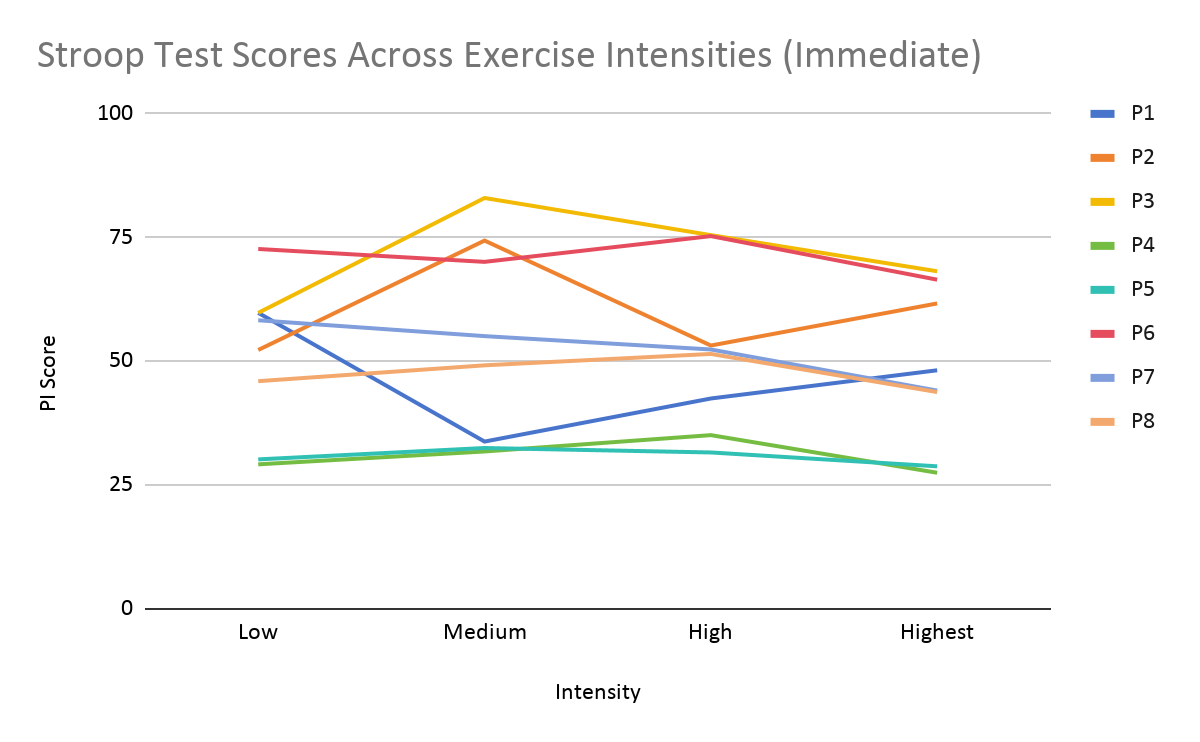
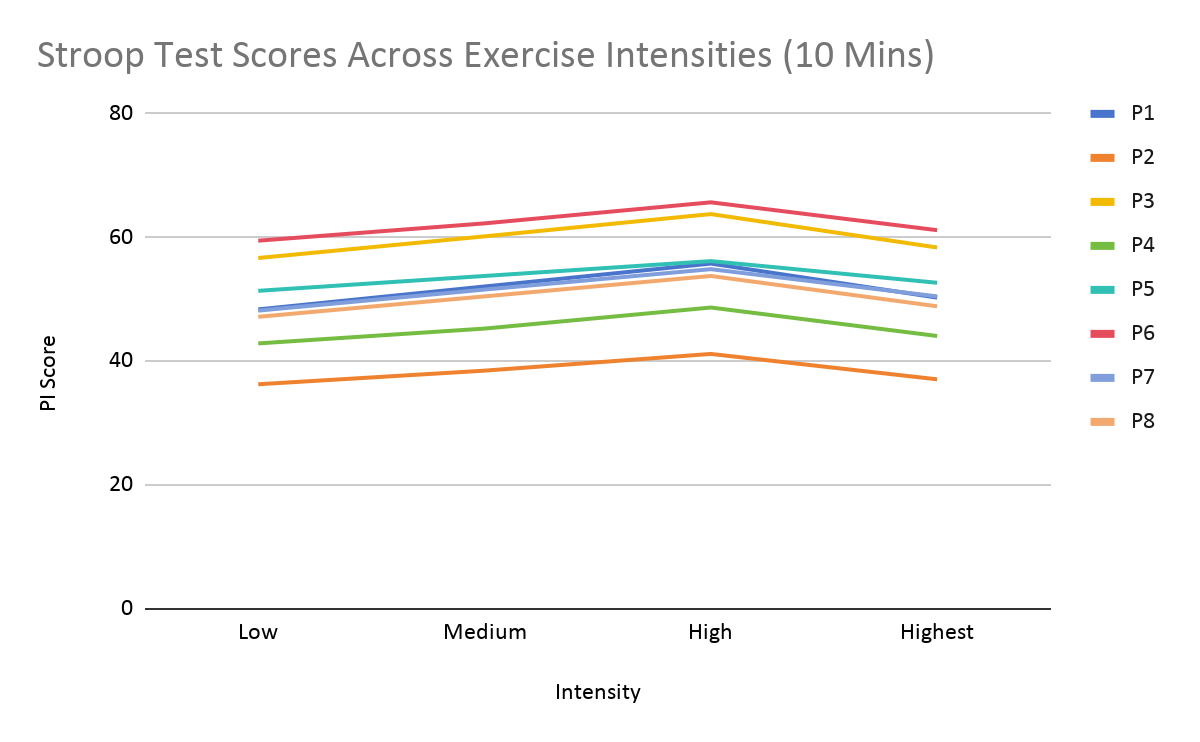
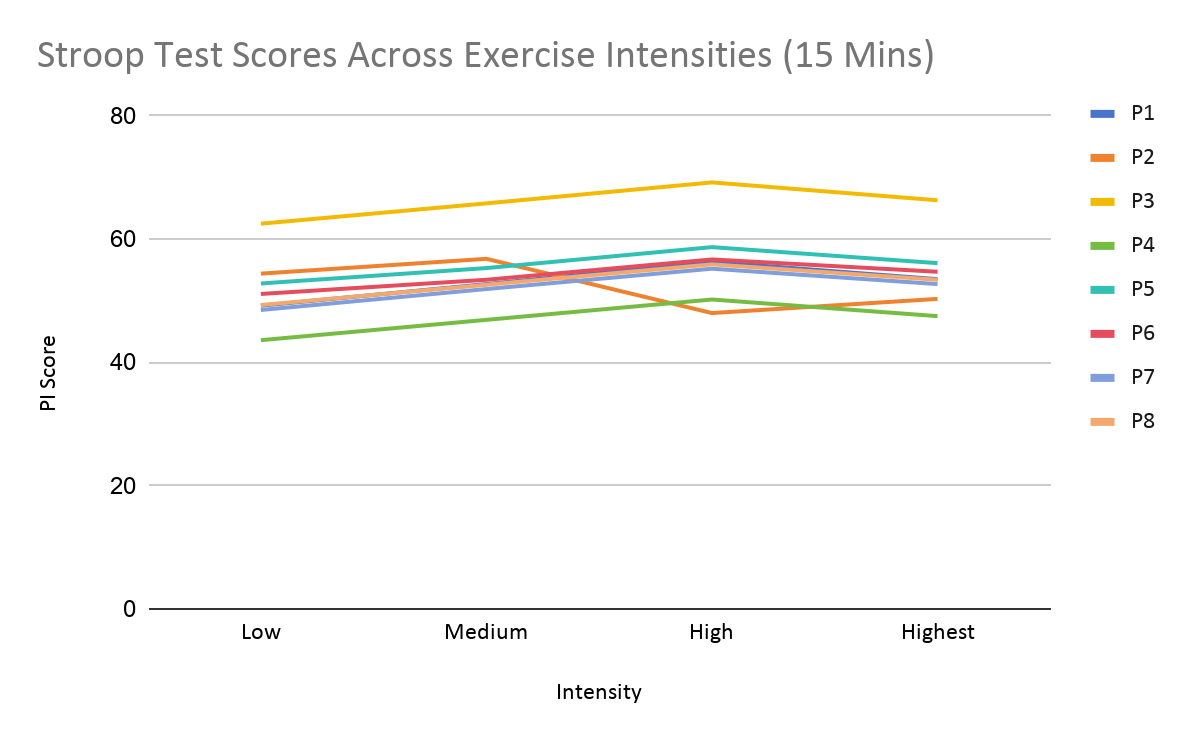
For Figure 2: Only P2, P3 and P6 show a mild inverted-U with PI peaking at Medium intensity, other participants display flat, steadily rising or sharply dipping performance curves across intensities.
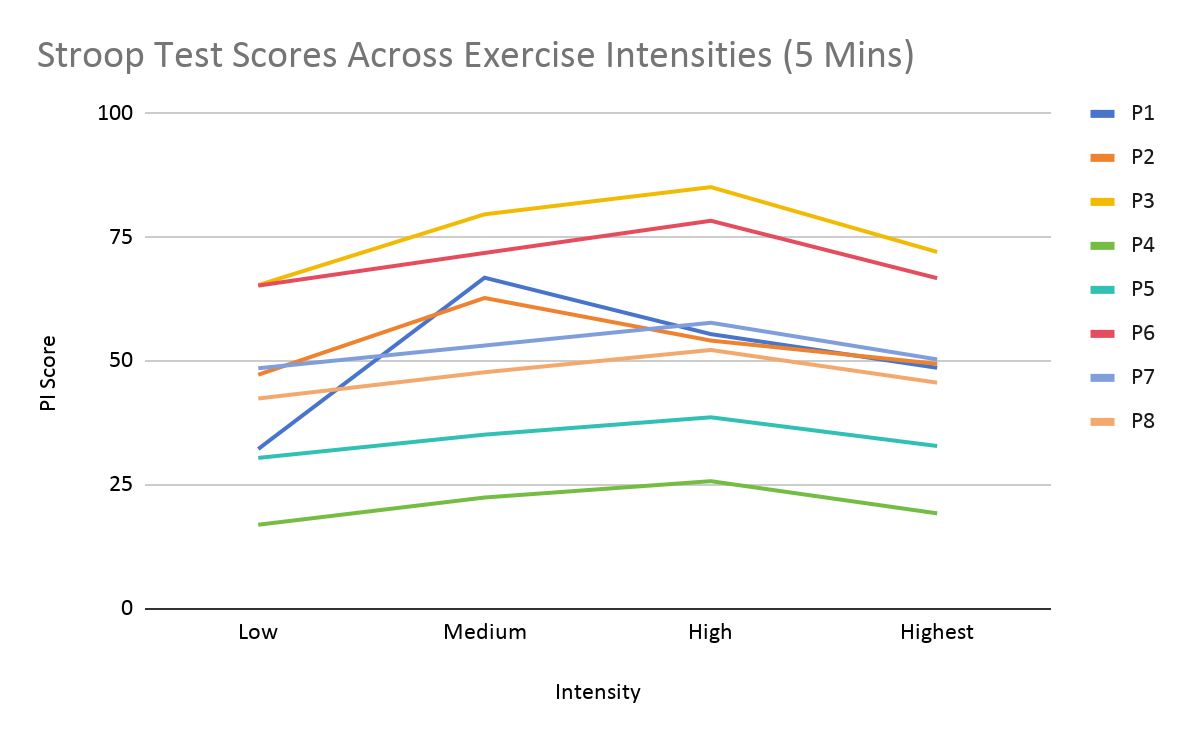
For Figure 3: For Multiple participants show mild inverted-U-shaped peaking at Medium or High intensity before falling at the highest intensity, yet peak positions and score magnitudes differ widely across individuals. P3 and P6 show prominent inverted-U curves peaking at High intensity, P1 peaks sharply at Medium intensity before falling, P2, P7, P8 display very shallow mid-intensity peaks with minor score shifts, P5 rises slowly to high intensity with almost no subsequent drop, P4 forms a low-amplitude inverted-U with the lowest overall PI values.
For Figure 4: Every participant forms a shallow inverted-U curve peaking at High intensity, with reduced score separation between subjects relative to earlier recovery timepoints. P6 and P3 maintain the highest PI values, while P2 records the lowest overall scores.
For Figure 5: P3 maintains a prominent inverted-U curve peaking at High intensity and holds the highest PI range. P1, P5, P6, P7 and P8 form shallow inverted-U with shared high-intensity peaks. While P4 shows a linear trend and irregular for P2.
A One-way Repeated Measure ANOVA using orthogonal polynomial contrasts was used to test the effect of exercise intensity on cognitive performance at five levels of intensity (Control, Light, Low, Medium, High). There was no significant effect of exercise intensity on cognitive performance since F(4, 35) = 0.30, p = 0.876. It means that there were no significant effects on cognitive performance due to different intensities of exercise. Moreover, the application of polynomial contrasts revealed that neither a linear relationship (b = 3.18, p = 0.488) nor a quadratic relationship (b = 2.99, p = 0.515) existed.
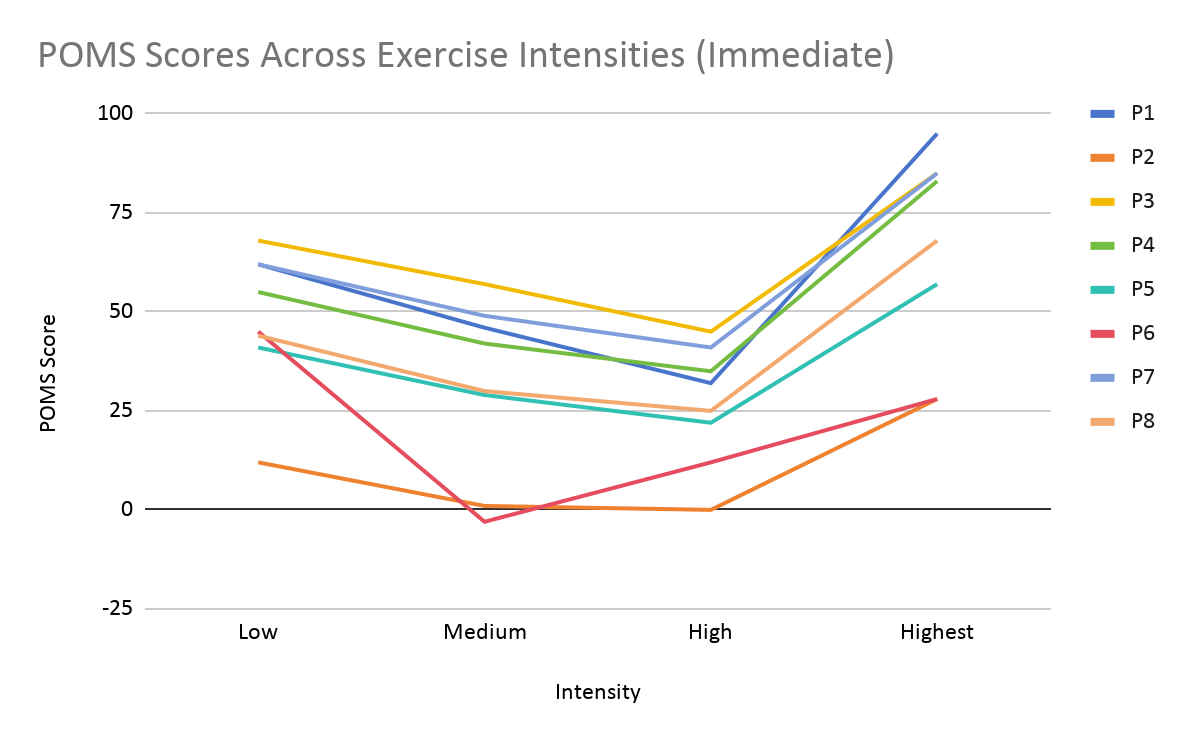
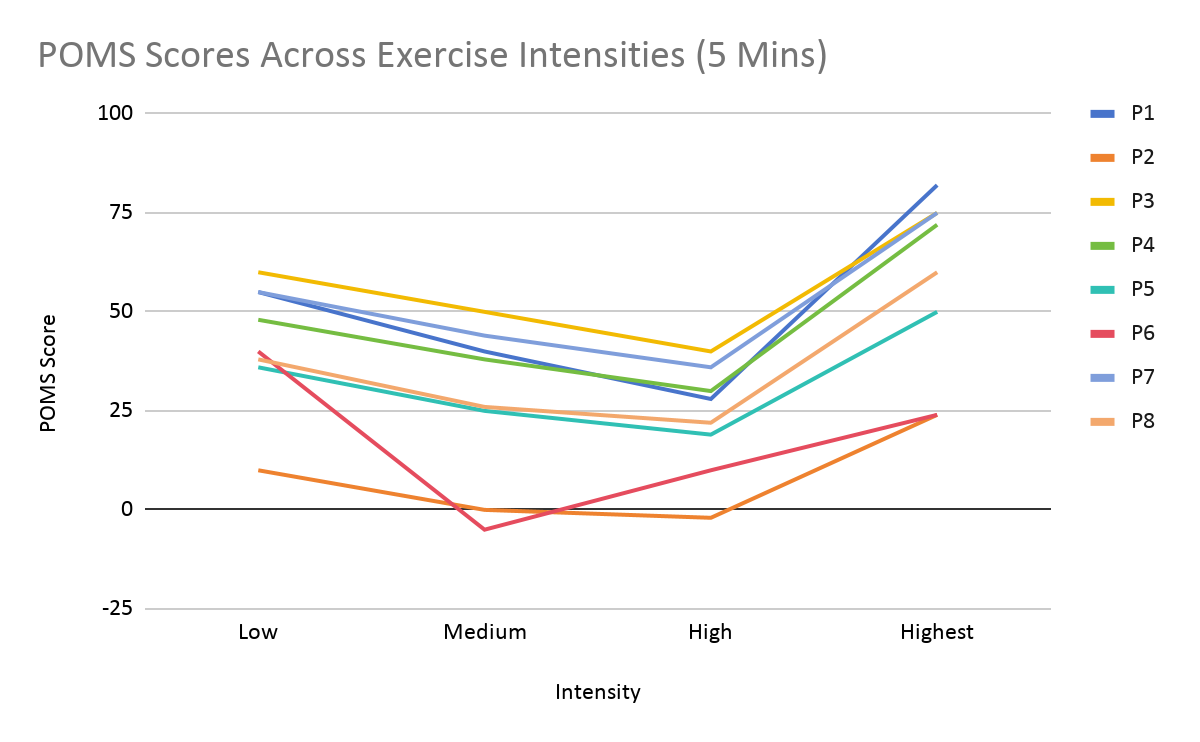
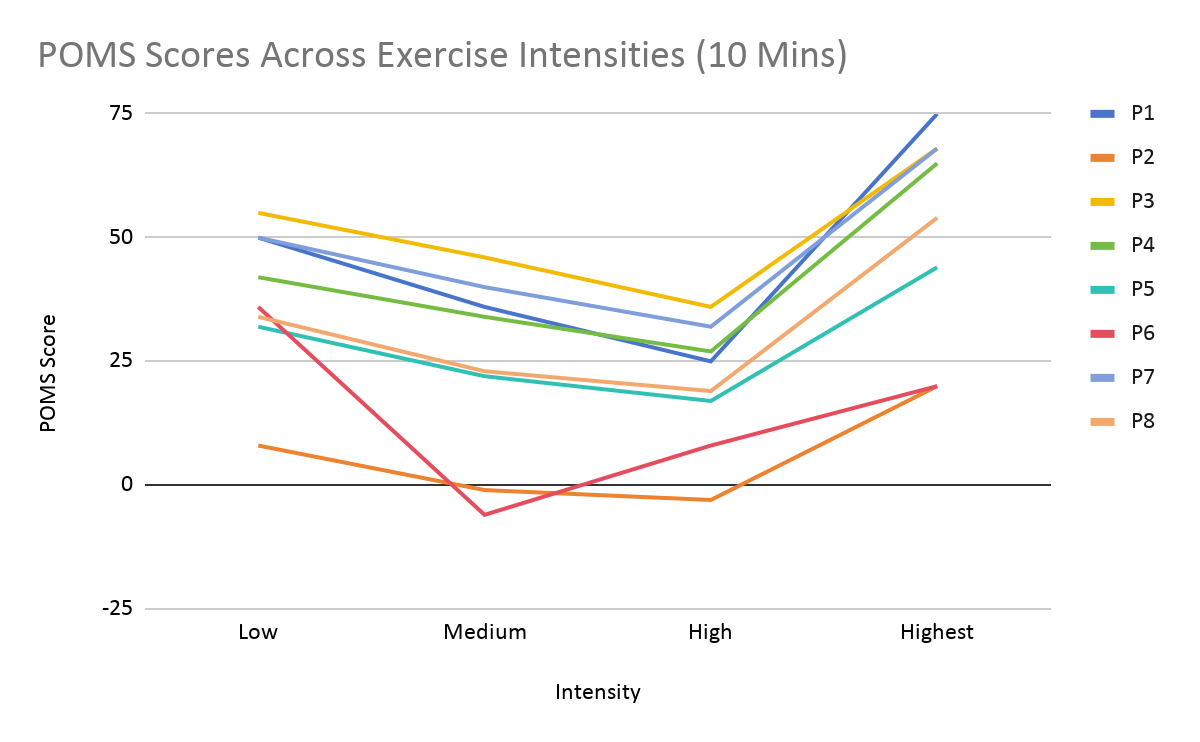
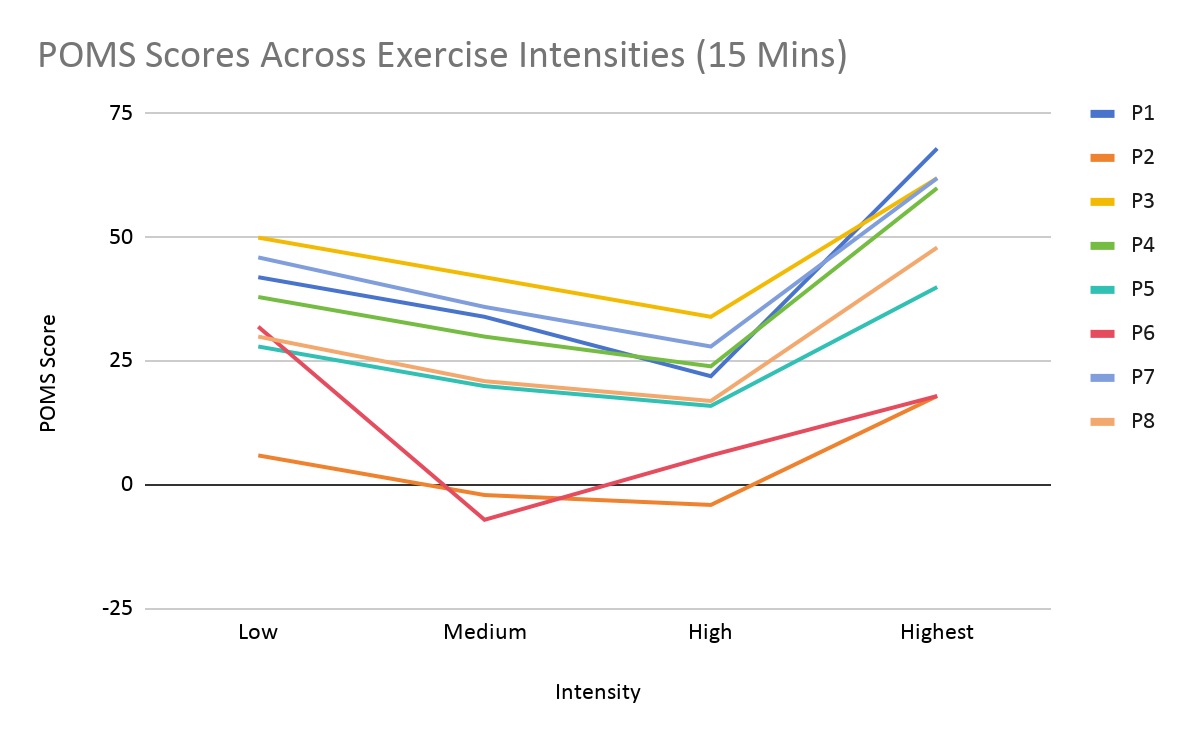
P1 exhibits the largest swing in mood disturbance magnitude, while P2 shows the flattest curve with minimal overall score change. P6’s mood minimum occurs at Medium intensity, whereas all remaining participants reach their lowest TMD at High intensity.
The study of the effects of the intensity of physical activity on the mood states (POMS score) in five different conditions (Control, Light, Low, Medium, and High) was performed using one-way repeated measures ANOVA with orthogonal polynomial contrasts. One-way ANOVA analysis showed the significant influence of the intensity of physical activity on POMS score, F(4, 35) = 3.35, p = 0.020; however, the effect size was determined mainly by variation between conditions, rather than linear relationship. Linear trend analysis did not detect linear (b = -8.48, p = 0.309) and quadratic (b = -21.11, p = 0.015) relationships. It appears that the relationship between the intensity of physical activity and POMS score is much more complicated than could have been assumed. Generally speaking, one can conclude that the intensity of physical activity significantly influences the mood states, but not in a linear manner.
Though the tests were performed right after a high-intensity activity, cognitive performance/clarity peak occurred in 10-to-15 minutes recovery period.29
Discussion
The results do not support the hypothesis statistically that cognitive performance follows an inverted-U relationship with exercise intensity. But Cognitive performance did improve during the post-exercise recovery period, particularly between 5 and 15 minutes after exercise while concurrent downward shifts in POMS mood disturbance scores were recorded following all graded brief running sessions.These findings suggest that short bouts of exercise are associated with both cognitive function and emotional state in adolescents.
Moreover, the result suggests a “window of enhancement” where the performance rebounded and often exceeded the baseline levels during the 5 to 15 minutes of the post-exercise interval, suggesting that the cognitive benefits of exercise are most accessible and evident to observe when the heart rate begins to stabilize.
Likewise, mood scales (POMS) indicated that moderate exercise is associated with the highest levels of vigor and alertness, whereas vigorous exercise temporarily increased subjective feelings of fatigue or tension.
The main significance of this study is to confirm that even just 3 minutes of exercise can significantly affect cognition and emotion in the sample of adolescents, while most existing literature has focused on exercise with considerable duration (20-60 minutes) to aim for health benefits. However, the performance indicator improved immediately after such brief training, suggesting that even the “micro-interventions” in exercise can be highly effective for a cognitive boost.
Moreover, this research has practical application in the area of education. Considering the fact that teenagers have to spend much time while studying in a sedentary position in class, one possible way of improving attention and brain activity is through the use of physical exercises. The impact seen in the enhancement window shows that brief physical exercises before difficult academic activities help enhance learning.
Theoretically, this study advances knowledge regarding the inverted U-shaped relation between arousal level and physical performance in the adolescent peer group (16-18 years old). According to our results, the optimal level of arousal is not static but variable and highly dependent on the sport experience and initial physical condition of each participant. Elite participants showed stable or increasing Stroop PI values over the entire 15-minute period after vigorous intensity, along with a significant increase in the overall number of completed test items. In turn, less experienced adolescents demonstrated a drastic decrease in the minimum Stroop PI value from 27.5 at the initial measurement point to 17.0 at the 5-minute point, as well as the persistence of relatively high POMS TMD values associated with increased fatigue and tension.
The descending part of the inverted U-shaped curve can be effectively compensated for in the high-intensity workout. This study serves as academic proof of the necessity to customize an exercise program, as the identical 3-minute running protocol within the same HRmax interval led to different results of Stroop tests and changes in mood. The vigorous intensity helped the regular exercisers perform better in the cognitive task and decreased their TMD values, whereas caused some cognitive drop and TMD increase among less experienced peers. Thus, if schools implement common exercise intensity standards for all their students, the low-fitness adolescents would not get any cognitive benefit or even have temporary cognitive fatigue, whereas the athletes could still achieve optimal arousal level.
Theoretically, this study deepens the understanding of the inverted U-shaped relationship between arousal level and sports performance among the adolescent group (aged 16-18). Our findings indicate that the optimal arousal is not fixed but dynamic and is strikingly influenced by individual sport experience and baseline physical fitness. At vigorous intensity, elite participants maintained stable or rising Stroop PI across the 15-minute recovery window, with steady growth in the total number of completed test items. In contrast, less sport-experienced adolescents exhibited a sharp decline in the minimum Stroop PI value from 27.5 immediately post-exercise to 17.0 at the 5-minute time point, paired with persistently higher POMS TMD scores that reflected greater fatigue and tension.
The downward-sloping segment of the inverted U-shaped curve can be effectively offset during high-intensity training. This provides academic evidence that exercise intervention should be individualized, identical 3-minute running protocols matched to fixed HRmax bands produced inconsistent Stroop and mood outcomes across the sample. Vigorous intensity boosted cognitive performance and lowered mood disturbance for regularly trained adolescents, yet triggered temporary cognitive drops and higher TMD scores among less active participants. If schools adopt unified exercise intensity standards for all students, low-fitness adolescents may fail to or to gain less cognitive benefits or even experience transient cognitive fatigue, while athletic students could still reach optimal arousal for executive function.
One of the core hypotheses of this study was supported by the results. In particular, the predicted post-exercise cognitive enhancement window and the positive emotional benefits of short-term exercise. However, the points regarding immediate cognitive impairment induced by vigorous exercise were not supported enough by the results, as well as the inverted U trend for the Stroop PI, it turned out to be linear instead of following the anticipated tendency.
Cognitive performance peaked at 10-15 mins post-exercise with a 5-15 min enhancement window.
This part of the hypothesis was consistently supported across all Stroop test measures, a correlated time-dependent in cognitive performance improvement was observed in 5-15 minutes post-recovery window.
Our study only focuses on the performance of adolescents aged 16-18 after exercise of varying intensities, including reaction time and mood changes. Also, the sample size is too little, this creates serious limitations. Our study did not include information on the long-term effects of exercise of different intensities, and we did not include any people with disabilities or with some cognitive impairments either. Furthermore, our data collection was insufficient, particularly regarding comparisons between different genders and physical conditions.
The prediction mentioned in the previous section indicated an inverted-U shape curve in the relation between the exercise intensity and the Stroop PI, where Stroop PI will increase at lower and moderate levels of exercise intensity, but decrease when the level reaches the vigorous range. However, this hypothesis is not supported by the results through statistical tests.
While the repeated-measure ANOVA did not find any significant effect of the intensity on Stroop PI [F(4,35)=0.30, (p=0.876)]. The quadratic polynomial contrast, which tested directly for the inverted-U effect, was not significant [(t=0.658), (p=0.515)], along with the linear trend [(t=0.701), (p=0.488)]. No non-linear association was found in all groups.
From Figure 2, 3, 4 and 5, many participants’ data did not present the predicted quadratic inverted-U curve, but flat, increasing or irregular curves.
Causes of this mismatching:
Individual differences in the inverted-U arousal curve in the Stroop test.
The relationship between inverted-U arousal and cognitive performance is affected by the variation in the physical fitness and arousal tolerance.3
And for most participants, arousal induced by short-term vigorous exercise did not exceed their individual optimal arousal threshold, this could be the reason why cognitive performance observed matches the hypothesis.
For instance, for less physically fit participants whose intensity exceeded individual capacity, we observed an isolated decline in cognitive function: the lowest PI score dropped from 27.5 immediately post-exercise to 17.0 at 5 mins, indicating that a small group of participants experienced transient cognitive impairment as predicted. Therefore, such individual differences in the inverted-U curve can result in no expected significant decrease in the group mean values.
Also, within every participant, the total range of Stroop PI variation across low to highest intensity was numerically trivial. These minor score fluctuations are indistinguishable from routine measurement noise inherent to the 1-minute Stroop task.
Unexpected findings:
Even though no hypothesis has been made about how the participants’ variability will change during and after the exercise, the data still shows that the IQR and range of values are going down for almost all indicators. During the recovery time after 15 minutes , the IQR of TMD decreased by 22.4%, the IQR of Stroop’s PI decreased by 79.1%, and the IQR of the number of questions answered reduced by 47.6%. This unexpected finding indicates that the benefits of short-term vigorous exercise were stronger in participants with poorer baseline cognitive ability or higher levels of emotional distress/obstruction.
Although our research only reflects the short-term effects of quick training sessions. There may also be long-term consequences that are not yet researched. Our research can be applied to adolescent education programs, using exercise of varying intensities to regulate adolescent performance during school. Future research could delve deeper into the long-term effects of exercise on adolescents.
Firstly, the experimental data is insufficient, especially with only two female participants and six male participants. A small sample size creates inevitable restrictions in this preliminary study. That is because few people are allowed to be randomly selected for the experiment, and the other teachers do not allow their students to take part in our experiment during the time we are testing. Thus, we were not able to get abundant experimental data. This makes it impossible to obtain a relatively accurate dataset. Our experiment also doesn’t have any data about special populations like disabled persons, and we only focus on short- to medium-term effects; long-term developmental impacts are not fully tracked.
Another limitation is that during the tests, although female participants self-reported themselves as not impacted by their menstrual cycle, this can still be subjective.30 Objective effects on cognitive and physical performance,31. Subsequent emotional changes due to decline in physical performance may still occur as a result.
Moreover, a counterbalanced test order has not been used; all participants had done thePOMS after the Stroop test. This may alter the results of POMS due tothe results of the Stroop test affecting the emotion of the participants.
Also, participants get to recover quickly from exercises; the tension and fatigue values of the POMS test could decline. This may occur during the case where participants are getting tested with POMS one minute after exercise, since they are tested with the Stroop test immediately after exercise.
This also can help adolescents to maintain consistency; lifelong health habits are better than pursuing extreme intensity. In future studies, researchers can use our data to develop a systematic approach to help teenagers activate their brains in a short period of time, such as using short activities to enhance cognitive function before exams. Teachers can also encourage children to maintain good study habits while improving their learning. This can not only help children but also potentially change teachers’ teaching methods, making them pay more attention to children’s exercise habits and prompting teachers to proactively consider how to make children participate in sports more. Moreover, this experiment helps to provide a chance for future scholars to develop therapies for patients who suffer from dysfunction of cognitive conflict.
Acknowledgement
Several people helped and guided this research to a successful conclusion. The researchers want to thank the following people from the bottom of their hearts:
Their Research Adviser(Joan Palcongan): For her guidance, technical knowledge, and close supervision during the writing of the paper and the carrying of the experiments.
Their Friends: For always being there for them and pushing them to stay on track and meet their deadlines, especially when things were tough.
Research participants: For their time and willingness to share their experiences. This study would not have been possible without their commitment and voluntary participation.
References
- L. Liu, X. Xin, Y. Zhang. The effects of physical exercise on cognitive function in adolescents: a systematic review and meta-analysis. Frontiers in Psychology. Vol. 16, Article 1556721, 2025, https://doi.org/10.3389/fpsyg.2025.1556721. [↩]
- F. Peruyero, J. Zapata, D. Pastor, E. Cervelló. The acute effects of exercise intensity on inhibitory cognitive control in adolescents. Frontiers in Psychology. Vol. 8, Article 921, 2017, https://doi.org/10.3389/fpsyg.2017.00921. [↩]
- M. Tsukamoto, T. Suga, K. Takenaka, et al. Acute moderate-intensity exercise enhances executive function and alters prefrontal cortex activation in adolescents. Frontiers in Human Neuroscience. Vol. 10, Article 607, 2016, https://doi.org/10.3389/fnhum.2016.00607. [↩] [↩]
- Y. Shen, H. Zhang, X. Li, et al. Exercise-induced changes in prefrontal cortex hemodynamics and cognitive function: a systematic review of fNIRS studies. Frontiers in Psychology. Vol. 15, 2024. https://www.frontiersin.org/journals/psychology/articles/10.3389/fpsyg.2024.1327822/full. [↩]
- T. Naito, K. Ishii, K. Oka. Hemodynamics of short-duration light-intensity physical exercise in the prefrontal cortex of children: a functional near-infrared spectroscopy study. Scientific Reports. Vol. 14, 2024, https://www.nature.com/articles/s41598-024-66598-6. [↩]
- S. T. Nieuwenhuis. Arousal and performance: revisiting the famous inverted-U-shaped curve. Trends in Cognitive Sciences. Vol. 28, No. 5, pg. 394–396, 2024, https://www.sciencedirect.com/science/article/abs/pii/S1364661324000780. [↩]
- M. J. A. McDonough, J. W. A. Holtzman, J. E. S. J. A. R. J. J. et al. Effects of acute aerobic exercise on cognition: A meta-analysis of randomized controlled trials. Psychopharmacology. Vol. 221, Issue 1, 2012, https://www.sciencedirect.com/science/article/pii/S0006899312004003. [↩] [↩]
- F. B. Alexandrino, S. N. Augusto Jr., D. Alexandrino, W. H. W. Tang. Clinical profiles to guide decongestion in acute heart failure. American Heart Journal. Vol. 281, Article 107510, 2026, https://doi.org/10.1016/j.ahj.2026.107510. [↩]
- S. Nieuwenhuis. Revisiting the inverted-U relationship between arousal and performance: a neurobiological computational framework. Trends in Cognitive Sciences. Vol. 28, pg. 879–892, 2024. https://pubmed.ncbi.nlm.nih.gov/38570252/. [↩]
- Y. Shen, H. Zhang, X. Li, et al. Exercise-induced changes in prefrontal cortex hemodynamics and cognitive function: a systematic review of fNIRS studies. Frontiers in Psychology. Vol. 15, 2024. https://www.frontiersin.org/journals/psychology/articles/10.3389/fpsyg.2024.1327822/full [↩]
- T. Wang, W. Li, J. Deng, Q. Zhang, Y. Liu. The influence of physical exercise on negative emotions in adolescents: a meta-analysis. Frontiers in Psychiatry. Vol. 15, 2024, https://www.ncbi.nlm.nih.gov/pmc/articles/PMC11588725/. [↩]
- A. Kovacevic, B. Fenesi, E. Paolucci, J. J. Heisz. The effects of aerobic exercise intensity on memory in older adults. Applied Physiology, Nutrition, and Metabolism. Vol. 45, Issue 6, pp. 591–600, 2020, https://doi.org/10.1139/apnm-2019-0495. [↩]
- L. G. Johnson, P. K. Addamo, I. S. Raj, E. Borkoles, V. Wyckelsma, E. Cyarto, R. C. Polman. An Acute Bout of Exercise Improves the Cognitive Performance of Older Adults. Journal of Aging and Physical Activity. Vol. 24, Issue 4, pp. 591–598, 2016, https://doi.org/10.1123/japa.2015-0097. [↩]
- A. Vollaard, J. Metcalfe. Applications of the 3-min all-out exercise test for prescribing high-intensity interval training: a narrative review. Sports Medicine. 2024, https://www.researchgate.net/publication/382728008_Applications_of_the_3-Min_All-Out_Exercise_Test_for_Prescribing_High-Intensity_Interval_Training_A_Narrative_Review_on_a_Decade_of_Research_Progress). [↩]
- A. Vollaard, J. Metcalfe. Applications of the 3-min all-out exercise test for prescribing high-intensity interval training: a narrative review. Sports Medicine. 2024, https://www.researchgate.net/publication/382728008_Applications_of_the_3-Min_All-Out_Exercise_Test_for_Prescribing_High-Intensity_Interval_Training_A_Narrative_Review_on_a_Decade_of_Research_Progress. [↩]
- R. Robertson, F. Goss, T. Michael, N. Moyna, P. Gordon, P. Visich, J. Kang, T. Angelopoulos, S. Dasilva, K. Metz. Validity of the Borg perceived exertion scale for use in semirecumbent ergometry during immersion in water. Perceptual and Motor Skills. Vol. 83, Issue 1, 1996, https://doi.org/10.2466/pms.1996.83.1.3. [↩]
- B. Mackenzie. Profile of mood states (POMS). https://www.brianmac.co.uk/poms.htm, 2023. [↩]
- FocusAur. Stroop effect test. https://www.focusaur.com/pages/stroop-effect-test, 2024. [↩]
- A. Vollaard, J. Metcalfe. Applications of the 3-min all-out exercise test for prescribing high-intensity interval training: a narrative review. Sports Medicine. 2024, https://www.researchgate.net/publication/382728008_Applications_of_the_3-Min_All-Out_Exercise_Test_for_Prescribing_High-Intensity_Interval_Training_A_Narrative_Review_on_a_Decade_of_Research_Progress. [↩]
- Y. Uthman, Y. George, T. Abubakar, A. A. S. Mohammed. Validity of Cooper’s 12-minute run test for estimation of maximum oxygen uptake in male university students. Biomedical Human Kinetics. Vol. 7, No. 1, 2015, https://pmc.ncbi.nlm.nih.gov/articles/PMC4314605/. [↩] [↩]
- Y. Li, H. Wang, Z. Chen. Effects of exercise intensity on cognitive performance and mood states. Journal of Cognitive Enhancement. Vol. 6, 2024, https://pmc.ncbi.nlm.nih.gov/articles/PMC11946962/. [↩] [↩] [↩]
- FocusAur. Stroop effect test. 2024, https://www.focusaur.com/pages/stroop-effect-test. [↩] [↩]
- B. Mackenzie. Profile of mood states (POMS). 2023, https://www.brianmac.co.uk/poms.htm. [↩] [↩]
- P. Whelton, R. Carey, W. Aronow, et al. 2017 guideline for the prevention, detection, evaluation, and management of high blood pressure in adults. Circulation. 2018, https://www.ahajournals.org/doi/10.1161/CIR.0000000000001356. [↩]
- S. M. Kim, F. Sultana, S. Sims, J. Gimenez-Roig, V. Laurencin, A. Pallapati, et al. Menstrual cycle and athletic status interact to influence symptoms, mood, and cognition in females. Sports Medicine – Open. Vol. 10, 2024, https://doi.org/10.1186/s40798-024-00776-8. [↩]
- S. D. Hillman, A. F. Kamijo, C. H. Pontifex, D. Kramer, K. I. Kahn, L. G. Scudder, A. A. Etnier. Effects of acute treadmill walking on cognitive control and academic achievement in preadolescent children. Medicine & Science in Sports & Exercise. Vol. 46, Issue 5, pp. 957–967, 2014, https://pmc.ncbi.nlm.nih.gov/articles/PMC3944103/. [↩]
- A. N. Lacewell, T. M. Buck, S. A. Romero, J. R. Halliwill. Post-exercise syncope: Wingate syncope test and effective countermeasure. Medicine & Science in Sports & Exercise. Vol. 46, Issue 2, pp. 351–357, 2014, https://pmc.ncbi.nlm.nih.gov/articles/PMC3947357/. [↩]
- R. Robertson, F. Goss, T. Michael, N. Moyna, P. Gordon, P. Visich, J. Kang, T. Angelopoulos, S. Dasilva, K. Metz. Validity of the Borg perceived exertion scale for use in semirecumbent ergometry during immersion in water. Perceptual and Motor Skills. Vol. 83, Issue 1, 1996, https://doi.org/10.2466/pms.1996.83.1.3. [↩]
- Y. Li, H. Wang, Z. Chen. Effects of exercise intensity on cognitive performance and mood states. *Journal of Cognitive Enhancement*. Vol. 6, 2024, [https://pmc.ncbi.nlm.nih.gov/articles/PMC11946962/](https://pmc.ncbi.nlm.nih.gov/articles/PMC11946962/). [↩]
- F. Ronca, J. M. Blodgett, G. Bruinvels, M. Lowery, M. Raviraj, G. Sandhar, N. Symeonides, C. Jones, M. Loosemore, P. W. Burgess. Attentional, anticipatory and spatial cognition fluctuate throughout the menstrual cycle: Potential implications for female sport. Neuropsychologia. Vol. 206, Article 108909, 2025, https://www.sciencedirect.com/science/article/pii/S0028393224001246. [↩]
- T. Naito, K. Ishii, K. Oka. Hemodynamics of short-duration light-intensity physical exercise in the prefrontal cortex of children: a functional near-infrared spectroscopy study. Scientific Reports. Vol. 14, 2024, https://www.nature.com/articles/s41598-024-66598-6 [↩]