
Abstract
Background/Objective: Vitamin D, a secosteroid hormone, contributes to skeletal muscle function through its binding to vitamin D receptors (VDRs). Despite this, the literature on vitamin D supplementation’s effect on muscle strength and recovery remains inconsistent. This review investigates whether baseline 25-hydroxyvitamin D (25(OH)D) status is the primary determinant of supplementation effect and identifies methodological assumptions that may explain the inconsistencies.
Methods: This systematic review, employing narrative synthesis, searched MEDLINE and the Cochrane Library. Of 1,175 records identified, 909 remained after deduplication, and 27 met inclusion criteria. Results were stratified by baseline 25(OH)D status into three deficiency categories. Methodological quality was appraised narratively.
Results: Of 27 primary RCTs, 10 reported a significant between-group improvement in a muscle outcome, 5 a significant adverse effect and 12 no significant difference. Improvements occurred in deficient or insufficient (7), replete (2) and mixed-baseline (1) cohorts, and adverse effects in deficient or insufficient (4) and replete (1) cohorts, so benefit was not confined to deficient populations. Only three trials tested a baseline-by-treatment interaction. Three methodological flaws were identified: prescribing dosage independent of baseline deficit, pooling of biologically heterogeneous recovery biomarkers, and age-indiscriminate application of sufficiency thresholds.
Conclusions: These findings are compatible with, but do not establish, the hypothesis that supplementation benefits rely on correcting a baseline deficit rather than enhancing performance universally. Trials stratified by baseline status are needed before targeted dosing is recommended. Findings reflect single-reviewer screening and extraction.
Keywords: vitamin D supplementation, skeletal muscle, 25-hydroxyvitamin D, muscle recovery, deficiency, VDR, sarcopenia, systematic review.
Introduction
The regulation of healthy, efficacious muscle function is the underlying fundamental behind human mobility, physical independence and athletic performance at any level. Global analyses show that, due to rising inactivity levels, there has been a major policy-driven push to increase physical activity, showing the increasing clinical relevance of musculoskeletal health1.
When considering the widespread deficiency, even in developed countries, as well as its hypothesised role in muscle strengthening and inhibiting exercise-induced damage, the issue as to whether the supplementation of vitamin D improves muscle function and recovery is of growing physiological and biomedical relevance.
Vitamin D must first undergo dual enzymatic conversions before it may become biologically active in the body. The first is undergone in the liver, where it is hydroxylated to form 25-hydroxyvitamin D [25(OH)D], then it is converted in the kidneys into 1,25-dihydroxyvitamin D [1,25(OH)₂D], calcitriol, the active hormone form of vitamin D. Calcitriol then binds to vitamin D receptors (VDRs), which can be found in a variety of tissues, proposedly including skeletal muscle, though this remains contested2. Here, it influences how the genes involved in muscle regeneration and mitochondrial function are expressed3.
However, the literature on vitamin D’s effects is not unanimous. A variety of studies, often those involving individuals who were not deficient in vitamin D, have reported null results. This raises questions about its true efficacy, particularly among varying demographics. Issues arise within dosing regimens, the durations of trials, and the unit or measure of outcome between different studies. A variety of factors further complicate the evidence base, most significantly baseline 25(OH)D levels, age, ethnicity and genetic variation in VDR expression. This review addresses a specific gap: the field lacks a conclusive systematic account of whether baseline 25(OH)D status is the primary moderator of supplementation response and has not explicitly examined the methodological assumptions that may explain why effect sizes vary so substantially across studies. Despite earlier reviews suggesting that baseline 25(OH)D status may moderate supplementation response, this has not been examined separately by outcome domain in primary trials. Finally, the review considers what the evidence implies for future trial design and for whom supplementation might be warranted if the baseline-dependence hypothesis is confirmed.
Prior attempts to synthesise this literature have reached varying conclusions using similar evidence bases, with several pointing to baseline status as a possible moderator. Beaudart et al.4 (2014) pooled trials across mixed populations and reported a significant benefit for global muscle strength, whereas Stockton et al.5 (2011), analysing an overlapping set of trials, found no significant effect in adults with baseline 25(OH)D above 25 nmol/L, and a large effect on strength in two studies of deficient adults. Farrokhyar et al.6 (2017), focusing specifically on athletes, found no significant overall benefit despite stratifying analyses by baseline vitamin D status. Likewise, Sist et al.7 (2023) found no significant effect on maximal strength or power in 436 athletes, including in athletes with baseline 25(OH)D below 75 nmol/L. Rosendahl-Riise et al.8 (2017), reviewing older adults specifically, similarly found inconsistent results and found that heterogeneity in handgrip strength was eliminated after excluding studies involving vitamin-D-deficient participants, a finding consistent with this review’s approach of stratifying by baseline vitamin D status. The divergence among reviews covering similar trials suggests that the inconsistency may partly lie in analytic choices rather than in the primary evidence itself. Even clinical guidelines are disagreed upon, with the Endocrine Society’s 2011 guidelines9 defining sufficiency as 25(OH)D ≥75 nmol/L, and the Institute of Medicine10 at ≥50 nmol/L. Trials conducted under these differing frameworks may classify the same participant as deficient under one guideline and sufficient under another, independently contributing to the inconsistent findings this review investigates.
Determining the conditions under which vitamin D supplementation is and is not effective has far-reaching and directly relevant applications in clinical and sports science practice. This review examines whether baseline 25(OH)D status helps identify who is likely to benefit from supplementation and evaluates methodological features that may sway estimates of the supplementation effect.
This review is focused solely on human studies reporting quantitative outcomes on skeletal muscle strength, function or recovery in response to exogenous vitamin D supplementation. The review is restricted to English-language publications and does not perform statistical pooling on account of the heterogeneity of included studies; findings are synthesised narratively. This review addresses the following question: does baseline 25(OH)D status determine whether vitamin D supplementation improves skeletal muscle strength and recovery in adults? In addressing it, the review has two objectives: (1) to establish whether the muscular effects of supplementation are contingent on baseline 25(OH)D status; and (2) to identify methodological features of the existing literature that may systematically bias estimates of the supplementation effect.
To address these objectives, a deficiency-stratified systematic review was conducted across MEDLINE and the Cochrane Library, with studies grouped by baseline 25(OH)D status to test whether deficiency is the primary moderator of response to exogenous vitamin D supplementation. Full methodological details are provided in the Methods section.
Methods
In investigating whether vitamin D supplementation significantly impacts muscle function and recovery, this review employed a systematic search and narrative synthesis of literature, drawing upon clinical trials, peer-reviewed human studies and using meta-analyses as context, all of which were published between 2000 and 2025 to ensure currency and relevance of the evidence base. Randomised controlled trials (RCTs) comprise the evidence base as they provide the highest quality sources of evidence. As this review is based solely on published literature and did not involve human participants directly, no ethical approval was required.
A systematic search of MEDLINE (via PubMed), 2 February 2026 and 1 October 2026, and the Cochrane Library, 1 February 2026 and 1 October 2026, was conducted. Search terms for MEDLINE included:
(“vitamin D”[Title/Abstract] OR “cholecalciferol”[Title/Abstract] OR “25-hydroxyvitamin D”[Title/Abstract] OR “25(OH)D”[Title/Abstract]) AND (“muscle strength”[Title/Abstract] OR “muscle recovery”[Title/Abstract] OR “skeletal muscle”[Title/Abstract] OR “muscle function”[Title/Abstract]) AND (“supplementation”[Title/Abstract] OR “supplement”[Title/Abstract])
Search terms for the Cochrane Library included:
(“vitamin D” OR cholecalciferol OR “25-hydroxyvitamin D”) AND (“muscle strength” OR “muscle recovery” OR “skeletal muscle” OR “muscle function”) AND (supplementation OR supplement)
Filters: Humans; English language; publication date 2000–2025. This yielded 561 results for MEDLINE and 614 for the Cochrane Library, hence 1,175 records across databases. After removal of 266 duplicates, 909 records were screened by title and abstract, of which 79 were assessed at full text. Twenty-seven studies met all inclusion criteria and were hence included in the review.
Studies were included if they: (1) involved adult human participants (≥18 years); (2) reported quantitative outcomes on skeletal muscle strength, power, function, structure or recovery following vitamin D supplementation, including biomarkers of muscle damage; (3) reported baseline 25(OH)D status, either as a measured concentration or, where concentrations were not given, as a defined category or threshold; (4) explicitly reported supplementation dosage and duration; (5) were published in peer-reviewed journals, and (6) were not co-administered with other nutrients (often calcium) without clear disaggregation in results. Animal studies, paediatric studies, in vitro studies, and trials in which vitamin D was co-administered with other active nutrients without statistical disaggregation of their individual effects were systematically excluded.
Screening was conducted primarily by a single reviewer using Rayyan (Rayyan Systems Inc.). Titles were screened for all records; abstracts, where available (Cochrane Library records), were also reviewed at this stage. To assess reliability, a second reviewer independently screened a random sample of 100 of the 909 deduplicated records (11.0%) against the eligibility criteria above, without access to the primary reviewer’s decisions. Agreement between reviewers was 98 of 100 records (98%); the two disagreements were resolved by discussion. The remaining records were screened by the primary reviewer alone. Only primary RCTs were included in the outcome synthesis and significance count; meta-analyses and narrative or mechanistic reviews are used for interpretive context only and are identified as such each time they are mentioned.
Data were extracted from each study independently. This followed a consistent, standardised extraction template of recording study design, sample size (n), population demographics studied (age, sex, athletic status), mean baseline 25(OH)D concentration (nmol/L), supplementation form (D₂ or D₃), dose (international units [IU]/day or equivalent), duration (weeks), primary outcome measure(s), and key quantitative findings including effect sizes and confidence intervals. Where studies reported multiple outcome measures, all were extracted and categorised by biological domain: strength outcomes (maximal force, grip strength, jump performance), functional/coordination tasks (Timed Up and Go [TUG], chair rise) and biomarkers of muscle damage (creatine kinase [CK], myoglobin). Where 25(OH)D concentrations were reported in ng/mL, values were converted to nmol/L using the standard factor of 2.496 to enable comparison across studies. Included studies were stratified by participant baseline 25(OH)D status into three categories: deficient (<50 nmol/L), insufficient (50-75 nmol/L), and sufficient (>75 nmol/L), following established clinical thresholds9. Effect sizes are reported as standardised mean differences (SMDs) with 95% confidence intervals (CIs) where available in the original studies. Results are presented separately for maximal strength and power, functional/coordination tasks, and muscle damage biomarkers to reflect the biological distinction between these domains.
Meta-analytic pooling was not undertaken. The primary RCT evidence base comprised 27 studies distributed across three outcome domains (maximal strength and force, n=21; functional/coordination tasks, n=11; biomarkers, n=7), with many trials contributing to more than one domain. While techniques such as random-effects modelling and meta-regression are designed to accommodate heterogeneity, they generally require at least 8-10 studies per domain to produce reliable quantitative results. Although the strength and functional domains each contain more than 10 trials, the studies within each domain are not homogeneous: within each domain, trials measured different outcomes (for example, grip strength, knee extension, and isometric force within maximal strength), in different populations and at different baseline 25(OH)D concentrations, so the number of studies comparable enough to pool for any single outcome within any single stratum falls well below this threshold. Formal pooling would therefore risk producing falsely precise estimates rather than resolving genuine uncertainty. This led to the decision to employ narrative synthesis. Given this within-domain heterogeneity, narrative synthesis also allows differences in population, dosing, and protocol to be examined explicitly, rather than collapsed into a single pooled estimate that could obscure the very sources of variation most relevant to interpreting these findings. To address potential overlap, only primary RCTs were counted in the outcome synthesis. Meta-analyses were used for context only, so no trial contributes twice to a count. Some included trials are also pooled in the cited meta-analyses (for example Nieman11, Todd12 and Close13 in Sist et al.7, and Bislev 201814 and Mason15 in Bislev et al.16, and a meta-analysis is therefore not presented as independent confirmation of a trial it contains.
This review structurally addressed heterogeneity through stratification by baseline 25(OH)D status, which is the variable most plausibly responsible for inconsistent effects across the literature. Findings were further separated by outcome domain (maximal strength and force, functional/coordination tasks, biomarkers), preventing heterogeneous outcome types from being averaged into a single undifferentiated result. Differences in study design and quality relevant to interpreting individual findings are noted alongside each study in the Results. Each trial was assigned to a stratum using its mean baseline 25(OH)D. Trials that reported participants in more than one stratum, with outcomes reported only at group level (Barker et al.17, Todd et al.12, were classed as mixed-status and not assigned to a single stratum. Attention was given to sample size and statistical power, the adequacy of randomisation and blinding where reported, the completeness of baseline 25(OH)D reporting, the representativeness of the study population, and whether supplementation dose and duration were sufficient to correct the deficit under investigation. As no formal meta-analysis was undertaken, methods for exploring heterogeneity, sensitivity analysis, and quantitative reporting-bias assessment were not applicable.
Results
Study characteristics and quality assessment
Findings are reported by outcome domain rather than by study, in line with the biological domain categories defined in Methods: maximal strength and force, functional/coordination tasks, and biomarkers of muscle damage. These domains place focus on the specific neuromuscular or structural adaptations of different physiological processes that do not necessarily respond uniformly to supplementation. Reporting them separately avoids implying that improvement in one domain is generalisable to another, as well as allowing for null or adverse findings in one domain to be recognised and analysed independently rather than being diluted by other positive findings in the same study.
Assay methods varied across the included trials. Houston et al.18 measured 25(OH)D using an immunochemiluminometric assay for screening, with stored samples subsequently analysed by liquid chromatography–tandem mass spectrometry (LC-MS/MS), whereas Nieman et al.11 and Bislev et al.14 used LC-MS/MS. Cut-offs also differed from this review’s 50 and 75 nmol/L thresholds: Nieman et al.11 defined vitamin D deficiency as ≤20 ng/mL and insufficiency as 21–29 ng/mL, while Houston et al.18 enrolled participants with 25(OH)D concentrations of 18 to <30 ng/mL (45 to <75 nmol/L), spanning the deficient and insufficient categories according to the limits operationalised in this review. Because assays differ in calibration and limits differ between trials, participants classed as deficient or sufficient in one trial are not strictly equivalent to those in another, so the strata should be read as approximate. Future trials should use assay-harmonised 25(OH)D measurement and consistent limits. This reflects the primary literature rather than the stratification method itself and is discussed further in the Discussion section.
Twenty-seven primary randomised controlled trials met inclusion criteria and form the evidence base for the synthesis (Table 1); meta-analyses and narrative or mechanistic reviews are cited for interpretive context only. The included studies vary substantially in methodological strength. Barker et al.17 is limited by a small cohort (n=28) spanning all three baseline strata, restricting statistical power and precluding subgroup analysis. Nieman et al.11 draws on a narrow and unrepresentative occupational population (NASCAR pit crew athletes). Houston et al.18 is a well-conducted 12-month double-blind RCT. Among the meta-analyses cited as context, Bislev et al.16 is the most robust: it pools 54 RCTs and 8,747 participants with comprehensive reporting, and its principal outcomes show minimal between-study heterogeneity. Tomlinson et al.19 and Zhang et al.20 are smaller, with Tomlinson19 failing to examine baseline 25(OH)D as a moderator in meta-regression – a limitation directly relevant to this review’s central hypothesis.
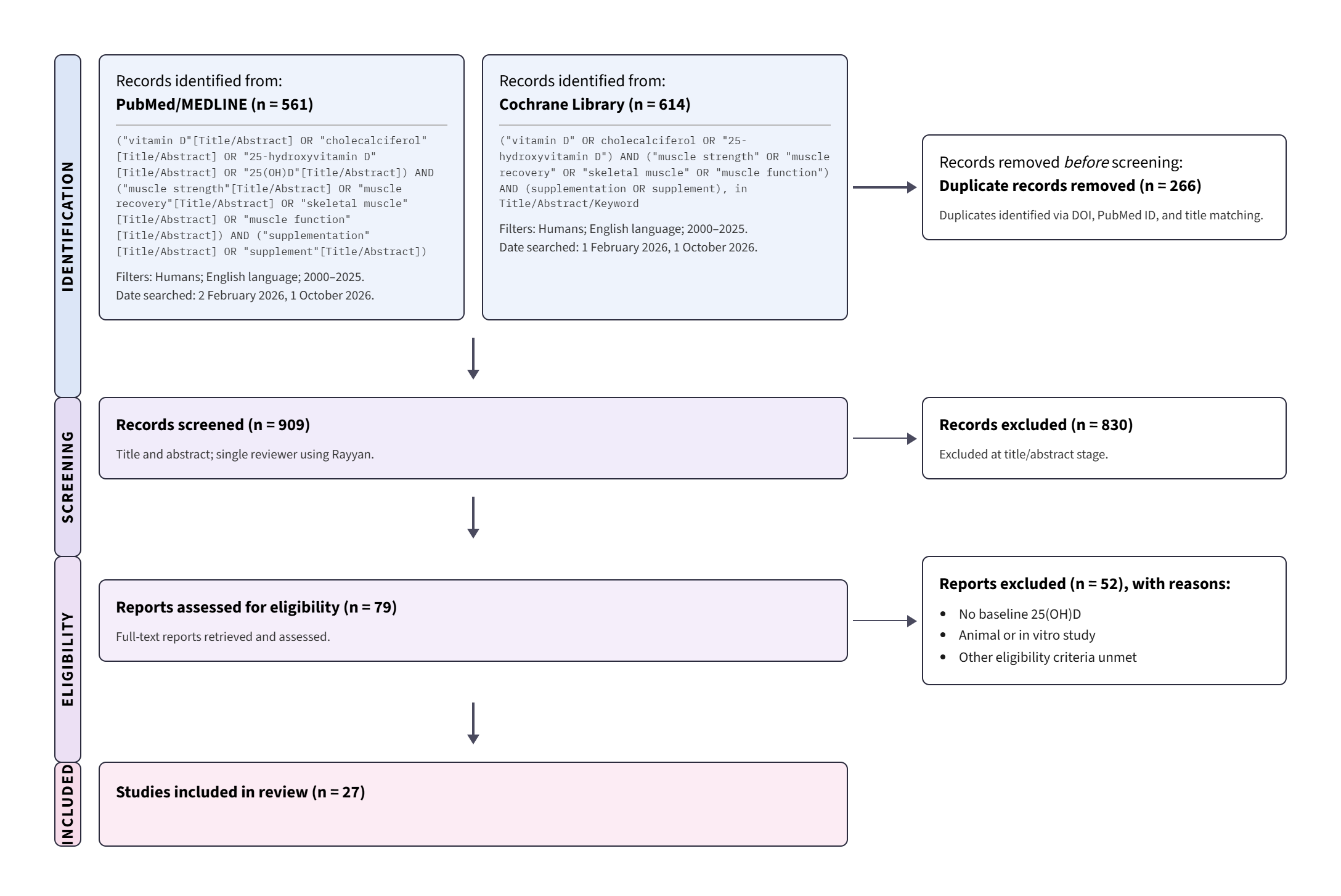
Of the 79 records assessed at full text, 52 were excluded, predominantly for lacking a clearly reported baseline 25(OH)D concentration or for co-administering vitamin D with other nutrients without statistically disaggregated results – criteria that could only reasonably be confirmed by reading each study’s full methods and results. The full record selection process is shown in Figure 1.
| Study | n | Baseline 25(OH)D | Vitamin D dose | 25(OH)D response | Muscle/function outcome | Treatment effect |
| Maximal strength/force | ||||||
| Barker et al. (2013)17 | 28 | 76.1 ± 23.5 vs 77.4 ± 20.5 nmol/L | 4,000 IU/d, 35 d | ↑ ~70% | Recovery of peak isometric force | significant increase ~8% at 24 h, P<0.05 against placebo |
| Nieman et al. (2014)11 | 28 | 98.8 ± 4.0 intervention, 109.1 ± 6.7 nmol/L placebo | 3,800 IU/d, 6 wk | ↑ D2 456%; ↓ D3 21% | Leg-back; handgrip; bench press; vertical jump; Wingate | null |
| Houston et al. (2023)18 | 136 | 48.4 ± 10.5 vs 49.7 ± 12.2 nmol/L | 2,000 IU/d, 12 mo | ↑ 71.4 ± 16.7 vs 50.4 ± 12.5 nmol/L; P<0.0001 | Leg power; leg/grip strength | null |
| Owens et al. (2014)22 | 29 | 41 ± 20 vs 40 ± 17 nmol/L | 10,000 IU/d, 3 mo | ↑ to 150 ± 31 nmol/L | Isokinetic strength; electrically evoked contraction | null |
| Alimoradi et al. (2019)23 | 70 | ~68.6 ± 44.7 vs 60.9 ± 31.7 nmol/L | 50,000 IU/wk, 8 wk | ↑ 43.2 ± 42.2 vs −7.7 ± 21.0 nmol/L, P<0.001 | Leg press | significant increase, P=0.034 |
| Rockwell et al. (2020)24 | 19 | Optimal/sufficient | 5,000 IU/d, 12 wk | ↑ 8% vs ↓44% | Deadlift; bench press; squat; jump | significant increase deadlift, P<0.01; significant increase vertical jump, P<0.01 |
| Todd et al. (2017)12 | 42 | 50% insufficient; 22% deficient | 3,000 IU/d, 12 wk | ↑ 36.31 ± 32.34 vs 6.11 ± 23.93 nmol/L, P=0.006 | Handgrip; vertical jump | null |
| Jung et al. (2018)25 | 35 | 28.8 ± 1.1 nmol/L | 5,000 IU/d, 4 wk | ↑ to 96.0 ± 3.77 nmol/L, P<0.001 | Knee extension; Wingate peak power | significant increase knee extension, P=0.019; significant increase peak power, P=0.010 |
| Bislev et al. (2018)14 | 81 | <50 nmol/L | 2,800 IU/d, 3 mo | ↑ 230%, P<0.001 | Handgrip; knee-flexion strength | significant decrease handgrip 9%, P<0.01; significant decrease knee-flexion 13%, P=0.02 |
| Suebthawinkul et al. (2018)26 | 88 | <49.9 nmol/L | 40,000 IU/wk, 12 wk | ↑; 70% achieved sufficiency | Muscle strength; muscle CSA | null |
| Ceglia et al. (2013)27 | 21 | 46.3 ± 9.5 nmol/L | 4,000 IU/d, 4 mo | ↑ to 80.0 ± 11.5 vs 52.5 ± 17.1 nmol/L at 4 mo, P<0.001 | Muscle-fibre CSA; VDR | significant increase VDR ~30%, P=0.03; significant increase CSA ~10%, P=0.048 |
| Grove-Laugesen et al. (2020)28 | 86 | 60 nmol/L | 2,800 IU/d, 9 mo | ↑ to 106 vs 49 nmol/L | Knee-extension strength | significant decrease gain by 24%, P=0.04 |
| Mason et al. (2016)15 | 218 | 53.4 ± 15.2 nmol/L | 2,000 IU/d, 12 mo | ↑ 33.9 vs −3.2 nmol/L, P<0.0001 | Leg/upper-body strength | significant decrease leg strength, P=0.03 |
| Knutsen et al. (2014)29 | 251 | 27 nmol/L | 400/1,000 IU/d, 16 wk | ↑ 43/52 nmol/L | Handgrip; jump height | null |
| Vaes et al. (2018)30 | 78 | 37.7 (35.4–39.9) nmol/L | 10/20 µg/d, 6 mo | ↑ to 98.7/72.0 vs 47.5 nmol/L | Knee-extension; knee-flexion; handgrip | null; Pinteraction=0.74 |
| Grimnes et al. (2019)31 | 417 | 32.6 ± 11.1 vs 35.1 ± 13.6 nmol/L | 100,000 IU loading + 20,000 IU/wk, 4 mo | ↑ to 88.8 ± 19.4 nmol/L, P<0.01 | Hip; biceps; pectoral; handgrip | null |
| Rips et al. (2022)32 | 53 | 47.2 nmol/L Vitamin D, 49.8 nmol/L control | 1,200 IU/d, 7 mo | 53.6 vs 29.9 nmol/L | Handgrip | null |
| Chou et al. (2024)33 | 1,054 | 68.9 ± 22.0 Vitamin D vs 71.6 ± 23.2 nmol/L control | 2,000 IU/d, 2 y | 99.8 ± 1.0 nmol/L Vitamin D | Grip strength | null |
| Close et al. (2013) (BJSM)13 | 30 | 51 ± 24 nmol/L overall | 20,000 or 40,000 IU D₃ /wk for 12 wk | 85 ± 10 nmol/L vs 91 ± 24 nmol/L. Placebo: 41 ± 22 nmol/L. | 1-RM bench press, 1-RM leg press, vertical jump height | null |
| Wyon et al. (2016)34 | 22 | insufficient | Single 150,000 IU vitamin D₃ dose | ↑ 34% in serum 25(OH)D₃, P ≤ 0.001 | Isokinetic concentric quadriceps and hamstring force (30 and 200°/s) | 13% muscle strength increase (p = 0.01) |
| Owens et al. (2015)35 | 20 | 45 ± 25 vs 45 ± 15 nmol/L | 4,000 IU/d D₃, 6 wk | ↑ to 115 ± 31 vs ↓ to 33 ± 13 nmol/L, P<0.005 | Recovery of isokinetic knee-extensor peak torque (60 and 180°/s) after 200 eccentric contractions | significant increase torque recovery: 14% at 48 h, P=0.042; 13.7% at 7 d, P=0.001 (group × time × week interaction P=0.049) |
| Functional / coordination tasks | ||||||
| Houston et al. (2023)18 | 136 | 48.4 ± 10.5 vs 49.7 ± 12.2 nmol/L | 2,000 IU/d, 12 mo | ↑ 71.4 ± 16.7 vs 50.4 ± 12.5 nmol/L; P<0.0001 | SPPB; TUG; postural sway; gait velocity | null |
| Todd et al. (2017)12 | 42 | 50% insufficient; 22% deficient | 3,000 IU/d, 12 wk | ↑ 36.31 ± 32.34 vs 6.11 ± 23.93 nmol/L, P=0.006 | VO₂max; vertical jump | null |
| Jung et al. (2018)25 | 35 | 28.8 ± 1.1 nmol/L | 5,000 IU/d, 4 wk | ↑ to 96.0 ± 3.77 nmol/L, P<0.001 | Agility; sit-ups; 20-m pacer | null |
| Bislev et al. (2018)14 | 81 | <50 nmol/L | 2,800 IU/d, 3 mo | ↑ 230%, P<0.001 | TUG; postural stability | significant increase TUG time 4.4%, P<0.05 |
| Suebthawinkul et al. (2018)26 | 88 | <49.9 nmol/L | 40,000 IU/wk, 12 wk | ↑; 70% achieved sufficiency | Muscle CSA | null |
| Knutsen et al. (2014)29 | 251 | 27 nmol/L | 400/1,000 IU/d, 16 wk | ↑ 43/52 nmol/L | Chair-rise | null |
| Vaes et al. (2018)30 | 78 | 37.7 (35.4–39.9) nmol/L | 10/20 µg/d, 6 mo | ↑ to 98.7/72.0 vs 47.5 nmol/L | SPPB; TUG; postural sway | null |
| Guralnik et al. (2022)36 | 688 | 55.2 ± 12.7 nmol/L | ≥1,000 vs 200 IU/d, ≤2 y | 84.9 Vitamin D vs 67.4 nmol/L control | SPPB; TUG; 6-min walk; gait speed | null |
| Bischoff-Ferrari et al. (2016)37 | 200 | 46.7 ± 24.5 nmol/L, 52.2 ± 23.0 nmol/L, 45.9 ± 19.0 nmol/L | 24,000/60,000/24,000 IU + 300 µg Calcifediol/mo; 12 mo | +29.2 nmol/L (95% CI: 24.0 to 34.4), +47.9 nmol/L (95% CI: 42.7 to 53.4), +64.4 nmol/L (95% CI: 58.9 to 69.6) | Functional decline | null |
| Close et al. (2013) (J Sports Sci)38 | 10 | 29 ± 25 vs 53 ± 29 nmol/L | 5,000 IU/d, 8 wk | ↑ 29→103 ± 25 nmol/L, P=0.0028 | 10-m sprint; vertical jump | Significant improvement in 10 m sprint times (P = 0.008) and vertical-jump (P = 0.008) |
| Chou et al. (2024)33 | 1,054 | 68.9 ± 22.0 Vitamin D vs 71.6 ± 23.2 nmol/L control | 2,000 IU/d, 2 y | 99.8 ± 1.0 nmol/L Vitamin D | Walking speed; balance; chair stands; SPPB; TUG | null; TUG worsened (interaction p=0.04) |
| Biomarkers | ||||||
| Study | n | Baseline 25(OH)D | Vitamin D dose | 25(OH)D response | Biomarker outcome | Treatment effect |
| Barker et al. (2013)17 | 28 | 76.1 ± 23.5 vs 77.4 ± 20.5 nmol/L | 4,000 IU/d, 35 d | ↑ ~70% | ALT; AST | significant decrease exercise-related elevation |
| Nieman et al. (2014)11 | 28 | 98.8 ± 4.0 intervention, 109.1 ± 6.7 nmol/L placebo | 3,800 IU/d, 6 wk | ↑ D2 456%; ↓ D3 21% | Myoglobin; CPK | significant increase post-exercise myoglobin/CPK with D2 |
| Żebrowska et al. (2020)39 | 24 | 87.1 ± 11.7 nmol/L | 2,000 IU/d, 3 wk | ↑ 100.6 ± 12.2 vs 79.4 ± 10.5 nmol/L, P<0.05 | Troponin; myoglobin; CK; TNF-α | significant decrease troponin; significant decrease myoglobin; significant decrease TNF-α; significant decrease 24-h CK |
| Kasprowicz et al. (2020)40 | 20 | 68.2 ± 17.7 nmol/L | 10,000 IU/d, 2 wk | 69.4 ± 14.5 vitamin D vs 50.9 ± 11.7 nmol/L control after 2 wk | IL-6 | null |
| Alimoradi et al. (2019)23 | 70 | ~68.6 ± 44.7 vs 60.9 ± 31.7 nmol/L | 50,000 IU/wk, 8 wk | ↑ 43.2 ± 42.2 vs −7.7 ± 21.0 nmol/L, P<0.001 | PTH | significant decrease PTH |
| Ceglia et al. (2013)27 | 21 | 46.3 ± 9.5 nmol/L | 4,000 IU/d, 4 mo | ↑ to 80.0 ± 11.5 vs 52.5 ± 17.1 nmol/L at 4 mo, P<0.001 | Intramyonuclear VDR | significant increase ~30%, P=0.03 |
| Pilch et al. (2020)41 | 60 | Suboptimal group 42.6 ± 10.3; optimal group 83.2 ± 5.5 nmol/L | Individually calculated D₃ dose based on body mass and baseline 25(OH)D, once daily, 3 mo | ↑ to 102.1, 114.2 nmol/L | IL-1β; myoglobin; LDH; CK after eccentric exercise (pre, 1 h, 24 h) | Significant decrease in myoglobin in suboptimal group only; altered IL-1β; LDH/CK null |
Baseline and follow-up 25(OH)D concentrations originally reported in ng/mL were converted to nmol/L by multiplying by 2.496.
Abbreviations: 1-RM, one-repetition maximum; ALT, alanine aminotransferase; AST, aspartate aminotransferase; CPK, creatine phosphokinase; CSA, cross-sectional area; HR, hazard ratio; IL, interleukin; LDH, lactate dehydrogenase; PTH, parathyroid hormone; SPPB, Short Physical Performance Battery; TNF-α, tumour necrosis factor alpha; TUG, Timed Up and Go; VO₂max, maximal oxygen uptake.
Table 1. Each trial is listed under every domain for which it reported an outcome. The three domains were (A) maximal strength and force, (B) functional and coordination tasks, and (C) biomarkers of muscle damage. Columns give sample size, baseline serum 25(OH)D, vitamin D dose and duration, 25(OH)D response, the outcome measures, and the treatment effect versus the comparator (“null” = no significant between-group difference; “significant increase” and “significant decrease” give the direction of the stated result). Baseline and follow-up 25(OH)D are in nmol/L (originally reported ng/mL × 2.496), as mean ± SD unless stated; baseline is given as a category where the trial reported only that.
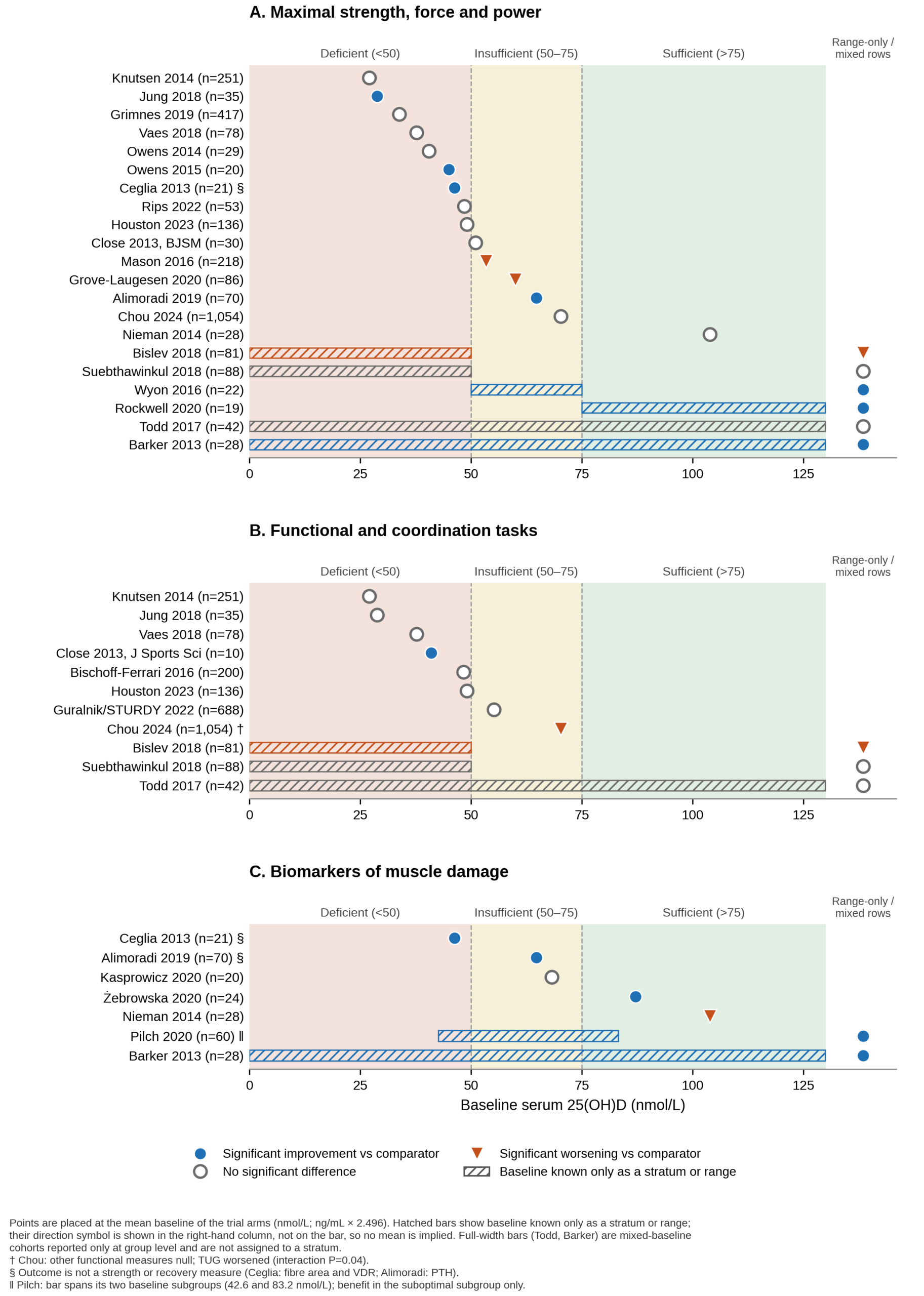
A within-study baseline-by-treatment interaction was formally tested and reported in only three trials across all domains – Vaes et al.30 (knee extension, P=0.74), Bischoff-Ferrari et al.37 (Short Physical Performance Battery [SPPB], not significant), and Chou et al.33 (Timed Up and Go [TUG], P=0.04, significant). No other trial reported such a test. The direction of effect across primary trials by baseline 25(OH)D status is summarised in Figure 2. Confidence intervals were available for meta-analytic estimates and for a minority of primary trials that reported them explicitly; the majority of included primary trials reported significance via p-value alone, without an accompanying confidence interval. Those that were reported among primary trials: Bislev et al.14 reported handgrip strength reduced by 9% (95% CI −15 to −3%) and knee-flexion strength reduced by 13% (95% CI −24 to −2%); Knutsen et al.29 reported no significant effect on jump height, mean difference (MD) −1.4% (95% CI −4.9 to 2.2).
Severe vitamin D deficiency is known to cause muscle weakness in humans. Patients suffering from end-stage renal disease are unable to undergo the second hydroxylation reaction to produce active vitamin D, so they develop significant weakness that is rapidly rectified when treated with vitamin D (calcitriol) treatment42. This is consistent with proposed VDR-mediated effects on calcium handling and protein synthesis, historically attributed in part to type II fast-twitch fibres, though the presence of VDR in mature muscle fibres themselves remains contested2. Tomlinson et al.19, a meta-analysis, reported significant gains in both upper (SMD=0.32, 95% CI 0.10–0.54) and lower-body strength (SMD=0.32, 95% CI 0.01–0.63); the lower-body interval approaches zero at its lower bound, warranting cautious interpretation. Zhang et al.20, a meta-analysis, found no overall effect but a significant improvement in lower-limb strength under subgroup analysis (SMD=0.55, 95% CI 0.12–0.98, P=0.01), most pronounced among athletes training indoors (SMD=0.48, 95% CI 0.06–0.90, P=0.02). Bislev et al.16, a meta-analysis of 54 RCTs, found no overall strength benefit but a significant negative effect on TUG and knee-flexion strength (though the knee-flexion finding lost significance when restricted to studies published 2015 and later: MD −4.04 [−9.10 to 1.01] N, p = 0.12), discussed separately below.
Discussion
This review set out to determine whether baseline 25(OH)D status governs the muscular response to vitamin D supplementation. Across twenty-seven studies, ten reported statistically significant benefits to strength, function or recovery, of which seven were in deficient or insufficient populations (Jung25, Ceglia27, Close38, Wyon34, Pilch41, Owens35 (2015), Alimoradi23, two were in replete populations (Rockwell24, Żebrowska39 and one spanned strata (Barker17; benefits therefore occurred in both replete and insufficient/deficient populations, though they were observed to be concentrated in, but not confined to, deficient populations. Though, it should be considered that four of five adverse effects were reported in deficient/insufficient populations. This reflects the increased proportion of studies focusing on them rather than sufficient groups, so the benefits of vitamin D bearing relation to baseline status should be treated as a hypothesis. The review reinterpreted the statistically significant worsening of Timed Up and Go performance in the largest pooled dataset16 as evidence for a hypothesised emphasis on deficit correction. Three methodological assumptions in the field – fixed-dose prescribing, recovery biomarker conflation, and age-indiscriminate thresholds – were identified as sources of its apparent inconsistency.
The deficiency-stratified pattern suggests, as a hypothesis to be tested, that vitamin D acts primarily as a corrective therapy rather than a general ergogenic aid, and this would have direct practical consequences. If benefit is only apparent through correcting a deficit, the widespread practice of recommending supplementation to athletes and older adults indiscriminately is not supported by the evidence. Should this hypothesis be proven, the advisable clinical action would therefore not be universal supplementation but identification of the deficient subgroup before supplementation. This interpretation is consistent with, though not proven by, evidence of harm when supplementation exceeds need. Among primary trials, Chou et al.33 found that TUG worsened with vitamin D only in participants whose baseline 25(OH)D was above the median, and higher-dose regimens were associated with more falls in two trials of older adults43,37. However, adverse effects were not confined to replete participants: Bislev et al.14 reported reduced handgrip (−9%) and knee-flexion strength (−13%) and slower TUG in women with baseline 25(OH)D below 50 nmol/L, and Mason et al.15 observed reduced leg strength in insufficient postmenopausal women. Risk may therefore depend as much on dose and the size of the rise in 25(OH)D as on baseline status. If supplementation beyond physiological need can measurably impair muscular function, indiscriminate high-dose supplementation is not merely wasteful but potentially counterproductive.
The three methodological assumptions identified carry implications beyond this review. If a substantial portion of the field’s null results arises from fixed-dose trajectory confounding and the pooling of biologically heterogeneous recovery markers, then existing meta-analyses may systematically underestimate a possible true effect in deficient subgroups, and the apparent inconsistency of the literature may be partly artificial rather than biological. A fixed dose obscures three biologically distinct trajectories within a single trial: severely deficient participants who partially correct but remain below sufficiency, mildly deficient participants who cross the threshold, and already-sufficient participants pushed above a potential physiological optimum. Each trajectory predicts a different direction of effect – partial benefit, full benefit, and potential impairment respectively – yet all three are typically reported as one group-level mean. This can produce analytical cancellation, generating a null result even where genuine effects exist within subgroups. Barker et al.17 illustrates the problem directly: its cohort spanned all three strata, yet outcomes were reported only at group level, so any difference in response by baseline status could not be examined. A related problem affects how recovery is measured. Creatine kinase and myoglobin reflect membrane damage, and isometric torque reflects contractile function – distinct biological processes routinely pooled under one “recovery” label. Kasprowicz et al.40 found no difference in IL-6 after a 100 km run, and Pilch et al.41 found a significant fall in myoglobin only in the suboptimal subgroup, with LDH and CK unchanged. Pooling such non-equivalent markers could explain a share of the recovery literature’s apparent inconsistency.
A further complication is that sufficiency thresholds are applied uniformly across age groups. This is problematic when considering the theory that VDRs are concentrated in type II fast-twitch fibres, which decline proportionally with age. This would explain why significant effects were seen in young insufficient athletes25,34,38, while Houston et al.18found none in older adults at comparable baseline concentrations, consistent with null results in older cohorts with baselines of roughly 38–55 nmol/L30,36,37. The pattern is not uniform, however: Owens et al.22 and Knutsen et al.29 found no strength benefit in deficient younger adults, while insufficient males reported improved torque recovery after eccentric damage35. Moreover, Ceglia et al.27 reported increased fibre cross-sectional area (CSA) in deficient older women. This hypothesis remains speculative given VDR’s cellular location being disputed by some studies; one reported undetectable VDR in mature mouse fibres2 and another low or undetectable levels in adult human muscle44 despite being readily detected in human precursor cells.
The adverse findings from Chou et al.33, who found that TUG worsened with vitamin D only in participants whose baseline 25(OH)D was above the median, remain mechanistically unexplained. This trend remains consistent when widened to include other studies, as seen in the significant adverse TUG and knee-flexion reported by the meta-analysis by Bislev et al. (2021)16, which does not include Chou et al.33 as a source. However, this interpretation of over-supplementation is complicated by two primary trials: Bislev et al. (2018)14 reported reduced handgrip and knee-flexion strength and slower TUG in women with baseline 25(OH)D below 50 nmol/L, and Mason et al.15 observed reduced leg strength in insufficient postmenopausal women. Because both adverse signals arose in participants who were not replete at baseline, over-supplementation alone cannot account for the pattern, and dose or the magnitude of the rise in 25(OH)D may matter as much as starting status. No subgroup analysis has isolated over-supplemented participants specifically, so this signal cannot be confidently attributed to over-supplementation rather than some other feature of the pooled population. This represents an important and currently unresolved question for future research, addressed further in the Discussion below.
Both of the review’s objectives were addressed, although the first remains unresolved. First, the determination as to whether muscular effects are contingent on baseline 25(OH)D was addressed: the stratified synthesis determined that, while significant effects were largely, but not exclusively, observed within deficient and insufficient groups, and this is compatible with a baseline-effect relation, this could not be conclusively proved, so baseline contingency is supported as a hypothesis rather than established as a result. Second, three methodological assumptions that may systematically bias the existing evidence were identified: fixed-dose trajectory confounding, recovery biomarker heterogeneity, and age-indiscriminate thresholds.
If the hypothesis is confirmed through further testing, a targeted rather than universal approach to vitamin D supplementation would be warranted. Clinicians and sports practitioners should consider periodically measuring 25(OH)D levels, with an emphasis on athletic and elderly populations. These measurements would be concentrated particularly across seasonal extremes, correcting the more-likely winter deficit and avoiding compounding on vitamin D from sunlight in summer. Supplementation should be prioritised for those found deficient or insufficient (<50 nmol/L, and especially <30 nmol/L), and should aim to correct the deficit toward sufficiency rather than to merely maximise 25(OH)D. Even in this group, benefit is not guaranteed, as several trials in deficient or insufficient adults reported null or adverse effects, so supplementation should be followed by repeat testing rather than assumed to be effective. Supplementation calibrated to the individual baseline deficit, rather than a fixed daily dose, would better approximate the corrective mechanism hypothesised here. For the already-replete, high-dose supplementation is not supported and resources are better directed toward established recovery determinants: nutrition, sleep, and optimisation of training load. Given evidence that sustained high intakes may compromise bone density45 and the proposed functional harm at the upper end of vitamin D levels33,43,37, supra-physiological dosing should be avoided outside clinically supervised contexts if regular 25(OH)D level tests are not available.
The methodological gaps identified could be largely resolved by a single adaptive randomised controlled trial. Participants would be enrolled across three pre-specified age strata (18-35, 36-60, and >60 years) with stratified randomisation, ensuring power for age-stratified analysis and enabling a direct test of the VDR-fibre-age hypothesis. Rather than a fixed dose, the supplementation recipients would receive a dose calculated from each participant’s baseline deficit, targeting a common 25(OH)D endpoint (e.g., 75 nmol/L) across strata. Supplementation dosage would be recalculated at set intervals in order to pursue isolation of achieved status from administered dose. Recovery outcomes would be reported separately by biological domain – membrane integrity (CK, myoglobin), contractile function (isometric torque), and inflammation (interleukin-6 [IL-6], C-reactive protein [CRP]) – and never pooled. Critically, a timing-sensitive battery (TUG, stair-descent speed, balance) would be measured alongside maximal strength across multiple joints, allowing a direct test of the graded prediction that over-supplemented participants show impaired force production, most strongly on tasks demanding repeated contraction-relaxation cycles, and more weakly on isolated maximal contractions.
Supplement form may also appear to matter. Nieman et al.11found that D₂ (ergocalciferol) not only failed to improve recovery but was associated with significantly higher post-exercise myoglobin and creatine kinase than placebo, indicating greater muscle damage. Though, it should be considered that this study was against placebo, not D3, so the result has limited value for drawing conclusions on the importance of form.
Several limitations bound this review’s conclusions. Publication bias is likely to inflate the apparent effects in deficient populations, since small trials reporting positive results are more readily published than null ones, leading to a skewed evidence body. The restriction to English-language publications may have led to exclusion of relevant trials. The heterogeneity in population, dose, duration, and outcome measure across included studies precluded formal meta-analytical pooling; this led to the narrative deficiency-stratified synthesis. This same heterogeneity in outcome definitions, alongside uncontrolled confounders such as sunlight exposure, limits what any synthesis of this literature can firmly establish. The included studies also varied in how 25(OH)D was measured and how deficiency was defined, meaning baseline strata should be treated as approximate rather than exact.
Several confounding variables present across the primary literature were not consistently controlled for and may have influenced the findings independent of supplementation status. Seasonal ultraviolet B (UVB) exposure directly affects endogenous vitamin D synthesis; trials conducted without controlling for season or geographic latitude may have had the 25(OH)D status of participants shift due to sunlight rather than only from supplementation. This would serve to inflate or obscure the true effect of supplementation. Baseline dietary calcium intake is mechanistically relevant because calcium and vitamin D act jointly in bone and muscle calcium handling; uncontrolled variation in calcium intake could independently affect the muscular outcomes that are attributed to supplementation, specifically those quantified through biomarkers and force-recovery. Physical activity level outside the study protocol could similarly confound recovery and strength outcomes, as training status independently affects muscle adaptation and damage-marker response, potentially exaggerating the effect of supplementation. As these variables were not uniformly reported or adjusted for across included studies, the findings synthesised here should be interpreted as the effect of supplementation status under uncontrolled real-world conditions.
The proposed VDR-fibre-age mechanism rests on a contested premise: whether VDR is meaningfully expressed in mature skeletal muscle fibres at all remains disputed in the physiological literature, with some studies failing to detect VDRs in mature mouse fibres2and others reporting low to nondetectable levels in adult skeletal muscle44. This hypothesis should therefore be treated as conditional, contingent on clarification of VDR’s precise cellular localisation from further research.
Most importantly, the model predicting negative returns from over-supplementation rests on a small evidence base, primarily Chou et al.33, contextualised by a concordant meta-analysis pooling result by Bislev et al.16. The proposition of a model in which beyond the optimum, harm begins, cannot fully be determined from existing data. This element of the review’s account should therefore be regarded as a hypothesis for testing rather than an established finding. Screening was conducted primarily by a single reviewer using Rayyan; a second, independent reviewer screened a random 11.0% sample (100 of 909 records) without access to the primary reviewer’s decisions, showing 98% agreement. This verification suggests reasonable consistency in the application of the eligibility criteria; however, the majority of records were not independently double-screened, and data extraction was performed by a single reviewer throughout. This introduces a residual risk of selection or extraction error that full independent dual screening would further mitigate and should be considered when weighing the review’s conclusions.
The value of vitamin D to skeletal muscle has been debated as though the question were binary, oversimplified into whether it works or does not. The evidence assembled here suggests this question has been framed too simply: vitamin D neither uniformly helps nor uniformly fails, and whether its effects depend mainly on baseline status remains a hypothesis. Testing this hypothesis may help determine when, in whom, and to what degree the supplementation of vitamin D helps muscle recovery.
Acknowledgments
In the preparation of this work, AI (Claude) was used solely to assist with the visual presentation of data in the manuscript. Specifically, it was used to generate graphs/figures from data that I had already collected and processed myself.
AI did not: collect or generate any of the research data; perform or determine the statistical analysis; interpret the results; generate, write, or edit the manuscript text; select, generate, or substantiate references; formulate the conclusions or scientific claims. The data and all scientific analyses are my own work. The AI-assisted figures were produced only as a means of presenting those pre-existing results visually. I also independently checked each figure against the underlying data to ensure that it fully and accurately represents the results and contains no alterations or errors.
Registration and protocol. This review was not registered, and no formal protocol was prepared in advance. As an independent systematic review conducted outside an institutional research programme, pre-registration was not pursued.
Support. This review received no external funding.
Competing interests. The author declares no competing interests.
References
- World Health Organization. Global action plan on physical activity 2018–2030: more active people for a healthier world. https://www.who.int/initiatives/gappa, 2018. [↩]
- Y. Wang, H. F. DeLuca. Is the vitamin D receptor found in muscle? Endocrinology. Vol. 152, pg. 354-363, 2011, https://doi.org/10.1210/en.2010-1109. [↩] [↩] [↩] [↩]
- C. M. Latham, C. R. Brightwell, A. R. Keeble, B. D. Munson, N. T. Thomas, A. M. Zagzoog, C. S. Fry, J. L. Fry. Vitamin D promotes skeletal muscle regeneration and mitochondrial health. Frontiers in Physiology. Vol. 12, pg. 660498, 2021, https://doi.org/10.3389/fphys.2021.660498. [↩]
- C. Beaudart, F. Buckinx, V. Rabenda, S. Gillain, E. Cavalier, J. Slomian, J. Petermans, J. Y. Reginster, O. Bruyère. The effects of vitamin D on skeletal muscle strength, muscle mass, and muscle power: a systematic review and meta-analysis of randomized controlled trials. Journal of Clinical Endocrinology and Metabolism. Vol. 99, pg. 4336-4345, 2014, https://doi.org/10.1210/jc.2014-1742. [↩]
- K. A. Stockton, K. Mengersen, J. D. Paratz, D. Kandiah, K. L. Bennell. Effect of vitamin D supplementation on muscle strength: a systematic review and meta-analysis. Osteoporosis International. Vol. 22, pg. 859-871, 2011, https://doi.org/10.1007/s00198-010-1407-y. [↩]
- F. Farrokhyar, G. Sivakumar, K. Savage, A. Koziarz, S. Jamshidi, O. R. Ayeni, D. Peterson, M. Bhandari. Effects of vitamin D supplementation on serum 25-hydroxyvitamin D concentrations and physical performance in athletes: a systematic review and meta-analysis of randomized controlled trials. Sports Medicine. Vol. 47, pg. 2323-2339, 2017, https://doi.org/10.1007/s40279-017-0749-4. [↩]
- M. Sist, L. Zou, S. D. R. Galloway, N. Rodriguez-Sanchez. Effects of vitamin D supplementation on maximal strength and power in athletes: a systematic review and meta-analysis of randomized controlled trials. Frontiers in Nutrition. Vol. 10, pg. 1163313, 2023, https://doi.org/10.3389/fnut.2023.1163313. [↩] [↩]
- H. Rosendahl-Riise, U. Spielau, A. H. Ranhoff, O. A. Gudbrandsen, J. Dierkes. Vitamin D supplementation and its influence on muscle strength and mobility in community-dwelling older persons: a systematic review and meta-analysis. Journal of Human Nutrition and Dietetics. Vol. 30, pg. 3-15, 2017, https://doi.org/10.1111/jhn.12394. [↩]
- M. F. Holick, N. C. Binkley, H. A. Bischoff-Ferrari, C. M. Gordon, D. A. Hanley, R. P. Heaney, M. H. Murad, C. M. Weaver. Evaluation, treatment, and prevention of vitamin D deficiency: an Endocrine Society clinical practice guideline. Journal of Clinical Endocrinology and Metabolism. Vol. 96, pg. 1911-1930, 2011, https://doi.org/10.1210/jc.2011-0385. [↩] [↩]
- A. C. Ross, J. E. Manson, S. A. Abrams, J. F. Aloia, P. M. Brannon, S. K. Clinton, R. A. Durazo-Arvizu, J. C. Gallagher, R. L. Gallo, G. Jones, C. S. Kovacs, S. T. Mayne, C. J. Rosen, S. A. Shapses. The 2011 report on dietary reference intakes for calcium and vitamin D from the Institute of Medicine: what clinicians need to know. Journal of Clinical Endocrinology and Metabolism. Vol. 96, pg. 53-58, 2011, https://doi.org/10.1210/jc.2010-2704. [↩]
- D. C. Nieman, N. D. Gillitt, R. A. Shanely, D. Dew, M. P. Meaney, B. Luo. Vitamin D2 supplementation amplifies eccentric exercise-induced muscle damage in NASCAR pit crew athletes. Nutrients. Vol. 6, pg. 63-75, 2014, https://doi.org/10.3390/nu6010063. [↩] [↩] [↩] [↩] [↩] [↩] [↩]
- J. J. Todd, E. M. McSorley, L. K. Pourshahidi, S. M. Madigan, E. Laird, M. Healy, P. J. Magee. Vitamin D3 supplementation using an oral spray solution resolves deficiency but has no effect on VO2 max in Gaelic footballers: results from a randomised, double-blind, placebo-controlled trial. European Journal of Nutrition. Vol. 56, pg. 1577-1587, 2017, https://doi.org/10.1007/s00394-016-1202-4. [↩] [↩] [↩] [↩]
- G. L. Close, J. Leckey, M. Patterson, W. Bradley, D. J. Owens, W. D. Fraser, J. P. Morton. The effects of vitamin D3 supplementation on serum total 25[OH]D concentration and physical performance: a randomised dose-response study. British Journal of Sports Medicine. Vol. 47, pg. 692-696, 2013, https://doi.org/10.1136/bjsports-2012-091735. [↩] [↩]
- L. S. Bislev, L. Langagergaard Rødbro, L. Rolighed, T. Sikjaer, L. Rejnmark. Effects of vitamin D3 supplementation on muscle strength, mass, and physical performance in women with vitamin D insufficiency: a randomized placebo-controlled trial. Calcified Tissue International. Vol. 103, pg. 483-493, 2018, https://doi.org/10.1007/s00223-018-0443-z. [↩] [↩] [↩] [↩] [↩] [↩] [↩]
- C. Mason, J. D. Tapsoba, C. Duggan, I. Imayama, C. Y. Wang, L. Korde, A. McTiernan. Effects of vitamin D3 supplementation on lean mass, muscle strength, and bone mineral density during weight loss: a double-blind randomized controlled trial. Journal of the American Geriatrics Society. Vol. 64, pg. 769-778, 2016, https://doi.org/10.1111/jgs.14049. [↩] [↩] [↩] [↩]
- L. S. Bislev, D. Grove-Laugesen, L. Rejnmark. Vitamin D and muscle health: a systematic review and meta-analysis of randomized placebo-controlled trials. Journal of Bone and Mineral Research. Vol. 36, pg. 1651-1660, 2021, https://doi.org/10.1002/jbmr.4412. [↩] [↩] [↩] [↩] [↩] [↩]
- T. Barker, E. D. Schneider, B. M. Dixon, V. T. Henriksen, L. K. Weaver. Supplemental vitamin D enhances the recovery in peak isometric force shortly after intense exercise. Nutrition & Metabolism. Vol. 10, pg. 69, 2013, https://doi.org/10.1186/1743-7075-10-69. [↩] [↩] [↩] [↩] [↩] [↩]
- D. K. Houston, A. P. Marsh, R. H. Neiberg, J. L. Demons, C. L. Campos, S. B. Kritchevsky, O. Delbono, J. A. Tooze. Vitamin D supplementation and muscle power, strength and physical performance in older adults: a randomized controlled trial. The American Journal of Clinical Nutrition. Vol. 117, pg. 1086-1095, 2023, https://doi.org/10.1016/j.ajcnut.2023.04.021. [↩] [↩] [↩] [↩] [↩] [↩]
- P. B. Tomlinson, C. Joseph, M. Angioi. Effects of vitamin D supplementation on upper and lower body muscle strength levels in healthy individuals: a systematic review with meta-analysis. Journal of Science and Medicine in Sport. Vol. 18, pg. 575-580, 2015, https://doi.org/10.1016/j.jsams.2014.07.022. [↩] [↩] [↩]
- L. Zhang, M. Quan, Z.-B. Cao. Effect of vitamin D supplementation on upper and lower limb muscle strength and muscle power in athletes: a meta-analysis. PLOS ONE. Vol. 14, pg. e0215826, 2019, https://doi.org/10.1371/journal.pone.0215826. [↩] [↩]
- M. J. Page, J. E. McKenzie, P. M. Bossuyt, I. Boutron, T. C. Hoffmann, C. D. Mulrow, L. Shamseer, J. M. Tetzlaff, E. A. Akl, S. E. Brennan, R. Chou, J. Glanville, J. M. Grimshaw, A. Hróbjartsson, M. M. Lalu, T. Li, E. W. Loder, E. Mayo-Wilson, S. McDonald, L. A. McGuinness, L. A. Stewart, J. Thomas, A. C. Tricco, V. A. Welch, P. Whiting, D. Moher. The PRISMA 2020 statement: an updated guideline for reporting systematic reviews. BMJ. Vol. 372, pg. n71, 2021, https://doi.org/10.1136/bmj.n71. [↩]
- D. J. Owens, D. Webber, S. G. Impey, J. Tang, T. F. Donovan, W. D. Fraser, J. P. Morton, G. L. Close. Vitamin D supplementation does not improve human skeletal muscle contractile properties in insufficient young males. European Journal of Applied Physiology. Vol. 114, pg. 1309-1320, 2014, https://doi.org/10.1007/s00421-014-2865-2. [↩] [↩]
- K. Alimoradi, B. Nikooyeh, A. A. Ravasi, M. Zahedirad, N. Shariatzadeh, A. Kalayi, T. R. Neyestani. Efficacy of vitamin D supplementation in physical performance of Iranian elite athletes. International Journal of Preventive Medicine. Vol. 10, pg. 100, 2019, https://doi.org/10.4103/ijpvm.IJPVM_227_18. [↩] [↩] [↩]
- M. S. Rockwell, M. I. Frisard, J. W. Rankin, J. S. Zabinsky, R. P. McMillan, W. You, K. P. Davy, M. W. Hulver. Effects of seasonal vitamin D3 supplementation on strength, power, and body composition in college swimmers. International Journal of Sport Nutrition and Exercise Metabolism. Vol. 30, pg. 165-173, 2020, https://doi.org/10.1123/ijsnem.2019-0250. [↩] [↩]
- H. C. Jung, M. W. Seo, S. Lee, S. W. Jung, J. K. Song. Correcting vitamin D insufficiency improves some but not all aspects of physical performance during winter training in taekwondo athletes. International Journal of Sport Nutrition and Exercise Metabolism. Vol. 28, pg. 635-643, 2018, https://doi.org/10.1123/ijsnem.2017-0412. [↩] [↩] [↩] [↩]
- C. Suebthawinkul, K. Panyakhamlerd, P. Yotnuengnit, A. Suwan, N. Chaiyasit, N. Taechakraichana. The effect of vitamin D2 supplementation on muscle strength in early postmenopausal women: a randomized, double-blind, placebo-controlled trial. Climacteric. Vol. 21, pg. 491-497, 2018, https://doi.org/10.1080/13697137.2018.1480600. [↩] [↩]
- L. Ceglia, S. Niramitmahapanya, M. da Silva Morais, D. A. Rivas, S. S. Harris, H. Bischoff-Ferrari, R. A. Fielding, B. Dawson-Hughes. A randomized study on the effect of vitamin D3 supplementation on skeletal muscle morphology and vitamin D receptor concentration in older women. Journal of Clinical Endocrinology and Metabolism. Vol. 98, pg. E1927-E1935, 2013, https://doi.org/10.1210/jc.2013-2820. [↩] [↩] [↩] [↩]
- D. Grove-Laugesen, P. K. Cramon, S. Malmstroem, E. Ebbehoj, T. Watt, K. W. Hansen, L. Rejnmark. Effects of supplemental vitamin D on muscle performance and quality of life in Graves’ disease: a randomized clinical trial. Thyroid. Vol. 30, pg. 661-671, 2020, https://doi.org/10.1089/thy.2019.0634. [↩]
- K. V. Knutsen, A. A. Madar, P. Lagerløv, M. Brekke, T. Raastad, L. C. Stene, H. E. Meyer. Does vitamin D improve muscle strength in adults? a randomized, double-blind, placebo-controlled trial among ethnic minorities in Norway. Journal of Clinical Endocrinology and Metabolism. Vol. 99, pg. 194-202, 2014, https://doi.org/10.1210/jc.2013-2647. [↩] [↩] [↩] [↩]
- A. M. M. Vaes, M. Tieland, N. Toussaint, R. Nilwik, L. B. Verdijk, L. J. C. van Loon, L. C. P. G. M. de Groot. Cholecalciferol or 25-hydroxycholecalciferol supplementation does not affect muscle strength and physical performance in prefrail and frail older adults. The Journal of Nutrition. Vol. 148, pg. 712-720, 2018, https://doi.org/10.1093/jn/nxy024. [↩] [↩] [↩] [↩]
- G. Grimnes, J. Kubiak, R. Jorde. Four months vitamin D supplementation to vitamin D insufficient individuals does not improve muscular strength: a randomized controlled trial. PLOS ONE. Vol. 14, pg. e0225600, 2019, https://doi.org/10.1371/journal.pone.0225600. [↩]
- L. Rips, A. Toom, R. Kuik, A. Varblane, H. Mölder, M. Tammaru, M. Kull, V. Ööpik, J.-T. Kartus, H. Gapeyeva, M. Rahu. Seven-month wintertime supplementation of 1200 IU vitamin D has no effect on hand grip strength in young, physically active males: a randomized, controlled study. Journal of the International Society of Sports Nutrition. Vol. 19, pg. 437-454, 2022, https://doi.org/10.1080/15502783.2022.2100718. [↩]
- S. H. Chou, N. R. Cook, G. Kotler, E. Kim, T. Copeland, I. M. Lee, P. M. Cawthon, J. E. Buring, J. E. Manson, M. S. LeBoff. Effects of supplemental vitamin D3, omega-3 fatty acids on physical performance measures in the VITamin D and OmegA-3 TriaL. Journal of Clinical Endocrinology and Metabolism. Vol. 110, pg. e44-e53, 2025, https://doi.org/10.1210/clinem/dgae150. [↩] [↩] [↩] [↩] [↩] [↩] [↩] [↩]
- M. A. Wyon, R. Wolman, A. M. Nevill, R. Cloak, G. S. Metsios, D. Gould, A. Ingham, Y. Koutedakis. Acute effects of vitamin D3 supplementation on muscle strength in judoka athletes: a randomized placebo-controlled, double-blind trial. Clinical Journal of Sport Medicine. Vol. 26, pg. 279-284, 2016, https://doi.org/10.1097/JSM.0000000000000264. [↩] [↩] [↩]
- D. J. Owens, A. P. Sharples, I. Polydorou, N. Alwan, T. Donovan, J. Tang, W. D. Fraser, R. Cooper, J. P. Morton, C. Stewart, G. L. Close. A systems-based investigation into vitamin D and skeletal muscle repair, regeneration, and hypertrophy. American Journal of Physiology-Endocrinology and Metabolism. Vol. 309, pg. E1019-E1031, 2015, https://doi.org/10.1152/ajpendo.00375.2015. [↩] [↩] [↩]
- J. M. Guralnik, A. L. Sternberg, C. M. Mitchell, A. L. Blackford, J. Schrack, A. A. Wanigatunga, E. Michos, S. P. Juraschek, S. Szanton, R. Kalyani, Y. Cai, L. J. Appel. Effects of vitamin D on physical function: results from the STURDY trial. The Journals of Gerontology: Series A. Vol. 77, pg. 1585-1592, 2022, https://doi.org/10.1093/gerona/glab379. [↩] [↩]
- H. A. Bischoff-Ferrari, B. Dawson-Hughes, E. J. Orav, H. B. Staehelin, O. W. Meyer, R. Theiler, W. Dick, W. C. Willett, A. Egli. Monthly high-dose vitamin D treatment for the prevention of functional decline: a randomized clinical trial. JAMA Internal Medicine. Vol. 176, pg. 175-183, 2016, https://doi.org/10.1001/jamainternmed.2015.7148. [↩] [↩] [↩] [↩] [↩]
- G. L. Close, J. Russell, J. N. Cobley, D. J. Owens, G. Wilson, W. Gregson, W. D. Fraser, J. P. Morton. Assessment of vitamin D concentration in non-supplemented professional athletes and healthy adults during the winter months in the UK: implications for skeletal muscle function. Journal of Sports Sciences. Vol. 31, pg. 344-353, 2013, https://doi.org/10.1080/02640414.2012.733822. [↩] [↩] [↩]
- A. Żebrowska, E. Sadowska-Krępa, A. Stanula, Z. Waśkiewicz, O. Łakomy, E. Bezuglov, P. T. Nikolaidis, T. Rosemann, B. Knechtle. The effect of vitamin D supplementation on serum total 25(OH) levels and biochemical markers of skeletal muscles in runners. Journal of the International Society of Sports Nutrition. Vol. 17, pg. 18, 2020, https://doi.org/10.1186/s12970-020-00347-8. [↩] [↩]
- K. Kasprowicz, W. Ratkowski, W. Wołyniec, M. Kaczmarczyk, K. Witek, P. Żmijewski, M. Renke, Z. Jastrzębski, T. Rosemann, P. T. Nikolaidis, B. Knechtle. The effect of vitamin D3 supplementation on hepcidin, iron, and IL-6 responses after a 100 km ultra-marathon. International Journal of Environmental Research and Public Health. Vol. 17, pg. 2962, 2020, https://doi.org/10.3390/ijerph17082962. [↩] [↩]
- W. Pilch, B. Kita, A. Piotrowska, Ł. Tota, M. Maciejczyk, O. Czerwińska-Ledwig, E. Sadowska-Krepa, S. Kita, T. Pałka. The effect of vitamin D supplementation on the muscle damage after eccentric exercise in young men: a randomized, control trial. Journal of the International Society of Sports Nutrition. Vol. 17, pg. 53, 2020, https://doi.org/10.1186/s12970-020-00386-1. [↩] [↩] [↩]
- L. Ceglia. Vitamin D and its role in skeletal muscle. Current Opinion in Clinical Nutrition and Metabolic Care. Vol. 12, pg. 628-633, 2009, https://doi.org/10.1097/MCO.0b013e328331c707. [↩]
- L. J. Appel, E. D. Michos, C. M. Mitchell, A. L. Blackford, A. L. Sternberg, E. R. Miller III, S. P. Juraschek, J. A. Schrack, S. L. Szanton, J. Charleston, M. Minotti, S. N. Baksh, R. H. Christenson, J. Coresh, L. T. Drye, J. M. Guralnik, R. R. Kalyani, T. B. Plante, D. M. Shade, D. L. Roth, J. Tonascia. The effects of four doses of vitamin D supplements on falls in older adults: a response-adaptive, randomized clinical trial. Annals of Internal Medicine. Vol. 174, pg. 145-156, 2021, https://doi.org/10.7326/M20-3812. [↩] [↩]
- K. Olsson, A. Saini, A. Strömberg, S. Alam, M. Lilja, E. Rullman, T. Gustafsson. Evidence for vitamin D receptor expression and direct effects of 1α,25(OH)₂D₃ in human skeletal muscle precursor cells. Endocrinology. Vol. 157, pg. 98-111, 2016, https://doi.org/10.1210/en.2015-1685. [↩] [↩]
- R. Bouillon, D. Manousaki, C. Rosen, K. Trajanoska, F. Rivadeneira, J. B. Richards. The health effects of vitamin D supplementation: evidence from human studies. Nature Reviews Endocrinology. Vol. 18, pg. 96-110, 2022, https://doi.org/10.1038/s41574-021-00593-z. [↩]