
Abstract
Japan is currently having trouble with population decline which is causing labor shortages. In the manufacturing industry, labor input decline is one of the challenges that Japan is currently facing. So, in this research, I examine how industrial robot adoption is associated with manufacturing labor productivity and declining labor input. I use observations from 1995 to 2023 about manufacturing employment, robot density, annual labor hours, and real manufacturing value added to calculate total labor input, labor productivity, and manufacturing output proxy. I also use Pearson correlation and index comparison to determine its significance and trends. The main finding I mention is that labor input has dropped substantially; however, manufacturing output remains above the 1995 level and manufacturing labor productivity increases substantially. Additionally, robot density generally increased, but when I compared robot density and labor productivity with Pearson correlation, I found a moderate positive relationship with a p-value of 0.148 which is not statistically significant. Based on these findings, I conclude that observed patterns are consistent with partial compensation. However, I cannot conclude whether industrial robotics in fact contributed to the observed compensation, but other factors such as exchange rates, trade conditions, or technological factors may also contribute to these trends.
Introduction
Background and Research Purpose
To put it bluntly, Japan’s problem is not simply whether there is a labor shortage, but how quickly it will become serious. The number of people who can participate in the total labor force has been decreasing significantly due to the decline in employment. As the number of available workers decreases, total labor input may also decrease depending on changes in working hours; along with that, the economic growth of Japan has remained poor for over 30 years. From what I hear from people saying, there are multiple negative comments concluding that Japan has gone downhill. To address the labor shortage, many governments and companies elevate the development of industrial robots and automated systems. Industrial robotics has expanded significantly for the manufacturing sector over time. Many people conclude that robotics can be a potential response to labor shortages and help maintain production. However, whether this expansion is related to maintaining manufacturing labor productivity has remained unclear. In this study, “Compensation” refers to maintaining real manufacturing output despite declining total labor input, supported by an increase in manufacturing labor productivity.
Population Decline and its significance for Manufacturing
Japan has been experiencing population decline and rapid population aging, contributing to a shrinking working–age population1. As the number of young workers is decreasing, the number of people retiring is increasing, so the overall labor force has been shrinking over time. This change in population trends has had an extreme impact on the manufacturing industry since manufacturing industries were dependent on sustained labor input to maintain quality and quantity of production. Therefore, labor shortages are especially relevant to manufacturing2.
Hope of Industrial Robotics
As I explained beforehand, one of the potential ways to respond to labor shortages is to create automated systems. However, automation can be a very broad concept since automation includes various technologies such as AI, digitalization, and process automation2. So, in this study, I specifically focus on industrial robotics because especially in Japan, manufacturing is an extremely important sector for Japan’s economy. Additionally, industrial robot adoption can be measured using robot density that provides a way to quantify the expansion of industrial robot adoption over time3. However, whether greater industrial robot adoption is associated with maintaining manufacturing labor productivity under decline; labor input remains unclear.
Literature Review
Automation, Robotics and Employment
Research on industrial automation has produced multiple contradicting ideas regarding its effect on employment. Some studies identify displacement effects, in which greater exposure to industrial robots’ adoption is associated with reduction in employment or wages. For example, Acemoglu and Restrepo found negative employment effects of robot exposure in U.S local labor markets4. Evidence from Japan, however, complicates these patterns. Adachi et al found that greater robot adoption could increase employment when productivity and output expansion offset the direct substitution of labor5. Similarly, Ni and Obashi showed that robot adoption in Japanese manufacturing was associated with both job creation and job destruction6, indicating that automation may reorganize employment rather than simply eliminate jobs. These findings suggest that the effect of employment may not only depend on worker displacement, but also on productivity gains, firm expansion, and changes in the composition of labor.
Multiple studies identify mechanisms that may explain these differing employment outcomes. For example, Dekle found that the displacement effect was not significant for robot adoption. Instead, the productivity and general-equilibrium effects contributed positively to labor demand7. This finding suggests that robot adoption may affect employment not only through worker displacement, but also cost reduction, productivity gains, firm expansion, and increased demand. Furthermore, Zhu and Nie found that industrial robot adoption was positively associated with firm employment8. This relationship was stronger in capital-intensive industrial, non-state-owned firms, and coastal firms. Additionally, robot adoption was associated with higher average wages but lower labor share which shows spillover effect was not found. Similarly, Wang, Zhang, and Liu found that robot adoption was associated with increased firm employment, especially for higher-skilled workers. They also found that productivity improvement was one possible mechanism behind this result9. These findings support that robot adoption should not automatically be interpreted as direct labor displacement, but higher productivity and scale expansion may partially outweigh the effect on employment.
Automation, Robotics, and Productivity
Existing empirical research generally finds a positive relationship between industrial robot adoption and productivity, although the magnitude of the effect varies across countries, industries, and productivity measures. For instance, Matsuki found that industrial robot adoption is associated with higher total factor productivity growth, but it differs across outcomes10. Similarly, Graetz and Michaels found that greater use of industrial robots across multiple countries was associated with higher labor productivity and total factor productivity11. Correspondingly, Zhao, Wang and Liu found that Industrial robot application was positively associated with total factor productivity, and the effect remained robust across multiple specifications, with human-capital accumulation and innovation identified as potential mechanisms12. Duan et al. also found that industrial robot adoption was associated with higher firm productivity, and they identified human capital and innovation as possible mechanisms13. Lastly, a study of Chinese Industries found that higher industrial robotics density significantly increases labor productivity; the study found that a 1% increase in robot density was associated with about a 0.018% increase in labor productivity14. This supports that industrial robotics can improve manufacturing productivity through which automation may help maintain output when labor input declines even if automation does not generate additional output growth; although, this automation may only compensate for declining labor input partially.
The effect of these productivity gains may depend on the economic and organizational conditions. For example, Autor and Salomons found that productivity growth can displace labor directly within the advancing industry, while indirect output and demand effect can offset employment losses at the aggregate level15. Similarly, Cette, Spezia, and Nobile found that robots make a measurable contribution to economic growth and productivity, but the estimated magnitude varies substantially depending on how robot capital and its quality price are measured16. However, this finding is cross-country and macroeconomic, so it supports the general mechanism rather than providing a manufacturing outcome. These ideas suggest that higher robot capital can boost productivity and manufacturing output growth, while also showing that estimation of the size of effect is methodologically sensitive. Thus, productivity growth provides a solid mechanism through which automation may partially compensate for declining labor input, although productivity gains alone do not demonstrate that manufacturing output has been fully maintained.
Population Aging and the Manufacturing Workforce
Population aging can affect manufacturing not only through changes in workforce size, but also by increasing incentives for automation. For example, Acemoglu and Restrepo found that countries undergoing faster population aging adopted more industrial robots and other automation technologies. One mechanism is that aging creates scarcity of middle-aged workers concentrated in manual production tasks, increasing incentives for automation17. Moreover, Chen and Liu found that labor force aging significantly increased industrial robotics adoption, especially in capital-intensive manufacturing sectors18. This suggests that the aging population decreases labor availability, which increases incentives for automation adoption. Therefore, these studies suggest that demographic aging may contribute to automation by increasing the scarcity of labor, particularly in manufacturing industries.
However, an aging workforce should not be interpreted simply as a decline in individual worker productivity. For instance, Lu found that the aging population raises the relative productivity of some groups of older-workers, while industrial robots show complementary particularly with high-skill older workers19; however, the effect may vary by industry and country. Additionally, Katiraee et al. found that managing an aging manufacturing workforce involves challenges beyond worker numbers20 which include physical workload, worker retention, knowledge transfer, work design, health management, and organizational readiness. Furthermore, Weiss and Borsch-Supan found that productivity did not show the expected decline with age, at least up to around age 6021. These findings suggest that the consequences of workforce aging should be evaluated through factors such as labor availability, workforce composition, physical demands, and organizational conditions rather than assuming that older workers are inherently less productive. Therefore, the main challenge created by population aging may be the declining availability and changing composition of labor, rather than a uniform decline in the productivity of older workers.
Labor Scarcity, Manufacturing and Automation Context
Labor scarcity can create a direct economic incentive for firms to adopt automation technologies. For example, Benmelech and Zator found that firms facing greater difficulty finding suitable workers adopt more automation22; moving from low to high local labor scarcity is associated with greater technology adoption. Firms adopting robots also tend to expand employment, while broader employment effects are comparatively modest. In addition, Deng, Fujio, Lin, and Ota found that shortages of unskilled factory workers were strongly positively associated with subsequent robot adoption23. Fairly interesting, a shortage of skilled workers showed a different, negative pattern. These findings support that automation can be a direct response to labor scarcity rather than simply an independent technological trend.
The consequences of automation in response to labor scarcity; however, vary across firms, worker groups and level of aggregation. For example, Fujimoto found that manufacturing employment declined substantially while real manufacturing value – added increased moderately over the long period24. Additionally, Mann and Pozzoli found that changes in local labor supply affected firm-level robot adoption in Denmark, suggesting that the availability of workers can influence firms’ decisions to adopt robots25. Equally notably, Koch, Manuylov, and Smolka found that robot adoption in Spanish manufacturing firms increased output and employment while reducing the labor cost share26. Their findings suggest that robot adoption can expand production while also changing the structure of labor costs. Therefore, labor scarcity suggests a direct motivation for automation adoption, but the extent to which automation compensates for missing labor must be evaluated through its effects on productivity and output.
Japan – Specific manufacturing and Automation context
Japan-specific studies provide evidence on how demographic change, automation adoption, and employment restructuring interact within the manufacturing sector. For example, Nakamura et al. found that automation in Japanese manufacturing increased through capital deepening even during periods of relatively slow productivity growth27. Another example is Ni and Obashi’s finding that greater robot adoption is associated with both job creation and job destruction inside Japanese manufacturing firms; destruction was larger overall, but technological change also creates new jobs rather than resulting solely in worker replacement6. In terms of time, Kim found that adjustment speeds for both labor and capital increased over time, particularly after 200028. Japanese manufacturers became more flexible in adjusting employment and faster in adjusting investment which reduced adjustment cost. Together, these studies suggest that automation in Japanese manufacturing has involved broader adjustment in capital investment and employment structure rather than simple worker replacement.
More recent evidence also shows that automation in Japan extends beyond industrial robots and affects both the production process and the composition of employment. For example, Hadid, Horii and Yokota found that AI adoption in Japanese manufacturing was still uneven: about one-third of sampled firms used none of the seven technologies, while most adopters used only one or two29. Major motivation included improving operational efficiency, automating processes, improving defect detection or prediction, and reducing labor costs. Similarly, Kikuchi, Fujiwara, and Shirota found that greater exposure to automation was not associated with a clear overall decline in employment rates30. Employment shifted away from routine manufacturing occupation toward other types of work, especially service sector jobs. Automation was associated with changes in the composition of employment rather than simply eliminating jobs one-for-one. They also found that areas with greater automation exposure also experienced increases in manufacturing establishments and sales, suggesting that automation can coexist with expansion of manufacturing activity.
Research Gap
Existing studies have examined industrial robotics from several perspectives, including employment effects, productivity gains, demographic aging, labor scarcity, and Japan-specific manufacturing adjustment. However, these studies often examine these mechanisms separately. Less attention has been given to whether declining labor input, rising robot density, manufacturing labor productivity, and real manufacturing output move together over the long term within Japan’s manufacturing sector. Therefore, this study examines whether the observed expansion of industrial robotics is associated with the maintenance of manufacturing output and labor productivity as labor input declines. Rather than attempting to establish causation, the study evaluates whether the aggregate trends are consistent with partial compensation for labor shortages.
Theoretical Framework
Why labor scarcity may induce automation
One theoretical mechanism that links population aging to automation is labor scarcity. As the working-age population declines, firms may face greater difficulty obtaining sufficient labor, particularly in labor-intensive manufacturing activities. This scarcity increases the incentive to substitute capital for labor by adopting automation technologies. Thus, population aging may encourage automation by reducing labor availability and increasing the relative value of labor-saving technologies. This mechanism is consistent with Acemoglu’s theory that labor scarcity can create incentives for technological advance when the technology is strongly labor-saving; the opposite can occur when technology strongly complements labor31. Additionally, empirical evidence from Japan also supports this pathway, as Deng et al. found that shortages of unskilled factory workers were positively associated with subsequent robot adoption23.
How automation may compensate for declining labor input
Automation may compensate for declining labor input by increasing the amount of output produced per unit of labor. When industrial robots perform tasks that would otherwise require human labor, firms may maintain production with fewer labor hours. In this framework, compensation does not mean that automation fully replaces missing workers. Rather, it refers to the extent to which productivity gains allow manufacturing output to be maintained despite declining labor input. This mechanism accounts for Nakamura et al27 that automation in Japanese manufacturing increases through capital deepening even during periods of relatively slow productivity growth. Furthermore, empirical studies suggest that greater robot capital can contribute to productivity growth even when labor input declines. Conceptually, manufacturing output depends on both labor productivity and labor input; therefore, an increase in productivity can offset part of a decline in labor input.
Why compensation is not automatic
However, automation does not automatically compensate for declining labor input. The effectiveness of automation largely depends on whether firms can integrate new technologies with appropriate worker skills, organizational practices, and complementary investments32. Productivity gains may also vary across industries and economic conditions, while external factors such as changes in demand, trade, exchange rates, or economic crises can affect manufacturing output independently of automation. Therefore, the effect of automation cannot be evaluated based on robot adoption alone. In this study, compensation is assessed by examining whether rising robot density and labor productivity coincide with the maintenance of real manufacturing output as labor input declines.
Methods
Data Source
In this study, I utilized the data from 1995 to 2023 with a total of 7 observations. The main variables were manufacturing employment, annual labor hours in manufacturing, robot density in manufacturing, and real manufacturing value added. Manufacturing employment was obtained from e-Stat33. Labor-hour data were obtained from the Ministry of Health, Labour and Welfare (MHLW)34 and the Japan Institute for Labour Policy and Training (JILPT)35. Robot density was obtained from the United Nations Economic Commission for Europe (UNECE)36 and the International Federation of Robotics (IFR)3. Real manufacturing value added was obtained from the Cabinet Office, Government of Japan37.
Variables / Measurement
First, I used manufacturing employment and annual labor hours to calculate and examine the changes in total labor input over time. Manufacturing employment alone cannot fully represent the total labor input because it cannot consider the changes in the number of working hours of each employee. Secondly, robot density was used as a proxy for industrial robot adoption in Japan. Lastly, the real manufacturing value added was divided by total labor input to measure manufacturing labor productivity in Japan. Additionally, I normalize the variables to index value by using values of 1995 to a based value (1995 = 100). Each index for the observation year was calculated by dividing the value in that year by 1995 value and multiplying by 100. The reason is that different variables had different units and scales, so I set the year 1995 to 100 and compare changes over time.
Statistical Analysis
To begin with, I used Pearson correlation to observe the relationship between robot density and manufacturing labor productivity and created the scatter plot. In that scatter plot, I drew a best-fit line on a graph with the use of a total of 7 observations. Since the sample size is relatively small, I treated this statistical analysis as an exploratory analysis. A two-sided p-value was used to identify statistical significance, with p < 0.05 as the significance level.
Methodological Limitations
In this study, there are various methodological limitations. First, my statistical analysis, including graphs, only contains 7 observations. This relatively small number of samples will limit the statistical power of the Pearson correlation analysis, which makes it difficult to identify statistically significant relationships. Second, my graph’s observation interval is not static. From 1995 to 2020, the interval of every 5 years; however, the last observation is based on 2023, which makes changes between observation periods less directly comparable. Third, there is a possibility that a simple correlation is occurring within a period since both robot density and manufacturing labor productivity increase over time. Fourth, robot density does not represent all automation systems such as artificial intelligence, digitalization, and process automation. Fifth, these data are aggregated since it is focusing on full manufacturing data which does not provide specific fields such as electronics and chemical industries. Lastly, since manufacturing employment is a denominator of robot density and labor productivity, it may increase robot density even though the number of robots has not changed.
Results and Analysis
Long-term Changes in Manufacturing Employment and Labor Input in Japan
Japan’s population has been declining substantially. However, we need to specifically identify the decline of manufacturing employment and labor input index since national population decline alone cannot demonstrate a manufacturing labor shortage. In this section, I compare manufacturing employment with the labor input index to examine how changes in the number of employees relate to total labor input in manufacturing. Manufacturing employment data were obtained from e-Stat33, while annual labor-hour data were obtained from MHLW34. Figure 1 shows that both index and employment have decreased considerably over 1995 to 2020 and increased a little afterward. The number of manufacturing employment in 1995 was roughly 13.17 million people, and it decreased to roughly 9.06 million people in 2020 and increased little to 10.55 million people in 2023. This indicates that manufacturing employment remained well below its 1995 level despite the rebound by 2023. However, when we focus on labors‘ hours of year per employee, I found that that also decreases but relatively stable through 2020 before declining to 1901 hours in 2023. In 1995, each employee had 1975 hours per year; however, in 2020, it decreases to 1963 and in 2023, it decreases to 1901. COVID-19 may have affected labor conditions around 2020, although the data do not isolate its effect. Additionally, the labor input index fell from 100 in 1995 to about 68 in 2020, before recovering to about 77 in 2023. Taken together, these trends of value show that Japan’s manufacturing sector has been operating with substantially less labor input than in 1995. This decline in labor input may lead to limited capacity to sustain manufacturing output. Thus, the following section mainly examines whether industrial robot adoption compensates for this labor shortage that occurs by population decline. In this study, I will define “automation compensate for labor shortage” as being able to maintain manufacturing output despite overall labor input being reduced, supported by improvement in labor productivity.
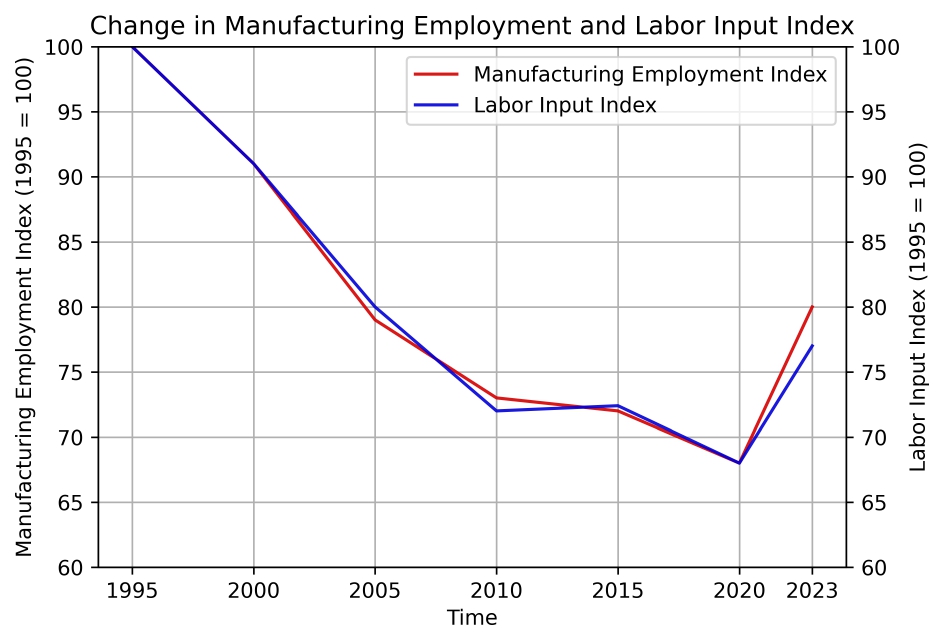
Figure 1 | Change in Manufacturing Employment and Labor Input in Japan, 1995-2023 (1995 = 100)
Industrial Adoption and Declining Manufacturing Employment
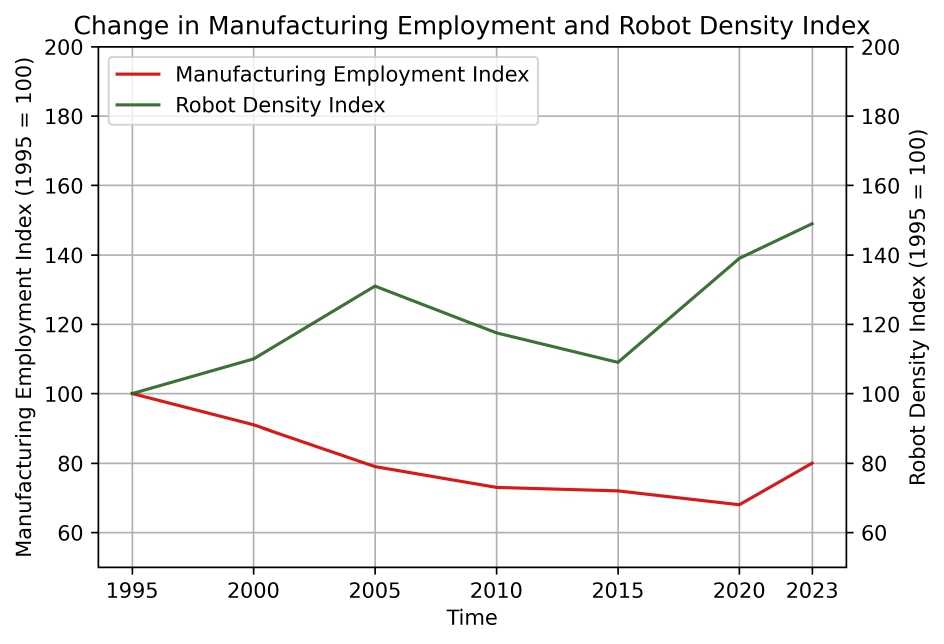
First, Figure 2 suggests that the robot density index has increased substantially overall as the manufacturing employment index decreased. The manufacturing employment data were obtained from e-Stat33 while robot density data were obtained from IFR3. When I focus on 1995 as an index of 100, the robot density index has increase to 149 in 2023 even though it declined in 2005 to 2015 with 131 to 109. The robot density (number of robots in 10000 employees) in 1995 was 280, while it was 419 in 2023. This indicates that robot density generally increased over the study period, although the trend isn’t continuous. However, robot density alone cannot show whether declining labor input was compensated since it does not measure manufacturing output.
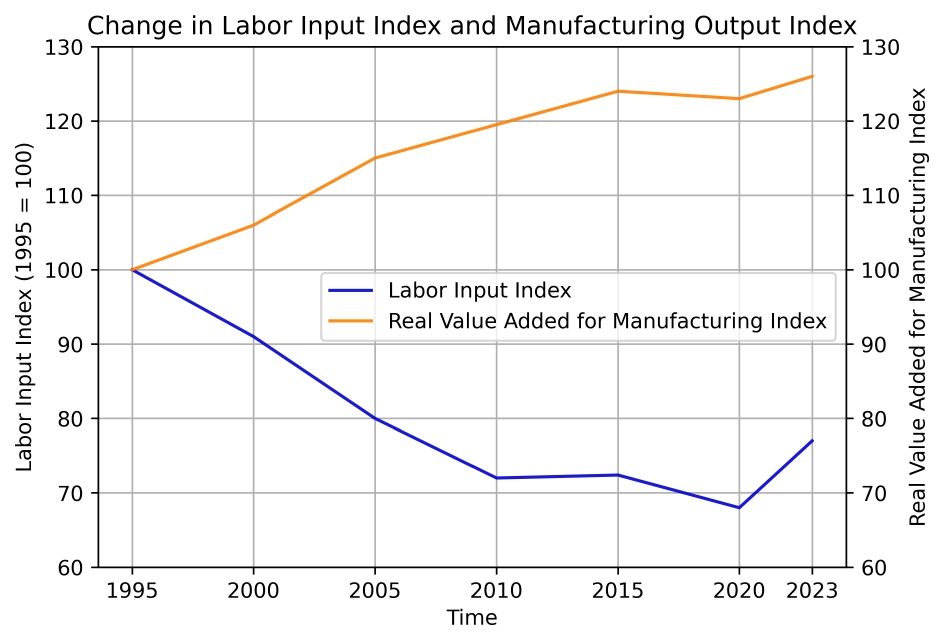
Manufacturing Output under Decline of Labor Input
So, in this section, I use Figure 3 to compare the labor input index and real value added for manufacturing index to understand whether manufacturing output has maintained despite decline of labor input. When I focus on 1995 as index of 100, real value added for the manufacturing index has increased to 123 in 2020, and 126 in 2023 even though the labor input index has decreased to 68 in 2020, and 77 in 2023. Based on this graph, I can recognize that manufacturing output has remained above its 1995 level regardless of substantial lower labor input. However, this result may lead to a new question: How did manufacturing labor productivity change as labor input declined?
Manufacturing Labor Productivity under Declining Labor Input
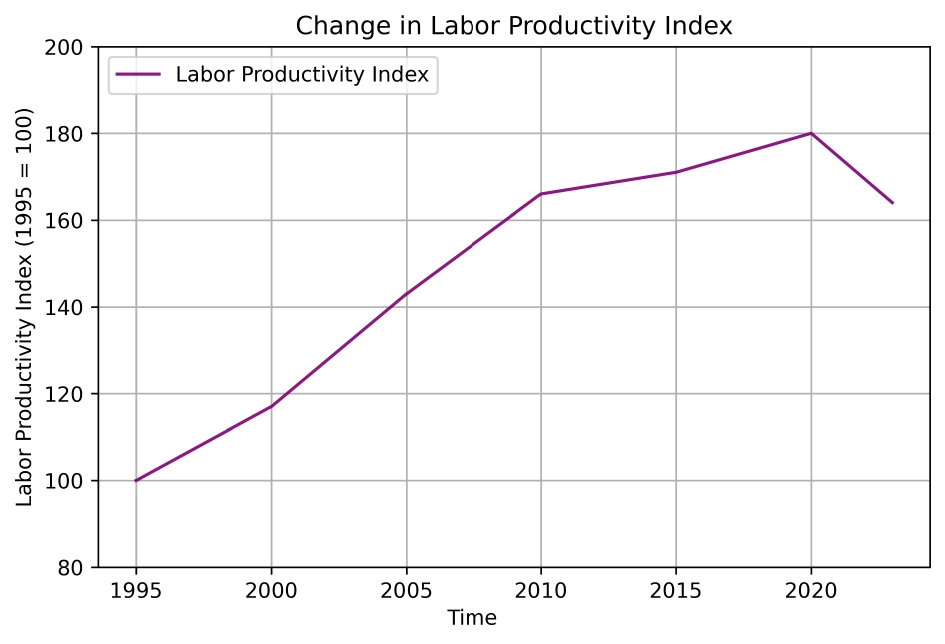
To answer a previous question, this section shows a change in labor productivity that is calculated by manufacturing output divided by total labor input. Figure 4 illustrates that labor productivity has increased recognizably from 1995 to 2023. When I focus 1995 as index of 100, it increases to 180 in 2020 and declines slightly to 164 in 2023. This pattern gives understanding of possible associations with compensation for declining labor input. However, this graph cannot determine whether industrial robot adoption in fact contributed to the increase in labor productivity.
Association between Robot Density and Manufacturing Labor Productivity
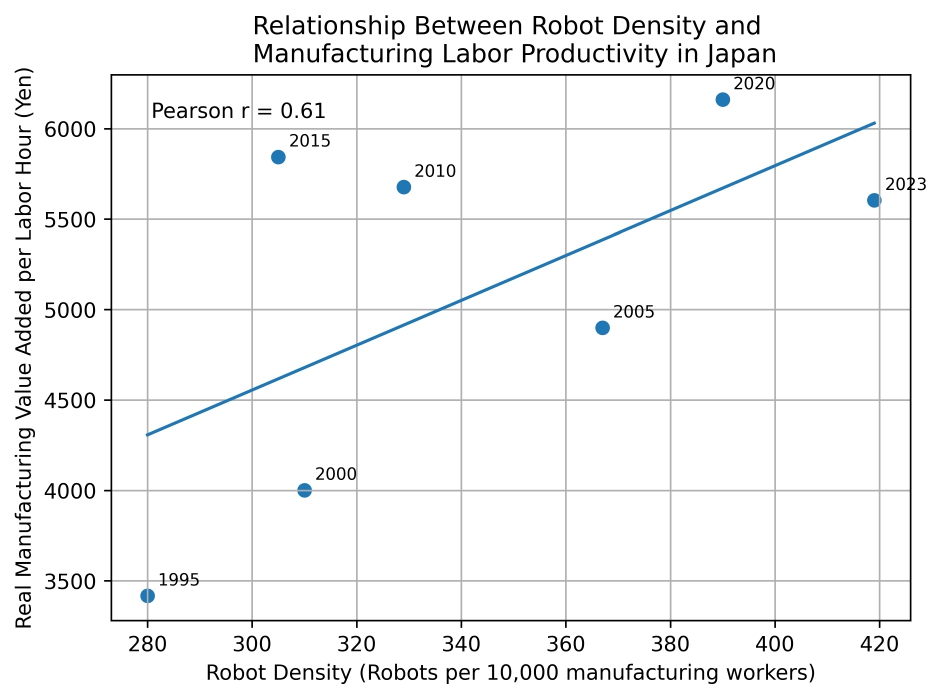
To understand whether industrial robot adoption is associated with increased labor productivity, correlation is an important method to Figure it out. In Figure 5, I calculate the correlation between robot density and real manufacturing value added per labor hour. This graph has a Pearson Correlation coefficient of 0.61 with a moderate positive relationship. However, this graph has a P-value of 0.148, so this analysis does not provide enough sufficient statistical evidence to conclude that greater robot density is associated with higher manufacturing labor productivity. Plus, this graph only has 7 observations, so additional caution is needed to create a more accurate graph.
Discussion and limitations
From these patterns consistent with partial compensation for declining labor input. However, these patterns cannot conclude only robot adoption make changes toward manufacturing output. In addition to the methodological limitation described above, several external factors may have affected manufacturing output and productivity of Japan. To fully conclude the patterns, I need mention effect of COVID-19, exchange rate and international trade between other countries and Japan because manufacturing output can also be affected by international demand and trade conditions. Not only abut trade, but I also must bring up Japanese industrial policy, investments, economic crisis and other automation technologies.
Conclusion
In this research, I conclude that industrial robot adoption may be associated with maintaining manufacturing output under declining labor input but need to face other factors to fully understand the result. However, when I only mention robot density, it generally increases between 1995 and 2023, which suggests how industrial robot adoption has expanded. Throughout 1995 and 2023, labor input has dropped, manufacturing output, labor productivity, and robot density has generally increased and maintained positive relationships. However, the correlation coefficient r was 0.61 with a p-value of 0.148 which was positive, but correlation was not statistically significant. The observed patterns were consistent with partial compensation, but industrial robotics alone cannot fully determine its contribution. It can show association but cannot conclude causation. Overall, I can suggest that Japan’s manufacturing output can be maintained even though labor input, and industrial robotics may be one of factors associated with this pattern. However, there is another huge possible factor that determines this result. This limitation may partly come from a small sample size as one of the reasons. So, in future research, I would use annual data to increase the sample size to make more accurate results. I also should have mentioned subsectors in automation such as electronics, automotive, and chemicals. Additionally, it may create more accurate data by bringing up exchange rate, trade, and investment policy because it can change data such as added values. I would focus more on methodological limitations and variables to create accurate data. Within this research, I learned that Japan’s manufacturing sector may have some capacity to maintain output despite labor constraints.
References
- Statistics Bureau of Japan. Current population estimates as of October 1, 2024. https://www.stat.go.jp/english/data/jinsui/2024np/index.html, 2025 [↩]
- Ministry of Economy, Trade and Industry, Ministry of Health, Labour and Welfare, Ministry of Education, Culture, Sports, Science and Technology. FY2025 measures to promote manufacturing technology (White paper on manufacturing industries, 2026). https://www.meti.go.jp/english/press/2026/0529_003.html, 2026 [↩] [↩]
- International Federation of Robotics. Global automation in 2023 and beyond. https://ifr.org/post/global-automation-in-2023-and-beyond. [↩] [↩] [↩]
- D. Acemoglu, P. Restrepo. Robots and jobs: Evidence from US labor markets. Journal of Political Economy. Vol. 128(6), pg. 2188–2244, 2020, https://doi.org/10.1086/705716. [↩]
- D. Adachi, D. Kawaguchi, Y. U. Saito. Robots and employment: Evidence from Japan, 1978–2017. Journal of Labor Economics. Vol. 42(2), pg. 591–634, 2024, https://doi.org/10.1086/723205. [↩]
- B. Ni, A. Obashi. Robotics technology and firm-level employment adjustment in Japan. Japan and the World Economy. Vol. 57, pg. 101054, 2021, https://doi.org/10.1016/j.japwor.2021.101054. [↩] [↩]
- R. Dekle. Robots and industrial labor: Evidence from Japan. Journal of the Japanese and International Economies. Vol. 58, pg. 101108, 2020, https://doi.org/10.1016/j.jjie.2020.101108. [↩]
- G. Zhu, A. Nie. How industrial robots affect employment: Firm-level evidence from China. Journal of the Asia Pacific Economy. Vol. 31(1), pg. 31–61, 2026, https://doi.org/10.1080/13547860.2024.2403399. [↩]
- T. Wang, Y. Zhang, C. Liu. Robot adoption and employment adjustment: Firm-level evidence from China. China Economic Review. Vol. 84, pg. 102137, 2024, https://doi.org/10.1016/j.chieco.2024.102137. [↩]
- T. Matsuki. Improving the effects of industrial robot adoption on employment, total factor productivity, and real wages in 52 world economies and OECD members. Review of World Economics. Vol. 162, pg. 417–448, 2026, https://doi.org/10.1007/s10290-025-00626-z. [↩]
- G. Graetz, G. Michaels. Robots at work. The Review of Economics and Statistics. Vol. 100(5), pg. 753–768, 2018, https://doi.org/10.1162/rest_a_00754. [↩]
- M. Zhao, Z. Wang, S. Liu. Industrial robot application and total factor productivity of manufacturing enterprises. PLOS ONE. Vol. 20(9), pg. e0331378, 2025, https://doi.org/10.1371/journal.pone.0331378. [↩]
- D. Duan, S. Chen, Z. Feng, J. Li. Industrial robots and firm productivity. Structural Change and Economic Dynamics. Vol. 67, pg. 388–406, 2023, https://doi.org/10.1016/j.strueco.2023.08.002. [↩]
- Y. Zhao, R. Said, N. W. Ismail, H. Z. Hamzah. Impact of industrial robots on labour productivity: Empirical study based on industry panel data. Innovation and Green Development. Vol. 3(2), pg. 100148, 2024, https://doi.org/10.1016/j.igd.2024.100148. [↩]
- D. Autor, A. Salomons. Is automation labor-displacing? Productivity growth, employment, and the labor share. Brookings Papers on Economic Activity. Spring 2018, pg. 1–87, 2018. [↩]
- G. Cette, V. Spiezia, C. Nobile. The contribution of robots to productivity and GDP growth in advanced economies over 1960–2022. Comparative Economic Studies. Vol. 67(4), pg. 896–917, 2025, https://doi.org/10.1057/s41294-025-00264-2. [↩]
- D. Acemoglu, P. Restrepo. Demographics and automation. The Review of Economic Studies. Vol. 89(1), pg. 1–44, 2022, https://doi.org/10.1093/restud/rdab031. [↩]
- F. Chen, W. Liu. Aging workforce and industrial robots: Industry-level evidence from Japan. The Journal of the Economics of Ageing. Vol. 32, pg. 100602, 2025, https://doi.org/10.1016/j.jeoa.2025.100602. [↩]
- H. Lu. Robots, ICT and aging: How do advanced technologies interact with aging. Japan and the World Economy. Vol. 76, pg. 101335, 2025, https://doi.org/10.1016/j.japwor.2025.101335. [↩]
- N. Katiraee, G. Caprari, A. Das, D. Battini. A roadmap for managing an ageing workforce in the manufacturing sector: An Italian case study. Open Research Europe. Vol. 5, pg. 253, 2025, https://doi.org/10.12688/openreseurope.20511.1. [↩]
- A. Börsch-Supan, M. Weiss. Productivity and age: Evidence from work teams at the assembly line. The Journal of the Economics of Ageing. Vol. 7, pg. 30–42, 2016, https://doi.org/10.1016/j.jeoa.2015.12.001. [↩]
- E. Benmelech, M. Zator. Robots and firm investment. Journal of Financial Economics. Vol. 174, pg. 104183, 2025, https://doi.org/10.1016/j.jfineco.2025.104183. [↩]
- L. Deng, M. Fujio, X. Lin, R. Ota. Labor shortage and early robotization in Japan. Economics Letters. Vol. 233, pg. 111404, 2023, https://doi.org/10.1016/j.econlet.2023.111404. [↩] [↩]
- T. Fujimoto. Growth, stagnation, and resilience—the Japanese manufacturing industry in the post-Cold-War period. The Japanese Political Economy. Vol. 52(1), pg. 59–101, 2026, https://doi.org/10.1080/2329194X.2026.2629324. [↩]
- K. Mann, D. Pozzoli. Robots and immigration. Journal of Economic Behavior & Organization. Vol. 227, pg. 106708, 2024, https://doi.org/10.1016/j.jebo.2024.106708. [↩]
- M. Koch, I. Manuylov, M. Smolka. Robots and firms. The Economic Journal. Vol. 131(638), pg. 2553–2584, 2021, https://doi.org/10.1093/ej/ueab009. [↩]
- H. Nakamura, M. Nakamura, S. Moriwaki. The macroeconomics of automation. Journal of Economic Growth. Vol. 31(3), pg. 349–395, 2026, https://doi.org/10.1007/s10887-026-09265-x. [↩] [↩]
- S. Kim. Temporal changes in factor adjustment of the Japanese manufacturing industry. Cogent Economics & Finance. Vol. 10(1), pg. 2122191, 2022, https://doi.org/10.1080/23322039.2022.2122191. [↩]
- W. Hadid, S. Horii, A. Yokota. Artificial intelligent technologies in Japanese manufacturing firms: An empirical survey study. International Journal of Production Research. Vol. 63(1), pg. 193–219, 2025, https://doi.org/10.1080/00207543.2024.2358409. [↩]
- S. Kikuchi, I. Fujiwara, T. Shirota. Automation and disappearing routine occupations in Japan. Journal of the Japanese and International Economies. Vol. 74, pg. 101338, 2024, https://doi.org/10.1016/j.jjie.2024.101338. [↩]
- D. Acemoglu. When does labor scarcity encourage innovation? Journal of Political Economy. Vol. 118(6), pg. 1037–1078, 2010, https://doi.org/10.1086/658160. [↩]
- P. Mikalef, M. Gupta. Artificial intelligence capability: Conceptualization, measurement calibration, and empirical study on its impact on organizational creativity and firm performance. Information & Management. Vol. 58(3), pg. 103434, 2021, https://doi.org/10.1016/j.im.2021.103434. [↩]
- Statistics Bureau of Japan. Labour Force Survey: Historical data, basic tabulation – employed persons by industry. e-Stat, Statistics of Japan. https://www.e-stat.go.jp/en/stat-search/files?cycle=0&tclass=000001226526. [↩] [↩] [↩]
- Ministry of Health, Labour and Welfare, Japan. Monthly Labour Survey / Data on working hours in Japan and other countries. https://www.mhlw.go.jp/shingi/2005/05/s0520-7c.html, 2005. [↩] [↩]
- Japan Institute for Labour Policy and Training. Databook of international labour statistics 2023. https://www.jil.go.jp/kokunai/statistics/databook/2023/index.html, 2023. [↩]
- United Nations Economic Commission for Europe. World industrial robots / robot density statistics. https://unece.org/fileadmin/DAM/press/pr1996/96ind7.htm. [↩]
- Cabinet Office, Government of Japan, Economic and Social Research Institute. National accounts for 2023: Gross domestic product classified by economic activities, in real terms. https://www.esri.cao.go.jp/en/sna/data/kakuhou/files/2023/2023annual_report_e.html. [↩]