
Abstract
Introduction: Adolescence is a critical period for cognitive and emotional growth. In the U.S., an estimated 38% of high school students report serious cognitive difficulties, and about 20% of adolescents have a diagnosed mental or behavioral health condition such as anxiety, both associated with poorer academic performance and psychosocial functioning. Because both problems are common and affect how students do in school, it is worth finding accessible activities that might help with each. This study examined whether sustained participation in structured dance is associated with better cognitive functioning and reduced generalized anxiety among female high school students.
Methods: Forty-seven female adolescents aged 14–17 were recruited into two groups: dancers with ≥5 years of structured training (n = 22) and peers with no formal dance experience (control; n = 25). Cognitive functioning was assessed using standardized PsyToolkit tasks: Corsi Block Tapping Task (working memory), Mental Rotation Task (visuospatial reasoning), and Deary–Liewald Simple Reaction Time Task (processing speed). Anxiety was assessed with the Generalized Anxiety Disorder‑7 (GAD-7). Groups were compared using independent-samples t-tests (Welch-corrected where variances were unequal), with Benjamini–Hochberg correction for multiple comparisons.
Results: Compared to controls, dancers demonstrated significantly faster reaction times (337.56 vs. 440.57 ms; p = .024, d = 0.90), higher visuospatial working memory span (Corsi span 5.56 vs. 4.14; p = .037, d = 0.82), and greater mental rotation accuracy (86.11% vs. 75.71%; p = .013, d = 0.95). Dancers also reported significantly lower generalized anxiety (GAD-7 4.36 vs. 7.86; p = .016, d = 0.98).
Conclusion: Long-term structured dance participation was associated with better cognitive performance, particularly in visuospatial working memory and spatial reasoning. Dancers also reported significantly lower anxiety, with a mean score in the minimal range compared with the mild range for non-dancers. The design is cross-sectional, so these results cannot show that dance causes the differences. They do suggest that dance is worth studying further as a possible support for cognitive development in adolescence, not only as an elective physical activity.
Keywords: Dance, Cognition, Anxiety, Female, Adolescents
Introduction
In the United States, cognitive difficulties among high school students represent a major public health concern. On the 2019 Youth Risk Behavior Survey, 38% of U.S. high school students (ages 14–18) reported serious difficulty concentrating, remembering, or making decisions because of a physical, mental, or emotional problem, including 45% of girls, and these difficulties were closely associated with emotional distress1,2. At the same time, roughly 20% of adolescents, about 5.3 million nationwide, have a diagnosed mental or behavioral health condition such as anxiety or depression3, and nearly one in three U.S. adolescents meets criteria for an anxiety disorder at some point by late adolescence4. While cognitive and emotional difficulties are often studied separately, the two frequently overlap: adolescents with cognitive difficulties are also more likely to experience mental health challenges such as depression1. It makes sense, then, to look for interventions that could help with both. Adolescents with co-occurring cognitive and emotional difficulties often face substantial deficits in working memory, attention, and executive functioning, which can undermine academic performance, self-esteem, and social interactions5,6. Because thinking skills and emotional regulation are both still maturing in adolescence, this overlap is especially important during these years. Schools reach nearly all adolescents, and programs that target cognitive skills and mental health together could help students both academically and emotionally7.
Long-term dance participation has been linked to both cognitive and emotional benefits, and one likely reason is that dance draws on several neural systems at the same time, including sensory–motor integration, working memory, spatial navigation, rhythm processing, and social–emotional regulation8,9,10. Systematic reviews and randomized controlled trials in older adults indicate that dance interventions can improve global cognition10 and white-matter integrity11, although comparisons with other forms of exercise have been mixed; for example, one randomized trial found no advantage of social dancing over walking for executive function, but did find a benefit for spatial memory12. Cross-sectional studies also show structural and functional brain differences in expert dancers13. Dance has also been associated with fewer symptoms of depression and anxiety, possibly because it combines exercise, music, social contact, and emotional expression in a single activity14,15. One proposed explanation is that learning and performing choreography, which requires balance, timing, and moving in sync with others, may promote neuroplasticity. Exercise in general also raises levels of brain-derived neurotrophic factor (BDNF), a protein involved in learning and mood regulation9,16.
Structured dance interventions have been shown to improve functional mobility and physical endurance17,18, and neuroimaging studies suggest that the effects reach the brain as well. PET and MRI research has shown that dance activates the motor cortex, somatosensory cortex, basal ganglia, and cerebellum19. These regions are responsible for planning, sequencing, and coordinating voluntary movement, along with integrating sensory feedback. Longer-term dance training has also been associated with larger hippocampal volume and stronger white-matter pathways, both of which are tied to memory9,11. Neuropsychological (NPSY) tests of attention, working memory, learning, and perceptual-motor skills offer a way to measure these changes in behavior. Most of this evidence comes from older adults. Whether the same changes happen in adolescents is less clear, but the question is worth asking, since the adolescent brain is still changing quickly7.
Alongside cognitive benefits, structured dance participation has been shown to support emotional and psychological well-being. Involvement in a variety of dance styles has been associated with reduced depressive symptoms and increased perceived competence20, which may reflect gains in self-esteem and emotional regulation. Dance interventions have also been associated with improvements in quality of life and psychological well-being17,15. Possible reasons include the chance to express emotion through movement, the experience of moving in time with music and with other dancers, and the sense of identity that can come from performing. These experiences may matter most to teenagers, who are still working out their social roles and sense of self. Researchers typically measure these effects with standardized instruments such as the State–Trait Anxiety Inventory21 and the Symptom Checklist-9022, which measure anxiety and broader psychological symptoms. The present study used the briefer Generalized Anxiety Disorder 7-item scale (GAD-7), which has been validated in adolescent samples23,24.
Most research on the cognitive and emotional benefits of dance, however, focuses on older adults. Far fewer studies have looked at adolescents, even though the brain is especially adaptable during these years. High school students also deal with academic pressure and constant comparison with peers, which can strain attention, mood, and self-esteem. Because dance combines movement, memorization, emotional expression, and working with others, it uses many of the same skills that are still developing at this age. If dance benefits cognition and mood in adults, it is reasonable to ask whether the same is true for teenagers, and there is little direct evidence either way. The present study addresses that question: do adolescents with long-term dance training perform better on standardized cognitive tasks and report less anxiety than adolescents with no formal dance experience?
Aim. This study examined whether long-term structured dance training (≥ 5 years) is associated with differences in cognitive performance (visuospatial working memory, visuospatial reasoning, and processing speed) and self-reported anxiety in adolescent females, compared with non-dancers.
H1 (Working memory). Adolescents with ≥ 5 years of structured dance training will show higher visuospatial working memory, measured by the Corsi Block Tapping Task, than non-dancers, as choreography requires continuous spatial updating, sequencing, and motor planning25.
H2 (Visuospatial reasoning). Dancers will show higher mental rotation accuracy, measured by the Mental Rotation Task, than non-dancers, consistent with the repeated spatial-transformation and embodied-cognition demands of dance26,15.
H3 (Processing speed). Dancers will show faster processing speed and reaction time, measured by the Deary–Liewald Simple Reaction Time Task, than non-dancers, consistent with evidence that physical training and effort influence reaction time in physically active young adults27.
H4 (Anxiety). Dancers will report lower generalized anxiety, measured by the GAD-7, than non-dancers, consistent with evidence that dance is associated with reduced anxiety and improved emotional regulation14,15.
Theoretical framework
This study is grounded in embodied cognition, a framework proposing that repeated sensorimotor experience shapes related cognitive skills28,26. Applied to dance, this suggests that years of training could be linked to the specific skills measured here. Choreography requires dancers to keep track of their position and orientation in space, which connects to visuospatial reasoning (Mental Rotation Task) and working memory (Corsi Block Tapping Task). Reacting quickly to music and cues connects to processing speed (Simple Reaction Time Task). The routine, emotional outlet, and social support of regular dance classes connect to anxiety (GAD-7). These links come from earlier research and are offered only as possible explanations. This study did not include any neuroimaging, biochemical, or physiological measures, so it cannot test the mechanisms behind them.
Methods
The study recruited 54 female high school students (ages 14–17) into two pre-defined groups based on dance experience: a dance-trained group with ≥5 years of formal dance training and a non-dancer group with no prior formal dance experience. Participants were recruited through convenience sampling: an open invitation, along with consent and assent forms, was distributed to high schools in the surrounding area, and eligible students voluntarily enrolled by returning completed forms. Sample size was determined by the number of eligible students who enrolled during the recruitment period. With 22 dancers and 25 non-dancers, the study had 80% power (two-tailed α = .05) to detect only large effects (Cohen’s d ≈ 0.84); power to detect a medium effect (d = 0.5) was approximately 39%. Inclusion criteria included regular school attendance, access to a computer that meets the study’s technical requirements, and willingness to participate. Participants were excluded if they had a neurological or psychiatric disorder, were currently taking medication that affects cognition or mood, had significant uncorrected visual or motor impairments, or had a recent injury. Parental consent and student assent were collected digitally prior to participation.
Participants were included in the dancer group if they had at least 5 years of formal dance training and reported currently practicing at least one hour per week. Participants reported involvement in a range of dance styles, most commonly ballet, hip hop, contemporary, and folk. Several participants also reported “other” styles or mixed training backgrounds, so the group’s training backgrounds were varied.
All assessments were administered online through PsyToolkit, a secure online experiment platform29,30, and were completed at school or at home. To standardize testing conditions, students were required to use a laptop or desktop computer with a physical keyboard and a mouse or trackpad; smartphones, tablets, and touchscreen-only devices were not permitted, since they can introduce input variability and timing inaccuracies. Participants were also asked to complete the assessment battery in a quiet, well-lit room free of distractions, avoid caffeine or stimulants for at least 2 hours beforehand, and get a normal night’s sleep before testing. The entire battery was completed in a single session. All responses were de-identified, and the data have been securely stored.
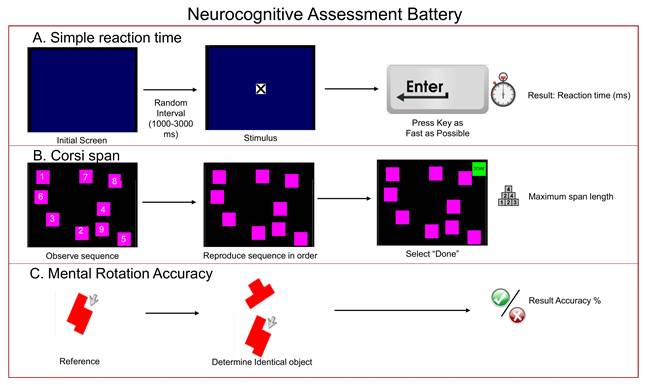
Outcome measures were selected to assess multiple cognitive domains and anxiety severity, using standardized tasks and questionnaires well established in the literature. All measures were implemented through PsyToolkit31 (Figure 1).
Cognitive outcomes included the Deary–Liewald Simple Reaction Time task, a computerized measure of processing speed implemented as described in the PsyToolkit experiment library32. Visuospatial working memory span and sequencing ability were assessed using the Corsi Block Tapping Task, following the standard format and normative procedures described by Kessels et al., who validated it as a visuospatial memory assessment33. Visuospatial reasoning was measured with a computerized mental rotation task implemented in PsyToolkit, in which participants viewed a reference shape and identified which of two rotated shapes was identical to it (Figure 1C). The task is a two-dimensional adaptation of the mental rotation paradigm used in the classic three-dimensional Mental Rotation Test developed by Vandenberg and Kuse34.
Each cognitive task was scored according to its standard conventions: mean reaction time (ms) for the simple reaction time task, maximum span length for the Corsi task, and percentage of correct responses for the mental rotation task.
Psychological outcomes were assessed using the Generalized Anxiety Disorder 7‑item scale (GAD‑7), a brief self‑report questionnaire that screens for and assesses the severity of generalized anxiety. The GAD‑7 has seven items scored 0–3 (total range 0–21), with established cutoffs for minimal, mild, moderate, and severe anxiety, and it is widely validated in both clinical and research settings. Respondents rate how often they have been bothered by each symptom over the preceding two weeks on a four-point scale (0 = not at all, 1 = several days, 2 = more than half the days, 3 = nearly every day). Its reliability and construct validity have also been established specifically in adolescent samples23,24.
Potential limitations include variability in internet connectivity and differences in computer hardware; however, these issues were minimized by requiring standardized equipment (a laptop or desktop with a keyboard and mouse or trackpad) and by providing clear environmental and behavioral guidelines to minimize external influences on performance. Socioeconomic status was not formally measured using a standardized scale and was therefore not included in the analysis; future studies should incorporate such a measure to examine its potential influence on cognitive and emotional outcomes. As participation was voluntary, the sample was self-selected rather than random, which may limit the extent to which the findings generalize. Both groups were recruited through the same open invitation, applying similar selection pressures across groups, but self-selection bias cannot be fully ruled out.
Statistical Analysis
Independent-samples t-tests were used to compare age and grade level between groups, and Fisher’s exact test was used to compare handedness. Group differences on each outcome were tested with independent-samples t-tests. Prior to analysis, the data were screened for outliers, and normality was assessed with Shapiro–Wilk tests; most variables were approximately normally distributed (p > .05). Levene’s test for equality of variances was conducted for each comparison, and where the assumption of homogeneity of variance was violated, Welch’s t-test was reported instead. Effect sizes were calculated using Cohen’s d, with 0.2, 0.5, and 0.8 representing small, medium, and large effects, respectively. The three cognitive measures (visuospatial working memory, visuospatial reasoning, and processing speed) were treated as primary outcomes and self-reported anxiety (GAD-7) as a secondary outcome. The study was exploratory and not pre-registered. To limit false positives from multiple comparisons, p-values were adjusted across the four outcome comparisons using the Benjamini–Hochberg false discovery rate procedure.
Ethical Considerations
This study received Full Committee Review approval from the Metea Valley High School Institutional Review Board (IRB) prior to participant recruitment and data collection, in accordance with Society for Science/ISEF rules for research involving human participants (ISEF Human Participants Form 4). The reviewing committee included three independent members unaffiliated with the research team: a school psychologist, a science educator, and a school administrator. The protocol was classified as greater than minimal risk. A formal risk assessment was completed, and parental permission and minor assent (collected digitally, as described above) were obtained for all participants. This IRB does not assign protocol numbers for student research; signed documentation is available on request.
Cognitive assessment and GAD-7 data were collected through PsyToolkit in de-identified form, with no key linking responses to participant identities. Data were stored within the password-protected PsyToolkit account and on a password-protected, school-managed computer. Identifiable parental consent and assent records were stored separately from the de-identified analysis dataset and were not linked to it. Access to all records was restricted to the student researcher and the adult sponsor. De-identified data will be retained for two years following publication, then permanently deleted.
The GAD-7 was administered as an anonymous screening measure for research purposes only, not intended as a diagnostic instrument. Scores were not disclosed to participants, who could skip any item or withdraw at any time without penalty. A protocol established before data collection specified that anyone scoring in the moderate-to-severe range would automatically see school counseling and mental-health resources displayed within the survey itself, since responses could not be tracked back to individual participants. No participant in the sample scored in this range.
Results
Participant Flow
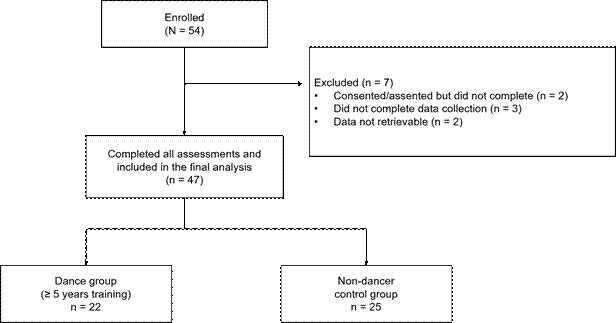
A total of 54 participants were enrolled. Of these, 2 consented and assented but did not go on to complete the study, 3 began but did not complete data collection, and data from 2 participants could not be retrieved. This left a total of 47 participants who completed the study and were included in the analysis (dance group, n = 22; non-dancer control group, n = 25; Figure 2).
Participant Characteristics and Group Comparisons
This study included 47 participants. The Dance Group (n = 22) consisted of adolescents with an average age of 16.26 years (SD = 0.87). All participants in the dance group were in 11th grade (M = 11.16, SD = 2.03). The Control Group (n = 25) had a mean age of 16.28 years (SD = 0.83) and a mean grade level of 10.91 (SD = 0.51), comprising 10th- and 11th-grade students.
Regarding handedness, both groups were predominantly right-handed: the dance group included 17 right-handed individuals, 4 left-handed individuals, and 1 ambidextrous individual (77.3% right-handed), while the control group included 21 right-handed individuals and 4 left-handed individuals (84% right-handed). The groups did not differ significantly in age (p = .94) or grade level (p = .58) (Table 1).
In the Deary–Liewald Simple Reaction Time task (Table 2), dancers demonstrated faster processing speed (M = 337.56 ms, SD = 73.10) compared with non-dancers (M = 440.57 ms, SD = 141.54), and this difference was statistically significant (p = .024, Cohen’s d = 0.90, 95% CI for the mean difference [37, 169] ms). Dancers may respond to stimuli more efficiently, which would fit with the quick, reactive movement that dance practice requires.
Visuospatial working memory capacity was assessed using the Corsi Block Tapping Task. Dancers achieved a higher mean span (M = 5.56, SD = 0.96) compared with non-dancers (M = 4.14, SD = 2.18), and this difference was statistically significant (p = .037, Cohen’s d = 0.82, 95% CI for the mean difference [0.44, 2.40] blocks). Dancers’ scores were also less spread out (smaller SD), so their performance was more consistent as a group.
Among the cognitive measures, the largest group difference was observed in the Mental Rotation Task. Dancers demonstrated higher accuracy in identifying rotated shapes (M = 86.11%, SD = 10.92) compared with non-dancers (M = 75.71%, SD = 10.89), and this difference was statistically significant (p = .013, Cohen’s d = 0.95, 95% CI for the mean difference [3.98, 16.82] percentage points). Dancers may use more effective strategies for rotating shapes in their heads, although this study cannot show that training is the reason.
The Dance Group reported lower levels of generalized anxiety (M = 4.36, SD = 4.03) compared with the Control Group (M = 7.86, SD = 3.08), and this difference was statistically significant (p = .016, Cohen’s d = 0.98, 95% CI for the mean difference [1.36, 5.64] points). On average, the dance group scored in the minimal range (0–4) and the control group in the mild range (5–9); neither group mean fell in the clinically elevated (moderate or severe) range.
After adjusting for multiple comparisons with the Benjamini-Hochberg false discovery rate procedure, all four group differences remained statistically significant (adjusted p ≈ .03–.04). With four comparisons and a small sample, however, these results should still be treated as preliminary. Under the more conservative Bonferroni correction (α = .0125), no comparison reached significance, although mental rotation (p = .013) came close.
Discussion
This study compared adolescent girls with at least five years of dance training to girls with no formal dance experience on three cognitive tasks and a measure of anxiety. All four hypotheses were supported. Dancers had higher Corsi spans (H1), more accurate mental rotation (H2), and faster reaction times (H3), and they reported lower anxiety on the GAD-7 (H4).
The mental rotation result fits the embodied cognition account, which holds that motor experience shapes cognitive skills. In class, dancers constantly have to rotate what they see in their heads, for example when mirroring a teacher who is facing them or working out where to stand relative to other dancers on stage26. These findings are consistent with work by Rehfeld et al.9, who found that dance training in older adults was associated with increased volume of the hippocampus, a region involved in spatial memory and orientation. Because only one spatial reasoning task was used, however, these data cannot show whether this advantage generalizes to other spatial skills.
The Corsi result makes sense given how much of dance involves memorizing long sequences of steps and positions and then reproducing them exactly. The faster reaction times may likewise reflect years of practice turning music and visual cues into precisely timed movement. Each skill tested here is one that dance uses regularly, which fits an embodied cognition account. The study did not include a task unrelated to dance, though, so it cannot show that the differences are limited to dance-trained skills. It is also possible that girls who already have strong spatial or attention skills are more likely to start dance and stay with it, and these data cannot rule that out.
Implications
The results may also matter for education. Subjects such as geometry, architectural design, and organic chemistry require students to picture and rotate 3D structures in their heads, and STEM (Science, Technology, Engineering, and Mathematics) courses depend on this skill. Spatial ability is a well-established predictor of achievement in STEM fields35. If the link between dance and spatial ability holds up, dance could indirectly support skills used in science and engineering, but this study did not test that.
Anxiety and Emotional Regulation
Dancers scored significantly lower on the GAD-7 than non-dancers. One possible reason is what a dance studio offers: a regular routine, physical activity, and a group of peers and teachers14. Neither group was free of anxiety symptoms, though. The dance group averaged in the minimal range and the non-dancers in the mild range, which is in line with national data showing that mental health concerns are common among U.S. adolescents2,3. It is tempting to think of dance as a kind of “moving meditation,” and the results point in that direction, but the idea is speculative, and the sample is too small for firm conclusions.
Limitations
This study has several limitations. First, because the design is cross-sectional, it shows associations, not causes. Second, the dancers trained in different styles. Participants trained in forms such as ballet, hip hop, contemporary, and folk, which differ in physical intensity and in the specific perceptual, motor, and memory demands they place on performers. Because participants were not stratified by style, and training intensity beyond the minimum eligibility threshold (e.g., actual hours per week or competitive level) was not recorded, this study could not examine whether particular styles or intensities were more strongly associated with the outcomes observed; future work should collect and analyze this information. Third, because testing was conducted online, variation in participants’ hardware could have introduced minor timing “noise” into the reaction-time measurements30. Device, browser, and display characteristics were not logged, and per-trial timing could not be independently validated, so the reaction-time findings should be considered exploratory. Fourth, all participants were girls from one area, so the results may not apply to boys or to other populations. Testing was also unsupervised, so there was no way to confirm that participants followed the pre-test instructions.
The biggest limitation is confounding. Participants were not randomly assigned, so dancers and non-dancers may differ in other ways that also affect cognition and anxiety, including habitual sleep, physical activity outside of dance, diet, socioeconomic status, parental education, participation in other structured or competitive activities, music training, screen and video-game use, academic achievement, subclinical anxiety or neurodevelopmental history (beyond the exclusion of diagnosed disorders), and menstrual-cycle phase. None of these variables were measured in the present study, so groups could not be matched on them or statistically adjusted (for example, through regression with prespecified covariates). Excluding students with diagnosed psychiatric disorders also restricted the range of anxiety scores, which limits the generalizability of the GAD-7 findings. The pre-test instructions (no caffeine or stimulants, normal sleep, a quiet room) help with differences on the day of testing, but not with longer-lasting differences between the groups. The results therefore cannot be credited to dance training alone. Future studies should measure these factors and either match groups on them or include them as covariates.
A longitudinal study that follows non-dancers for six months to a year after they start dance would help show which way the relationship runs, and a randomized trial would be needed to show that dance causes the differences. Diffusion MRI could also be used to see whether white-matter integrity in adolescents changes with intensive dance training.
Conclusion
Adolescent girls with at least five years of dance training did better than non-dancers on tests of visuospatial reasoning, working memory, and reaction time, and they reported less anxiety. The dancers’ average GAD-7 score was in the minimal range, while the non-dancers’ was in the mild range. These results do not show that dance causes the differences, but they give good reason to test dance in longitudinal and randomized studies as a possible support for adolescent development, and not just as an elective.
| Variable | Dancers (n=22) | Non-Dancers (n=25) | p-value |
| Age (Years) | 16.26 ± 0.87 | 16.28 ± 0.83 | .94 |
| Grade Level | 11.16 ± 2.03 | 10.91 ± 0.51 | .58 |
| Handedness (R/L/A) | 17 / 4 / 1 | 21 / 4 / 0 | __ |
| Variable | Dancers (n=22) | Non-Dancers (n=25) | Mean Diff. | p value |
| Deary–Liewald Simple RT (ms) | 337.56 ± 73.10 | 440.57 ± 141.54 | −103.01 | .024 |
| Corsi Span | 5.56 ± 0.96 | 4.14 ± 2.18 | 1.42 | .037 |
| Mental Rotation Accuracy (%) | 86.11 ± 10.92 | 75.71 ± 10.89 | 10.40 | .013 |
| GAD-7 Score | 4.36 ± 4.03 | 7.86 ± 3.08 | −3.50 | .016 |
Conflict of interest
The authors declare that the research was conducted in the absence of any commercial or financial relationships that could be construed as a potential conflict of interest.
Author contribution
Shivani Munaga (SM) was responsible for the conceptualization of the study, software development and coding of the cognitive assessment tools, data collection, formal analysis, and the original drafting of the manuscript. Joanne Vakil (JV) provided methodology supervision, ensured adherence to ethical research standards, and mentored the overall research process. Savitha Subramaniam (SS) provided a critical review of the manuscript. All authors contributed to the article and approved the submitted version.
Funding
The author(s) received no financial support for the research, authorship, and/or publication of this article.
Acknowledgements
I would like to express my sincere gratitude to my Illinois Mathematics and Science Academy (IMSA) instructor, Dr. Vakil, for guiding me through the research process and research ethics. I thank Dr. Subramaniam for her help with the study’s conceptual framework and for her careful review of the manuscript. I wish to acknowledge Metea Valley High School and Principal DeBruycker for supporting this project. I am also grateful to the IMSA program and collaborators at the University of Illinois Chicago (UIC) for the resources and setting that made this research possible. Additionally, I would like to recognize the Illinois Junior Academy of Science (IJAS) and Bradley University for the scholarship award that recognized the early stages of this work. Finally, thank you to Dr. Stoet for creating PsyToolkit, which I used to build and run the cognitive tasks in this study.
Data availability statement
The raw data supporting the conclusions of this article will be made available by the authors, without undue reservation, to any qualified researcher. To protect the privacy of the adolescent participants, data will be provided in a de-identified format upon request for two years following publication, after which the data will be permanently deleted, as described in the Ethical Considerations.
References
- G. L. Iverson, I. A. Iverson. Perceived cognitive impairment in high school students in the United States. Frontiers in Psychology. Vol. 13, pg. 1019159, 2022. [↩] [↩]
- Centers for Disease Control and Prevention. Youth risk behavior surveillance system (YRBSS). U.S. Department of Health and Human Services. https://www.cdc.gov/yrbs, 2023. [↩] [↩]
- O. Sappenfield, C. Alberto, J. Minnaert, J. Donney, L. Lebrun-Harris, R. Ghandour. Adolescent mental and behavioral health, 2023. National Survey of Children’s Health Data Briefs. Health Resources and Services Administration, 2024. [↩] [↩]
- K. R. Merikangas, J.-P. He, M. Burstein, S. A. Swanson. Lifetime prevalence of mental disorders in U.S. adolescents: Results from the National Comorbidity Survey Replication–Adolescent Supplement (NCS-A). Journal of the American Academy of Child & Adolescent Psychiatry. Vol. 49, pg. 980–989, 2010. [↩]
- H. R. Snyder. Major depressive disorder is associated with broad impairments on neuropsychological measures of executive function: A meta-analysis and review. Psychological Bulletin. Vol. 139, pg. 81–132, 2013. [↩]
- J. Urbańska-Grosz, M. Walkiewicz, E. J. Sitek. Is there sufficient evidence for the association between executive dysfunction and academic performance in adolescents with major depressive disorder? A systematic review. European Child & Adolescent Psychiatry. Vol. 33, pg. 2129–2140, 2024. [↩]
- Y. D. Chen, S. Agrawal, A. P. Anokhin, M. Luciana, D. G. Gee, Y. T. Cho. Untangling relationships between cognitive development and child and adolescent mental health: Findings from the ABCD Study. Developmental Cognitive Neuroscience. Vol. 80, pg. Article 101772, 2026. [↩] [↩]
- J.-C. Kattenstroth, T. Kalisch, S. Holt, M. Tegenthoff, H. R. Dinse. Six months of dance intervention enhances postural, sensorimotor, and cognitive performance in elderly without affecting cardio-respiratory functions. Frontiers in Aging Neuroscience. Vol. 5, pg. 5, 2013. [↩]
- K. Rehfeld, P. Müller, N. Aye, M. Schmicker, M. Dordevic, J. Kaufmann, N. G. Müller. Dancing or fitness training? Effects on hippocampal plasticity and balance in seniors. Frontiers in Human Neuroscience. Vol. 11, pg. 305, 2017. [↩] [↩] [↩] [↩]
- P. Hewston, C. C. Kennedy, S. Borhan, D. Merom, P. Santaguida, G. Ioannidis, S. Marr, N. Santesso, L. Thabane, S. Bray, A. Papaioannou. Effects of dance on cognitive function in older adults: A systematic review and meta-analysis. Age and Ageing. Vol. 50, pg. 1084–1092, 2021. [↩] [↩]
- A. Z. Burzynska, Y. Jiao, A. M. Knecht, J. Fanning, E. A. Awick, T. Chen, N. Gothe, M. W. Voss, E. McAuley, A. F. Kramer. White matter integrity declined over 6-months, but dance intervention improved integrity of the fornix of older adults. Frontiers in Aging Neuroscience. Vol. 9, pg. 59, 2017. [↩] [↩]
- D. Merom, A. Grunseit, R. Eramudugolla, B. Jefferis, J. Mcneill, K. J. Anstey. Cognitive Benefits of Social Dancing and Walking in Old Age: The Dancing Mind Randomized Controlled Trial. Frontiers in Aging Neuroscience. Vol. 8, pg. Article 26, 2016. [↩]
- A. Z. Burzynska, K. Finc, B. K. Taylor, A. M. Knecht, A. F. Kramer. The dancing brain: Structural and functional signatures of expert dance training. Frontiers in Human Neuroscience. Vol. 11, pg. 566, 2017. [↩]
- S. C. Koch, R. F. F. Riege, K. Tisborn, J. Biondo, L. Martin, A. Beelmann. Effects of dance movement therapy and dance on health-related psychological outcomes: A meta-analysis update. Frontiers in Psychology. Vol. 10, pg. 1806, 2019. [↩] [↩] [↩]
- A. Fong Yan, L. L. Nicholson, R. E. Ward, C. E. Hiller, K. Dovey, H. M. Parker, L.-F. Low, G. Moyle, C. Chan. The effectiveness of dance interventions on psychological and cognitive health outcomes compared with other forms of physical activity: A systematic review with meta-analysis. Sports Medicine. Vol. 54, pg. 1179–1205, 2024. [↩] [↩] [↩] [↩]
- G. Liu, Z. Liang, W. Wang, R. Ge. Optimizing exercise modalities to enhance brain-derived neurotrophic factor levels in older adults: A Bayesian network and dose-response meta-analysis. Frontiers in Physiology. Vol. 17, pg. Article 1777058, 2026. [↩]
- J. Lu, N. A. Abd Rahman, M. Wyon, S. Shaharudin. The effects of dance interventions on physical function and quality of life among middle-aged and older adults: A systematic review. PLOS ONE. Vol. 19, pg. e0301236, 2024. [↩] [↩]
- A. Fong Yan, S. Cobley, C. Chan, E. Pappas, L. L. Nicholson, R. E. Ward, R. E. Murdoch, Y. Gu, B. L. Trevor, A. J. Vassallo, M. A. Wewege, C. E. Hiller. The effectiveness of dance interventions on physical health outcomes compared to other forms of physical activity: A systematic review and meta-analysis. Sports Medicine. Vol. 48, pg. 933–951, 2018. [↩]
- F. J. Karpati, C. Giacosa, N. E. V. Foster, V. B. Penhune, K. L. Hyde. Dance and the brain: A review. Annals of the New York Academy of Sciences. Vol. 1337, pg. 140–146, 2015. [↩]
- D. Tao, Y. Gao, A. Cole, J. S. Baker, Y. Gu, R. Supriya, T. K. Tong, Q. Hu, R. Awan-Scully. The physiological and psychological benefits of dance and its effects on children and adolescents: A systematic review. Frontiers in Physiology. Vol. 13, pg. 925958, 2022. [↩]
- C. D. Spielberger, R. L. Gorsuch, R. Lushene, P. R. Vagg, G. A. Jacobs. Manual for the State–Trait Anxiety Inventory. Consulting Psychologists Press, 1983. [↩]
- L. R. Derogatis. SCL-90: Administration, scoring, and procedures manual for the revised version. Johns Hopkins University Press, 1977. [↩]
- K. Tiirikainen, H. Haravuori, K. Ranta, R. Kaltiala-Heino, M. Marttunen. Psychometric properties of the 7-item Generalized Anxiety Disorder Scale (GAD-7) in a large representative sample of Finnish adolescents. Psychiatry Research. Vol. 272, pg. 30–35, 2019. [↩] [↩]
- S. A. Mossman, M. J. Luft, H. K. Schroeder, S. T. Varney, D. E. Fleck, D. H. Barzman. The Generalized Anxiety Disorder 7-item scale in adolescents with generalized anxiety disorder: Signal detection and validation. Annals of Clinical Psychiatry. Vol. 29, pg. 227–234, 2017. [↩] [↩]
- P. Shi, Y. Tang, Z. Zhang, X. Feng, C. Li. Effect of physical exercise in real-world settings on executive function of typical children and adolescents: A systematic review. Brain Sciences. Vol. 12, pg. 1734, 2022. [↩]
- M. E. Hackney, A. Z. Burzynska, L. H. Ting. The cognitive neuroscience and neurocognitive rehabilitation of dance. BMC Neuroscience. Vol. 25, pg. Article 58, 2024. [↩] [↩] [↩]
- A. Berdowska, D. Dusiński, K. Bandurska, A. Tsos. Effort and reaction time in weightlifters, manual workers, and students – a pilot study. Physical Activity Review. Vol. 13, pg. 97–105, 2025. [↩]
- M. Wilson. Six views of embodied cognition. Psychonomic Bulletin & Review. Vol. 9, pg. 625–636, 2002. [↩]
- G. Stoet. PsyToolkit: A software package for programming psychological experiments using Linux. Behavior Research Methods. Vol. 42, pg. 1096–1104, 2010. [↩]
- G. Stoet. PsyToolkit: A novel web-based method for running online questionnaires and reaction-time experiments. Teaching of Psychology. Vol. 44, pg. 24–31, 2017. [↩] [↩]
- PsyToolkit. PsyToolkit: Experimental software for cognitive social neuroscience and psychophysics. https://www.psytoolkit.org, n.d. [↩]
- I. J. Deary, D. Liewald, J. Nissan. A free, easy-to-use, computer-based simple and four-choice reaction time programme: The Deary-Liewald reaction time task. Behavior Research Methods. Vol. 43, pg. 258–268, 2011. [↩]
- R. P. C. Kessels, M. J. E. van Zandvoort, A. Postma, L. J. Kappelle, E. H. F. de Haan. The Corsi block-tapping task: Standardization and normative data. Applied Neuropsychology. Vol. 7, pg. 252–258, 2000. [↩]
- S. G. Vandenberg, A. R. Kuse. Mental rotations, a group test of three dimensional spatial visualization. Perceptual and Motor Skills. Vol. 47, pg. 599–604, 1978. [↩]
- J. Wai, D. Lubinski, C. P. Benbow. Spatial ability for STEM domains: Aligning over 50 years of cumulative psychological knowledge solidifies its importance. Journal of Educational Psychology. Vol. 101, pg. 817–835, 2009. [↩]