

Abstract
Schizophrenia is a serious mental health disorder that affects thinking, emotions, and behavior, but it is often diagnosed only after symptoms appear. Bioinformatics offers a way to study large genetic datasets and identify genetic markers that may help researchers better understand schizophrenia risk. In this research paper, the National Human Genome Research Institute–European Bioinformatics Institute Genome-Wide Association Studies Catalog (NHGRI–EBI GWAS Catalog) was searched using the term “schizophrenia”. The catalog collates the results of genome-wide association studies, which identify genetic variants contributing to diseases by comparing the DNA of those affected with specific conditions against the DNA of the general population. From this search, three frequently reported genes or loci were identified: CACNA1C, GRIN2A, and MIR137HG. These genes were chosen because they appeared in schizophrenia related GWAS records and because they are connected to brain processes that may matter in schizophrenia. CACNA1C is involved in calcium signaling, GRIN2A is involved in NMDA/glutamate receptor signaling, and MIR137HG is connected to miR-137, which helps regulate genes during brain development. MIR137HG is a GWAS-associated genomic locus linked to miR-137 biology, but it is not the same as mature miR-137, the processed microRNA molecule. These findings highlight the MIR137HG/miR-137 pathway as an important area for future research. However, this study only summarizes reporting frequency and biological relevance from public databases and published literature. It does not test whether miR-137 can diagnose, predict, or detect schizophrenia in patients.
Keywords: schizophrenia; miR-137; bioinformatics; genome-wide association studies; GWAS; CACNA1C; GRIN2A; genetic loci; reporting frequency.
Introduction
Schizophrenia is a severe mental health disorder that affects approximately 23 million people worldwide,1 or about 1 in 345 people globally and 1 in 233 adults, according to the World Health Organization1. Although it is less common than many other mental disorders, schizophrenia can cause major disruptions in thinking, emotions, behavior, education, work, and daily functioning.
Common symptoms include hallucinations, delusions, memory difficulties, and impaired concentration2. The disorder typically begins in late adolescence or early adulthood, a critical period when the brain is still maturing3. Although early treatment can improve long term outcomes, identifying schizophrenia before clear symptoms appear remains difficult4,5,6. Early warning signs, such as sleep changes or academic decline, are often dismissed as normal teenage stress.
Schizophrenia has a strong genetic component, with studies estimating that genetics may explain about 70 to 80% of the risk7. However, schizophrenia is not caused by one single gene or mutation. Instead, many different genetic variants, each with a small effect, can add together and increase a person’s overall risk8. Since these risk factors are spread across the genome, researchers need large genetic datasets and computational tools to identify patterns that may be linked to schizophrenia8. Because schizophrenia has a strong genetic component and involves many small genetic risk factors, researchers use bioinformatics to study large genetic datasets and identify patterns that may be linked to disease risk. This field makes it possible to analyze huge amounts of genetic data and find patterns that would be impossible to see by hand. Because schizophrenia involves many genetic risk factors, researchers use GWAS and bioinformatics to analyze large datasets and identify recurring schizophrenia associated loci9,10,11,12,13. These tools are useful for schizophrenia research because they can help identify repeated genetic signals across large datasets. Bioinformatics can scan thousands of genetic variations at once and reveal subtle patterns associated with disease9,10,11,12,13.
Scientists are focusing on using bioinformatics to identify biomarkers, which are measurable signals in the body that can reveal the presence or likelihood of disease. Biomarkers can appear in many forms, such as molecular signals, protein patterns, or imaging features in the brain14. Biomarkers are measurable biological signals that can help researchers study disease processes. However, biomarkers for schizophrenia are still much less established than biomarkers for some other neurological diseases. One recent study identified possible blood biomarkers for schizophrenia, but more research is needed to confirm these findings15. Therefore, this study uses bioinformatics only to explore genetic signals that may be useful for future research, not to identify a validated clinical test.
Some genes and genomic loci linked to schizophrenia are important because they influence how brain cells develop and communicate. CACNA1C is involved in neuronal calcium channel signaling16,17. GRIN2A encodes a subunit of the NMDA glutamate receptor and contributes to neuronal signaling and synaptic function18. MIR137HG is a genomic locus connected to miR-137 expression19. Mature miR-137 is a regulatory microRNA20, and studies have linked it to neuronal maturation and synaptic processes21,22,23. These genes and loci were selected because they appeared in schizophrenia related GWAS records and because published studies connect them to biological processes relevant to schizophrenia.
Bioinformatics offers new ways to identify genetic markers of schizophrenia. Large GWAS can analyze thousands of genetic variants and identify schizophrenia associated loci across large populations9,10,11,12,13. miR-137 is of interest because experimental studies have linked it to neuronal maturation, presynaptic plasticity, and glutamatergic signaling21,22,23. Recognizing these repeated genetic signals will provide a good basis on which to explore how bioinformatics may study genes that increase the risk of schizophrenia8,9,11,12,13. The objective of this study is to use publicly available genome wide association data to identify genes that are frequently reported in schizophrenia related studies and to examine their possible biological importance using published scientific literature. This study does not prove that these genes can diagnose or predict schizophrenia, but it may help point to genetic signals that could be useful for future research on schizophrenia risk and biological pathways involved in the disorder9,21.
Materials and Methods
This study used publicly available genetic data and published research articles to examine genes and genetic regions connected to schizophrenia. No patient samples, private medical records, or personal information were used.
GWAS Catalog Data Extraction and Ranking Procedure
The NHGRI-EBI GWAS Catalog file used in this study was downloaded on May 26, 2026. The search was for schizophrenia, identified by MONDO:0005090, and included child traits. The downloaded file was named “gwas-association-downloaded_2026-05-26-MONDO_0005090-withChildTraits.tsv.” No additional disease filters were applied after the file was downloaded.
The file included information such as disease or trait, mapped gene, reported gene, PubMed ID, study title, p-value, and study accession number.
Data Cleaning and Gene Mapping Rules
The original file contained 6,509 association records. Twenty rows that were completely identical were removed, leaving 6,489 records. Records with a blank MAPPED_GENE field were also removed. After this step, 6,409 association records remained for the analysis.
Repeated PubMed IDs and study accession numbers were kept when the records represented different genetic associations. This was done because the study counted association records rather than only counting unique research papers.
The MAPPED_GENE column was used for the frequency count. When a cell contained several entries separated by commas, each comma-separated entry was placed in its own row. If the same gene name appeared more than once in one association record, it was counted only once for that record.
Hyphenated entries, such as TMF1P1–ERCC4 and DRD2–TMPRSS5, were kept together as single mapped locus entries. They were not separated into individual genes. After the data were cleaned and organized, there were 6,862 mapped gene or locus occurrences representing 2,834 unique entries.
Frequency and Ranking
The mapped gene and locus entries were counted using a Microsoft Excel PivotTable. The entries were then ranked from the highest to the lowest reporting frequency.
Reporting frequency means the number of GWAS Catalog association records in which a gene or locus appeared. A higher count did not necessarily mean that a gene had a stronger biological effect or a stronger connection to schizophrenia. The ranking was not used to measure effect size, statistical significance, causation, independent replication, or diagnostic value.
Selection of Genes and Loci
The frequency ranking was used as a starting point for choosing genes and loci for closer discussion. CACNA1C was selected because it had the highest reporting frequency in this analysis. MIR137HG and GRIN2A were also selected because they appeared in the GWAS Catalog records and because published studies connect them to brain processes related to schizophrenia.
The three genes or loci were therefore selected based on both reporting frequency and biological relevance. Their selection does not mean that they are the main causes of schizophrenia or that they can be used as diagnostic biomarkers.
Review of Published Studies
Peer reviewed studies were reviewed to better understand the biological roles of CACNA1C, GRIN2A, MIR137HG, and mature miR-137. The review focused on processes related to schizophrenia, including calcium signaling, glutamate-receptor function, synaptic plasticity, brain development, and gene regulation.
The published studies were used to explain the biological importance of the selected genes and loci. They were not used to calculate the frequency counts or to test diagnostic accuracy.
Results
To look at genetic markers related to schizophrenia, the NHGRI-EBI GWAS Catalog results were reviewed and the mapped genes were counted based on how often they appeared. This was done because schizophrenia is not usually caused by one single gene, but instead involves many genetic factors8,9,11,12,13. Table 1 shows the top 10 mapped genes from the GWAS Catalog search.
| Rank | Mapped Gene | Reporting Frequency |
| 1 | CACNA1C | 44 |
| 2 | LINC01470 | 34 |
| 3 | MAD1L1 | 32 |
| 4 | TCF4 | 31 |
| 5 | TSNARE1 | 26 |
| 6 | CACNB2 | 26 |
| 7 | TMF1P1 – ERCC4 | 24 |
| 8 | IMMP2L | 23 |
| 9 | MPHOSPH9 | 22 |
| 10 | DRD2 – TMPRSS5 | 22 |
Some genes had the same reporting frequency. When there was a tie, the first 10 entries from the sorted worksheet were shown. ZNF804A and CSMD1 also appeared 22 times.
Table 1 helps show how the selected genes compared with other genes in the same search results. CACNA1C was selected because it had the highest reporting frequency in this analysis. MIR137HG and GRIN2A were also selected for closer discussion because they appeared in the GWAS Catalog records and are connected to schizophrenia-related brain pathways discussed in published research3,9,21. Therefore, the three genes were not chosen only because of frequency. Reporting frequency was used as a starting point, but biological relevance was also considered. These genes were chosen because they appeared in schizophrenia-related GWAS records and because they are connected to brain processes that may matter in schizophrenia3,9. CACNA1C is involved in neuronal calcium-channel signaling16,17, GRIN2A is involved in NMDA/glutamate-receptor signaling18, and MIR137HG is connected to miR-137 biology and gene regulation21,22,19,23. This means the genes were not selected only because they appeared often in the database.
| Mapped Gene | Reporting Frequency | Reason included |
| CACNA1C | 44 | Highest reporting frequency in this analysis and involved in neuronal calcium-channel signaling |
| MIR137HG | 19 | GWAS-associated locus connected to miR-137 biology and gene regulation |
| GRIN2A | 17 | Encodes an NMDA receptor subunit involved in glutamate signaling, synaptic plasticity, learning, and memory |
Table 2 shows the three genes selected for closer discussion in this paper. These numbers only show how often each gene appeared in the GWAS Catalog records. They do not prove that one gene is more important than another or that any of these genes can be used for diagnosis.
The frequency ranking was used only to help choose genes for further discussion. A higher frequency does not always mean that a gene has a stronger connection to schizophrenia. Some genes may appear more often because they have been studied more, because the same genetic region appears in multiple records, or because of how the GWAS Catalog maps genes. For this reason, the results should be understood as a summary of reporting frequency, not as proof that these genes can be used as diagnostic biomarkers. MIR137HG was included for closer discussion because previous research connects this genomic locus and miR-137 biology to gene regulation and schizophrenia related biological pathways21,22,19,23.
Discussion
Interpretation of the Selected Genes and Locus
Studies show that miR-137, GRIN2A, and CACNA1C can each affect neuronal signaling in different ways. Smrt et al. linked miR-137 to neuronal maturation22, while Siegert et al. found that increased miR-137 reduced the proteins CPLX1, NSF, and SYT1 and disrupted presynaptic plasticity21. In Grin2a-mutant mice, researchers observed changes in glutamate and dopamine signaling18. In rats with reduced Cacna1c activity, researchers found reduced calcium signaling, disrupted synaptic plasticity, and learning difficulties16. Mature miR-137 is a regulatory microRNA, whereas CACNA1C and GRIN2A are protein-coding genes involved in complex neuronal signaling processes. These findings support discussing them as separate schizophrenia-associated factors, but they do not establish that miR-137 directly regulates GRIN2A or CACNA1C.
Other studies have also looked at how these genes and molecules may be connected to schizophrenia. One study found that changing miR-137 levels in human brain cells affected genes involved in neuron development24. Another study found that differences in MIR137HG and genes controlled by miR-137 were linked to changes in gray matter in people with schizophrenia25. In mice, lower levels of miR-137 affected learning, social behavior, and communication between brain cells26. A brain imaging study also found that a CACNA1C variant was linked to differences in brain activity during attention tasks27. In another study, Grin2a-mutant mice showed patterns of brain activity that were similar to some patterns seen in people with schizophrenia28. A study of human brain tissue also found differences in microRNA expression in the prefrontal cortex of people with schizophrenia and schizoaffective disorder29. These studies show why miR-137, CACNA1C, and GRIN2A are useful to study, but they do not prove that these factors directly cause schizophrenia or can be used to diagnose it.
Distinguishing MIR137HG from mature miR-137
MIR137HG and mature miR-137 are related but not identical. MIR137HG refers to a genomic locus identified in GWAS records, while mature miR-137 is the processed microRNA molecule that can regulate gene expression. Therefore, a GWAS association at the MIR137HG locus does not prove that mature miR-137 levels are changed in blood, CSF, or other patient samples. In this study, MIR137HG should be interpreted as a schizophrenia-associated locus of interest, not as evidence that mature miR-137 is already a validated early-detection biomarker. Additional primary studies have examined the MIR137HG/miR-137 pathway using human neural cells, postmortem brain tissue, and neuronal models. These studies reported changes in gene-expression pathways after miR-137 manipulation, an association between a schizophrenia risk variant and miR-137 expression in the prefrontal cortex, disrupted neurodevelopmental signaling after miR-137 inhibition, and effects of variation within MIR137HG on miR-137 transcript processing30,31,32,33.
Limitations and Future Research
The findings of this study should be interpreted carefully. Reporting frequency shows how often a gene or locus appeared in the reviewed GWAS Catalog records, but it does not measure effect size, causation, diagnostic accuracy, or clinical usefulness. This study also did not examine patient samples, gene-expression levels, or clinical outcomes. Therefore, the findings cannot show whether MIR137HG, mature miR-137, CACNA1C, or GRIN2A can predict or diagnose schizophrenia.
Future research could combine GWAS findings with gene-expression studies, laboratory experiments, and clinical data to better understand how these genes and loci contribute to schizophrenia risk. Figure 1 presents a hypothetical future research workflow and does not represent the methods used in this study or a currently validated clinical process.
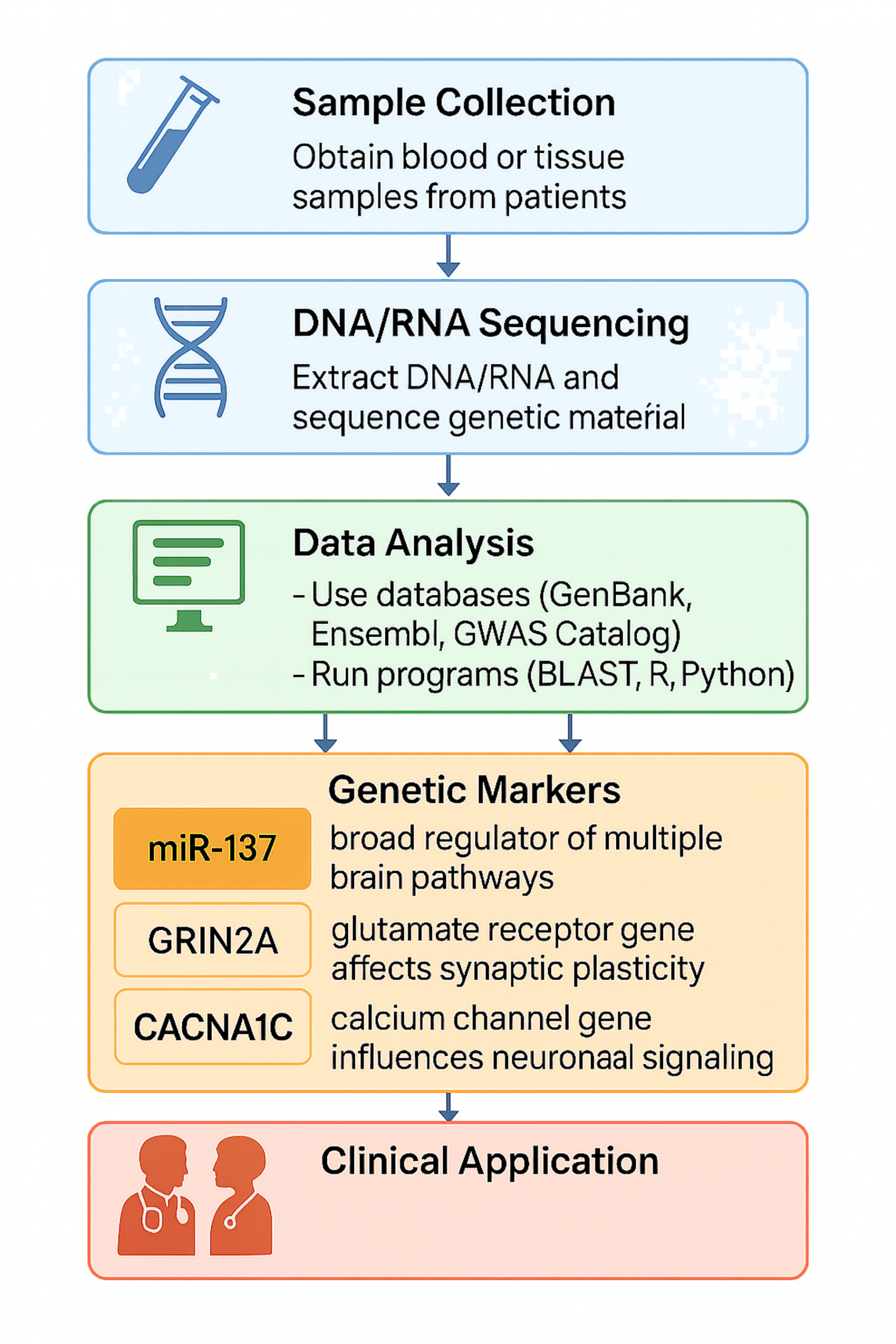
The “Clinical Application” stage shown in the figure is hypothetical and would require further laboratory studies, clinical testing, and validation. The present study did not analyze patient samples, test diagnostic accuracy, or evaluate treatment selection.
Clinical application would require prospective studies that directly evaluate predictive accuracy, clinical usefulness, feasibility, and ethical concerns. These questions were not examined in the present study.
Conclusion
The significance of this study lies in showing how existing bioinformatics resources can be used to explore complex psychiatric disorders without generating new genetic data. MIR137HG remains a schizophrenia-associated genomic locus of interest9,11,12,13,19, whereas mature miR-137 has been linked experimentally to neuronal maturation and synaptic function21,22,23. However, this study does not prove that miR-137, CACNA1C, or GRIN2A can diagnose schizophrenia or predict future illness. Instead, these findings should be viewed as a starting point for future research.
A major strength of this study is its use of a large, well-curated public database that integrates findings from many independent genetic studies, increasing the reliability of the identified associations. However, the study also has limitations. GWAS findings can show that certain genes are linked to schizophrenia, but they do not prove that those genes directly cause the disorder. Schizophrenia is influenced by many different genetic factors8,9,11,12,13. In addition, this analysis did not examine gene expression levels or clinical outcomes, which limits how directly the findings can be applied to patient care.
Future research could build on this work by combining GWAS data with gene expression studies, functional experiments, or clinical data to better understand how miR-137, CACNA1C, and GRIN2A influence disease development. Further studies could also explore how these markers interact with environmental risk factors and how they may contribute to schizophrenia related biological processes. Together, these steps could help clarify how genetic loci and regulatory pathways contribute to schizophrenia risk and biology.
References
- World Health Organization. Schizophrenia. https://www.who.int/news-room/fact-sheets/detail/schizophrenia, 2025. [↩] [↩]
- M. J. Owen, A. Sawa, P. B. Mortensen. Schizophrenia. The Lancet. Vol. 388, pg. 86–97, 2016, https://doi.org/10.1016/S0140-6736(15)01121-6. [↩]
- R. Birnbaum, D. R. Weinberger. Genetic insights into the neurodevelopmental origins of schizophrenia. Nature Reviews Neuroscience. Vol. 18, pg. 727–740, 2017, https://doi.org/10.1038/nrn.2017.125. [↩] [↩] [↩]
- J. M. Kane, D. G. Robinson, N. R. Schooler, K. T. Mueser, D. L. Penn, R. A. Rosenheck, J. Addington, M. F. Brunette, C. U. Correll, S. E. Estroff, P. Marcy, J. Robinson, P. S. Meyer-Kalos, J. D. Gottlieb, S. M. Glynn, D. W. Lynde, R. Pipes, B. T. Kurian, A. L. Miller, S. T. Azrin, A. B. Goldstein, J. B. Severe, H. Lin, K. J. Sint, M. John, R. K. Heinssen. Comprehensive Versus Usual Community Care for First-Episode Psychosis: 2-Year Outcomes From the NIMH RAISE Early Treatment Program. American Journal of Psychiatry. 2016;173(4):362–372. doi:10.1176/appi.ajp.2015.15050632. [↩]
- P. D. McGorry, A. R. Yung. Early intervention in psychosis: An overview. Australian & New Zealand Journal of Psychiatry. Vol. 46, pg. 607–616, 2012, https://doi.org/10.1177/0004867412435327. [↩]
- P. D. McGorry, E. Killackey, A. R. Yung. Early intervention in psychosis: concepts, evidence and future directions. World Psychiatry. Vol. 7, pg. 148–156, 2008, https://doi.org/10.1002/j.2051-5545.2008.tb00182. [↩]
- R. Hilker, D. Helenius, B. Fagerlund, A. Skytthe, K. Christensen, T. M. Werge, M. Nordentoft, B. Glenthoj. Heritability of schizophrenia and schizophrenia spectrum based on the nationwide Danish Twin Register. Biological Psychiatry. Vol. 83, pg. 492–498, 2018, https://doi.org/10.1016/j.biopsych.2017.08.017. [↩]
- P. F. Sullivan, M. J. Daly, M. O’Donovan. Genetic architectures of psychiatric disorders: The emerging picture and its implications. Nature Reviews Genetics. Vol. 13, pg. 537–551, 2012, https://doi.org/10.1038/nrg3240. [↩] [↩] [↩] [↩] [↩]
- Schizophrenia Working Group of the Psychiatric Genomics Consortium. Biological insights from 108 schizophrenia-associated genetic loci. Nature. Vol. 511, pg. 421–427, 2014. https://doi.org/10.1038/nature13595. [↩] [↩] [↩] [↩] [↩] [↩] [↩] [↩] [↩] [↩]
- The Schizophrenia Psychiatric Genome-Wide Association Study (GWAS) Consortium. Genome-wide association study identifies five new schizophrenia loci. Nature Genetics. Vol. 43, pg. 969–976, 2011. https://doi.org/10.1038/ng.940. [↩] [↩] [↩]
- S. Ripke, C. O’Dushlaine, K. Chambert, J. L. Moran, A. K. Kähler, S. Akterin, S. E. Bergen, A. L. Collins, J. J. Crowley, M. Fromer, Y. Kim, S. H. Lee, P. K. E. Magnusson, N. Sanchez, E. A. Stahl, S. Williams, N. R. Wray, K. Xia, F. Bettella, A. D. Borglum, B. K. Bulik-Sullivan, P. Cormican, N. Craddock, C. de Leeuw, N. Durmishi, M. Gill, V. Golimbet, M. L. Hamshere, P. Holmans, D. M. Hougaard, K. S. Kendler, K. Lin, D. W. Morris, O. Mors, P. B. Mortensen, B. M. Neale, F. A. O’Neill, M. J. Owen, M. Pejovic Milovancevic, D. Posthuma, J. Powell, A. L. Richards, B. P. Riley, D. Ruderfer, D. Rujescu, E. Sigurdsson, T. Silagadze, A. B. Smit, H. Stefansson, S. Steinberg, J. Suvisaari, S. Tosato, M. Verhage, J. T. Walters, Multicenter Genetic Studies of Schizophrenia Consortium, Psychosis Endophenotypes International Consortium, Wellcome Trust Case Control Consortium 2, E. Bramon, A. P. Corvin, M. C. O’Donovan, K. Stefansson, E. Scolnick, S. Purcell, S. A. McCarroll, P. Sklar, C. M. Hultman, P. F. Sullivan. Genome-wide association analysis identifies 13 new risk loci for schizophrenia. Nature Genetics. Vol. 45, pg. 1150–1159, 2013. https://doi.org/10.1038/ng.2742. [↩] [↩] [↩] [↩] [↩] [↩] [↩]
- A. F. Pardiñas, P. Holmans, A. J. Pocklington. Common schizophrenia alleles are enriched in mutation-intolerant genes and in regions under strong background selection. Nature Genetics. Vol. 50, pg. 381–389, 2018. https://doi.org/10.1038/s41588-018-0059-2. [↩] [↩] [↩] [↩] [↩] [↩] [↩]
- V. Trubetskoy, A. F. Pardiñas, T. Qi. Mapping genomic loci implicates genes and synaptic biology in schizophrenia. Nature. Vol. 604, pg. 502–508, 2022. https://doi.org/10.1038/s41586-022-04434-5. [↩] [↩] [↩] [↩] [↩] [↩] [↩]
- S. Singh, S. K. Gupta, P. K. Seth. Biomarkers for detection, prognosis and therapeutic assessment of neurological disorders. Reviews in Neuroscience. Vol. 29, pg. 771–789, 2018. https://doi.org/10.1515/revneuro-2017-0097. [↩]
- L. Zhang, J. Zhang. Bioinformatics-based identification of CTSS, DOK2, and ENTPD1 as potential blood biomarkers of schizophrenia. BMC Psychiatry. Vol. 25, pg. 157, 2025, https://doi.org/10.1186/s12888-025-06512-0. [↩]
- C. M. Tigaret, T. C. E. Lin, E. R. Morrell, L. Sykes, A. L. Moon, M. C. O’Donovan, M. J. Owen, L. S. Wilkinson, M. W. Jones, K. L. Thomas, J. Hall. Neurotrophin receptor activation rescues cognitive and synaptic abnormalities caused by hemizygosity of the psychiatric risk gene Cacna1c. Molecular Psychiatry. Vol. 26, pg. 1748–1760, 2021. https://doi.org/10.1038/s41380-020-01001-0. [↩] [↩] [↩] [↩]
- K. L. Bigos, V. S. Mattay, J. H. Callicott, R. E. Straub, R. Vakkalanka, B. Kolachana, T. M. Hyde, B. K. Lipska, J. E. Kleinman, D. R. Weinberger. Genetic variation in CACNA1C affects brain circuitries related to mental illness. Archives of General Psychiatry. Vol. 67, pg. 939–945, 2010. https://doi.org/10.1001/archgenpsychiatry.2010.96. [↩] [↩]
- Z. Farsi, A. Nicolella, S. K. Simmons, S. Aryal, N. Shepard, K. Brenner, S. Lin, L. Herzog, W. Shin, V. Gazestani, B. Song, K. Bonanno, H. Keshishian, S. A. Carr, E. Macosko, S. Datta, B. Dejanovic, E. Kim, J. Z. Levin, M. Sheng. Brain-region-specific changes in neurons and glia and dysregulation of dopamine signaling in Grin2a mutant mice. Neuron. Vol. 111, pg. 3378–3396, 2023. https://doi.org/10.1016/j.neuron.2023.08.004. [↩] [↩] [↩] [↩]
- A. Warburton, G. Breen, V. J. Bubb, J. P. Quinn. A GWAS SNP for schizophrenia is linked to the internal MIR137 promoter and supports differential allele-specific expression. Schizophrenia Bulletin. Vol. 42, pg. 1003–1008, 2016. https://doi.org/10.1093/schbul/sbv144. [↩] [↩] [↩] [↩] [↩]
- D. P. Bartel. MicroRNAs: Genomics, biogenesis, mechanism, and function. Cell. Vol. 116, pg. 281–297, 2004, https://doi.org/10.1016/S0092-8674(04)00045-5. [↩]
- S. Siegert, J. Seo, E. J. Kwon, A. Rudenko, S. Cho, W. Wang, L. H. Tsai. The schizophrenia risk gene product miR-137 alters presynaptic plasticity. Nature Neuroscience. Vol. 18, pg. 1008–1016, 2015. https://doi.org/10.1038/nn.4023. [↩] [↩] [↩] [↩] [↩] [↩] [↩] [↩] [↩]
- R. D. Smrt, K. E. Szulwach, R. L. Pfeiffer, X. Li, W. Guo, M. Pathania, Z. Q. Teng, Y. Luo, J. Peng, A. Bordey, P. Jin, X. Zhao. MicroRNA miR-137 regulates neuronal maturation by targeting ubiquitin ligase Mind Bomb-1. Stem Cells. Vol. 28, pg. 1060–1070, 2010. https://doi.org/10.1002/stem.431. [↩] [↩] [↩] [↩] [↩] [↩] [↩]
- N. F. M. Olde Loohuis, W. Ba, P. H. Stoerchel, A. Kos, A. Jager, G. Schratt, G. J. M. Martens, H. van Bokhoven, N. Nadif Kasri, A. Aschrafi. MicroRNA-137 controls AMPA-receptor-mediated transmission and mGluR-dependent LTD. Cell Reports. Vol. 11, pg. 1876–1884, 2015. https://doi.org/10.1016/j.celrep.2015.05.040. [↩] [↩] [↩] [↩] [↩]
- M. J. Hill, J. G. Donocik, R. A. Nuamah, C. A. Mein, R. Sainz-Fuertes, N. J. Bray. Transcriptional consequences of schizophrenia candidate miR-137 manipulation in human neural progenitor cells. Schizophrenia Research. Vol. 153, pg. 225–230, 2014. https://doi.org/10.1016/j.schres.2014.01.034. [↩]
- C. Wright, C. N. Gupta, J. Chen, V. Patel, V. D. Calhoun, S. Ehrlich, L. Wang, J. R. Bustillo, N. I. Perrone-Bizzozero, J. A. Turner. Polymorphisms in MIR137HG and microRNA-137-regulated genes influence gray matter structure in schizophrenia. Translational Psychiatry. Vol. 6, e724, 2016. https://doi.org/10.1038/tp.2015.211. [↩]
- Y. Cheng, Z. M. Wang, W. Tan, X. Wang, Y. Li, B. Bai, Y. Li, S. F. Zhang, H. L. Yan, Z. L. Chen, C. M. Liu, T. W. Mi, S. Xia, Z. Zhou, A. Liu, G. B. Tang, C. Liu, Z. J. Dai, Y. Y. Wang, H. Wang, X. Wang, Y. Kang, L. Lin, Z. Chen, N. Xie, Q. Sun, W. Xie, J. Peng, D. Chen, Z. Q. Teng, P. Jin. Partial loss of psychiatric risk gene Mir137 in mice causes repetitive behavior and impairs sociability and learning via increased Pde10a. Nature Neuroscience. Vol. 21, pg. 1689–1703, 2018. https://doi.org/10.1038/s41593-018-0261-7. [↩]
- M. Thimm, T. Kircher, T. Kellermann, V. Markov, S. Krach, A. Jansen, K. Zerres, T. Eggermann, T. Stöcker, N. J. Shah, M. M. Nöthen, M. Rietschel, S. H. Witt, K. Mathiak, A. Krug. Effects of a CACNA1C genotype on attention networks in healthy individuals. Psychological Medicine. Vol. 41, pg. 1551–1561, 2011. doi:10.1017/S0033291710002217. [↩]
- L. E. Herzog, L. Wang, E. Yu, S. Choi, Z. Farsi, B. J. Song, J. Q. Pan, M. Sheng. Mouse mutants in schizophrenia risk genes GRIN2A and AKAP11 show EEG abnormalities in common with schizophrenia patients. Translational Psychiatry. Vol. 13, article 92, 2023. doi:10.1038/s41398-023-02393-7. [↩]
- D. O. Perkins, C. D. Jeffries, L. F. Jarskog, J. M. Thomson, K. Woods, M. A. Newman, J. S. Parker, J. Jin, S. M. Hammond. MicroRNA expression in the prefrontal cortex of individuals with schizophrenia and schizoaffective disorder. Genome Biology. Vol. 8, R27, 2007. https://doi.org/10.1186/gb-2007-8-2-r27. [↩]
- A. L. Collins, Y. Kim, R. J. Bloom, S. N. Kelada, P. Sethupathy, P. F. Sullivan. Transcriptional targets of the schizophrenia risk gene MIR137. Translational Psychiatry. Vol. 4, e404, 2014. https://doi.org/10.1038/tp.2014.42. [↩]
- I. Guella, A. Sequeira, B. Rollins, L. Morgan, F. Torri, T. G. M. van Erp, R. M. Myers, J. D. Barchas, A. F. Schatzberg, S. J. Watson, H. Akil, W. E. Bunney, S. G. Potkin, F. Macciardi, M. P. Vawter. Analysis of miR-137 expression and rs1625579 in dorsolateral prefrontal cortex. Journal of Psychiatric Research. Vol. 47, pg. 1215–1221, 2013. https://doi.org/10.1016/j.jpsychires.2013.05.021. [↩]
- K. T. Thomas, B. R. Anderson, N. Shah, S. E. Zimmer, D. Hawkins, A. N. Valdez, Q. Gu, G. J. Bassell. Inhibition of the schizophrenia-associated microRNA miR-137 disrupts Nrg1α neurodevelopmental signal transduction. Cell Reports. Vol. 20, pg. 1–12, 2017. https://doi.org/10.1016/j.celrep.2017.06.038. [↩]
- A. Pacheco, R. Berger, R. Freedman, A. J. Law. A VNTR regulates miR-137 expression through novel alternative splicing and contributes to risk for schizophrenia. Scientific Reports. Vol. 9, article 11793, 2019. https://doi.org/10.1038/s41598-019-48141-0. [↩]