

Abstract
Allergic rhinitis is a common disorder characterized by an exaggerated immune response to environmental allergens such as pollen. Sublingual immunotherapy (SLIT) has the potential to reduce symptoms and provide long-term clinical benefit, however, the transcriptomic signatures of treatment response are not fully characterized. Most of the previous studies have focused on identifying individual differentially expressed genes, which might have ignored the coordinated changes across biological pathways. We analyzed publicly available bulk RNA-sequencing (RNA-seq) data from GSE206149 (n=255 samples), and single-cell RNA-sequencing (scRNA-seq) data from GSE200107 (n=15 expression libraries from 7 patients with paired pre- and post-treatment samples) to explore transcriptomic patterns associated with SLIT. Differential expression analysis of the bulk RNA-seq data set identified only 13 significantly altered genes (adjusted p < 0.05 and |log2 fold change| > 1), indicative of modest gene-level effects. Conversely, gene set enrichment analysis revealed significant enrichment of immune-related pathways such as leukocyte migration, chemotaxis, lymphocyte activation and humoral immune response. Likewise, pseudobulk analysis of the scRNA-seq dataset at the cell-type level revealed limited gene-level changes across major immune-cell populations, while coordinated pathway-level patterns were observed across CD4⁺ T cells, monocytes, and dendritic cells. Overall, our results suggest that transcriptomic differences associated with SLIT might be more apparent at the pathway level than at the single gene level. These results support the use of pathway-based approaches to study complex immune responses and provide a framework for future studies of allergen immunotherapy.
Introduction
Allergic rhinitis (AR) is one of the most common chronic allergic diseases worldwide with hundreds of millions of people affected and significant impairment of quality of life with symptoms like nasal obstruction, rhinorrhea, sneezing and nasal itching. In susceptible individuals, exposure to otherwise innocuous environmental allergens leads to production of allergen-specific IgE, mast cell and basophil activation and recruitment of inflammatory immune cells, resulting in chronic type 2 immune inflammation. Pharmacologic therapies, such as antihistamines and intranasal corticosteroids, are effective at relieving symptoms but do not alter the underlying immune dysregulation, and symptoms often recur after the treatment is stopped1,2
Among the currently available therapies, allergen immunotherapy (AIT) is the only disease-modifying treatment that has the potential to modify the natural history of allergic disease through the induction of immune tolerance rather than simply offering symptomatic relief. Sublingual immunotherapy (SLIT) is now a common AIT because it is safe to use, easy to administer, and has lasting clinical efficacy after the treatment is completed3,4. The successful immunotherapy is associated with complex immunologic changes, including induction of regulatory T and B cells, changes in allergen-specific antibody responses, modulation of dendritic-cell function and suppression of type 2 inflammatory pathways4,5,6,7,8. These have been demonstrated in clinical and experimental studies. However, the molecular mechanisms responsible for the durable immune remodeling induced by SLIT are not completely understood. Transcriptomic studies have recently begun to define molecular correlates of allergen immunotherapy. The GRASS trial showed treatment-associated transcriptional changes during grass pollen SLIT by bulk RNA sequencing. Single-cell RNA sequencing with paired V(D)J analysis of Japanese cedar pollinosis showed dynamic changes in pathogenic T-cell populations and clonal evolution, providing unprecedented resolution of immune-cell remodeling during SLIT9,10. Taken together, these studies have greatly increased the knowledge on cellular and molecular effects of allergen immunotherapy. Most transcriptomic studies, however, have largely focused on identifying differentially expressed genes or characterizing individual immune-cell populations. Immune responses are orchestrated at the system level, with multiple cell types and signaling pathways interacting. Therefore, analysis focused only on single genes may underestimate more global system level changes associated with successful immunotherapy. Systems biology is providing increasing evidence that biologically significant responses typically arise from coordinated regulation of gene networks, rather than from large changes in expression of individual genes. Therefore, gene set enrichment and pathway-based approaches have become powerful tools to identify reproducible biological processes underlying complex diseases11,12. Recent advances in immunology have similarly shown that immune cell phenotypes exist along dynamic functional continua and are shaped by extensive interactions between diverse immune cell populations rather than discrete cell states13,14. These findings suggest that analysis at the pathway level may offer a more complete framework to comprehend the coordinated immune remodeling induced by allergen immunotherapy.
Based on this rationale, we hypothesized that successful SLIT is primarily characterized by coordinated remodeling of immune pathways across multiple immune-cell populations, rather than large transcriptional changes in individual genes. We tested this hypothesis through an integrated analysis of publicly available bulk RNA sequencing and single cell RNA sequencing datasets, combining differential expression analysis, gene set enrichment analysis and patient-level pseudobulk analysis. The inclusion of transcriptomic information across biological scales provides a systems-level view of immune remodeling in the setting of allergen immunotherapy, and suggests pathway-focused analysis as a complementary approach for investigating treatment-related immune responses.
Methods
Data Sources
All datasets used in this study were downloaded from Gene expression omnibus (GEO) database. To characterize transcriptome-wide changes associated with treatment, we used bulk RNA sequencing (RNA-seq) data from GSE206149 as part of the GRASS transcriptomics study of grass pollen sublingual immunotherapy (SLIT). To investigate cell-type-specific immune responses and transcriptional remodeling, we used scRNA-seq data from GSE200107, which was generated from SLIT-treated patients with Japanese cedar pollinosis9,10. Table 1 summarizes the characteristics of the dataset.
| Dataset | Data type | Samples | Subjects | Comparison | Role in study |
| GSE206149 | Bulk RNA-seq | 255 samples | Not reported | SLIT vs Placebo | Primary bulk transcriptomic analysis |
| GSE200107 | scRNA-seq + paired V(D)J | 15 expression libraries | 7 patients | Paired pre- vs post-SLIT | Cell-type-specific transcriptomic analysis |
Note. SLIT = sublingual immunotherapy; RNA-seq = RNA sequencing; scRNA-seq = single-cell RNA sequencing.
Bulk RNA-seq Analysis
Bulk RNA-seq data were processed with DESeq2 package (version 1.52.0) in R (version 4.5.2). The raw counts were normalized by the median-of-ratios method in DESeq2. The Wald test was employed to compare differential expression between SLIT treated and placebo samples. Multiple testing was corrected using Benjamini-Hochberg procedure and genes with adjusted P value < 0.05 were considered statistically significant. The results of differential expression were ranked by log2 fold change for subsequent pathway enrichment analysis15.
Gene Set Enrichment Analysis
Gene set enrichment analysis (GSEA) was performed with the clusterProfiler package (version 4.20.0). Genes were ranked according to log₂ fold change from differential expression analysis. For the reference pathway collection, gene sets were derived from Gene Ontology Biological Process (GO-BP). The significance of enrichment was evaluated by the Benjamini–Hochberg false discovery rate (FDR) correction, and pathways with FDR-adjusted P values < 0.05 were considered significantly enriched11,16. Table 2 summarizes the representative enriched pathways.
| GO Biological Process | NES | FDR q-value |
| Humoral immune response | 2.348 | 6.46 × 10⁻⁸ |
| B cell mediated immunity | 2.213 | 1.19 × 10⁻⁶ |
| Lymphocyte mediated immunity | 2.160 | 6.46 × 10⁻⁸ |
| Defense response to virus | 2.098 | 6.46 × 10⁻⁸ |
| Leukocyte mediated immunity | 1.965 | 6.49 × 10⁻⁸ |
| Response to type II interferon | 2.266 | 4.05 × 10⁻⁶ |
Note. GSEA = gene set enrichment analysis; GO = Gene Ontology; NES = normalized enrichment score; FDR = false discovery rate.
Single-cell RNA-seq Analysis
We used Seurat (version 5.1.0) for single-cell RNA-seq data analysis. Cells with fewer than 200 detected genes or more than 10% mitochondrial transcript content were filtered out during quality control. Gene expression data were normalized using the LogNormalize method and scaled prior to principal component analysis (PCA). Cell clusters were identified with a shared nearest neighbor (SNN) graph-based clustering algorithm and visualized by Uniform Manifold Approximation and Projection (UMAP). Major immune-cell populations were annotated using canonical marker genes: CD3D, CD3E, and TRAC for T cells; MS4A1 and CD79A for B cells; LST1, LYZ, and FCN1 for monocytes; FCER1A and HLA-DRA for dendritic cells; NKG7 and GNLY for natural killer cells; and MZB1 and JCHAIN for plasma cells17.
Pseudobulk Differential Expression Analysis
We used a patient-level pseudobulk approach to assess cell-type-specific transcriptional responses. Patient, treatment time point, and annotated cell type were used to aggregate the raw reads count. We used DESeq2 with the design formula ~ patient_id + timepoint for differential expression analysis, where patients and not individual cells are treated as biological replicates. Statistical significance was assessed by the Wald test with Benjamini–Hochberg correction and genes with adjusted P < 0.05 were considered statistically significant15.
Pathway-Level Analysis Across Cell Types
We characterized coordinated immune responses across cell populations by summarizing pathway-level activity using curated immune-related gene sets describing T-cell activation, cytotoxic lymphocyte function, B-cell responses, monocyte inflammatory signaling, antigen presentation, interferon signaling, and tissue remodeling. For each immune-cell population, pathway scores were calculated as the mean log2 fold change of genes in each pathway. These scores were used to compare functional patterns across immune-cell populations12,13,14. The curated pathway gene sets were listed in Table 3.
| Pathway | Representative genes |
| T-cell activation | CD3D, CD3E, TRAC, IL7R, CCR7, LEF1, TCF7 |
| Cytotoxic/NK-cell function | NKG7, GNLY, CTSW, GZMB, GZMK, PRF1, KLRD1, FCGR3A |
| B-cell / plasma-cell response | MS4A1, CD79A, CD79B, MZB1, JCHAIN, XBP1, SDC1 |
| Monocyte inflammatory signaling | LYZ, S100A8, S100A9, FCN1, LST1, CTSS, IL1B, TNF, CXCL8, CCL2, CCL3, CCL4 |
| Antigen presentation | FCER1A, HLA-DRA, HLA-DRB1, HLA-DPA1, HLA-DPB1, CST3 |
| Interferon response | ISG15, IFIT1, IFIT3, IRF7, STAT1 |
| Tissue remodeling | MMP14, GSN, ADGRE2 |
Note. Representative genes are listed for each curated pathway. Pathway scores in Figure 4B were calculated as the mean log2 fold change of genes within each pathway.
Code Availability
All code used for data processing, analysis, and figure generation is publicly available on GitHub at GitHub repository.
Results
Overview of Study Design and Analytical Approach
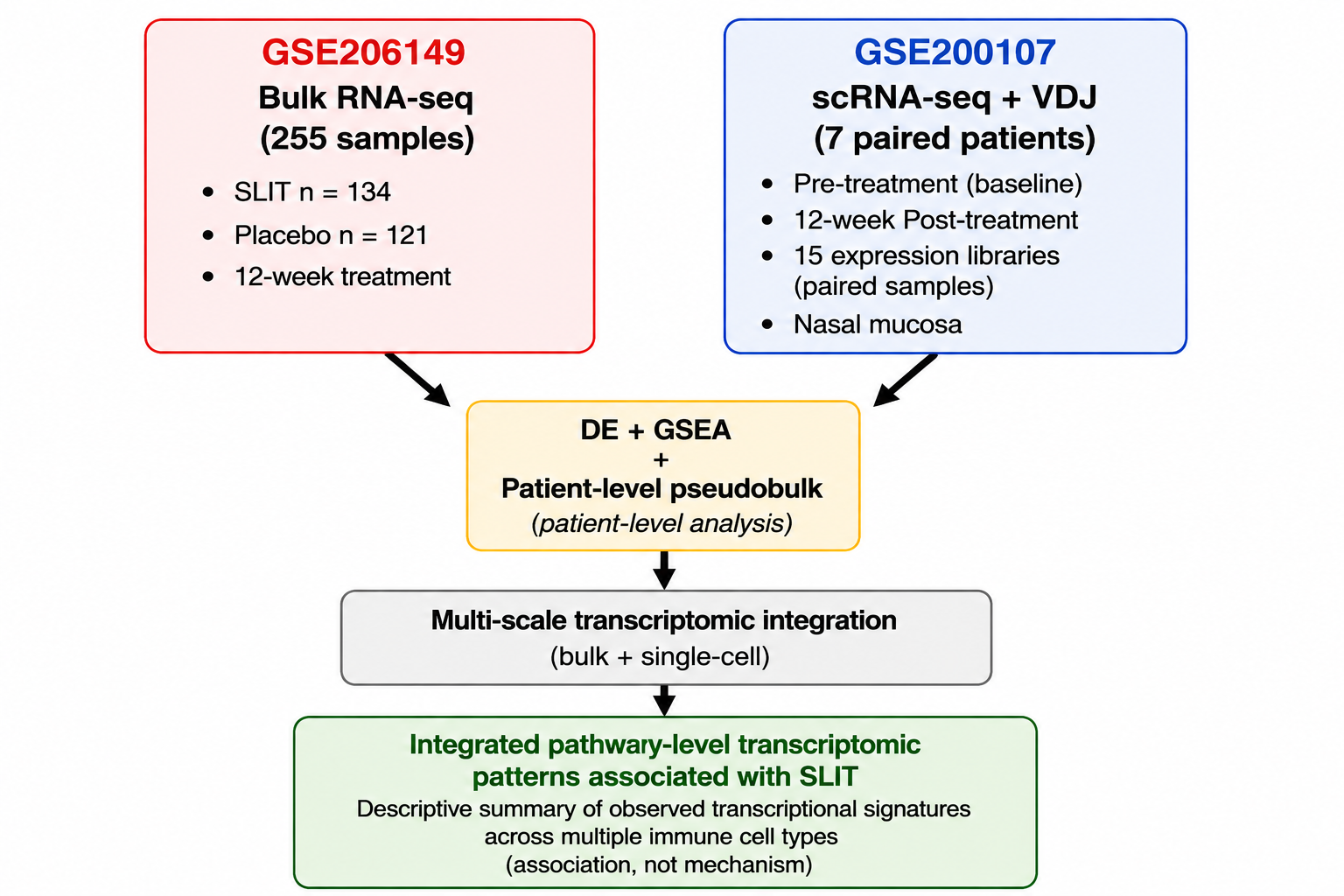
We performed a multi-scale analysis by integration of bulk and single-cell RNA sequencing data to explore the transcriptomic patterns related to sublingual immunotherapy (SLIT) (Fig. 1). Bulk RNA-seq data (GSE206149) were used to analyze global transcriptional differences between SLIT and placebo samples. The GSE200107 single-cell RNA-seq data were used to examine the cell type-specific transcriptomic patterns pre- and post-treatment. We utilized these complementary datasets in conjunction to assess pathway-level transcriptional patterns associated with SLIT in several immune-cell populations.
SLIT triggers minor gene-level but significant pathway-level changes
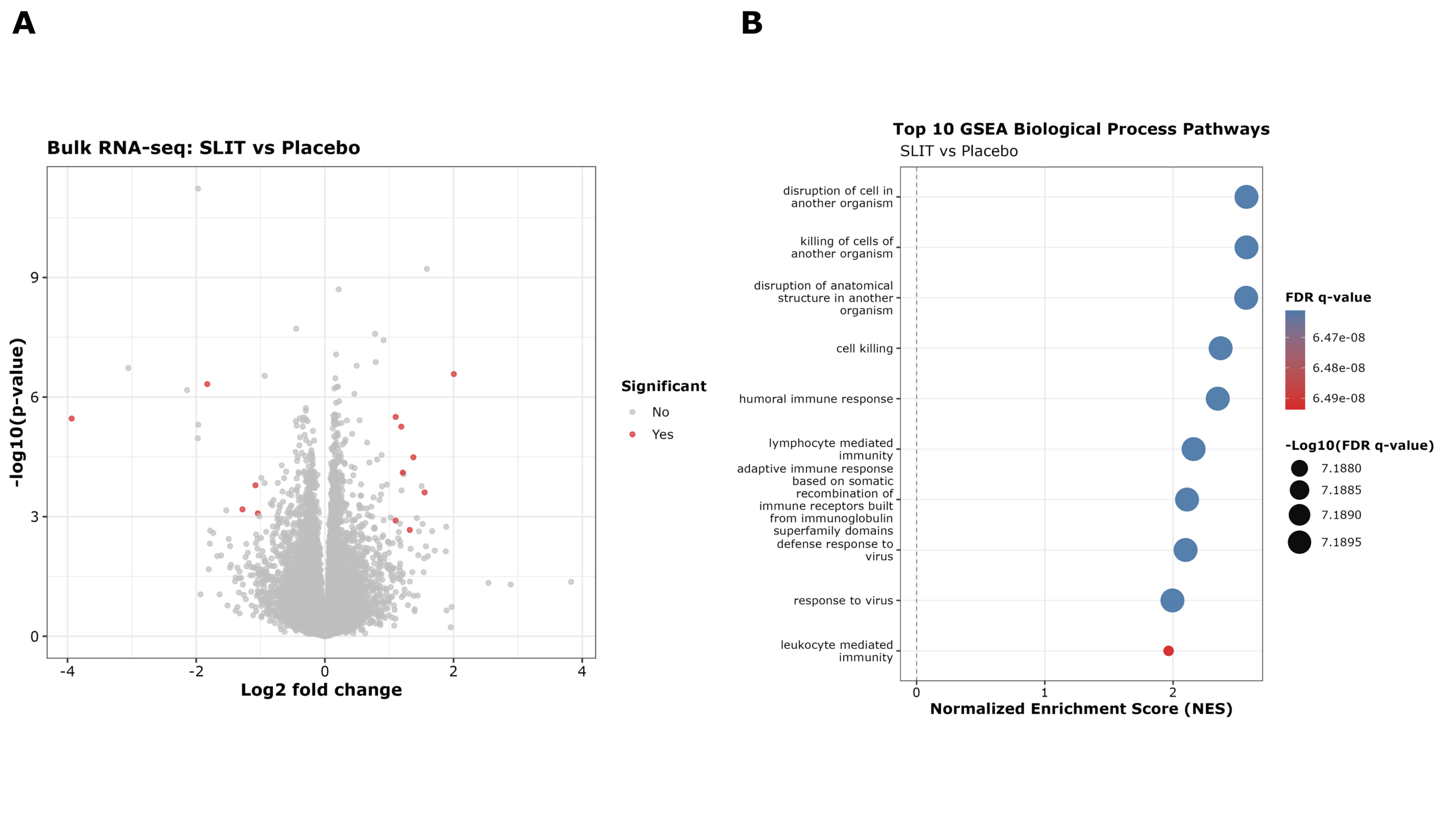
Differential expression analysis of the GSE206149 bulk RNA-seq dataset showed that there were relatively few genes significantly changed between SLIT treated and placebo samples. Gene-level transcriptional changes were generally small as indicated by 13 significant genes at the modified p-value threshold of 0.05 and absolute log2 fold change threshold of 1 (Fig. 2A).
Conversely, gene set enrichment analysis (GSEA) revealed significant enrichment of several immune-related pathways (Fig. 2B). Humoral immune response (NES = 2.35, FDR = 6.46 × 10⁻⁸), lymphocyte mediated immunity (NES = 2.16, FDR = 6.46 × 10⁻⁸), Leucocyte mediated immunity (NES = 1.97, FDR = 6.49 × 10⁻⁸), B-cell mediated immunity (NES = 2.21, FDR = 1.19 × 10⁻⁶), response to type II interferon (NES = 2.27, FDR = 4.05 × 10⁻⁶). Table 2 summarizes the representative enriched pathways. These findings imply that immune signatures at the pathway level were more prominent than those at the individual gene level in this dataset.
Single-Cell RNA-seq Reveals Main Immune Cell Types
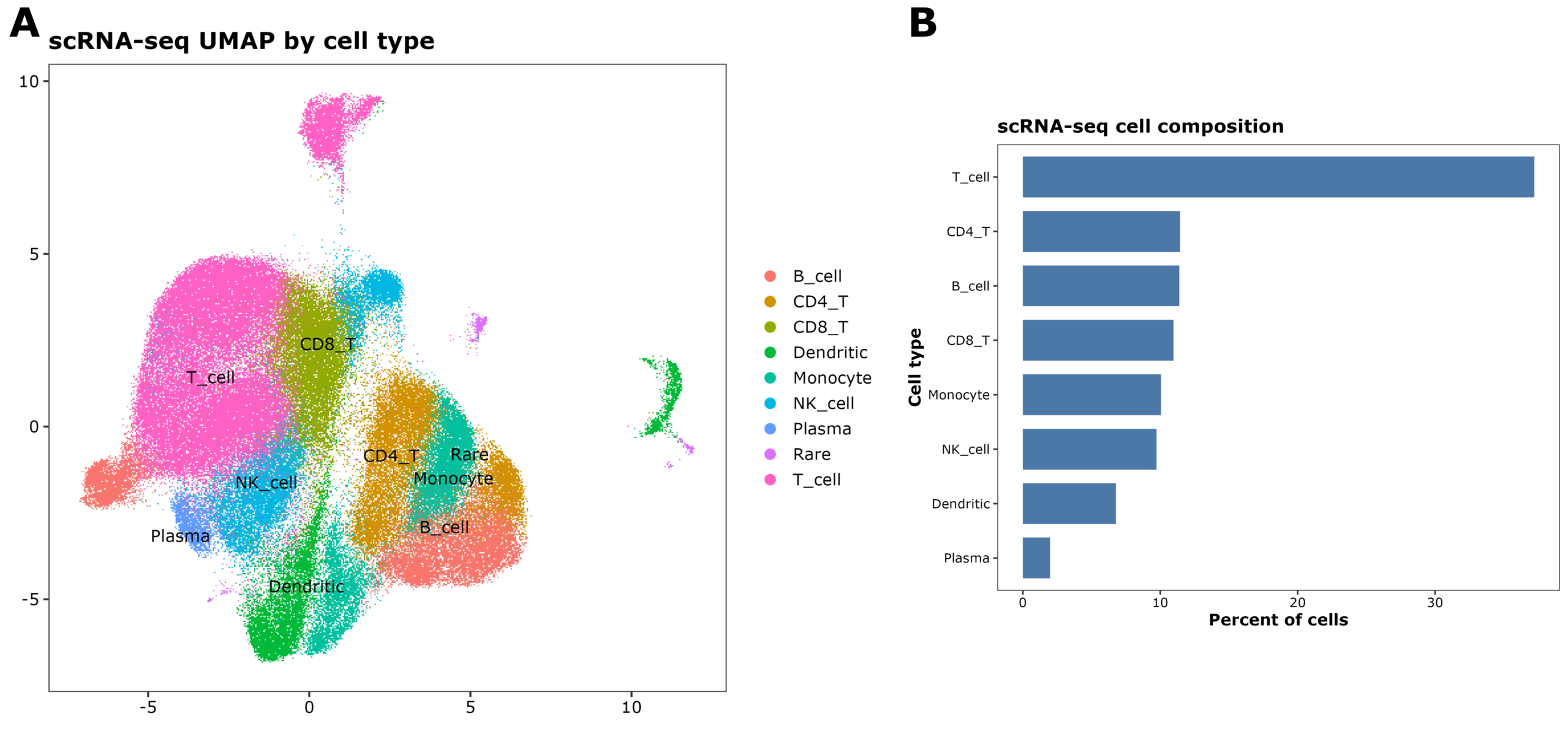
Single cell RNA sequencing analysis of GSE200107 identified several major immune-cell populations including T cells, CD4 T cells, CD8 T cells, B cells, monocytes, dendritic cells, NK cells and plasma cells (Fig. 3A). Cell types were annotated based on canonical marker genes for each immune population. The relative abundance of each immune-cell population is shown in Fig. 3B.
T cells were the most represented cell population in the dataset, followed by B cells, monocytes, NK cells, dendritic cells and plasma cells. In the exploratory analysis, no major global changes in immune cell composition were seen, and therefore subsequent analysis focused more on transcriptional and pathway level differences rather than large scale compositional changes.
Subtle cell-type-specific transcriptional changes support immune modulation.
To assess cell type-specific transcriptional changes we employed a paired patient-level pseudobulk approach, where cells were grouped by patient, time point and annotated cell type prior to differential expression analysis. As with bulk RNA-seq, the number of genes that were statistically significant in major immune-cell populations was relatively small, indicating that effects at the gene level associated with treatment were overall modest.
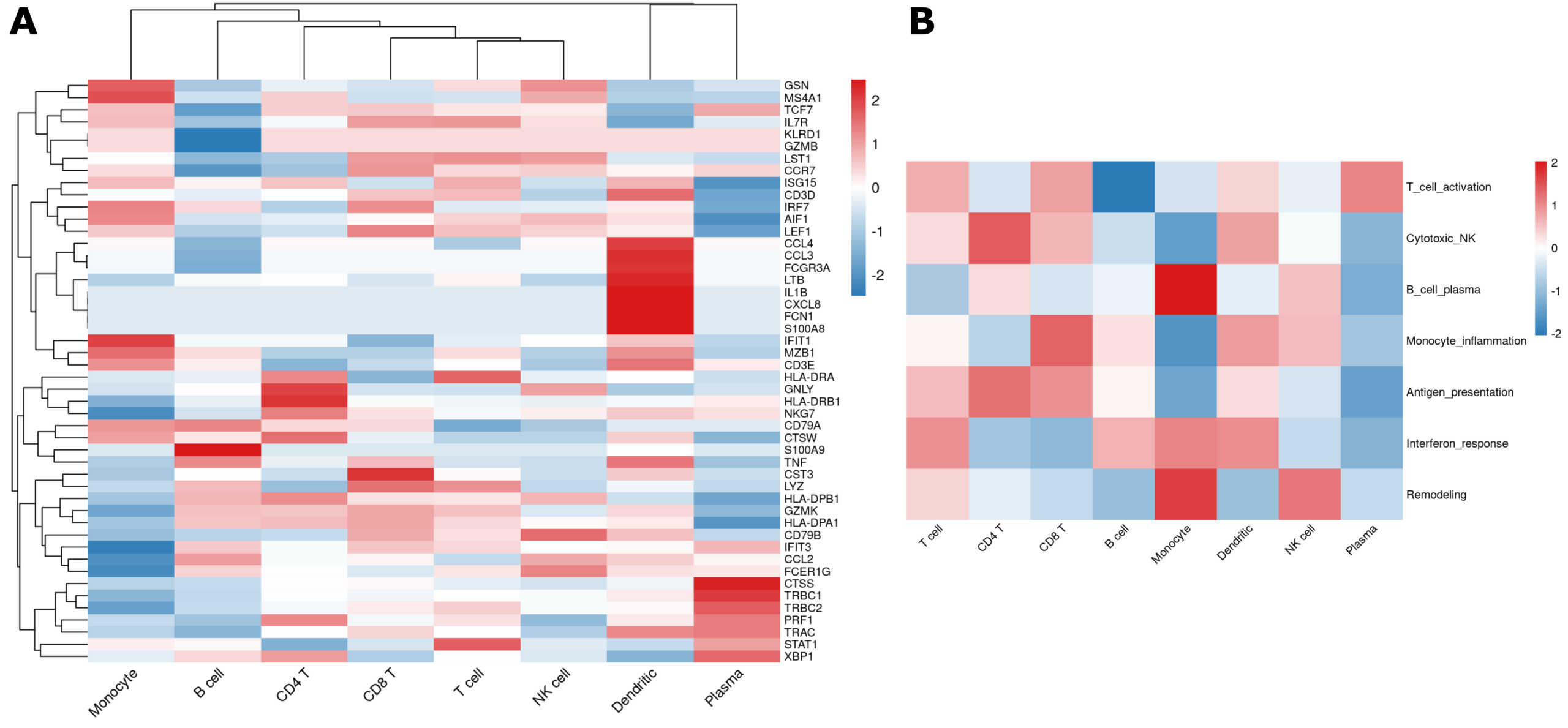
We identified several representative immune-related genes that exhibit consistent directionality of transcriptional patterns across all cell types despite the small number of statistically significant genes (Fig. 4A). Expression changes of activation and differentiation program-related genes such as IL7R, CCR7, TCF7 were observed in T-cell subsets. In monocytes, differences were noted in S100A8, S100A9 and IL1B populations, and in dendritic cells, differences were observed in genes related to antigen presentation, including HLA-DRA and HLA-DRB1. These observations are consistent with bulk RNA-seq analysis, suggesting that pathway-level patterns were more apparent than large individual gene-level differences.
Pathway-Level Analysis Identifies Coordinated Immune Signatures Across Cell Types
We evaluated pathway-level summaries across major immune-cell populations using curated immune-related gene sets (Table 3) to better define coordinated functional patterns. We observed distinct, but coordinated pathway-level patterns across different cell types (Fig. 4B). T-cell activation signatures were most prevalent in T-cell populations, monocyte-associated inflammatory pathways were most prevalent in monocytes, and antigen-presentation pathways were enriched in dendritic cells. We also found signatures of interferon-response in several populations of immune cells.
Pathway-level summaries provided a more coherent description of transcriptomic variation across immune-cell populations than individual gene-level analysis. Although many genes were differentially expressed at modest levels, pathway-level patterns were consistent across biologically related cell populations. Results suggest that pathway-level analysis may offer further insight into SLIT related transcriptomic responses.
Pathway-level patterns generally provided a more informative description of SLIT-associated transcriptomic responses than changes in single genes in bulk and single-cell transcriptomic studies. Although the difference in the expression of individual genes was modest, we observed coordinated immune related pathway signatures from both approaches, supporting the use of pathway-based analysis for interpretation of complex immune transcriptomic datasets.
Discussion
This study characterized transcriptomic responses associated with sublingual immunotherapy (SLIT) integrated bulk and single-cell transcriptomic analysis. In both datasets, only a small number of genes showed large signals of differential expression, but pathway-level analysis revealed consistent enrichment of multiple immune related processes. The results show that the transcriptomic responses related to SLIT are more easily detectable at the pathway level than at the gene level. This is consistent with systems biology approaches in which biological responses are driven by coordinated regulation of interacting gene networks rather than by major changes in isolated genes11,12,13,18.
One of the main findings of this study was the difference between gene and pathway-level analysis. In the bulk RNA-seq analysis, only 13 genes satisfied the criteria for significance; however, gene set enrichment analysis (GSEA) indicated significant enrichment for several immune-related pathways including humoral immune response, lymphocyte mediated immunity, leukocyte mediated immunity and interferon associated signaling. These results imply that it is easier to detect coordinated biological processes at the pathway level than at the individual gene level. Similar observations have also been reported for other complex biological systems, where pathway-based approaches provided more robust and biologically interpretable insights than analysis based on individual genes only11,12,18,19.
Single-cell RNA sequencing gave a more detailed view of the cellular distribution of the pathway-level immune signatures identified in the bulk RNA-seq analysis. We used a paired patient-level pseudobulk framework to assess transcriptomic changes across major immune-cell populations including T cells, monocytes, dendritic cells, natural killer (NK) cells, B cells, and plasma cells. Individual cell types had few statistically significant genes, but coordinated responses were seen at the pathway level across multiple immune-cell populations. These results are consistent with current concepts of immune regulation that emphasize the dynamic interactions of different immune cell populations and not isolated responses in one cell type. Recent single-cell studies of allergen immunotherapy have also shown that successful SLIT is associated with coordinated remodeling of immune-cell states and functional T-cell populations, rather than large transcriptional changes within individual cell types13,14,18,20.
Integration of bulk and single cell transcriptomics provided complementary insights into the coordinated immune remodeling observed in this study. Bulk RNA-seq analysis showed a general enrichment of immune-related pathways, whereas single-cell RNA-seq assigned pathway signatures to specific immune-cell populations. These complementary approaches together suggest that coordinated pathway-level changes across multiple immune-cell populations are more readily detected for SLIT-associated immune remodeling than large transcriptional changes in individual genes. This integrative analytical framework provides a systems view of immune regulation and complements recent developments in single cell transcriptomics and systems immunology10,14,21.
The pathway-level signatures are consistent with biological processes previously implicated in allergen immunotherapy and immune regulation, though immune function or clinical outcomes are not directly assessed here. While the current study did not directly assess immune function or clinical outcomes, the pathway-level immune signatures in this study are consistent with biological processes previously associated with allergen immunotherapy including induction of immune tolerance, regulation of inflammatory pathways and modulation of adaptive immune responses5,6,7. Further studies combining transcriptomic, immunological and clinical measurements will be required to understand how these coordinated pathway-level changes relate to treatment efficacy and development of long-term immune tolerance19,22.
Limitations
These findings should be considered in light of several limitations. We initially analyzed several publicly available transcriptomic datasets, but the statistical power to find differences at the gene level may still be limited, especially in individual immune-cell populations studied with the patient-level pseudobulk approach. Second, the datasets analyzed had different biological contexts and experimental designs. Bulk transcriptomic profiles of GRASS study were available in GSE206149. GSE200107 Single-cell transcriptomic and paired V(D)J profiling of immune responses in a Japanese cedar pollinosis cohort. These differences should be taken into account when comparing pathway-level patterns across datasets. Third, because the analysis presented here were computational and transcriptomic, they identify associations, not causal mechanisms. Finally, the present study lacked clinical outcome measures, immunological phenotyping or functional validation experiments. Future studies integrating transcriptomic, immunological, clinical and complementary multi-omics data will be important to determine the biological significance and clinical relevance of the pathway-level immune signatures identified here21,22.
Future Directions
Larger, well-characterized longitudinal cohorts with repeated sampling over the course of allergen immunotherapy could be used in future studies to expand on these findings. Linking transcriptomic data to clinical response data, such as symptom scores, treatment response classification, and immunological measurements, can help to establish the link between pathway-level immune signatures and treatment response. Moreover, integration of transcriptomic, proteomic, epigenomic and functional immune-cell data may contribute to a comprehensive systems-level understanding of the molecular mechanisms of allergen immunotherapy and enable the identification of robust biomarkers of treatment response21,22,23.
Conclusion
In conclusion, an integrated analysis of bulk and single-cell transcriptomic datasets revealed pathway-level immune signatures associated with sublingual immunotherapy that were beyond individual gene-level differences. Both analytic approaches demonstrated relatively modest differential expression at the gene level but multiple immune-cell populations demonstrated coordinated patterns at the pathway level. These results highlight the relevance of pathway-based approaches for the study of complex immune responses and provide a framework for future investigations of transcriptomic patterns associated with allergen immunotherapy.
References
- J. Bousquet, N. Khaltaev, A. A. Cruz, J. Denburg, W. J. Fokkens, A. Togias, T. Zuberbier, C. E. Baena‐Cagnani, G. W. Canonica, C. Van Weel, I. Agache, N. Aït‐Khaled, C. Bachert, M. S. Blaiss, S. Bonini, L. ‐P. Boulet, P. ‐J. Bousquet, P. Camargos, K. ‐H. Carlsen, Y. Chen, A. Custovic, R. Dahl, P. Demoly, H. Douagui, S. R. Durham, R. G. Van Wijk, O. Kalayci, M. A. Kaliner, Y. ‐Y. Kim, M. L. Kowalski, P. Kuna, L. T. T. Le, C. Lemiere, J. Li, R. F. Lockey, S. Mavale‐Manuel, E. O. Meltzer, Y. Mohammad, J. Mullol, R. Naclerio, R. E. O’Hehir, K. Ohta, S. Ouedraogo, S. Palkonen, N. Papadopoulos, G. Passalacqua, R. Pawankar, T. A. Popov, K. F. Rabe, J. Rosado‐Pinto, G. K. Scadding, F. E. R. Simons, E. Toskala, E. Valovirta, P. Van Cauwenberge, D. ‐Y. Wang, M. Wickman, B. P. Yawn, A. Yorgancioglu, O. M. Yusuf, H. Zar, I. Annesi‐Maesano, E. D. Bateman, A. B. Kheder, D. A. Boakye, J. Bouchard, P. Burney, W. W. Busse, M. Chan‐Yeung, N. H. Chavannes, A. Chuchalin, W. K. Dolen, R. Emuzyte, L. Grouse, M. Humbert, C. Jackson, S. L. Johnston, P. K. Keith, J. P. Kemp, J. ‐M. Klossek, D. Larenas‐Linnemann, B. Lipworth, J. ‐L. Malo, G. D. Marshall, C. Naspitz, K. Nekam, B. Niggemann, E. Nizankowska‐Mogilnicka, Y. Okamoto, M. P. Orru, P. Potter, D. Price, S. W. Stoloff, O. Vandenplas, G. Viegi, D. Williams. Allergic rhinitis and its impact on asthma (aria) 2008*. Allergy. Vol. 63, pg. 8–160, 2008 https://doi.org/10.1111/j.1398-9995.2007.01620.x [↩]
- D. Wallace, M. Dykewicz, D. Bernstein, J. Blessingmoore, L. Cox, D. Khan, D. Lang, R. Nicklas, J. Oppenheimer, J. Portnoy. The diagnosis and management of rhinitis: an updated practice parameter. Journal of Allergy and Clinical Immunology. Vol. 122, pg. S1–S84, 2008 https://doi.org/10.1016/j.jaci.2008.06.003. [↩]
- S. R. Durham, S. M. Walker, E.-M. Varga, M. R. Jacobson, F. O’Brien, W. Noble, S. J. Till, Q. A. Hamid, K. T. Nouri-Aria. Long-term clinical efficacy of grass-pollen immunotherapy. New England Journal of Medicine. Vol. 341, pg. 468–475, 1999 https://doi.org/10.1056/NEJM199908123410702 [↩]
- G. W. Canonica, L. Cox, R. Pawankar, C. E. Baena-Cagnani, M. Blaiss, S. Bonini, J. Bousquet, M. Calderón, E. Compalati, S. R. Durham, R. G. Van Wijk, D. Larenas-Linnemann, H. Nelson, G. Passalacqua, O. Pfaar, N. Rosário, D. Ryan, L. Rosenwasser, P. Schmid-Grendelmeier, G. Senna, E. Valovirta, H. Van Bever, P. Vichyanond, U. Wahn, O. Yusuf. Sublingual immunotherapy: world allergy organization position paper 2013 update. World Allergy Organization Journal. Vol. 7, pg. 6, 2014 https://doi.org/10.1186/1939-4551-7-6 [↩] [↩]
- C. A. Akdis, M. Akdis. Mechanisms of allergen-specific immunotherapy. Journal of Allergy and Clinical Immunology. Vol. 127, pg. 18–27, 2011 https://doi.org/10.1016/j.jaci.2010.11.030 [↩] [↩]
- O. Palomares, M. Akdis, M. Martín‐Fontecha, C. A. Akdis. Mechanisms of immune regulation in allergic diseases: the role of regulatory t and b cells. Immunological Reviews. Vol. 278, pg. 219–236, 2017 https://doi.org/10.1111/imr.12555 [↩] [↩]
- G. Roberts, O. Pfaar, C. A. Akdis, I. J. Ansotegui, S. R. Durham, R. Gerth Van Wijk, S. Halken, D. Larenas‐Linnemann, R. Pawankar, C. Pitsios, A. Sheikh, M. Worm, S. Arasi, M. A. Calderon, C. Cingi, S. Dhami, J. L. Fauquert, E. Hamelmann, P. Hellings, L. Jacobsen, E. F. Knol, S. Y. Lin, P. Maggina, R. Mösges, J. N. G. Oude Elberink, G. B. Pajno, E. A. Pastorello, M. Penagos, G. Rotiroti, C. B. Schmidt‐Weber, F. Timmermans, O. Tsilochristou, E. ‐M. Varga, J. N. Wilkinson, A. Williams, L. Zhang, I. Agache, E. Angier, M. Fernandez‐Rivas, M. Jutel, S. Lau, R. Van Ree, D. Ryan, G. J. Sturm, A. Muraro. EAACI guidelines on allergen immunotherapy: allergic rhinoconjunctivitis. Allergy. Vol. 73, pg. 765–798, 2018 https://doi.org/10.1111/all.13317 [↩] [↩]
- S. Dhami, U. Nurmatov, S. Arasi, T. Khan, M. Asaria, H. Zaman, A. Agarwal, G. Netuveli, G. Roberts, O. Pfaar, A. Muraro, I. J. Ansotegui, M. Calderon, C. Cingi, S. Durham, R. G. Van Wijk, S. Halken, E. Hamelmann, P. Hellings, L. Jacobsen, E. Knol, D. Larenas‐Linnemann, S. Lin, P. Maggina, R. Mösges, H. Oude Elberink, G. Pajno, R. Panwankar, E. Pastorello, M. Penagos, C. Pitsios, G. Rotiroti, F. Timmermans, O. Tsilochristou, E. ‐M. Varga, C. Schmidt‐Weber, J. Wilkinson, A. Williams, M. Worm, L. Zhang, A. Sheikh. Allergen immunotherapy for allergic rhinoconjunctivitis: a systematic review and meta‐analysis. Allergy. Vol. 72, pg. 1597–1631, 2017 https://doi.org/10.1111/all.13201 [↩]
- M. C. Altman, R. M. Segnitz, D. Larson, N. D. Jayavelu, M. T. Smith, S. Patel, G. W. Scadding, T. Qin, S. Sanda, E. Steveling, A. O. Eifan, M. Penagos, M. R. Jacobson, R. V. Parkin, M. H. Shamji, A. Togias, S. R. Durham. Nasal and blood transcriptomic pathways underpinning the clinical response to grass pollen immunotherapy. Journal of Allergy and Clinical Immunology. Vol. 152, pg. 1247–1260, 2023 https://doi.org/10.1016/j.jaci.2023.06.025 [↩] [↩]
- T. Iinuma, M. Kiuchi, K. Hirahara, J. Kurita, K. Kokubo, H. Yagyu, R. Yoneda, T. Arai, Y. Sonobe, M. Fukuyo, A. Kaneda, S. Yonekura, T. Nakayama, Y. Okamoto, T. Hanazawa. Single-cell immunoprofiling after immunotherapy for allergic rhinitis reveals functional suppression of pathogenic th2 cells and clonal conversion. Journal of Allergy and Clinical Immunology. Vol. 150, pg. 850-860.e5, 2022 https://doi.org/10.1016/j.jaci.2022.06.024 [↩] [↩] [↩]
- A. Subramanian, P. Tamayo, V. K. Mootha, S. Mukherjee, B. L. Ebert, M. A. Gillette, A. Paulovich, S. L. Pomeroy, T. R. Golub, E. S. Lander, J. P. Mesirov. Gene set enrichment analysis: a knowledge-based approach for interpreting genome-wide expression profiles. Proceedings of the National Academy of Sciences. Vol. 102, pg. 15545–15550, 2005 https://doi.org/10.1073/pnas.0506580102 [↩] [↩] [↩] [↩]
- A. L. Tarca, S. Draghici, P. Khatri, S. S. Hassan, P. Mittal, J. Kim, C. J. Kim, J. P. Kusanovic, R. Romero. A novel signaling pathway impact analysis. Bioinformatics. Vol. 25, pg. 75–82, 2009 https://doi.org/10.1093/bioinformatics/btn577 [↩] [↩] [↩] [↩]
- E. Kiner, E. Willie, B. Vijaykumar, K. Chowdhary, H. Schmutz, J. Chandler, A. Schnell, P. I. Thakore, G. LeGros, S. Mostafavi, D. Mathis, C. Benoist, The Immunological Genome Project Consortium, O. Aguilar, R. Allan, J. Astarita, K. F. Austen, N. Barrett, A. Baysoy, C. Benoist, B. D. Brown, M. Buechler, J. Buenrostro, M. A. Casanova, K. Choi, K. Chowdhary, M. Colonna, T. Crowl, T. Deng, J. V. Desai, F. Desland, M. Dhainaut, J. Ding, C. Dominguez, D. Dwyer, M. Frascoli, S. Gal-Oz, A. Goldrath, R. Grieshaber-Bouyer, B. Jia, T. Johanson, S. Jordan, J. Kang, V. Kapoor, E. Kenigsberg, J. Kim, K. Wook Kim, E. Kiner, M. Kronenberg, L. Lanier, C. Laplace, C. Lareau, A. Leader, J. Lee, A. Magen, B. Maier, A. Maslova, D. Mathis, A. McFarland, M. Merad, E. Meunier, P. Monach, S. Mostafavi, S. Muller, C. Muus, H. Ner-Gaon, Q. Nguyen, P. A. Nigrovic, G. Novakovsky, S. Nutt, K. Omilusik, A. Ortiz-Lopez, M. Paynich, V. Peng, M. Potempa, R. Pradhan, S. Quon, R. Ramirez, D. Ramanan, G. Randolph, A. Regev, S. A. Rose, K. Seddu, T. Shay, A. Shemesh, J. Shyer, C. Smilie, N. Spidale, A. Subramanian, K. Sylvia, J. Tellier, S. Turley, B. Vijaykumar, A. Wagers, C. Wang, P. L. Wang, A. Wroblewska, L. Yang, A. Yim, H. Yoshida. Gut cd4+ t cell phenotypes are a continuum molded by microbes, not by th archetypes. Nature Immunology. Vol. 22, pg. 216–228, 2021 https://doi.org/10.1038/s41590-020-00836-7 [↩] [↩] [↩] [↩]
- E. Armingol, A. Officer, O. Harismendy, N. E. Lewis. Deciphering cell–cell interactions and communication from gene expression. Nature Reviews Genetics. Vol. 22, pg. 71–88, 2021 https://doi.org/10.1038/s41576-020-00292-x [↩] [↩] [↩] [↩]
- M. I. Love, W. Huber, S. Anders. Moderated estimation of fold change and dispersion for rna-seq data with deseq2. Genome Biology. Vol. 15, pg. 550, 2014 https://doi.org/10.1186/s13059-014-0550-8 [↩] [↩]
- G. Yu, L.-G. Wang, Y. Han, Q.-Y. He. ClusterProfiler: an r package for comparing biological themes among gene clusters. OMICS: A Journal of Integrative Biology. Vol. 16, pg. 284–287, 2012 https://doi.org/10.1089/omi.2011.0118 [↩]
- Y. Hao, S. Hao, E. Andersen-Nissen, W. M. Mauck, S. Zheng, A. Butler, M. J. Lee, A. J. Wilk, C. Darby, M. Zager, P. Hoffman, M. Stoeckius, E. Papalexi, E. P. Mimitou, J. Jain, A. Srivastava, T. Stuart, L. M. Fleming, B. Yeung, A. J. Rogers, J. M. McElrath, C. A. Blish, R. Gottardo, P. Smibert, R. Satija. Integrated analysis of multimodal single-cell data. Cell. Vol. 184, pg. 3573-3587.e29, 2021 https://doi.org/10.1016/j.cell.2021.04.048 [↩]
- T. Ideker, N. J. Krogan. Differential network biology. Molecular Systems Biology. Vol. 8, pg. MSB201199, 2012 https://doi.org/10.1038/msb.2011.99 [↩] [↩] [↩]
- A. Liberzon, C. Birger, H. Thorvaldsdóttir, M. Ghandi, J. P. Mesirov, P. Tamayo. The molecular signatures database hallmark gene set collection. Cell Systems. Vol. 1, pg. 417–425, 2015 https://doi.org/10.1016/j.cels.2015.12.004 [↩] [↩]
- M. J. T. Stubbington, O. Rozenblatt-Rosen, A. Regev, S. A. Teichmann. Single-cell transcriptomics to explore the immune system in health and disease. Science. Vol. 358, pg. 58–63, 2017 https://doi.org/10.1126/science.aan6828 [↩]
- T. Stuart, R. Satija. Integrative single-cell analysis. Nature Reviews Genetics. Vol. 20, pg. 257–272, 2019 https://doi.org/10.1038/s41576-019-0093-7 [↩] [↩] [↩]
- Y. Hasin, M. Seldin, A. Lusis. Multi-omics approaches to disease. Genome Biology. Vol. 18, pg. 83, 2017 https://doi.org/10.1186/s13059-017-1215-1 [↩] [↩] [↩]
- R. Argelaguet, D. Arnol, D. Bredikhin, Y. Deloro, B. Velten, J. C. Marioni, O. Stegle. MOFA+: a statistical framework for comprehensive integration of multi-modal single-cell data. Genome Biology. Vol. 21, pg. 111, 2020 https://doi.org/10.1186/s13059-020-02015-1 [↩]