

Abstract
Chronic pruritus (itch persisting for more than six weeks) is a symptom present in conditions relating to the skin, nerves, and organs. Though it is primarily considered a physical condition, there is emerging evidence linking chronic pruritus with psychological and mental health outcomes like anxiety, depression, impaired sleep, and reduced quality of life. Existing literature often addresses the severity, frequency, and duration of chronic itch together rather than evaluating them separately. This review examines whether these dimensions distinctly relate to psychosocial outcomes. Studies correlating mental health and chronic pruritus reveal both differences and overlap between each dimension. Itch severity is associated with anxiety, stress, and depressive symptoms, while itch frequency is associated with anxiety, sleep disturbance, and psychosocial burden. Prolonged itch duration has been linked to psychological distress and lower quality of life. Recent studies examining different dimensions of itch in the same samples suggest that these dimensions are unlikely to be interchangeable, with psychological outcomes associated with the presence of itch or severity, but not with duration. Relevant studies use both cross-sectional designs and heterogeneous measures of itch, which can confound conclusions regarding causality and independent effects. These studies use inconsistent assessment methods, employing different combinations of itch characteristics and psychosocial outcomes. In particular, studies often combine or use frequency and duration as components of itch severity, despite these dimensions being distinct characteristics of chronic pruritus. This inconsistency makes it structurally impossible to determine whether conflicting findings reflect true causality from itch dimensions to psychosocial outcomes. In this paper, we propose a conceptual framework using severity, frequency, and duration as distinct dimensions of chronic pruritus. We argue that standardized, dimension-specific assessment tools as well as longitudinal designs are necessary to clarify causal relationships, resolve inconsistencies in the existing literature, and determine their clinical significance.
Introduction
Chronic pruritus, also referred to as chronic itch, is defined as persistent itching lasting six weeks or longer. It is a common symptom of not only skin conditions such as eczema and psoriasis, but also certain neuropathic, psychogenic, and systemic disorders. A cross-sectional study of 11,730 German working adults found a point prevalence of 16.8%, rising from 12.3% among those aged 16–30 to 20.3% among those aged 61–701.
Despite its prevalence, chronic pruritus is often underrecognized and misunderstood as a solely physical complaint. However, itching also engages emotional and cognitive processes, making chronic pruritus a multidimensional condition. Increasing evidence demonstrates how this misunderstanding understates the physical, social, and emotional burden chronic pruritus places on daily life.
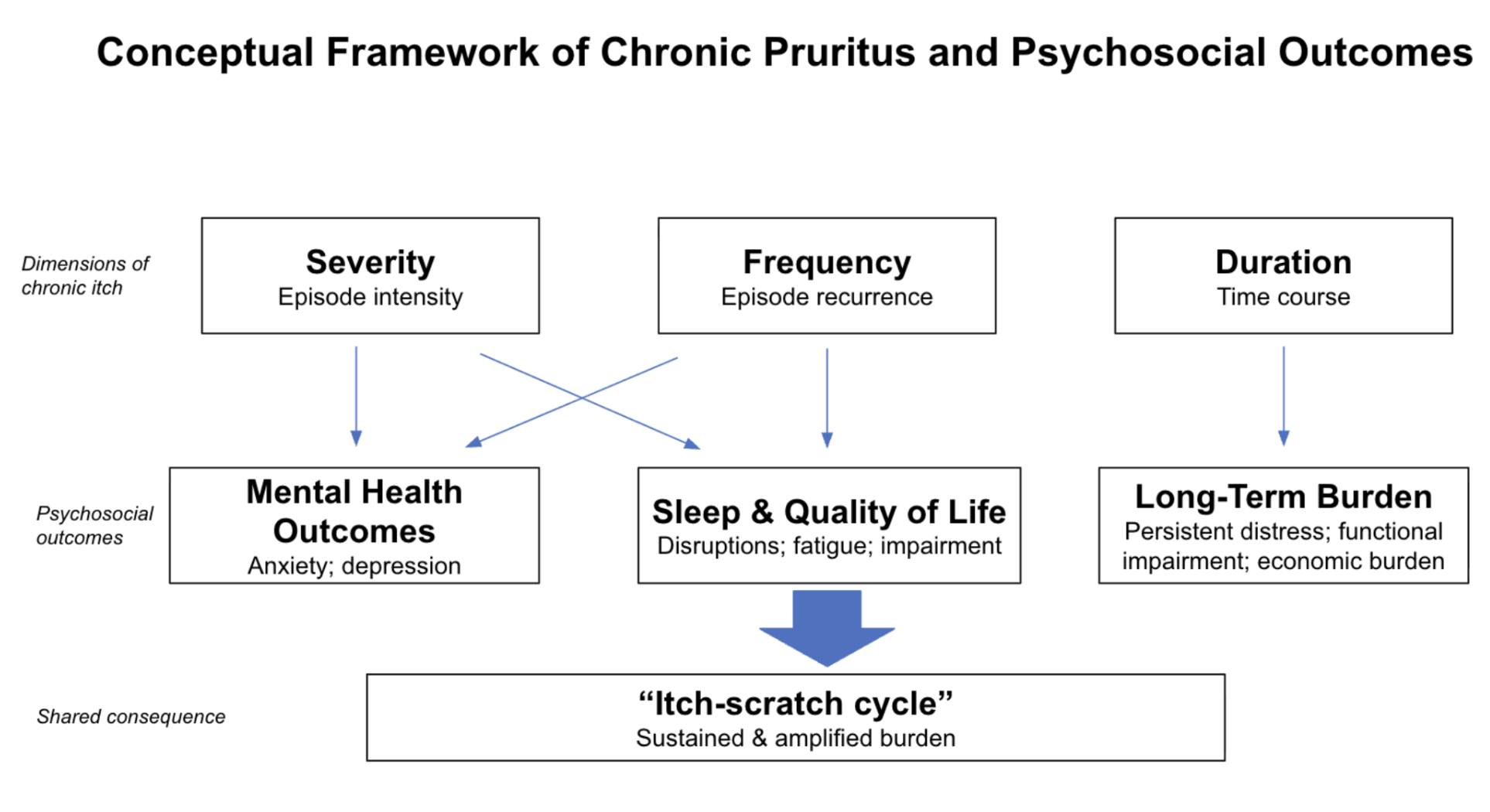
For example, a growing body of work reveals a positive correlation between itch severity and symptoms of both anxiety and depression2. Many patients with chronic pruritus become stuck in the “itch-scratch cycle,” in which psychological distress heightens skin sensitivity, which lowers the itch threshold and increases scratch behavior. As a result, both skin health and psychological symptoms worsen3.
When considering psychological outcomes related to chronic pruritus, it is important to recognize that itch is characterized as a multidimensional sensory and affective experience with three related but conceptually distinct dimensions. These include severity (the perceived intensity of each itch episode), frequency (how often itch episodes occur), and duration (how long itch symptoms have been present). These dimensions often co-occur, but they may represent distinct aspects of the chronic itch experience.
Dimensions of itch are not universally defined across existing literature. Many studies consider itch frequency and duration as components of itch severity, obscuring the independent contribution of each dimension. Combining these factors creates inconsistencies across studies and may weaken the value of the findings in a clinical setting. Therefore, this review considers severity, frequency, and duration separately whenever possible.
The purpose of this literature review is to examine existing research on chronic pruritus and mental health, evaluating whether itch severity, frequency, and duration relate to psychosocial outcomes in different ways. Specifically, this review examines the relationships between these itch dimensions and symptoms of anxiety, depression, sleep disturbance, and reduced quality of life, and explores the limitations to treating severity, frequency and duration as interchangeable measures. Varied findings from literature maintain the clinical significance of understanding chronic pruritus as a complex condition. Furthermore, more comprehensive approaches are required to assess and manage its psychosocial impact.
Methods
PubMed and Google Scholar were used to locate relevant studies. Search terms included combinations of “chronic pruritus,” “chronic itch,” “itch severity,” “itch frequency,” “itch duration,” “anxiety,” “depression,” “sleep disturbance,” “insomnia,” “quality of life,” and “stigmatization.” Studies were also found using reference lists of relevant articles and review papers. Studies were excluded if they focused entirely on acute itch, physiological outcomes, non-human subjects, or conditions unrelated to chronic pruritus.
Criteria for inclusion were peer-reviewed human studies that examined chronic pruritus in relation to psychosocial outcomes. These studies often measured anxiety, depression, sleep disturbance, insomnia, quality of life, stigmatization, psychiatric comorbidity, and psychological well-being. Due to limited longitudinal research examining these relationships, both observational and cross-sectional studies were included. The review interprets findings from smaller disease-specific cohorts, retrospective analyses, and conceptual reviews within the context of their limitations. Studies that were larger population-based, multicenter, and directly evaluated psychosocial outcomes were preferred when overlap in content was present.
Risk-of-bias was not formally assessed and meta analysis was not performed. Findings from studies were narratively synthesized according to whether studies assessed itch severity, frequency, duration, or composite measures of itch burden.
When interpreting the proposed framework of examining itch dimensions in relation to psychosocial outcomes, it should be considered that several studies evaluated composite itch measures that combined aspects of severity, frequency, and duration. Dalgard (2020) recorded presence, chronicity, and intensity of itch as separate variables; only presence was significantly associated with depression and suicidal ideation. Golpanian (2020) recorded presence of itch without measuring severity, frequency, nor duration2,4.
| Study | Population | Sev | Freq | Dur | Anx | Dep | Sleep | QoL | Stigma |
| Dalgard 2020 | Dermatology patients | + | — | + | + | + | — | + | — |
| Zeidler 2024 | Itchy dermatoses | + | + | + | + | + | — | + | + |
| Lee 2021 | Chronic pruritus | + | C | C | — | + | + | — | — |
| Yamamoto 2009 | General population | — | + | — | + | — | — | — | — |
| Sinikumpu 2023 | General population | — | + | C | + | + | + | + | — |
| Golpanian 2020 | Chronic pruritus | — | — | — | + | + | — | — | — |
| Stefaniak 2024 | Chronic itch | + | — | + | + | + | — | + | — |
Abbreviations: Sev = severity; Freq = frequency; Dur = duration; Anx = anxiety/stress; Dep = depression; QoL = quality of life.
+ = directly measured; C = composite measure incorporating multiple itch dimensions; — = not assessed.
Several studies evaluated composite itch measures that incorporated aspects of severity, frequency, and duration simultaneously. This limitation should be considered when interpreting the proposed severity–frequency–duration framework.
Itch Severity, Frequency, and Duration in Relation to Anxiety and Stress
Severity and Anxiety Symptoms
Itch severity is the most extensively studied dimension in regards to chronic pruritus. Research has consistently found a correlation between itch intensity and higher levels of anxiety and stress. Across multiple European dermatological centers, patients with more intense itch reported significantly higher anxiety levels than those without.2,5. Studies in prurigo nodularis point the same way, showing that itch severity is positively correlated with worsened mood6.
However, some findings show that disease context could moderate this association in ways that are not fully understood. A cross-sectional study conducted in South Korea found no significant differences across patients with eczema, chronic urticaria, and prurigo simplex in itch severity and its relation to stress. This suggests the relationship between itch severity and perceived stress may not be largely influenced by the type of skin disease7. In contrast, a European multicenter study comparing 14 pruritic dermatoses found the strongest association between perceived stress and itch intensity in patients with rosacea5.
Based on the mixed results, the relation between severity and anxiety may at least be partly explained either by how visible a condition is or the stigma associated with it.
Frequency, Duration, and Anxiety Symptoms
Itch frequency is often conflated with severity, but how often itch episodes occur may be associated with anxiety in ways that differ from how intensely itch is perceived. Increased itch frequency was associated with higher perceived psychological stress in a study concentrated on frequency over a one-month observation window8. More frequent itch was correlated with elevated anxiety in a large population-based study of 6,809 adults9. These findings suggest that repeated itch episodes may contribute to anticipatory psychological responses. However, it is unresolved whether itch frequency independently contributes information beyond itch severity. In addition, most frequency studies used cross-sectional designs, which limits conclusions regarding directionality. Heightened anxiety and stress may increase itch frequency, while frequent itch episodes may aggravate psychological distress10.
Examining duration also gives insight into the relationship between long-standing itch and psychological outcomes over periods of time. Not only have patients with chronic itch been reported to have psychiatric comorbidities, but systematic reviews have also consistently drawn associations between chronic pruritus and distress4,11. However, current literature does not conclusively establish whether longer itch duration independently predicts psychological burden beyond the itch itself. In addition, conceptual models of itch propose a feed-forward cycle through which chronic itch heightens stress response, which in turn intensifies itch perception3. Prolonged itch duration may be correlated with persistent psychological burden, although longitudinal studies are needed to further clarify this relationship11.
Therefore, current research suggests that severity, frequency, and duration may each be associated with anxiety and may partake in different aspects of the experience of chronic itch. However, further exploration is needed to determine whether these dimensions independently contribute to psychological burden.
Itch Severity, Frequency, and Duration in Relation to Depression
Severity, Frequency, and Depressive symptoms
Itch severity and depressive symptoms have been shown to be positively correlated by multiple studies. Patients across European multicenters with higher itch intensity demonstrated higher depression scores on validated instruments2,5. A study of patients with prurigo nodularis found that neuroimmune markers, including serotonin and interleukin-6, were associated with both pruritus severity and depression severity6. The shared biological processes indicate how these conditions may be concurrent due to the overlap between nervous and immune systems.
Similarly, some studies show how itch frequency is associated with depressive symptoms. Population-based evidence suggests that individuals who report more frequent pruritus also report higher levels of depressive symptoms7,9. Over time, repeated symptoms may contribute to increased psychosocial burden. The direction of this relationship remains unclear12.
Presence of Itch versus Intensity of Itch
Though several studies have found associations between specific itch characteristics and psychosocial outcomes, one large study complicates this picture. Dalgard et al. (2020) recorded presence, duration, and itch severity as three separate variables in 3,530 dermatological patients and 1,094 healthy controls across 13 European countries. Presence of itch was significantly associated with clinical depression (OR 1.53, 95% CI 1.15–2.02), suicidal ideation (OR 1.27, 95% CI 1.01–1.60), and economic difficulties (OR 1.24, 95% CI 1.10–1.50). Depression was present in 14% of patients with itch, compared to 5.7% of patients without. Neither duration nor severity was significantly associated with depression or suicidal ideation2.
This finding contradicts the assumption that greater itch intensity causes greater psychological burden. In fact, it suggests that in the most severe psychiatric outcomes, the relevant variable may be whether a patient has chronic itch at all. While an earlier study of 89 patients with atopic dermatitis found depression associated with itch severity, this discrepancy is attributed to the two studies using a different questionnaire to assess depression13. Difference in assessment tools can help explain two contradictory findings about itch and depression, as well as conflicting findings more broadly across relevant literature.
Additionally, a retrospective chart review of 502 adult patients at a US specialist itch clinic also suggests that specific itch characteristic does not reliably map onto psychological outcomes. Of these patients, 10.9% carried a psychiatric diagnostic code, most commonly anxiety disorders (45.5%) and major depressive disorder (36.4%), and no specific itch characteristics distinguished patients with psychiatric diagnoses from those without4. That 10.9% is low for a population attending a clinic for a chronic and poorly controlled symptom, which suggests that psychiatric symptoms in these patients are substantially under-detected.
Anhedonia as a Potentially Distinct Outcome
A recent study of 137 patients with chronic itch found a significant association between chronic itch and anhedonia for itch severity but not for itch duration, despite a mean itch duration of 9.9 ± 5.7 years in the sample14. Overall, 13.1% of patients met criteria for anhedonia, with rates rising to 26.9% among those with severe itch and 23% among those with very severe itch. Based on this finding, severity and duration may not be interchangeable measures of itch burden. However, additional research is needed to clarify whether this pattern can be found across other patient populations and psychosocial outcomes.
One limitation of this study was that itch severity was assessed using a 22-item self-report questionnaire that incorporated frequency-related items, meaning severity was examined beyond the intensity of itch alone. In the questionnaire, there was a point-based scoring system across all items, while different scales were used for itch duration and severity. These distinctions limit direct comparisons with studies that focus on severity. Rather than undermining the overall pattern of results, however, it emphasizes the need for consistent, dimension-specific methods of measuring itch in clinical and research settings.
Itch Severity, Frequency, and Duration in Relation to Sleep and Quality of Life
Severity, Frequency, and Sleep
Itch severity is associated with sleep disruption and diminished quality of life. Studies in prurigo nodularis have demonstrated that itch severity is correlated with poor sleep quality and reduced daily functioning6. Quality of life assessments in chronic itch populations, especially individuals with intense symptoms, show patterns of substantial impairment15. In the Dalgard cohort, generic health status on the EQ-5D visual analogue scale was 65.9 (SD 20.1) among patients with itch compared with 74.7 (SD 18.0) among those without (p < 0.001). Whether itch severity alone reduces quality of life is unclear, as quality of life measures usually depend on sleep quality. This makes it difficult to distinguish whether itch severity directly impairs quality of life or indirectly does so by driving anxiety and depression4.
Itch frequency disrupts sleep differently from itch severity. Recurrent itch fragments sleep through repeated nocturnal awakenings, such that even moderate itch, when frequent, can produce cumulative fatigue. Population data show that more frequent pruritus is correlated with poorer social functioning and well-being, as well as higher rates of insomnia7,9. These findings suggest that nightly moderate itch would impair sleep more than occasional severe itch. However, this comparison has not been tested directly by literature identified in this review and will be an important future direction in research.
Duration and Long-Term Burden
Long-term chronic itch has also been associated with sustained functional impairment. Chronic prurigo nodularis is related to significantly lower measures of quality of life, as well as higher financial burden15. Gender-level studies indicate higher levels of morbidity and overall burden among women with symptoms of chronic pruritus16. Specifically, duration of itch may be correlated with sleep disruption and social withdrawal, potentially contributing to reduced quality of life over time17. Recent studies have identified factors such as greater itch frequency, duration, stress, and associated itch-related symptoms as all predictors of poorer quality of life18. Isolating duration as an independent predictor of quality of life remains methodologically difficult given it is often reported together with severe and frequent itch, but its effects may be most visible in long-term functioning.
Social Functioning and Stigmatization
The psychosocial consequences of chronic pruritus extends beyond internal psychological states to encompass social functioning. Particularly when present over an extended duration, visible skin changes resulting from repetitive scratching can contribute to stigmatization and social withdrawal. This social dimension consistently interacts with all three itch dimensions. Patients with more pronounced lesions, which is an outcome associated with higher severity, greater frequency, and longer duration, report greater psychological burden and morbidity19,20.
Additionally, a retrospective study on gender differences in chronic pruritus found that women had significantly more scratch lesions than men, though the literature on gender and chronic pruritus remains limited16. Disease-specific patterns of stigmatization is also reported in the literature, where a study focusing on chronic pruritus across multiple diseases found the highest correlation between itch intensity and perceived stigmatization in patients with seborrheic dermatitis, while patients with psoriasis most frequently reported experiencing stigmatization5. This suggests that the link between different aspects of itch and stigma may depend on how visible the condition is to others or by gender stereotypes. This can complicate comparisons across different conditions and highlights the need for future studies to analyze results separately by disease type or by gender.
Discussion
Proposed Conceptual Framework
The diverse findings from reviewed literature indicate that itch severity, frequency, and duration should not be categorized as a single measure of itch burden, because they relate to psychosocial outcomes in different ways. However, because these dimensions were rarely assessed simultaneously, current literature does not establish independent contributions from each dimension, and it is difficult to draw direct comparisons across studies. Accordingly, Figure 1 presents a conceptual framework that organizes existing evidence, where distinctions should be viewed as hypothesis-generating rather than definitive.
Disease Heterogeneity and Potential Confounding
Chronic pruritus is present in a wide array of disorders that are neuropathic, psychogenic, systemic, and dermatological. Depending on the condition, there are differences in lesion visibility, inflammatory burden, treatment availability, and social stigma. Scratch behavior may also influence the relationship between itch dimensions and psychosocial outcomes. Repetitive scratching can lead to excoriations, chronic scratch lesions, bleeding, secondary skin changes, and visible skin damage21,20. Patients suffering from repetitive scratching may experience not only impaired quality of life and psychological distress, but also stigmatization and social avoidance. A study of patients with psoriasis supports the possibility that scratch frequency is a significant predictor of perceived stigmatization, potentially because the visible consequences of scratching are more apparent during social interactions than itch perception itself22. Some of the psychosocial burden associated with greater itch severity, frequency, or duration may therefore be attributable to the long-term effects of scratching rather than itch perception alone20. Contributions from scratch behavior is incompletely understood due to few studies evaluating it as a separate variable.
Many studies focus on specific dermatological conditions, notably atopic dermatitis. Patients experiencing chronic pruritus from other neuropathic, psychogenic, or systemic causes may not relate to observations from such studies. Findings from the proposed framework should be interpreted considering this variability. Moreover, relationships between itch characteristics and psychosocial outcomes could further be influenced by a multitude of factors, such as disease severity, lesion visibility, socioeconomic status, treatment status, comorbid medical conditions, and pre-existing psychiatric disorders.
Limitations of Current Evidence
Inconsistent itch measurement is one of the most prevalent limitations throughout the literature. Severity is sometimes assessed as itch intensity alone, or an umbrella term encompassing frequency and duration. Stefaniak et al. (2024) illustrates the problem within a single study, where the association between severity and anhedonia holds for some severity instruments and not others14. In proposed causal relationships derived from other dimensional labels, similar inconsistencies over-generalize how itch dimensions may independently relate to psychosocial outcomes. Studies may use the same label to refer to two different constructs, making their findings appear more consistent that they actually are, which confounds pooled conclusions drawn from multiple studies.
Moreover, most studies are cross-sectional and do not establish how itch dimensions and psychosocial outcomes influence each other over time. There is a positive correlation between dimensions of itch and anxiety, depression, sleep disturbance, and reduced quality of life, but directionality remains unclear. Dimensions may contribute to distress, distress may influence itch perception, or the relationship could be bidirectional12. Most existing studies cannot distinguish between these possibilities.
The included studies largely vary in design and sample size. Findings from population-based studies, multicenter investigations, disease-specific cohorts, retrospective analyses, and conceptual reviews should be interpreted within the context of their respective strengths and limitations. Due to few studies directly assessing itch characteristics within the same patient population, this review separates findings based on comparisons across separate studies.
Publication bias could also limit findings because journals may be less inclined to publish studies reporting null findings. Thus, studies identifying significant associations between chronic itch and psychosocial outcomes become more concentrated and overestimate the strength or consistency of these relationships.
Finally, this review has its own limitations. It is narrative rather than systematic, and there is no formal risk-of-bias assessment and predefined quantitative criteria for selected literature.
Future Research Directions
Prospective longitudinal studies must be conducted to determine how itch dimensions independently relate to psychosocial burden over time. Future research should also prioritize standardizing assessment tools that measure severity, frequency, and duration separately. These dimensions are commonly measured using different visual analog scales, numeric rating scales, and multi-item questionnaires. Comparability across studies would be improved by more consistency in definitions and measurement strategies.
Greater attention should be given to disease heterogeneity in chronic itch. Across diverse dermatological, neuropathic, psychogenic, and systemic conditions, future studies should evaluate consistency in the observed relations to itch characteristics. What drives psychosocial burden in chronic itch would be clarified by research examining the roles of scratch behavior, lesion visibility, social stigma, and disease severity.
Clinical implications
Current studies underscore the need to consider chronic pruritus beyond a purely physical symptom. Patients with chronic pruritus consistently report anxiety, depression, impaired sleep, social difficulties, and reduced quality of life. The reviewed literature also suggests that current methods of measuring itch burden can be limited. Clinicians who consider each dimension separately may identify aspects of burden that a single composite score conceals: two individuals with the same severity score could differ substantially in itch frequency or duration.
The proposed conceptual framework, though requiring testing, could assist in organizing future research. However, as stated above, this framework is limited by a lack of studies that consider severity, frequency, and duration simultaneously. Isolating each itch characteristic would clarify its relation to psychosocial health and ultimately support more individualized approaches to patient care.
Conclusion
Across all reviewed literature, chronic pruritus is associated with anxiety, depression, sleep disturbance, stigmatization, and reduced quality of life; what remains unresolved is which itch dimensions produce which outcomes. Where dimensions have been separated, results have not converged. In the largest such study, only the presence of itch predicted depression and suicidal ideation, while intensity and chronicity did not; in another, severity predicted anhedonia while duration did not. Future research should consequently utilize standardized, dimension-specific assessments and longitudinal study design. To create more comprehensive approaches to patient assessment and management, chronic pruritus must be viewed and treated as a multidimensional condition.
References
- S. Ständer, I. Schäfer, N. Q. Phan, C. Blome, K. Herberger, H. Heigel, M. Augustin. Prevalence of chronic pruritus in Germany: results of a cross-sectional study in a sample working population of 11,730. Dermatology. Vol. 221, pg. 229–235, 2010, https://doi.org/10.1159/000319862. [↩]
- F. J. Dalgard, Å. Svensson, J. A. Halvorsen, U. Gieler, C. Schut, L. Tomas-Aragones, L. Lien, F. Poot, G. B. Jemec, L. Misery, C. Szabo, D. Linder, F. Sampogna, S. S.-V. Koulil, F. Balieva, J. C. Szepietowski, A. Lvov, S. E. Marron, I. K. Altunay, J. Kupfer. Itch and mental health in dermatological patients across Europe: a cross-sectional study in 13 countries. Journal of Investigative Dermatology. Vol. 140, pg. 568–573, 2020, https://doi.org/10.1016/j.jid.2019.05.034. [↩] [↩] [↩] [↩] [↩]
- G. Yosipovitch, L. S. Samuel. Neuropathic and psychogenic itch. Dermatologic Therapy. Vol. 21, pg. 32–41, 2008, https://doi.org/10.1111/j.1529-8019.2008.00167.x. [↩] [↩]
- R. Golpanian, Z. Lipman, K. Fourzali, E. Fowler, L. Nattkemper, Y. Chan, G. Yosipovitch. Psychiatric comorbidities in non-psychogenic chronic itch, a US-based study. Acta Dermato-Venereologica. Vol. 100, pg. adv00169, 2020, https://doi.org/10.2340/00015555-3487. [↩] [↩] [↩] [↩]
- C. Zeidler, J. Kupfer, F. J. Dalgard, A. Bewley, A. W. M. Evers, U. Gieler, L. Lien, F. Sampogna, L. Tomas Aragones, N. Vulink, A. Y. Finlay, F. J. Legat, G. Titeca, G. B. Jemec, L. Misery, C. Szabó, V. Grivcheva Panovska, S. Spillekom van Koulil, F. Balieva, A. R. Thompson. Dermatological patients with itch report more stress, stigmatization experience, anxiety and depression compared to patients without itch: results from a European multi-centre study. Journal of the European Academy of Dermatology and Venereology. Vol. 38, pg. 1649–1661, 2024, https://doi.org/10.1111/jdv.19913. [↩] [↩] [↩] [↩]
- D. Konda, L. Chandrashekar, M. Rajappa, S. Kattimani, D. M. Thappa, P. Ananthanarayanan. Serotonin and interleukin-6: association with pruritus severity, sleep quality and depression severity in prurigo nodularis. Asian Journal of Psychiatry. Vol. 17, pg. 24–28, 2015,https://doi.org/10.1016/j.ajp.2015.07.010. [↩] [↩] [↩]
- J. Lee, H. Suh, H. Jung, M. Park, J. Ahn. Association between chronic pruritus, depression, and insomnia: a cross-sectional study. JAAD International. Vol. 3, pg. 54–60, 2021, https://doi.org/10.1016/j.jdin.2021.02.004. [↩] [↩] [↩]
- Y. Yamamoto, S. Yamazaki, Y. Hayashino, O. Takahashi, Y. Tokuda, T. Shimbo, T. Fukui, S. Hinohara, Y. Miyachi, S. Fukuhara. Association between frequency of pruritic symptoms and perceived psychological stress. Archives of Dermatology. Vol. 145, pg. not listed, 2009, https://doi.org/10.1001/archdermatol.2009.290. [↩]
- S.-P. Sinikumpu, J. Jokelainen, K. Tasanen, M. Timonen, L. Huilaja. Association between pruritus and psychosocial well-being: a population-based study among 6,809 subjects. Acta Dermato-Venereologica. Vol. 103, pg. adv00837, 2023, https://doi.org/10.2340/actadv.v103.2922. [↩] [↩] [↩]
- B. R. Ferreira, L. Misery. Psychopathology associated with chronic pruritus: a systematic review. Acta Dermato-Venereologica. Vol. 103, pg. adv8488, 2023, https://doi.org/10.2340/actadv.v103.8488. [↩]
- N. B. Khalil, G. Coscarella, F. S. Dhabhar, G. Yosipovitch. A narrative review on stress and itch: what we know and what we would like to know. Journal of Clinical Medicine. Vol. 13, pg. 6854, 2024, https://doi.org/10.3390/jcm13226854. [↩] [↩]
- L. Misery, S. Dutray, M. Chastaing, M. Schollhammer, S. G. Consoli, S. M. Consoli. Psychogenic itch. Translational Psychiatry. Vol. 8, pg. 52, 2018, https://doi.org/10.1038/s41398-018-0097-7 [↩] [↩]
- D. Chrostowska-Plak, A. Reich, J.C. Szepietowski. Relationship between itch and psychological status of patients with atopic dermatitis. Journal of the European Academy of Dermatology and Venereology. Vol. 19, https://doi.org/10.1111/j.1468-3083.2012.04578.x. [↩]
- A. Stefaniak, M. Berek-Zamorska, C. Zeidler, S. Ständer, J. C. Szepietowski. Chronic itch affects patients’ ability to experience pleasure: anhedonia in itchy disorders. Acta Dermato-Venereologica. Vol. 104, pg. adv35420, 2024, https://doi.org/10.2340/actadv.v104.35420. [↩] [↩]
- K. A. Whang, T. K. Le, R. Khanna, K. A. Williams, Y. S. Roh, N. Sutaria, J. Choi, S. Gabriel, R. Chavda, Y. Semenov, S. G. Kwatra. Health-related quality of life and economic burden of prurigo nodularis. Journal of the American Academy of Dermatology. Vol. 86, pg. 573–580, 2022, https://doi.org/10.1016/j.jaad.2021.05.036. [↩] [↩]
- S. Ständer, A. Stumpf, N. Osada, S. Wilp, E. Chatzigeorgakidis, B. Pfleiderer. Gender differences in chronic pruritus: women present different morbidity, more scratch lesions and higher burden. British Journal of Dermatology. Vol. 168, pg. 1273–1280, 2013,https://doi.org/10.1111/bjd.12267. [↩] [↩]
- S. P. Patel, R. Khanna, J. Choi, K. A. Williams, Y. S. Roh, M. S. Hong, N. H. Sutaria, T. Pritchard, M. M. Kwatra, S. G. Kwatra. Sleep disturbance in adults with chronic pruritic dermatoses is associated with increased C-reactive protein levels. Journal of the American Academy of Dermatology. Vol. 84, pg. 265–272, 2021, https://doi.org/10.1016/j.jaad.2020.08.059. [↩]
- S. Choragudi, G. Biazus Soares, G. Yosipovitch. Predictive factors of quality of life in chronic pruritus patients: a cross-sectional study. JAAD International. Vol. 11, pg. 65–71, 2023, https://doi.org/10.1016/j.jdin.2022.12.005. [↩]
- T. Ju, A. Vander Does, N. Mohsin, G. Yosipovitch. Lichen simplex chronicus itch: an update. Acta Dermato-Venereologica. Vol. 102, pg. adv00796, 2022, https://doi.org/10.2340/actadv.v102.4367. [↩]
- J. H. Lee, C. H. Na, J. H. Ryoo, S. Y. Chae, J. H. Kim, D. Y. Park, J. S. Bang, E. Kim, J. H. Kwak, D. H. Kang, B. L. Lew, Y. H. Jang. A study on scratching behavior characteristics in patients with various types of chronic pruritus. Allergy, Asthma & Immunology Research. Vol. 17, pg. 371–383, 2025, https://doi.org/10.4168/aair.2025.17.3.371. [↩] [↩] [↩]
- R. Reszke, J. C. Szepietowski. Itch and psyche: bilateral associations. Acta Dermato-Venereologica. Vol. 100, pg. adv00026, 2020, https://doi.org/10.2340/00015555-3346. [↩]
- J. Kupfer, C. Schut. What are important predictors of perceived stigmatization in patients with psoriasis? Commentary to ‘Significance of chronic pruritus for intrapersonal burden and interpersonal experiences of stigmatization and sexuality in patients with psoriasis’ by R. Sommer et al. Journal of the European Academy of Dermatology and Venereology. Vol. 35, pg. 1418–1419, 2021, https://doi.org/10.1111/jdv.17299. [↩]