

Abstract
Dark matter is a hypothesized, non-luminous form of matter proposed to explain discrepancies between observed gravitational effects and visible mass in the universe. Although supported by extensive astrophysical evidence, dark matter is not accounted for within the Standard Model of Particle Physics. A qualitative literature review was conducted using academic databases including Google Scholar and arXiv. Peer-reviewed journal articles and publications from established research institutions were analyzed and organized into thematic categories addressing observational evidence, theoretical implications, and candidate particles. Observational evidence supporting dark matter includes galaxy rotation curves, gravitational lensing, the Bullet Cluster, anisotropies in the cosmic microwave background, and large-scale structure formation. Analysis of the Standard Model reveals that it lacks a viable particle candidate capable of explaining these gravitational effects. Proposed extensions to the model introduce candidates such as weakly interacting massive particles (WIMPs), Massive Compact Halo Objects (MACHOs) and axions, which remain under experimental investigation. The abundance of astrophysical evidence, combined with the Standard Model’s limitations, positions dark matter as one of the most significant unresolved problems in modern physics. Continued theoretical development and experimental detection efforts are essential to resolving its fundamental nature.
Introduction
Dark matter remains one of the most significant unresolved problems in modern physics. Though supported by extensive astrophysical evidence, dark matter remains relatively unexplained within the Standard Model of Particle Physics. Unfortunately, dark matter creates issues within the Standard Model of Particle physics (SM), because the SM fails to provide an explanation of what elementary particle dark matter is made of. Extensive research searching for a viable candidate has proposed many hypotheses such as WIMPs, and Axions. Axions are a very strong candidate as they also solve the strong charged parity problem, and exhibit properties that would make the perfect fit. In this paper, we provide a comprehensive overview of dark matter, the observational evidence surrounding it, and possible particle candidates. Section 2 covers observational/indirect evidence for dark matter. Section 3 covers particle candidates.
Currently, the study of dark matter is at a point of exceptional progress in both particle physics and cosmology. Direct-detection experiments, such as the LUX-ZEPLIN (LZ) experiment, have reached unprecedented levels of sensitivity. The LZ experiment is ongoing and located at the Sanford Underground Research Facility in South Dakota. It recently analyzed the largest dataset ever collected by a dark matter detector. This dataset proved strong constraints surrounding the possibility of WIMPs involvement in dark matter. There was no evidence of WIMPS observed; However, the results of this experiment narrow the parameter for one of the most studied dark matter particle candidates.1 Additionally, axion searches continue to advance. The Axion Dark Matter eXperiment (ADMX) has expanded its search and achieved sensitivity capable of probing well- motivated QCD axion models, which increases the possibility of testing axion dark matter in the near future.2
Cosmology is reaching an incredibly seminal point as well because New observational programs are producing precise measurements of the universe. This allows researchers to test dark matter models with unprecedented accuracy. The Vera C. Rubin Observatory’s Legacy Survey of Space and Time (LSST) is expected to map billion of galaxies and create some of the most detailed measurements of dark matter distribution. The survey uses gravitational lensing to make these measurements and is currently part way through its 10 year mission. When completed, this survey will allow scientist to compare theoretical predictions of dark matter with observational data.3
Major experiments such as the LZ experiment, ADMX and LSST are precisely why this is precisely the moment to review the current observational evidence for dark matter and its limitations on the standard model.
Methods
This paper is a narrative literature review of observational and theoretical research on dark matter and its relationship to the Standard Model of Particle Physics. Academic sources were identified using databases including Google Scholar, arXiv, peer-reviewed journal archives and recommendations from a mentor. Search terms included “dark matter observational evidence,” “galaxy rotation curves,” “gravitational lensing dark matter,” “Bullet Cluster,” “cosmic microwave background dark matter,” “Standard Model limitations,” “WIMPs,” and “axion dark matter.” Sources were selected based on relevance, credibility, and publication in peer-reviewed journals or by established research institutions such as CERN and NASA. Popular science articles were excluded. The collected literature was analyzed qualitatively and organized into thematic categories: astrophysical evidence for dark matter, implications for the Standard Model, and proposed particle candidates. Findings were synthesized descriptively rather than statistically, as the goal of this paper is to provide conceptual clarification rather than quantitative meta-analysis. To assure this review reflected the current standing of the field, priority was given to peer-reviewed articles, major collaboration papers, and review articles published between 2010 and 2025. Earlier publications were only included to represent foundational discoveries and landmark theoretical development. For example, both the original bullet cluster observations and seminal papers on axions and dark matter were used despite being outside of this date range. Sources were included if they directly addressed observational evidence for dark matter, cosmological constraints on dark matter, limitations of the standard model, possibly dark matter candidates, or focused on results of major contemporary experiments. Sources were excluded if they focused on unrelated area of particle physics, were popular science reporting without referees to primary research or, were without scholarly documentation. Highly cited review papers and primary research papers that remain prominent within the field were given preference. The literature selected was then organized into thematic categories and combined to provide a modern overview of the current state of dark matter research.
Observational Evidence for Dark Matter
Galaxy Rotation Curves
One of the first pieces of evidence for dark matter is from the observations of galaxy rotation curve. A spiral galaxy consists of a central bulge surround by rotating disk which contains stars, gas, dust, and spiral arms. Since gravity dictates orbital motion, the speed at which stars and gas orbit the galactic center is dependent on the amount of mass within their orbit.
The circular velocity of an object at a distance (r) from center of a galaxy is given by
v(r)= √(GM(r)/r)
G is the gravitational constant, M(r) is the total mass within the radius.4 If most of a galaxy’s mass were concentrated within its luminous center, beyond that region M(r) should remain constant, and therefore the orbital velocity would follow a Keplerian decline which is defined as:
v(r) ∝ 1/√r
This relationship predicts that stars and gas from the center should orbit more slowly than the material then the material closer to the center. In reality, this is not observed. Measurements of spiral galaxies show that rotation curves remain approximately flat at a large radii. Orbital velocities of starts and gas remain nearly constant beyond the visible edge of the galaxy. Figure 1 illustrates this behavior for spiral galaxy NGC 6503.5
The flat rotation curve implies that the enclosed mass continues to increase with radius even though no luminous matter is observed. The simplest explanation is the galaxies must be embedded within halos of data matter that contain much more mass than that of the visible components. These dark matter halos extend far beyond the luminous disk and dominate the gravitational potential at large distances from the galactic center. While galaxy rotation curves provide evidence for dark matter within individual galaxies, galaxy clusters provide independent evidence on much larger scales.6
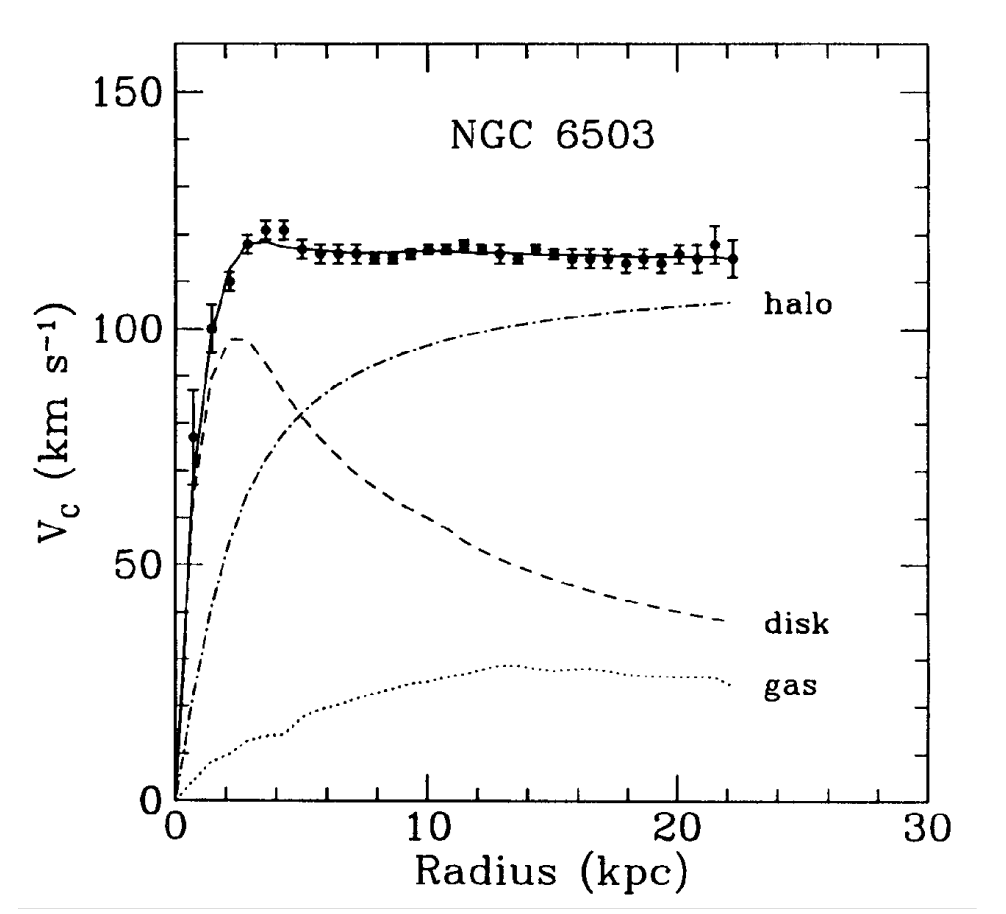
Observed rotation curve of the spiral galaxy NGC 6503 showing the contributions from the stellar disk, interstellar gas, and inferred dark matter halo. The observed velocity remains approximately constant at large radii rather than exhibiting the expected Keplerian decline, providing evidence for an extended dark matter halo. Reproduced from Katherine Freese, “Review of Observational Evidence for Dark Matter in the Universe and in Upcoming Searches for Dark Stars,” EAS Publications Series 36 (2009): 115. Used for scholarly and educational purposes with attribution. This figure supports the argument that visible matter alone cannot account for the observed galactic rotation curve.
Gravitational lensing
Unlike galaxy rotation curves, which confirm the existence of dark matter in galaxies and give us some information about its total mass, gravitational lensing gives us an idea of how widespread dark matter really is. Einstein’s theory of relativity, which states that mass- even if non-luminous- bends light, allows us to not only confirm the presence of dark matter, but also measure the enormous quantities of it in the universe.7
A more quantitative way to describe gravitation lensing is through the les equation. This equation relates the angular position of an image, θ, to the angular position of the background source, β.
β = θ – α(θ)
α(θ) is the deflection angle caused but he gravitational pull of the foreground mass. The lens equation shows that the location where a galaxy appears is not its true position. This is because the mass between the observer and the galaxy bends light. Because of this, gravitational lensing can be used to find mass, including that of dark matter.7
For strong lensing systems, one must also consider the Einstein radius, θE, which is defined as
θE = √[(4GM/c²)(DLS / DLDs)]
In this equation, G is the gravitational constant, M is the mass of the lens, c is the speed of light, DL is the angular diameter distance to the lends, DS is the angular diameter distance to the background source, and DLS is the distance between the lens and the source. The Einstein radius describes the angular scale that strong lensing features appear. A larger Einstein radius indicates a more massive lens. Measuring θE allows astronomers to estimate the mass enclosed within the lensing region, including both visible and dark matter.8
In weak lensing, convergence, k, and shear(y) are used to describe the effect of mass on light bending. The convergence is defined as:
κ = Σ / Σcrit
Σ is the projected surface mass density of the lens and Σ crit is the critical surface density needed for strong lensing. Convergence measures how much the lens magnifies or focuses the background light. If κ is large, the lens has a high projected mass density along the line of sight. Since dark matter contributes to Σ, maps of κ can be used to reconstruct the total mass distribution of galaxy clusters, including matter that is invisible.8The shear describes the distortion of background galaxy images. Shear, unlike convergence which changes the size or brightness of a source, changes the shape. The source, which was originally round, is changed into an ellipse. Because of this, astronomers cannot determine the lensing distortion from a single galaxy. So, they find the statistic average of many background galaxies. When multiple galaxies are located behind the same cluster and they exhibit a consistent stretching pattern that alignment provides evidence of the lens gravitational influence. This means that weak lensing is effective for finding the distribution of dark matter across large scale structures.9
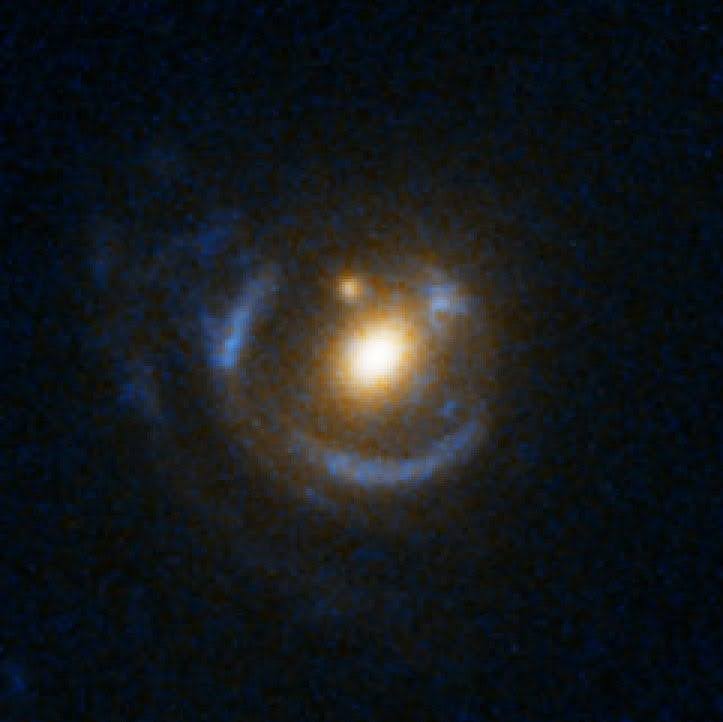
An example of this would be the phenomenon of Einstein rings, which are massive objects acting as a lens as seen in both Figure 2 and 3. The Sloan Digital Sky Survey used studies of lensed galaxies to deduce the size of galaxies and galaxy clusters, from which they realized that galaxies, including our own Milky Way, are far more massive than initially believed due to the vast amounts of dark matter.
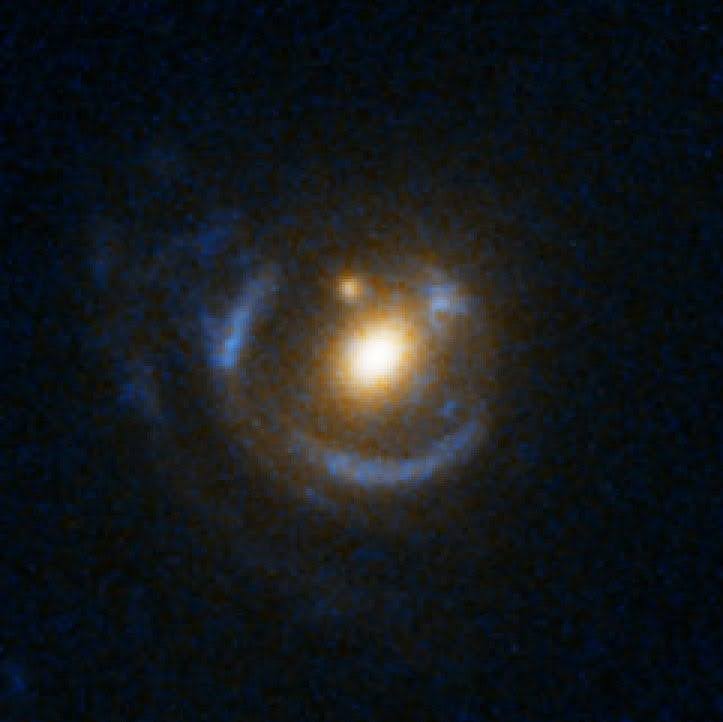
Hubble Space Telescope image of a gravitationally lensed background galaxy forming an Einstein ring around a foreground lensing galaxy. Credit: NASA, ESA, and the Hubble Space Telescope. Publicly released image used with attribution. This figure demonstrates strong gravitational lensing, illustrating how mass bends light and allowing astronomers to measure the total mass of a system, including dark matter.
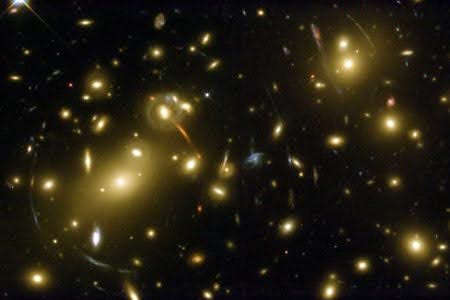
Hubble Space Telescope image of the galaxy cluster Abell 2218 showing multiple gravitationally lensed background galaxies appearing as arcs. Credit: NASA, ESA, and the Hubble Heritage Team (STScI/AURA). Publicly released image used with attribution. This figure demonstrates how galaxy clusters act as gravitational lenses and provides evidence that the total cluster mass substantially exceeds the mass visible in stars and gas.5
Galaxy Clusters
The fact that galaxy clusters even exist is evidence of dark matter halos. Dark matter, which has gravitational pull, attracts galaxies to the areas in which there are dark matter halos, or dense areas of dark matter.5 In turn this creates dense areas of galaxies throughout the observable universe while some areas are left with no galaxies at all called voids. By measuring the mass of these clusters, we can see there is much more mass than just what is visible. There are three main ways to measure the mass of galaxy clusters. One being gravitational lensing and another being differences in radial velocities from rotation curves. By measuring the orbital speeds of stars and gas, researchers apply the law of gravity to determine the enclosed mass.10 The third way of measuring the total mass of dark matter is to use X-ray observation. This type of measurement uses the x-rays emitted from hot gas within galaxy clusters to determine the temperature and density of the said gas. From this one can calculate pressure and thereby ascertain the mass. All three of these methods corroborate that dark matter is five times more abundant than visible matter.
The bullet cluster: The observation of the bullet cluster was also used to confirm the existence of dark matter. The Bullet cluster refers to the collision of one large galaxy cluster and one small cluster. Gravitational lensing was used to find the center of mass. When looking at the bent light of a bullet cluster, the center of mass does not line up with the baryonic matter, it shows mass in different locations than the hot visible gas, pointing to the presence of non-visible matter.5 This is because during the collision the dark matter does not experience friction like the gas does. Instead, the dark matter continues to travel past the collision point while the gas and baryonic matter settle in the center of the newly formed cluster.9
Composite image of the Bullet Cluster showing X-ray emitting baryonic gas (pink) and mass distribution inferred from gravitational lensing (blue). Credit: X-ray: NASA/CXC/CfA/M. Markevitch et al.; Optical: NASA/STScI; Lensing Map: NASA/STScI; ESO WFI; Magellan/U. Arizona/D. Clowe et al. Publicly released image used with attribution. This figure provides evidence for dark matter because the gravitational mass distribution is spatially separated from the majority of the baryonic matter following the cluster collision.
Structure formation
The Standard Model of Cosmology, 𝜆CDM, states that the universe began as a singularity and then immediately after its birth, went through a period of rapid exponential expansion known as inflation. During this period quantum fluctuations from the singularity were exacerbated into density perturbations, which eventually became the gravitational potential wells of dark matter. Following inflation, the universe expanded and cool which produced a hot, dense plasma composed of photos, electrons, protons, and other elementary particles. During this period ordinary matter was tightly coupled to photons. However, dark matter did not interact significantly with the electromagnetic interactions that held the baryonic matter to the photons. This led to dark matter over densities which formed gravitational potential wells which would eventually serve as the seeds of cosmic structure formation.10 As gravity pulled baryons into these dark matter potential wells, photons pressure resisted the compressions of the baryon-photon plasma. The competition between gravitational attraction and radiation pressure produced oscillations known as the baryon acoustic oscillations, or BAOs. These oscillations traveled through the plasma and left signatures that can currently observed today in the CMB. Approximately 380,00 years offer the big bang the universe cooled enough elections and protons to combine into neutral hydrogen in a process which is now known as recombination. Free electrons were no linger abundant enough to scatter photons efficiently which meant that radiation decoupled from matter and began to travel freely. These photons are now observed as the CMB. After recombination, baryons were no longer supported by the photon pressure and could enter the dark matter potential wells more quickly, which in turn accelerated the formation of galaxies, galaxy clusters and the large-scale structure of the universe.11Dark matter throughout this period did not interact with light, in fact it clumped the same way it does now. If dark matter had travelled with photons at the speed of light up until this point, then structure formation would not have been allowed because its gravitational potential wells would not exist, and thus high-density regions normal matter would not have been able to form.
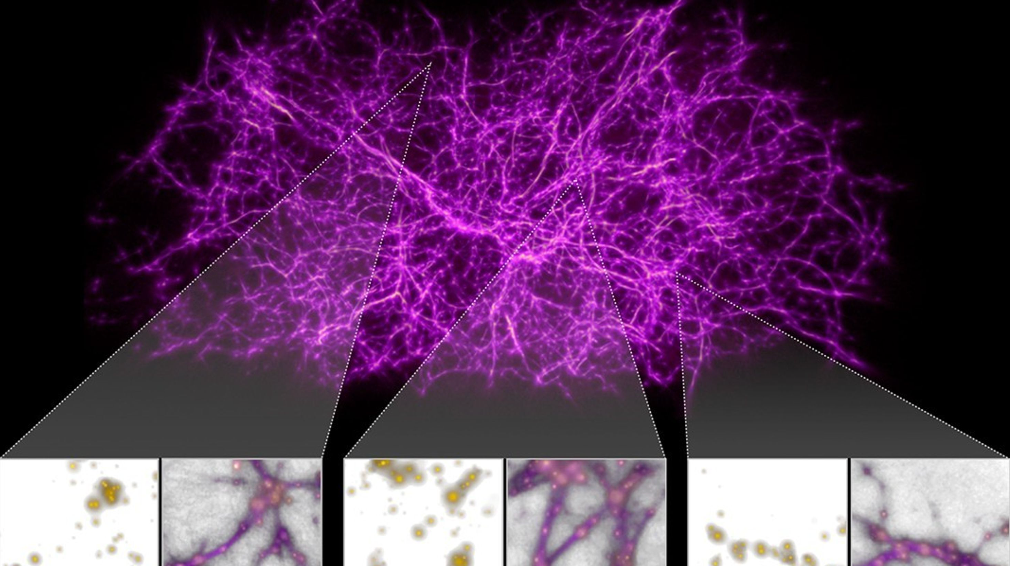
Visualization of large-scale structure showing the filamentary distribution of matter throughout the universe. Credit: NASA, ESA, J. Burchett (University of California, Santa Cruz), and O. Elek. Publicly released image used with attribution. This figure illustrates the large-scale structures whose formation is explained within the ΛCDM framework through the growth of dark matter density perturbations.
The Cosmic Microwave Background
Another compelling piece of observational evidence for dark matter comes from precise measurements of the CMB which is the faint thermal radiation left over from about 380,000 years after the Big Bang. While the CMB appears almost perfectly uniform, small temperature fluctuations, known as temperature anisotropies, across the sky at the microkelvin level contain information about the composition and evolution of the early universe. These fluctuations arise from acoustic oscillations within the primordial baryon-photon fluid in the early Universe. Dark matter plays a crucial role in creating these oscillations.11 Unlike baryonic matter, dark matter does not scatter off photons, so it was able to start clumping together under gravity long before ordinary matter could. This early collapse created gravitational wells that influenced how baryons and photons oscillated, leaving a recognizable imprint on the CMB anisotropy pattern.11
The angular power spectrum of the CMB, as seen in Figure 5, particularly the heights and positions of its acoustic peaks, provides quantitative evidence for dark matter. The first peak corresponds to the largest sound waves that had time to compress once, while the relative heights of the second and third peaks reveal the ratio of baryonic matter to non-baryonic dark matter.5 Observations from the power spectrum show that the amplitude of the 3rd peak can only be produced if the universe contains significantly more matter than can be accounted for by baryonic matter. In fact, the CMB power spectrum consistently indicates that roughly 85% of all matter in the universe is dark matter.12 Without this unseen mass, the characteristic pattern of the peaks could not form. This means, the observation of the CMB not only supports the existence of dark matter but also helps constrain its properties. It confirms that dark matter must be non-baryonic, cold, and gravitationally interacting, fitting seamlessly with other observations such as galaxy rotation curves and gravitational lensing.13
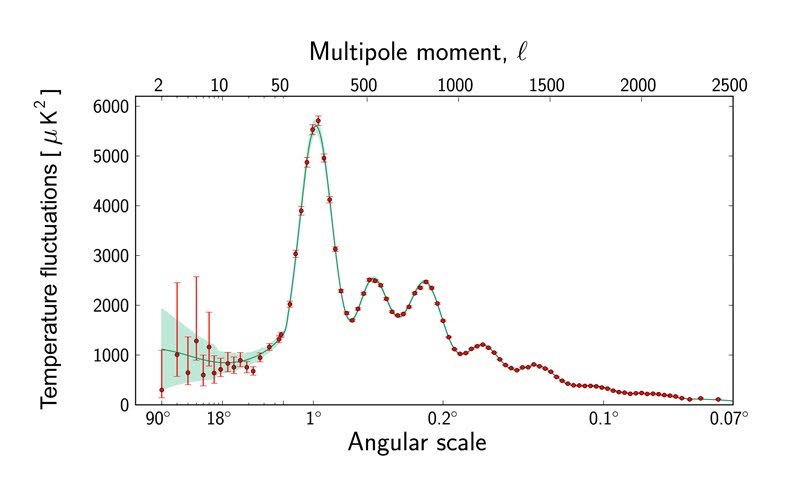
Angular power spectrum of temperature anisotropies in the cosmic microwave background measured by the Planck Collaboration. Credit: ESA and the Planck Collaboration. Reproduced with attribution from Planck Collaboration publications. This figure demonstrates how the heights and locations of acoustic peaks constrain cosmological parameters, including the density of dark matter.12
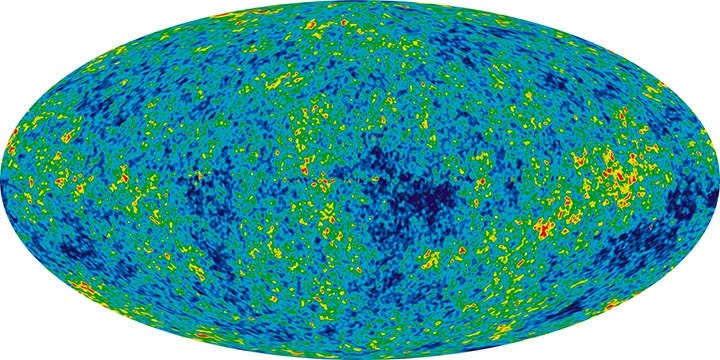
Full-sky map of temperature fluctuations in the cosmic microwave background. Credit: NASA/WMAP Science Team. Public-domain U.S. government image used with attribution. This figure visualizes the primordial density fluctuations that later evolved into galaxies and galaxy clusters under the influence of dark matter.
Particle Candidates
While observational evidence provides strong evidence for non-baryonic matter, they fail to identify the nature of dark matter. Over the past several decades, many particle candidates have been proposed to explain these observations, and to satisfy both cosmological constraints and the requirements of particle physics.14Many theoretical extensions to the Standard Model have therefore proposed new particles capable of explaining the observed dark matter abundance while remaining consistent with observations.15The connection between these observations and particle physics is provided by ΛCDM (Lambda Cold Dark Matter) model, the current standard model of cosmology. Within ΛCDM, Λ represents dark energy, while CDM stands for cold dark matter. The parameters of the ΛCDM model are determined by fitting theoretical prediction to observation. Cosmologists are able to estimate total matter density, dark matter density, and the growth rate of cosmic structure using measurement of the CMB, baryon acoustic oscillations, gravitational lensing, galaxy clustering and super nova distance. Results from the Planck mission indicate that approximately 26% of the total energy density of the universe consists of dark matter, while ordinary baryonic matter accounts for only about 5%.12
ΛCDM model imposes significant constraints on the physical characteristics of dark matter particles. Because dark matter must have formed stable gravitational potential wells before recombination and support the observed large-scale structure of the universe, it cannot be made up of particles moving near the speed of light. Traveling so fast would mean such particles would erase small-scale density fluctuations through free streaming and prevent galaxies from forming as observed. So, dark matter must be cold, non- baryonic, electrically neutral and stable over cosmological timescales.12 These constraints narrow the number of viable particle candidates. Dark matter particles must explain astrophysical observations, reproduce the dark matter density inferred from ΛCDM, and remain consistence with measurements of structure formation and the CMB.
The Standard Model of Particle Physics is a model used for understanding the material out of which every substance is made. The basic idea of this model is that all matter is made up of a type of elementary particle known as a fermion, and every force has a force carrier particle also known as a boson.16 For example an electron is a type of fermion, and the electromagnetic force interacts through its boson, photons. But the Standard Model isn’t perfect. It has several significant problems: including the fact that it cannot describe dark matter. For as long as scientists have known about dark matter’s existence, they have been hypothesizing its particle candidates.17
MACHOs
Many scientists originally hypothesized that Massive Compact Halo Objects or MACHOs were what made up dark matter. MACHOS are objects that do not proportionally produce as much light as they should compared to their mass. Examples of this would be faint stars, stellar remnants, or White Dwarfs.
White dwarfs are very old stars, and about 94% of stars end their lives as such16. Before turning into a white dwarfs, stars shed a large fraction of their mass, while consuming the last of their fuel that was used during nuclear fusion. After this the dense core of the star is all that remains, which is what is known a white dwarf. While white dwarfs are around the size of the earth, they are very dense, containing about half of the mass of the sun. White Dwarfs cool as they age, often starting off at temperatures close to 100,000 Kelvin, but after 10 billion years or more of cooling reach around 4,000 Kelvin. White dwarfs also have a low luminosity, which is what distinguishes them as MACHOs.
As technology progresses, with telescopes such as the Hubble Space telescope and James Webb Space Telescope, we have found that low mass stars would at most make up at most 3% of the dark matter abundant in the Milky Way galaxy which is one of the reasons they are no longer considered a dark matter particle candidates.4 As shown by Brandt in a 2016, evidence from dwarf galaxies and other astronomical observations show that cannot make up of the dark matter over a wide range of masses. Additionally, surveys such as MACHO, EROS and OGLE suggest that MACHOs only contribute to a small percentage of dark matter abundance, because they found fewer lensing events than would be expected if most of the dark matter was to primarily be made up by MACHOs. Because of this, contemporary dark matter research has begun to focus on non-baryonic candidates.14
WIMPs
WIMPs or Weakly Interacting Massive Particles were also once a popular candidate. WIMPs are a hypothetical particle with weak interactions that do not emit light nor interact strongly with other particles. When they collide with each other, they may annihilate and create gamma rays. WIMPs have a very large mass range, from a few GeV to several TeV, which is roughly 10 to 10,000 times the mass of a proton14. If detected, WIMPs could help to solve other issues within theoretical physics which are beyond the standard model such as SUSY, or supersymmetry, which is a theoretical expansion to the Standard Model. SUSY theorizes that each fermion should have a more massive bosonic partner.17 If SUSY is correct, it would solve issues regarding the mass of the Higgs Boson. The lightest of these theorized SUSY partners are predicted to be stable, electrically neutral and to interact weakly with the baryonic members of the Standard Model, which are the same characteristics that would be required of dark matter particles.11
The early universe provides key insights into how WIMPs could have formed and evolved. A phenomenon called the WIMP miracle explains why they were once such strong particle candidates for dark matter via. In the early universe, all particles were far more dense. During this period, WIMPs were in a state of thermal equilibrium, meaning they were being created and annihilated at the same rate. However, as the universe rapidly expanded and cooled, the creation of new WIMPs and many other particles ceased, while annihilation continued; this stage is known as freeze-out. The abundance of WIMPs is inversely proportional to their likelihood to annihilate, in other words, the less frequently they annihilate, the more of them remain. Eventually, the universe’s expansion rate surpassed the annihilation rate of WIMPs, which prevented further interactions and should have left behind a stable population of WIMPs that could still exist today. By calculating the temperature at which WIMPs froze out and the expansion rate of the universe at that time, physicists can determine the annihilation likelihood, and from that estimate the WIMP abundance today. Remarkably, this calculation is exactly equal to the observed abundance of dark matter in the universe when standard WIMP parameters are used in the calculation.11
Though WIMPs still hold theoretical validity, their status as dark matter candidates has greatly been eroded during the last twenty years. Many experiments that directly look for the interaction of WIMPs with regular matter, like XENON1T, PandaX, and LUX-ZEPLIN (LZ), have found no statistically significant signals. However, increasing sensitivity of the detectors allowed obtaining more strict upper bounds on WIMPs’ interaction cross section with the particles of the Standard Model. In many cases, interaction strengths for WIMPs now have to be several orders of magnitude lower than the ones suggested by the first WIMP models.18 Despite extensive search and time, the Large Hadron Collider (LHC) and dark matter direct detection experiments have been on the search for WIMPs for over a decade with no result, making them a weaker dark matter particle candidate. Comprehensive reviews of current direct-detection, collider and indirect search experiments conclude that although WIMPs are theoretically viable, the remaining allowed parameter space has become increasingly constrained.19 As a result, many researchers have shifted attention toward alternative dark matter candidates that better accommodate existing experimental limits.20
Axions
Axions have become one of the leading dark matter particle candidates because they both address an unresolved problem in quantum chromodynamics and satisfy many of the cosmological requirements for cold dark matter.21 They were originally created to solve the strong charged parity (CP) problem.22
Charge-parity symmetry explained: Axions were originally proposed as a solution to the Strong CP Problem in quantum chromodynamics (QCD), the theory that describes the nuclear force. In theory, the QCD Lafrangian permits a term characterized by a parameter known as θ which would violate the combined charge-parity (CP) symmetry. If this parameter were different from zero, QCD would produce measurable CP-violating effects such as an electric dipole moment. However, such effects have never been found, meany that value of θ is likely extraordinarily small. The question of why θ is so close to zero is known as the strong CP problem.15
Proberto Pecci and Helen Quinn proposed an answer to this problem which is known as Pecci-Quinn symmetry, which suggest a new global symmetry that when broken creates a new particle, the axion. The Pecci- Quinn mechanism causes the effective value of θ to relax toward zero which explains the CP- Problem.17
Axions also hypothetically possess properties that make them compelling dark matter candidates. Firstly, unlike WIMPs, they are expected to be extremely light and only weakly interact with baryonic matter. Additionally, because axions could have been produced through non-thermal mechanisms, there is a possibility that a large number of cold axions were created which survive to the present day. This would explain the abundance of dark matter in the universe.4
Axions can be regarded as viable dark matter candidates because of they are electrically neutral, stable at the cosmological level, and able to reproduce the observed amount of dark matter under realistic cosmological circumstances. Currently, physicists are actively working to detect axions, with one of the leading detection experiments being the Axion Dark Matter eXperiment (ADMX). ADMX searches for Axions by looking for their interaction with photons. Hypothetically axions couple to photons, and, within a magnetic field, convert into microwave wavelength photons. However, even as microwave wavelength photons, these signals are hard to find because they are so small, and there is so much experimental noise.2Beyond axions, recent research has expanded to include other ultralight dark matter candidates whose wave-like behavior may produce distinct signatures, which further broadens the search for dark matter.23
Conclusion
Despite decades of research, dark matter remains one of the biggest mysteries in modern physics. Observational evidence, from galaxy rotation curves and gravitational lensing to the Bullet Cluster and the anisotropies of the cosmic microwave background, shows overwhelmingly that dark matter exists. Yet the Standard Model of Particle Physics provides no explanation of what this dominant, invisible part of the universe is made. Traditional candidates such as MACHOs and WIMPs have steadily lost support as surveys rule them out and direct-detection experiments continue to return null results. In contrast, axions remain a compelling possibility. They not only fit naturally into the Peccei–Quinn mechanism to solve the strong CP problem, but they may also behave as cold dark matter and fit the constraints set by cosmological observations. As next-generation experiments push deeper into the axion mass range and new surveys refine our understanding of structure formation, the search for dark matter is entering a transformative era. Identifying the true particle responsible would not simply extend the Standard Model; it would fundamentally reshape our understanding of the universe. As experiments continue to improve and theoretical models become increasingly refined, physicists are entering what many describe as a new era in the search for dark matter.24,23
Acknowledgements
I would like to thank the UCI x GATI High School Research Paper Writing Program for providing the structure and support necessary to complete this work. Special thanks are extended to Sanah Bhimani for her guidance, insightful feedback, and encouragement throughout the research and writing process. Her mentorship allowed me to strengthen both the scientific understanding and clarity of this paper.
References
- Akerib, D. S., et al. “First Dark Matter Search Results from the LUX-ZEPLIN (LZ) Experiment.” Physical Review Letters 131, no. 4 (2023): 041002. https://doi.org/10.1103/PhysRevLett.131.041002. [↩]
- Du, N., et al. “A Search for Invisible Axion Dark Matter with the Axion Dark Matter Experiment.” Physical Review Letters 120, no. 15 (2018): 151301. https://doi.org/10.1103/PhysRevLett.120.151301. [↩] [↩]
- Ivezić, Željko, et al. “LSST: From Science Drivers to Reference Design and Anticipated Data Products.” The Astrophysical Journal 873, no. 2 (2019): 111. https://doi.org/10.3847/1538-4357/ab042c. [↩]
- Freese, Katherine. “Status of Dark Matter in the Universe.” International Journal of Modern Physics D 26, no. 6 (2017): 1730012. https://doi.org/10.1142/S0218271817300129. [↩] [↩] [↩]
- Freese, Katherine. “Review of Observational Evidence for Dark Matter in the Universe and in Upcoming Searches for Dark Stars.” EAS Publications Series 36 (2009): 113-126. https://doi.org/10.1051/eas/0936016. [↩] [↩] [↩] [↩] [↩]
- Rubin, Vera C., W. Kent Ford Jr., and Norbert Thonnard. “Rotational Properties of 21 Sc Galaxies with a Large Range of Luminosities and Radii.” The Astrophysical Journal 238 (1980): 471-487. [↩]
- Bertone, Gianfranco, Dan Hooper, and Joseph Silk. “Particle Dark Matter: Evidence, Candidates and Constraints.” Physics Reports 405, nos. 5-6 (2005): 279-390. https://doi.org/10.1016/j.physrep.2004.08.031. [↩] [↩]
- Bartelmann, Matthias. “Gravitational Lensing.” Classical and Quantum Gravity 27, no. 23 (2010): 233001. https://doi.org/10.1088/0264-9381/27/23/233001. [↩] [↩]
- Bartelmann, Matthias, and Peter Schneider. “Weak Gravitational Lensing.” Physics Reports 340, nos. 4-5 (2001): 291-472. https://doi.org/10.1016/S0370-1573(00)00082-X. [↩] [↩]
- Clowe, Douglas, Maruša Bradač, Anthony H. Gonzalez, Maxim Markevitch, Scott W. Randall, Christine Jones, and Dennis Zaritsky. “A Direct Empirical Proof of the Existence of Dark Matter.” The Astrophysical Journal Letters 648, no. 2 (2006): L109-L113. https://doi.org/10.1086/508162. [↩] [↩]
- Feng, Jonathan L. “The WIMP Paradigm: Theme and Variations.” SciPost Physics Lecture Notes 71 (2023). https://doi.org/10.21468/SciPostPhysLectNotes.71. [↩] [↩] [↩] [↩] [↩]
- Planck Collaboration. “Planck 2018 Results. VI. Cosmological Parameters.” Astronomy & Astrophysics 641 (2020): A6. https://doi.org/10.1051/0004-6361/201833910. [↩] [↩] [↩] [↩]
- DESI Collaboration. “DESI 2024 VI: Cosmological Constraints from the Measurements of Baryon Acoustic Oscillations.” arXiv (2024). arXiv:2404.03002. [↩]
- Bergström, Lars. “Dark Matter Evidence, Particle Physics Candidates and Detection Methods.” Annalen der Physik 524, no. 9–10 (2012): 479–496. https://doi.org/10.1002/andp.201200116. [↩] [↩] [↩]
- Feng, Jonathan L. “Dark Matter Candidates from Particle Physics and Methods of Detection.” Annual Review of Astronomy and Astrophysics 48 (2010): 495–545. https://doi.org/10.1146/annurev-astro-082708-101659. [↩] [↩]
- Navas, S., et al. “Review of Particle Physics.” Physical Review D 110 (2024): 030001. https://doi.org/10.1103/PhysRevD.110.030001. [↩] [↩]
- Berlin, Asher, and Yonatan Kahn. “New Technologies for Axion and Dark Photon Searches.” Annual Review of Nuclear and Particle Science 75 (2025): 83–108. https://doi.org/10.1146/annurev-nucl-121423-101015. [↩] [↩] [↩]
- Brandt, Timothy D. “Constraints on MACHO Dark Matter from Compact Stellar Systems in Ultra-Faint Dwarf Galaxies.” The Astrophysical Journal Letters 824, no. 2 (2016): L31. https://doi.org/10.3847/2041-8205/824/2/L31. [↩]
- Roszkowski, Leszek, Enrico Maria Sessolo, and Sebastian Trojanowski. “WIMP Dark Matter Candidates and Searches: Current Status and Future Prospects.” Reports on Progress in Physics 81, no. 6 (2018): 066201. https://doi.org/10.1088/1361-6633/aab913. [↩]
- Arcadi, Giorgio, Maíra Dutra, Pradipta Ghosh, Manfred Lindner, Yann Mambrini, Mathias Pierre, Stefano Profumo, and Farinaldo S. Queiroz. “The Waning of the WIMP? A Review of Models, Searches, and Constraints.” European Physical Journal C 78, no. 3 (2018): 203. https://doi.org/10.1140/epjc/s10052-018-5662-y. [↩]
- Chadha-Day, Francesca, John Ellis, and David J. E. Marsh. “Axion Dark Matter: What Is It and Why Now?” Science Advances 8, no. 8 (2022): eabj3618. https://doi.org/10.1126/sciadv.abj3618. [↩]
- Kim, Jihn E., and Gianpaolo Carosi. “Axions and the Strong CP Problem.” Reviews of Modern Physics 82, no. 1 (2010): 557-602. https://doi.org/10.1103/RevModPhys.82.557. [↩]
- Dark Matter Candidates of a Very Low Mass Zurek, Kathryn M. “Dark Matter Candidates of a Very Low Mass.” Annual Review of Nuclear and Particle Science 74 (2024): 287-319. https://doi.org/10.1146/annurev-nucl-101918-023542. [↩] [↩]
- Bertone, Gianfranco, and Tim M. P. Tait. “A New Era in the Search for Dark Matter.” Nature 562 (2018): 51-56. https://doi.org/10.1038/s41586-018-0542-z. [↩]